Market Overview:
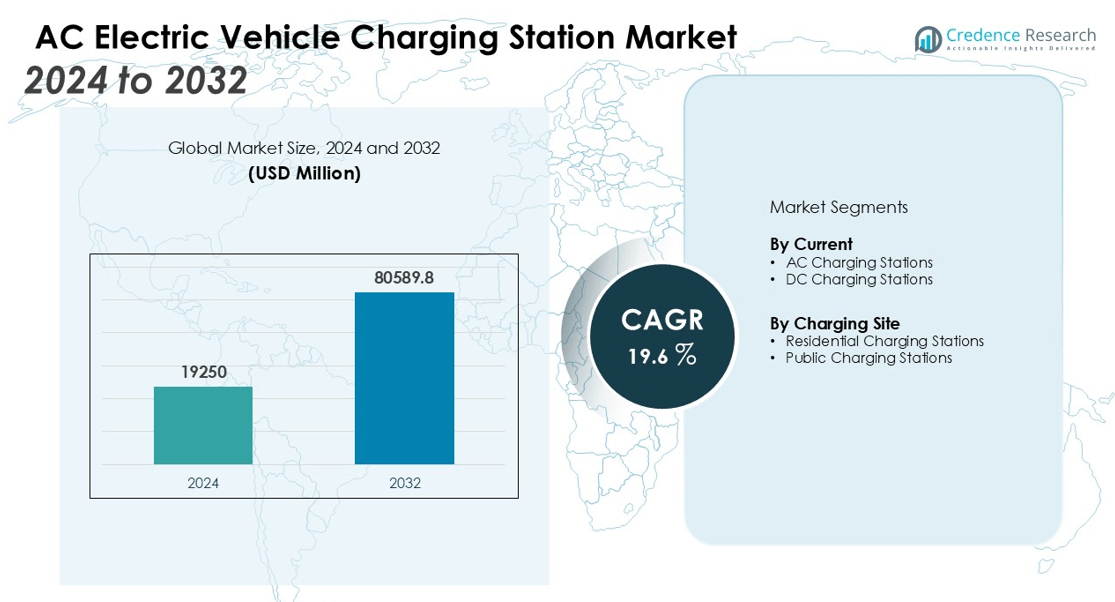
The AC Electric Vehicle Charging Station Market size was valued at USD 19250 million in 2024 and is anticipated to reach USD 80589.8 million by 2032, at a CAGR of 19.6% during the forecast period (2024-2032).
| REPORT ATTRIBUTE | DETAILS |
|---|---|
| Historical Period | 2020-2023 |
| Base Year | 2024 |
| Forecast Period | 2025-2032 |
| AC Electric Vehicle Charging Station Market Size 2024 | USD 19250 million |
| AC Electric Vehicle Charging Station Market, CAGR | 19.6% |
| AC Electric Vehicle Charging Station Market Size 2032 | USD 80589.8 million |
Key drivers of this market include the global shift towards electric mobility, supported by stringent emission regulations and growing awareness of climate change. Additionally, advancements in charging technology, coupled with the expansion of fast-charging infrastructure, contribute significantly to market growth. The increasing demand for residential and public EV charging stations, along with the rise in EV sales, further fuels market development. Additionally, strategic partnerships among key players and investments in charging infrastructure continue to enhance market opportunities. The growing emphasis on sustainable urban mobility and electric vehicle integration into smart cities also plays a crucial role in driving market growth.
Regionally, North America and Europe dominate the AC EV Charging Station Market, driven by the high adoption rate of electric vehicles and supportive government policies. In North America, the U.S. leads the charge with extensive infrastructure development and federal incentives. Europe is also witnessing a surge in EV adoption, particularly in countries like Germany and the UK, bolstered by EU mandates for zero-emission vehicles. The Asia-Pacific region is expected to experience the fastest growth, with China leading the way in EV adoption and infrastructure development.
Market Insights:
- The AC Electric Vehicle Charging Station Market is valued at USD 19,250 million in 2024 and is projected to reach USD 80,589.8 million by 2032, growing at a CAGR of 19.6%, driven by the shift towards electric mobility.
- Advancements in charging technology, including faster charging speeds and improved power distribution, are enhancing user experience and boosting EV adoption.
- The expansion of charging infrastructure, with more public and residential charging stations, is crucial to meet the growing demand for electric vehicles and enhance accessibility.
- Strategic partnerships and investments from automotive and energy sectors are accelerating the development of extensive EV charging networks.
- Limited charging infrastructure in remote areas remains a key challenge, slowing EV adoption in rural and underserved locations.
- High installation and maintenance costs of charging stations, particularly fast-charging ones, pose financial challenges for market expansion.
- North America holds 35% of the market share, Europe 30%, and Asia-Pacific 25%, with China leading the fastest-growing region in EV infrastructure development.
Market Drivers:
Global Shift Towards Electric Mobility
The AC Electric Vehicle Charging Station Market is being driven by the global transition to electric mobility. With the rising demand for sustainable transportation options, more consumers and businesses are shifting towards electric vehicles (EVs). This trend is supported by government policies that promote eco-friendly alternatives to traditional gasoline-powered vehicles. Stringent emission regulations and increasing environmental concerns about climate change have accelerated the adoption of EVs, leading to greater demand for efficient and widespread charging infrastructure.
Advancements in Charging Technology
Technological advancements in electric vehicle charging are enhancing the growth of the AC EV Charging Station Market. Charging technology has improved significantly, with faster charging times and more efficient power distribution systems. These developments make electric vehicles more convenient to use, reducing the range anxiety often associated with EVs. As charging stations evolve, they provide greater charging speeds and more reliable service, further stimulating market demand.
- For instance, Tesla’s battery preconditioning activates 30–45 minutes before arrival at a Supercharger, directly reducing AC charging session times.
Expansion of Charging Infrastructure
The expansion of charging infrastructure plays a critical role in the AC Electric Vehicle Charging Station Market’s growth. As electric vehicle adoption increases, there is a corresponding need for more charging stations, both residential and public. Investment from governments and private sector players has led to the rapid development of charging networks across cities and highways, ensuring convenient access for EV owners. This increased availability of charging stations encourages greater consumer confidence in adopting EVs.
- For instance, ChargePoint, in collaboration with the Colorado Energy Office, completed 33 new DC fast charging sites with over 80 charging ports across Colorado highways in December 2024, ensuring high-speed charging is available within 30 miles on major corridors.
Strategic Partnerships and Investments
Strategic partnerships and investments in the AC EV Charging Station Market are contributing to its growth. Companies in the automotive and energy sectors are collaborating to build an extensive network of charging stations. These alliances ensure robust infrastructure development and bring advanced solutions to the market. Financial backing from public and private investors supports the further expansion of charging networks, allowing the market to meet the growing demand for electric vehicles.
Market Trends:
Increasing Integration of Smart Charging Solutions
The AC Electric Vehicle Charging Station Market is experiencing a growing trend towards the integration of smart charging solutions. As the demand for electric vehicles (EVs) rises, charging infrastructure is becoming more advanced, incorporating features such as real-time monitoring, remote diagnostics, and automated billing systems. These smart charging stations enable users to schedule charging sessions based on electricity rates, reducing costs and optimizing energy use. The integration of Internet of Things (IoT) technology in charging stations allows for seamless interaction between vehicles, charging stations, and network operators. This trend is driving the development of next-generation charging solutions that enhance user convenience and efficiency, supporting the expansion of EV adoption.
- For instance, Chargemap Business Supervision enables over 3,100 businesses to actively monitor workplace EV charging stations in real time, track individual staff charging sessions, and conduct remote maintenance operations such as unblocking connectors or restarting chargepoint-all through a single, cloud-based interface.
Growth of Public Charging Infrastructure
Public charging infrastructure is rapidly expanding within the AC Electric Vehicle Charging Station Market, reflecting the increasing need for widespread availability of charging stations. Governments and private enterprises are investing heavily in the creation of networks of fast-charging stations in urban areas, highways, and remote locations. These efforts aim to address the issue of range anxiety, a primary barrier to the adoption of electric vehicles. The trend is particularly prominent in regions such as North America, Europe, and Asia-Pacific, where national and local policies are pushing for the installation of more public charging points. With ongoing initiatives and rising infrastructure investments, the availability of accessible, reliable, and high-speed charging options is expected to foster EV adoption further and accelerate market growth.
- For instance, as of July 2025, the United States operates 59,694 public DC fast charging ports at 11,687 stations nationwide.
Market Challenges Analysis:
Limited Charging Infrastructure in Remote Areas
One of the key challenges in the AC Electric Vehicle Charging Station Market is the limited availability of charging infrastructure in remote or underserved areas. While urban regions see rapid growth in charging stations, rural and isolated locations still lack sufficient coverage, creating barriers for potential EV users. This discrepancy in infrastructure development hinders the widespread adoption of electric vehicles, as users in these areas face challenges in accessing charging points. Expanding the charging network to these underserved regions requires significant investment and planning, which may take time to fully implement.
High Installation and Maintenance Costs
The high installation and maintenance costs associated with AC Electric Vehicle Charging Stations present another challenge for market growth. While charging stations are essential for supporting the growing EV market, the infrastructure required for their installation is costly. This includes the installation of high-capacity electrical systems, real estate considerations, and compliance with local regulations. Maintenance costs further add to the financial burden, particularly for fast-charging stations, which require regular upkeep. These financial challenges can slow down the pace at which new stations are established, limiting the overall growth of the charging infrastructure network.
Market Opportunities:
Expansion of Charging Networks in Emerging Markets
The AC Electric Vehicle Charging Station Market offers significant opportunities in emerging markets where the adoption of electric vehicles is still in its early stages. Governments in regions such as Asia-Pacific, Latin America, and the Middle East are increasingly focused on sustainable transportation, providing incentives to build charging infrastructure. As electric vehicle adoption grows in these regions, there will be a rising demand for both residential and public charging stations. This expansion of charging networks will create new business opportunities for market players looking to tap into these developing markets. The increasing urbanization and industrialization in these regions further fuel the demand for reliable and accessible EV charging infrastructure.
Integration with Renewable Energy Sources
Another opportunity within the AC Electric Vehicle Charging Station Market lies in the integration of charging stations with renewable energy sources. With the global emphasis on reducing carbon emissions, there is a growing interest in using solar and wind energy to power charging stations. This not only reduces the environmental impact of charging but also lowers operating costs. The integration of renewable energy systems with EV charging stations aligns with global sustainability goals, making it an attractive option for governments and businesses. Such integration can further accelerate the adoption of electric vehicles by offering a cleaner, more cost-effective charging solution.
Market Segmentation Analysis:
By Current Type
The market is primarily divided into alternating current (AC) and direct current (DC) charging stations. AC charging stations are more commonly used for residential and lower-speed charging applications, offering cost-effective solutions with longer charging times. DC fast-charging stations, on the other hand, are deployed for commercial and high-speed charging, offering much faster charging times, which are crucial for high-traffic areas. AC chargers are expected to dominate the market due to their affordability and suitability for residential use, while DC chargers are witnessing growing demand in commercial sectors and along highways.
- For instance, ChargePoint Home Flex delivers up to 12kW, providing 37 miles of range per hour, and is ENERGY STAR certified for efficiency.
By Charging Site
Charging sites are another key segmentation in the AC Electric Vehicle Charging Station Market. The market is categorized into residential and public charging stations. Residential charging stations account for a significant share, driven by the increasing adoption of electric vehicles in households. Public charging stations, however, are seeing rapid growth, especially in urban areas and along highways, due to the need for accessible, fast-charging infrastructure. With urbanization and the growing number of electric vehicles on the road, public charging stations are expected to witness a faster growth rate, supported by government incentives and investments in infrastructure.
- For instance, the Tesla Wall Connector delivers up to 48 amps (11.5kW) and 44 miles of range per hour.
Segmentations:
By Current:- AC Charging Stations
- DC Charging Stations
- Residential Charging Stations
- Public Charging Stations
- North America
- U.S.
- Canada
- Mexico
- Europe
- Germany
- France
- U.K.
- Italy
- Spain
- Rest of Europe
- Asia Pacific
- China
- Japan
- India
- South Korea
- South-east Asia
- Rest of Asia Pacific
- Latin America
- Brazil
- Argentina
- Rest of Latin America
- Middle East & Africa
- GCC Countries
- South Africa
- Rest of the Middle East and Africa
Regional Analysis:
North America: Leading the Charge in Infrastructure Development
North America holds a dominant share of 35% in the AC Electric Vehicle Charging Station Market, with the United States contributing the largest portion. The region is witnessing rapid adoption of electric vehicles, fueled by robust government incentives and policies aimed at enhancing EV infrastructure. Several states, including California, are spearheading the installation of charging stations to meet the growing demand. Private companies, alongside government initiatives, are expanding the charging network across urban and rural areas, which will further drive EV adoption. The increasing number of EVs on the road requires an enhanced charging infrastructure, making North America a dominant player in the market.
Europe: Embracing Sustainability and Green Mobility
Europe holds a 30% share of the AC Electric Vehicle Charging Station Market, with key players such as Germany, the UK, and Norway leading in EV adoption. The European Union’s stringent environmental regulations and sustainability goals are accelerating the development of EV charging infrastructure. Governments have introduced various subsidies, tax breaks, and support programs for both consumers and businesses. European cities, known for their high population density, are also implementing smart charging solutions to cater to the rising demand for electric vehicles. These efforts position Europe as a leader in the transition towards greener transportation and extensive charging networks.
Asia-Pacific: Fastest Growing Market with Untapped Potential
Asia-Pacific accounts for 25% of the AC Electric Vehicle Charging Station Market, with China being the dominant contributor. The country’s policies, including tax incentives and infrastructure investments, are accelerating the expansion of EV charging stations. Other countries like Japan, South Korea, and India are also developing their EV charging networks to meet the increasing demand for electric vehicles. The rapid urbanization, industrialization, and growing awareness of environmental sustainability in these nations present substantial growth opportunities in the market. With continued governmental support and infrastructure growth, the Asia-Pacific region is expected to witness the fastest market growth.
Key Player Analysis:
- Bosch
- ChargePoint, Inc.
- ABB
- Blink Charging Co.
- Charge Zone India
- Siemens
- SIGNET EV
- Delta Electronics
- Leviton Industries
- NIO
- Elli
- StarCharge
- Vinfast
- Enphase Energy
- Volta Industries Inc.
- Zunder
- EVBox
- Schneider Electric
Competitive Analysis:
The AC Electric Vehicle Charging Station Market is highly competitive, with major players like Tesla, ABB, Schneider Electric, and Siemens leading the way through technological innovations and infrastructure expansion. These companies offer a variety of solutions, ranging from residential chargers to fast-charging stations, focusing on improving charging speeds and integrating smart features. In addition to established companies, regional players and emerging entrants are gaining ground, particularly in fast-growing markets like Asia-Pacific. Strategic partnerships between automotive manufacturers and energy providers are accelerating the development of extensive charging networks, while government incentives and large-scale investments further enhance market dynamics. The increasing demand for public charging infrastructure, especially in urban areas, intensifies the competition, making the market vibrant and rapidly evolving.
Recent Developments:
- In June 2025, ABB launched the IRB 6730S, IRB 6750S, and IRB 6760 industrial robots, expanding its robotics portfolio with advanced capabilities for heavy industries.
- In July 2025, Blink Charging announced a strategic partnership with bf YOUNG to offer a nationwide turnkey EV fleet management solution and at-home charger installation for corporate sales force in the United States.
- In July 2024, Bosch announced its largest acquisition in history, agreeing to purchase the global HVAC solutions business for residences and small commercial buildings from Johnson Controls.
Market Concentration & Characteristics:
The AC Electric Vehicle Charging Station Market exhibits moderate concentration, with several key players dominating the landscape while numerous regional and emerging companies contribute to its growth. Large multinational corporations such as Tesla, ABB, Schneider Electric, and Siemens hold substantial market share through their extensive charging infrastructure networks and technological advancements. The market is characterized by rapid innovation, particularly in the development of fast-charging solutions and integration with smart grids. It is highly influenced by government policies and incentives that encourage infrastructure expansion. Competition is driven by the demand for more accessible and faster charging options, especially in urban and high-traffic areas. While the market is still growing, its dynamics are shaped by strategic partnerships, investments in infrastructure, and the increasing adoption of electric vehicles globally. These factors contribute to a competitive yet evolving market structure.
Report Coverage:
The research report offers an in-depth analysis based on Current, Charging Site and Region. It details leading market players, providing an overview of their business, product offerings, investments, revenue streams, and key applications. Additionally, the report includes insights into the competitive environment, SWOT analysis, current market trends, as well as the primary drivers and constraints. Furthermore, it discusses various factors that have driven market expansion in recent years. The report also explores market dynamics, regulatory scenarios, and technological advancements that are shaping the industry. It assesses the impact of external factors and global economic changes on market growth. Lastly, it provides strategic recommendations for new entrants and established companies to navigate the complexities of the market.
Future Outlook:
- The AC Electric Vehicle Charging Station Market is projected to experience significant growth, driven by increasing electric vehicle adoption and supportive government policies.
- Technological advancements, such as ultra-fast charging capabilities and integration with smart grids, are enhancing the efficiency and appeal of charging stations.
- The expansion of charging infrastructure is essential to meet the growing demand for electric vehicles, necessitating substantial investments in both public and private sectors.
- Standardization efforts, including the adoption of universal charging connectors, are streamlining the charging process and promoting interoperability across different EV models and charging networks.
- The development of mobile charging solutions is addressing the needs of remote areas and providing flexible options for EV owners without access to fixed charging stations.
- Partnerships between automakers, energy providers, and technology companies are fostering innovation and accelerating the deployment of charging infrastructure.
- Government incentives and subsidies are playing a crucial role in reducing the financial barriers to EV adoption and encouraging the establishment of charging networks.
- Consumer awareness and demand for sustainable transportation options are increasing, influencing the expansion of EV charging facilities.
- Cybersecurity measures are becoming increasingly important to protect charging infrastructure from potential threats and ensure the safety of users.
- The integration of renewable energy sources into charging stations is promoting environmental sustainability and reducing the carbon footprint of electric vehicle usage.

Request a Free Sample
Fill in your details and we'll send you a free sample report.
- Sample data tables & charts
- Research methodology
Market Dynamics
Global Shift Towards Electric Mobility
Stringent emission regulations and growing climate change awareness are accelerating the adoption of electric vehicles, which in turn drives demand for AC charging infrastructure to support the expanding EV fleet.
Advancements in Charging Technology
Improvements in charging speeds, power distribution, and smart features are making AC charging stations more efficient and user-friendly, reducing range anxiety and encouraging broader EV adoption.
Expansion of Charging Infrastructure
Significant investments from both public and private sectors are rapidly increasing the number of residential and public charging stations, making EV ownership more practical and accessible.
Strategic Partnerships and Investments
Collaborations between automotive, energy, and technology companies are accelerating the rollout of extensive charging networks, leveraging shared expertise and resources to scale infrastructure quickly.
Integration with Renewable Energy Sources
The growing emphasis on sustainability is leading to the integration of solar and wind power with charging stations, reducing operational costs and aligning with global decarbonization goals, which further incentivizes market growth.
Need a Custom Version of This Report?
Tailor the scope, geography, or segments to your exact requirements.
- Custom geography or segment scope
- Direct access to our analyst team
Frequently Asked Questions
What is the current size of the AC Electric Vehicle Charging Station Market?
What are the key segments within the AC Electric Vehicle Charging Station Market?
What are some challenges faced by the AC Electric Vehicle Charging Station Market?
Which segment is leading the market share?
Table of Content
Chapter 1 Market Segmentation
- 1.1 Segmentation Framework
- 1.1.1 Product and Service Classification
- 1.1.2 Application and End-Use Classification
- 1.1.3 Technology and Solution Classification
- 1.1.4 Customer and Distribution Channel Classification
- 1.1.5 Geographic Segmentation
- 1.1.6 Market Segment Definitions and Boundaries
- 1.2 By Current
- 1.2.1 AC Charging Stations
- 1.2.2 DC Charging Stations
- 1.3 By Charging Site
- 1.3.1 Residential Charging Stations
- 1.3.2 Public Charging Stations
Chapter 2 Introduction
- 2.1 Report Objectives and Scope
- 2.2 Product Definition and Industry Terminology
- 2.3 Market Inclusions and Exclusions
- 2.4 Research Process
- 2.4.1 Primary Research and Expert Interviews
- 2.4.2 Secondary Research and Source Review
- 2.4.3 Top-Down and Bottom-Up Estimation
- 2.4.4 Data Triangulation and Verification
- 2.5 Market Size Measurement Basis
- 2.5.1 2024: USD 19,250 million → 2032: USD 80,589.8 million
- 2.6 Historical and Forecast Reference Periods
- 2.6.1 Base Year: 2024
- 2.6.2 Forecast Period: 2024-2032
- 2.7 Research Assumptions and Limitations
Chapter 3 Executive Summary
- 3.1 Market Snapshot and Key Findings
- 3.2 Base-Year Market Size, 2024
- 3.3 Forecast Market Size, 2032
- 3.4 Revenue and Volume Growth Outlook
- 3.5 Key Demand and Supply Indicators
- 3.6 Leading Market Segments
- 3.7 Fastest-Growing Market Opportunities
- 3.8 Regional Performance Highlights
- 3.9 Technology and Industry Transformation
- 3.10 Competitive Landscape Summary
- 3.11 Analyst View and Strategic Implications
Chapter 4 Global AC Electric Vehicle Charging Station Market Trends and Developments
- 4.1 Historical Industry Development
- 4.2 Recent Market Trends and Developments
- 4.3 Demand and Customer Behavior Trends
- 4.4 Technology and Product Innovation
- 4.5 Artificial Intelligence, Automation and Digitalization
- 4.6 Local Manufacturing and Supply Chain Realignment
- 4.7 Industry Partnerships, Mergers and Acquisitions
- 4.8 Sustainability and Circular Economy Developments
- 4.9 Government and Private Sector Investment Trends
- 4.10 Emerging Business Models and Commercialization
- 4.11 Industry Developments and Announcements
Chapter 5 Global AC Electric Vehicle Charging Station Market Production, Supply and Demand Analysis
- 5.1 Demand Trend and Consumption Analysis
- 5.2 Demand Forecast, 2024-2032
- 5.3 Production and Output Trend
- 5.4 Production and Output Forecast, 2024-2032
- 5.5 Installed Capacity and Capacity Utilization
- 5.6 Company-Wise Production Plants and Statistics
- 5.6.1 Installed Production Capacity
- 5.6.2 Actual Production
- 5.6.3 Planned Capacity and Expansion Targets
- 5.7 Supply Chain Structure and Procurement Trends
- 5.8 Supply-Demand Gap and Bottlenecks
- 5.9 Import Dependence and Sourcing Structure
- 5.10 Contract Manufacturing and Outsourcing
- 5.11 Regional Supply and Demand Concentration
Chapter 6 Global AC Electric Vehicle Charging Station Market Pricing Analysis
- 6.1 Pricing Structure and Measurement
- 6.2 Historical Pricing Trends
- 6.3 Pricing Outlook, 2024-2032
- 6.4 Average Selling Price and Unit Economics
- 6.5 Pricing by Product and Market Segment
- 6.6 Geographic Pricing Differences
- 6.7 Key Input, Energy, Labor and Logistics Costs
- 6.8 Contract Pricing and Purchasing Models
- 6.9 Pricing Sensitivity and Competitive Positioning
- 6.10 Price, Margin and Profitability Implications
Chapter 7 Global AC Electric Vehicle Charging Station Market Dynamics
- 7.1 Market Growth Drivers
- 7.1.1 Demand-Side Drivers
- 7.1.2 Technology and Innovation Drivers
- 7.1.3 Infrastructure and Investment Drivers
- 7.1.4 Regulatory and Policy Drivers
- 7.2 Market Restraints
- 7.2.1 Cost and Affordability Constraints
- 7.2.2 Technology and Adoption Barriers
- 7.2.3 Supply Chain and Operational Constraints
- 7.3 Market Challenges
- 7.3.1 Competitive Pressure and Margin Erosion
- 7.3.2 Skills, Infrastructure and Implementation Gaps
- 7.4 Emerging Market Opportunities
- 7.5 Market Dynamics Impact and Time-Horizon Assessment
Chapter 8 Global AC Electric Vehicle Charging Station Value Chain Analysis
- 8.1 Industry Value Chain Overview
- 8.2 Upstream Suppliers and Critical Inputs
- 8.3 Technology and Component Providers
- 8.4 Manufacturing or Service Delivery
- 8.5 Distribution, Channel Partners and Integrators
- 8.6 Downstream Applications and End Users
- 8.7 Value Addition and Profit Pools
- 8.8 Vertical Integration and Outsourcing
- 8.9 Supplier Concentration and Risk
- 8.10 Supply Chain Localization and Resilience
Chapter 9 Global AC Electric Vehicle Charging Station Market Regulations and Policies
- 9.1 Relevant Laws, Standards and Compliance Frameworks
- 9.2 Product, Service, Safety and Quality Requirements
- 9.3 Government Policies, Incentives and Subsidies
- 9.4 Imports, Exports and Trade Barriers
- 9.5 Public Procurement and Local Content Requirements
- 9.6 Environmental and Sustainability Compliance
- 9.7 Upcoming Policy Changes and Market Implications
Chapter 10 Global AC Electric Vehicle Charging Station Market Hotspots and Opportunities
- 10.1 Market Opportunity Mapping and Growth Hotspots
- 10.2 High-Growth Applications and Customer Groups
- 10.3 Underserved Markets and White-Space Opportunities
- 10.4 Emerging Technology and Product Opportunities
- 10.5 New Capacity and Investment Hotspots
- 10.6 Market Entry and Expansion Opportunities
- 10.7 Distribution and Partnership Opportunities
- 10.8 Near-Term and Long-Term Commercial Potential
- 10.9 Opportunity Attractiveness and Execution Risks
Chapter 11 Global AC Electric Vehicle Charging Station Market Outlook, 2024-2032
- 11.1 Market Size and Analysis
- 11.1.1 Revenue (Market Measurement: 2024: USD 19,250 million → 2032: USD 80,589.8 million)
- 11.1.2 Market Volume and Quantity Sold
- 11.1.3 Historical Market Size
- 11.1.4 Base-Year Market Size, 2024
- 11.2 Market Forecast, 2024-2032
- 11.2.1 Revenue Forecast to 2032
- 11.2.2 Volume Forecast to 2032
- 11.2.3 CAGR and Year-on-Year Growth
- 11.2.4 Incremental Revenue Opportunity
- 11.3 Forecast Assumptions and Scenario Analysis
- 11.3.1 Base-Case Forecast
- 11.3.2 Optimistic and Conservative Scenarios
- 11.3.3 Technology, Pricing and Policy Sensitivities
- 11.4 Market Attractiveness and Growth Outlook
Chapter 12 Global AC Electric Vehicle Charging Station Market Segmentation and Outlook
- 12.1 Segmentation Summary and Market Shares, 2024
- 12.2 Largest and Fastest-Growing Segments
- 12.3 By Current - Market Size and Forecast, 2024-2032
- 12.3.1 Segment Definition and Scope
- 12.3.2 Historical Market Size
- 12.3.3 Revenue Forecast, 2024-2032
- 12.3.4 Volume Forecast, 2024-2032
- 12.3.5 Base-Year Market Share, 2024
- 12.3.6 Segment CAGR and Growth Drivers
- 12.3.7 Subsegment Market Size and Forecast
- 12.3.7.1 AC Charging Stations
- 12.3.7.2 DC Charging Stations
- 12.3.8 Subsegment Pricing and Adoption Trends
- 12.3.9 Leading Suppliers and Competition
- 12.3.10 Regional Demand and Opportunities
- 12.4 By Charging Site - Market Size and Forecast, 2024-2032
- 12.4.1 Segment Definition and Scope
- 12.4.2 Historical Market Size
- 12.4.3 Revenue Forecast, 2024-2032
- 12.4.4 Volume Forecast, 2024-2032
- 12.4.5 Base-Year Market Share, 2024
- 12.4.6 Segment CAGR and Growth Drivers
- 12.4.7 Subsegment Market Size and Forecast
- 12.4.7.1 Residential Charging Stations
- 12.4.7.2 Public Charging Stations
- 12.4.8 Subsegment Pricing and Adoption Trends
- 12.4.9 Leading Suppliers and Competition
- 12.4.10 Regional Demand and Opportunities
- 12.5 Segment Growth Comparison
- 12.6 Segment Attractiveness and Priority Matrix
Chapter 13 Global AC Electric Vehicle Charging Station Geographic Market Outlook, 2024-2032
- 13.1 Regional Market Size and Share, 2024
- 13.2 Regional Market Forecast, 2024-2032
- 13.3 Regional Pricing, Production and Demand Differences
- 13.4 North America
- 13.4.1 United States
- 13.4.2 Canada
- 13.4.3 Mexico
- 13.5 Europe
- 13.5.1 Germany
- 13.5.2 France
- 13.5.3 Italy
- 13.5.4 United Kingdom
- 13.5.5 Spain
- 13.5.6 Poland
- 13.5.7 Russia
- 13.5.8 Netherlands
- 13.5.9 Belgium
- 13.5.10 Sweden
- 13.5.11 Denmark
- 13.5.12 Norway
- 13.5.13 Rest of Europe
- 13.6 Asia Pacific
- 13.6.1 China
- 13.6.2 India
- 13.6.3 Japan
- 13.6.4 South Korea
- 13.6.5 Thailand
- 13.6.6 Indonesia
- 13.6.7 Vietnam
- 13.6.8 Malaysia
- 13.6.9 Australia
- 13.6.10 Rest of Asia Pacific
- 13.7 Latin America
- 13.7.1 Brazil
- 13.7.2 Argentina
- 13.7.3 Colombia
- 13.7.4 Chile
- 13.7.5 Rest of Latin America
- 13.8 Middle East
- 13.8.1 Saudi Arabia
- 13.8.2 United Arab Emirates
- 13.8.3 Turkey
- 13.8.4 Israel
- 13.8.5 Iran
- 13.8.6 Rest of the Middle East
- 13.9 Africa
- 13.9.1 South Africa
- 13.9.2 Egypt
- 13.9.3 Nigeria
- 13.9.4 Morocco
- 13.9.5 Rest of Africa
- 13.10 Regional Investment, Policy and Supply Chain Differences
- 13.11 Regional Competitive Landscape
- 13.12 Geographic Growth Hotspots
Chapter 14 Global AC Electric Vehicle Charging Station Technology, Innovation and Sustainability Outlook
- 14.1 Technology Landscape and Maturity
- 14.2 Product, Process and Service Innovation
- 14.3 AI, Automation and Digital Tools in the Industry
- 14.4 Technology Adoption and Performance Benchmarking
- 14.5 Innovation Pipeline and R&D Investment
- 14.6 Patent and Intellectual Property Trends
- 14.7 Energy Efficiency and Resource Management
- 14.8 Sustainability, Recycling and Circularity
- 14.9 Technology Roadmap, 2024-2032
- 14.10 Risks of Obsolescence and Technology Substitution
Chapter 15 Global AC Electric Vehicle Charging Station Market Key Strategic Imperatives
- 15.1 Growth and Market Entry Priorities
- 15.2 High-Return Products and Segments
- 15.3 Pricing, Profitability and Cost Optimization
- 15.4 Technology Investment and Product Differentiation
- 15.5 Supply Chain Localization and Resilience
- 15.6 Distribution and Customer Acquisition
- 15.7 Partnership, Acquisition and Capacity Strategy
- 15.8 Regional Expansion Priorities
- 15.9 Short-, Medium- and Long-Term Actions
Chapter 16 Competition Outlook
- 16.1 Industry Competition Characteristics
- 16.2 Market Structure and Concentration
- 16.3 Market Share and Competitive Positioning, 2024
- 16.4 Company-Wise Revenue and Product Benchmarking
- 16.5 Production and Service Capacity Benchmarking
- 16.6 Technology, Pricing and Differentiation
- 16.7 Regional Footprint and Distribution Strength
- 16.8 Mergers, Acquisitions and Strategic Alliances
- 16.9 New Entrants and Competitive Threats
- 16.10 Porter's Five Forces and Industry Attractiveness
- 16.11 Competitive Outlook, 2024-2032
Chapter 17 Company Profiles
- 17.1 Company Coverage and Selection Criteria
- 17.2 ChargePoint, Inc.
- 17.2.1 Business Description
- 17.2.2 Company Ownership and Geographic Presence
- 17.2.3 Product and Service Portfolio
- 17.2.4 Manufacturing and Operating Footprint
- 17.2.5 Production Capacity and Expansion Plans
- 17.2.6 Financial Performance and Investment
- 17.2.7 Market Share and Competitive Position
- 17.2.8 Technology and Innovation Capabilities
- 17.2.9 Strategic Alliances or Partnerships
- 17.2.10 Recent Developments
- 17.2.11 Growth Strategy and Outlook
- 17.3 ABB
- 17.4 Blink Charging Co.
- 17.5 Siemens
- 17.6 Bosch
- 17.7 Schneider Electric
- 17.8 EVBox
- 17.9 Delta Electronics
- 17.10 Leviton Industries
- 17.11 NIO
- 17.12 Other Relevant Market Participants
Note: Every listed company is profiled on the structure shown under the first company. The company list is preliminary and may change based on research findings, market developments, data availability and client requirements.
Chapter 18 Disclaimer
- 18.1 Research and Forecast Disclaimer
- 18.2 Data Source and Estimation Limitations
Note: The depth of individual sections depends on data availability for this market. Volume, capacity, trade and other unit-based metrics are included where applicable.