
Pork leads a protein market moving from stalls to chilled
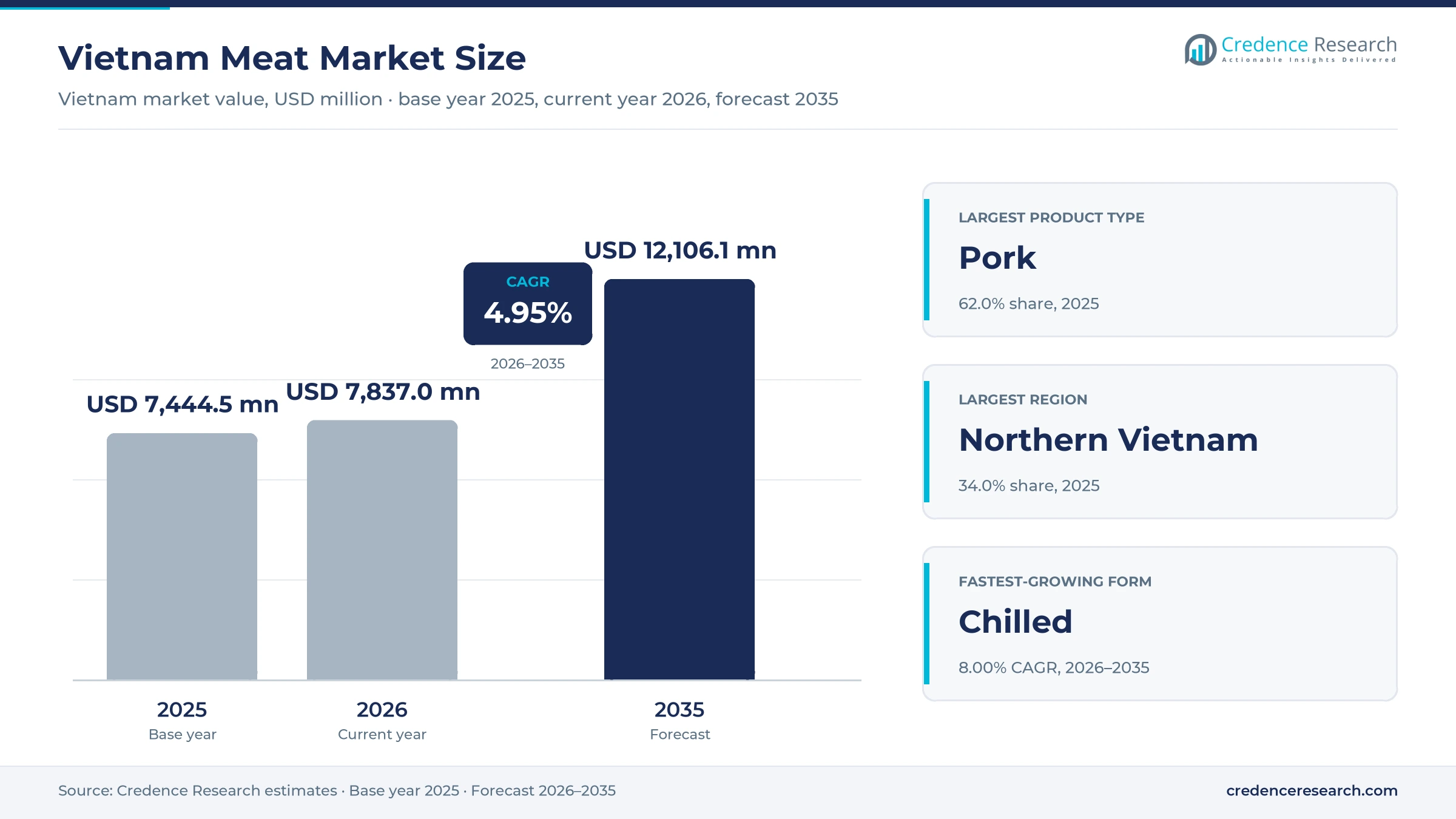
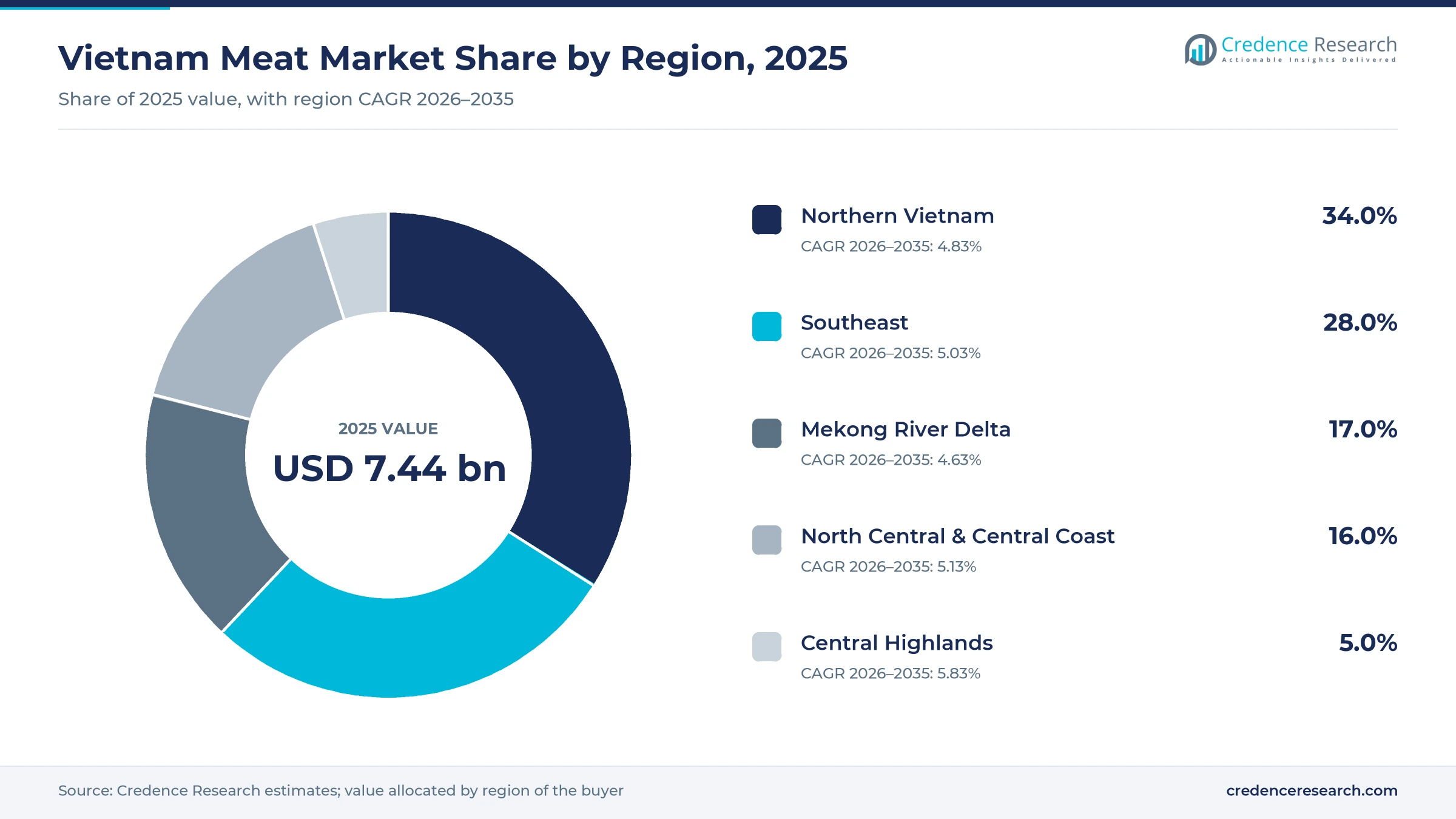
The Vietnam meat market was valued at USD 7.44 billion in 2025 and is projected to increase from USD 7.84 billion in 2026 to USD 12.11 billion by 2035, registering a CAGR of 4.95% during 2026–2035. Demand rests on a pork-centered diet, a national income level that passed USD 5,000 per person in 2025 and steady buying by restaurants, canteens and food processors. Northern Vietnam held the largest regional share, 34.0% in 2025, because of Hanoi and the dense pig and poultry belts around the Red River Delta. Central Highlands is the fastest-growing region at 5.83% a year, as integrators add hatcheries and contract farms there. Supply is also moving away from small backyard farms toward companies that control feed, farms and food, and that shift is changing how meat reaches shoppers. African swine fever and a 2025 food safety case have pushed authorities to tighten traceability rules in the largest cities.
What does the Vietnam meat market cover and how do buyers purchase?
The market covers pork, poultry, beef and buffalo, goat and sheep, and other meat sold as fresh, chilled, frozen, processed and canned products. Households still buy most of it daily from market stalls, while restaurants, canteens and manufacturers purchase through wholesalers, integrators and importers.
The value is a Credence Research model estimate covering only part of national meat sales, not all meat eaten in Vietnam. National output at farm-gate prices would be worth considerably more on official output and live-hog price data, so this figure should not be divided by tonnage to derive a price per kilogram. Live animal exports, feed, breeding stock, eggs, dairy, seafood and plant-based alternatives fall outside the scope.
Vietnam Meat Market Insights
- The market rises from USD 7.44 billion in 2025 to USD 12.11 billion by 2035, a 4.95% CAGR, with volume and product mix both contributing to value growth.
- Northern Vietnam led with 34.0% of 2025 value, supported by Hanoi demand of about 900 metric tons of meat a day, according to city officials.
- Pork held 62.0% of 2025 value, reflecting 54.9 kg of pork per person in 2025 in Ministry of Agriculture and Environment data.
- Hanoi launched a plan to close small residential slaughterhouses by 2030 and move 70% of slaughter to centralized plants, which favors branded and inspected supply.
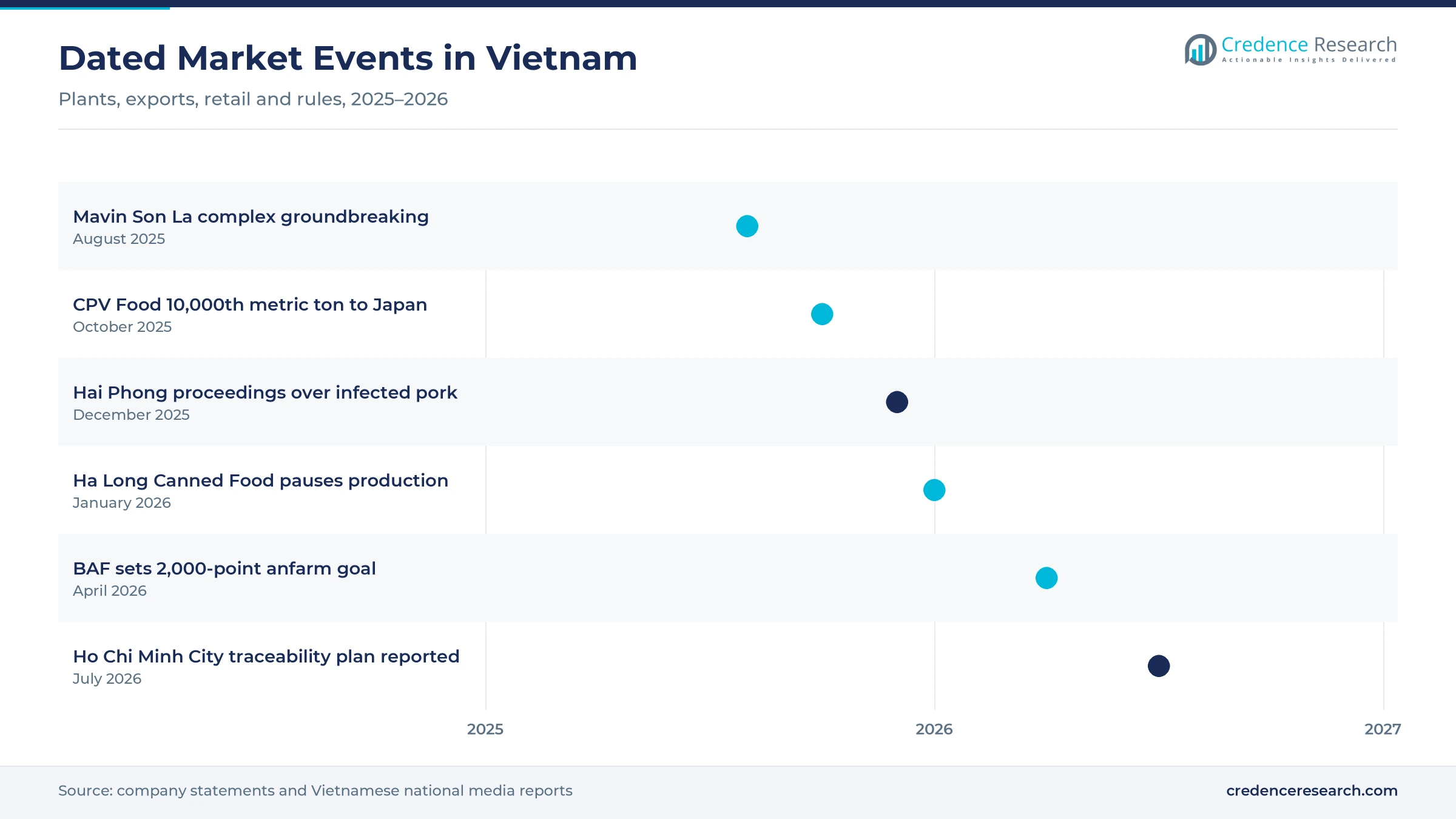
- BAF Vietnam Agriculture plans to grow its anfarm chilled meat network from over 800 points to 2,000 by the end of 2026, raising competition with established branded chains.
Pork and fresh stalls lead while chilled shops gain fastest
Why does pork lead while beef and buffalo grow fastest?
Based on product type, the market is categorized into pork, poultry, beef & buffalo, goat & sheep and other meat. Pork led with 62.0% of 2025 value because Ministry of Agriculture and Environment data show 54.9 kg of pork per person that year, against 25.8 kg of poultry meat. Beef & Buffalo grows fastest at 6.20% a year as the Tam Dao complex of Japan-Vietnam Livestock adds about 10,000 metric tons of annual beef capacity, according to Vietnam Investment Review in May 2025. Local supply remains short, since buffalo meat was the largest import item by value in 2025 customs data.
Why do fresh cuts lead while chilled meat gains ground?
Based on product form, the market is categorized into fresh, chilled, frozen, processed & cooked, and canned & shelf-stable products. Fresh led with 58.0% of 2025 value because unrefrigerated stall meat remains the daily habit, and RongViet Securities put chilled meat at only about 9% of consumption in 2023. Chilled grows fastest at 8.00% a year as Masan runs a Ha Nam plant with 140,000 metric tons of annual capacity, while anfarm adds chilled points. Frozen supply stays competitive, since imported pork averaged USD 2,273 a ton in 2025 customs data reported by VietNamNet.
Why do wet markets lead while brand-owned shops grow fastest?
Based on distribution channel, the market is categorized into wet markets & butcher shops, supermarkets & hypermarkets, convenience & specialty stores, brand-owned meat shops and e-commerce & quick commerce. Wet Markets & Butcher Shops led with 66.0% of 2025 value because the Ministry of Industry and Trade counted 8,274 traditional markets against 1,293 supermarkets in its 2025 domestic market report. Brand-Owned Meat Shops grows fastest at 8.79% a year as BAF plans 2,000 anfarm points by the end of 2026, up from over 800 at its April 2026 shareholder meeting.
Why do integrated 3F chains lead while contract farming rises fastest?
Based on production system, the market is categorized into smallholder farms, contract farming, integrated 3F chains, cooperative clusters and import-based processing. Integrated 3F Chains led with 31.0% of 2025 value because the Department of Livestock Production and Animal Health attributes most pork output to industrial and professional farms. Contract Farming grows fastest at 5.81% a year as Japfa Comfeed Vietnam guarantees offtake for nearly 600 farming households and plans to triple its chicken population, according to Vietstock in July 2025. Smallholders keep about 30% of pork output, which still gives independent stalls a local supply base.
| Segment Group | Leading Sub-segment | Share, 2025 | Fastest-growing Sub-segment | CAGR, 2026–2035 |
|---|---|---|---|---|
| By Product Type | Pork | 62.0% | Beef & Buffalo | 6.20% |
| By Product Form | Fresh | 58.0% | Chilled | 8.00% |
| By Distribution Channel | Wet Markets & Butcher Shops | 66.0% | Brand-Owned Meat Shops | 8.79% |
| By Production System | Integrated 3F Chains | 31.0% | Contract Farming | 5.81% |
Request a Free Sample
Fill in your details and we'll send you a free sample report.
- Sample data tables & charts
- Research methodology
Income, integrated farms and retail reshape meat buying
Rising protein consumption and household purchasing power
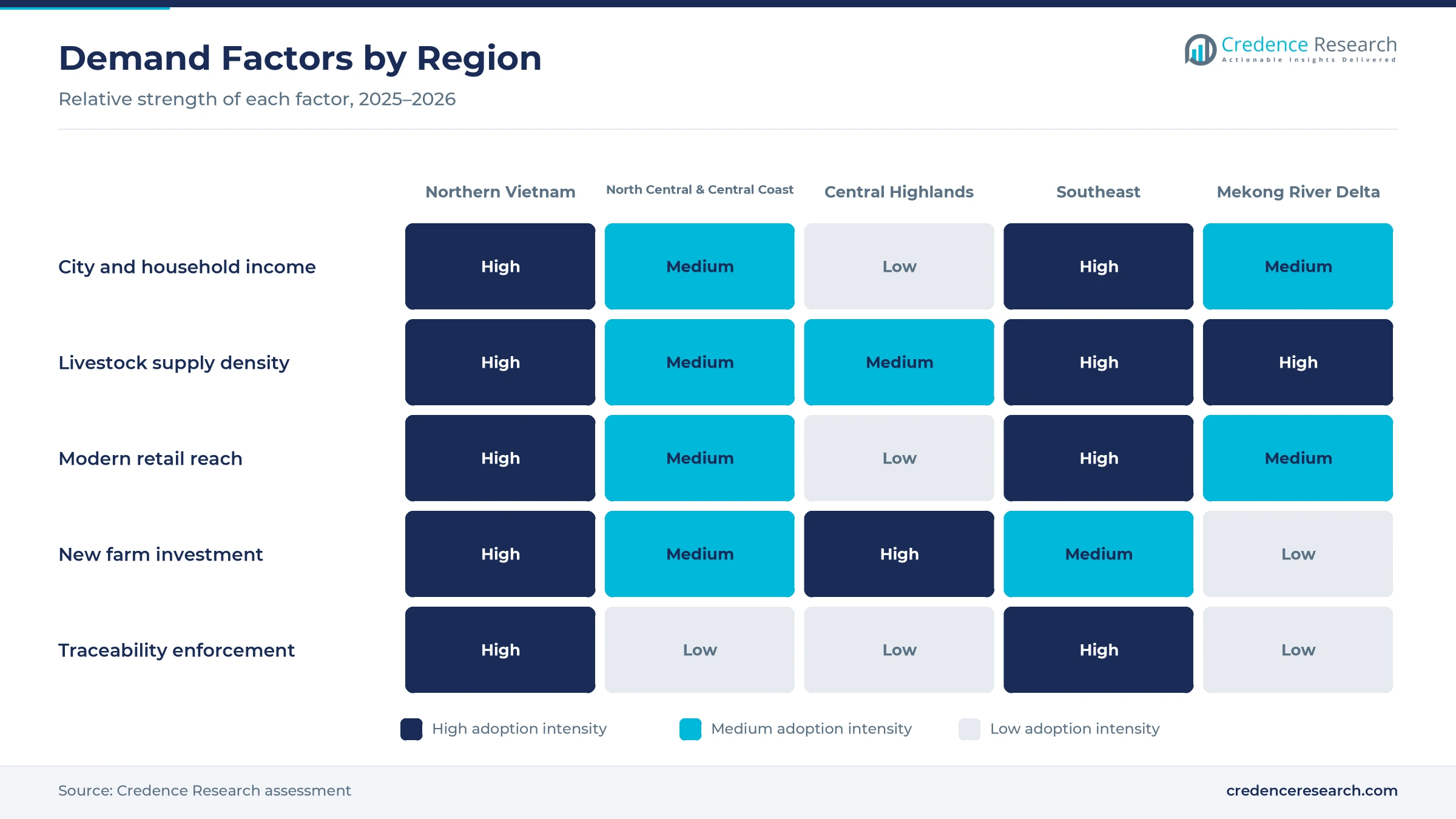
Higher household income is lifting both the amount of meat eaten and the price shoppers accept for it. World Bank data show GDP per capita of about USD 5,066 in 2025, up from about USD 3,704 in 2021. Over the same years, Ministry of Agriculture and Environment figures show consumption rising from 69.6 kg to about 87.6 kg of meat per person. Pork accounted for 54.9 kg of that 2025 total and poultry meat for 25.8 kg, while buffalo and beef stayed near 6.3 kg. As a result, pork volume underpins the market, whereas beef and processed items gain from trading up. Pham Kim Dang of the livestock department also put meat demand growth at 5% to 10% in February 2026.
Livestock modernization and integrated production
Company-run farms are replacing backyard pens, and that shift gives branded meat a more reliable and traceable supply base. Viet Nam News reported in June 2025 that about 90% of small pig farms had left the market compared with five years earlier, citing the Dong Nai Livestock Association. BAF Vietnam Agriculture now runs 100 farms and 13 processing plants, and it targets 10 million pigs a year by 2030. VietNamNet reported that CP Vietnam held about 350,000 sows in June 2025, more than 16% of the national total. Dabaco Group reached 52,000 sows and targets 60,000, according to Vietcap Securities. In turn, these company networks form the core of the Integrated 3F Chains segment in this report.
Modern retail, foodservice and convenience formats
Modern stores are moving meat out of open stalls and into refrigerated cabinets, including in smaller towns. WinCommerce added 415 stores in the first eight months of 2025, about 75% of them rural WinMart+ outlets, and its network neared 4,200 stores, according to Masan Group. Masan MEATLife products reached 69% of meat sales in that chain by July 2025, up from 49% in 2023, and Masan planned dedicated Meat Corners inside its stores. Food and foodstuffs also made up 34.1% of retail goods sales in the 2025 Ministry of Industry and Trade report. Demand from catering and foodservice operators adds further volume, since service sectors grew 10% to 14% a year over the past decade, excluding pandemic years, in that report.
Processed meat capacity and new export approvals
Investment in further processing is widening the market beyond raw cuts and is building export-grade skills at home. Mavin Group broke ground on Aug. 16, 2025, on a VND350 billion complex in Son La, with a 300,000-metric-ton agricultural processing factory due to deliver first products in 2026. CPV Food Binh Phuoc has annual capacity of 52 million broilers and 19,200 metric tons of processed chicken, according to Vietstock and it shipped its 10,000th metric ton to Japan by October 2025. Vissan also plans more than 20,300 metric tons of processed food output in 2026, according to Sai Gon Giai Phong. Together, these plants help cooked and ready-to-heat items compete for shelf space with packaged food and beverage makers.
Traceability, imports and export approvals shift the trade
Traceability rules are shifting city meat supply
City authorities are moving from voluntary quality claims toward enforced origin records, and that shift raises the cost of informal supply. Hanoi launched a plan to eliminate small unlicensed slaughterhouses in residential areas by 2030, with 70% of animals slaughtered at centralized or industrial plants, according to Porcinews. Ho Chi Minh City published its own 2026 plan covering pork, poultry and eggs, and VnEconomy reported in July 2026 that pork moving through the Binh Dien and Hoc Mon wholesale hubs must follow the protocols. The stakes are large, since Hanoi alone needs about 900 metric tons of meat a day. As a result, registered suppliers should gain share in both of the largest cities over the forecast period, particularly in the Southeast, which holds 28.0% of 2025 value.
Rising imports are reshaping price competition
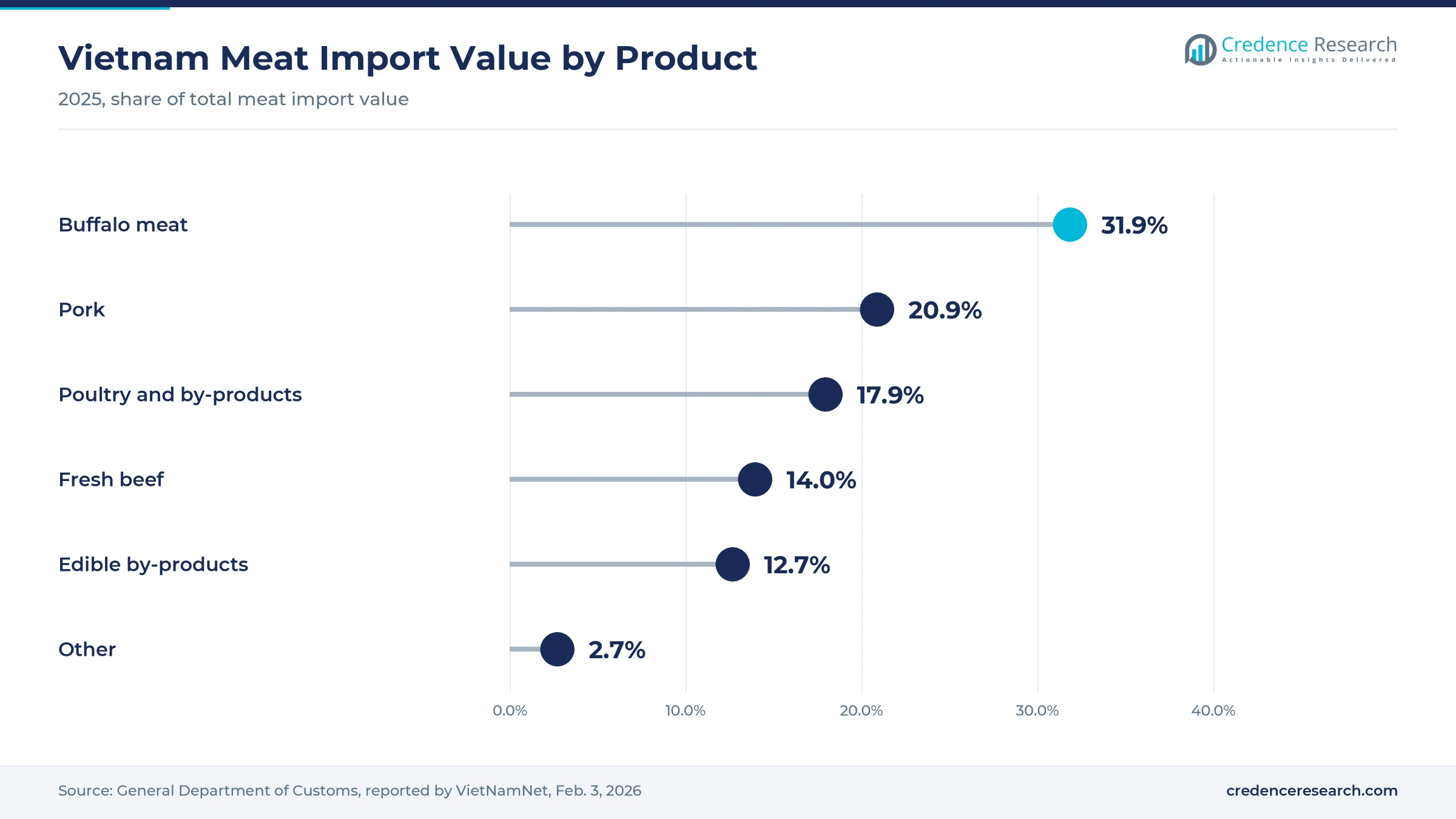
Imports have become a larger influence on domestic prices, especially when swine fever tightens local supply. VietNamNet reported customs data showing about USD 2 billion spent on nearly 1 million tons of meat and by-products in 2025. Pork imports reached 183,400 tons at an average of USD 2,273 a ton, with Russia supplying 48.44% and Brazil 30.91%. India remained the largest overall supplier at USD 681.32 million, which equaled 19.29% of import volume. This pressure matters most for processors, since Brazil-based JBS also announced a USD 100 million plan for two local factories in March 2025, starting in Haiphong, according to Vietnam Investment Review.
Opportunity in branded chilled retail outside the big cities
Chilled meat has room to expand because hot stall meat still dominates and refrigerated retail is only now reaching rural towns. RongViet Securities estimated chilled meat at about 9% of consumption in 2023, compared with about 40% in China by 2017. Vietnam also passed USD 5,000 of GDP per capita in 2025, a level Masan Group associates with sharp chilled and processed growth in China and Thailand. Nearly half of the 415 WinCommerce openings in the first eight months of 2025 were in central Vietnam, which brings new cold cabinets to underserved towns. Better tray and vacuum packs extend shelf life, so Chilled can grow at 8.00% a year in smaller towns as well as large cities.
Opportunity in processed poultry exports to new markets
Export approval gives processors a second outlet and a reason to invest in higher food safety standards. Livestock product exports reached USD 628 million in 2025, up 17.4% and above the ministry target of USD 550 million, according to Viet Nam News. Vietnam concluded processed poultry negotiations with South Korea in May 2025, and Korean inspectors visited in December 2025 as a final step. CP Vietnam also shipped its first processed chicken batch to Singapore in December 2025, and Japanese retailer Ito-Yokado imports five containers a year from its Binh Phuoc plant. The ministry now aims for USD 1 billion in exports, and Bizhub reported January-February 2026 exports of about USD 141 million, up 84%.
Swine fever, feed costs and food safety cases test trust
African swine fever disrupts supply and prices
African swine fever remains the largest single supply risk for the market. The Ministry of Agriculture and Environment reported more than 1.23 million pigs culled in the first 11 months of 2025, excluding flood losses. Live hog prices then rose from about VND50,000 to VND80,000 a kilogram by late January 2026, according to VCCI. Processors and household buyers both absorb these swings, so farms with stronger biosecurity and companies holding inventory carry an advantage during shortages.
Feed costs keep local meat dearer than imports
Local producers carry a structural cost problem because feed makes up 65% to 70% of livestock production expenses, according to an October 2025 Hanoi forum reported by Viet Nam News. Some frozen imports consequently sold 40% to 60% below domestic meat in Ho Chi Minh City in August 2025. Small farms and mid-sized processors feel this gap most sharply. Integrated groups can respond through their own feed mills, breeding programs and larger herds.
Food safety cases weaken shopper confidence
Public trust suffered when Hai Phong police brought proceedings against nine suspects on Dec. 24, 2025, in a case involving more than 120 tons of pork allegedly infected with swine fever, according to The Investor. Ha Long Canned Food said it was only a recipient of raw materials, relying on documents that appeared complete. The company paused production from Jan. 12, 2026, and an Emart spokesperson reported canned food sales down about 5%. Retailers such as Lotte Mart then added factory visits and certificate checks for suppliers.
Informal slaughter limits inspected supply
Informal slaughter keeps much meat outside inspection and undercuts compliant plants on price. Tuoi Tre News reported in July 2025 that only 60% of the meat Hanoi supplies itself passes regulated slaughter control. The same report said the Department of Animal Husbandry and Veterinary Medicine counted nearly 25,000 small slaughter establishments, and 73% had no business registration. Consolidation will therefore take years of provincial effort and needs fresh investment in slaughter and cutting lines, alongside steady enforcement by provinces.
The North leads while the central Highlands grows fastest
| Region | Value, 2025 (USD billion) | Share, 2025 | CAGR, 2026–2035 |
|---|---|---|---|
| Northern Vietnam | 2.53 | 34.0% | 4.83% |
| Southeast | 2.08 | 28.0% | 5.03% |
| Mekong River Delta | 1.27 | 17.0% | 4.63% |
| North Central & Central Coast | 1.19 | 16.0% | 5.13% |
| Central Highlands | 0.37 | 5.0% | 5.83% |
Northern Vietnam leads on Hanoi demand and dense farming
Northern Vietnam held 34.0% of 2025 value and grows at 4.83% a year, led by Hanoi demand of about 900 metric tons of meat a day, according to city officials. Dabaco keeps most of its sows in the North, and Mavin Group broke ground on its Son La complex in August 2025. The Tam Dao beef complex in Vinh Phuc adds local supply of chilled beef. Slaughter reform in Hanoi is the main change that buyers in this region should track through 2030.
The Southeast combines high-income buyers with strict hubs
The Southeast held 28.0% of 2025 value and grows at 5.03% a year, anchored by Ho Chi Minh City and its Binh Dien and Hoc Mon wholesale hubs. The CPV Food plant at Becamex Binh Phuoc Industrial Park serves export buyers from this zone. Vissan also plans a livestock farm in Binh Duong, set to start in late 2026 and finish in 2027, and Tay Ninh posted a 54.3% herd rise by May 2025 in livestock department data, according to VietNamNet.
The Mekong River Delta supplies poultry and duck
The Mekong River Delta held 17.0% of 2025 value and grows at 4.63% a year, drawing on a large poultry flock and rural markets. Livestock department data reported by aviNews show An Giang flocks up 15.7% and Can Tho flocks up 7.9% by September 2025. Tien Giang also raised its pig herd 24.1% by May 2025. Japfa management sees more room for growth in the Highlands than in the delta, so some new poultry capacity may settle elsewhere.
North central and Central Coast gain from new stores
North Central & Central Coast held 16.0% of 2025 value and grows at 5.13% a year as refrigerated retail arrives. Nearly half of WinCommerce store openings in the first eight months of 2025 were in central Vietnam, according to Masan Group. Binh Dinh raised its pig herd 9.5% by May 2025, whereas Quang Tri suffered sharp herd losses from swine fever later that year. Masan also runs a 200-hectare pig farm in Nghe An.
Central Highlands grows fastest on hatcheries and contract farms
Central Highlands held 5.0% of 2025 value and grows at 5.83% a year, the fastest rate among the five zones. Japfa Comfeed Vietnam built a hatchery in Dak Lak with capacity for 40 million chicks a year, backed by more than 120 contract households, according to Vietstock. BAF also took a stake in a 33-hectare farm in Dak Nong, while Gia Lai raised its pig herd 38.6% by May 2025. Japfa management sees substantial room for growth here compared with the Southeast and the Mekong River Delta.
Plants, exports and enforcement marked 2025 and 2026
| Development | Status and market relevance |
|---|---|
| In August 2025, Mavin Group broke ground on a VND350 billion agricultural complex in Son La with feed and processing plants | First products are scheduled for 2026, adding northern upland capacity |
| In October 2025, CPV Food Binh Phuoc marked its 10,000th metric ton of processed chicken shipped to Japan since 2022 | Exports also reach Hong Kong, Singapore, Laos, Cambodia and Mongolia |
| In December 2025, Hai Phong police brought proceedings against nine suspects over swine fever pork linked to Ha Long Canned Food stock | Investigation continued in early 2026; the company describes itself as a recipient of raw materials |
| In April 2026, BAF Vietnam Agriculture told shareholders it aims for 2,000 anfarm chilled meat points by the end of 2026 | The network had over 800 points at that meeting |
| In July 2026, VnEconomy reported the Ho Chi Minh City plan for pork, poultry and egg traceability | Binh Dien and Hoc Mon wholesale hubs must follow the protocols |
Cold chain, closed barns and traceability tools spread
- Closed high-rise barns are central to the BAF plan developed with Muyuan, which aims for a long-term target of 10 million pigs a year by 2030.
- Automated hatcheries such as the Japfa site in Dak Lak use 12 Belgian incubators and infrared beak treatment, which reduces chick stress and labor on partner farms.
- Chilled processing lines such as the BRC-certified Masan plant in Ha Nam were launched in 2018 to produce chilled meat to European standards at 140,000 metric tons a year.
- Traceability databases in Ho Chi Minh City will connect pork, poultry and egg records to the National Traceability Portal, so inspectors can check origin at wholesale hubs.
Need a Custom Version of This Report?
Tailor the scope, geography, or segments to your exact requirements.
- Custom geography or segment scope
- Direct access to our analyst team
Integrators race for sows, shelves and branded shops
Competition in the Vietnam meat market turns on control of the chain from feed and sows to the shop cabinet. CP Vietnam, GreenFeed Vietnam and BAF Vietnam Agriculture compete on herd scale, with VietNamNet reporting about 350,000 sows at CP Vietnam in June 2025 and a company-reported 116,000 at GreenFeed in June 2024. Masan MEATLife competes on retail access through WinCommerce, while Dabaco Group holds a strong northern position across pigs, poultry and processing. Japfa Comfeed Vietnam concentrates on colored chickens and contract households, supplying over 40 million birds a year. Vissan and Ha Long Canned Food built their positions in processed goods, although MM Mega Market recalled all Ha Long products in January 2026, showing how quickly a processor can lose shelf space. Mavin Group and CJ Vina Agri add foreign-backed capacity, and the planned JBS factories could sharpen rivalry in processing. Shoppers increasingly compare origin claims and safety records alongside price.
Leading companies and their roles in Vietnam
| Company | Type | Role in the market |
|---|---|---|
| C.P. Vietnam Corporation | Integrator | About 350,000 sows in June 2025; exports chicken from Binh Phuoc |
| Masan MEATLife Corporation | Branded meat | 69% of WinCommerce meat sales in July 2025; plant in Ha Nam |
| Vissan Joint Stock Company | Processor | Plans plant relocation and Binh Duong farm; 2026 processed output above 20,300 metric tons |
| Dabaco Group | Integrator | 52,000 sows, mostly in the North; target of 60,000 |
| GreenFeed Vietnam Corporation | Integrator | 116,000 sows reported in June 2024 |
| Japfa Comfeed Vietnam Limited | Poultry integrator | Nearly 600 contract households; Dak Lak hatchery |
| BAF Vietnam Agriculture JSC | Pig producer and retailer | 100 farms, 13 plants; anfarm chilled points |
| CJ Vina Agri Co., Ltd. | Livestock and processing | South Korean-owned pork, poultry and processed meat activity |
| Mavin Group | Integrator | Son La feed and processing complex started August 2025 |
| Ha Long Canned Food Joint Stock Corporation | Canned processor | Paused production in January 2026 during a pork probe |
Trust and cold chain will decide who wins share
Credence Research's view is that the next decade of the Vietnam meat market will reward companies able to prove origin and hold temperature, more than those with the largest herds alone. Stall trade will still hold most volume for years because shoppers trust what they can inspect each morning. However, Hanoi and Ho Chi Minh City are now raising the compliance burden on that trade, and the Ha Long case showed that packaged brands can lose trust as quickly. The most assumption-heavy estimates are the channel and form splits, since no official series separates them. Buyers should treat these as directional and test them against their own sell-through data.
How the meat market model and its splits were built
The report uses 2025 as the base year and forecasts values to 2035 through the Credence Research market model. Market values come from that model and cover only part of national meat sales, so they are well below the farm-gate value of national output. Segment, channel and regional splits are Credence Research estimates informed by public sources, including Vietnam ministry and customs data reported in national media, World Bank statistics and company announcements. No interviews or surveys were conducted for this edition of the report.
Chilled, processed and traceable supply lead to 2035
The Vietnam meat market is projected to reach USD 12.11 billion by 2035, with pork remaining the largest species and poultry and beef adding share gradually. Chilled and processed formats should gain the most value as refrigerated stores reach smaller towns and online food delivery apps widen access to ready meals. Slaughter consolidation in Hanoi is scheduled to run through 2030, so inspected supply should become easier to source in the second half of the forecast. Swine fever remains the largest risk to this path, and a sustained outbreak would again raise imports and prices.
Frequently Asked Questions
How big is the Vietnam meat market?
Which meat type leads in Vietnam?
Which product form is growing fastest?
Which region holds the largest share?
Why does Vietnam import meat when it produces so much?
How has African swine fever affected the market?
Which companies lead the market?
What rules are changing how meat is sold?
Table of Content
Chapter 1 Market Segmentation
- 1.1 Segmentation Framework
- 1.1.1 Product and Service Classification
- 1.1.2 Application and End-Use Classification
- 1.1.3 Technology and Solution Classification
- 1.1.4 Customer and Distribution Channel Classification
- 1.1.5 Geographic Segmentation
- 1.1.6 Market Segment Definitions and Boundaries
- 1.2 By Product Type
- 1.2.1 Pork
- 1.2.2 Poultry
- 1.2.3 Beef & Buffalo
- 1.2.4 Goat & Sheep
- 1.2.5 Other Meat
- 1.3 By Product Form
- 1.3.1 Fresh
- 1.3.2 Chilled
- 1.3.3 Frozen
- 1.3.4 Processed & Cooked
- 1.3.5 Canned & Shelf-Stable
- 1.4 By Production System
- 1.4.1 Smallholder Farms
- 1.4.2 Contract Farming
- 1.4.3 Integrated 3F Chains
- 1.4.4 Cooperative Clusters
- 1.4.5 Import-Based Processing
Chapter 2 Introduction
- 2.1 Report Objectives and Scope
- 2.2 Product Definition and Industry Terminology
- 2.3 Market Inclusions and Exclusions
- 2.4 Research Process
- 2.4.1 Primary Research and Expert Interviews
- 2.4.2 Secondary Research and Source Review
- 2.4.3 Top-Down and Bottom-Up Estimation
- 2.4.4 Data Triangulation and Verification
- 2.5 Market Size Measurement Basis
- 2.5.1 2025: USD 7.44 billion → 2035: USD 12.11 billion
- 2.6 Historical and Forecast Reference Periods
- 2.6.1 Historical Period: 2018-2025
- 2.6.2 Base Year: 2025
- 2.6.3 Forecast Period: 2025-2035
- 2.7 Research Assumptions and Limitations
Chapter 3 Executive Summary
- 3.1 Market Snapshot and Key Findings
- 3.2 Base-Year Market Size, 2025
- 3.3 Forecast Market Size, 2035
- 3.4 Revenue and Volume Growth Outlook
- 3.5 Key Demand and Supply Indicators
- 3.6 Leading Market Segments
- 3.7 Fastest-Growing Market Opportunities
- 3.8 Regional Performance Highlights
- 3.9 Technology and Industry Transformation
- 3.10 Competitive Landscape Summary
- 3.11 Analyst View and Strategic Implications
Chapter 4 Vietnam Meat Market Trends and Developments
- 4.1 Historical Industry Development, 2018-2025
- 4.2 Recent Market Trends and Developments
- 4.3 Demand and Customer Behavior Trends
- 4.4 Technology and Product Innovation
- 4.5 Artificial Intelligence, Automation and Digitalization
- 4.6 Local Manufacturing and Supply Chain Realignment
- 4.7 Industry Partnerships, Mergers and Acquisitions
- 4.8 Sustainability and Circular Economy Developments
- 4.9 Government and Private Sector Investment Trends
- 4.10 Emerging Business Models and Commercialization
- 4.11 Industry Developments and Announcements
Chapter 5 Vietnam Meat Market Production, Supply and Demand Analysis
- 5.1 Demand Trend and Consumption Analysis, 2018-2025
- 5.2 Demand Forecast, 2025-2035
- 5.3 Production and Output Trend, 2018-2025
- 5.4 Production and Output Forecast, 2025-2035
- 5.5 Installed Capacity and Capacity Utilization
- 5.6 Company-Wise Production Plants and Statistics
- 5.6.1 Installed Production Capacity
- 5.6.2 Actual Production
- 5.6.3 Planned Capacity and Expansion Targets
- 5.7 Supply Chain Structure and Procurement Trends
- 5.8 Supply-Demand Gap and Bottlenecks
- 5.9 Import Dependence and Sourcing Structure
- 5.10 Contract Manufacturing and Outsourcing
- 5.11 Regional Supply and Demand Concentration
Chapter 6 Vietnam Meat Market Pricing Analysis
- 6.1 Pricing Structure and Measurement
- 6.2 Historical Pricing Trends, 2018-2025
- 6.3 Pricing Outlook, 2025-2035
- 6.4 Average Selling Price and Unit Economics
- 6.5 Pricing by Product and Market Segment
- 6.6 Geographic Pricing Differences
- 6.7 Key Input, Energy, Labor and Logistics Costs
- 6.8 Contract Pricing and Purchasing Models
- 6.9 Pricing Sensitivity and Competitive Positioning
- 6.10 Price, Margin and Profitability Implications
Chapter 7 Vietnam Meat Market Dynamics
- 7.1 Market Growth Drivers
- 7.1.1 Demand-Side Drivers
- 7.1.2 Technology and Innovation Drivers
- 7.1.3 Infrastructure and Investment Drivers
- 7.1.4 Regulatory and Policy Drivers
- 7.2 Market Restraints
- 7.2.1 Cost and Affordability Constraints
- 7.2.2 Technology and Adoption Barriers
- 7.2.3 Supply Chain and Operational Constraints
- 7.3 Market Challenges
- 7.3.1 Competitive Pressure and Margin Erosion
- 7.3.2 Skills, Infrastructure and Implementation Gaps
- 7.4 Emerging Market Opportunities
- 7.5 Market Dynamics Impact and Time-Horizon Assessment
Chapter 8 Vietnam Meat Value Chain Analysis
- 8.1 Industry Value Chain Overview
- 8.2 Upstream Suppliers and Critical Inputs
- 8.3 Technology and Component Providers
- 8.4 Manufacturing or Service Delivery
- 8.5 Distribution, Channel Partners and Integrators
- 8.6 Downstream Applications and End Users
- 8.7 Value Addition and Profit Pools
- 8.8 Vertical Integration and Outsourcing
- 8.9 Supplier Concentration and Risk
- 8.10 Supply Chain Localization and Resilience
Chapter 9 Vietnam Meat Market Regulations and Policies
- 9.1 Relevant Laws, Standards and Compliance Frameworks
- 9.2 Product, Service, Safety and Quality Requirements
- 9.3 Government Policies, Incentives and Subsidies
- 9.4 Imports, Exports and Trade Barriers
- 9.5 Public Procurement and Local Content Requirements
- 9.6 Environmental and Sustainability Compliance
- 9.7 Upcoming Policy Changes and Market Implications
Chapter 10 Vietnam Meat Market Hotspots and Opportunities
- 10.1 Market Opportunity Mapping and Growth Hotspots
- 10.2 High-Growth Applications and Customer Groups
- 10.3 Underserved Markets and White-Space Opportunities
- 10.4 Emerging Technology and Product Opportunities
- 10.5 New Capacity and Investment Hotspots
- 10.6 Market Entry and Expansion Opportunities
- 10.7 Distribution and Partnership Opportunities
- 10.8 Near-Term and Long-Term Commercial Potential
- 10.9 Opportunity Attractiveness and Execution Risks
Chapter 11 Vietnam Meat Market Outlook, 2025-2035
- 11.1 Market Size and Analysis
- 11.1.1 Revenue (Market Measurement: 2025: USD 7.44 billion → 2035: USD 12.11 billion)
- 11.1.2 Market Volume and Quantity Sold
- 11.1.3 Historical Market Size, 2018-2025
- 11.1.4 Base-Year Market Size, 2025
- 11.2 Market Forecast, 2025-2035
- 11.2.1 Revenue Forecast to 2035
- 11.2.2 Volume Forecast to 2035
- 11.2.3 CAGR and Year-on-Year Growth
- 11.2.4 Incremental Revenue Opportunity
- 11.3 Forecast Assumptions and Scenario Analysis
- 11.3.1 Base-Case Forecast
- 11.3.2 Optimistic and Conservative Scenarios
- 11.3.3 Technology, Pricing and Policy Sensitivities
- 11.4 Market Attractiveness and Growth Outlook
Chapter 12 Vietnam Meat Market Segmentation and Outlook
- 12.1 Segmentation Summary and Market Shares, 2025
- 12.2 Largest and Fastest-Growing Segments
- 12.3 By Product Type - Market Size and Forecast, 2025-2035
- 12.3.1 Segment Definition and Scope
- 12.3.2 Historical Market Size, 2018-2025
- 12.3.3 Revenue Forecast, 2025-2035
- 12.3.4 Volume Forecast, 2025-2035
- 12.3.5 Base-Year Market Share, 2025
- 12.3.6 Segment CAGR and Growth Drivers
- 12.3.7 Subsegment Market Size and Forecast
- 12.3.7.1 Pork
- 12.3.7.2 Poultry
- 12.3.7.3 Beef & Buffalo
- 12.3.7.4 Goat & Sheep
- 12.3.7.5 Other Meat
- 12.3.8 Subsegment Pricing and Adoption Trends
- 12.3.9 Leading Suppliers and Competition
- 12.3.10 Regional Demand and Opportunities
- 12.4 By Product Form - Market Size and Forecast, 2025-2035
- 12.4.1 Segment Definition and Scope
- 12.4.2 Historical Market Size, 2018-2025
- 12.4.3 Revenue Forecast, 2025-2035
- 12.4.4 Volume Forecast, 2025-2035
- 12.4.5 Base-Year Market Share, 2025
- 12.4.6 Segment CAGR and Growth Drivers
- 12.4.7 Subsegment Market Size and Forecast
- 12.4.7.1 Fresh
- 12.4.7.2 Chilled
- 12.4.7.3 Frozen
- 12.4.7.4 Processed & Cooked
- 12.4.7.5 Canned & Shelf-Stable
- 12.4.8 Subsegment Pricing and Adoption Trends
- 12.4.9 Leading Suppliers and Competition
- 12.4.10 Regional Demand and Opportunities
- 12.5 By Production System - Market Size and Forecast, 2025-2035
- 12.5.1 Segment Definition and Scope
- 12.5.2 Historical Market Size, 2018-2025
- 12.5.3 Revenue Forecast, 2025-2035
- 12.5.4 Volume Forecast, 2025-2035
- 12.5.5 Base-Year Market Share, 2025
- 12.5.6 Segment CAGR and Growth Drivers
- 12.5.7 Subsegment Market Size and Forecast
- 12.5.7.1 Smallholder Farms
- 12.5.7.2 Contract Farming
- 12.5.7.3 Integrated 3F Chains
- 12.5.7.4 Cooperative Clusters
- 12.5.7.5 Import-Based Processing
- 12.5.8 Subsegment Pricing and Adoption Trends
- 12.5.9 Leading Suppliers and Competition
- 12.5.10 Regional Demand and Opportunities
- 12.6 Segment Growth Comparison
- 12.7 Segment Attractiveness and Priority Matrix
Chapter 13 Vietnam Meat Geographic Market Outlook, 2025-2035
- 13.1 Domestic Market Distribution and Demand Clusters
- 13.2 State- or Province-Wise Market Size and Forecast, 2025-2035
- 13.3 City and Metropolitan Market Outlook
- 13.4 Industrial, Manufacturing and Commercial Clusters
- 13.5 Geographic Concentration of Key End Users
- 13.6 Local Pricing and Purchasing Differences
- 13.7 Domestic Production Facilities and Capacity Map
- 13.8 Local Infrastructure and Project Pipeline
- 13.9 State-Level Policy and Incentive Differences
- 13.10 Subnational Investment Hotspots and Opportunities
- 13.11 Distribution and Logistics Networks
- 13.12 Domestic Competitive Footprint
Chapter 14 Vietnam Meat Technology, Innovation and Sustainability Outlook
- 14.1 Technology Landscape and Maturity
- 14.2 Product, Process and Service Innovation
- 14.3 AI, Automation and Digital Tools in the Industry
- 14.4 Technology Adoption and Performance Benchmarking
- 14.5 Innovation Pipeline and R&D Investment
- 14.6 Patent and Intellectual Property Trends
- 14.7 Energy Efficiency and Resource Management
- 14.8 Sustainability, Recycling and Circularity
- 14.9 Technology Roadmap, 2025-2035
- 14.10 Risks of Obsolescence and Technology Substitution
Chapter 15 Vietnam Meat Market Key Strategic Imperatives
- 15.1 Growth and Market Entry Priorities
- 15.2 High-Return Products and Segments
- 15.3 Pricing, Profitability and Cost Optimization
- 15.4 Technology Investment and Product Differentiation
- 15.5 Supply Chain Localization and Resilience
- 15.6 Distribution and Customer Acquisition
- 15.7 Partnership, Acquisition and Capacity Strategy
- 15.8 Regional Expansion Priorities
- 15.9 Short-, Medium- and Long-Term Actions
Chapter 16 Competition Outlook
- 16.1 Industry Competition Characteristics
- 16.2 Market Structure and Concentration
- 16.3 Market Share and Competitive Positioning, 2025
- 16.4 Company-Wise Revenue and Product Benchmarking
- 16.5 Production and Service Capacity Benchmarking
- 16.6 Technology, Pricing and Differentiation
- 16.7 Regional Footprint and Distribution Strength
- 16.8 Mergers, Acquisitions and Strategic Alliances
- 16.9 New Entrants and Competitive Threats
- 16.10 Porter's Five Forces and Industry Attractiveness
- 16.11 Competitive Outlook, 2025-2035
Chapter 17 Company Profiles
- 17.1 Company Coverage and Selection Criteria
- 17.2 C.P. Vietnam Corporation
- 17.2.1 Business Description
- 17.2.2 Company Ownership and Geographic Presence
- 17.2.3 Product and Service Portfolio
- 17.2.4 Manufacturing and Operating Footprint
- 17.2.5 Production Capacity and Expansion Plans
- 17.2.6 Financial Performance and Investment
- 17.2.7 Market Share and Competitive Position
- 17.2.8 Technology and Innovation Capabilities
- 17.2.9 Strategic Alliances or Partnerships
- 17.2.10 Recent Developments
- 17.2.11 Growth Strategy and Outlook
- 17.3 Masan MEATLife Corporation
- 17.4 Vissan Joint Stock Company
- 17.5 Dabaco Group
- 17.6 GreenFeed Vietnam Corporation
- 17.7 Japfa Comfeed Vietnam Limited
- 17.8 BAF Vietnam Agriculture JSC
- 17.9 CJ Vina Agri Co., Ltd.
- 17.10 Mavin Group
- 17.11 Ha Long Canned Food Joint Stock Corporation
- 17.12 Other Relevant Market Participants
Note: Every listed company is profiled on the structure shown under the first company. The company list is preliminary and may change based on research findings, market developments, data availability and client requirements.
Chapter 18 Disclaimer
- 18.1 Research and Forecast Disclaimer
- 18.2 Data Source and Estimation Limitations
Note: The depth of individual sections depends on data availability for this market. Volume, capacity, trade and other unit-based metrics are included where applicable.

