Market Overview:
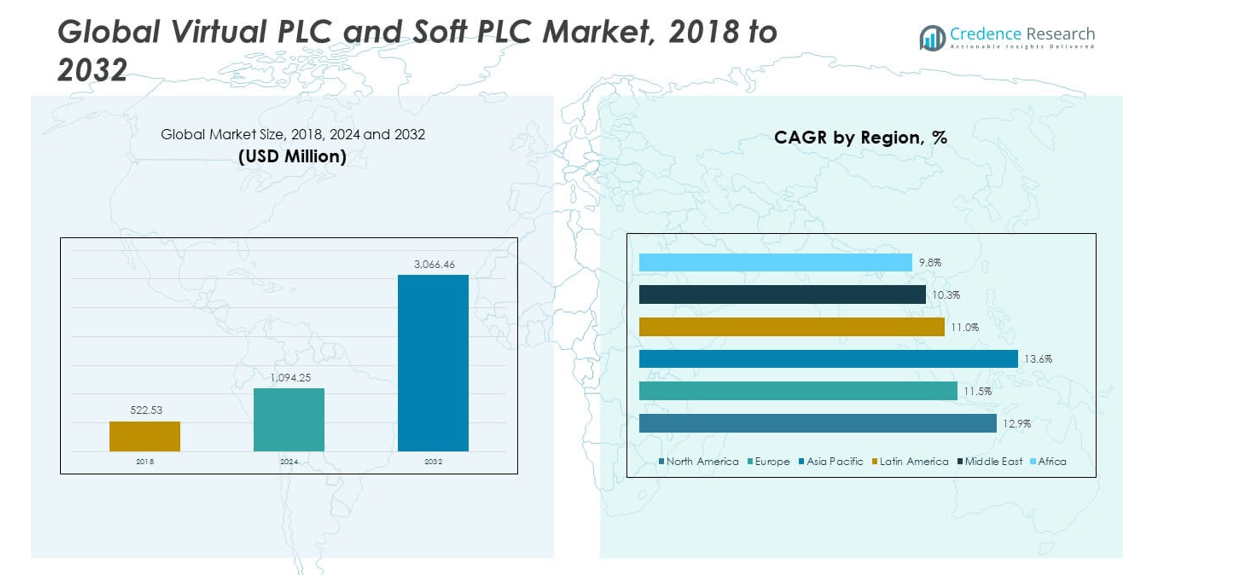
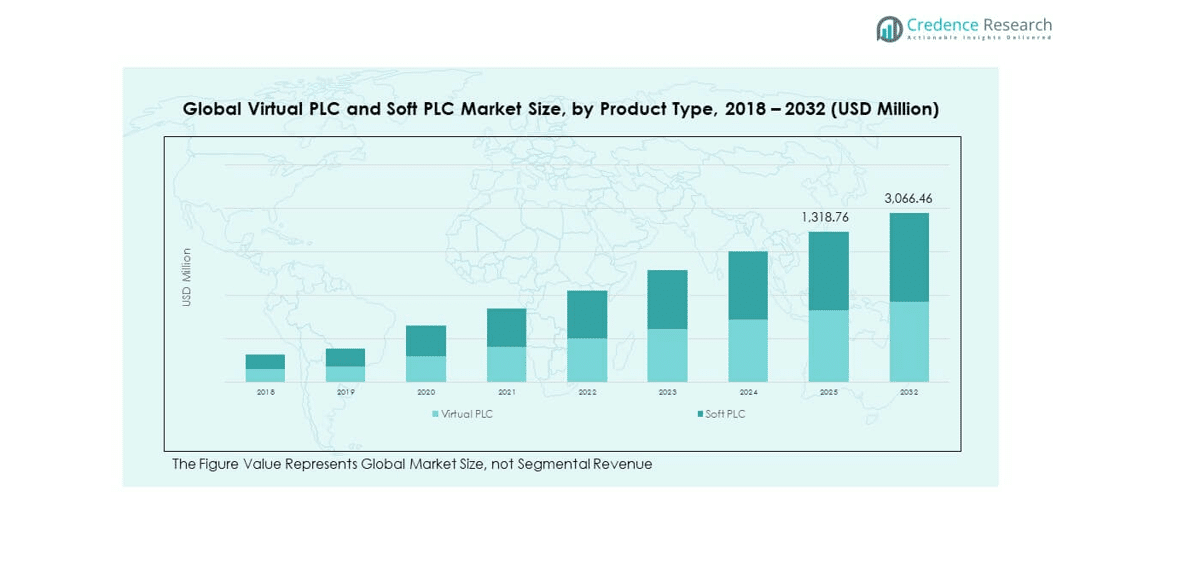
The Global Virtual PLC and Soft PLC Market size was valued at USD 522.53 million in 2018 to USD 1,094.25 million in 2024 and is anticipated to reach USD 3,066.46 million by 2032, at a CAGR of 12.81% during the forecast period.
| REPORT ATTRIBUTE | DETAILS |
|---|---|
| Historical Period | 2020-2023 |
| Base Year | 2024 |
| Forecast Period | 2025-2032 |
| Virtual PLC and Soft PLC Market Size 2024 | USD 1,094.25 million |
| Virtual PLC and Soft PLC Market, CAGR | 12.81% |
| Virtual PLC and Soft PLC Market Size 2032 | USD 3,066.46 million |
The market growth is driven by the rising adoption of industrial automation, digitalization, and Industry 4.0 technologies. Manufacturers are shifting from traditional hardware-based PLCs to software-based solutions that offer flexibility, scalability, and lower operational costs. Increasing demand for real-time data monitoring, predictive maintenance, and cloud integration further supports the market expansion across various industrial sectors.
North America leads the Global Virtual PLC and Soft PLC Market due to its strong industrial base, advanced automation infrastructure, and high investment in digital transformation. Europe follows closely, driven by the widespread adoption of smart factories and government support for industrial modernization. Asia-Pacific is emerging rapidly, led by growing manufacturing activity in China, Japan, South Korea, and India, where industries are upgrading to intelligent control systems for improved efficiency and productivity.
Market Insights:
- The Global Virtual PLC and Soft PLC Market was valued at USD 522.53 million in 2018, reached USD 1,094.25 million in 2024, and is projected to reach USD 3,066.46 million by 2032, growing at a CAGR of 12.81%.
- North America (28%), Asia Pacific (36%), and Europe (22%) held the top three regional shares. Asia Pacific leads due to industrial automation expansion in China, Japan, and India, while North America benefits from digital manufacturing, and Europe advances through strong Industry 4.0 policies.
- Asia Pacific is the fastest-growing region, accounting for 36% of the market. Growth is supported by manufacturing digitization, favorable government initiatives, and rapid cloud adoption across smart factories.
- By product type, Virtual PLC accounts for around 60% of the total share due to its scalability and integration benefits.
- Soft PLC represents approximately 40% of the share, driven by increasing use of PC-based control and cost-efficient automation in emerging industries.
Market Drivers:
Rising Demand for Industrial Automation and Process Optimization
The Global Virtual PLC and Soft PLC Market is growing due to the rapid adoption of industrial automation. Companies are replacing traditional control systems with flexible, software-based solutions to improve productivity and reduce downtime. The ability to program, monitor, and modify processes remotely helps manufacturers streamline operations. This shift supports real-time control, predictive maintenance, and data-driven decision-making. Automation demand across automotive, manufacturing, and energy sectors is creating sustained momentum. The software-centric architecture enables faster system upgrades without hardware replacement. It reduces production costs and increases operational agility. The transition to connected, digital environments continues to drive strong market adoption.
- For instance, Siemens’ SIMATIC S7-1500V virtual PLC was recognized at the 2025 EDGE Awards for its capability to deliver resilient automation with validated failsafe functions in production, providing remote diagnostics and flexible upgrades without requiring physical controller changes.
Integration with Industry 4.0 and Smart Factory Ecosystems
The rise of Industry 4.0 has accelerated the deployment of virtual and soft PLCs across modern factories. These systems integrate seamlessly with IoT devices, AI-based monitoring tools, and cloud platforms. Manufacturers benefit from centralized control, improved scalability, and advanced analytics. It enhances visibility across production lines and improves overall equipment efficiency. Virtual PLCs also enable easy customization, supporting dynamic production models. Businesses are adopting these solutions to strengthen digital transformation strategies. The focus on connected manufacturing environments is reinforcing their importance. Continuous technological improvements ensure stronger performance and easier integration into smart factory frameworks.
- For instance, Audi deployed Siemens’ SIMATIC S7-1500V virtual PLC on its shop floor, successfully virtualizing production automation to reduce the number and variety of devices, transitioning processes to software and enabling faster, more robust production systems with enhanced flexibility and real-time system visibility.
Growing Focus on Cost Reduction and Flexibility in Control Systems
Industries are shifting toward virtual PLCs to lower capital and maintenance costs. Hardware-based systems require regular replacements and servicing, while software PLCs offer easier scalability and reduced lifecycle costs. It allows firms to adapt production setups without significant investments. Cloud-based deployment further eliminates the need for expensive physical infrastructure. Virtual PLCs provide enhanced flexibility, letting operators run multiple control functions on one platform. This model supports distributed and hybrid operations across different sites. Cost-effective solutions appeal to small and medium manufacturers aiming to stay competitive. Growing focus on agility and return on investment strengthens this driver’s impact.
Increasing Adoption of Cloud and Edge Computing Platforms
The adoption of cloud and edge computing is transforming industrial control systems. Virtual PLCs can now operate with enhanced speed and reliability through hybrid cloud setups. Edge-based control ensures minimal latency, which is crucial for real-time operations. It improves scalability while maintaining security and data ownership. Businesses benefit from centralized management and remote diagnostics. Cloud integration also facilitates automatic software updates and easy system expansion. It allows seamless communication between devices and platforms. The shift toward decentralized control architectures continues to enhance performance and expand market penetration globally.
Market Trends:
Shift Toward Open-Source and Interoperable Control Platforms
The Global Virtual PLC and Soft PLC Market is witnessing strong momentum toward open-source platforms. Industries prefer systems that allow integration with various hardware and software vendors. This shift improves interoperability and lowers dependency on proprietary ecosystems. Developers are focusing on flexible frameworks that support diverse industrial applications. It encourages innovation and customization according to process requirements. Open-source models accelerate deployment and ensure compatibility with legacy systems. Many enterprises are transitioning to vendor-neutral systems to future-proof operations. The trend enhances adaptability and fosters a collaborative ecosystem within industrial automation.
- For instance, Mitsubishi Electric’s MELSEC MX Controller series was launched in 2025, supporting CC-Link IE TSN networks for industrial connectivity with cycle times as low as 1.2 ms and high-speed synchronization across multiple device brands-enabling diverse hardware to operate on a unified, real-time digital platform.
Expansion of AI-Driven Control and Predictive Analytics
Artificial intelligence is redefining how control systems operate across industries. Virtual PLCs now incorporate AI algorithms to optimize performance and detect anomalies. Predictive analytics enhances decision-making by identifying potential failures before disruption. It helps reduce downtime and improve operational efficiency. AI integration supports adaptive control strategies for complex processes. Manufacturers use AI insights to enhance throughput and energy efficiency. It strengthens data-driven manufacturing ecosystems by connecting sensors, controllers, and analytics engines. The integration of AI continues to expand across industrial verticals, reinforcing smarter and more responsive automation environments.
- For instance, Rockwell Automation’s FactoryTalk Analytics enables continuous machine learning analysis, delivers advanced maintenance warnings, and helped users reduce unplanned downtime through GuardianAI predictive maintenance tools, which track asset health and performance KPIs in real time as deployed in 2025.
Emergence of Virtual Commissioning and Digital Twin Applications
Virtual commissioning is becoming a major trend in industrial system development. It allows engineers to simulate PLC logic before physical deployment. This reduces setup errors, testing time, and commissioning costs. Digital twins further enhance this by mirroring real-world equipment and processes. It provides continuous feedback for performance optimization and predictive maintenance. The combination of simulation and control creates safer and more efficient production environments. It supports real-time experimentation without interrupting actual operations. Growing emphasis on digital twins positions this trend as a vital evolution in automation technology.
Rising Implementation of Cybersecurity Solutions in Automation Systems
The rise in connected automation systems has increased exposure to cyber threats. Industries are prioritizing cybersecurity within PLC architectures. Advanced encryption and secure communication protocols are now essential features. It ensures system reliability and prevents unauthorized access. Virtual PLC providers are embedding multi-layered security frameworks to safeguard critical operations. Compliance with cybersecurity standards strengthens industry confidence. Secure-by-design approaches are becoming common in industrial automation. This focus on protection is reshaping control system design and deployment strategies worldwide.
Market Challenges Analysis:
Concerns Over System Reliability and Network Dependence
The Global Virtual PLC and Soft PLC Market faces challenges related to system reliability and network stability. Unlike traditional hardware PLCs, virtual systems rely heavily on software and connectivity. Network interruptions or software glitches can disrupt production processes. It creates hesitation among manufacturers operating in high-risk or continuous operations. Concerns about data integrity and latency in distributed environments remain significant. Firms must invest in redundant systems and strong IT infrastructure to maintain uptime. Integrating safety-critical applications also requires higher validation standards. Ensuring stable, fault-tolerant performance remains a priority for broader adoption.
Complex Integration with Legacy Infrastructure and Skill Gaps
Adopting virtual PLCs in existing industrial setups often requires major integration efforts. Many factories operate with older systems that lack compatibility with modern digital controllers. Upgrading infrastructure involves high costs and technical expertise. It also demands retraining the workforce to manage advanced software-based control environments. The lack of standardized communication protocols adds complexity during transition phases. Smaller enterprises may struggle to justify investment due to uncertain returns. Vendors need to offer simplified migration tools and support programs. Addressing these integration and skill challenges will determine long-term market penetration.
Market Opportunities:
Expansion Across Emerging Economies and SME Adoption
The Global Virtual PLC and Soft PLC Market has strong growth potential in emerging economies. Manufacturing expansion in Asia-Pacific, Latin America, and Eastern Europe is driving new adoption. SMEs are increasingly investing in software-based automation due to lower upfront costs. It allows smaller firms to benefit from flexibility and scalability previously limited to large corporations. Local governments are supporting digital transformation and Industry 4.0 initiatives. Vendors offering cost-effective, localized solutions can capture significant market share. The growing ecosystem of system integrators supports faster deployment across new industries.
Growth in Cloud-Native and Edge-Integrated Control Architectures
The market is evolving toward cloud-native and edge-integrated architectures that enhance responsiveness. Virtual PLCs are leveraging these technologies to deliver faster, decentralized control solutions. It supports real-time data processing closer to the production floor. Integration with 5G and IoT infrastructure strengthens communication efficiency. Vendors developing adaptive, modular, and secure systems will gain competitive advantage. The demand for flexible, scalable automation frameworks continues to create long-term business opportunities.
Market Segmentation Analysis:
Product Type
The Global Virtual PLC and Soft PLC Market favors Virtual PLC for flexibility. Soft PLC grows where PC-based control and low latency matter. It enables faster updates and easier scaling across multi-line plants.
- For instance, Beckhoff’s TwinCAT PLC++ offers control logic execution up to 3 times faster compared to its previous PLC models, allowing machine builders to minimize cycle times and switch between batch runs with industrial PCs in multi-line automotive manufacturing as reported in 2025.
Component
The Global Virtual PLC and Soft PLC Market sees Software leading on value creation. Hardware persists for I/O, gateways, and ruggedized compute. Services expand through integration, migration, and lifecycle support. It strengthens time-to-value and reduces deployment risk.
- For instance, ABB’s DCS and Freelance nodes enable phased migration from legacy PLCs with near-seamless drop-in replacement and minimal disruption, supporting uninterrupted operations and reducing risk in plant-wide upgrades in 2025.
Control Level Type
The Global Virtual PLC and Soft PLC Market advances in Advanced Control Systems. Basic Control Systems remain in cost-sensitive, discrete tasks. Distributed Control Systems rise with complex, multi-asset sites. It enhances coordination, redundancy, and real-time responsiveness.
Deployment Mode
The Global Virtual PLC and Soft PLC Market is shifting to Cloud-Based models. On-Premise stays critical for deterministic, regulated, or air-gapped plants. Hybrid designs link edge control with cloud orchestration. It optimizes latency, security, and fleet management.
Operating System
The Global Virtual PLC and Soft PLC Market relies on Windows for legacy toolchains. Linux adoption grows for openness, security hardening, and cost control. Others cover RTOS and container hosts for edge nodes. It supports diverse workloads and vendor ecosystems.
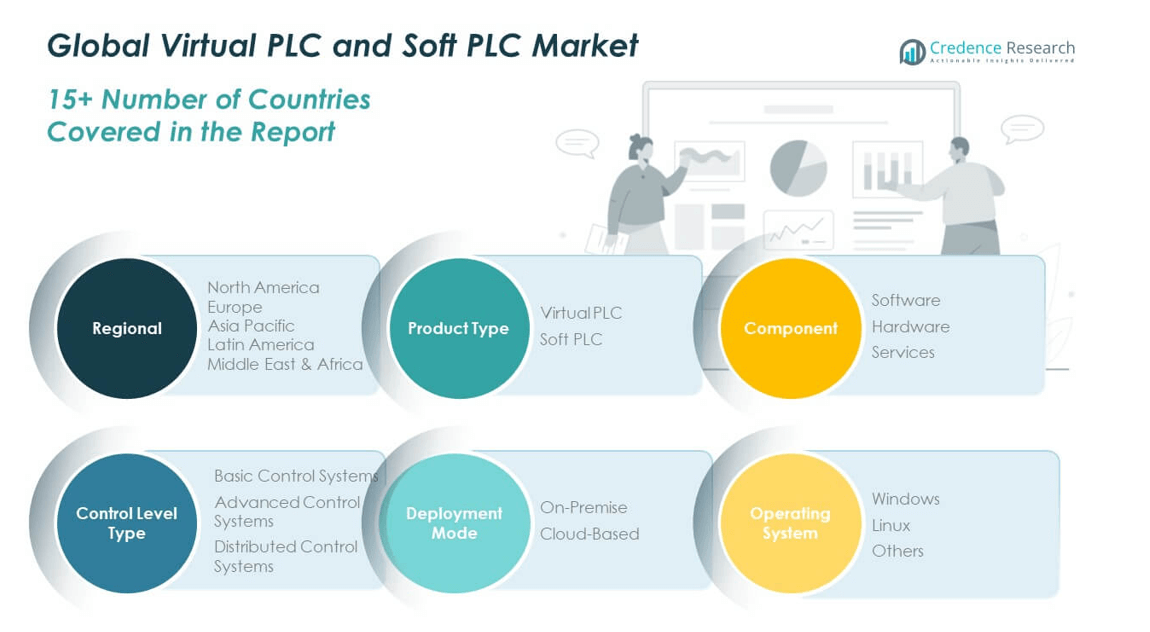
By Segmentation:
By Product Type
- Virtual PLC
- Soft PLC
By Component
- Software
- Hardware
- Services
By Control Level Type
- Basic Control Systems
- Advanced Control Systems
- Distributed Control Systems
By Deployment Mode
- On-Premise
- Cloud-Based
By Operating System
- Windows
- Linux
- Others
By Regions
- North America
- U.S.
- Canada
- Mexico
- Europe
- Germany
- France
- U.K.
- Italy
- Spain
- Rest of Europe
- Asia Pacific
- China
- Japan
- India
- South Korea
- South-east Asia
- Rest of Asia Pacific
- Latin America
- Brazil
- Argentina
- Rest of Latin America
- Middle East & Africa
- GCC Countries
- South Africa
- Rest of the Middle East and Africa
Regional Analysis:
North America
The North America Global Virtual PLC and Soft PLC Market size was valued at USD 150.15 million in 2018 to USD 309.46 million in 2024 and is anticipated to reach USD 870.90 million by 2032, at a CAGR of 12.9% during the forecast period. North America holds around 28% market share, driven by strong automation penetration and early adoption of digital control systems. The U.S. leads regional growth through investment in smart manufacturing and industrial IoT infrastructure. Canada supports market expansion with increased deployment in energy and utilities. It benefits from advanced R&D initiatives, cloud-based adoption, and strong integration between software vendors and manufacturing hubs. The presence of established automation giants and start-ups boosts innovation. High awareness of Industry 4.0 and industrial cybersecurity strengthens the market’s maturity. Continuous upgrades in data centers and industrial networks further propel technology adoption across major industries.
Europe
The Europe Global Virtual PLC and Soft PLC Market size was valued at USD 97.31 million in 2018 to USD 192.60 million in 2024 and is anticipated to reach USD 490.66 million by 2032, at a CAGR of 11.5% during the forecast period. Europe commands around 22% market share, supported by robust industrial digitalization policies. Germany, France, and the UK drive demand through initiatives promoting automation and process control modernization. It benefits from a mature manufacturing sector emphasizing energy efficiency and operational reliability. Advanced research in mechatronics, industrial software, and IoT integration enhances competitiveness. The EU’s push for carbon reduction aligns with intelligent factory systems powered by software-based PLCs. Increasing use of cloud and edge computing also accelerates adoption. Strong regional standards and vendor collaboration maintain consistent technology quality across sectors.
Asia Pacific
The Asia Pacific Global Virtual PLC and Soft PLC Market size was valued at USD 228.53 million in 2018 to USD 496.22 million in 2024 and is anticipated to reach USD 1,475.33 million by 2032, at a CAGR of 13.6% during the forecast period. Asia Pacific dominates with around 36% market share, led by China, Japan, South Korea, and India. Rapid industrialization and investment in smart factories fuel demand. It benefits from government programs supporting automation in manufacturing, automotive, and electronics industries. China drives production efficiency through digital transformation initiatives, while Japan focuses on precision engineering applications. India and Southeast Asia show rapid adoption through new industrial corridors. Growing IT infrastructure and cloud ecosystems encourage PLC virtualization. Regional manufacturers also collaborate with global players for cost-effective automation solutions.
Latin America
The Latin America Global Virtual PLC and Soft PLC Market size was valued at USD 23.64 million in 2018 to USD 48.86 million in 2024 and is anticipated to reach USD 120.47 million by 2032, at a CAGR of 11.0% during the forecast period. Latin America accounts for around 7% market share, supported by digital modernization in process industries. Brazil and Mexico lead through adoption in food processing, energy, and automotive sectors. It benefits from modernization of legacy plants and industrial reforms promoting automation. Cloud adoption among regional enterprises enhances accessibility for smaller manufacturers. Infrastructure growth projects are also encouraging investment in intelligent control systems. Vendors are partnering with local integrators to provide affordable software-based control solutions. Ongoing industrial digitization continues to strengthen the regional market outlook.
Middle East
The Middle East Global Virtual PLC and Soft PLC Market size was valued at USD 14.23 million in 2018 to USD 27.17 million in 2024 and is anticipated to reach USD 63.87 million by 2032, at a CAGR of 10.3% during the forecast period. The region holds about 4% market share, with GCC countries driving growth through automation in oil, gas, and energy industries. The UAE and Saudi Arabia invest heavily in smart industrial ecosystems under Vision 2030 programs. It benefits from strong focus on digital industrial infrastructure and cybersecurity. Integration of cloud platforms enhances remote operations and control system efficiency. The push toward non-oil industries, including logistics and manufacturing, increases technology uptake. Advanced system integrators are expanding partnerships with local governments to enhance deployment capacity. The rising importance of predictive maintenance further drives adoption.
Africa
The Africa Global Virtual PLC and Soft PLC Market size was valued at USD 8.68 million in 2018 to USD 19.95 million in 2024 and is anticipated to reach USD 45.22 million by 2032, at a CAGR of 9.8% during the forecast period. Africa represents around 3% market share, with South Africa and Nigeria emerging as key growth contributors. The market benefits from gradual automation adoption in mining, manufacturing, and energy sectors. It gains momentum from rising investments in smart grids and infrastructure projects. Software-based PLCs provide cost-effective control solutions suitable for diverse industrial applications. Multinational automation firms are expanding presence to support local digitization efforts. It faces infrastructure and connectivity challenges, but new partnerships are bridging these gaps. Ongoing regional reforms and industrial growth support steady long-term expansion.
Key Player Analysis:
- ABB Ltd.
- Advantech Co., Ltd.
- Bosch Rexroth
- Delta Electronics, Inc.
- Emerson Electric Co.
- Hitachi Industrial Equipment Systems
- Honeywell International Inc.
Competitive Analysis:
The Global Virtual PLC and Soft PLC Market is highly competitive, driven by rapid industrial automation and digital transformation. Leading players focus on innovation, integration, and expanding software ecosystems. It features strong participation from global automation companies such as ABB, Siemens, Schneider Electric, and Emerson, competing on flexibility, cloud compatibility, and interoperability. Vendors are developing scalable, software-driven control systems tailored for smart factories. Strategic partnerships, acquisitions, and technological collaborations enhance competitiveness. Emerging firms target cost-effective virtual solutions to attract small and mid-sized manufacturers. The market’s structure encourages continuous product evolution and robust after-sales support.
Recent Developments:
- In October 2025, ABB Ltd. entered into a definitive agreement with SoftBank Group Corp. to divest its global Robotics division for an enterprise value of $5.375 billion. This strategic acquisition, set to close in mid-to-late 2026, positions SoftBank to integrate ABB’s leading automation technology with its own AI and robotics expertise, driving an ambitious evolution toward artificial super intelligence in industrial automation.
- In July 2025, Advantech Co., Ltd. announced the launch of its AMAX IoT Control Platform, which merges PLC, HMI, and IoT functions into a unified, software-defined platform for real-time automation. This innovation, leveraging EtherCAT industrial Ethernet and CODESYS, enables microsecond-level precision and simplifies integration in industries such as semiconductor manufacturing and robotics.
Report Coverage:
The research report offers an in-depth analysis based on product type, component, control level, deployment mode, and operating system. It details leading market players, providing an overview of their business, product offerings, investments, revenue streams, and key applications. Additionally, the report includes insights into the competitive environment, SWOT analysis, current market trends, as well as the primary drivers and constraints. Furthermore, it discusses various factors that have driven market expansion in recent years. The report also explores market dynamics, regulatory scenarios, and technological advancements that are shaping the industry. It assesses the impact of external factors and global economic changes on market growth. Lastly, it provides strategic recommendations for new entrants and established companies to navigate the complexities of the market.
Future Outlook:
- Rising industrial automation will continue to drive adoption of virtual PLC technologies.
- Cloud-based deployments will gain momentum across manufacturing and energy sectors.
- Integration of AI and analytics will enhance predictive control and performance efficiency.
- Edge computing will strengthen decentralized and real-time control architectures.
- Demand for open-source and interoperable platforms will expand rapidly.
- Cybersecurity innovation will become a key focus for industrial software vendors.
- Partnerships between OEMs and IT firms will shape hybrid automation ecosystems.
- SMEs will increasingly adopt subscription-based or SaaS control solutions.
- Regional manufacturing hubs in Asia-Pacific will lead future growth momentum.
- Continuous R&D investment will fuel product innovation and market differentiation.

Request a Free Sample
Fill in your details and we'll send you a free sample report.
- Sample data tables & charts
- Research methodology
Market Dynamics
Industrial Automation and Process Optimization
Manufacturers are rapidly adopting virtual and soft PLCs to replace traditional hardware-based control systems, enabling greater flexibility, remote monitoring, and real-time process optimization. This shift supports predictive maintenance and data-driven decision-making, reducing downtime and improving productivity.
Integration with Industry 4.0 and Smart Factories
The proliferation of Industry 4.0 initiatives is accelerating the deployment of software-based PLCs that seamlessly integrate with IoT devices, AI analytics, and cloud platforms. This integration enhances centralized control, scalability, and advanced analytics, driving adoption across modern manufacturing environments.
Cost Reduction and Flexibility in Control Systems
Virtual PLCs offer significant cost savings by reducing the need for physical hardware, lowering maintenance expenses, and enabling scalable upgrades. This flexibility allows manufacturers, especially SMEs, to adapt production setups quickly and efficiently without large capital investments.
Adoption of Cloud and Edge Computing
The increasing use of cloud and edge computing platforms enables virtual PLCs to deliver low-latency, reliable, and scalable control solutions. Centralized management, remote diagnostics, and seamless system expansion through cloud integration are making these solutions attractive for diverse industrial applications.
Demand for Open-Source and Interoperable Platforms
Industries are seeking open-source and interoperable control platforms to avoid vendor lock-in and ensure compatibility with a wide range of hardware and software. This trend fosters innovation, easier integration with legacy systems, and future-proofs automation investments.
Need a Custom Version of This Report?
Tailor the scope, geography, or segments to your exact requirements.
- Custom geography or segment scope
- Direct access to our analyst team
Frequently Asked Questions
What is the current market size for Virtual PLC and Soft PLC Automation, and what is its projected size in 2032?
At what Compound Annual Growth Rate is the Virtual PLC and Soft PLC market projected to grow between 2024 and 2032?
Which Virtual PLC and Soft PLC market segment held the largest share in 2024?
What are the primary factors fueling the growth of the Virtual PLC and Soft PLC market?
Who are the leading companies in the Virtual PLC and Soft PLC market?
Which region commanded the largest share of the Virtual PLC and Soft PLC market in 2024?
Table of Content
Chapter 1 Market Segmentation
- 1.1 Segmentation Framework
- 1.1.1 Product and Service Classification
- 1.1.2 Application and End-Use Classification
- 1.1.3 Technology and Solution Classification
- 1.1.4 Customer and Distribution Channel Classification
- 1.1.5 Geographic Segmentation
- 1.1.6 Market Segment Definitions and Boundaries
- 1.2 By Component
- 1.2.1 Software
- 1.2.2 Hardware
- 1.2.3 Services
- 1.3 By Product Type
- 1.3.1 Virtual PLC
- 1.3.2 Soft PLC
- 1.4 By Deployment Mode
- 1.4.1 On-Premise
- 1.4.2 Cloud-Based
- 1.4.3 Hybrid
- 1.5 By Operating System
- 1.5.1 Windows
- 1.5.2 Linux
- 1.5.3 Others
Chapter 2 Introduction
- 2.1 Report Objectives and Scope
- 2.2 Product Definition and Industry Terminology
- 2.3 Market Inclusions and Exclusions
- 2.4 Research Process
- 2.4.1 Primary Research and Expert Interviews
- 2.4.2 Secondary Research and Source Review
- 2.4.3 Top-Down and Bottom-Up Estimation
- 2.4.4 Data Triangulation and Verification
- 2.5 Market Size Measurement Basis
- 2.5.1 2018: USD 522.53 million → 2032: USD 3,066.46 million
- 2.6 Historical and Forecast Reference Periods
- 2.6.1 Base Year: 2018
- 2.6.2 Forecast Period: 2018-2032
- 2.7 Research Assumptions and Limitations
Chapter 3 Executive Summary
- 3.1 Market Snapshot and Key Findings
- 3.2 Base-Year Market Size, 2018
- 3.3 Forecast Market Size, 2032
- 3.4 Revenue and Volume Growth Outlook
- 3.5 Key Demand and Supply Indicators
- 3.6 Leading Market Segments
- 3.7 Fastest-Growing Market Opportunities
- 3.8 Regional Performance Highlights
- 3.9 Technology and Industry Transformation
- 3.10 Competitive Landscape Summary
- 3.11 Analyst View and Strategic Implications
Chapter 4 Global Virtual PLC and Soft PLC Market Trends and Developments
- 4.1 Historical Industry Development
- 4.2 Recent Market Trends and Developments
- 4.3 Demand and Customer Behavior Trends
- 4.4 Technology and Product Innovation
- 4.5 Artificial Intelligence, Automation and Digitalization
- 4.6 Local Manufacturing and Supply Chain Realignment
- 4.7 Industry Partnerships, Mergers and Acquisitions
- 4.8 Sustainability and Circular Economy Developments
- 4.9 Government and Private Sector Investment Trends
- 4.10 Emerging Business Models and Commercialization
- 4.11 Industry Developments and Announcements
Chapter 5 Global Virtual PLC and Soft PLC Market Production, Supply and Demand Analysis
- 5.1 Demand Trend and Consumption Analysis
- 5.2 Demand Forecast, 2018-2032
- 5.3 Production and Output Trend
- 5.4 Production and Output Forecast, 2018-2032
- 5.5 Installed Capacity and Capacity Utilization
- 5.6 Company-Wise Production Plants and Statistics
- 5.6.1 Installed Production Capacity
- 5.6.2 Actual Production
- 5.6.3 Planned Capacity and Expansion Targets
- 5.7 Supply Chain Structure and Procurement Trends
- 5.8 Supply-Demand Gap and Bottlenecks
- 5.9 Import Dependence and Sourcing Structure
- 5.10 Contract Manufacturing and Outsourcing
- 5.11 Regional Supply and Demand Concentration
Chapter 6 Global Virtual PLC and Soft PLC Market Pricing Analysis
- 6.1 Pricing Structure and Measurement
- 6.2 Historical Pricing Trends
- 6.3 Pricing Outlook, 2018-2032
- 6.4 Average Selling Price and Unit Economics
- 6.5 Pricing by Product and Market Segment
- 6.6 Geographic Pricing Differences
- 6.7 Key Input, Energy, Labor and Logistics Costs
- 6.8 Contract Pricing and Purchasing Models
- 6.9 Pricing Sensitivity and Competitive Positioning
- 6.10 Price, Margin and Profitability Implications
Chapter 7 Global Virtual PLC and Soft PLC Market Dynamics
- 7.1 Market Growth Drivers
- 7.1.1 Demand-Side Drivers
- 7.1.2 Technology and Innovation Drivers
- 7.1.3 Infrastructure and Investment Drivers
- 7.1.4 Regulatory and Policy Drivers
- 7.2 Market Restraints
- 7.2.1 Cost and Affordability Constraints
- 7.2.2 Technology and Adoption Barriers
- 7.2.3 Supply Chain and Operational Constraints
- 7.3 Market Challenges
- 7.3.1 Competitive Pressure and Margin Erosion
- 7.3.2 Skills, Infrastructure and Implementation Gaps
- 7.4 Emerging Market Opportunities
- 7.5 Market Dynamics Impact and Time-Horizon Assessment
Chapter 8 Global Virtual PLC and Soft PLC Value Chain Analysis
- 8.1 Industry Value Chain Overview
- 8.2 Upstream Suppliers and Critical Inputs
- 8.3 Technology and Component Providers
- 8.4 Manufacturing or Service Delivery
- 8.5 Distribution, Channel Partners and Integrators
- 8.6 Downstream Applications and End Users
- 8.7 Value Addition and Profit Pools
- 8.8 Vertical Integration and Outsourcing
- 8.9 Supplier Concentration and Risk
- 8.10 Supply Chain Localization and Resilience
Chapter 9 Global Virtual PLC and Soft PLC Market Regulations and Policies
- 9.1 Relevant Laws, Standards and Compliance Frameworks
- 9.2 Product, Service, Safety and Quality Requirements
- 9.3 Government Policies, Incentives and Subsidies
- 9.4 Imports, Exports and Trade Barriers
- 9.5 Public Procurement and Local Content Requirements
- 9.6 Environmental and Sustainability Compliance
- 9.7 Data Protection, AI and Cybersecurity Compliance
- 9.8 Upcoming Policy Changes and Market Implications
Chapter 10 Global Virtual PLC and Soft PLC Market Hotspots and Opportunities
- 10.1 Market Opportunity Mapping and Growth Hotspots
- 10.2 High-Growth Applications and Customer Groups
- 10.3 Underserved Markets and White-Space Opportunities
- 10.4 Emerging Technology and Product Opportunities
- 10.5 New Capacity and Investment Hotspots
- 10.6 Market Entry and Expansion Opportunities
- 10.7 Distribution and Partnership Opportunities
- 10.8 Near-Term and Long-Term Commercial Potential
- 10.9 Opportunity Attractiveness and Execution Risks
Chapter 11 Global Virtual PLC and Soft PLC Market Outlook, 2018-2032
- 11.1 Market Size and Analysis
- 11.1.1 Revenue (Market Measurement: 2018: USD 522.53 million → 2032: USD 3,066.46 million)
- 11.1.2 Market Volume and Quantity Sold
- 11.1.3 Historical Market Size
- 11.1.4 Base-Year Market Size, 2018
- 11.2 Market Forecast, 2018-2032
- 11.2.1 Revenue Forecast to 2032
- 11.2.2 Volume Forecast to 2032
- 11.2.3 CAGR and Year-on-Year Growth
- 11.2.4 Incremental Revenue Opportunity
- 11.3 Forecast Assumptions and Scenario Analysis
- 11.3.1 Base-Case Forecast
- 11.3.2 Optimistic and Conservative Scenarios
- 11.3.3 Technology, Pricing and Policy Sensitivities
- 11.4 Market Attractiveness and Growth Outlook
Chapter 12 Global Virtual PLC and Soft PLC Market Segmentation and Outlook
- 12.1 Segmentation Summary and Market Shares, 2018
- 12.2 Largest and Fastest-Growing Segments
- 12.3 By Component - Market Size and Forecast, 2018-2032
- 12.3.1 Segment Definition and Scope
- 12.3.2 Historical Market Size
- 12.3.3 Revenue Forecast, 2018-2032
- 12.3.4 Volume Forecast, 2018-2032
- 12.3.5 Base-Year Market Share, 2018
- 12.3.6 Segment CAGR and Growth Drivers
- 12.3.7 Subsegment Market Size and Forecast
- 12.3.7.1 Software
- 12.3.7.2 Hardware
- 12.3.7.3 Services
- 12.3.8 Subsegment Pricing and Adoption Trends
- 12.3.9 Leading Suppliers and Competition
- 12.3.10 Regional Demand and Opportunities
- 12.4 By Product Type - Market Size and Forecast, 2018-2032
- 12.4.1 Segment Definition and Scope
- 12.4.2 Historical Market Size
- 12.4.3 Revenue Forecast, 2018-2032
- 12.4.4 Volume Forecast, 2018-2032
- 12.4.5 Base-Year Market Share, 2018
- 12.4.6 Segment CAGR and Growth Drivers
- 12.4.7 Subsegment Market Size and Forecast
- 12.4.7.1 Virtual PLC
- 12.4.7.2 Soft PLC
- 12.4.8 Subsegment Pricing and Adoption Trends
- 12.4.9 Leading Suppliers and Competition
- 12.4.10 Regional Demand and Opportunities
- 12.5 By Deployment Mode - Market Size and Forecast, 2018-2032
- 12.5.1 Segment Definition and Scope
- 12.5.2 Historical Market Size
- 12.5.3 Revenue Forecast, 2018-2032
- 12.5.4 Volume Forecast, 2018-2032
- 12.5.5 Base-Year Market Share, 2018
- 12.5.6 Segment CAGR and Growth Drivers
- 12.5.7 Subsegment Market Size and Forecast
- 12.5.7.1 On-Premise
- 12.5.7.2 Cloud-Based
- 12.5.7.3 Hybrid
- 12.5.8 Subsegment Pricing and Adoption Trends
- 12.5.9 Leading Suppliers and Competition
- 12.5.10 Regional Demand and Opportunities
- 12.6 By Operating System - Market Size and Forecast, 2018-2032
- 12.6.1 Segment Definition and Scope
- 12.6.2 Historical Market Size
- 12.6.3 Revenue Forecast, 2018-2032
- 12.6.4 Volume Forecast, 2018-2032
- 12.6.5 Base-Year Market Share, 2018
- 12.6.6 Segment CAGR and Growth Drivers
- 12.6.7 Subsegment Market Size and Forecast
- 12.6.7.1 Windows
- 12.6.7.2 Linux
- 12.6.7.3 Others
- 12.6.8 Subsegment Pricing and Adoption Trends
- 12.6.9 Leading Suppliers and Competition
- 12.6.10 Regional Demand and Opportunities
- 12.7 Segment Growth Comparison
- 12.8 Segment Attractiveness and Priority Matrix
Chapter 13 Global Virtual PLC and Soft PLC Geographic Market Outlook, 2018-2032
- 13.1 Regional Market Size and Share, 2018
- 13.2 Regional Market Forecast, 2018-2032
- 13.3 Regional Pricing, Production and Demand Differences
- 13.4 North America
- 13.4.1 United States
- 13.4.2 Canada
- 13.4.3 Mexico
- 13.5 Europe
- 13.5.1 Germany
- 13.5.2 France
- 13.5.3 Italy
- 13.5.4 United Kingdom
- 13.5.5 Spain
- 13.5.6 Poland
- 13.5.7 Russia
- 13.5.8 Netherlands
- 13.5.9 Belgium
- 13.5.10 Sweden
- 13.5.11 Denmark
- 13.5.12 Norway
- 13.5.13 Rest of Europe
- 13.6 Asia Pacific
- 13.6.1 China
- 13.6.2 India
- 13.6.3 Japan
- 13.6.4 South Korea
- 13.6.5 Thailand
- 13.6.6 Indonesia
- 13.6.7 Vietnam
- 13.6.8 Malaysia
- 13.6.9 Australia
- 13.6.10 Rest of Asia Pacific
- 13.7 Latin America
- 13.7.1 Brazil
- 13.7.2 Argentina
- 13.7.3 Colombia
- 13.7.4 Chile
- 13.7.5 Rest of Latin America
- 13.8 Middle East
- 13.8.1 Saudi Arabia
- 13.8.2 United Arab Emirates
- 13.8.3 Turkey
- 13.8.4 Israel
- 13.8.5 Iran
- 13.8.6 Rest of the Middle East
- 13.9 Africa
- 13.9.1 South Africa
- 13.9.2 Egypt
- 13.9.3 Nigeria
- 13.9.4 Morocco
- 13.9.5 Rest of Africa
- 13.10 Regional Investment, Policy and Supply Chain Differences
- 13.11 Regional Competitive Landscape
- 13.12 Geographic Growth Hotspots
Chapter 14 Global Virtual PLC and Soft PLC Technology, Innovation and Sustainability Outlook
- 14.1 Technology Landscape and Maturity
- 14.2 Product, Process and Service Innovation
- 14.3 AI, Automation and Digital Tools in the Industry
- 14.4 Technology Adoption and Performance Benchmarking
- 14.5 Innovation Pipeline and R&D Investment
- 14.6 Patent and Intellectual Property Trends
- 14.7 Energy Efficiency and Resource Management
- 14.8 Sustainability, Recycling and Circularity
- 14.9 Technology Roadmap, 2018-2032
- 14.10 Risks of Obsolescence and Technology Substitution
Chapter 15 Global Virtual PLC and Soft PLC Market Key Strategic Imperatives
- 15.1 Growth and Market Entry Priorities
- 15.2 High-Return Products and Segments
- 15.3 Pricing, Profitability and Cost Optimization
- 15.4 Technology Investment and Product Differentiation
- 15.5 Supply Chain Localization and Resilience
- 15.6 Distribution and Customer Acquisition
- 15.7 Partnership, Acquisition and Capacity Strategy
- 15.8 Regional Expansion Priorities
- 15.9 Short-, Medium- and Long-Term Actions
Chapter 16 Competition Outlook
- 16.1 Industry Competition Characteristics
- 16.2 Market Structure and Concentration
- 16.3 Market Share and Competitive Positioning, 2018
- 16.4 Company-Wise Revenue and Product Benchmarking
- 16.5 Production and Service Capacity Benchmarking
- 16.6 Technology, Pricing and Differentiation
- 16.7 Regional Footprint and Distribution Strength
- 16.8 Mergers, Acquisitions and Strategic Alliances
- 16.9 New Entrants and Competitive Threats
- 16.10 Porter's Five Forces and Industry Attractiveness
- 16.11 Competitive Outlook, 2018-2032
Chapter 17 Company Profiles
- 17.1 Company Coverage and Selection Criteria
- 17.2 ABB Ltd.
- 17.2.1 Business Description
- 17.2.2 Company Ownership and Geographic Presence
- 17.2.3 Product and Service Portfolio
- 17.2.4 Manufacturing and Operating Footprint
- 17.2.5 Production Capacity and Expansion Plans
- 17.2.6 Financial Performance and Investment
- 17.2.7 Market Share and Competitive Position
- 17.2.8 Technology and Innovation Capabilities
- 17.2.9 Strategic Alliances or Partnerships
- 17.2.10 Recent Developments
- 17.2.11 Growth Strategy and Outlook
- 17.3 Siemens AG
- 17.4 Schneider Electric
- 17.5 Emerson Electric Co.
- 17.6 Rockwell Automation
- 17.7 Advantech Co., Ltd.
- 17.8 Bosch Rexroth
- 17.9 Delta Electronics, Inc.
- 17.10 Hitachi Industrial Equipment Systems
- 17.11 Honeywell International Inc.
- 17.12 Other Relevant Market Participants
Note: Every listed company is profiled on the structure shown under the first company. The company list is preliminary and may change based on research findings, market developments, data availability and client requirements.
Chapter 18 Disclaimer
- 18.1 Research and Forecast Disclaimer
- 18.2 Data Source and Estimation Limitations
Note: The depth of individual sections depends on data availability for this market. Volume, capacity, trade and other unit-based metrics are included where applicable.