Market Overview
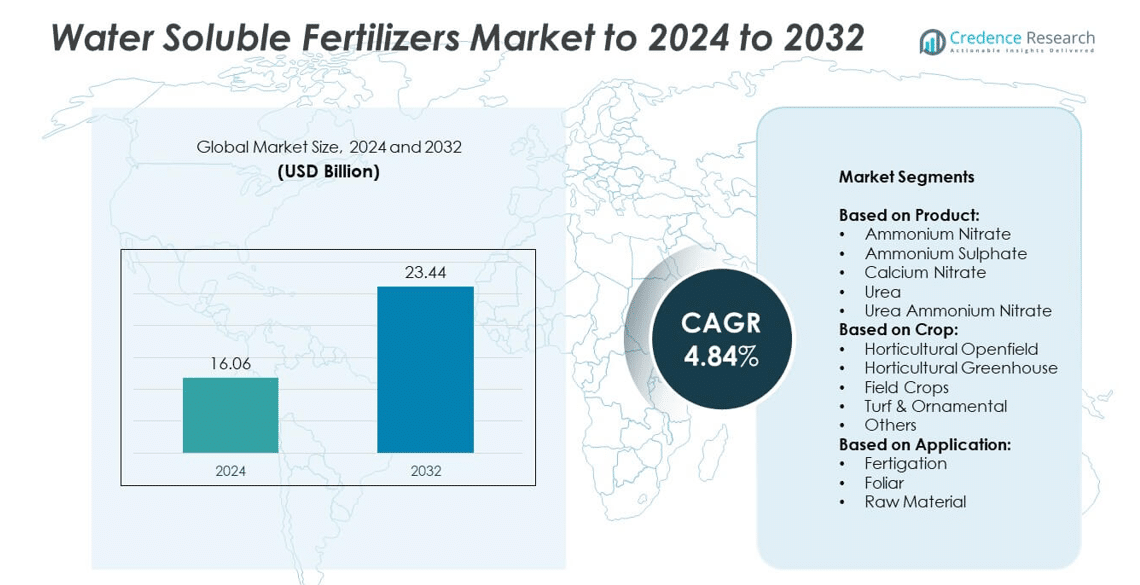
Water Soluble Fertilizers Market size was valued at USD 16.06 Billion in 2024 and is anticipated to reach USD 23.44 Billion by 2032, at a CAGR of 4.84% during the forecast period.
| REPORT ATTRIBUTE | DETAILS |
|---|---|
| Historical Period | 2020-2023 |
| Base Year | 2024 |
| Forecast Period | 2025-2032 |
| Water Soluble Fertilizers Market Size 2024 | USD 16.06 Billion |
| Water Soluble Fertilizers Market, CAGR | 4.84% |
| Water Soluble Fertilizers Market Size 2032 | USD 23.44 Billion |
The water-soluble fertilizers market is driven by major players including Haifa Group, EuroChem, Yara International ASA, Agrium Inc., Potash Corp, The Mosaic Company, K+S AG, ICL, Hebei Monband Water Soluble Fertilizer Co., Compo GmbH & Co. KG, and Coromandel International Limited. These companies focus on advanced formulations, precision nutrient delivery, and sustainable solutions to enhance crop productivity. Asia Pacific leads the market with nearly 33% share in 2024, supported by extensive agricultural activity, rising adoption of fertigation, and government initiatives promoting efficient irrigation. North America and Europe follow, driven by advanced farming practices and strict environmental regulations.
Market Insights
- The water-soluble fertilizers market was valued at USD 16.06 Billion in 2024 and is projected to reach USD 23.44 Billion by 2032, growing at a CAGR of 4.84%.
- Rising demand for high-value horticultural crops, adoption of fertigation systems, and precision farming practices are key drivers boosting market growth globally.
- Trends include increasing greenhouse cultivation, adoption of hydroponics, and development of micronutrient-enriched and specialty formulations to enhance crop yields.
- The market is competitive with leading players focusing on innovation, product portfolio expansion, and global distribution network strengthening to capture emerging opportunities.
- Asia Pacific dominates with 33% share in 2024, followed by North America at 27% and Europe at 24%; calcium nitrate leads the product segment due to its dual nutrient benefits and suitability for high-value crops, while fertigation remains the most widely used application method across all major regions.
Market Segmentation Analysis:
By Product
Calcium nitrate dominated the water-soluble fertilizers market in 2024, holding the largest share due to its dual nutrient composition that provides both calcium and nitrate nitrogen. Its fast solubility and ability to improve soil structure make it ideal for high-value crops. Increasing adoption in horticulture and greenhouse farming is driving demand, as it supports better fruit quality and extended shelf life. Urea and urea ammonium nitrate are growing segments, favored for cost efficiency and easy integration into fertigation systems for large-scale field crop applications.
- For instance, CF Industries reported a total sales volume of approximately 19.130 million product tons in 2023. These sales included products such as urea ammonium nitrate (UAN), granular urea, ammonia, and diesel exhaust fluid (DEF), as well as other nitrogen-based products like ammonium nitrate.
By Crop
Horticultural open-field crops led the market in 2024, accounting for the highest share. These crops include fruits, vegetables, and plantation crops, which require consistent nutrient delivery for quality yield. Rising demand for high-value fruits and vegetables and a shift toward precision farming are driving segment growth. Greenhouse horticulture is expanding quickly due to controlled environment farming, which requires water-soluble fertilizers for precise nutrient management. Turf and ornamental crops contribute steadily, supported by landscaping projects and urban green initiatives.
- For instance, Haifa Group operates through 18 subsidiariesworldwide, with the recent establishment of its India subsidiary in January 2025, and continues to serve horticulture growers.
By Application
Fertigation was the leading application segment in 2024, capturing the largest market share. The method allows accurate nutrient dosing through irrigation systems, resulting in higher yield and reduced fertilizer wastage. Its popularity is growing in regions with water scarcity, as it supports efficient water and nutrient use. Foliar applications follow, preferred for correcting nutrient deficiencies rapidly during critical growth stages. Raw material usage is increasing as fertilizer blenders and manufacturers focus on custom formulations for crop-specific nutrient solutions.
Key Growth Drivers
Rising Demand for High-Value Crops
The rising production of fruits, vegetables, and ornamental crops is a key growth driver for the market. Water-soluble fertilizers offer fast nutrient uptake, enhancing yield and produce quality. Farmers use them to improve shelf life and meet export quality standards. Increasing global consumption of high-value horticultural products, supported by population growth and changing diets, is boosting demand. This trend is especially strong in Asia-Pacific and Europe, where greenhouse and open-field horticulture are expanding rapidly, driving consistent adoption across both small-scale and commercial farms.
- For instance, Nutrien supplied 27 million tonnesof essential fertilizer products (N, P, and K) to customers and served approximately 500,000 grower accounts in 2024.
Adoption of Precision Farming Technologies
The adoption of precision farming practices is a major growth driver for water-soluble fertilizers. Drip irrigation and fertigation systems allow accurate nutrient dosing, improving efficiency and reducing losses. Farmers benefit from higher productivity, better soil management, and reduced water consumption. Government incentives, subsidies, and agritech initiatives encourage farmers to invest in precision systems. This driver is particularly strong in regions with water scarcity, where resource-efficient solutions are necessary. The trend is likely to intensify as farmers seek cost savings and sustainability while meeting rising global food demand.
- For instance, Netafim’s systems irrigated over 10,000,000 hectares and used 150,000,000,000 drippers.
Focus on Sustainable Agriculture
The global shift toward sustainable agriculture acts as a key growth driver, promoting the use of efficient fertilizers. Water-soluble fertilizers reduce nutrient runoff and leaching, protecting soil and water resources. Farmers are under increasing pressure to comply with environmental regulations and adopt eco-friendly practices. Chloride-free and specialty formulations are being developed to minimize ecological impact. Consumer demand for sustainably grown produce is also driving this transition. As a result, adoption rates are growing steadily, especially in developed regions where environmental compliance and certification programs are strictly enforced.
Key Trends & Opportunities
Expansion of Greenhouse Cultivation
Greenhouse farming is a key trend creating growth opportunities for water-soluble fertilizers. Controlled environments demand precise nutrient management, and fertigation is the preferred approach. Countries like the Netherlands, China, and India are rapidly expanding greenhouse infrastructure to meet year-round food demand. This shift increases the use of customized nutrient blends tailored to crop requirements. The rising popularity of hydroponics and vertical farming further drives demand for soluble fertilizers that deliver consistent results in soil-less growing systems.
- For instance, Nature Fresh Farms operates and markets over 2,500 acres of greenhouses.
Development of Specialty Formulations
Innovation in fertilizer formulations presents a strong opportunity for market growth. Manufacturers are focusing on slow-release, micronutrient-enriched, and crop-specific products. These advanced solutions allow farmers to target nutrient deficiencies efficiently, resulting in better yields and quality. Specialty formulations cater to premium crops and high-value horticulture segments, offering growers a higher return on investment. The development of environmentally safe and residue-free solutions also addresses growing regulatory and consumer requirements, opening new opportunities for manufacturers in export-driven agricultural economies.
- For instance, Coromandel introduced 10 new products in Q4 FY24, including new formulations, which contributed to growth in Q1 FY25.
Key Challenges
High Cost of Adoption
The relatively higher cost of water-soluble fertilizers compared to conventional products is a major challenge. The need for infrastructure such as fertigation systems increases overall investment, which can deter small-scale farmers. Price sensitivity in developing regions limits penetration despite the long-term benefits. Manufacturers and governments are working to reduce costs through subsidies and training, but affordability remains a key hurdle to large-scale adoption.
Limited Technical Knowledge
Lack of farmer awareness and technical expertise is another challenge affecting market growth. Many growers are unfamiliar with correct dosing, timing, and application methods for water-soluble fertilizers. Incorrect use can lead to crop damage or nutrient imbalances, reducing confidence in the products. Training programs, demonstrations, and extension services are essential to bridge this knowledge gap and ensure efficient utilization. Without proper guidance, adoption may remain restricted in less-developed agricultural regions.
Regional Analysis
North America
North America accounted for nearly 27% share of the water-soluble fertilizers market in 2024. The region benefits from advanced agricultural infrastructure, high adoption of fertigation, and strong demand for high-value crops such as fruits, vegetables, and ornamentals. The United States leads the market, supported by large-scale greenhouse production and precision farming practices. Government support for sustainable agriculture and efficient irrigation technologies further drives growth. Canada contributes steadily, focusing on horticultural crops and turf applications. Rising awareness about nutrient efficiency and environmental compliance continues to boost the adoption of water-soluble fertilizers across the region.
Europe
Europe held around 24% market share in 2024, driven by strong adoption of specialty fertilizers for horticulture and greenhouse farming. Countries like Spain, the Netherlands, and Italy are key consumers due to extensive greenhouse production and export-oriented agriculture. Stringent EU regulations on nutrient management encourage the use of precise, water-soluble solutions to minimize runoff and environmental impact. The region also focuses on high-value crops such as berries, flowers, and vegetables, which require consistent nutrient supply. Investments in advanced irrigation systems and sustainable practices are further supporting the steady growth of the water-soluble fertilizers market in Europe.
Asia Pacific
Asia Pacific dominated the market with nearly 33% share in 2024, making it the largest regional segment. China and India lead demand, supported by large agricultural bases and growing adoption of drip irrigation and fertigation systems. Rising population and demand for food security are encouraging farmers to increase productivity through efficient fertilizers. Greenhouse farming is expanding rapidly in China and Southeast Asia, driving demand for soluble nutrients. Government subsidies and initiatives to promote water-efficient farming techniques further support market expansion. The region’s diverse crop production, including horticulture and field crops, ensures strong and consistent consumption of these fertilizers.
Latin America
Latin America captured close to 10% share of the water-soluble fertilizers market in 2024. Brazil and Mexico are major contributors, driven by large-scale cultivation of fruits, vegetables, and cash crops. Adoption of fertigation is increasing in response to water scarcity issues and the need for higher yields. The region’s export-driven horticulture sector encourages the use of high-quality fertilizers to meet international standards. Rising investments in irrigation infrastructure and training programs for farmers are improving market penetration. Demand is expected to grow steadily as more growers shift toward precision farming and sustainable crop nutrition solutions.
Middle East & Africa
The Middle East & Africa region held about 6% market share in 2024, supported by increasing investments in irrigation systems and controlled-environment agriculture. Countries like Israel, Saudi Arabia, and South Africa are adopting fertigation to optimize water use in arid conditions. Growing demand for horticultural crops, especially fruits and vegetables, is driving fertilizer usage. Government programs promoting sustainable agriculture and food security are encouraging adoption of efficient nutrient solutions. Although market penetration is relatively low, rising awareness and infrastructure development are expected to create significant opportunities for growth over the forecast period.
Market Segmentations:
By Product:
- Ammonium Nitrate
- Ammonium Sulphate
- Calcium Nitrate
- Urea
- Urea Ammonium Nitrate
By Crop:
- Horticultural Openfield
- Horticultural Greenhouse
- Field Crops
- Turf & Ornamental
- Others
By Application:
- Fertigation
- Foliar
- Raw Material
By Geography:
- North America
- U.S.
- Canada
- Mexico
- Europe
- UK
- France
- Germany
- Italy
- Spain
- Russia
- Belgium
- Netherlands
- Austria
- Sweden
- Poland
- Denmark
- Switzerland
- Rest of Europe
- Asia Pacific
- China
- Japan
- South Korea
- India
- Australia
- Thailand
- Indonesia
- Vietnam
- Malaysia
- Philippines
- Taiwan
- Rest of Asia Pacific
- Latin America
- Brazil
- Argentina
- Peru
- Chile
- Colombia
- Rest of Latin America
- Middle East
- UAE
- KSA
- Israel
- Turkey
- Iran
- Rest of Middle East
- Africa
- Egypt
- Nigeria
- Algeria
- Morocco
- Rest of Africa
Competitive Landscape
The competitive landscape of the water-soluble fertilizers market features key players such as Haifa Group, EuroChem, Yara International ASA, Agrium Inc., Compo GmbH & Co. KG, Potash Corp, Hebei Monband Water Soluble Fertilizer Co., Limited, K+S AG, The Mosaic Company, ICL, Yara, and Coromandel International Limited. The market is characterized by continuous innovation in formulations, focusing on crop-specific and micronutrient-enriched products to improve efficiency and yield. Companies are investing in advanced production technologies and expanding their distribution networks to strengthen global presence. Strategic collaborations, mergers, and acquisitions are commonly used to expand portfolios and penetrate emerging markets. Manufacturers emphasize sustainable solutions, including chloride-free and eco-friendly products, aligning with global environmental regulations. Rising demand for fertigation and precision agriculture solutions drives competition, pushing suppliers to offer value-added services such as agronomic support and digital advisory tools. This dynamic environment fosters product differentiation and encourages ongoing research and development efforts.
Key Player Analysis
- Haifa Group
- EuroChem
- Yara International ASA
- Agrium Inc.
- Compo GmbH & Co. KG
- Potash Corp
- Hebei Monband Water Soluble Fertilizer Co., Limited
- K+S AG
- The Mosaic Company
- ICL
- Yara
- Coromandel International Limited
Recent Developments
- In 2025, Haifa Group launched its 18th international subsidiary in India. This move was designed to improve the availability of Haifa's high-quality solutions in the region and better adapt them to local agricultural challenges.
- In 2023, Yara opened its first water-soluble fertilizer factory in China. The new facility was designed to help local farmers improve agricultural productivity and profitability, supporting Yara China's goal of providing sustainable solutions in the region.
- In 2023, ICL launched a new line of advanced foliar and fertigation treatments in North America under its Nova brand. This line included specialized products like Nova FINISH, Nova PULSE, Nova ELEVATE, and Nova FLOW, formulated for maximum solubility and compatibility with most crop protectants.
Report Coverage
The research report offers an in-depth analysis based on Product, Crop, Application and Geography. It details leading market players, providing an overview of their business, product offerings, investments, revenue streams, and key applications. Additionally, the report includes insights into the competitive environment, SWOT analysis, current market trends, as well as the primary drivers and constraints. Furthermore, it discusses various factors that have driven market expansion in recent years. The report also explores market dynamics, regulatory scenarios, and technological advancements that are shaping the industry. It assesses the impact of external factors and global economic changes on market growth. Lastly, it provides strategic recommendations for new entrants and established companies to navigate the complexities of the market.
Future Outlook
- The market is expected to grow steadily, driven by increasing adoption of fertigation systems.
- Demand for specialty and customized nutrient formulations will rise across horticulture and greenhouse farming.
- Asia Pacific will remain the largest market, supported by growing agricultural modernization and population growth.
- North America and Europe will see strong adoption due to sustainability initiatives and regulatory compliance.
- Technological innovations in slow-release and micronutrient-enriched fertilizers will gain traction.
- Expansion of greenhouse farming and hydroponic systems will fuel consistent product demand.
- Government programs promoting water efficiency will support wider adoption among farmers.
- Digital agriculture and precision farming practices will improve fertilizer use efficiency.
- Growing awareness of soil health and nutrient balance will drive preference for water-soluble solutions.
- Market players will invest in R&D to develop eco-friendly and chloride-free formulations.

Request a Free Sample
Fill in your details and we'll send you a free sample report.
- Sample data tables & charts
- Research methodology
Market Dynamics
Adoption of Fertigation and Precision Farming
The increasing use of fertigation and precision farming technologies enables accurate nutrient dosing and efficient water use, leading to higher yields and reduced fertilizer wastage. This is particularly important in regions facing water scarcity and is driving the adoption of water-soluble fertilizers globally.
Expansion of Greenhouse and Controlled Environment Agriculture
The rapid growth of greenhouse cultivation and hydroponic systems requires precise and consistent nutrient delivery, which water-soluble fertilizers provide. Countries investing in greenhouse infrastructure are fueling demand for these specialized fertilizers.
Rising Demand for High-Value Horticultural Crops
Growing global consumption of fruits, vegetables, and ornamental crops, especially in Asia Pacific and Europe, is increasing the need for fast-acting, high-efficiency fertilizers that improve crop quality and shelf life.
Focus on Sustainable and Environmentally Friendly Solutions
Stricter environmental regulations and consumer demand for sustainably grown produce are pushing farmers and suppliers toward water-soluble fertilizers, which reduce nutrient runoff and support eco-friendly agricultural practices.
Innovation in Specialty and Micronutrient-Enriched Formulations
Manufacturers are developing advanced, crop-specific, and micronutrient-enriched water-soluble fertilizers to address specific nutrient deficiencies and improve yields, creating new opportunities and driving market growth.
Need a Custom Version of This Report?
Tailor the scope, geography, or segments to your exact requirements.
- Custom geography or segment scope
- Direct access to our analyst team
Frequently Asked Questions
What is the current market size for Water Soluble Fertilizers Market, and what is its projected size in 2032?
At what Compound Annual Growth Rate is the Water Soluble Fertilizers Market projected to grow between 2025 and 2032?
Which Water Soluble Fertilizers Market segment held the largest share in 2024?
What are the primary factors fueling the growth of the Water Soluble Fertilizers Market?
Which region commanded the largest share of the Water Soluble Fertilizers Market in 2024?
Table of Content
Chapter 1 Market Segmentation
- 1.1 Segmentation Framework
- 1.1.1 Product and Service Classification
- 1.1.2 Application and End-Use Classification
- 1.1.3 Technology and Solution Classification
- 1.1.4 Customer and Distribution Channel Classification
- 1.1.5 Geographic Segmentation
- 1.1.6 Market Segment Definitions and Boundaries
- 1.2 By Crop
- 1.2.1 Horticultural Openfield
- 1.2.2 Horticultural Greenhouse
- 1.2.3 Field Crops
- 1.2.4 Turf & Ornamental
- 1.2.5 Others
- 1.3 By Product
- 1.3.1 Ammonium Nitrate
- 1.3.2 Ammonium Sulphate
- 1.3.3 Calcium Nitrate
- 1.3.4 Urea
- 1.3.5 Urea Ammonium Nitrate
- 1.4 By Application
- 1.4.1 Fertigation
- 1.4.2 Foliar
- 1.4.3 Raw Material
Chapter 2 Introduction
- 2.1 Report Objectives and Scope
- 2.2 Product Definition and Industry Terminology
- 2.3 Market Inclusions and Exclusions
- 2.4 Research Process
- 2.4.1 Primary Research and Expert Interviews
- 2.4.2 Secondary Research and Source Review
- 2.4.3 Top-Down and Bottom-Up Estimation
- 2.4.4 Data Triangulation and Verification
- 2.5 Market Size Measurement Basis
- 2.5.1 2024: USD 16.06 Billion → 2032: USD 23.44 Billion
- 2.6 Historical and Forecast Reference Periods
- 2.6.1 Base Year: 2024
- 2.6.2 Forecast Period: 2024-2032
- 2.7 Research Assumptions and Limitations
Chapter 3 Executive Summary
- 3.1 Market Snapshot and Key Findings
- 3.2 Base-Year Market Size, 2024
- 3.3 Forecast Market Size, 2032
- 3.4 Revenue and Volume Growth Outlook
- 3.5 Key Demand and Supply Indicators
- 3.6 Leading Market Segments
- 3.7 Fastest-Growing Market Opportunities
- 3.8 Regional Performance Highlights
- 3.9 Technology and Industry Transformation
- 3.10 Competitive Landscape Summary
- 3.11 Analyst View and Strategic Implications
Chapter 4 Global Water Soluble Fertilizers Market Trends and Developments
- 4.1 Historical Industry Development
- 4.2 Recent Market Trends and Developments
- 4.3 Demand and Customer Behavior Trends
- 4.4 Technology and Product Innovation
- 4.5 Artificial Intelligence, Automation and Digitalization
- 4.6 Local Manufacturing and Supply Chain Realignment
- 4.7 Industry Partnerships, Mergers and Acquisitions
- 4.8 Sustainability and Circular Economy Developments
- 4.9 Government and Private Sector Investment Trends
- 4.10 Emerging Business Models and Commercialization
- 4.11 Industry Developments and Announcements
Chapter 5 Global Water Soluble Fertilizers Market Production, Supply and Demand Analysis
- 5.1 Demand Trend and Consumption Analysis
- 5.2 Demand Forecast, 2024-2032
- 5.3 Production and Output Trend
- 5.4 Production and Output Forecast, 2024-2032
- 5.5 Installed Capacity and Capacity Utilization
- 5.6 Company-Wise Production Plants and Statistics
- 5.6.1 Installed Production Capacity
- 5.6.2 Actual Production
- 5.6.3 Planned Capacity and Expansion Targets
- 5.7 Supply Chain Structure and Procurement Trends
- 5.8 Supply-Demand Gap and Bottlenecks
- 5.9 Import Dependence and Sourcing Structure
- 5.10 Contract Manufacturing and Outsourcing
- 5.11 Regional Supply and Demand Concentration
Chapter 6 Global Water Soluble Fertilizers Market Pricing Analysis
- 6.1 Pricing Structure and Measurement
- 6.2 Historical Pricing Trends
- 6.3 Pricing Outlook, 2024-2032
- 6.4 Average Selling Price and Unit Economics
- 6.5 Pricing by Product and Market Segment
- 6.6 Geographic Pricing Differences
- 6.7 Key Input, Energy, Labor and Logistics Costs
- 6.8 Contract Pricing and Purchasing Models
- 6.9 Pricing Sensitivity and Competitive Positioning
- 6.10 Price, Margin and Profitability Implications
Chapter 7 Global Water Soluble Fertilizers Market Dynamics
- 7.1 Market Growth Drivers
- 7.1.1 Demand-Side Drivers
- 7.1.2 Technology and Innovation Drivers
- 7.1.3 Infrastructure and Investment Drivers
- 7.1.4 Regulatory and Policy Drivers
- 7.2 Market Restraints
- 7.2.1 Cost and Affordability Constraints
- 7.2.2 Technology and Adoption Barriers
- 7.2.3 Supply Chain and Operational Constraints
- 7.3 Market Challenges
- 7.3.1 Competitive Pressure and Margin Erosion
- 7.3.2 Skills, Infrastructure and Implementation Gaps
- 7.4 Emerging Market Opportunities
- 7.5 Market Dynamics Impact and Time-Horizon Assessment
Chapter 8 Global Water Soluble Fertilizers Value Chain Analysis
- 8.1 Industry Value Chain Overview
- 8.2 Upstream Suppliers and Critical Inputs
- 8.3 Technology and Component Providers
- 8.4 Manufacturing or Service Delivery
- 8.5 Distribution, Channel Partners and Integrators
- 8.6 Downstream Applications and End Users
- 8.7 Value Addition and Profit Pools
- 8.8 Vertical Integration and Outsourcing
- 8.9 Supplier Concentration and Risk
- 8.10 Supply Chain Localization and Resilience
Chapter 9 Global Water Soluble Fertilizers Market Regulations and Policies
- 9.1 Relevant Laws, Standards and Compliance Frameworks
- 9.2 Product, Service, Safety and Quality Requirements
- 9.3 Government Policies, Incentives and Subsidies
- 9.4 Imports, Exports and Trade Barriers
- 9.5 Public Procurement and Local Content Requirements
- 9.6 Environmental and Sustainability Compliance
- 9.7 Upcoming Policy Changes and Market Implications
Chapter 10 Global Water Soluble Fertilizers Market Hotspots and Opportunities
- 10.1 Market Opportunity Mapping and Growth Hotspots
- 10.2 High-Growth Applications and Customer Groups
- 10.3 Underserved Markets and White-Space Opportunities
- 10.4 Emerging Technology and Product Opportunities
- 10.5 New Capacity and Investment Hotspots
- 10.6 Market Entry and Expansion Opportunities
- 10.7 Distribution and Partnership Opportunities
- 10.8 Near-Term and Long-Term Commercial Potential
- 10.9 Opportunity Attractiveness and Execution Risks
Chapter 11 Global Water Soluble Fertilizers Market Outlook, 2024-2032
- 11.1 Market Size and Analysis
- 11.1.1 Revenue (Market Measurement: 2024: USD 16.06 Billion → 2032: USD 23.44 Billion)
- 11.1.2 Market Volume and Quantity Sold
- 11.1.3 Historical Market Size
- 11.1.4 Base-Year Market Size, 2024
- 11.2 Market Forecast, 2024-2032
- 11.2.1 Revenue Forecast to 2032
- 11.2.2 Volume Forecast to 2032
- 11.2.3 CAGR and Year-on-Year Growth
- 11.2.4 Incremental Revenue Opportunity
- 11.3 Forecast Assumptions and Scenario Analysis
- 11.3.1 Base-Case Forecast
- 11.3.2 Optimistic and Conservative Scenarios
- 11.3.3 Technology, Pricing and Policy Sensitivities
- 11.4 Market Attractiveness and Growth Outlook
Chapter 12 Global Water Soluble Fertilizers Market Segmentation and Outlook
- 12.1 Segmentation Summary and Market Shares, 2024
- 12.2 Largest and Fastest-Growing Segments
- 12.3 By Crop - Market Size and Forecast, 2024-2032
- 12.3.1 Segment Definition and Scope
- 12.3.2 Historical Market Size
- 12.3.3 Revenue Forecast, 2024-2032
- 12.3.4 Volume Forecast, 2024-2032
- 12.3.5 Base-Year Market Share, 2024
- 12.3.6 Segment CAGR and Growth Drivers
- 12.3.7 Subsegment Market Size and Forecast
- 12.3.7.1 Horticultural Openfield
- 12.3.7.2 Horticultural Greenhouse
- 12.3.7.3 Field Crops
- 12.3.7.4 Turf & Ornamental
- 12.3.7.5 Others
- 12.3.8 Subsegment Pricing and Adoption Trends
- 12.3.9 Leading Suppliers and Competition
- 12.3.10 Regional Demand and Opportunities
- 12.4 By Product - Market Size and Forecast, 2024-2032
- 12.4.1 Segment Definition and Scope
- 12.4.2 Historical Market Size
- 12.4.3 Revenue Forecast, 2024-2032
- 12.4.4 Volume Forecast, 2024-2032
- 12.4.5 Base-Year Market Share, 2024
- 12.4.6 Segment CAGR and Growth Drivers
- 12.4.7 Subsegment Market Size and Forecast
- 12.4.7.1 Ammonium Nitrate
- 12.4.7.2 Ammonium Sulphate
- 12.4.7.3 Calcium Nitrate
- 12.4.7.4 Urea
- 12.4.7.5 Urea Ammonium Nitrate
- 12.4.8 Subsegment Pricing and Adoption Trends
- 12.4.9 Leading Suppliers and Competition
- 12.4.10 Regional Demand and Opportunities
- 12.5 By Application - Market Size and Forecast, 2024-2032
- 12.5.1 Segment Definition and Scope
- 12.5.2 Historical Market Size
- 12.5.3 Revenue Forecast, 2024-2032
- 12.5.4 Volume Forecast, 2024-2032
- 12.5.5 Base-Year Market Share, 2024
- 12.5.6 Segment CAGR and Growth Drivers
- 12.5.7 Subsegment Market Size and Forecast
- 12.5.7.1 Fertigation
- 12.5.7.2 Foliar
- 12.5.7.3 Raw Material
- 12.5.8 Subsegment Pricing and Adoption Trends
- 12.5.9 Leading Suppliers and Competition
- 12.5.10 Regional Demand and Opportunities
- 12.6 Segment Growth Comparison
- 12.7 Segment Attractiveness and Priority Matrix
Chapter 13 Global Water Soluble Fertilizers End-Use and Application Market Outlook
- 13.1 End-Use Industry and Customer Demand Structure
- 13.2 Leading Applications and Customer Groups
- 13.3 End-Use Market Size, Share and Forecast
- 13.4 Major End-Use Industry Deep Dives
- 13.4.1 Customer Requirements and Use Cases
- 13.4.2 Demand and Replacement Cycles
- 13.4.3 Technical and Regulatory Considerations
- 13.4.4 Purchasing and Procurement Models
- 13.4.5 Leading Vendors and Distribution Channels
- 13.4.6 Forecast and Commercial Opportunities
- 13.5 Emerging Applications and Cross-Segment Demand
- 13.6 End-Use Industry Investment Priorities
Chapter 14 Global Water Soluble Fertilizers Geographic Market Outlook, 2024-2032
- 14.1 Regional Market Size and Share, 2024
- 14.2 Regional Market Forecast, 2024-2032
- 14.3 Regional Pricing, Production and Demand Differences
- 14.4 North America
- 14.4.1 United States
- 14.4.2 Canada
- 14.4.3 Mexico
- 14.5 Europe
- 14.5.1 Germany
- 14.5.2 France
- 14.5.3 Italy
- 14.5.4 United Kingdom
- 14.5.5 Spain
- 14.5.6 Poland
- 14.5.7 Russia
- 14.5.8 Netherlands
- 14.5.9 Belgium
- 14.5.10 Sweden
- 14.5.11 Denmark
- 14.5.12 Norway
- 14.5.13 Rest of Europe
- 14.6 Asia Pacific
- 14.6.1 China
- 14.6.2 India
- 14.6.3 Japan
- 14.6.4 South Korea
- 14.6.5 Thailand
- 14.6.6 Indonesia
- 14.6.7 Vietnam
- 14.6.8 Malaysia
- 14.6.9 Australia
- 14.6.10 Rest of Asia Pacific
- 14.7 Latin America
- 14.7.1 Brazil
- 14.7.2 Argentina
- 14.7.3 Colombia
- 14.7.4 Chile
- 14.7.5 Rest of Latin America
- 14.8 Middle East
- 14.8.1 Saudi Arabia
- 14.8.2 United Arab Emirates
- 14.8.3 Turkey
- 14.8.4 Israel
- 14.8.5 Iran
- 14.8.6 Rest of the Middle East
- 14.9 Africa
- 14.9.1 South Africa
- 14.9.2 Egypt
- 14.9.3 Nigeria
- 14.9.4 Morocco
- 14.9.5 Rest of Africa
- 14.10 Regional Investment, Policy and Supply Chain Differences
- 14.11 Regional Competitive Landscape
- 14.12 Geographic Growth Hotspots
Chapter 15 Global Water Soluble Fertilizers Technology, Innovation and Sustainability Outlook
- 15.1 Technology Landscape and Maturity
- 15.2 Product, Process and Service Innovation
- 15.3 AI, Automation and Digital Tools in the Industry
- 15.4 Technology Adoption and Performance Benchmarking
- 15.5 Innovation Pipeline and R&D Investment
- 15.6 Patent and Intellectual Property Trends
- 15.7 Energy Efficiency and Resource Management
- 15.8 Sustainability, Recycling and Circularity
- 15.9 Technology Roadmap, 2024-2032
- 15.10 Risks of Obsolescence and Technology Substitution
Chapter 16 Global Water Soluble Fertilizers Market Key Strategic Imperatives
- 16.1 Growth and Market Entry Priorities
- 16.2 High-Return Products and Segments
- 16.3 Pricing, Profitability and Cost Optimization
- 16.4 Technology Investment and Product Differentiation
- 16.5 Supply Chain Localization and Resilience
- 16.6 Distribution and Customer Acquisition
- 16.7 Partnership, Acquisition and Capacity Strategy
- 16.8 Regional Expansion Priorities
- 16.9 Short-, Medium- and Long-Term Actions
Chapter 17 Competition Outlook
- 17.1 Industry Competition Characteristics
- 17.2 Market Structure and Concentration
- 17.3 Market Share and Competitive Positioning, 2024
- 17.4 Company-Wise Revenue and Product Benchmarking
- 17.5 Production and Service Capacity Benchmarking
- 17.6 Technology, Pricing and Differentiation
- 17.7 Regional Footprint and Distribution Strength
- 17.8 Mergers, Acquisitions and Strategic Alliances
- 17.9 New Entrants and Competitive Threats
- 17.10 Porter's Five Forces and Industry Attractiveness
- 17.11 Competitive Outlook, 2024-2032
Chapter 18 Company Profiles
- 18.1 Company Coverage and Selection Criteria
- 18.2 Haifa Group
- 18.2.1 Business Description
- 18.2.2 Company Ownership and Geographic Presence
- 18.2.3 Product and Service Portfolio
- 18.2.4 Manufacturing and Operating Footprint
- 18.2.5 Production Capacity and Expansion Plans
- 18.2.6 Financial Performance and Investment
- 18.2.7 Market Share and Competitive Position
- 18.2.8 Technology and Innovation Capabilities
- 18.2.9 Strategic Alliances or Partnerships
- 18.2.10 Recent Developments
- 18.2.11 Growth Strategy and Outlook
- 18.3 EuroChem
- 18.4 Yara International ASA
- 18.5 Agrium Inc.
- 18.6 Potash Corp
- 18.7 The Mosaic Company
- 18.8 K+S AG
- 18.9 ICL
- 18.10 Hebei Monband Water Soluble Fertilizer Co.
- 18.11 Coromandel International Limited
- 18.12 Other Relevant Market Participants
Note: Every listed company is profiled on the structure shown under the first company. The company list is preliminary and may change based on research findings, market developments, data availability and client requirements.
Chapter 19 Disclaimer
- 19.1 Research and Forecast Disclaimer
- 19.2 Data Source and Estimation Limitations
Note: The depth of individual sections depends on data availability for this market. Volume, capacity, trade and other unit-based metrics are included where applicable.