
Market Overview
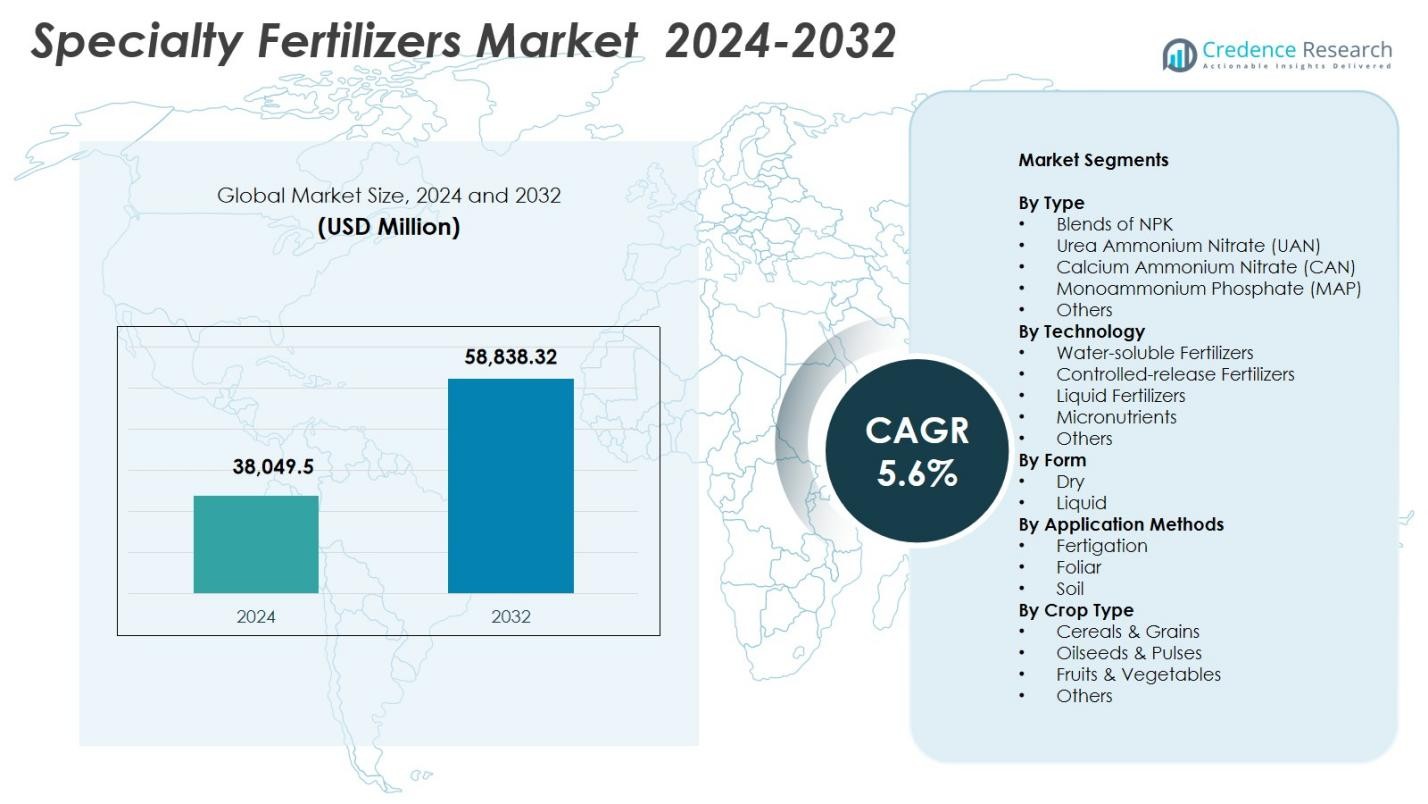
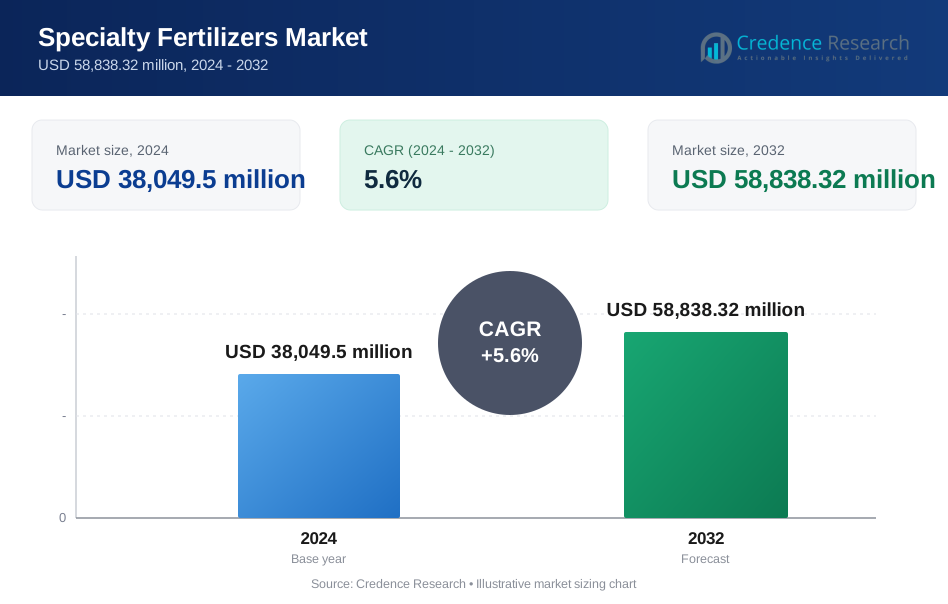
Specialty Fertilizers Market size was valued USD 38,049.5 Million in 2024 and is anticipated to reach USD 58,838.32 Million by 2032, at a CAGR of 5.6% during the forecast period.
| REPORT ATTRIBUTE | DETAILS |
|---|---|
| Historical Period | 2020-2023 |
| Base Year | 2024 |
| Forecast Period | 2025-2032 |
| Specialty Fertilizers Market Size 2024 | USD 38,049.5 Million |
| Specialty Fertilizers Market, CAGR | 5.6% |
| Specialty Fertilizers Market Size 2032 | USD 58,838.32 Million |
Specialty Fertilizers Market features leading players such as Nutrien Ltd., Yara, ICL, The Mosaic Company, CF Industries Holdings Inc., Nufarm, SQM SA, OCP Group, Kingenta, and K+S Aktiengesellschaft, each advancing high-efficiency nutrient technologies to meet evolving agricultural needs. These companies focus on expanding controlled-release, water-soluble, and micronutrient-rich formulations that enhance crop productivity and sustainability. Regionally, Asia-Pacific leads the Specialty Fertilizers Market with a 36.8% share, driven by rapid agricultural expansion, rising adoption of precision farming, and strong government support for efficient nutrient management, positioning the region at the forefront of market growth.
Market Insights
- The Specialty Fertilizers Market reached USD 38,049.5 million in 2024 and will grow at a CAGR of 5.6% through 2032, driven by rising demand for efficient nutrient solutions.
- Strong market drivers include expansion of high-value crops, increasing adoption of precision farming, and rising use of water-soluble and controlled-release fertilizers, which enhance nutrient-use efficiency.
- Key trends highlight rapid integration of digital tools, growing demand for micronutrient-enriched formulations, and rising preference for dry fertilizers, which held a 62.7% share in 2024.
- Major players such as Nutrien, Yara, ICL, Mosaic, and OCP Group continue investing in sustainable technologies and customized nutrient blends, strengthening their market presence across global agriculture.
- Asia-Pacific led the market with a 36.8% share in 2024, followed by Europe at 30.1% and North America at 27.4%, reflecting strong adoption of advanced fertilization practices across key agricultural regions.
Market Segmentation Analysis:
By Type:
The Specialty Fertilizers Market by type is led by Blends of NPK, which accounted for 34.2% share in 2024, driven by their balanced nutrient composition and broad applicability across diverse crops. Their ability to enhance nutrient-use efficiency and support precision farming practices strengthens adoption. Urea Ammonium Nitrate (UAN) and Calcium Ammonium Nitrate (CAN) also show strong utilization in high-yield agriculture due to rapid nutrient availability, while Monoammonium Phosphate (MAP) remains essential for phosphorus-intensive crops. The increasing demand for customized nutrient solutions continues to propel the growth of blended NPK formulations globally.
- For instance, Haifa Group's Turbo-K™ granular NPK complex fertilizer, based on potassium nitrate, supplies macro- and micronutrients in uniform granules ideal for open fields, greenhouses, orchards, and turf to maximize plant yield and vigor.
By Technology:
Within the technology segment, Water-soluble Fertilizers dominate with 41.6% market share in 2024, supported by their compatibility with drip irrigation, fertigation, and precision application systems. Their high nutrient uptake efficiency and minimal wastage drive adoption in horticulture, greenhouse farming, and high-value crops. Controlled-release fertilizers also gain momentum due to consistent nutrient release and reduced leaching. Liquid fertilizers and micronutrients support targeted nutrition for specific soil deficiencies. The shift toward sustainable input management and efficient resource utilization continues to reinforce the leadership of water-soluble technologies.
- For instance, ICL’s Agrolution and Solinure water-soluble NPK lines are formulated for fertigation in fruit and vegetable crops, using high-purity raw materials to prevent deposit build-up and dripper clogging in drip and greenhouse systems.
By Form:
In terms of form, the Dry specialty fertilizers segment held a 62.7% share in 2024, driven by longer shelf life, ease of storage, and broad suitability for large-scale field applications. Dry formulations such as granules and prills offer controlled application rates and cost-efficient distribution for commercial farming. Liquid fertilizers maintain steady growth owing to their rapid plant uptake and strong integration in fertigation systems. Increasing mechanization in agriculture and the need for scalable nutrient delivery continue to strengthen the dominance of dry-form specialty fertilizers across major markets.
Key Growth Drivers
Rising Demand for High-Efficiency Fertilization
The Specialty Fertilizers Market grows significantly due to increasing adoption of high-efficiency fertilization practices that enhance nutrient-use efficiency and crop productivity. Farmers are shifting from conventional fertilizers to targeted inputs such as water-soluble, controlled-release, and micronutrient formulations to minimize nutrient losses and maximize yield per hectare. Precision agriculture, fertigation, and sensor-based nutrient monitoring further strengthen demand. As global food requirements intensify and arable land declines, specialty fertilizers play a critical role in ensuring sustainable, high-output farming systems.
- For instance, ICL Growing Solutions supplies fully water-soluble fertigation fertilizers under brands such as Agrolution, Solinure, NovaNPK, Novacid, and Fertiflow, formulated for specific crops, water qualities, and greenhouse or open-field conditions to increase yield while reducing nutrient leaching and volatilization.
Expansion of High-Value and Horticultural Crops
The rapid expansion of high-value crops including fruits, vegetables, ornamentals, and greenhouse produce remains a strong driver for the Specialty Fertilizers Market. These crops require precise nutrient management and consistent feeding, creating strong demand for liquid fertilizers, micronutrients, and water-soluble blends. Rising adoption of protected cultivation methods such as hydroponics, vertical farming, and greenhouse systems accelerates consumption of premium nutrient formulations. Growing consumer preference for quality produce with enhanced appearance, shelf life, and nutritional value further supports the shift toward specialty fertilization solutions.
- For instance, General Hydroponics’ Flora Series three‑part liquid nutrient system, first formulated in 1976 and widely used in commercial hydroponics, provides complete primary, secondary, and micronutrients for fruiting and leafy crops, and has even been adopted in controlled-environment research such as NASA’s space hydroponic experiments to ensure reliable crop quality.
Government Support for Sustainable Agriculture
Government incentives promoting sustainable agricultural practices strongly support market growth. Policies focusing on reducing environmental impact, improving soil health, and optimizing fertilizer usage encourage adoption of controlled-release and specialty nutrient formulations. Subsidies for drip irrigation, fertigation equipment, and precision farming tools drive uptake of water-soluble fertilizers. Regulatory pressures to minimize nitrogen loss, runoff, and greenhouse gas emissions also accelerate the transition to efficient specialty fertilizers. These supportive frameworks foster widespread modernization of nutrient management across developing and developed agricultural economies.
Key Trends & Opportunities
Integration of Digital and Precision Farming Technologies
The integration of digital agriculture, including GPS-based nutrient mapping, IoT-enabled soil sensors, and satellite crop monitoring, creates new opportunities for specialty fertilizer optimization. Data-driven insights enable farmers to apply nutrients with greater accuracy, aligning perfectly with high-efficiency products such as micronutrients, controlled-release granules, and liquid formulations. This digital transformation not only increases adoption of premium fertilizers but also enhances traceability and performance analytics. As precision agriculture expands globally, specialty fertilizers aligned with intelligent application systems gain strong market momentum.
- For instance, John Deere’s See & Spray Ultimate uses boom-mounted cameras and onboard processors to distinguish weeds from crops and apply inputs only where needed, reducing spray volume by up to about two-thirds in corn, soybeans, and cotton compared with broadcast treatment.
Growth of Water-Soluble and Controlled-Release Fertilizers
Water-soluble and controlled-release fertilizers present major opportunities as modern farming systems demand uniform nutrient delivery, reduced wastage, and compatibility with automated irrigation. These technologies support sustainable nutrient management by providing consistent feeding to crops and reducing environmental losses. Their strong adoption in horticulture, greenhouse farming, and high-value export crops further strengthens market prospects. As global agriculture shifts toward resource-efficient methods, manufacturers introducing advanced formulations with improved solubility and nutrient-release characteristics gain competitive advantage.
- For instance, Haifa Group’s fully water-soluble Nutrigation fertilizers, designed for drip and sprinkler systems, have been used in fertigation programs that improve nutrient-use efficiency and yield by delivering dissolved NPK directly to the active root zone in greenhouse and high-value horticultural crops.
Key Challenges
High Production Costs and Limited Affordability
Specialty fertilizers face growth constraints due to their higher production costs compared to conventional fertilizers. Advanced technologies such as coating materials, controlled-release polymers, and micronutrient chelation significantly increase final product prices, limiting adoption among small and medium-scale farmers, especially in developing regions. Price sensitivity in cost-driven agricultural economies often slows transition toward premium fertilizers. Manufacturers must balance affordability with performance, while governments may need to expand subsidies to encourage broader adoption of high-efficiency inputs.
Environmental and Regulatory Compliance Pressure
Increasingly stringent environmental regulations challenge the Specialty Fertilizers Market as authorities restrict nutrient runoff, leaching, and greenhouse gas emissions. Manufacturers must comply with evolving standards related to nutrient efficiency, biodegradability of coatings, and permissible application rates. These regulatory demands raise R&D and certification costs, complicating market entry for new formulations. Moreover, improper usage by farmers can still cause ecological risks, prompting stricter monitoring and enforcement. Ensuring compliance while maintaining cost-effectiveness remains a significant challenge for industry players.
Regional Analysis
North America
North America holds a 27.4% share of the Specialty Fertilizers Market in 2024, driven by strong adoption of precision agriculture, fertigation systems, and high-value crop cultivation. The region benefits from advanced farming infrastructure, widespread use of controlled-release fertilizers, and strong demand for water-soluble formulations in horticulture and greenhouse production. Regulatory focus on reducing nutrient losses and improving soil health further accelerates the shift toward specialty products. The United States leads consumption due to large-scale commercial farming and rapid integration of digital nutrient management tools, solidifying the region’s dominant role in specialty fertilizer adoption.
Europe
Europe accounted for a 30.1% market share in 2024, supported by stringent environmental regulations promoting sustainable fertilization practices. The region’s emphasis on reducing nitrogen runoff, enhancing nutrient-use efficiency, and meeting carbon-reduction targets drives demand for controlled-release, micronutrient, and water-soluble fertilizers. High-value crop segments such as fruits, vegetables, and viticulture further strengthen market uptake. Countries like Germany, France, Spain, and Italy lead consumption due to advanced agricultural systems and strong adoption of precision farming technologies. Government-backed initiatives supporting eco-friendly products reinforce Europe’s leadership in specialty fertilizer innovation and sustainable nutrient management.
Asia-Pacific
Asia-Pacific dominates the Specialty Fertilizers Market with a 36.8% share in 2024, driven by expanding agricultural activities, rising adoption of high-efficiency fertilizers, and rapid growth of horticulture and greenhouse farming. Countries like China, India, Japan, and Australia show strong transitions toward water-soluble and liquid fertilizers to support high-yield crop production. Government subsidies promoting drip irrigation, micronutrient fortification, and balanced nutrient management further strengthen demand. Increasing population pressure and shrinking arable land compel farmers to adopt productivity-enhancing specialty formulations, making Asia-Pacific the fastest-growing hub for advanced fertilization technologies.
Latin America
Latin America captured a 7.9% market share in 2024, supported by expanding commercial agriculture and growing demand for premium fertilizers across crops such as sugarcane, soybeans, coffee, and fruits. Brazil and Argentina drive regional consumption due to large-scale farming operations and rising adoption of fertigation and controlled-release products. The region’s focus on improving soil fertility and nutrient efficiency in degraded lands strengthens reliance on specialty fertilizers. Investments in modern irrigation systems and export-oriented horticulture further enhance market growth, positioning Latin America as an emerging high-potential region for advanced nutrient solutions.
Middle East & Africa
The Middle East & Africa region held a 4.8% share in 2024, driven by increasing adoption of water-soluble and liquid fertilizers to support agriculture in arid and semi-arid climates. Countries such as Saudi Arabia, the UAE, South Africa, and Egypt accelerate uptake through investments in controlled irrigation, greenhouse farming, and high-value horticulture. Soil nutrient deficiencies and water scarcity challenge traditional farming, creating strong demand for efficient specialty formulations. Government programs promoting food security and modernization of agricultural practices contribute to steady market expansion across the region.
Market Segmentations:
By Type
- Blends of NPK
- Urea Ammonium Nitrate (UAN)
- Calcium Ammonium Nitrate (CAN)
- Monoammonium Phosphate (MAP)
- Others
By Technology
- Water-soluble Fertilizers
- Controlled-release Fertilizers
- Liquid Fertilizers
- Micronutrients
- Others
By Form
- Dry
- Liquid
By Application Methods
- Fertigation
- Foliar
- Soil
Ву Сгор Туре
- Cereals & Grains
- Oilseeds & Pulses
- Fruits & Vegetables
- Others
By Geography
- North America
- U.S.
- Canada
- Mexico
- Europe
- Germany
- France
- U.K.
- Italy
- Spain
- Rest of Europe
- Asia Pacific
- China
- Japan
- India
- South Korea
- South-east Asia
- Rest of Asia Pacific
- Latin America
- Brazil
- Argentina
- Rest of Latin America
- Middle East & Africa
- GCC Countries
- South Africa
- Rest of the Middle East and Africa
Competitive Landscape
Competitive landscape in the Specialty Fertilizers Market features leading players such as Nutrien Ltd., Yara, ICL, The Mosaic Company, CF Industries Holdings Inc., Nufarm, SQM SA, OCP Group, Kingenta, and K+S Aktiengesellschaft, all of which focus on expanding advanced and high-efficiency nutrient solutions. These companies strengthen their market positions through innovations in controlled-release technologies, water-soluble formulations, and micronutrient-enhanced blends that support precision agriculture. Strategic initiatives including capacity expansions, distribution network strengthening, and partnerships with agritech firms enable broader access to premium fertilizer solutions. Sustainability remains a central competitive theme, with major players investing in low-emission manufacturing, nutrient-efficient coatings, and environmentally safe formulations. Additionally, rising demand for customized crop-specific blends pushes manufacturers to enhance R&D capabilities and collaborate closely with growers and input dealers. Competitive momentum is further shaped by global food security concerns, regulatory shifts toward nutrient-efficient products, and rapid adoption of digital farming platforms, which collectively create a dynamic landscape for innovation-driven companies.
Key Player Analysis
- Kingenta
- Nutrien Ltd.
- Nufarm
- The Mosaic Company
- SQM SA
- Yara
- CF Industries and Holdings, Inc.
- ICL
- OCP Group
- K+S Aktiengesellschaft
Recent Developments
- In December 2025, Yara International ASA entered advanced negotiations with Air Products for a partnership on low-emission ammonia projects in the U.S. and Saudi Arabia a move that could strengthen Yara’s specialty fertilizer production network.
- In April 2025, Pursell Agri-Tech and Wastech Group entered a partnership to establish a controlled-release fertilizer production facility in Malaysia to serve Southeast Asian growers with higher-efficiency specialty nutrients.
- In December 2023, Yara International expanded its specialty and organic fertilizer portfolio through the acquisition of Italy-based Agribios Italiana, strengthening its position in value-added nutrient solutions for horticulture and specialty crops.
- In November 2023, Nutrien Ltd. formed a partnership with a startup to develop a sustainable controlled-release nitrogen fertilizer for large-acre crop production, demonstrating innovation in specialty fertilizers.
Report Coverage
The research report offers an in-depth analysis based on Type, Technology, Form, Application Methods, Crop Type and Geography. It details leading market players, providing an overview of their business, product offerings, investments, revenue streams, and key applications. Additionally, the report includes insights into the competitive environment, SWOT analysis, current market trends, as well as the primary drivers and constraints. Furthermore, it discusses various factors that have driven market expansion in recent years. The report also explores market dynamics, regulatory scenarios, and technological advancements that are shaping the industry. It assesses the impact of external factors and global economic changes on market growth. Lastly, it provides strategic recommendations for new entrants and established companies to navigate the complexities of the market.
Future Outlook
- The market will experience strong demand as farmers increasingly adopt high-efficiency and precision fertilization practices.
- Water-soluble and controlled-release fertilizers will gain wider penetration across high-value and greenhouse crops.
- Digital agriculture tools will drive more accurate nutrient application and boost uptake of specialty formulations.
- Sustainability pressures will push manufacturers to introduce eco-friendly coatings and low-emission fertilizer technologies.
- Demand for micronutrient-enriched products will rise due to growing concerns about soil deficiencies and crop nutrition.
- Expansion of protected cultivation, hydroponics, and vertical farming will accelerate the use of liquid and soluble fertilizers.
- Government incentives for balanced nutrient management will support broader adoption of specialty fertilizers in developing regions.
- Customized, crop-specific nutrient blends will gain traction as growers seek higher productivity and quality output.
- Investments in R&D will increase as companies innovate new formulations with enhanced nutrient-use efficiency.
- Global food security challenges will reinforce the shift toward specialty fertilizers to maximize yield from limited arable land.
Request a Free Sample
Fill in your details and we'll send you a free sample report.
- Sample data tables & charts
- Research methodology
Need a Custom Version of This Report?
Tailor the scope, geography, or segments to your exact requirements.
- Custom geography or segment scope
- Direct access to our analyst team
Frequently Asked Questions
What is the current market size for Specialty Fertilizers Market, and what is its projected size in 2032?
At what Compound Annual Growth Rate is the Specialty Fertilizers Market projected to grow between 2024 and 2032?
Which Specialty Fertilizers Market segment held the largest share in 2024?
What are the primary factors fueling the growth of the Specialty Fertilizers Market?
Who are the leading companies in the Specialty Fertilizers Market?
Which region commanded the largest share of the Specialty Fertilizers Market in 2024?
Table of Content
Chapter 1. Report Introduction
- 1.1 Report Description & Purpose
- 1.1.1 Report Title & Market Definition
- 1.1.2 Unique Selling Propositions (USP) & Key Differentiators
- 1.1.3 Value Proposition for Stakeholders
- 1.2 Research Objectives
- 1.2.1 Market Sizing Objectives (Volume & Revenue)
- 1.2.2 Segmentation Objectives
- 1.2.3 Competitive Intelligence Objectives
- 1.2.4 Forecast & Scenario Objectives
- 1.3 Report Scope
- 1.3.1 Specialty Fertilizers Scope – Types & Subtypes Covered
- 1.3.2 Geographic Scope – Regions & Countries Covered
- 1.3.3 Historical Period, Base Year & Forecast Period (2024; forecast to 2032)
- 1.3.4 Inclusions & Exclusions
- 1.4 HS Code & Classification Framework
- 1.5 Currency, Units & Pricing Basis
- 1.6 Target Stakeholders
- 1.7 Limitations & Assumptions
Chapter 2. Executive Summary
- 2.1 Global Specialty Fertilizers Market Snapshot
- 2.1.1 Market Size – Historical (2024) & Forecast (2024-2032) (2024: USD 38,049.5 million → 2032: USD 58,838.32 million)
- 2.1.2 Volume & Revenue – Global Totals
- 2.1.3 Key Market Highlights – Top Five Facts
- 2.2 Specialty Fertilizers Market Segmentation Snapshot
- 2.2.1 Market Split by Region – 2024 vs. 2032
- 2.3 Competitive Snapshot
- 2.3.1 Top 10 Players by Revenue Share – 2024
- 2.3.2 Top 10 Players by Volume Share – 2024
- 2.3.3 Recent Strategic Developments (18-Month Summary)
- 2.4 Key Investment Highlights & Strategic Conclusions
Chapter 3. Specialty Fertilizers Market Dynamics & Industry Analysis
- 3.1 Market Overview & Context
- 3.1.1 Specialty Fertilizers Market Position in the Broader Automotive Value Chain
- 3.1.2 OEM vs. Replacement Market Dynamics
- 3.1.3 Market Maturity & Development Stage by Region
- 3.2 Specialty Fertilizers Market Drivers
- 3.3 Specialty Fertilizers Market Restraints & Challenges
- 3.4 Specialty Fertilizers Market Opportunities
- 3.5 Porter's Five Forces Analysis
- 3.5.1 Threat of New Entrants
- 3.5.2 Bargaining Power of Suppliers
- 3.5.3 Bargaining Power of Buyers
- 3.5.4 Threat of Substitutes
- 3.5.5 Competitive Rivalry – Intensity Assessment
- 3.6 Specialty Fertilizers Value Chain Analysis
- 3.6.1 Upstream – Raw Material/Input Suppliers
- 3.6.1.1 Raw Material/Input 1
- 3.6.1.2 Raw Material/Input 2
- 3.6.1.3 Raw Material/Input 3
- 3.6.2 Midstream – Production/Manufacturing/Service Delivery
- 3.6.2.1 Production/Process Overview
- 3.6.2.2 Key Facility Locations & Capacity by Manufacturer
- 3.6.3 Downstream – Distribution & End Consumer
- 3.6.3.1 Primary Channel – B2B/OEM
- 3.6.3.2 Secondary Channels – Dealer, Retail, Online, Direct
- 3.6.4 Value Chain Profitability Analysis
- 3.6.1 Upstream – Raw Material/Input Suppliers
- 3.7 PESTEL Analysis
- 3.7.1 Political Factors
- 3.7.2 Economic Factors
- 3.7.3 Social Factors
- 3.7.4 Technological Factors
- 3.7.5 Environmental Factors
- 3.7.6 Legal Factors
- 3.8 Specialty Fertilizers Supply Chain Analysis
- 3.8.1 Raw Material/Input Supply Risk Assessment
- 3.8.2 Manufacturing Concentration Risk (Geographic Exposure)
- 3.8.3 Trade Disruption Impact Analysis
- 3.9 Regulatory & Policy Landscape
Note: The regulatory and policy landscape section covers regulations based on their applicability to the market, Specialty Fertilizers category, geography, and scope of the study. Only regulatory frameworks with a material impact on operations, compliance, trade, sustainability, or market access are analyzed in detail.
Chapter 4. Key Investment Pockets & Opportunity Analysis
- 4.1 Specialty Fertilizers Market Attractiveness Analysis
- 4.1.1 By Region – Investment Attractiveness Matrix (Volume × CAGR)
- 4.2 Absolute Revenue Growth Opportunity
- 4.2.1 By Region – Absolute USD Growth Through 2032
- 4.3 Incremental Volume Opportunity
- 4.3.1 By Region – Incremental Volume Through 2032
- 4.3.2 Segment – Incremental Volume
- 4.4 Emerging Submarket Opportunity Deep Dive (Subject to Applicability)
- 4.5 Emerging Market Opportunity Scorecards
- 4.5.1 United States
- 4.5.2 Europe
- 4.5.3 Asia
- 4.5.4 Middle East & Africa
Note: Emerging Market Opportunity Scorecards will be included based on relevance and strategic importance. Regions listed are indicative and may vary depending on data availability and market dynamics.
Chapter 5. Specialty Fertilizers Import-Export Analysis & Trade Flows
- 5.1 Global Trade Overview
- 5.1.1 Global Export Value by Country (2024)
- 5.1.2 Global Export Volume by Country (2024)
- 5.1.3 Global Import Value by Country (2024)
- 5.1.4 Global Import Volume by Country (2024)
- 5.1.5 Net Trade Balance by Country (2024)
- 5.2 Export Analysis – Segment
- 5.2.1 Type 1 (HS Code)
- 5.2.2 Type 2 (HS Code)
- 5.2.3 Type 3 (HS Code)
- 5.2.4 Type 4 (HS Code)
- 5.2.5 Type 5 (HS Code)
- 5.3 Import Analysis – Segment
- 5.3.1 Type 1 (HS Code)
- 5.3.2 Type 2 (HS Code)
- 5.3.3 Type 3 (HS Code)
- 5.3.4 Type 4 (HS Code)
- 5.3.5 Type 5 (HS Code)
- 5.4 Average Unit Trade Prices
- 5.4.1 Average Export Price – Segment & Country
- 5.4.2 Average Import Price – Segment & Source Country
- 5.4.3 Price Trends (2024)
- 5.5 Key Trade Route Analysis
- 5.5.1 Trade Route 1
- 5.5.2 Trade Route 2
- 5.5.3 Trade Route 3
- 5.5.4 Trade Route 4
- 5.5.5 Trade Route 5
- 5.6 Trade Policy Impact Assessment
- 5.6.1 US Anti-Dumping & Section 301 Tariffs
- 5.6.2 EU Customs Union Impact
- 5.6.3 Major Free Trade Agreements
- 5.6.4 USMCA Rules of Origin
Note: Trade policy analysis will be included only where relevant to the Specialty Fertilizers market.
Chapter 6. Competitive Landscape & Company Benchmarking
- 6.1 Specialty Fertilizers Market Concentration & Structure
- 6.1.1 Herfindahl-Hirschman Index (HHI) – vs. 2024
- 6.1.2 Tier 1, Tier 2 & Tier 3 Market Structure
- 6.1.3 Global, Regional & Local Player Dynamics
- 6.2 Specialty Fertilizers Market Share Analysis – 2024
- 6.2.1 Global Revenue Share by Company
- 6.2.2 Global Volume Share by Company
- 6.2.3 Regional Revenue Share
- 6.2.4 Market Share Evolution ( vs. 2024)
- 6.2.5 OEM Segment Share by Company
- 6.2.6 Replacement Segment Share by Company
- 6.3 Production/Delivery Capacity & Facility Analysis
- 6.3.1 Global Installed Capacity
- 6.3.2 Capacity Utilization Rates
- 6.3.3 Production/Output Volume
- 6.3.4 Facility Locations & Capacity Map
- 6.3.5 Planned Capacity Additions
- 6.4 Specialty Fertilizers Competitive Benchmarking Matrix
- 6.4.1 Revenue, Volume, CAGR & Profitability Comparison
- 6.4.2 Channel Revenue Mix
- 6.4.3 Geographic Revenue Exposure
- 6.4.4 R&D Intensity
- 6.4.5 Sustainability Maturity
- 6.5 Strategic Developments in Specialty Fertilizers (Last 24 Months)
- 6.5.1 Mergers, Acquisitions & Divestments
- 6.5.2 New Specialty Fertilizers Launches
- 6.5.3 Facility Expansions
- 6.5.4 Strategic Alliances, Joint Ventures & Partnerships
- 6.5.5 Distribution Expansion & Market Entry
- 6.5.6 Sustainability & ESG Initiatives
- 6.6 Competitive Strategy Mapping
- 6.6.1 Leader, Challenger, Follower & Niche Classification
- 6.6.2 Pricing Strategy Comparison
- 6.6.3 Channel Strategy Matrix
Note: Strategic developments are included based on their materiality and the availability of reliable information.
Chapter 7. Global Specialty Fertilizers Market – By Distribution Channel
- 7.1 Segment Overview
- 7.1.1 Volume & Revenue Split by Channel (2024 & 2032)
- 7.1.2 Channel Mix Evolution (2024-2032)
Chapter 8. Regional Market Analysis – Global Overview
- 8.1 Global Regional Overview
- 8.1.1 Regional Volume Share
- 8.1.2 Regional Revenue Share
- 8.1.3 Regional Volume by Region
- 8.1.4 Regional Revenue by Region
- 8.1.5 Regional Forecast Through 2032
- 8.2 Cross-Regional Segment Analysis
- 8.2.1 By Distribution Channel
- 8.2.2 By Brand/Price Tier
Chapter 9. North America Specialty Fertilizers Market
- 9.1 United States
- 9.2 Canada
- 9.3 Mexico
Chapter 10. Europe Specialty Fertilizers Market
- 10.1 Germany
- 10.2 France
- 10.3 Italy
- 10.4 United Kingdom
- 10.5 Spain
- 10.6 Poland
- 10.7 Russia
- 10.8 Netherlands
- 10.9 Belgium
- 10.10 Sweden
- 10.11 Denmark
- 10.12 Norway
- 10.13 Rest of Europe
Chapter 11. Asia Pacific Specialty Fertilizers Market
- 11.1 China
- 11.2 India
- 11.3 Japan
- 11.4 South Korea
- 11.5 Thailand
- 11.6 Indonesia
- 11.7 Vietnam
- 11.8 Malaysia
- 11.9 Australia
- 11.10 Rest of Asia Pacific
Chapter 12. Latin America Specialty Fertilizers Market
- 12.1 Brazil
- 12.2 Argentina
- 12.3 Colombia
- 12.4 Chile
- 12.5 Rest of Latin America
Chapter 13. Middle East Specialty Fertilizers Market
- 13.1 Saudi Arabia
- 13.2 United Arab Emirates
- 13.3 Turkey
- 13.4 Israel
- 13.5 Iran
- 13.6 Rest of the Middle East
Chapter 14. Africa Specialty Fertilizers Market
- 14.1 South Africa
- 14.2 Egypt
- 14.3 Nigeria
- 14.4 Morocco
- 14.5 Rest of Africa
Chapter 15. Specialty Fertilizers Company Profiles
- 15.1 [Company 01]
- 15.1.1 Company Overview
- 15.1.2 Key Management Personnel
- 15.1.3 Products & Services Portfolio
- 15.1.4 Financial Performance
- 15.1.5 Key Market Focus & Geographic Presence
- 15.1.6 Recent Developments & Strategic Initiatives
Note: The company profile list is preliminary and may change based on research findings, market developments, data availability, and client requirements.
Chapter 16. Appendices
- Appendix A – List of Abbreviations & Acronyms
- Appendix B – Industry Classification Code Reference – Full Series
- Appendix C – Production & Capacity Data Tables
- Appendix D – End-Use & Demand Base Tables
- Appendix E – Consumption & Replacement Rate Assumptions
- Appendix F – ASP Reference Tables
- Appendix G – Manufacturing & Facility Database
- Appendix H – Import-Export Data Tables
- Appendix I – Regulatory Summary Tables
- Appendix J – Primary Research Participant List (Anonymized)
- Appendix K – Primary Research Questionnaire Framework
- Appendix L – Data Sources & Bibliography
- Appendix M – Market Size Divergence & Source Comparison
Chapter 17. Research Methodology
- 17.1 Research Framework & Philosophy
- 17.2 Secondary Research – Sources, Hierarchy & Data Extraction
- 17.3 Data Modeling – Bottom-Up & Top-Down Market Sizing
- 17.4 Primary Research – Stakeholder Framework, LOI & Sample Sizes
- 17.5 Forecast Methodology – Regression, Scenario & Sensitivity Analysis
- 17.6 Quality Control – Four-Layer Validation Framework
- 17.7 Limitations & Standard Assumptions
- 17.8 Disclaimer
