
Market Overview
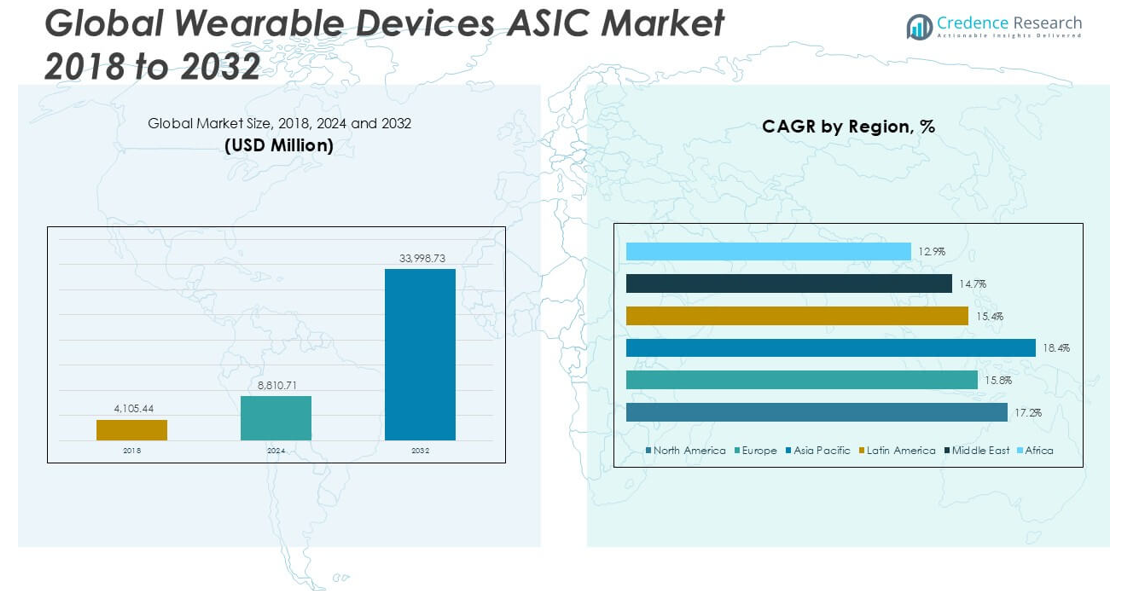
The Wearable Devices ASIC market size was valued at USD 4,105.44 million in 2018, increased to USD 8,810.71 million in 2024, and is anticipated to reach USD 33,998.73 million by 2032, at a CAGR of 17.15% during the forecast period.
| REPORT ATTRIBUTE | DETAILS |
|---|---|
| Historical Period | 2020-2023 |
| Base Year | 2024 |
| Forecast Period | 2025-2032 |
| Wearable Devices ASIC Market Size 2024 | USD 8,810.71 million |
| Wearable Devices ASIC Market, CAGR | 17.15% |
| Wearable Devices ASIC Market, Size 2032 | USD 33,998.73 million |
The wearable devices ASIC market is led by prominent players including Google, Apple, Samsung, Huawei, Xiaomi, Sony, Garmin, Nike, and adidas, each leveraging proprietary chip designs to enhance performance, energy efficiency, and device integration. These companies drive innovation through extensive R&D and strategic collaborations across the consumer electronics and health-tech sectors. Apple and Samsung hold significant influence due to their vertically integrated ecosystems and global brand reach. Regionally, North America emerged as the leading market in 2024, capturing approximately 42.7% of the global market share, driven by advanced technological infrastructure, strong consumer demand, and the presence of major players.
Market Insights
- The global wearable devices ASIC market was valued at USD 8,810.71 million in 2024 and is projected to reach USD 33,998.73 million by 2032, growing at a CAGR of 17.15% during the forecast period.
- Growth is primarily driven by rising demand for health and fitness monitoring, increasing adoption of smartwatches, and technological advancements in low-power ASICs for extended battery life.
- Sensor technology is the dominant segment due to its critical role in enabling real-time health data collection, while watches lead the product type category in terms of revenue share.
- The market is highly competitive, with major players such as Apple, Samsung, Google, Huawei, and Xiaomi focusing on proprietary ASIC development and ecosystem integration to maintain market leadership.
- Regionally, North America held the largest share at 42.7% in 2024, followed by Asia Pacific at 30.0%, supported by strong consumer adoption, advanced infrastructure, and growing digital health awareness.
Market Segmentation Analysis:
By Product Type:
Watches dominated the wearable devices ASIC market by product type, accounting for the largest market share in 2024. Their widespread consumer adoption is driven by their multifunctional capabilities, such as health tracking, smartphone integration, and communication features. Smartwatches have evolved into essential lifestyle accessories, supported by continuous innovation in user interface, battery life, and app ecosystems. Fitness trackers also hold a substantial share, particularly among health-conscious users, but are increasingly being integrated into smartwatch functionality. The growth of fabric wearables and glasses remains steady, driven by advancements in smart textiles and augmented reality applications.
- For instance, Apple Watch Series 9 incorporates the S9 SiP ASIC that features a 4-core Neural Engine capable of processing machine learning tasks up to 2x faster compared to its predecessor, enabling smoother Siri interactions and improved gesture recognition.
By Technology:
Sensor technology emerged as the leading segment within the wearable devices ASIC market, capturing the highest market share in 2024. This dominance stems from the essential role sensors play in monitoring biometric parameters like heart rate, temperature, motion, and oxygen levels. The miniaturization and improved accuracy of sensors have significantly enhanced the user experience, especially in health and fitness applications. Display technology follows closely, driven by demand for vibrant, energy-efficient screens that enable better user interaction. Networking and positioning technologies are gaining traction with the rise of GPS-enabled and connected devices, enabling seamless data transmission and real-time tracking.
- For instance, Fitbit Charge 6 uses a multipurpose ASIC that supports over 20 sensors, including a 3-axis accelerometer and a multipath optical heart rate sensor with a sampling frequency of 50 Hz.
By End User:
Personal users held the dominant share of the wearable devices ASIC market by end user in 2024, driven by growing consumer interest in health monitoring, fitness tracking, and mobile connectivity. The surge in wellness awareness and adoption of smart lifestyle tools has made personal wearables mainstream. Enterprises are also contributing to market expansion, especially in sectors such as healthcare, logistics, and industrial safety, where wearables are used for employee monitoring and operational efficiency. The 'Others' category, including education and military, is gradually expanding as these segments explore the utility of wearable technologies for specialized use cases.
Market Overview
Rising Demand for Health and Fitness Monitoring
The increasing global focus on health and wellness is significantly driving the growth of the wearable devices ASIC market. Consumers are actively seeking devices that can monitor vital health metrics such as heart rate, blood pressure, and sleep patterns. Advanced ASICs enable compact, energy-efficient, and high-performance processing for these wearable features. This demand is further amplified by the growing prevalence of lifestyle diseases and the integration of wearables into preventive healthcare and remote patient monitoring systems.
- For instance, Huawei’s Watch GT 4 integrates TruSeen 5.5+ ASIC-based sensor technology, which tracks heart rate with 10% higher accuracy and monitors SpO₂ levels continuously for 24 hours using an energy-efficient photoplethysmography system.
Technological Advancements in Miniaturization and Power Efficiency
Continuous innovations in ASIC design are enabling the development of smaller, more efficient, and feature-rich wearable devices. Miniaturized ASICs support the integration of multiple functions-such as sensors, processors, and communication modules-into a single chip, enhancing the overall device performance and user experience. Improved battery efficiency through low-power ASICs is also crucial, allowing for longer usage without frequent charging. These advancements are fostering the adoption of wearables in consumer electronics, healthcare, and industrial sectors.
- For instance, Qualcomm’s Snapdragon W5+ Gen 1 platform incorporates a 4 nm process ASIC that reduces power consumption by 50% compared to the previous generation while enabling continuous health monitoring and voice processing.
Expanding Applications Across Industry Verticals
Beyond consumer usage, the adoption of wearable devices is accelerating across various industries including healthcare, manufacturing, logistics, and defense. Customized ASICs power wearable technologies tailored for specific industry needs, such as real-time employee tracking, safety alerts, and biometric data analysis. The growing trend of digital transformation and Industry 4.0 is further promoting the integration of wearable solutions to enhance workforce productivity, operational efficiency, and safety compliance.
Key Trends & Opportunities
Integration of AI and Edge Computing
The incorporation of artificial intelligence and edge computing in wearable devices is emerging as a transformative trend. ASICs optimized for on-device processing enable real-time analytics, personalized feedback, and reduced reliance on cloud-based systems. This is particularly relevant in applications such as health diagnostics and fitness coaching, where latency and privacy are critical. As AI models become more efficient and specialized for wearables, the demand for advanced ASICs with AI acceleration capabilities is expected to rise.
- For instance, Google’s Pixel Watch 2 uses a co-processor ASIC that supports on-device ML inference for real-time fall detection and proactive health alerts, processing up to 2 billion operations per second (OPS).
Growth in Smart Textiles and Wearable Fabrics
The development of smart textiles and fabric-integrated electronics presents a promising opportunity for the wearable devices ASIC market. These innovations allow sensors and computing components to be embedded seamlessly into clothing and accessories, offering new avenues for health tracking, posture correction, and environmental monitoring. ASICs designed for flexibility, low power consumption, and durability are crucial to this segment’s expansion, paving the way for broader adoption in sportswear, healthcare garments, and military uniforms.
- For instance, Xenoma’s e-skin smart apparel utilizes an ASIC developed in collaboration with Asahi Kasei, capable of reading 14 motion-sensing channels at a sampling rate of 100 Hz with 24-hour continuous operation on a single battery charge.
Key Challenges
High Development and Integration Costs
One of the major challenges in the wearable devices ASIC market is the high cost associated with the design, testing, and integration of application-specific chips. Custom ASIC development requires significant investment in R&D and semiconductor manufacturing infrastructure. These costs can be prohibitive for small and medium-sized device manufacturers, limiting innovation and market entry. Additionally, continuous advancements demand frequent updates, adding to the lifecycle expenses of wearable products.
Data Privacy and Security Concerns
Wearable devices collect sensitive personal data, raising concerns over user privacy and data security. ASICs must be designed with built-in encryption and secure data transmission features to mitigate risks. However, implementing robust security mechanisms within limited silicon area and power budgets is complex. Any vulnerability can compromise user trust and deter adoption, especially in healthcare and enterprise environments where data integrity is paramount.
Short Product Lifecycles and Rapid Technological Obsolescence
The fast-paced nature of wearable technology results in frequent product updates and evolving consumer expectations. ASICs must be designed to accommodate emerging features and standards, which challenges manufacturers to balance customization with scalability. Devices quickly become obsolete, increasing pressure on companies to innovate rapidly while managing inventory and development costs. This dynamic environment poses a significant challenge for long-term planning and ROI in ASIC development.
Regional Analysis
North America
North America held the largest share in the wearable devices ASIC market in 2024, accounting for approximately 42.7% of the global market. The region’s market size grew from USD 1,770.84 million in 2018 to USD 3,760.46 million in 2024, and it is projected to reach USD 14,551.63 million by 2032, registering a CAGR of 17.2%. This growth is driven by widespread adoption of smart wearables, strong healthcare infrastructure, and increasing demand for fitness and health monitoring solutions. Technological advancements, high consumer spending power, and the presence of major industry players further contribute to regional dominance.
Europe
Europe accounted for around 18.5% of the global wearable devices ASIC market in 2024, with its market size rising from USD 801.50 million in 2018 to USD 1,630.01 million in 2024, and is expected to reach USD 5,745.88 million by 2032, at a CAGR of 15.8%. The growth is supported by increasing consumer awareness, healthcare digitalization, and demand for personalized medical monitoring. Countries like Germany, the UK, and France are leading adopters. The region also benefits from supportive government policies around health tech innovation and data regulation, which are boosting the demand for advanced ASIC-integrated wearables.
Asia Pacific
Asia Pacific is the fastest-growing region in the wearable devices ASIC market, with a projected CAGR of 18.4%. The regional market expanded from USD 1,166.45 million in 2018 to USD 2,645.49 million in 2024, and is forecast to reach USD 11,148.12 million by 2032, contributing 30.0% of the global market share in 2024. Rapid urbanization, rising disposable incomes, and a growing tech-savvy population are key growth drivers. Strong electronics manufacturing capabilities in countries like China, Japan, and South Korea also support ASIC production, while increasing smartphone penetration and fitness trends continue to drive wearable device adoption.
Latin America
Latin America contributed approximately 4.8% to the global wearable devices ASIC market in 2024. The region’s market size increased from USD 201.66 million in 2018 to USD 427.61 million in 2024, and is projected to reach USD 1,467.82 million by 2032, registering a CAGR of 15.4%. The growing popularity of health and fitness wearables, especially among younger demographics, is supporting market expansion. Brazil and Mexico lead regional demand due to their expanding middle-class populations and improving internet and smartphone penetration. However, infrastructure limitations and price sensitivity continue to present moderate barriers to widespread adoption.
Middle East
The Middle East wearable devices ASIC market was valued at USD 115.46 million in 2018 and reached USD 226.58 million in 2024, with expectations to grow to USD 738.33 million by 2032, at a CAGR of 14.7%. The region accounted for approximately 2.6% of the global market share in 2024. Demand is driven by increasing investments in healthcare innovation, rising health awareness, and smart city initiatives, particularly in countries like the UAE and Saudi Arabia. The growing use of wearable health monitors and government efforts to promote digital transformation in healthcare are further fueling regional growth.
Africa
Africa held the smallest market share of around 1.4% in the global wearable devices ASIC market in 2024. The market grew from USD 49.53 million in 2018 to USD 120.58 million in 2024, and is expected to reach USD 346.96 million by 2032, reflecting a CAGR of 12.9%. Although the region shows relatively slower growth compared to others, improvements in mobile connectivity, healthcare access, and digital literacy are gradually supporting wearable device adoption. South Africa and Nigeria are emerging as key markets, but challenges such as affordability, infrastructure gaps, and limited local manufacturing capabilities still restrain broader market penetration.
Market Segmentations:
By Product Type:
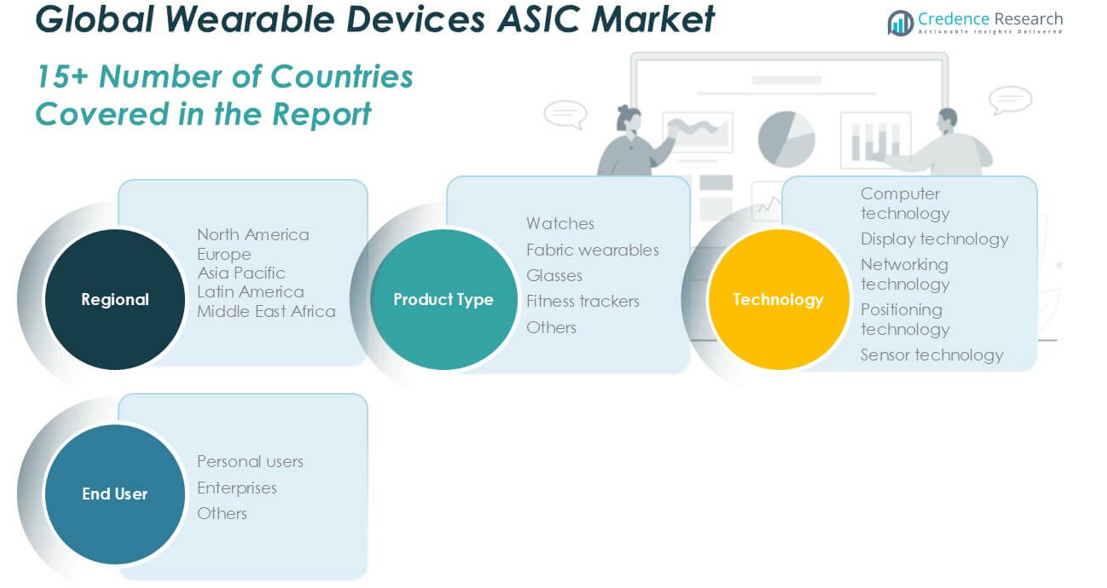
- Watches
- Fabric wearables
- Glasses
- Fitness trackers
- Others
By Technology:
- Computer technology
- Display technology
- Networking technology
- Positioning technology
- Sensor technology
By End User:
- Personal users
- Enterprises
- Others
By Geography:
- North America
- U.S.
- Canada
- Mexico
- Europe
- Germany
- France
- U.K.
- Italy
- Spain
- Rest of Europe
- Asia Pacific
- China
- Japan
- India
- South Korea
- South-east Asia
- Rest of Asia Pacific
- Latin America
- Brazil
- Argentina
- Rest of Latin America
- Middle East & Africa
- GCC Countries
- South Africa
- Rest of the Middle East and Africa
Competitive Landscape
The wearable devices ASIC market features a highly competitive landscape, marked by the presence of global technology giants and specialized semiconductor firms. Key players such as Google, Apple, Samsung, Huawei, and Xiaomi dominate the market with their vertically integrated ecosystems, leveraging in-house ASIC development to enhance performance, power efficiency, and device integration. These companies invest heavily in R&D to innovate ASIC architectures tailored for AI processing, sensor fusion, and real-time analytics. Additionally, sportswear brands like Nike and adidas, and electronics manufacturers like Garmin and Sony, are increasingly collaborating with semiconductor companies to embed customized ASICs into wearables for fitness, health, and lifestyle applications. Strategic partnerships, acquisitions, and the development of proprietary chipsets remain central to gaining a competitive edge. The market is also witnessing rising competition from emerging players in Asia and Europe, who focus on cost-effective and application-specific ASIC solutions to address the growing demand in healthcare, enterprise, and industrial sectors.
Key Player Analysis
- Apple
- adidas
- Garmin
- Huawei
- Nike
- Samsung
- Sony
- Xiaomi
Recent Developments
- In July 2025, Samsung previewed multiple wearable form factors (glasses, rings, earrings, and necklaces) with emphasis on AI-driven features realized through proprietary chipsets.
- In May/June 2025, Huawei launched the WATCH 5, featuring the new TruSense™ System and Multi-sensing X-TAP Technology. This technology utilizes a distributed sensor module and advanced ASIC for fingertip bio-reading, gesture control, and real-time health data. The WATCH 5 reflects Huawei's emphasis on self-developed silicon for health and AI applications.
- In January 2025, Sony showcased the XYN XR headset at CES with advanced spatial content capture, powered by custom silicon for real-time, low-latency 3D rendering. The headset, using Qualcomm hardware, emphasizes their ability to blend high-performance ASICs into both creative and industrial XR solutions.
- In January 2025, Apple filed patents detailing a next-generation Apple Watch band with integrated sensor nodes and control elements. The patents also suggest the development of smart rings and "wear loop" devices, all utilizing ASICs for advanced physiological and spatial sensing. This indicates a move towards more integrated and sophisticated wearable technology.
Market Concentration & Characteristics
The Wearable Devices ASIC Market exhibits moderate to high market concentration, with a few dominant players holding significant shares due to their strong R&D capabilities, proprietary chip designs, and established consumer bases. Companies such as Apple, Samsung, Google, and Huawei lead the market by leveraging in-house ASIC development to enhance performance, reduce power consumption, and ensure seamless device integration. It features characteristics of rapid innovation cycles, high entry barriers due to design complexity, and a strong focus on miniaturization. The market remains demand-driven, fueled by consumer preference for lightweight, multifunctional wearable devices with extended battery life. It reflects intense competition among global technology leaders and emerging semiconductor firms, each aiming to optimize ASICs for healthcare, fitness, and lifestyle applications. The need for real-time data processing and energy efficiency drives specialization in ASIC design. Price sensitivity in developing regions and the pressure to balance customization with scalability define the competitive dynamics across product categories.
Report Coverage
The research report offers an in-depth analysis based on Product Type, Technology, End User and Geography. It details leading market players, providing an overview of their business, product offerings, investments, revenue streams, and key applications. Additionally, the report includes insights into the competitive environment, SWOT analysis, current market trends, as well as the primary drivers and constraints. Furthermore, it discusses various factors that have driven market expansion in recent years. The report also explores market dynamics, regulatory scenarios, and technological advancements that are shaping the industry. It assesses the impact of external factors and global economic changes on market growth. Lastly, it provides strategic recommendations for new entrants and established companies to navigate the complexities of the market.
Future Outlook
- The market will continue to grow steadily due to rising demand for health and fitness monitoring features in wearable devices.
- Companies will invest more in developing energy-efficient ASICs to improve battery life and reduce heat generation.
- Integration of AI and machine learning into ASICs will enhance real-time data processing capabilities.
- Smartwatches will remain the dominant product category, supported by multifunctional features and consumer adoption.
- Sensor technology will advance further, driving the need for specialized ASICs for biometric and environmental data.
- Asia Pacific will experience the fastest growth, supported by strong manufacturing capacity and increasing consumer demand.
- Healthcare applications will expand, with ASIC-enabled wearables supporting remote patient monitoring and diagnostics.
- Enterprises will adopt more wearable solutions for workforce safety, productivity, and health management.
- Players will focus on miniaturization and multi-functionality to meet demand for compact and lightweight designs.
- Strategic partnerships and custom ASIC development will shape competition and innovation across global markets.

Request a Free Sample
Fill in your details and we'll send you a free sample report.
- Sample data tables & charts
- Research methodology
Market Dynamics
Health and Fitness Monitoring Demand
Consumers are increasingly seeking wearable devices that can monitor vital health metrics such as heart rate, blood pressure, and sleep patterns. Advanced ASICs enable compact, energy-efficient, and high-performance processing for these features, driving adoption in both consumer and healthcare sectors.
Technological Advancements in Miniaturization and Power Efficiency
Continuous innovation in ASIC design allows for smaller, more efficient chips that integrate multiple functions, improving device performance and battery life. This enables manufacturers to create lighter, more comfortable wearables with extended usage times, fueling market growth.
Integration of AI and Edge Computing
Wearable devices are increasingly incorporating AI and edge computing capabilities, requiring specialized ASICs for real-time analytics and personalized feedback. This trend supports advanced applications such as health diagnostics, gesture recognition, and proactive health alerts, expanding the market's scope.
Expansion into Enterprise and Industrial Applications
Beyond personal use, enterprises in healthcare, logistics, and manufacturing are adopting wearable devices powered by custom ASICs for employee monitoring, safety, and operational efficiency. This diversification of end users broadens the market and drives further ASIC innovation.
Growth in Smart Textiles and Wearable Fabrics
The development of smart textiles and fabric-integrated electronics is opening new opportunities for ASICs designed for flexibility and low power consumption. These innovations enable seamless integration of sensors and processors into clothing, expanding wearable applications in sports, healthcare, and military sectors.
Need a Custom Version of This Report?
Tailor the scope, geography, or segments to your exact requirements.
- Custom geography or segment scope
- Direct access to our analyst team
Frequently Asked Questions
What is the current size of the Wearable Devices ASIC Market?
What factors are driving the growth of the Wearable Devices ASIC Market?
What are some challenges faced by the Wearable Devices ASIC Market?
Who are the major players in the Wearable Devices ASIC Market?
Table of Content
Chapter 1 Market Segmentation
- 1.1 Segmentation Framework
- 1.1.1 Product and Service Classification
- 1.1.2 Application and End-Use Classification
- 1.1.3 Technology and Solution Classification
- 1.1.4 Customer and Distribution Channel Classification
- 1.1.5 Geographic Segmentation
- 1.1.6 Market Segment Definitions and Boundaries
- 1.2 By End User
- 1.2.1 Personal users
- 1.2.2 Enterprises
- 1.2.3 Others
- 1.3 By Technology
- 1.3.1 Sensor technology
- 1.3.2 Display technology
- 1.3.3 Networking technology
- 1.3.4 Positioning technology
- 1.3.5 Computer technology
- 1.4 By Product Type
- 1.4.1 Watches
- 1.4.2 Fabric wearables
- 1.4.3 Glasses
- 1.4.4 Fitness trackers
- 1.4.5 Others
Chapter 2 Introduction
- 2.1 Report Objectives and Scope
- 2.2 Product Definition and Industry Terminology
- 2.3 Market Inclusions and Exclusions
- 2.4 Research Process
- 2.4.1 Primary Research and Expert Interviews
- 2.4.2 Secondary Research and Source Review
- 2.4.3 Top-Down and Bottom-Up Estimation
- 2.4.4 Data Triangulation and Verification
- 2.5 Market Size Measurement Basis
- 2.5.1 2024: USD 8,810.71 million → 2032: USD 33,998.73 million
- 2.6 Historical and Forecast Reference Periods
- 2.6.1 Base Year: 2024
- 2.6.2 Forecast Period: 2024-2032
- 2.7 Research Assumptions and Limitations
Chapter 3 Executive Summary
- 3.1 Market Snapshot and Key Findings
- 3.2 Base-Year Market Size, 2024
- 3.3 Forecast Market Size, 2032
- 3.4 Revenue and Volume Growth Outlook
- 3.5 Key Demand and Supply Indicators
- 3.6 Leading Market Segments
- 3.7 Fastest-Growing Market Opportunities
- 3.8 Regional Performance Highlights
- 3.9 Technology and Industry Transformation
- 3.10 Competitive Landscape Summary
- 3.11 Analyst View and Strategic Implications
Chapter 4 Global Wearable Devices ASIC Market Trends and Developments
- 4.1 Historical Industry Development
- 4.2 Recent Market Trends and Developments
- 4.3 Demand and Customer Behavior Trends
- 4.4 Technology and Product Innovation
- 4.5 Artificial Intelligence, Automation and Digitalization
- 4.6 Local Manufacturing and Supply Chain Realignment
- 4.7 Industry Partnerships, Mergers and Acquisitions
- 4.8 Sustainability and Circular Economy Developments
- 4.9 Government and Private Sector Investment Trends
- 4.10 Emerging Business Models and Commercialization
- 4.11 Industry Developments and Announcements
Chapter 5 Global Wearable Devices ASIC Market Production, Supply and Demand Analysis
- 5.1 Demand Trend and Consumption Analysis
- 5.2 Demand Forecast, 2024-2032
- 5.3 Production and Output Trend
- 5.4 Production and Output Forecast, 2024-2032
- 5.5 Installed Capacity and Capacity Utilization
- 5.6 Company-Wise Production Plants and Statistics
- 5.6.1 Installed Production Capacity
- 5.6.2 Actual Production
- 5.6.3 Planned Capacity and Expansion Targets
- 5.7 Supply Chain Structure and Procurement Trends
- 5.8 Supply-Demand Gap and Bottlenecks
- 5.9 Import Dependence and Sourcing Structure
- 5.10 Contract Manufacturing and Outsourcing
- 5.11 Regional Supply and Demand Concentration
Chapter 6 Global Wearable Devices ASIC Market Pricing Analysis
- 6.1 Pricing Structure and Measurement
- 6.2 Historical Pricing Trends
- 6.3 Pricing Outlook, 2024-2032
- 6.4 Average Selling Price and Unit Economics
- 6.5 Pricing by Product and Market Segment
- 6.6 Geographic Pricing Differences
- 6.7 Key Input, Energy, Labor and Logistics Costs
- 6.8 Contract Pricing and Purchasing Models
- 6.9 Pricing Sensitivity and Competitive Positioning
- 6.10 Price, Margin and Profitability Implications
Chapter 7 Global Wearable Devices ASIC Market Dynamics
- 7.1 Market Growth Drivers
- 7.1.1 Demand-Side Drivers
- 7.1.2 Technology and Innovation Drivers
- 7.1.3 Infrastructure and Investment Drivers
- 7.1.4 Regulatory and Policy Drivers
- 7.2 Market Restraints
- 7.2.1 Cost and Affordability Constraints
- 7.2.2 Technology and Adoption Barriers
- 7.2.3 Supply Chain and Operational Constraints
- 7.3 Market Challenges
- 7.3.1 Competitive Pressure and Margin Erosion
- 7.3.2 Skills, Infrastructure and Implementation Gaps
- 7.4 Emerging Market Opportunities
- 7.5 Market Dynamics Impact and Time-Horizon Assessment
Chapter 8 Global Wearable Devices ASIC Value Chain Analysis
- 8.1 Industry Value Chain Overview
- 8.2 Upstream Suppliers and Critical Inputs
- 8.3 Technology and Component Providers
- 8.4 Manufacturing or Service Delivery
- 8.5 Distribution, Channel Partners and Integrators
- 8.6 Downstream Applications and End Users
- 8.7 Value Addition and Profit Pools
- 8.8 Vertical Integration and Outsourcing
- 8.9 Supplier Concentration and Risk
- 8.10 Supply Chain Localization and Resilience
Chapter 9 Global Wearable Devices ASIC Market Regulations and Policies
- 9.1 Relevant Laws, Standards and Compliance Frameworks
- 9.2 Product, Service, Safety and Quality Requirements
- 9.3 Government Policies, Incentives and Subsidies
- 9.4 Imports, Exports and Trade Barriers
- 9.5 Public Procurement and Local Content Requirements
- 9.6 Environmental and Sustainability Compliance
- 9.7 Data Protection, AI and Cybersecurity Compliance
- 9.8 Upcoming Policy Changes and Market Implications
Chapter 10 Global Wearable Devices ASIC Market Hotspots and Opportunities
- 10.1 Market Opportunity Mapping and Growth Hotspots
- 10.2 High-Growth Applications and Customer Groups
- 10.3 Underserved Markets and White-Space Opportunities
- 10.4 Emerging Technology and Product Opportunities
- 10.5 New Capacity and Investment Hotspots
- 10.6 Market Entry and Expansion Opportunities
- 10.7 Distribution and Partnership Opportunities
- 10.8 Near-Term and Long-Term Commercial Potential
- 10.9 Opportunity Attractiveness and Execution Risks
Chapter 11 Global Wearable Devices ASIC Market Outlook, 2024-2032
- 11.1 Market Size and Analysis
- 11.1.1 Revenue (Market Measurement: 2024: USD 8,810.71 million → 2032: USD 33,998.73 million)
- 11.1.2 Market Volume and Quantity Sold
- 11.1.3 Historical Market Size
- 11.1.4 Base-Year Market Size, 2024
- 11.2 Market Forecast, 2024-2032
- 11.2.1 Revenue Forecast to 2032
- 11.2.2 Volume Forecast to 2032
- 11.2.3 CAGR and Year-on-Year Growth
- 11.2.4 Incremental Revenue Opportunity
- 11.3 Forecast Assumptions and Scenario Analysis
- 11.3.1 Base-Case Forecast
- 11.3.2 Optimistic and Conservative Scenarios
- 11.3.3 Technology, Pricing and Policy Sensitivities
- 11.4 Market Attractiveness and Growth Outlook
Chapter 12 Global Wearable Devices ASIC Market Segmentation and Outlook
- 12.1 Segmentation Summary and Market Shares, 2024
- 12.2 Largest and Fastest-Growing Segments
- 12.3 By End User - Market Size and Forecast, 2024-2032
- 12.3.1 Segment Definition and Scope
- 12.3.2 Historical Market Size
- 12.3.3 Revenue Forecast, 2024-2032
- 12.3.4 Volume Forecast, 2024-2032
- 12.3.5 Base-Year Market Share, 2024
- 12.3.6 Segment CAGR and Growth Drivers
- 12.3.7 Subsegment Market Size and Forecast
- 12.3.7.1 Personal users
- 12.3.7.2 Enterprises
- 12.3.7.3 Others
- 12.3.8 Subsegment Pricing and Adoption Trends
- 12.3.9 Leading Suppliers and Competition
- 12.3.10 Regional Demand and Opportunities
- 12.4 By Technology - Market Size and Forecast, 2024-2032
- 12.4.1 Segment Definition and Scope
- 12.4.2 Historical Market Size
- 12.4.3 Revenue Forecast, 2024-2032
- 12.4.4 Volume Forecast, 2024-2032
- 12.4.5 Base-Year Market Share, 2024
- 12.4.6 Segment CAGR and Growth Drivers
- 12.4.7 Subsegment Market Size and Forecast
- 12.4.7.1 Sensor technology
- 12.4.7.2 Display technology
- 12.4.7.3 Networking technology
- 12.4.7.4 Positioning technology
- 12.4.7.5 Computer technology
- 12.4.8 Subsegment Pricing and Adoption Trends
- 12.4.9 Leading Suppliers and Competition
- 12.4.10 Regional Demand and Opportunities
- 12.5 By Product Type - Market Size and Forecast, 2024-2032
- 12.5.1 Segment Definition and Scope
- 12.5.2 Historical Market Size
- 12.5.3 Revenue Forecast, 2024-2032
- 12.5.4 Volume Forecast, 2024-2032
- 12.5.5 Base-Year Market Share, 2024
- 12.5.6 Segment CAGR and Growth Drivers
- 12.5.7 Subsegment Market Size and Forecast
- 12.5.7.1 Watches
- 12.5.7.2 Fabric wearables
- 12.5.7.3 Glasses
- 12.5.7.4 Fitness trackers
- 12.5.7.5 Others
- 12.5.8 Subsegment Pricing and Adoption Trends
- 12.5.9 Leading Suppliers and Competition
- 12.5.10 Regional Demand and Opportunities
- 12.6 Segment Growth Comparison
- 12.7 Segment Attractiveness and Priority Matrix
Chapter 13 Global Wearable Devices ASIC End-Use and Application Market Outlook
- 13.1 End-Use Industry and Customer Demand Structure
- 13.2 Leading Applications and Customer Groups
- 13.3 End-Use Market Size, Share and Forecast
- 13.4 Major End-Use Industry Deep Dives
- 13.4.1 Customer Requirements and Use Cases
- 13.4.2 Demand and Replacement Cycles
- 13.4.3 Technical and Regulatory Considerations
- 13.4.4 Purchasing and Procurement Models
- 13.4.5 Leading Vendors and Distribution Channels
- 13.4.6 Forecast and Commercial Opportunities
- 13.5 Emerging Applications and Cross-Segment Demand
- 13.6 End-Use Industry Investment Priorities
Chapter 14 Global Wearable Devices ASIC Geographic Market Outlook, 2024-2032
- 14.1 Regional Market Size and Share, 2024
- 14.2 Regional Market Forecast, 2024-2032
- 14.3 Regional Pricing, Production and Demand Differences
- 14.4 North America
- 14.4.1 United States
- 14.4.2 Canada
- 14.4.3 Mexico
- 14.5 Europe
- 14.5.1 Germany
- 14.5.2 France
- 14.5.3 Italy
- 14.5.4 United Kingdom
- 14.5.5 Spain
- 14.5.6 Poland
- 14.5.7 Russia
- 14.5.8 Netherlands
- 14.5.9 Belgium
- 14.5.10 Sweden
- 14.5.11 Denmark
- 14.5.12 Norway
- 14.5.13 Rest of Europe
- 14.6 Asia Pacific
- 14.6.1 China
- 14.6.2 India
- 14.6.3 Japan
- 14.6.4 South Korea
- 14.6.5 Thailand
- 14.6.6 Indonesia
- 14.6.7 Vietnam
- 14.6.8 Malaysia
- 14.6.9 Australia
- 14.6.10 Rest of Asia Pacific
- 14.7 Latin America
- 14.7.1 Brazil
- 14.7.2 Argentina
- 14.7.3 Colombia
- 14.7.4 Chile
- 14.7.5 Rest of Latin America
- 14.8 Middle East
- 14.8.1 Saudi Arabia
- 14.8.2 United Arab Emirates
- 14.8.3 Turkey
- 14.8.4 Israel
- 14.8.5 Iran
- 14.8.6 Rest of the Middle East
- 14.9 Africa
- 14.9.1 South Africa
- 14.9.2 Egypt
- 14.9.3 Nigeria
- 14.9.4 Morocco
- 14.9.5 Rest of Africa
- 14.10 Regional Investment, Policy and Supply Chain Differences
- 14.11 Regional Competitive Landscape
- 14.12 Geographic Growth Hotspots
Chapter 15 Global Wearable Devices ASIC Technology, Innovation and Sustainability Outlook
- 15.1 Technology Landscape and Maturity
- 15.2 Product, Process and Service Innovation
- 15.3 AI, Automation and Digital Tools in the Industry
- 15.4 Technology Adoption and Performance Benchmarking
- 15.5 Innovation Pipeline and R&D Investment
- 15.6 Patent and Intellectual Property Trends
- 15.7 Energy Efficiency and Resource Management
- 15.8 Sustainability, Recycling and Circularity
- 15.9 Technology Roadmap, 2024-2032
- 15.10 Risks of Obsolescence and Technology Substitution
Chapter 16 Global Wearable Devices ASIC Market Key Strategic Imperatives
- 16.1 Growth and Market Entry Priorities
- 16.2 High-Return Products and Segments
- 16.3 Pricing, Profitability and Cost Optimization
- 16.4 Technology Investment and Product Differentiation
- 16.5 Supply Chain Localization and Resilience
- 16.6 Distribution and Customer Acquisition
- 16.7 Partnership, Acquisition and Capacity Strategy
- 16.8 Regional Expansion Priorities
- 16.9 Short-, Medium- and Long-Term Actions
Chapter 17 Competition Outlook
- 17.1 Industry Competition Characteristics
- 17.2 Market Structure and Concentration
- 17.3 Market Share and Competitive Positioning, 2024
- 17.4 Company-Wise Revenue and Product Benchmarking
- 17.5 Production and Service Capacity Benchmarking
- 17.6 Technology, Pricing and Differentiation
- 17.7 Regional Footprint and Distribution Strength
- 17.8 Mergers, Acquisitions and Strategic Alliances
- 17.9 New Entrants and Competitive Threats
- 17.10 Porter's Five Forces and Industry Attractiveness
- 17.11 Competitive Outlook, 2024-2032
Chapter 18 Company Profiles
- 18.1 Company Coverage and Selection Criteria
- 18.2 Apple
- 18.2.1 Business Description
- 18.2.2 Company Ownership and Geographic Presence
- 18.2.3 Product and Service Portfolio
- 18.2.4 Manufacturing and Operating Footprint
- 18.2.5 Production Capacity and Expansion Plans
- 18.2.6 Financial Performance and Investment
- 18.2.7 Market Share and Competitive Position
- 18.2.8 Technology and Innovation Capabilities
- 18.2.9 Strategic Alliances or Partnerships
- 18.2.10 Recent Developments
- 18.2.11 Growth Strategy and Outlook
- 18.3 Samsung
- 18.4 Google
- 18.5 Huawei
- 18.6 Xiaomi
- 18.7 Sony
- 18.8 Garmin
- 18.9 Nike
- 18.10 adidas
- 18.11 Qualcomm
- 18.12 Other Relevant Market Participants
Note: Every listed company is profiled on the structure shown under the first company. The company list is preliminary and may change based on research findings, market developments, data availability and client requirements.
Chapter 19 Disclaimer
- 19.1 Research and Forecast Disclaimer
- 19.2 Data Source and Estimation Limitations
Note: The depth of individual sections depends on data availability for this market. Volume, capacity, trade and other unit-based metrics are included where applicable.

