
| REPORT ATTRIBUTE | DETAILS |
|---|---|
| Historical Period | 2020-2023 |
| Base Year | 2024 |
| Forecast Period | 2025-2032 |
| Wireless Earphones Market Size 2024 | USD 34,409.58 million |
| Wireless Earphones Market CAGR | 37.20% |
| Wireless Earphones Market Size 2032 | USD 4,31,109.89 million |
Market Overview
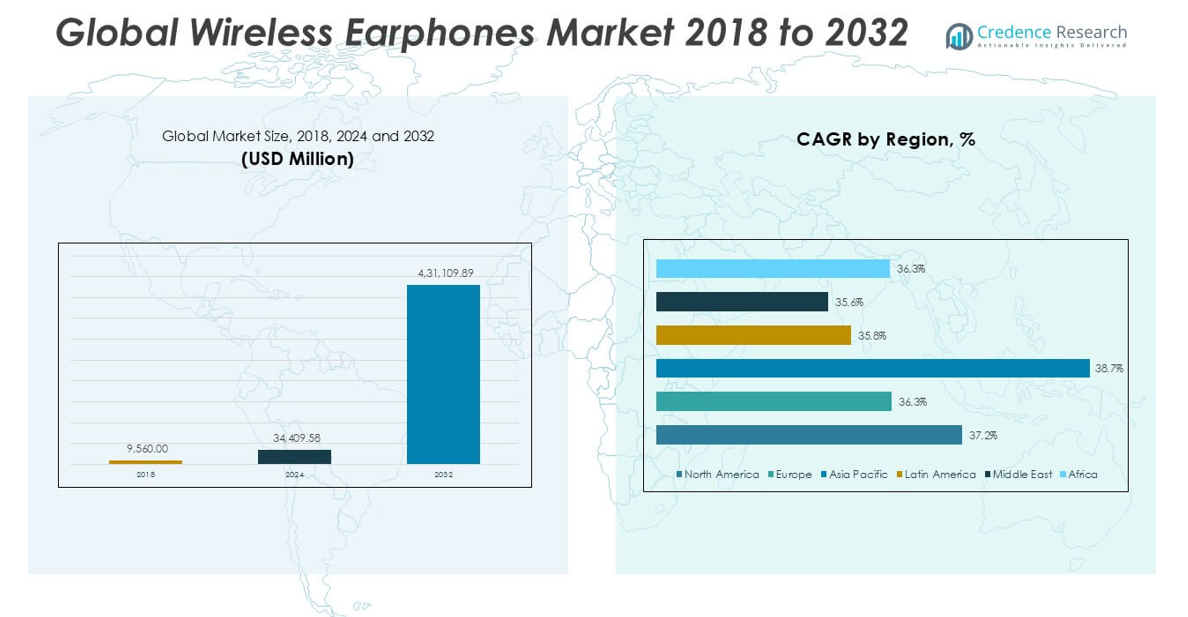
The Global Wireless Earphones Market is projected to grow from USD 34,409.58 million in 2024 to an estimated USD 4,31,109.89 million based on 2032, with a compound annual growth rate (CAGR) of 37.20% from 2025 to 2032.
Market growth is also supported by shifting consumer preferences toward convenience, portability, and minimalist design. Brands are focusing on active noise cancellation (ANC), sweat resistance, and ergonomic form factors to enhance user experience. Rapid innovation cycles, supported by tech giants and audio specialists, are reshaping competitive dynamics, especially with the rise of true wireless stereo (TWS) earbuds. E-commerce platforms and direct-to-consumer channels are expanding product accessibility, while bundling strategies with smart devices are boosting sales volumes.
Asia Pacific dominates the global wireless earphones market due to the high consumption of mobile devices and growing middle-class population. North America follows, driven by strong brand loyalty and high technology adoption. Europe maintains a robust market with increasing fitness-oriented usage and product innovation. Key players shaping the market landscape include Apple Inc., Samsung Electronics, Sony Corporation, Xiaomi Corporation, JBL (Harman International), Bose Corporation, Sennheiser Electronic GmbH & Co. KG, Skullcandy Inc., Realme, and OnePlus
Market Insights
- The Global Wireless Earphones Market is projected to grow from USD 34,409.58 million in 2024 to USD 4,31,109.89 million by 2032, at a CAGR of 37.20%.
- Rising demand for wireless audio solutions across mobile, fitness, and gaming platforms continues to accelerate global adoption.
- Advancements in Bluetooth technology, smart features, and noise-cancellation capabilities enhance user experience and drive repeat purchases.
- Increased smartphone penetration and streaming service consumption support consistent growth in developing and developed markets.
- High price sensitivity and growing competition from low-cost alternatives challenge brand margins and long-term customer loyalty.
- Limited battery life and product durability issues remain critical factors affecting consumer satisfaction and return rates.
- Asia Pacific leads the market with strong mobile device adoption, followed by North America and Europe, supported by high technology usage and brand loyalty.
Market Drivers
Rising Demand for Seamless Audio Experiences Across Devices
The Global Wireless Earphones Market is experiencing strong demand due to increasing consumer preference for cable-free and integrated audio solutions. Users expect uninterrupted connectivity with smartphones, laptops, tablets, and smartwatches, which boosts the appeal of wireless earphones. The rise of on-the-go lifestyles and mobile-first content consumption continues to drive adoption. Consumers value the freedom and flexibility of wireless audio, especially during travel, fitness routines, or work-from-anywhere environments. Manufacturers invest in multipoint connectivity and low-latency transmission to meet performance expectations. This shift toward seamless integration across devices sustains growth across both premium and mid-range product categories.
- For instance, Apple reported in its 2024 annual report that it shipped over 80 million AirPods units globally in the previous year, reflecting robust consumer demand for wireless audio solutions.
Smart Feature Integration Enhancing User Appeal
The integration of intelligent features strengthens market growth by improving functionality and user experience. Smart assistants, gesture controls, in-ear detection, and adaptive noise cancellation enhance product value. The Global Wireless Earphones Market benefits from consumer interest in hands-free controls and voice interactions. Many brands incorporate AI-powered features that personalize sound output or optimize battery usage based on user patterns. Health-tracking sensors in select models are expanding use cases beyond audio playback. These innovations increase customer engagement and drive repeat purchases or upgrades.
- For instance, according to a 2023 survey by Counterpoint Research, more than 45 million wireless earphones with active noise cancellation and voice assistant integration were sold in the United States alone.
Expansion of E-commerce and Direct-to-Consumer Channels
The expansion of online retail channels is supporting market growth through greater accessibility and product visibility. Consumers now explore and purchase wireless earphones across digital platforms, benefitting from reviews, comparison tools, and promotional pricing. It allows niche and emerging brands to reach global audiences and compete with established players. The Global Wireless Earphones Market sees rising direct-to-consumer strategies that offer customization and loyalty benefits. Shorter supply chains improve margins while offering faster product delivery. The shift to digital-first retail strategies reinforces consumer engagement and enhances product reach.
Technological Advancements Driving Product Evolution
Advancements in wireless technology play a central role in enhancing product performance and market attractiveness. Improvements in battery life, sound quality, and Bluetooth codecs such as aptX and LDAC contribute to user satisfaction. The Global Wireless Earphones Market continues evolving as chipsets become more power-efficient and compact. Manufacturers deploy adaptive algorithms for noise cancellation, beamforming, and environmental sound optimization. These developments enable higher fidelity audio and longer listening times. It ensures users receive premium performance in smaller, lighter designs without compromising comfort.
Market Trends
Shift Toward True Wireless Stereo (TWS) Dominating Consumer Preferences
True Wireless Stereo (TWS) earphones are setting the benchmark for innovation and consumer adoption. Users seek compact, cable-free solutions that offer high-quality sound and effortless portability. The Global Wireless Earphones Market is seeing a transition from neckband and over-ear formats to fully wireless earbuds. TWS devices combine sleek aesthetics with performance features such as ANC and intuitive touch controls. It allows users to enjoy music, calls, and virtual assistants without physical constraints. This trend continues to accelerate with frequent model updates from leading brands.
- For instance, according to Canalys, over 310 million TWS earphones were shipped globally in 2024, with Apple, Samsung, and Xiaomi accounting for the majority of new product launches.
Focus on Active Noise Cancellation and Audio Personalization
Noise cancellation and customized audio output are gaining traction across all price segments. Consumers demand immersive sound experiences in crowded or noisy environments, prompting brands to refine ANC technology. The Global Wireless Earphones Market supports this trend by integrating hybrid and adaptive ANC systems in both flagship and mid-range products. Brands now offer apps that let users adjust sound profiles or switch between noise modes. It enhances individual listening experiences and builds brand differentiation. These developments are shaping product design and influencing purchase decisions.
- For instance, Sony reported that its 2024 wireless earphone lineup included 12 different models with active noise cancellation and customizable sound settings, reflecting the rapid expansion of these features across its portfolio.
Integration of Health and Fitness Features in Audio Devices
Wireless earphones are evolving into multi-functional health companions. Heart rate monitoring, calorie tracking, and motion sensors are now embedded into select earphone models. The Global Wireless Earphones Market is aligning with the fitness and wellness ecosystem through seamless pairing with health apps. It encourages adoption among health-conscious users who prefer compact, wearable solutions. This trend appeals to consumers seeking devices that serve both entertainment and fitness needs. The convergence of audio and health technology is creating a distinct segment within the market.
Customization and Aesthetic Appeal Influencing Consumer Choices
Design personalization is becoming a key differentiator in brand loyalty and market appeal. Consumers expect more than functionality-they prioritize form, comfort, and visual style. The Global Wireless Earphones Market reflects this shift with customizable color options, interchangeable ear tips, and limited-edition releases. It helps brands target younger audiences and lifestyle-driven buyers. Minimalist designs, compact charging cases, and luxury branding are reshaping consumer expectations. Aesthetic innovation is now influencing both initial purchase and long-term brand perception.
Market Challenges
High Price Sensitivity and Intense Competition Impacting Profit Margins
The Global Wireless Earphones Market faces intense pricing pressure due to widespread competition across global and regional players. While premium brands command strong loyalty, budget-conscious consumers often shift toward low-cost alternatives. It challenges established companies to maintain margins without compromising quality. Frequent discounting and short product cycles reduce profitability, especially for mid-tier manufacturers. The influx of counterfeit products further complicates brand positioning and customer trust. Sustaining product innovation while staying competitively priced remains a critical hurdle.
- For instance, according to a 2024 customs enforcement report, authorities in the United States seized over 340,000 counterfeit wireless earphones at ports of entry in a single year, highlighting the scale of counterfeit activity impacting legitimate brands.
Battery Life Limitations and Durability Concerns Affecting User Experience
Battery performance and product durability continue to influence consumer satisfaction and replacement rates. Users expect long playback hours, fast charging, and reliable battery health over time, yet many models fall short. The Global Wireless Earphones Market sees returns and dissatisfaction when products underperform in active or outdoor conditions. It places pressure on manufacturers to improve design, water resistance, and battery management systems. Frequent upgrades also contribute to electronic waste, raising environmental and regulatory concerns. Meeting performance expectations while ensuring product longevity is a growing challenge
Market Opportunities
Emerging Markets and Affordable Product Lines Unlock Growth Potential
Expanding into emerging economies presents strong growth opportunities for manufacturers. Rising smartphone penetration and increasing disposable incomes support broader wireless earphone adoption. The Global Wireless Earphones Market can capitalize on demand by offering affordable yet feature-rich models tailored for price-sensitive consumers. Localized marketing strategies and regional distribution partnerships can further accelerate market entry. It allows brands to build loyalty and scale in underserved markets. Governments promoting digital connectivity and e-learning contribute to rising demand for personal audio devices.
Innovation in Niche Segments and Cross-Industry Integration Creating New Demand
Targeting niche segments such as gaming, enterprise communication, and education can drive product diversification. Specialized features like low-latency audio, multi-device switching, and voice enhancement open new use cases. The Global Wireless Earphones Market stands to benefit from partnerships with fitness, healthcare, and entertainment ecosystems. It enables deeper integration with smartwatches, health apps, and AR/VR platforms. Customized solutions for professionals, students, and gamers offer long-term value creation. Expanding use scenarios strengthens consumer engagement and broadens addressable market size.
Market Segmentation Analysis
By Type
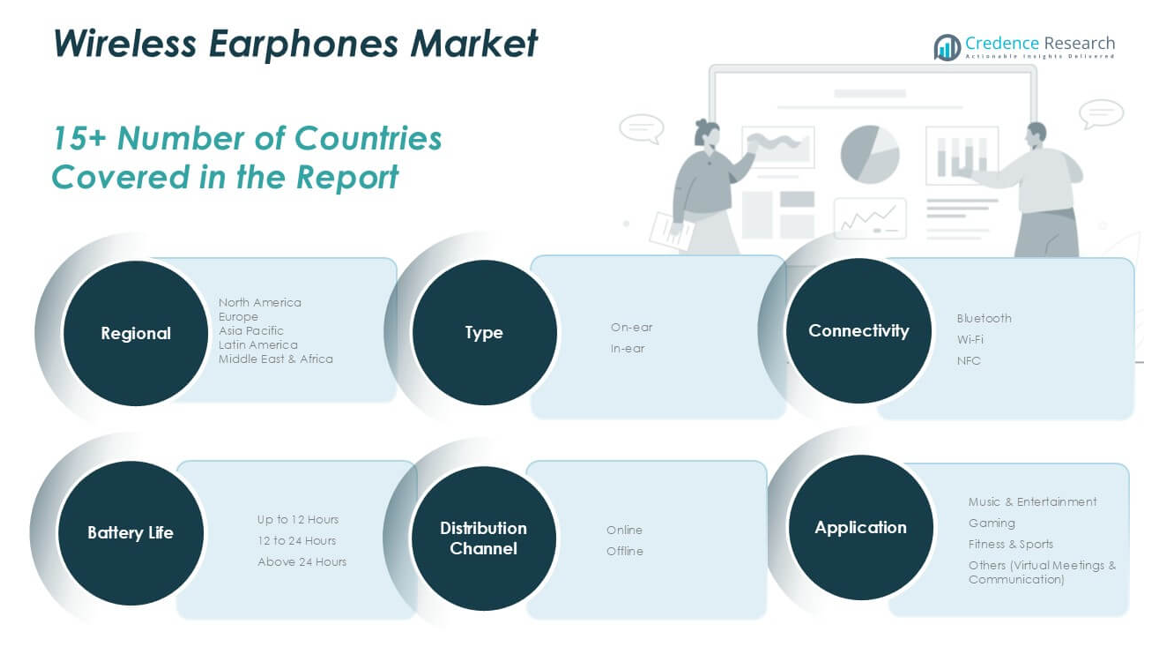
The Global Wireless Earphones Market is segmented into on-ear and in-ear categories, with in-ear devices holding the largest volume and revenue share. Compact design, portability, and advanced features such as active noise cancellation and water resistance drive in-ear dominance. On-ear models cater to users seeking better battery life and larger drivers for immersive audio, often preferred in home or office settings. Both segments benefit from design enhancements and expanding use cases across fitness, travel, and casual listening. It allows brands to target distinct consumer preferences through varied form factors and price points.
- For instance, according to Canalys, global shipments of in-ear wireless earphones reached 340 million units in 2024, compared to 85 million units for on-ear models.
By Application
Music and entertainment remain the leading application segment, driven by increasing audio streaming and content consumption across platforms. Fitness and sports applications show strong growth due to demand for lightweight, sweatproof devices. Gaming is an emerging segment with rising interest in low-latency sound and immersive experiences. The Global Wireless Earphones Market also benefits from wider adoption in virtual meetings and professional communication. It reflects broader use across hybrid work environments and digital classrooms, expanding the scope beyond traditional entertainment usage.
- For instance, over 250 million wireless earphones were used primarily for music and entertainment, while 70 million were used for fitness and sports, and 40 million for gaming worldwide.
By Connectivity
Bluetooth connectivity dominates the market due to its universal compatibility and energy efficiency. Wi-Fi-enabled earphones serve niche segments requiring high-bandwidth audio, such as studio use or content creation. NFC-based models offer quick pairing but remain limited in share. The Global Wireless Earphones Market continues to favor Bluetooth upgrades like LE Audio for better range and sound quality. It reinforces user expectations around seamless connectivity and stable performance.
By Battery Life
Models offering 12 to 24 hours of battery life lead the market, balancing usage time with comfort and charging convenience. Products with battery life above 24 hours are gaining attention among heavy users and travelers. Devices with under 12 hours appeal to casual listeners and budget-conscious buyers. The Global Wireless Earphones Market focuses on optimizing battery performance while maintaining compact form factors. It aligns with consumer demand for durability and uninterrupted usage.
By Distribution Channel
Online distribution channels dominate sales due to product variety, discounts, and doorstep delivery. Offline retail continues to attract customers valuing physical trials and immediate purchases. The Global Wireless Earphones Market benefits from hybrid retail strategies combining e-commerce with brand-owned stores. It allows companies to expand reach while offering personalized customer engagement.
Segments
Based on Type
- On-ear
- In-ear
Based on Application
- Music & Entertainment
- Gaming
- Fitness & Sports
- Others (Virtual Meetings & Communication)
Based on Connectivity
- Bluetooth
- Wi-Fi
- NF
Based on Battery Life
- Up to 12 Hours
- 12 to 24 Hours
- Above 24 Hour
Based on Distribution Channel
- Online
- Offline
Based on Region
- North America
- U.S.
- Canada
- Mexico
- Europe
- UK
- France
- Germany
- Italy
- Spain
- Russia
- Belgium
- Netherlands
- Austria
- Sweden
- Poland
- Denmark
- Switzerland
- Rest of Europe
- Asia Pacific
- China
- Japan
- South Korea
- India
- Australia
- Thailand
- Indonesia
- Vietnam
- Malaysia
- Philippines
- Taiwan
- Rest of Asia Pacific
- Latin America
- Brazil
- Argentina
- Peru
- Chile
- Colombia
- Rest of Latin America
- Middle East
- UAE
- KSA
- Israel
- Turkey
- Iran
- Rest of Middle East
- Africa
- Egypt
- Nigeria
- Algeria
- Morocco
- Rest of Africa
Regional Analysis
North America Wireless Earphones Market
North America accounted for 34.04% of the global Wireless Earphones Market in 2024, reaching a value of USD 11,719.69 million. It is projected to grow to USD 1,46,314.39 million by 2032, reflecting a CAGR of 37.2%. High smartphone penetration, advanced audio technologies, and strong consumer spending drive market growth across the U.S. and Canada. The region’s demand is further supported by premium brand adoption and strong e-commerce infrastructure. The Wireless Earphones Market in North America thrives on early technology adoption and high disposable income. It reflects sustained consumer interest in premium wireless audio solutions.
Europe Wireless Earphones Market
Europe captured 27.42% of the global market in 2024, with a valuation of USD 9,437.61 million, and is expected to reach USD 1,12,197.50 million by 2032 at a CAGR of 36.3%. Rising awareness of digital audio consumption, growing use of TWS earbuds, and fitness-driven lifestyle trends fuel regional demand. Countries like Germany, the UK, and France lead sales, driven by fashion-conscious and tech-savvy consumers. The Wireless Earphones Market in Europe also benefits from strong retail networks and sustainability-focused product offerings. It continues to expand with rising digital streaming and portable audio preferences.
Asia Pacific Wireless Earphones Market
Asia Pacific held 26.06% of the global share in 2024, valued at USD 8,968.71 million, and is forecasted to grow to USD 1,22,841.66 million by 2032 with the highest CAGR of 38.7%. China, India, Japan, and South Korea contribute significantly due to vast smartphone user bases and rising middle-class consumption. The Wireless Earphones Market in Asia Pacific benefits from both domestic brand expansion and international brand penetration. Rapid urbanization and affordable device availability continue to support volume growth. It reflects increasing digital lifestyle integration and tech adoption.
Latin America Wireless Earphones Market
Latin America accounted for 5.74% of the global market in 2024, reaching USD 1,974.77 million and projected to hit USD 22,792.78 million by 2032, growing at a CAGR of 35.8%. Brazil and Mexico are the key contributors, driven by expanding internet access and youth-oriented consumer behavior. The Wireless Earphones Market in this region is supported by aggressive pricing strategies and growing mobile entertainment demand. Offline and online retail expansions enhance product availability. It presents opportunities for mid-tier brands targeting volume growth.
Middle East Wireless Earphones Market
The Middle East contributed 3.74% to global market revenue in 2024, with USD 1,286.69 million, and is estimated to reach USD 14,617.00 million by 2032 at a CAGR of 35.6%. Urban consumer demand in the UAE and Saudi Arabia, combined with a rising fitness culture, supports growth. The Wireless Earphones Market here is fueled by premium product imports and increasing smart device penetration. E-commerce channels improve product reach, especially for international brands. It gains momentum through gifting trends and lifestyle-driven demand.
Africa Wireless Earphones Market
Africa represented 2.97% of the global market in 2024, valued at USD 1,022.10 million and forecasted to reach USD 12,346.58 million by 2032, growing at a CAGR of 36.3%. South Africa and Nigeria lead regional growth with increasing smartphone usage and digital content engagement. The Wireless Earphones Market in Africa benefits from the youth population and demand for affordable wireless accessories. Limited infrastructure poses challenges but also creates room for market entry innovation. It grows steadily through mobile retail channels and localized distribution models.
Key players
- Apple Inc.
- Audeze LLC
- Bose Corporation
- House of Marley
- Jabra
- JAYS Headphones
- Marshall Group
- Noise
- Plantronics, Inc.
- Samsung Electronics Co., Ltd.
- Sennheiser Electronic
- Skullcandy Inc.
- Sonova
- SONY Corporation
Competitive Analysis
The global Wireless Earphones Market features a dynamic and competitive landscape, led by both technology giants and specialized audio brands. Apple Inc., Samsung Electronics, and SONY Corporation dominate premium segments through proprietary technology, seamless device integration, and strong brand ecosystems. Bose, Sennheiser, and Jabra emphasize sound quality and noise cancellation to differentiate their offerings. Emerging players like Noise and House of Marley capture market share through affordability and design appeal. It reflects a balance between innovation-driven growth and price-sensitive volume strategies. Companies focus on expanding their product portfolios, investing in R\&D, and building multi-channel distribution to stay competitive.
Recent Developments
- In early 2025, Apple Inc. launched the AirPods 4, a new open‑ear model with Active Noise Cancellation powered by the H2 chip, Adaptive Audio, USB‑C charging, IP54 rating, Find My speaker in the case, and up to 30 hours of listening time
- In early 2025, Samsung Electronics released the Galaxy Buds3 Pro, which earned top recognition for noise cancellation performance and approximately six hours of battery life
Market Concentration and Characteristics
The global Wireless Earphones Market is moderately concentrated, with a few dominant players accounting for a significant revenue share. It features a mix of established consumer electronics brands and emerging audio-focused companies competing on innovation, design, and price. Market leaders maintain a competitive edge through proprietary technologies, brand loyalty, and integrated ecosystems. The market is characterized by rapid product cycles, continuous feature upgrades, and a high level of consumer engagement. It displays strong brand-driven segmentation across premium, mid-range, and budget categories. Barriers to entry remain moderate due to manufacturing accessibility and online distribution, yet differentiation through user experience and sound quality is critical for sustained growth.
Report Coverage
The research report offers an in-depth analysis based on Type, Application, Connectivity, Battery Life, Distribution Channel and Region. It details leading market players, providing an overview of their business, product offerings, investments, revenue streams, and key applications. Additionally, the report includes insights into the competitive environment, SWOT analysis, current market trends, as well as the primary drivers and constraints. Furthermore, it discusses various factors that have driven market expansion in recent years. The report also explores market dynamics, regulatory scenarios, and technological advancements that are shaping the industry. It assesses the impact of external factors and global economic changes on market growth. Lastly, it provides strategic recommendations for new entrants and established companies to navigate the complexities of the market.
Future Outlook
- Manufacturers will adopt next-generation audio codecs like LE Audio and LC3 to deliver higher fidelity and energy efficiency. They will improve battery life without increasing device size.
- Earphones will feature AI that adapts EQ levels, noise cancellation, and playback based on user behavior and environment. Brands will use firmware updates to refine auditory experiences over time.
- Future models will embed sensors for metrics such as heart rate, oxygen saturation, and posture detection. It will position earphones as wellness tools alongside audio devices.
- Earbuds will support simultaneous connections to multiple devices, enabling seamless transitions from phone to laptop or tablet. It will enhance productivity for hybrid work and learning environments.
- Gaming, professional communication, and language translation sectors will benefit from low‑latency and high‑clarity earbud designs. It will drive tailored solutions beyond general consumer use.
- Brands will offer modular and eco‑friendly designs using recycled materials and replaceable batteries. Consumers will gain options that align with longevity and environmental values.
- Recent designs will combine Bluetooth, Wi‑Fi, and low‑power proprietary radio links to enable high-bandwidth audio and live translation features. It will support remote conferencing and AR/VR applications.
- Companies will provide personalized molds or 3D‑printed housings to improve comfort and seal quality. It will drive premium service offerings for audiophiles and professionals.
- Earphones will sync effortlessly with smart home, wearable, and automotive platforms through shared assistants and control schemes. Brands will amplify experience via cross-device functionality.
- Manufacturers will target regions such as Latin America, Middle East, and Africa with cost-effective, feature-rich models tailored to local affordability and preferences. It will stimulate volume growth and brand penetration in new territories.

Request a Free Sample
Fill in your details and we'll send you a free sample report.
- Sample data tables & charts
- Research methodology
Market Dynamics
Seamless Audio Integration Across Devices
Consumers increasingly expect wireless earphones to connect effortlessly with smartphones, laptops, tablets, and smartwatches, driving demand for products with multipoint connectivity and low-latency performance. This integration supports on-the-go lifestyles and enhances the appeal of wireless audio solutions.
Smart Feature Integration and Personalization
The addition of intelligent features such as active noise cancellation, voice assistants, gesture controls, and health-tracking sensors increases product value and user engagement. These innovations encourage repeat purchases and upgrades as consumers seek enhanced functionality and personalized experiences.
Expansion of E-commerce and Direct-to-Consumer Channels
Online retail platforms and direct-to-consumer strategies have made wireless earphones more accessible, allowing both established and emerging brands to reach global audiences. This shift supports rapid market growth by offering consumers greater choice, convenience, and competitive pricing.
Technological Advancements in Battery Life and Audio Quality
Continuous improvements in battery efficiency, Bluetooth codecs, and sound quality are elevating user satisfaction and expanding use cases. Enhanced battery life and adaptive audio technologies enable longer listening times and better performance, making wireless earphones more attractive for diverse applications.
Rising Adoption in Fitness, Gaming, and Professional Use
Wireless earphones are increasingly used for fitness tracking, immersive gaming, and virtual meetings, expanding their relevance beyond traditional music listening. This diversification of applications is driving broader market adoption and supporting sustained growth across multiple consumer segments.
Need a Custom Version of This Report?
Tailor the scope, geography, or segments to your exact requirements.
- Custom geography or segment scope
- Direct access to our analyst team
Frequently Asked Questions
What is the market size of the global wireless earphones market in 2023 and 2032, and what is its CAGR?
What factors are driving the growth of the wireless earphones market?
Which region dominates the global wireless earphones market?
Who are the major players in the global wireless earphones market?
Table of Content
Chapter 1 Market Segmentation
- 1.1 Segmentation Framework
- 1.1.1 Product and Service Classification
- 1.1.2 Application and End-Use Classification
- 1.1.3 Technology and Solution Classification
- 1.1.4 Customer and Distribution Channel Classification
- 1.1.5 Geographic Segmentation
- 1.1.6 Market Segment Definitions and Boundaries
- 1.2 By Type
- 1.2.1 On-ear
- 1.2.2 In-ear
- 1.3 By Application
- 1.3.1 Music & Entertainment
- 1.3.2 Gaming
- 1.3.3 Fitness & Sports
- 1.3.4 Virtual Meetings & Communication
- 1.4 By Connectivity
- 1.4.1 Bluetooth
- 1.4.2 Wi-Fi
- 1.4.3 NFC
Chapter 2 Introduction
- 2.1 Report Objectives and Scope
- 2.2 Product Definition and Industry Terminology
- 2.3 Market Inclusions and Exclusions
- 2.4 Research Process
- 2.4.1 Primary Research and Expert Interviews
- 2.4.2 Secondary Research and Source Review
- 2.4.3 Top-Down and Bottom-Up Estimation
- 2.4.4 Data Triangulation and Verification
- 2.5 Market Size Measurement Basis
- 2.5.1 2024: USD 34,409.58 million → 2032: USD 4,31,109.89 million
- 2.6 Historical and Forecast Reference Periods
- 2.6.1 Base Year: 2024
- 2.6.2 Forecast Period: 2024-2032
- 2.7 Research Assumptions and Limitations
Chapter 3 Executive Summary
- 3.1 Market Snapshot and Key Findings
- 3.2 Base-Year Market Size, 2024
- 3.3 Forecast Market Size, 2032
- 3.4 Revenue and Volume Growth Outlook
- 3.5 Key Demand and Supply Indicators
- 3.6 Leading Market Segments
- 3.7 Fastest-Growing Market Opportunities
- 3.8 Regional Performance Highlights
- 3.9 Technology and Industry Transformation
- 3.10 Competitive Landscape Summary
- 3.11 Analyst View and Strategic Implications
Chapter 4 Global Wireless Earphone Market Trends and Developments
- 4.1 Historical Industry Development
- 4.2 Recent Market Trends and Developments
- 4.3 Demand and Customer Behavior Trends
- 4.4 Technology and Product Innovation
- 4.5 Artificial Intelligence, Automation and Digitalization
- 4.6 Local Manufacturing and Supply Chain Realignment
- 4.7 Industry Partnerships, Mergers and Acquisitions
- 4.8 Sustainability and Circular Economy Developments
- 4.9 Government and Private Sector Investment Trends
- 4.10 Emerging Business Models and Commercialization
- 4.11 Industry Developments and Announcements
Chapter 5 Global Wireless Earphone Market Production, Supply and Demand Analysis
- 5.1 Demand Trend and Consumption Analysis
- 5.2 Demand Forecast, 2024-2032
- 5.3 Production and Output Trend
- 5.4 Production and Output Forecast, 2024-2032
- 5.5 Installed Capacity and Capacity Utilization
- 5.6 Company-Wise Production Plants and Statistics
- 5.6.1 Installed Production Capacity
- 5.6.2 Actual Production
- 5.6.3 Planned Capacity and Expansion Targets
- 5.7 Supply Chain Structure and Procurement Trends
- 5.8 Supply-Demand Gap and Bottlenecks
- 5.9 Import Dependence and Sourcing Structure
- 5.10 Contract Manufacturing and Outsourcing
- 5.11 Regional Supply and Demand Concentration
Chapter 6 Global Wireless Earphone Market Pricing Analysis
- 6.1 Pricing Structure and Measurement
- 6.2 Historical Pricing Trends
- 6.3 Pricing Outlook, 2024-2032
- 6.4 Average Selling Price and Unit Economics
- 6.5 Pricing by Product and Market Segment
- 6.6 Geographic Pricing Differences
- 6.7 Key Input, Energy, Labor and Logistics Costs
- 6.8 Contract Pricing and Purchasing Models
- 6.9 Pricing Sensitivity and Competitive Positioning
- 6.10 Price, Margin and Profitability Implications
Chapter 7 Global Wireless Earphone Market Dynamics
- 7.1 Market Growth Drivers
- 7.1.1 Demand-Side Drivers
- 7.1.2 Technology and Innovation Drivers
- 7.1.3 Infrastructure and Investment Drivers
- 7.1.4 Regulatory and Policy Drivers
- 7.2 Market Restraints
- 7.2.1 Cost and Affordability Constraints
- 7.2.2 Technology and Adoption Barriers
- 7.2.3 Supply Chain and Operational Constraints
- 7.3 Market Challenges
- 7.3.1 Competitive Pressure and Margin Erosion
- 7.3.2 Skills, Infrastructure and Implementation Gaps
- 7.4 Emerging Market Opportunities
- 7.5 Market Dynamics Impact and Time-Horizon Assessment
Chapter 8 Global Wireless Earphone Value Chain Analysis
- 8.1 Industry Value Chain Overview
- 8.2 Upstream Suppliers and Critical Inputs
- 8.3 Technology and Component Providers
- 8.4 Manufacturing or Service Delivery
- 8.5 Distribution, Channel Partners and Integrators
- 8.6 Downstream Applications and End Users
- 8.7 Value Addition and Profit Pools
- 8.8 Vertical Integration and Outsourcing
- 8.9 Supplier Concentration and Risk
- 8.10 Supply Chain Localization and Resilience
Chapter 9 Global Wireless Earphone Market Regulations and Policies
- 9.1 Relevant Laws, Standards and Compliance Frameworks
- 9.2 Product, Service, Safety and Quality Requirements
- 9.3 Government Policies, Incentives and Subsidies
- 9.4 Imports, Exports and Trade Barriers
- 9.5 Public Procurement and Local Content Requirements
- 9.6 Environmental and Sustainability Compliance
- 9.7 Data Protection, AI and Cybersecurity Compliance
- 9.8 Upcoming Policy Changes and Market Implications
Chapter 10 Global Wireless Earphone Market Hotspots and Opportunities
- 10.1 Market Opportunity Mapping and Growth Hotspots
- 10.2 High-Growth Applications and Customer Groups
- 10.3 Underserved Markets and White-Space Opportunities
- 10.4 Emerging Technology and Product Opportunities
- 10.5 New Capacity and Investment Hotspots
- 10.6 Market Entry and Expansion Opportunities
- 10.7 Distribution and Partnership Opportunities
- 10.8 Near-Term and Long-Term Commercial Potential
- 10.9 Opportunity Attractiveness and Execution Risks
Chapter 11 Global Wireless Earphone Market Outlook, 2024-2032
- 11.1 Market Size and Analysis
- 11.1.1 Revenue (Market Measurement: 2024: USD 34,409.58 million → 2032: USD 4,31,109.89 million)
- 11.1.2 Market Volume and Quantity Sold
- 11.1.3 Historical Market Size
- 11.1.4 Base-Year Market Size, 2024
- 11.2 Market Forecast, 2024-2032
- 11.2.1 Revenue Forecast to 2032
- 11.2.2 Volume Forecast to 2032
- 11.2.3 CAGR and Year-on-Year Growth
- 11.2.4 Incremental Revenue Opportunity
- 11.3 Forecast Assumptions and Scenario Analysis
- 11.3.1 Base-Case Forecast
- 11.3.2 Optimistic and Conservative Scenarios
- 11.3.3 Technology, Pricing and Policy Sensitivities
- 11.4 Market Attractiveness and Growth Outlook
Chapter 12 Global Wireless Earphone Market Segmentation and Outlook
- 12.1 Segmentation Summary and Market Shares, 2024
- 12.2 Largest and Fastest-Growing Segments
- 12.3 By Type - Market Size and Forecast, 2024-2032
- 12.3.1 Segment Definition and Scope
- 12.3.2 Historical Market Size
- 12.3.3 Revenue Forecast, 2024-2032
- 12.3.4 Volume Forecast, 2024-2032
- 12.3.5 Base-Year Market Share, 2024
- 12.3.6 Segment CAGR and Growth Drivers
- 12.3.7 Subsegment Market Size and Forecast
- 12.3.7.1 On-ear
- 12.3.7.2 In-ear
- 12.3.8 Subsegment Pricing and Adoption Trends
- 12.3.9 Leading Suppliers and Competition
- 12.3.10 Regional Demand and Opportunities
- 12.4 By Application - Market Size and Forecast, 2024-2032
- 12.4.1 Segment Definition and Scope
- 12.4.2 Historical Market Size
- 12.4.3 Revenue Forecast, 2024-2032
- 12.4.4 Volume Forecast, 2024-2032
- 12.4.5 Base-Year Market Share, 2024
- 12.4.6 Segment CAGR and Growth Drivers
- 12.4.7 Subsegment Market Size and Forecast
- 12.4.7.1 Music & Entertainment
- 12.4.7.2 Gaming
- 12.4.7.3 Fitness & Sports
- 12.4.7.4 Virtual Meetings & Communication
- 12.4.8 Subsegment Pricing and Adoption Trends
- 12.4.9 Leading Suppliers and Competition
- 12.4.10 Regional Demand and Opportunities
- 12.5 By Connectivity - Market Size and Forecast, 2024-2032
- 12.5.1 Segment Definition and Scope
- 12.5.2 Historical Market Size
- 12.5.3 Revenue Forecast, 2024-2032
- 12.5.4 Volume Forecast, 2024-2032
- 12.5.5 Base-Year Market Share, 2024
- 12.5.6 Segment CAGR and Growth Drivers
- 12.5.7 Subsegment Market Size and Forecast
- 12.5.7.1 Bluetooth
- 12.5.7.2 Wi-Fi
- 12.5.7.3 NFC
- 12.5.8 Subsegment Pricing and Adoption Trends
- 12.5.9 Leading Suppliers and Competition
- 12.5.10 Regional Demand and Opportunities
- 12.6 Segment Growth Comparison
- 12.7 Segment Attractiveness and Priority Matrix
Chapter 13 Global Wireless Earphone End-Use and Application Market Outlook
- 13.1 End-Use Industry and Customer Demand Structure
- 13.2 Leading Applications and Customer Groups
- 13.3 End-Use Market Size, Share and Forecast
- 13.4 Major End-Use Industry Deep Dives
- 13.4.1 Customer Requirements and Use Cases
- 13.4.2 Demand and Replacement Cycles
- 13.4.3 Technical and Regulatory Considerations
- 13.4.4 Purchasing and Procurement Models
- 13.4.5 Leading Vendors and Distribution Channels
- 13.4.6 Forecast and Commercial Opportunities
- 13.5 Emerging Applications and Cross-Segment Demand
- 13.6 End-Use Industry Investment Priorities
Chapter 14 Global Wireless Earphone Geographic Market Outlook, 2024-2032
- 14.1 Regional Market Size and Share, 2024
- 14.2 Regional Market Forecast, 2024-2032
- 14.3 Regional Pricing, Production and Demand Differences
- 14.4 North America
- 14.4.1 United States
- 14.4.2 Canada
- 14.4.3 Mexico
- 14.5 Europe
- 14.5.1 Germany
- 14.5.2 France
- 14.5.3 Italy
- 14.5.4 United Kingdom
- 14.5.5 Spain
- 14.5.6 Poland
- 14.5.7 Russia
- 14.5.8 Netherlands
- 14.5.9 Belgium
- 14.5.10 Sweden
- 14.5.11 Denmark
- 14.5.12 Norway
- 14.5.13 Rest of Europe
- 14.6 Asia Pacific
- 14.6.1 China
- 14.6.2 India
- 14.6.3 Japan
- 14.6.4 South Korea
- 14.6.5 Thailand
- 14.6.6 Indonesia
- 14.6.7 Vietnam
- 14.6.8 Malaysia
- 14.6.9 Australia
- 14.6.10 Rest of Asia Pacific
- 14.7 Latin America
- 14.7.1 Brazil
- 14.7.2 Argentina
- 14.7.3 Colombia
- 14.7.4 Chile
- 14.7.5 Rest of Latin America
- 14.8 Middle East
- 14.8.1 Saudi Arabia
- 14.8.2 United Arab Emirates
- 14.8.3 Turkey
- 14.8.4 Israel
- 14.8.5 Iran
- 14.8.6 Rest of the Middle East
- 14.9 Africa
- 14.9.1 South Africa
- 14.9.2 Egypt
- 14.9.3 Nigeria
- 14.9.4 Morocco
- 14.9.5 Rest of Africa
- 14.10 Regional Investment, Policy and Supply Chain Differences
- 14.11 Regional Competitive Landscape
- 14.12 Geographic Growth Hotspots
Chapter 15 Global Wireless Earphone Technology, Innovation and Sustainability Outlook
- 15.1 Technology Landscape and Maturity
- 15.2 Product, Process and Service Innovation
- 15.3 AI, Automation and Digital Tools in the Industry
- 15.4 Technology Adoption and Performance Benchmarking
- 15.5 Innovation Pipeline and R&D Investment
- 15.6 Patent and Intellectual Property Trends
- 15.7 Energy Efficiency and Resource Management
- 15.8 Sustainability, Recycling and Circularity
- 15.9 Technology Roadmap, 2024-2032
- 15.10 Risks of Obsolescence and Technology Substitution
Chapter 16 Global Wireless Earphone Market Key Strategic Imperatives
- 16.1 Growth and Market Entry Priorities
- 16.2 High-Return Products and Segments
- 16.3 Pricing, Profitability and Cost Optimization
- 16.4 Technology Investment and Product Differentiation
- 16.5 Supply Chain Localization and Resilience
- 16.6 Distribution and Customer Acquisition
- 16.7 Partnership, Acquisition and Capacity Strategy
- 16.8 Regional Expansion Priorities
- 16.9 Short-, Medium- and Long-Term Actions
Chapter 17 Competition Outlook
- 17.1 Industry Competition Characteristics
- 17.2 Market Structure and Concentration
- 17.3 Market Share and Competitive Positioning, 2024
- 17.4 Company-Wise Revenue and Product Benchmarking
- 17.5 Production and Service Capacity Benchmarking
- 17.6 Technology, Pricing and Differentiation
- 17.7 Regional Footprint and Distribution Strength
- 17.8 Mergers, Acquisitions and Strategic Alliances
- 17.9 New Entrants and Competitive Threats
- 17.10 Porter's Five Forces and Industry Attractiveness
- 17.11 Competitive Outlook, 2024-2032
Chapter 18 Company Profiles
- 18.1 Company Coverage and Selection Criteria
- 18.2 Apple Inc.
- 18.2.1 Business Description
- 18.2.2 Company Ownership and Geographic Presence
- 18.2.3 Product and Service Portfolio
- 18.2.4 Manufacturing and Operating Footprint
- 18.2.5 Production Capacity and Expansion Plans
- 18.2.6 Financial Performance and Investment
- 18.2.7 Market Share and Competitive Position
- 18.2.8 Technology and Innovation Capabilities
- 18.2.9 Strategic Alliances or Partnerships
- 18.2.10 Recent Developments
- 18.2.11 Growth Strategy and Outlook
- 18.3 Samsung Electronics Co., Ltd.
- 18.4 SONY Corporation
- 18.5 Bose Corporation
- 18.6 Sennheiser Electronic
- 18.7 Skullcandy Inc.
- 18.8 Jabra
- 18.9 Xiaomi Corporation
- 18.10 Realme
- 18.11 OnePlus
- 18.12 Other Relevant Market Participants
Note: Every listed company is profiled on the structure shown under the first company. The company list is preliminary and may change based on research findings, market developments, data availability and client requirements.
Chapter 19 Disclaimer
- 19.1 Research and Forecast Disclaimer
- 19.2 Data Source and Estimation Limitations
Note: The depth of individual sections depends on data availability for this market. Volume, capacity, trade and other unit-based metrics are included where applicable.

