
Market Overview:
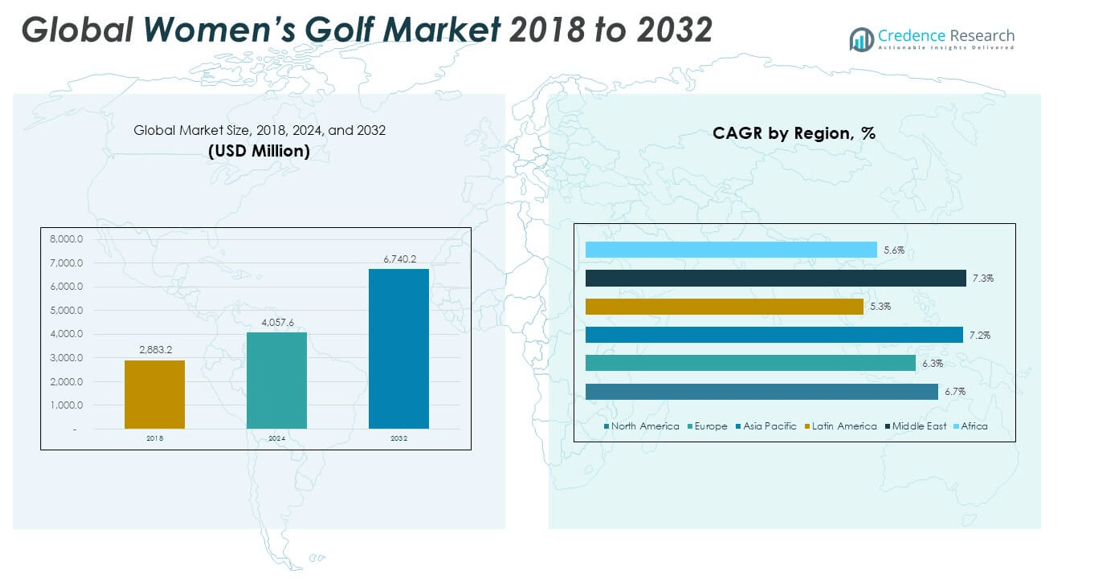
The Global Women’s Golf Market size was valued at USD 2,883.2 million in 2018 to USD 4,057.6 million in 2024 and is anticipated to reach USD 6,740.2 million by 2032, at a CAGR of 6.61% during the forecast period.
| REPORT ATTRIBUTE | DETAILS |
|---|---|
| Historical Period | 2020-2023 |
| Base Year | 2024 |
| Forecast Period | 2025-2032 |
| Women’s Golf Market Size 2024 | USD 4,057.6 million |
| Women’s Golf Market, CAGR | 6.61% |
| Women’s Golf Market Size 2032 | USD 6,740.2 million |
The market is experiencing robust growth driven by rising female participation in golf, supported by increasing professional tournaments, sponsorship opportunities, and the expansion of women-focused golf apparel and equipment lines. Lifestyle changes and the growing perception of golf as a fitness and networking activity are attracting younger demographics. Moreover, the influence of social media and celebrity endorsements is fueling brand engagement, while advancements in training technologies and inclusive club policies are creating a more welcoming environment for new entrants.
Regionally, North America leads the market due to a strong golfing culture, established infrastructure, and active participation across various age groups. Europe follows closely, benefiting from heritage golf destinations and a steady increase in women’s tournaments. The Asia-Pacific region is emerging rapidly, driven by rising interest in countries like South Korea, Japan, and China, supported by governmental sports initiatives and the global visibility of Asian women golfers. The Middle East also shows growing potential with luxury golf tourism and international event hosting.
Market Insights:
- The Global Women’s Golf Market was valued at USD 4,057.6 million in 2024 and is projected to reach USD 6,740.2 million by 2032, growing at a CAGR of 6.61%.
- Rising female participation in professional and amateur golf, supported by tournaments, sponsorships, and grassroots programs, is driving sustained demand.
- Technological advancements in equipment design, including lighter clubs and digital training aids, are enhancing player performance and market appeal.
- High infrastructure costs, membership fees, and limited accessibility in certain regions are restraining broader adoption.
- Europe leads the market share in 2024, supported by heritage golf destinations, tournament culture, and strong female participation.
- Asia Pacific is expected to record the fastest growth, driven by increasing interest in countries such as South Korea, Japan, and China, alongside rising investments in golf tourism.
- North America maintains strong demand through advanced infrastructure, high spending capacity, and consistent growth in apparel and equipment sales.
Market Drivers:
Rising Female Participation Supported by Expanding Professional Platforms
The Global Women’s Golf Market is experiencing strong growth due to increasing female participation at both amateur and professional levels. Greater visibility of women’s tournaments is inspiring more young players to take up the sport. Corporate sponsorships and media coverage have provided female golfers with enhanced exposure. Golf associations are implementing inclusive policies to attract women into clubs and competitive leagues. Sports academies are offering dedicated training programs tailored for female athletes. Apparel and equipment brands are investing in product lines designed specifically for women. The market benefits from social acceptance of golf as both a sport and a lifestyle choice for women. It continues to strengthen through partnerships between sports federations, schools, and corporate entities.
- For instance, in 2023, approximately 7million women and girls played golf on a course in the U.S., making up 26% of on-course participants-the highest proportion on record. Globally, women represent 23% of adult registered golfers, with countries like the Republic of Korea, Germany, and The Netherlands having particularly high female participation rates.
Support from Government and Sports Development Initiatives
Government-backed sports programs are contributing significantly to the expansion of women’s golf. National sports bodies are funding infrastructure projects to improve access to courses and practice facilities. Scholarships and grants for promising female athletes are increasing participation rates. The Global Women’s Golf Market benefits from initiatives that integrate golf into school and college sports curriculums. International sports events are receiving logistical and financial support from public agencies. Regulatory frameworks are promoting gender equality in sports funding. Tourism boards are promoting golf destinations with packages designed for women travelers. It is also witnessing an increase in cross-border player participation due to ease of travel and event coordination.
- For instance, in Wales, a £1million Women’s Golf Legacy Fund supported 74 projects at nearly 50 golf clubs in 2025, enhancing facilities such as on-course toilets and dedicated women’s coaching areas.
Lifestyle Evolution and Higher Disposable Incomes
Changing lifestyle preferences are influencing the growth of women’s golf worldwide. Higher disposable incomes allow women to invest in premium golfing equipment and memberships. The Global Women’s Golf Market gains momentum as working professionals view golf as a networking and leisure activity. Urban development projects are integrating golf courses into residential and hospitality spaces. Health-conscious consumers are recognizing golf’s fitness and mental well-being benefits. Businesses are hosting women-exclusive corporate golf events, creating exposure to the sport. Celebrity endorsements are encouraging wider audience engagement. It is also supported by digital platforms that offer learning modules for beginners.
Technological Advancements in Golf Equipment and Training
Innovation in golf equipment design is enhancing gameplay for women. Lighter clubs, optimized grip sizes, and advanced swing analysis tools are improving performance. The Global Women’s Golf Market benefits from the integration of smart sensors in clubs and balls for real-time feedback. Indoor simulation technology enables year-round practice regardless of climate. Data analytics tools help players refine strategies and improve consistency. Retailers are offering customization services for personalized club fitting. Brands are launching digital coaching platforms for remote learning. It is further supported by social media content that educates and engages prospective players.
Market Trends
Growth of Women-Centric Golf Apparel and Accessory Lines
Fashion trends are reshaping product offerings within women’s golf. Brands are introducing stylish, performance-oriented apparel tailored for female golfers. The Global Women’s Golf Market is seeing a rise in specialized footwear with improved comfort and traction. Accessories such as gloves, visors, and golf bags are being designed with both aesthetics and ergonomics in mind. Seasonal collections are attracting fashion-conscious golfers. Premium brands are collaborating with sports personalities to launch signature lines. Retail channels are expanding online sales platforms for golf wear. It is also benefitting from sustainability-focused apparel collections targeting environmentally aware consumers.
- For example, ALYN a women's golf apparel brand founded by former professional golfer Tisha Alyn debuted its Terra Collection, which introduces adjustable-length skirts and dresses designed to provide a customizable fit for heights ranging from 4′10″ to 5′10″. The tops include integrated sports bra support, delivering comfort and structure without additional layering.
Integration of Digital Engagement and Social Media Influence
Digital platforms are playing a major role in shaping the popularity of women’s golf. Influencers and professional golfers are using social media to engage audiences. The Global Women’s Golf Market is seeing strong engagement through video tutorials, live match coverage, and interactive content. Brands are leveraging digital campaigns to promote new product launches. Golf communities are connecting through online forums and virtual tournaments. E-commerce platforms are providing easy access to premium golfing gear. Streaming services are broadcasting niche women’s golf events to wider audiences. It is supported by mobile applications that track player performance and offer training resources.
Expansion of Golf Tourism Targeted at Female Travelers
Golf tourism is emerging as a strong trend, with packages designed specifically for women. Resorts are hosting women-only tournaments and training retreats. The Global Women’s Golf Market is benefitting from destinations that combine luxury travel with golfing experiences. Event organizers are creating itineraries that include wellness, spa, and cultural tours alongside golf activities. International golf festivals are featuring women’s divisions with attractive prizes. Airlines and hospitality providers are offering discounts for group golf travel. Travel agencies are promoting off-season packages to encourage year-round participation. It is also supported by media coverage of exotic golf destinations catering to women.
Collaborations Between Sports Organizations and Lifestyle Brands
Partnerships between sports bodies and lifestyle brands are shaping market growth. The Global Women’s Golf Market is experiencing co-branded events that merge sport with lifestyle experiences. Luxury brands are sponsoring exclusive tournaments. Sportswear companies are working with golf academies to supply training gear. High-profile events are incorporating fashion shows, product showcases, and networking sessions. Beverage and wellness brands are creating on-course experiences for participants. It is also seeing the introduction of loyalty programs that reward repeat participation. Celebrity-led campaigns are driving brand alignment with aspirational lifestyles.
- For example, in 2025, Gap partnered with Malbon Golf to launch a 33-piece limited‑edition collection that fuses Malbon’s streetwear‑inspired golf aesthetic with Gap’s prep‑school essentials, designed for both men and women.
Market Challenges Analysis
High Infrastructure Costs and Limited Accessibility in Certain Regions
The Global Women’s Golf Market faces challenges due to the high cost of developing and maintaining golf courses. Limited availability of affordable public courses restricts access in many regions. Urban areas often face land scarcity, reducing opportunities for new facilities. Membership fees and equipment costs remain barriers for entry-level players. It encounters difficulties in reaching underdeveloped markets with lower disposable incomes. Seasonal climate conditions in some areas limit year-round participation. Transportation to remote golf destinations can also impact accessibility. It must address these infrastructure and cost-related limitations to achieve broader participation.
Balancing Traditional Perceptions with Modern Engagement Strategies
Cultural perceptions in some regions hinder female participation in golf. The Global Women’s Golf Market needs to address gender biases and outdated views on sports involvement. Conservative dress codes and exclusive membership rules can deter new entrants. Marketing efforts must adapt to younger audiences without alienating traditional enthusiasts. It must also address competition from alternative sports and leisure activities. Maintaining player engagement over time is a challenge when competing with fast-paced, tech-driven entertainment options. Sponsorship opportunities can be uneven across regions, limiting exposure. It requires targeted outreach to align tradition with evolving consumer expectations.
Market Opportunities
Expanding Youth Development Programs and Grassroots Engagement
Youth-focused programs offer significant growth potential for the Global Women’s Golf Market. Training academies and school partnerships can introduce the sport at an early age. Affordable starter equipment can make entry easier for young players. Scholarships for talented female golfers can encourage competitive participation. It can also benefit from community-based initiatives that promote inclusivity. Corporate sponsorship for junior leagues can strengthen the pipeline of future professionals. Partnerships with non-profit organizations can further extend outreach to underserved communities.
Leveraging Technology for Wider Market Reach and Personalization
Adoption of virtual training platforms and AI-powered swing analysis tools presents strong opportunities. The Global Women’s Golf Market can benefit from gamified learning apps to attract younger demographics. Personalized equipment fitting services can enhance player experience. It can also use virtual reality to simulate global course play for training and leisure. Data analytics can optimize marketing strategies and player retention programs. Collaborations with tech companies can accelerate innovation in equipment and training systems.
Market Segmentation Analysis:
By product, the clubs segment holds the largest share in the Global Women’s Golf Market, driven by consistent demand from both amateur and professional players. Innovation in club design, including lighter materials and ergonomic grips, is enhancing playability for women. The training aids segment is gaining momentum with the adoption of swing analyzers, simulators, and portable practice tools that improve performance. Apparel is evolving from functional sportswear to a blend of performance and style, with brands introducing moisture-wicking fabrics, tailored fits, and designs that cater to varied climates. It continues to benefit from premiu.m positioning and brand collaborations with professional golfers.
- For example, TaylorMade designs women's fairway woods with lightweight components women’s flex graphite shafts typically weigh around 40–45 grams, which improves swing speed and feel for female golfers
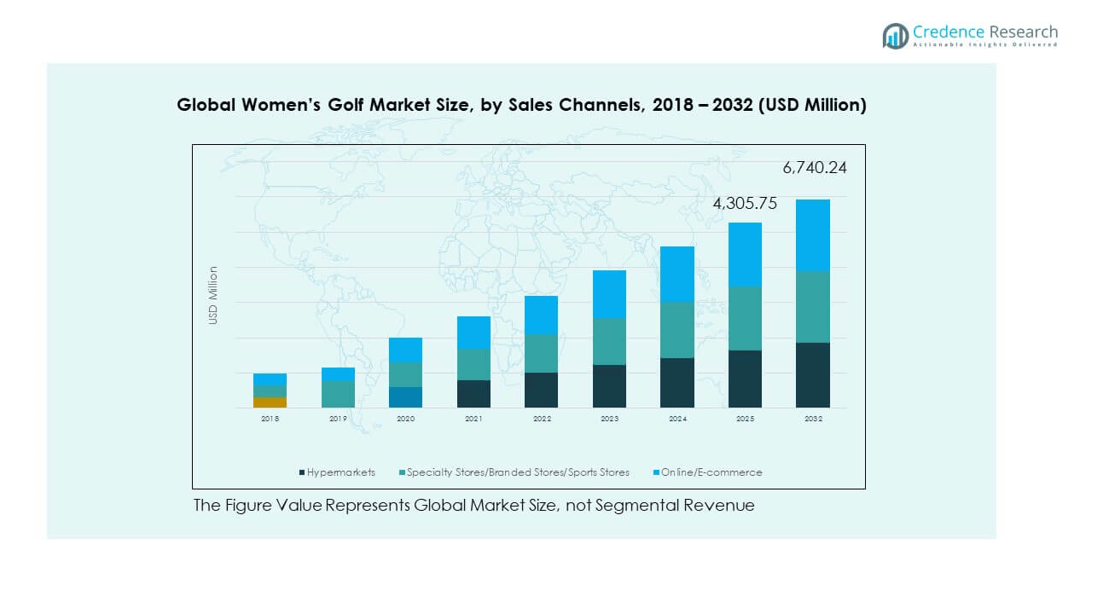
By sales channel, specialty stores, branded outlets, and sports stores dominate due to the advantage of personalized fitting services, expert guidance, and exclusive product availability. Hypermarkets contribute significantly in regions with strong retail penetration, offering competitive pricing and wide accessibility. Online and e-commerce channels are expanding rapidly, fueled by the convenience of doorstep delivery, a broad product range, and the integration of virtual fitting tools. It is also supported by digital marketing campaigns, influencer partnerships, and interactive shopping platforms that attract both new and experienced players.
- For example, Decathlon, Europe’s largest sporting goods retailer, actively promotes golf products across its French and Spanish hypermarket locations through seasonal campaigns such as “Golf Month,” offering discounts on apparel, clubs, and accessories under its in-house brand Inesis.
Segmentation:
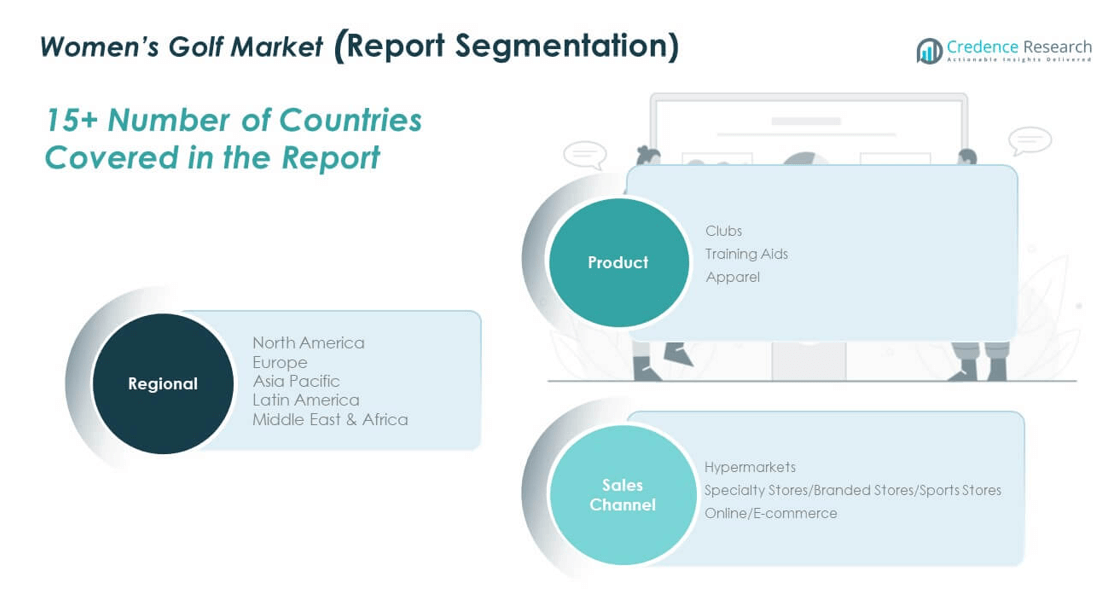
By Product
- Clubs
- Training Aids
- Apparel
By Sales Channel
- Hypermarkets
- Specialty Stores / Branded Stores / Sports Stores
- Online / E-commerce
By Region
- North America
- U.S.
- Canada
- Mexico
- Europe
- UK
- France
- Germany
- Italy
- Spain
- Russia
- Belgium
- Netherlands
- Austria
- Sweden
- Poland
- Denmark
- Switzerland
- Rest of Europe
- Asia Pacific
- China
- Japan
- South Korea
- India
- Australia
- Thailand
- Indonesia
- Vietnam
- Malaysia
- Philippines
- Taiwan
- Rest of Asia Pacific
- Latin America
- Brazil
- Argentina
- Peru
- Chile
- Colombia
- Rest of Latin America
- Middle East
- UAE
- KSA
- Israel
- Turkey
- Iran
- Rest of Middle East
- Africa
- Egypt
- Nigeria
- Algeria
- Morocco
- Rest of Africa
Regional Analysis:
North America
The North America Global Women’s Golf Market size was valued at USD 765.48 million in 2018 to USD 1,085.63 million in 2024 and is anticipated to reach USD 1,821.89 million by 2032, at a CAGR of 6.7% during the forecast period. North America accounts for 26.75% of the global market share in 2024, supported by its well-established golfing culture, extensive infrastructure, and high consumer spending power. The U.S. dominates regional demand, driven by a dense network of golf courses, professional tournaments, and active participation across all age groups. It benefits from strong brand presence, advanced retail networks, and access to premium golfing technology. Canada and Mexico are witnessing steady growth through tourism-driven events and grassroots programs. Regional sports associations actively promote female participation through scholarships, league events, and training initiatives. E-commerce platforms are expanding their footprint, catering to younger demographics seeking convenience. Golf apparel and equipment brands in the region are leveraging celebrity endorsements and digital campaigns to sustain growth.
Europe
The Europe Global Women’s Golf Market size was valued at USD 909.93 million in 2018 to USD 1,259.87 million in 2024 and is anticipated to reach USD 2,047.01 million by 2032, at a CAGR of 6.3% during the forecast period. Europe holds 31.04% of the global market share in 2024, supported by its heritage golf destinations and a growing number of women’s tournaments. The UK, Germany, and France lead in participation, with golf associations investing in grassroots programs. It is supported by advanced training facilities, seasonal tourism, and a strong culture of competitive play. Southern European countries such as Spain and Italy are attracting international players through resort-based golf tourism. The region benefits from cross-border leagues and pan-European tournaments that enhance visibility for female golfers. Apparel and accessory brands are integrating European fashion trends with performance gear to attract style-conscious players. Sponsorship from luxury and lifestyle brands is expanding opportunities for women athletes.
Asia Pacific
The Asia Pacific Global Women’s Golf Market size was valued at USD 631.99 million in 2018 to USD 921.76 million in 2024 and is anticipated to reach USD 1,602.83 million by 2032, at a CAGR of 7.2% during the forecast period. Asia Pacific represents 22.71% of the global market share in 2024, with rapid growth driven by rising interest in countries like South Korea, Japan, China, and Australia. Governments are investing in sports infrastructure and hosting international tournaments to boost tourism. It benefits from the global visibility of Asian women golfers excelling in professional tours. Japan and South Korea lead in market maturity, with high adoption of premium golf equipment and apparel. China and India are emerging markets with significant growth potential due to rising middle-class participation. Digital platforms are popular among younger players for skill development and product purchases. Golf tourism combining leisure and cultural experiences is expanding in Southeast Asia.
Latin America
The Latin America Global Women’s Golf Market size was valued at USD 294.37 million in 2018 to USD 387.50 million in 2024 and is anticipated to reach USD 584.38 million by 2032, at a CAGR of 5.3% during the forecast period. Latin America holds 9.55% of the global market share in 2024, supported by increasing interest in golf tourism and amateur tournaments. Brazil and Argentina are key markets, with golf courses integrated into luxury resorts. It benefits from favorable weather conditions that allow year-round play in many locations. Regional sports bodies are promoting female participation through development programs and partnerships with schools. Online retail growth is making premium equipment and apparel more accessible. Cross-border events with North America are boosting competitive exposure. Economic conditions influence purchasing behavior, making value-oriented product lines important. Brand-sponsored events and training clinics are gradually expanding the sport’s reach.
Middle East
The Middle East Global Women’s Golf Market size was valued at USD 211.05 million in 2018 to USD 309.01 million in 2024 and is anticipated to reach USD 539.89 million by 2032, at a CAGR of 7.3% during the forecast period. The Middle East accounts for 7.62% of the global market share in 2024, fueled by luxury golf tourism, high-profile tournaments, and investments in premium facilities. The UAE and Saudi Arabia are leading markets, hosting international events and developing women-focused golfing programs. It is supported by government initiatives to promote sports inclusivity and diversify tourism offerings. Golf resorts offer premium experiences that combine hospitality, wellness, and professional coaching. Retailers are catering to affluent customers with high-end apparel and customized equipment. Partnerships with global brands are increasing product availability. Regional events attract international players, boosting visibility and engagement.
Africa
The Africa Global Women’s Golf Market size was valued at USD 70.35 million in 2018 to USD 93.79 million in 2024 and is anticipated to reach USD 144.24 million by 2032, at a CAGR of 5.6% during the forecast period. Africa represents 2.87% of the global market share in 2024, with South Africa leading due to its established golfing infrastructure and international event hosting. Egypt and Morocco are emerging destinations for golf tourism. It benefits from a growing interest in women’s sports and regional training programs. Accessibility remains a challenge in rural areas due to limited facilities. Equipment imports play a key role in market supply. Climate diversity across the continent supports year-round golfing in certain regions. Local initiatives and corporate sponsorships are expanding awareness and participation.
Key Player Analysis:
- Acushnet Company
- Ping
- Mizuno Corporation
- Sun Mountain Sports
- Motocaddy
- TaylorMade Golf
- Wilson Sporting Goods
- Taser International Inc.
- Chicco Golf
- Other Key Players
Competitive Analysis:
The Global Women’s Golf Market is characterized by strong competition among established brands such as Acushnet Company, Ping, Mizuno Corporation, TaylorMade Golf, Wilson Sporting Goods, and Sun Mountain Sports. These companies focus on product innovation, premium quality, and targeted marketing strategies to maintain market leadership. It is witnessing increased collaborations between sports brands and professional female golfers to enhance brand visibility. Emerging players are entering niche segments such as women-specific apparel and advanced training aids. Distribution strategies include expansion into e-commerce platforms and specialty stores to reach wider audiences. Competitive positioning is influenced by product customization, technological integration, and sustainability-focused offerings.
Recent Developments:
- In June 2025, Acushnet Company, known for its Titleist and FootJoy brands, launched a new digital platform- the Acushnet Hub- to streamline ordering for trade partners, making it easier for golf retailers worldwide to access the latest women's golf equipment and custom club services. This platform rollout is paired with the continued strong performance of new product launches like the latest Pro V1 golf balls, which have contributed to a 5% year-over-year increase in net sales for the company in Q2 2025
- In May 2025, Mizuho Americas renewed its title sponsorship agreement with the LPGA Tour for the Mizuho Americas Open, extending through 2030. The company announced that it would raise the tournament purse to $3.25million starting in 2026, making it one of the largest purses on the LPGA Tour outside of the majors.
- In January 2025, Sun Mountain Sports unveiled several new products at the PGA Show, including the innovative Eclipse E-Series golf bags and a premium AW25 apparel collection-reflecting the brand's strategy to reinvent equipment specifically with women golfers in mind. This launch highlights Sun Mountain’s continued role as a leader in performance golf gear and apparel.
Market Concentration & Characteristics:
The Global Women’s Golf Market demonstrates moderate concentration, with a mix of global leaders and regional brands competing for market share. It is driven by innovation in product design, brand endorsements, and the integration of digital retail channels. Leading companies maintain dominance through extensive distribution networks and strong brand equity. The market shows seasonal sales patterns influenced by regional golfing climates. Product differentiation and targeted promotions are essential for sustaining growth. Sustainability initiatives and eco-friendly materials are gaining traction among premium brands. Strategic partnerships with tourism boards and event organizers are expanding the market’s visibility and consumer engagement.
Report Coverage:
The research report offers an in-depth analysis based on Product and Sales Channel. It details leading market players, providing an overview of their business, product offerings, investments, revenue streams, and key applications. Additionally, the report includes insights into the competitive environment, SWOT analysis, current market trends, as well as the primary drivers and constraints. Furthermore, it discusses various factors that have driven market expansion in recent years. The report also explores market dynamics, regulatory scenarios, and technological advancements that are shaping the industry. It assesses the impact of external factors and global economic changes on market growth. Lastly, it provides strategic recommendations for new entrants and established companies to navigate the complexities of the market.
Future Outlook:
- Expansion of women-focused golf academies will strengthen talent pipelines in both developed and emerging markets, fostering greater participation at competitive and recreational levels.
- Growing adoption of technology-driven training aids, including swing analyzers and simulators, will enhance skill development, improve performance, and attract tech-savvy consumers.
- Lifestyle-driven demand for golf apparel will open avenues for collaborations between fashion labels and sportswear brands, blending style with performance functionality.
- E-commerce growth will improve global accessibility to premium equipment, apparel, and accessories, supported by targeted online marketing campaigns.
- Rising popularity of golf tourism will drive demand for integrated travel experiences, combining sporting events with luxury accommodations and leisure activities.
- Strategic partnerships between professional women golfers and leading brands will increase consumer trust, visibility, and loyalty.
- Development of affordable starter kits will encourage younger demographics and first-time players to take up the sport.
- Sustainability-focused product innovation will influence purchase decisions, particularly in premium and eco-conscious segments.
- Increased media coverage and international tournaments will elevate visibility, attracting new participants and audiences worldwide.
- Investment in grassroots and community-based programs will expand the sport’s reach across underserved and remote regions.

Request a Free Sample
Fill in your details and we'll send you a free sample report.
- Sample data tables & charts
- Research methodology
Market Dynamics
Rising Female Participation and Professional Platforms
Increasing visibility of women's tournaments, corporate sponsorships, and inclusive club policies are inspiring more women and girls to take up golf, driving sustained demand for equipment, apparel, and training aids.
Government and Sports Development Initiatives
National sports bodies and government-backed programs are funding infrastructure, scholarships, and grassroots engagement, making golf more accessible to women and supporting market expansion, especially in emerging regions.
Lifestyle Evolution and Higher Disposable Incomes
Golf is increasingly seen as a fitness, networking, and leisure activity among women, with higher disposable incomes enabling investment in premium equipment, memberships, and travel, fueling market growth.
Technological Advancements in Equipment and Training
Innovations such as lighter clubs, digital swing analyzers, and virtual training platforms are enhancing player performance and attracting tech-savvy and younger demographics to the sport.
Growth of Women-Centric Apparel and Accessory Lines
Brands are launching stylish, performance-oriented apparel and accessories tailored for female golfers, supported by collaborations with athletes and fashion labels, which is expanding the market's appeal and reach.
Need a Custom Version of This Report?
Tailor the scope, geography, or segments to your exact requirements.
- Custom geography or segment scope
- Direct access to our analyst team
Frequently Asked Questions
What is the current market size for Global Women’s Golf Market, and what is its projected size in 2032?
At what Compound Annual Growth Rate is the Global Women’s Golf Market projected to grow between 2024 and 2032?
What are the primary factors fueling the growth of the Global Women’s Golf Market?
Which region commanded the largest share of the Global Women’s Golf Market in 2024?
Table of Content
Chapter 1 Market Segmentation
- 1.1 Segmentation Framework
- 1.1.1 Product and Service Classification
- 1.1.2 Application and End-Use Classification
- 1.1.3 Technology and Solution Classification
- 1.1.4 Customer and Distribution Channel Classification
- 1.1.5 Geographic Segmentation
- 1.1.6 Market Segment Definitions and Boundaries
- 1.2 By Product
- 1.2.1 Clubs
- 1.2.2 Training Aids
- 1.2.3 Apparel
- 1.3 By Sales Channel
- 1.3.1 Hypermarkets
- 1.3.2 Specialty Stores / Branded Stores / Sports Stores
- 1.3.3 Online / E-commerce
Chapter 2 Introduction
- 2.1 Report Objectives and Scope
- 2.2 Product Definition and Industry Terminology
- 2.3 Market Inclusions and Exclusions
- 2.4 Research Process
- 2.4.1 Primary Research and Expert Interviews
- 2.4.2 Secondary Research and Source Review
- 2.4.3 Top-Down and Bottom-Up Estimation
- 2.4.4 Data Triangulation and Verification
- 2.5 Market Size Measurement Basis
- 2.5.1 2024: USD 4,057.6 million → 2032: USD 6,740.2 million
- 2.6 Historical and Forecast Reference Periods
- 2.6.1 Base Year: 2024
- 2.6.2 Forecast Period: 2024-2032
- 2.7 Research Assumptions and Limitations
Chapter 3 Executive Summary
- 3.1 Market Snapshot and Key Findings
- 3.2 Base-Year Market Size, 2024
- 3.3 Forecast Market Size, 2032
- 3.4 Revenue and Volume Growth Outlook
- 3.5 Key Demand and Supply Indicators
- 3.6 Leading Market Segments
- 3.7 Fastest-Growing Market Opportunities
- 3.8 Regional Performance Highlights
- 3.9 Technology and Industry Transformation
- 3.10 Competitive Landscape Summary
- 3.11 Analyst View and Strategic Implications
Chapter 4 Global Women’s Golf Market Trends and Developments
- 4.1 Historical Industry Development
- 4.2 Recent Market Trends and Developments
- 4.3 Demand and Customer Behavior Trends
- 4.4 Technology and Product Innovation
- 4.5 Artificial Intelligence, Automation and Digitalization
- 4.6 Local Manufacturing and Supply Chain Realignment
- 4.7 Industry Partnerships, Mergers and Acquisitions
- 4.8 Sustainability and Circular Economy Developments
- 4.9 Government and Private Sector Investment Trends
- 4.10 Emerging Business Models and Commercialization
- 4.11 Industry Developments and Announcements
Chapter 5 Global Women’s Golf Market Production, Supply and Demand Analysis
- 5.1 Demand Trend and Consumption Analysis
- 5.2 Demand Forecast, 2024-2032
- 5.3 Production and Output Trend
- 5.4 Production and Output Forecast, 2024-2032
- 5.5 Installed Capacity and Capacity Utilization
- 5.6 Company-Wise Production Plants and Statistics
- 5.6.1 Installed Production Capacity
- 5.6.2 Actual Production
- 5.6.3 Planned Capacity and Expansion Targets
- 5.7 Supply Chain Structure and Procurement Trends
- 5.8 Supply-Demand Gap and Bottlenecks
- 5.9 Import Dependence and Sourcing Structure
- 5.10 Contract Manufacturing and Outsourcing
- 5.11 Regional Supply and Demand Concentration
Chapter 6 Global Women’s Golf Market Pricing Analysis
- 6.1 Pricing Structure and Measurement
- 6.2 Historical Pricing Trends
- 6.3 Pricing Outlook, 2024-2032
- 6.4 Average Selling Price and Unit Economics
- 6.5 Pricing by Product and Market Segment
- 6.6 Geographic Pricing Differences
- 6.7 Key Input, Energy, Labor and Logistics Costs
- 6.8 Contract Pricing and Purchasing Models
- 6.9 Pricing Sensitivity and Competitive Positioning
- 6.10 Price, Margin and Profitability Implications
Chapter 7 Global Women’s Golf Market Dynamics
- 7.1 Market Growth Drivers
- 7.1.1 Demand-Side Drivers
- 7.1.2 Technology and Innovation Drivers
- 7.1.3 Infrastructure and Investment Drivers
- 7.1.4 Regulatory and Policy Drivers
- 7.2 Market Restraints
- 7.2.1 Cost and Affordability Constraints
- 7.2.2 Technology and Adoption Barriers
- 7.2.3 Supply Chain and Operational Constraints
- 7.3 Market Challenges
- 7.3.1 Competitive Pressure and Margin Erosion
- 7.3.2 Skills, Infrastructure and Implementation Gaps
- 7.4 Emerging Market Opportunities
- 7.5 Market Dynamics Impact and Time-Horizon Assessment
Chapter 8 Global Women’s Golf Value Chain Analysis
- 8.1 Industry Value Chain Overview
- 8.2 Upstream Suppliers and Critical Inputs
- 8.3 Technology and Component Providers
- 8.4 Manufacturing or Service Delivery
- 8.5 Distribution, Channel Partners and Integrators
- 8.6 Downstream Applications and End Users
- 8.7 Value Addition and Profit Pools
- 8.8 Vertical Integration and Outsourcing
- 8.9 Supplier Concentration and Risk
- 8.10 Supply Chain Localization and Resilience
Chapter 9 Global Women’s Golf Market Regulations and Policies
- 9.1 Relevant Laws, Standards and Compliance Frameworks
- 9.2 Product, Service, Safety and Quality Requirements
- 9.3 Government Policies, Incentives and Subsidies
- 9.4 Imports, Exports and Trade Barriers
- 9.5 Public Procurement and Local Content Requirements
- 9.6 Environmental and Sustainability Compliance
- 9.7 Upcoming Policy Changes and Market Implications
Chapter 10 Global Women’s Golf Market Hotspots and Opportunities
- 10.1 Market Opportunity Mapping and Growth Hotspots
- 10.2 High-Growth Applications and Customer Groups
- 10.3 Underserved Markets and White-Space Opportunities
- 10.4 Emerging Technology and Product Opportunities
- 10.5 New Capacity and Investment Hotspots
- 10.6 Market Entry and Expansion Opportunities
- 10.7 Distribution and Partnership Opportunities
- 10.8 Near-Term and Long-Term Commercial Potential
- 10.9 Opportunity Attractiveness and Execution Risks
Chapter 11 Global Women’s Golf Market Outlook, 2024-2032
- 11.1 Market Size and Analysis
- 11.1.1 Revenue (Market Measurement: 2024: USD 4,057.6 million → 2032: USD 6,740.2 million)
- 11.1.2 Market Volume and Quantity Sold
- 11.1.3 Historical Market Size
- 11.1.4 Base-Year Market Size, 2024
- 11.2 Market Forecast, 2024-2032
- 11.2.1 Revenue Forecast to 2032
- 11.2.2 Volume Forecast to 2032
- 11.2.3 CAGR and Year-on-Year Growth
- 11.2.4 Incremental Revenue Opportunity
- 11.3 Forecast Assumptions and Scenario Analysis
- 11.3.1 Base-Case Forecast
- 11.3.2 Optimistic and Conservative Scenarios
- 11.3.3 Technology, Pricing and Policy Sensitivities
- 11.4 Market Attractiveness and Growth Outlook
Chapter 12 Global Women’s Golf Market Segmentation and Outlook
- 12.1 Segmentation Summary and Market Shares, 2024
- 12.2 Largest and Fastest-Growing Segments
- 12.3 By Product - Market Size and Forecast, 2024-2032
- 12.3.1 Segment Definition and Scope
- 12.3.2 Historical Market Size
- 12.3.3 Revenue Forecast, 2024-2032
- 12.3.4 Volume Forecast, 2024-2032
- 12.3.5 Base-Year Market Share, 2024
- 12.3.6 Segment CAGR and Growth Drivers
- 12.3.7 Subsegment Market Size and Forecast
- 12.3.7.1 Clubs
- 12.3.7.2 Training Aids
- 12.3.7.3 Apparel
- 12.3.8 Subsegment Pricing and Adoption Trends
- 12.3.9 Leading Suppliers and Competition
- 12.3.10 Regional Demand and Opportunities
- 12.4 By Sales Channel - Market Size and Forecast, 2024-2032
- 12.4.1 Segment Definition and Scope
- 12.4.2 Historical Market Size
- 12.4.3 Revenue Forecast, 2024-2032
- 12.4.4 Volume Forecast, 2024-2032
- 12.4.5 Base-Year Market Share, 2024
- 12.4.6 Segment CAGR and Growth Drivers
- 12.4.7 Subsegment Market Size and Forecast
- 12.4.7.1 Hypermarkets
- 12.4.7.2 Specialty Stores / Branded Stores / Sports Stores
- 12.4.7.3 Online / E-commerce
- 12.4.8 Subsegment Pricing and Adoption Trends
- 12.4.9 Leading Suppliers and Competition
- 12.4.10 Regional Demand and Opportunities
- 12.5 Segment Growth Comparison
- 12.6 Segment Attractiveness and Priority Matrix
Chapter 13 Global Women’s Golf Geographic Market Outlook, 2024-2032
- 13.1 Regional Market Size and Share, 2024
- 13.2 Regional Market Forecast, 2024-2032
- 13.3 Regional Pricing, Production and Demand Differences
- 13.4 North America
- 13.4.1 United States
- 13.4.2 Canada
- 13.4.3 Mexico
- 13.5 Europe
- 13.5.1 Germany
- 13.5.2 France
- 13.5.3 Italy
- 13.5.4 United Kingdom
- 13.5.5 Spain
- 13.5.6 Poland
- 13.5.7 Russia
- 13.5.8 Netherlands
- 13.5.9 Belgium
- 13.5.10 Sweden
- 13.5.11 Denmark
- 13.5.12 Norway
- 13.5.13 Rest of Europe
- 13.6 Asia Pacific
- 13.6.1 China
- 13.6.2 India
- 13.6.3 Japan
- 13.6.4 South Korea
- 13.6.5 Thailand
- 13.6.6 Indonesia
- 13.6.7 Vietnam
- 13.6.8 Malaysia
- 13.6.9 Australia
- 13.6.10 Rest of Asia Pacific
- 13.7 Latin America
- 13.7.1 Brazil
- 13.7.2 Argentina
- 13.7.3 Colombia
- 13.7.4 Chile
- 13.7.5 Rest of Latin America
- 13.8 Middle East
- 13.8.1 Saudi Arabia
- 13.8.2 United Arab Emirates
- 13.8.3 Turkey
- 13.8.4 Israel
- 13.8.5 Iran
- 13.8.6 Rest of the Middle East
- 13.9 Africa
- 13.9.1 South Africa
- 13.9.2 Egypt
- 13.9.3 Nigeria
- 13.9.4 Morocco
- 13.9.5 Rest of Africa
- 13.10 Regional Investment, Policy and Supply Chain Differences
- 13.11 Regional Competitive Landscape
- 13.12 Geographic Growth Hotspots
Chapter 14 Global Women’s Golf Technology, Innovation and Sustainability Outlook
- 14.1 Technology Landscape and Maturity
- 14.2 Product, Process and Service Innovation
- 14.3 AI, Automation and Digital Tools in the Industry
- 14.4 Technology Adoption and Performance Benchmarking
- 14.5 Innovation Pipeline and R&D Investment
- 14.6 Patent and Intellectual Property Trends
- 14.7 Energy Efficiency and Resource Management
- 14.8 Sustainability, Recycling and Circularity
- 14.9 Technology Roadmap, 2024-2032
- 14.10 Risks of Obsolescence and Technology Substitution
Chapter 15 Global Women’s Golf Market Key Strategic Imperatives
- 15.1 Growth and Market Entry Priorities
- 15.2 High-Return Products and Segments
- 15.3 Pricing, Profitability and Cost Optimization
- 15.4 Technology Investment and Product Differentiation
- 15.5 Supply Chain Localization and Resilience
- 15.6 Distribution and Customer Acquisition
- 15.7 Partnership, Acquisition and Capacity Strategy
- 15.8 Regional Expansion Priorities
- 15.9 Short-, Medium- and Long-Term Actions
Chapter 16 Competition Outlook
- 16.1 Industry Competition Characteristics
- 16.2 Market Structure and Concentration
- 16.3 Market Share and Competitive Positioning, 2024
- 16.4 Company-Wise Revenue and Product Benchmarking
- 16.5 Production and Service Capacity Benchmarking
- 16.6 Technology, Pricing and Differentiation
- 16.7 Regional Footprint and Distribution Strength
- 16.8 Mergers, Acquisitions and Strategic Alliances
- 16.9 New Entrants and Competitive Threats
- 16.10 Porter's Five Forces and Industry Attractiveness
- 16.11 Competitive Outlook, 2024-2032
Chapter 17 Company Profiles
- 17.1 Company Coverage and Selection Criteria
- 17.2 Acushnet Company
- 17.2.1 Business Description
- 17.2.2 Company Ownership and Geographic Presence
- 17.2.3 Product and Service Portfolio
- 17.2.4 Manufacturing and Operating Footprint
- 17.2.5 Production Capacity and Expansion Plans
- 17.2.6 Financial Performance and Investment
- 17.2.7 Market Share and Competitive Position
- 17.2.8 Technology and Innovation Capabilities
- 17.2.9 Strategic Alliances or Partnerships
- 17.2.10 Recent Developments
- 17.2.11 Growth Strategy and Outlook
- 17.3 Ping
- 17.4 Mizuno Corporation
- 17.5 Sun Mountain Sports
- 17.6 Motocaddy
- 17.7 TaylorMade Golf
- 17.8 Wilson Sporting Goods
- 17.9 Taser International Inc.
- 17.10 Chicco Golf
- 17.11 Other Relevant Market Participants
Note: Every listed company is profiled on the structure shown under the first company. The company list is preliminary and may change based on research findings, market developments, data availability and client requirements.
Chapter 18 Disclaimer
- 18.1 Research and Forecast Disclaimer
- 18.2 Data Source and Estimation Limitations
Note: The depth of individual sections depends on data availability for this market. Volume, capacity, trade and other unit-based metrics are included where applicable.

