
Adani Ports to Acquire Europe's Evos for 2.56 Billion Euros, Adding Eight Liquid Storage Terminals
Adani Ports and Special Economic Zone Ltd. (APSEZ) has agreed to buy all of Evos B.V., a Netherlands-based independent liquid storage operator, from Igneo Infrastructure Partners at an enterprise value of 2.56 billion euros. The all-cash deal, announced from Ahmedabad, India, on Nov. 5, 2026, gives the Indian port group eight port terminals across five European countries and what it called a significant European foothold in liquids handling.
Key developments
- APSEZ will acquire 100% of Evos for an enterprise value of 2.56 billion euros and an equity value of 1.18 billion euros, which the company put at 11.7 times Evos' 2025 EBITDA.
- Evos runs eight port-based terminals in the Netherlands, Germany, Spain, Belgium and Malta, with 6.3 million cubic meters of storage in 452 tanks and 63 vessel and barge berths.
- The terminals handled 37 million metric tons of liquids in 2025, producing revenue of 392 million euros and EBITDA of 219 million euros, a 56% margin, with average commercial occupancy of 99%.
- The purchase is funded with debt. MUFG is sole underwriter and has committed up to 2.8 billion euros of financing.
- Completion depends on regulatory and other approvals and works council consultation. APSEZ did not give a closing date.
Industry background
Independent tank terminals sit between refineries, importers, traders and end users. They rent tank space and berths to customers who need to receive, blend, hold and re-ship fuels and chemicals, usually under multi-year contracts. Evos stores conventional fuels such as gasoline, gasoil, marine fuel and jet fuel, along with sustainable aviation fuel, biofuels, methanol and bioethanol. According to APSEZ, most of its revenue comes from take-or-pay contracts with inflation-linked pricing, and its customers include global energy majors, chemical companies and commodity traders.
The portfolio is concentrated in the Amsterdam-Rotterdam-Antwerp (ARA) region, Europe's main hub for refined product trading, with additional sites in Hamburg and the Mediterranean. Baird Maritime reported that the terminals are in Amsterdam, Rotterdam and Terneuzen in the Netherlands, Ghent in Belgium, Hamburg in Germany, Algeciras in Spain and Malta. APSEZ said the network includes pipeline connections to Schiphol airport and the Central Europe Pipeline System, which carries military and civil jet fuel across several NATO countries.
For APSEZ, the deal extends an overseas build-out that already includes the Colombo West International Terminal in Sri Lanka, a terminal in Tanzania and the NQXT coal export terminal in Australia. The company said its international ports unit handled 47 million metric tons in the first half of fiscal 2027, up from 17 million a year earlier.
Industry implications
The transaction puts a large block of European fuel logistics capacity under the control of an Asian port group at a time when Europe's fuel supply chain is being rewired. Sanctions on Russian products, refinery closures in Northwest Europe and the EU's blending mandates for aviation and shipping fuels have all increased the amount of product that must be imported, stored and redistributed through coastal terminals. Tanks that can switch between fossil and renewable products are central to that shift.
APSEZ pitched Evos as exposure to the long-term move toward new fuels, while the cash flows still rest mostly on conventional products. That mix gives the buyer contracted income today and options on sustainable aviation fuel, methanol and biofuel storage as EU mandates step up. It also means Evos' customers will look for continuity in service terms, safety management and investment in tank conversions under new ownership.
Competitive and supply chain implications
Evos competes for tank storage customers in ARA and the Mediterranean with long-established operators such as Royal Vopak and Oiltanking, as well as smaller private terminal owners. A well-capitalized new owner with a stated goal of handling 1 billion tons of cargo a year could invest more aggressively in berth upgrades, new product tanks and digital terminal systems, raising the bar for rivals on service and conversion capability.
The deal also links European storage with APSEZ's port network in India and elsewhere. That could support integrated offers for traders moving products between Asia, the Middle East and Europe, although APSEZ has not announced specific commercial plans. For refiners and traders, high occupancy at Evos suggests that available tank space in key hubs remains tight, and any ownership change will be watched for its effect on contract renewals and pricing.
On the financing side, a single-bank underwriting commitment of up to 2.8 billion euros shows that lenders remain willing to back large infrastructure acquisitions with contracted, inflation-linked revenue. APSEZ said the combined company's net debt would equal 2.76 times EBITDA on a pro forma basis.
Regional implications
In the Netherlands and Belgium, the purchase brings a major non-European owner into terminals that serve refineries, chemical clusters and airports. Governments in the region have tightened scrutiny of foreign investment in critical infrastructure in recent years, and fuel storage linked to airport and cross-border pipeline systems is likely to draw attention during the approval process. Works councils in the Netherlands also have a formal advisory role in ownership changes.
In Germany, Spain and Malta, the terminals support bunkering and regional fuel distribution, including the Strait of Gibraltar shipping lane through Algeciras. For India, the deal adds to a run of overseas port investments by APSEZ and takes its footprint to 28 ports and terminals in 10 countries, according to the company.
Credence Research analysis
The Evos purchase shows APSEZ shifting from building and buying container and bulk ports in emerging markets to acquiring a mature, contract-backed platform in Europe's most developed fuel hub. The price paid, about 11.7 times trailing EBITDA, reflects the premium that investors place on high-occupancy terminals with take-or-pay revenue and inflation protection. APSEZ is betting that steady cash flows in euros will balance the currency and demand risk in its domestic business.
The bigger test will be execution and approvals. The deal must clear European regulators and works councils at a time when ownership of energy infrastructure is politically sensitive, and APSEZ will need to show customers that it will keep investing in safety and in tank conversions for renewable fuels. If those hurdles are cleared, Evos gives APSEZ a platform from which further European liquids or port acquisitions could follow.
What comes next
- APSEZ and Igneo begin regulatory filings and works council consultations, which the release said would start immediately.
- European competition and foreign investment authorities review the transaction; no closing date has been set.
- APSEZ finalizes the debt package backed by MUFG's commitment of up to 2.8 billion euros ahead of completion.
- Customers and employees at the eight terminals will watch for statements on management, investment plans and contract terms under APSEZ ownership.
- APSEZ is likely to update investors on integration and financing at its next quarterly results.
Sources
- Adani Group: APSEZ agrees to acquire 100% of Evos B.V. (Nov. 5, 2026)
- Baird Maritime: Adani Ports agrees acquisition of liquid storage operator Evos
- gCaptain: Adani Ports makes major push into Europe with Evos acquisition
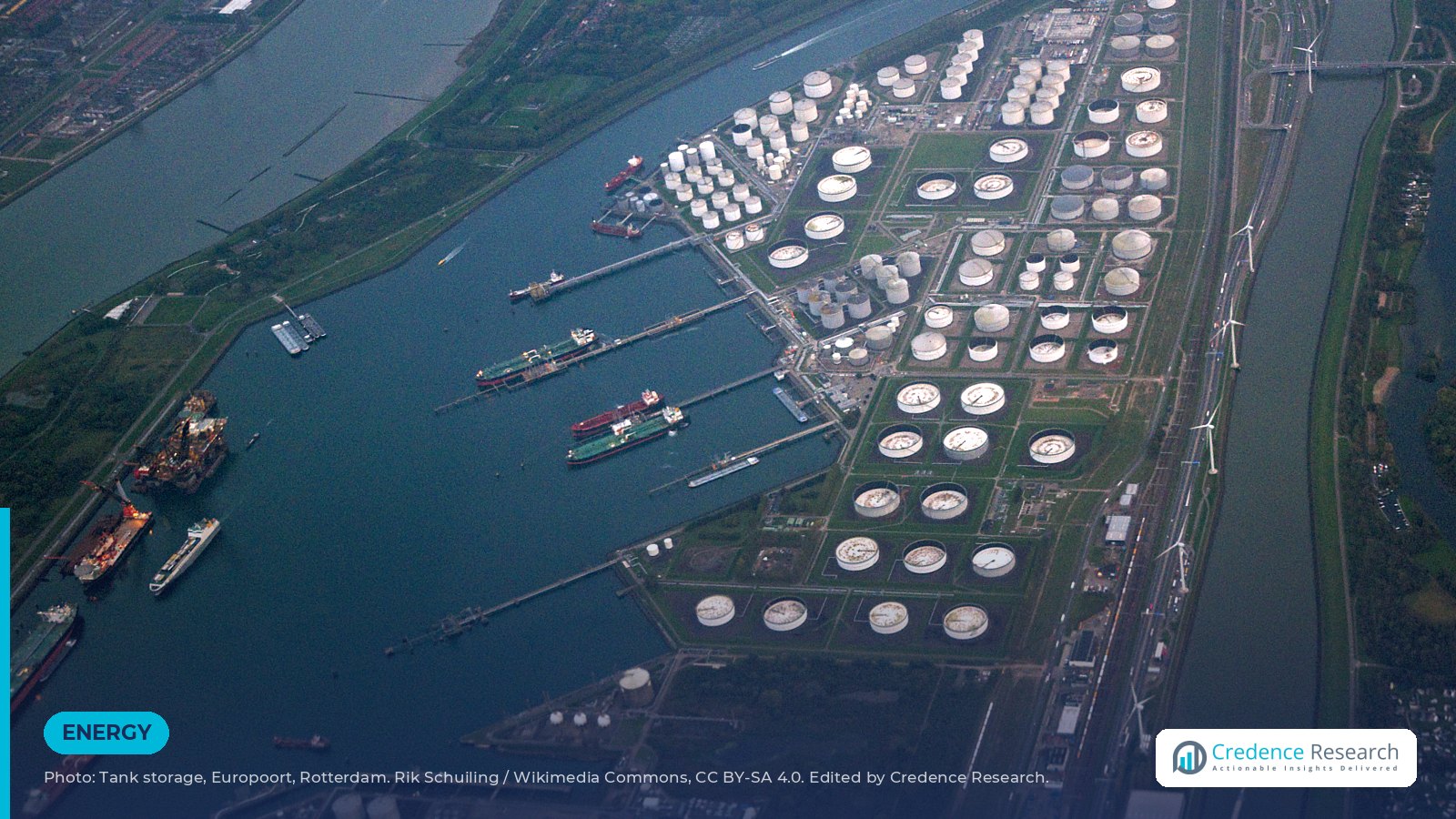
Image: Aerial view of tank storage at the Zevende Petroleumhaven, Europoort, Rotterdam (illustrative; not an Evos site), by Rik Schuiling / TropCrop-TCS via Wikimedia Commons, CC BY-SA 4.0. Cropped and edited by Credence Research.

About the Author

Senior News Editor at Credence Research Inc