
Coherent Signs $20 Billion, Five-Year PhotonLink Agreement With Unnamed AI Data Center Customer
Coherent Corp. has signed a five-year long-term agreement worth about $20 billion in revenue for its PhotonLink optical platform, the Saxonburg, Pennsylvania-based photonics manufacturer disclosed with its fiscal first-quarter results on Nov. 4, 2026. Chief Executive Jim Anderson told investors the customer is a leading AI data center company but did not name it. Revenue under the contract is scheduled to begin ramping in early calendar 2028, which makes the deal a commitment to capacity that has yet to be fully built.
Key developments
- The agreement carries a total revenue value of about $20 billion over five years, according to Coherent's investor presentation filed with the U.S. Securities and Exchange Commission.
- Anderson said the contract is anchored by the company's 400-milliwatt continuous wave laser and also covers other PhotonLink products. It comes in addition to the agreement Coherent signed with NVIDIA in March.
- Coherent's internal indium phosphide output capacity doubled year over year in the September quarter, about one quarter ahead of plan, and the company aims to more than double it again by the end of calendar 2027.
- Capital expenditures reached about $776 million in the quarter, up from $556 million in the prior quarter and $104 million a year earlier. Revenue was $2.37 billion, up about 50% from a year earlier as reported.
How the technology works
PhotonLink, launched Sept. 21 at the European Conference on Optical Communication in Malaga, Spain, packages Coherent's lasers, silicon photonics, isolators, specialty fibers, micro-optics and detectors into external laser sources, precision fiber assemblies and optical modules. Customers can buy individual components or complete assemblies from a single supplier. The platform targets co-packaged optics, near-packaged optics and emerging chip-to-chip links.
These designs move optical connections closer to the switch or processor than the pluggable transceivers common in today's data centers. Many of them keep the light source outside the package, so an external high-power continuous wave laser feeds the optical engines sitting next to the chip. That places the laser at the center of the design, and it explains why the new contract is anchored by that component.
Indium phosphide is the compound semiconductor used to make these lasers. Coherent reports that its data center manufacturing base has shipped more than 300 million indium phosphide lasers, and it is moving expansion toward 6-inch wafers, which yield more devices per wafer than smaller formats.
Industry implications
The size and length of the agreement show how AI infrastructure buyers are reserving optical supply years ahead of need. A contract signed in 2026 with revenue beginning in 2028 reflects the lead time involved in qualifying components and adding compound semiconductor capacity. Anderson said customers are now booking into calendar 2028, and that the company's long-term agreements typically extend through the end of the decade.
Anderson also said nearly all such agreements include an upfront customer payment, either a prepayment or nonrecurring engineering funding, which helps pay for the capacity built for that customer. He did not give the terms of this specific contract, and Coherent has not said whether it includes minimum purchase obligations. The structure matters because it shifts part of the capital burden of the buildout from the supplier to the buyer.
Timing also deserves attention. Coherent's September launch release said PhotonLink revenue would begin ramping in the fourth quarter of calendar 2026, while the new contract does not begin ramping until early 2028. The two statements cover different scopes: the first describes the platform, and the second describes this agreement. Early shipments are co-packaged optics for scale-out networks, with scale-up shipments expected to start in the second half of calendar 2027.
Competitive and supply chain implications
The disclosure arrived two days after Marvell Technology announced a definitive agreement to acquire laser and optical transceiver maker Lumentum Holdings on Nov. 2. Marvell expects to close in the first half of calendar 2028, subject to shareholder and regulatory approvals, and argues that AI bandwidth demands require closer integration of electrical and optical systems. Asked about that consolidation, Anderson positioned Coherent as an independent optical supplier able to serve customers without competitive conflict.
That pitch is aimed at chip and system designers who may not want to buy critical lasers from a company that also sells competing silicon. Anderson said he sees only one competitor in ultra-high-power continuous wave lasers. That is his own characterization, and customers and rivals may assess the field differently.
Inputs are the other pressure point. Anderson said Coherent has secured the substrates and other critical inputs needed for its ramp through 2027, drawing on more than five substrate suppliers, some under long-term agreements. Capacity beyond 2027 is planned but was not quantified. Customer concentration remains an open question, since the company now has two anchor PhotonLink customers and did not disclose revenue shares by customer.
Regional implications
Coherent's 6-inch indium phosphide lines in Texas and Sweden are producing electro-absorption modulated lasers, continuous wave lasers and high-speed photodiodes. Production on 6-inch wafers in Zurich is planned to begin in the first half of calendar 2027, which would add a third site across the United States and Europe.
NVIDIA's $2 billion investment in Coherent, announced March 2, was intended in part to support the buildout of U.S. manufacturing. Coherent has not said where the capacity for the new contract will be located, so the regional split of that spending remains unknown. Texas and Sweden are the only named indium phosphide lines already running on 6-inch wafers.
Credence Research analysis
The most significant feature of this contract is what it says about where the bottleneck in AI networking is moving. A single unnamed customer has committed to about $20 billion of optical content, with the contract anchored by a laser rather than a finished transceiver. That suggests buyers increasingly see light sources as a constraint worth securing directly, much as they have approached memory and advanced packaging. Paired with the Marvell-Lumentum agreement in the same week, it also points to a supply base sorting itself into integrated and independent camps.
The execution risk sits with Coherent. Quarterly capital spending rose more than sevenfold in a year, and it is set to rise again in the December quarter, while revenue under this contract is more than a year away. Upfront payments may soften that gap, but the details are undisclosed. The agreement also depends on co-packaged and near-packaged architectures reaching volume on schedule, a transition that has not yet been proven at the scale implied. Investors and customers will likely watch yield on 6-inch indium phosphide as closely as any new contract.
What comes next
- Coherent expects PhotonLink shipments in the current quarter to include the 400-milliwatt continuous wave laser.
- Six-inch indium phosphide production in Zurich is planned for the first half of calendar 2027.
- Co-packaged and near-packaged optics shipments for scale-up networks are expected to begin in the second half of calendar 2027.
- Internal indium phosphide capacity is targeted to more than double again by the end of calendar 2027.
- Revenue under the $20 billion agreement is due to begin ramping in early calendar 2028, around the same period Marvell expects to close its Lumentum purchase.
Sources
- Coherent fiscal first-quarter 2027 investor presentation, SEC Form 8-K exhibit
- Coherent fiscal first-quarter 2027 earnings call transcript, The Motley Fool
- Coherent: PhotonLink launch release
- NVIDIA: Strategic partnership with Coherent
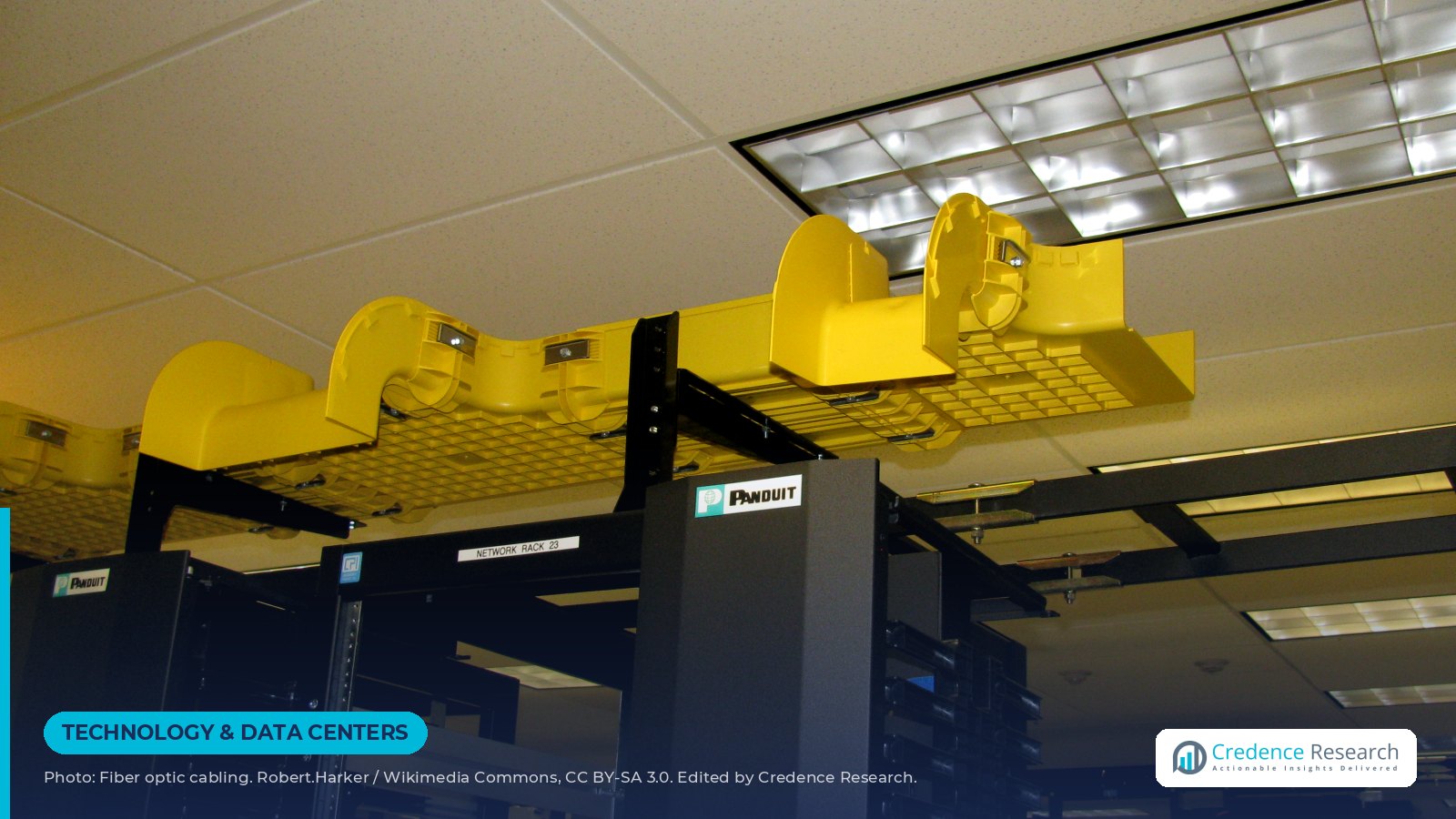
Image: Fiber optic cable raceway above network racks, by Robert.Harker via Wikimedia Commons, CC BY-SA 3.0. Cropped and edited by Credence Research.

About the Author

Senior News Editor at Credence Research Inc