
Alfa Laval to Buy Maritime Software Firm NAVTOR for $700 Million as Compliance Cover Is Deferred
Alfa Laval, the Swedish maker of heat transfer, separation and fluid handling equipment, agreed on Nov. 6 to buy Norwegian maritime software company NAVTOR for $700 million in cash, the company said from its headquarters in Lund, Sweden. The purchase places e-navigation and vessel performance software alongside the weather routing and port call tools Alfa Laval already owns, and it comes with a notable disclosure: NAVTOR has reported compliance matters, and the cover meant to protect the buyer from related liabilities has been deferred.
Key developments
- Alfa Laval will pay $700 million (6.85 billion Swedish kronor) in an all-cash transaction, funded from its own cash and existing funding programs.
- NAVTOR, founded in 2011, expects 2026 turnover of about $194 million (1.89 billion kronor) and has about 400 employees in 13 offices, with customers in more than 90 countries.
- The business will join Alfa Laval's Ocean Division and be consolidated with StormGeo and Portchain in its digital fleet solutions portfolio.
- Closing is expected in the first quarter of 2027, subject to customary regulatory approvals. Alfa Laval expects the deal to be neutral to group margin in the short term.
- A recent NAVTOR internal review identified compliance matters and led to an enhanced internal control and compliance program. Alfa Laval did not describe the matters.
Industry background
NAVTOR began in Egersund, Norway, as a supplier of digital navigation products to shipowners, ship managers and operators. Its website traces a run of product launches, including its NavBox and NavStation systems, followed by a series of deals. Private equity firm Accel-KKR invested in 2020, and NAVTOR later added Tres Solutions, Ingenium Marine and Voyager Worldwide. The Alfa Laval release does not name the seller.
The company's work now extends well beyond electronic charts. NAVTOR's NavFleet line covers fleet monitoring, hull-condition decisions and emissions records for European, British and International Maritime Organization rules. A company interview published in February said its compliance subscription also helps owners prepare voyage statements used to recover compliance costs from charterers.
Alfa Laval built its position in the field through acquisitions. It agreed in 2021 to buy weather software and routing company StormGeo for about 3.63 billion Norwegian kroner, then about $435 million, according to Maritime Executive. On Oct. 30 of this year, StormGeo completed its purchase of Portchain, whose berth alignment software links container carriers with more than 200 terminals. Alfa Laval did not disclose a price for that deal, and said Portchain will run independently under StormGeo for the next few years before full integration.
Industry implications
The deal shows how a supplier of physical ship equipment is moving further into software used on the bridge and in fleet offices. Alfa Laval said NAVTOR gives it product strength in on-vessel software, performance and route optimization. Combined with StormGeo's weather services and Portchain's berth data, that would give one owner several inputs a voyage decision depends on: where the weather is, how the ship is performing and when a berth will be ready.
Regulation is a large part of the case for that combination. FuelEU Maritime has set greenhouse gas intensity targets for energy used on board since Jan. 1, 2025. The EU Emissions Trading System already puts a carbon price on shipping emissions, and the U.K. scheme extended to domestic maritime voyages by ships of 5,000 gross tons and above from July 1, 2026. Each regime requires verified voyage and fuel data, which raises the value of software that captures those records on board and carries them ashore.
Global rules remain unsettled. The IMO's Net-Zero Framework has not been finalized, with further talks planned at the Marine Environment Protection Committee's session this month. Software demand tied to compliance therefore rests for now on regional regimes, while owners also weigh fuel savings from hull cleaning and just-in-time arrival.
Competitive and supply chain implications
Alfa Laval will meet established marine technology groups such as Kongsberg and Wartsila, both of which pair ship equipment with digital fleet tools, along with specialist software vendors. Its argument to customers will likely rest on breadth, since a shipowner could buy routing, performance, emissions and berth coordination from one supplier. Whether customers prefer that to selecting separate tools is an open question, and many fleets already run mixed systems.
Integration is the practical test. Consolidating NAVTOR, StormGeo and Portchain means reconciling products that arrived through separate acquisitions, and NAVTOR itself was assembled from several businesses. Alfa Laval has already said Portchain customers should see no service disruption, and NAVTOR's users will look for similar assurances on onboard systems that crews rely on for navigation.
For suppliers and data partners, the transaction places more voyage data inside an equipment manufacturer. Rival vendors that exchange data with NAVTOR or StormGeo will want clarity on how open the combined platform remains. Alfa Laval has not addressed that point, and said it will give more detail on the deal at its Capital Markets Day on Nov. 18.
Regional implications
The deal brings a Norwegian maritime technology company under Swedish ownership. Alfa Laval has said closing depends on customary regulatory approvals but has not itemized the jurisdictions involved.
Beyond the Nordics, NAVTOR's website lists offices in Singapore, Japan, the U.K., the U.S., Germany, Denmark, Poland, Greece, Turkey and Dubai, which places it near many shipowning and ship management centers. The site cites a larger office network than the 13 stated in Alfa Laval's release. European operators, who face FuelEU Maritime and the EU carbon system directly, are the customers most immediately exposed to the compliance tools NAVTOR sells.
Credence Research analysis
At $700 million, the purchase exceeds the price reported for StormGeo five years ago and signals that Alfa Laval sees digital fleet services as a lasting part of its Ocean Division rather than an add-on to equipment sales. The timing also matters: the company took on Portchain only a week earlier, and it reported third-quarter order intake of 23.2 billion kronor, up from 17.1 billion a year before. The evidence supports reading this as a sustained build rather than an isolated purchase, although the margin guidance suggests no immediate financial lift.
The compliance disclosure is the main uncertainty. The release does not state the nature or scale of the matters, and CEO Tom Erixon said Alfa Laval has confidence the issues will be resolved, calling the enhanced program a strong step in the right direction. The release says cover against pre-acquisition liabilities has been deferred, without saying for how long or what it would involve. Until Alfa Laval says more, investors and customers cannot judge the exposure, which makes the Nov. 18 presentation the first meaningful checkpoint.
What comes next
- Nov. 16-27: The IMO's Marine Environment Protection Committee is scheduled to hold its 85th session, with the Net-Zero Framework still unresolved.
- Nov. 18: Alfa Laval plans to detail the strategic rationale and transaction at its Capital Markets Day.
- First quarter of 2027: Targeted closing, subject to customary regulatory approvals.
- After closing: Consolidation of NAVTOR with StormGeo and Portchain inside the Ocean Division.
- Open item: Further detail on the compliance matters and on the deferred liability cover.
Sources
- Alfa Laval: Alfa Laval to acquire NAVTOR AS
- Alfa Laval: StormGeo acquires Portchain
- NAVTOR: Driving maritime performance growth
- Maritime Executive: Alfa Laval to Acquire StormGeo
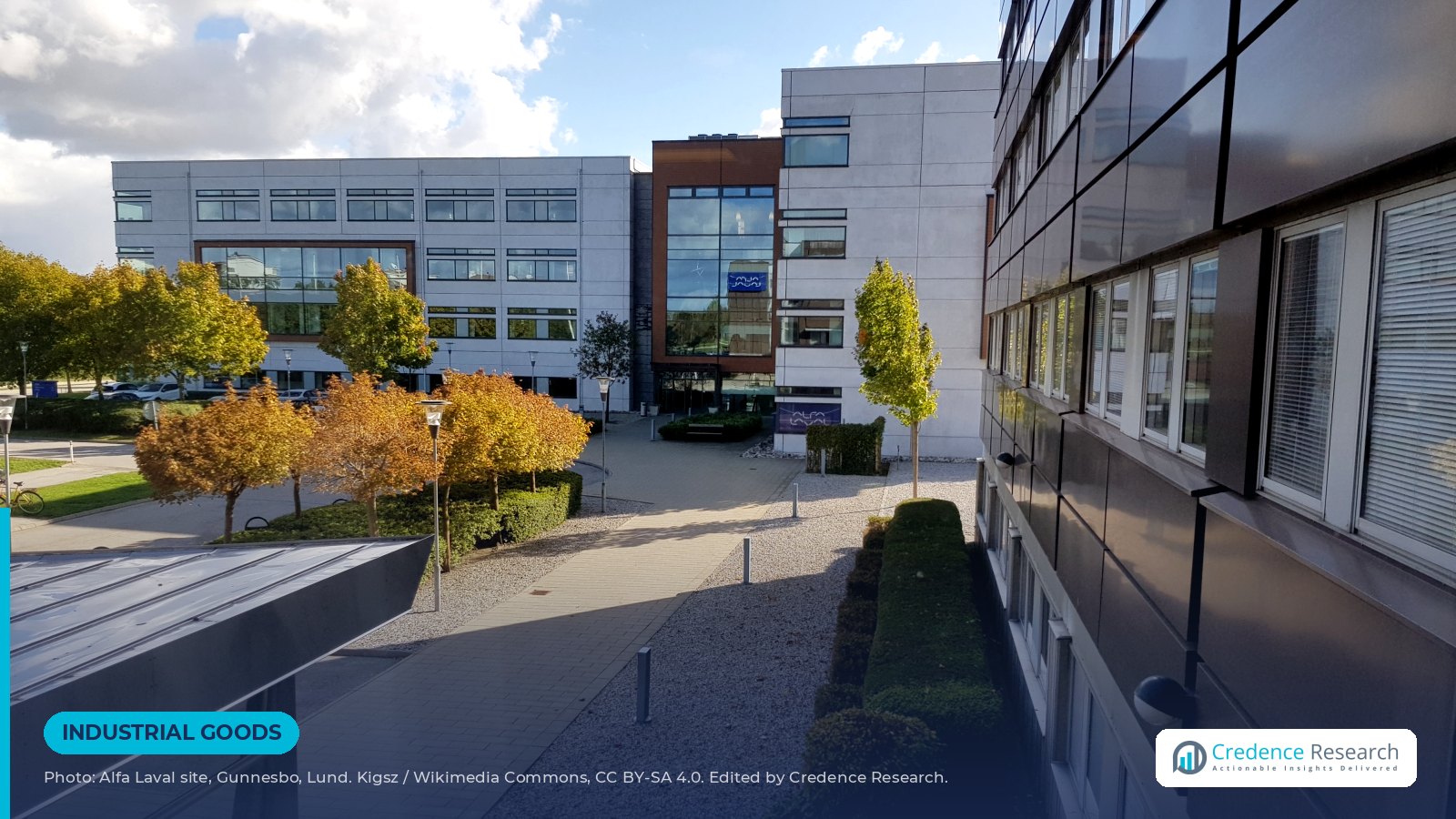
Image: Alfa Laval site in Gunnesbo, Lund, Sweden, by Kigsz via Wikimedia Commons, CC BY-SA 4.0. Cropped and edited by Credence Research.

About the Author

Senior News Editor at Credence Research Inc