
Siemens Healthineers to Become Healthineers, Starts Olyrian Diagnostics Carve-Out
Siemens Healthineers said Nov. 5 it will rename itself Healthineers as parent Siemens AG prepares to spin off control of the German medical technology group in 2027, and it began carving out its in vitro diagnostics business under the new name Olyrian Diagnostics. The announcements, issued from Erlangen, Munich and Tarrytown, New York, came alongside fiscal 2026 results and set up two separations at once: one from the Siemens parent and one from the company's own laboratory testing arm.
Key developments
- Siemens plans to deconsolidate Siemens Healthineers in 2027 through a spin-off, with shareholders of both companies voting at annual meetings in February 2027.
- The name change to Healthineers also needs approval at the Siemens Healthineers annual meeting. The brand transition starts after the spin-off is entered in the German Commercial Register, followed by a three-year period to re-register legal entities and products.
- The diagnostics carve-out has started, with the transition to a standalone Olyrian Diagnostics expected to finish by mid-2028. The business stays part of Siemens Healthineers until then.
- Diagnostics was the only segment to post a comparable revenue decline in the fiscal fourth quarter, falling 4.2% with a 5.4% adjusted EBIT margin. Imaging grew 10% with a 21.9% margin.
- For fiscal 2027, the company guided to comparable revenue growth of 4% to 5% and adjusted basic earnings per share of 2.20 to 2.40 euros, against 2.42 euros in fiscal 2026.
Background on the separation
Siemens first laid out the deconsolidation plan on Nov. 12, 2025. At that time it held about 67% of Siemens Healthineers and said its preferred route was a direct spin-off of 30% of the shares to Siemens AG shareholders. It said it would keep a significant minority stake and aimed to reduce that holding to a financial asset over the medium term. The Nov. 5 release did not restate those percentages.
The rename gives the plan a public identity. Siemens Healthineers CEO Bernd Montag said, "Healthineers is who we are," describing the staff as engineers and pioneers in healthcare. Siemens CEO Roland Busch called the move "the logical next step" in a long process, and Siemens said the separation sharpens its focus on industrial AI, which combines the physical and digital worlds.
The diagnostics business has a longer history than its new name suggests. Siemens built it through the purchase of Diagnostic Products Corporation in 2006 and the Bayer and Dade Behring diagnostics businesses in 2007, with predecessor companies dating to 1884. The unit covers laboratory automation, informatics and point-of-care testing, and the company said it manufactures more than 16 billion tests a year. Sharon Bracken, head of Diagnostics, said Olyrian "is how we'll define our next chapter."
Industry implications
The two moves point toward a narrower Healthineers built around imaging and precision therapy, the segments that carried its growth and higher margins in the latest quarter. Fourth-quarter figures make the contrast plain. Imaging posted double-digit comparable growth and a margin above 21%, Precision Therapy grew 4.8% with a 13.8% margin, and Diagnostics shrank while earning 5.4%. Group results were stronger than that segment: fiscal 2026 revenue came to about 23.6 billion euros, with comparable growth of 4% and an adjusted EBIT margin of 16.2%.
Montag said the company is "positioning our Diagnostics business for a successful future and initiating the carve-out process." The wording matters, because the releases describe a standalone organization and do not disclose a buyer, a listing or other transaction terms. Olyrian's headcount, site footprint and revenue were also absent from the release, so investors and customers cannot yet judge the unit's cost base as an independent company.
For hospitals and reference laboratories, the near-term message is continuity. Olyrian said products, services, contracts, service levels and customer contacts are unchanged for now, and that any future changes will be communicated directly.
Competitive and supply chain implications
Olyrian describes itself as set to become one of the largest stand-alone, diagnostics-focused companies. As an independent business it would face Roche, Abbott and Danaher's Beckman Coulter without a larger imaging group behind it, and it would need to fund automation, informatics and assay development from its own balance sheet.
A carve-out of this size also touches the supply chain. Shared procurement, IT, logistics and service arrangements typically need to be split or covered by transition agreements, and laboratory customers tend to value uninterrupted reagent supply above most other terms. The company has not published details of how those arrangements will work, which makes them a key item to watch through 2028.
Healthineers, meanwhile, would compete with GE HealthCare and Philips in imaging as a company no longer controlled by an industrial parent. The three-year brand transition gives it time to re-register products and legal entities under the new name.
Regional implications
The most immediate effects fall in Germany. Decisions rest with shareholders at the February 2027 meetings of the two German companies, and completion hinges on entry in the German Commercial Register. A spin-off would hand a block of Frankfurt-listed Siemens Healthineers shares directly to Siemens AG investors, changing the shareholder base of a major German technology company.
The Olyrian announcement carried a Tarrytown, New York, dateline, underscoring the role of the U.S. in the diagnostics business, whose history includes the American Dade Behring and Diagnostic Products Corporation franchises. The release set out no region-specific changes for customers, and the company did not identify any plant or site actions tied to the carve-out.
Credence Research analysis
The sequencing is the most telling part of this announcement. By naming Olyrian before the parent separation is even voted on, management is signaling that the Healthineers that leaves Siemens in 2027 should be judged primarily as an imaging and therapy group, with diagnostics on a defined separation path. The segment margins disclosed on Nov. 5 explain the logic: a business earning 5.4% sits awkwardly beside one earning 21.9%, and separating them gives each a clearer capital allocation case.
The execution risk sits with Olyrian. Mid-2028 is a firm-sounding date for a business that posted a revenue decline in the latest quarter and has not yet disclosed its operating structure as a standalone company. In diagnostics, installed analyzers and long reagent contracts tend to keep customers in place, so the early test will be whether Olyrian can hold service levels during the split, not whether a new name wins attention. Rebranding is the visible step; the systems, supply and contract work behind it will determine the outcome.
What comes next
- February 2027: Siemens and Siemens Healthineers shareholders vote on the spin-off, and Siemens Healthineers shareholders vote on the name change.
- 2027: Planned deconsolidation, completed on entry of the spin-off in the German Commercial Register.
- After registration: A three-year brand transition begins for legal entities and products.
- Through mid-2028: Staged rollout of the Olyrian Diagnostics name and completion of the carve-out.
- Fiscal 2027: Results will test guidance of 4% to 5% comparable revenue growth and adjusted earnings per share of 2.20 to 2.40 euros.
Sources
- Siemens and Siemens Healthineers: Name change release, Nov. 5, 2026
- Siemens Healthineers: Olyrian Diagnostics release, Nov. 5, 2026
- Siemens Healthineers: Fiscal 2026 results release, Nov. 5, 2026
- Siemens: Deconsolidation plan release, Nov. 12, 2025
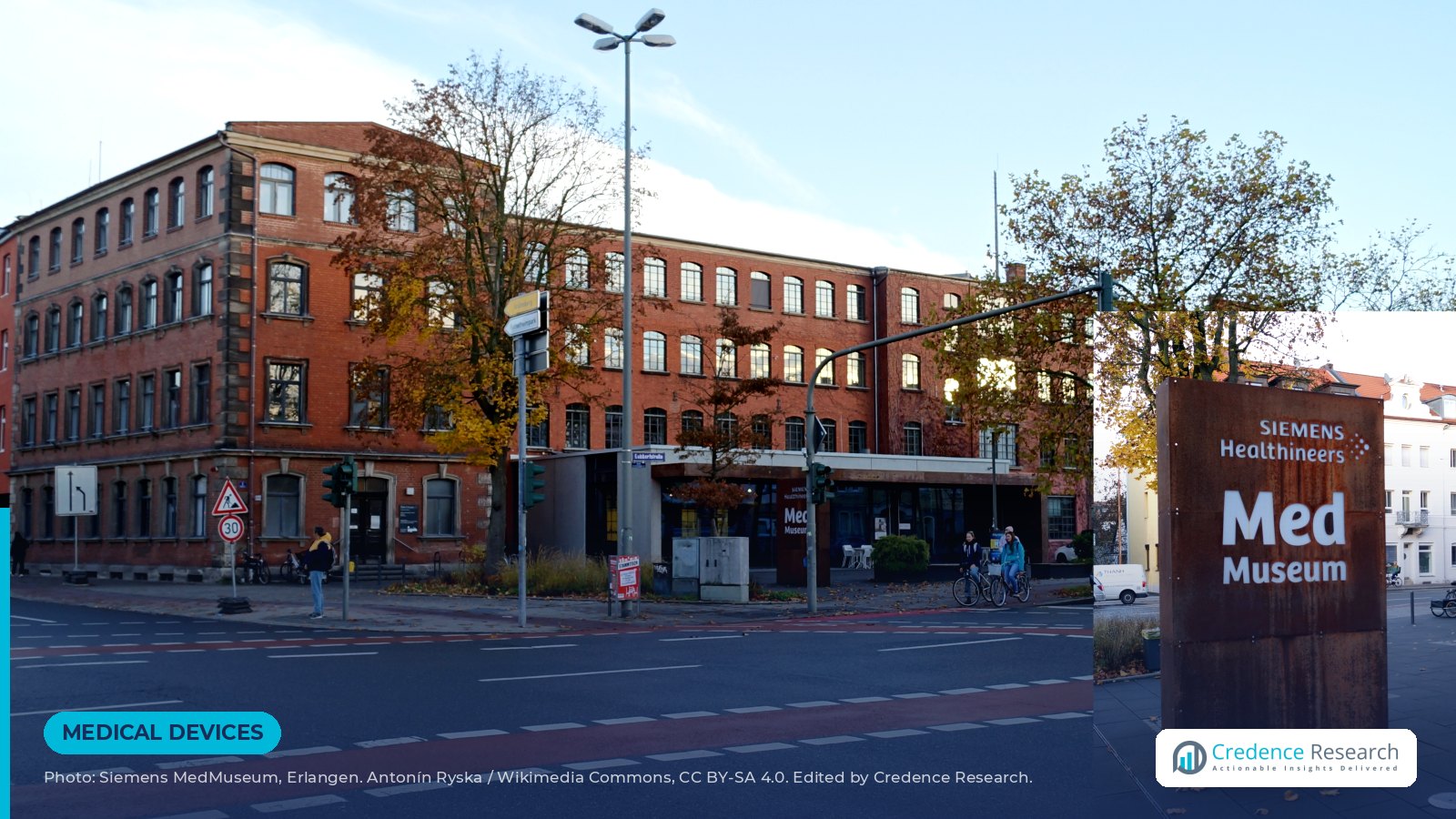
Image: Siemens MedMuseum in Erlangen, Germany, by Antonín Ryska via Wikimedia Commons, CC BY-SA 4.0. Cropped and edited by Credence Research.

About the Author

Senior News Editor at Credence Research Inc