
Walmart adds 300 Zipline drone sites as Zipline raises $1.5 billion for U.S. buildout
Walmart signed a multi-year agreement with Zipline on Nov. 5, 2026, to open 300 more drone delivery sites across the United States, while Zipline said the same day that it had raised $1.5 billion to expand U.S. aircraft manufacturing and hiring. The retailer announced the deal from Bentonville, Arkansas, and Zipline announced its financing from South San Francisco, California. A day later, rival operator Wing, part of Alphabet, was reported to be committing up to $125 million to build delivery aircraft in Fort Worth, Texas, putting the leading names in U.S. drone delivery on a faster growth track in the same week.
Key developments
- Walmart and Zipline agreed to launch 300 additional Zipline sites nationwide under a new multi-year agreement that Walmart said has the potential to expand further.
- Walmart said its drone program has completed more than 2 million deliveries and that it now runs the largest retail drone delivery operation in the country.
- Zipline raised $1.5 billion in a round led by Paradigm, WCM Investment Management and Layer Global, with participation from Valor Equity Partners, Fidelity Management & Research Company, Uber, Tiger Global, J.P. Morgan, ARK Invest and Salesforce Ventures.
- Zipline said the capital will fund larger U.S. manufacturing facilities and faster hiring, and it introduced a next-generation aircraft designed to fly higher and quieter while carrying heavier orders over longer distances.
- Wing will invest up to $125 million over two years, including a 15,000-square-foot Fort Worth plant able to build tens of thousands of aircraft a year with up to 100 jobs, according to DroneLife.
How the Walmart drone network works
Walmart has worked with Zipline since 2021. Under the program, eligible customers can choose from tens of thousands of items in the Walmart app or on Walmart.com, and households at eligible addresses can also order through the Zipline app. Walmart said deliveries can arrive in as little as 30 minutes where the service is available. Zipline's home delivery system uses a two-part design: the aircraft holds position about 330 feet above the ground while a pod carrying the order is lowered on a tether to a front yard, backyard or driveway.
Greg Cathey, Walmart's senior vice president of eCommerce fulfillment transformation, said many customers try drone delivery for the novelty and keep using it because it is convenient. Zipline CEO and co-founder Keller Cliffton said the company plans to "expand this tech to homes throughout the country" with Walmart. Neither company named the states or metro areas that will receive the 300 new sites or gave a rollout schedule.
Zipline said it has flown 150 million commercial autonomous miles and completed more than 1 million deliveries in the Dallas-Fort Worth area this year alone. Wing, Walmart's other drone partner, said in October that the two companies plan to reach more than 270 Walmart stores and nearly 20 U.S. metro areas, with Denver and Seattle added for 2027.
Industry implications
The Walmart agreement turns drone delivery from a regional pilot into a national logistics commitment. A store-based model lets the retailer launch aircraft from existing inventory, which avoids building new warehouses and keeps delivery distances short. Walmart says about 90% of Americans live within 10 miles of one of its stores, which helps explain why it is willing to scale a store-based drone service nationally.
For the transportation sector, the size of the commitments matters more than any single launch. Hundreds of new sites require aircraft, charging and launch hardware, flight operations staff and airspace approvals. Zipline's choice to direct new capital to U.S. manufacturing suggests aircraft supply, not customer demand, is now the gating factor. Last-mile delivery is one of the costliest steps in e-commerce logistics, and automated flights are being tested as a way to cut the cost of small, urgent orders.
Competitive and supply chain implications
Walmart is now running two large drone partners side by side, which can give the retailer negotiating leverage and redundancy while pushing Zipline and Wing to compete on reliability, payload and noise. Wing's reported Fort Worth plant places production in the same region where both companies fly Walmart orders, shortening the path from factory to operating site. Zipline announced in September 2025 that it would triple its South San Francisco facility to build up to 15,000 aircraft a year, and its new funding points to further expansion beyond that plan.
Domestic production also carries regulatory weight. The Federal Aviation Administration's proposed Part 108 rule would set a standard framework for routine flights beyond the pilot's visual line of sight, the type of operation that delivery networks depend on. DroneXL reported that the final rule has been under White House review since July 10 and that the 2025 draft tied acceptance of foreign-built aircraft to bilateral agreements. U.S.-built fleets would sidestep that issue. Component suppliers for motors, batteries, composite airframes and flight computers stand to see steadier orders as both companies scale their factories.
Regional implications
Texas is the clearest early beneficiary. Dallas-Fort Worth is a core operating market for both Zipline and Wing, and Wing's reported plant adds manufacturing jobs in Fort Worth. Beyond Texas, the 300 new sites could extend service across far more suburban and exurban communities, where large lots and lower building density suit tethered deliveries.
Local governments will face more permit requests for launch sites at store parking lots, along with resident questions about noise and flight paths. Zipline said its next-generation aircraft is designed to fly quieter, a feature aimed at that community concern. Outside the U.S., Zipline continues to run medical delivery networks, including a nationwide program in Côte d'Ivoire expected to serve more than 2,200 health facilities.
Credence Research analysis
The week's announcements show U.S. drone delivery moving from proof of concept to an industrial scale-up, and the constraint has shifted from consumer acceptance to aircraft output, site approvals and airspace rules. Walmart's 2 million cumulative deliveries give the retailer operating data that few competitors can match, and a 300-site commitment signals that it sees the economics improving enough to justify a national rollout. The absence of a site list or timeline, however, leaves room for the pace to depend on how quickly Zipline can build aircraft and win local approvals.
The bigger structural point is that manufacturing capacity is becoming a competitive weapon. Zipline and Wing are both investing in U.S. production at the same moment the FAA's BVLOS rule nears a decision, and domestic supply could help them clear regulatory hurdles faster than operators relying on imported hardware. Retailers without a drone partner, along with grocers and restaurant chains, will be watching whether Walmart's model produces repeat use at scale, because that evidence will shape how quickly drone delivery spreads beyond a few metro areas.
What comes next
- Walmart and Zipline to name the first markets and stores for the 300 new sites.
- FAA publication of the final Part 108 rule for beyond-visual-line-of-sight operations, pending White House review.
- Zipline to expand U.S. manufacturing and begin service with its next-generation aircraft.
- Wing to ramp its Fort Worth production and launch Walmart service in Denver and Seattle in 2027.
- Local permitting decisions on new launch sites and community noise standards in expansion markets.
Sources
- Walmart: Walmart Expands Nation's Largest Retail Drone Delivery Operation with 300 New Zipline Sites
- Zipline: Zipline Raises $1.5 Billion to Build Nationwide Drone Delivery Network
- Wing: Wing and Walmart name new metros to expand the nation's largest drone delivery network
- DroneLife: Wing to Invest Up to $125 Million in U.S. Drone Manufacturing
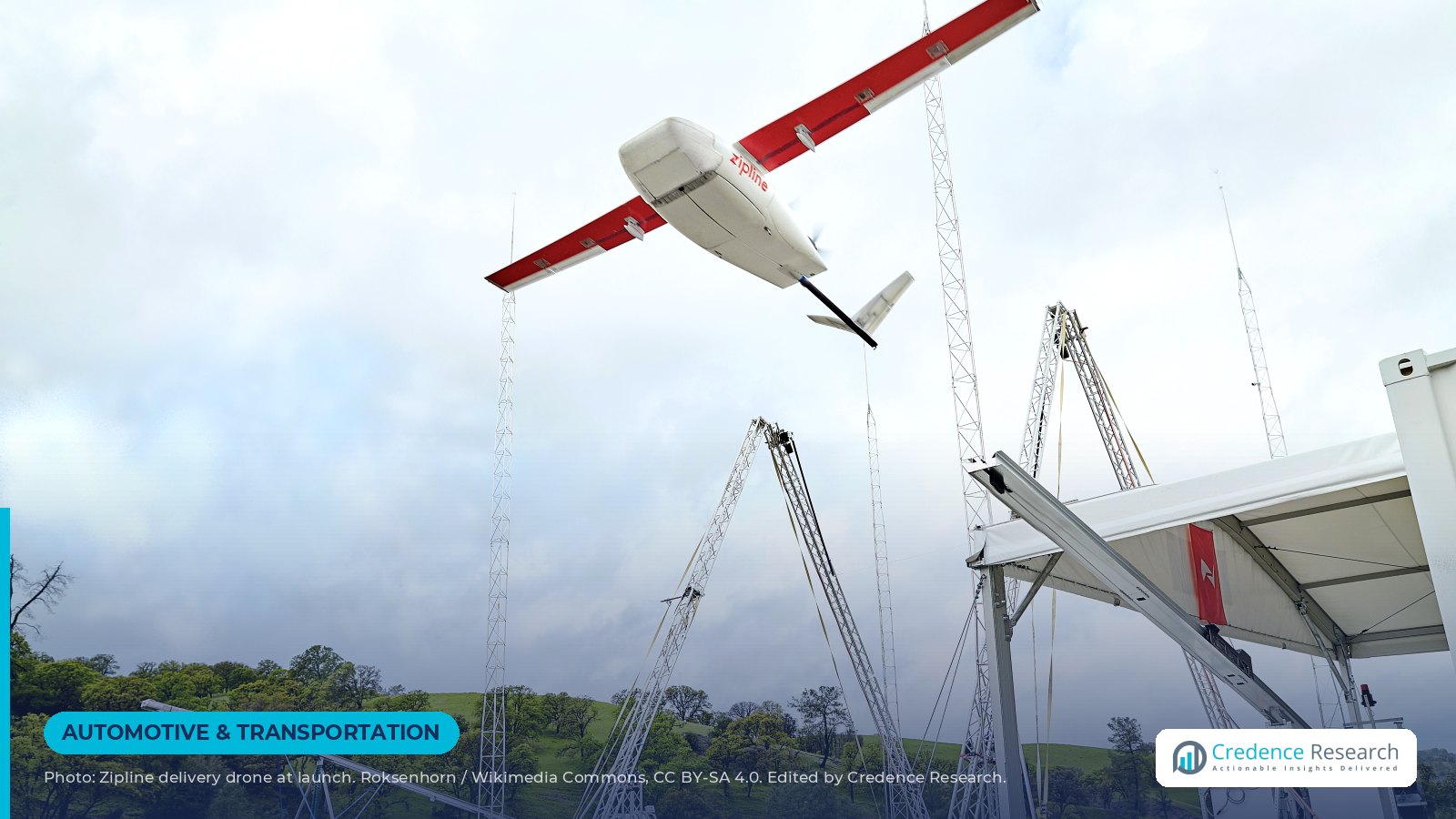
Image: Zipline delivery drone at launch, by Roksenhorn via Wikimedia Commons, CC BY-SA 4.0. Cropped and edited by Credence Research.

About the Author

Senior News Editor at Credence Research Inc