
argenx to Acquire Unnatural Products for Up to $1.15 Billion to Add Oral Macrocyclic Peptides
argenx SE agreed on Nov. 9 to buy Unnatural Products Inc., a Santa Cruz, California, developer of oral macrocyclic peptides, in a deal worth up to about $1.15 billion. The immunology company, which already owns a minority stake in the startup, will pay $550 million in cash upfront and up to $595 million more in contingent payments tied to development and regulatory milestones. The move gives argenx, best known for its antibody-based medicines, an in-house engine for small, potentially oral drugs aimed at targets that have resisted conventional chemistry.
Key developments
- argenx will acquire all outstanding Unnatural Products (UNP) shares it does not already own for $550 million upfront, funded from cash on hand, plus contingent value rights worth up to $595 million.
- Both boards have approved the transaction, which is expected to close by the end of 2026, subject to customary closing conditions.
- UNP's team of more than 50 employees and its leadership will stay in Santa Cruz, which becomes argenx's macrocyclic peptide discovery hub; argenx will lead clinical development and commercialization.
- The deal follows a multi-target research collaboration the two companies signed in July 2025, under which argenx took an equity stake and an exclusive option on products against targets it selected.
- Morgan Stanley is argenx's exclusive financial adviser and DLA Piper its legal adviser; Latham & Watkins is counsel to UNP.
How the technology works
Macrocyclic peptides are ring-shaped chains of amino acids. Their size lets them grip broad, flat protein surfaces that small-molecule drugs often cannot bind, while the ring structure can make them more stable and, with the right design, absorbable when swallowed. The long-standing obstacle has been medicinal chemistry: making a large peptide pass through the gut wall and survive in the body usually requires slow, molecule-by-molecule optimization.
UNP says its platform attacks that bottleneck by pairing AI-guided design with massively parallel synthesis and direct-to-biology screening, so that large numbers of variants can be made and tested quickly. The company was founded in 2016 by Cameron Pye and Joshua Schwochert during their doctoral work in Scott Lokey's laboratory at the University of California, Santa Cruz, a group that studies how natural macrocycles cross cell membranes. Pye is chief executive and Schwochert is chief scientific officer.
Before this deal, UNP had built a partnering model around its platform, signing four large pharmaceutical collaborations in under five years, including work with Novartis, Merck, BridgeBio and argenx. The July 2025 argenx agreement carried a double-digit-million-dollar upfront payment and up to about $1.5 billion in option, development, regulatory and commercial milestones, according to UNP's announcement at the time.
Industry implications
The acquisition is a bet that oral peptides can move from a niche modality into mainstream immunology. That case strengthened in March 2026, when the U.S. Food and Drug Administration approved Johnson & Johnson's icotrokinra, an oral peptide that blocks the interleukin-23 receptor, for plaque psoriasis. That approval showed regulators and prescribers that a swallowed peptide can deliver the kind of targeted immune modulation that previously required injections.
For argenx, the logic is pipeline breadth. Its commercial engine is VYVGART (efgartigimod), an antibody fragment that blocks the neonatal Fc receptor. VYVGART generated $1.721 billion in global product net sales in the third quarter of 2026, up 54% from a year earlier, according to the company's Oct. 22 results. Antibodies remain the company's core, but chief executive Karen Massey said UNP's peptide capabilities are highly complementary to argenx's antibody engineering. Oral or long-acting peptides could let argenx reach chronic autoimmune patients who prefer pills, or pursue intracellular and protein-protein interaction targets that antibodies handle poorly.
The structure of the price also signals discipline. Just under half of the headline value is upfront; the rest depends on programs reaching defined milestones, which shifts part of the scientific risk back to UNP's sellers.
Competitive and supply chain implications
Buying the platform outright changes UNP's role across the industry. A discovery shop that served several big drugmakers now becomes one company's internal engine. argenx and UNP did not disclose how UNP's existing collaborations with other partners will be handled after closing, a point those partners and investors will watch.
The deal also tightens competition for scarce macrocycle expertise. Large companies including Merck, Novartis and J&J have invested in cyclic and oral peptide programs, and specialist platforms are a limited pool. Owning one gives argenx control over target selection and timelines, rather than competing for a partner's capacity.
On the supply side, peptide medicines rely on specialized solid-phase synthesis, purification and, for oral forms, absorption-enhancing formulation. Contract manufacturers that built capacity for GLP-1 peptides have expanded those capabilities, but argenx has not said how it plans to manufacture future UNP-derived candidates. That question is years away, since no UNP program has been publicly identified as clinical-stage.
Regional implications
The transaction anchors a European-listed biotech's discovery operations more deeply in the United States. argenx, which is listed on Euronext and Nasdaq, will keep UNP as a distinct site in Santa Cruz rather than consolidate it in Belgium, adding a West Coast research base alongside its existing operations. For Santa Cruz, a smaller life sciences cluster than the San Francisco Bay Area to its north, retaining a 50-plus-person research company under a larger owner is a meaningful local outcome.
The deal also reflects continued cross-border flow of capital into U.S. early-stage biotech. UNP raised a $45 million Series B in March 2026 led by The Venture Collective, as reported by BioPharmaTrend, and the full exit comes less than a year later.
Credence Research analysis
This is a capability acquisition, not a product acquisition. argenx is paying for a discovery method and the people who run it, at a time when its VYVGART revenue gives it the cash to build for the next decade. The company's Vision 2030 goals, which include progressing five pipeline candidates into registrational development, require a steady flow of new molecules. An internal oral-peptide engine diversifies that flow beyond FcRn biology and the antibody format, reducing dependence on a single mechanism as competing FcRn blockers reach the market.
The risk is execution. Platform deals often lose momentum when a nimble startup is absorbed by a larger organization, and argenx has tried to guard against that by keeping UNP's leaders, site and discovery mandate intact. The more concrete test will be whether argenx names its first UNP-derived development candidates and whether milestone payments start to trigger. The approval of icotrokinra shows the modality can work; whether UNP's speed advantage translates into differentiated immunology drugs remains to be proven in the clinic.
What comes next
- Closing of the acquisition, targeted by the end of 2026, subject to customary conditions.
- Clarity on the treatment of UNP's existing collaborations with Novartis, Merck and BridgeBio.
- argenx's fourth-quarter and full-year 2026 results, where investors will look for how the deal is reflected in its pipeline priorities.
- Phase 3 EMPASSION topline data for empasiprubart in multifocal motor neuropathy, which argenx expects in December 2026.
- Disclosure of the first oral macrocyclic peptide programs selected for development under argenx ownership.
Sources
- argenx: argenx to Acquire Unnatural Products, Inc. (Nov. 9, 2026)
- Unnatural Products: Unnatural Products to be Acquired by argenx (Nov. 9, 2026)
- Unnatural Products: Multi-Target Collaboration with argenx (July 1, 2025)
- argenx: Third Quarter 2026 Financial Results (SEC Form 6-K, Oct. 22, 2026)
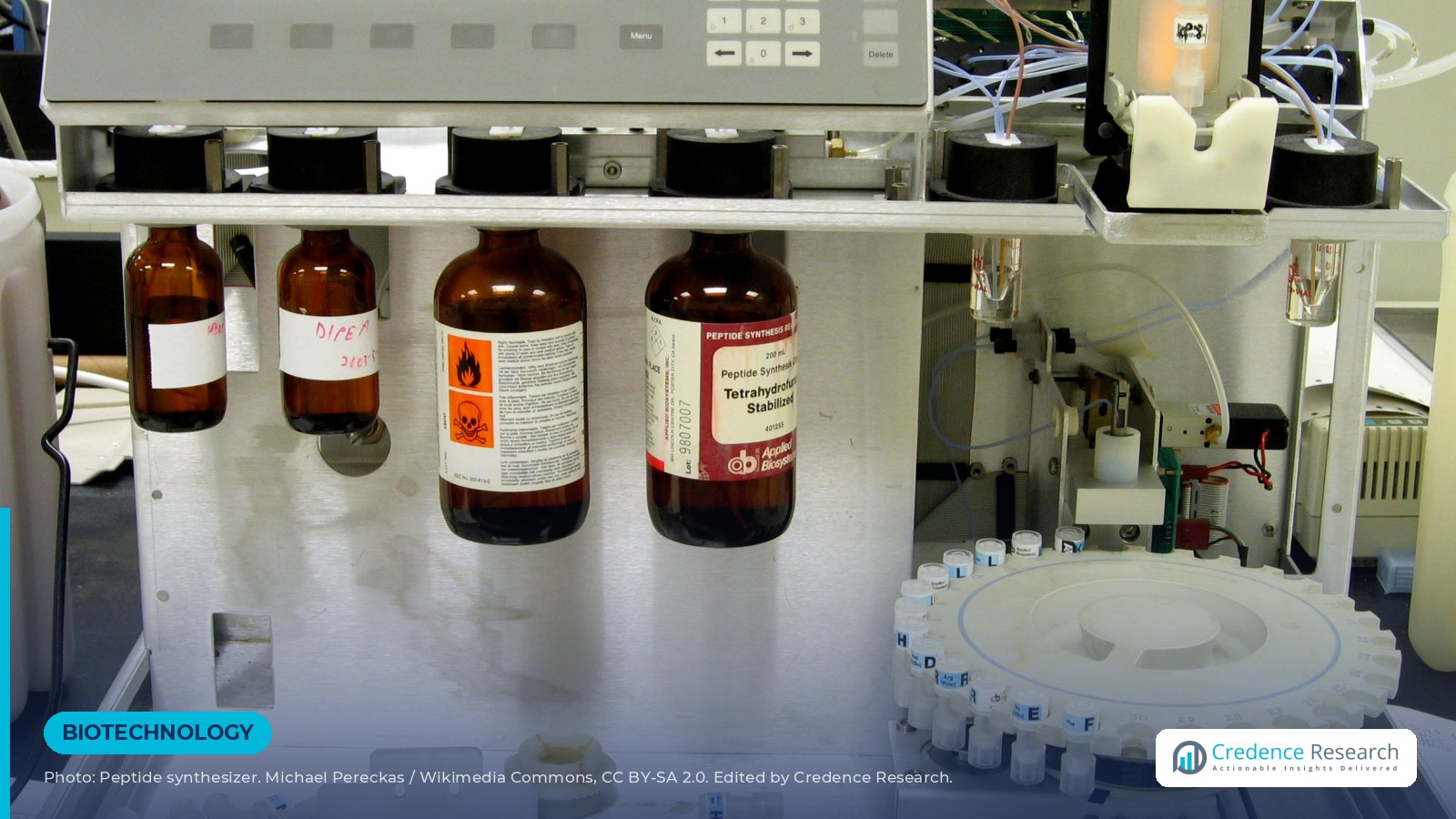
Image: Peptide synthesizer, by Michael Pereckas via Wikimedia Commons, CC BY-SA 2.0. Cropped and edited by Credence Research.

About the Author

Senior News Editor at Credence Research Inc