
DOE Closes $480 Million Loan to Arena Energy to Revive 22 Gulf of America Oil Platforms
The U.S. Department of Energy said on Tuesday, Nov. 10, 2026, that it has closed a $480 million loan to Arena Energy for Project Elkhorn, a plan to modernize 22 offshore platforms on the Gulf of America shelf off Louisiana. The financing, issued through the department's Office of Energy Dominance Financing, is the first loan the office has closed to support domestic oil and natural gas production, marking a clear shift in how the federal lender deploys its balance sheet.
Key developments
- DOE's Office of Energy Dominance Financing (EDF) reached financial close on a $480 million loan to Arena Energy for Project Elkhorn, announced Nov. 10, 2026.
- The project will modernize 22 existing platforms off the Louisiana coast, returning idled structures to service and expanding production and water-handling capacity at active facilities.
- At peak, DOE expects the work to add up to 38,600 barrels of oil per day and up to 77 million cubic feet of natural gas per day. Arena currently produces about 30,000 barrels of oil per day offshore, according to the department.
- Over the life of the project, DOE expects about 125 million barrels of oil and 250 billion cubic feet of natural gas, along with 2,400 construction-related jobs and 400 operations jobs.
- DOE described the deal as EDF's first closed loan supporting domestic oil and gas output.
Industry background
The Energy Dominance Financing program was created by the One Big Beautiful Bill Act, signed on July 4, 2025. The law amended Section 1706 of the Energy Policy Act and replaced the Energy Infrastructure Reinvestment program that the Inflation Reduction Act had set up in 2022. According to an analysis by law firm Hunton Andrews Kurth, EDF can back loans that retool, repower, repurpose or replace energy infrastructure that has stopped operating, help operating infrastructure raise capacity or output, or support electric supply needed for grid reliability. The law also dropped the earlier requirement that projects avoid or reduce emissions, and it appropriated $1 billion for credit subsidy and administrative costs.
Project Elkhorn fits the first two categories almost exactly. Trade publication Pipeline & Gas Journal reported that the borrower is Elkhorn Offshore, an Arena subsidiary, and that the work centers on the Southern Eugene Island area. The scope includes retooling, refurbishing and repowering platforms, restarting idled structures and building new gas pipeline connections that tie future wells into existing lines. Arena will carry out the program with affiliated companies White Fleet Drilling and Rosefield Pipeline, the publication said.
Arena, founded in 1999 and based in The Woodlands, Texas, describes itself as one of the largest private offshore oil and gas companies on the shelf. Earlier this year, White Fleet Drilling returned the WFD 450 jack-up rig to service after about $65 million in acquisition and refurbishment costs, World Oil reported in September. The rig, rated for up to 400 feet of water, began drilling in the Southern Eugene Island area to reach proved reserves that the Gulf's existing jack-up fleet could not access.
Industry implications
The loan matters less for its size than for what it signals. The federal loan office, set up in 2005 to finance emerging energy technologies, spent most of the past two decades backing solar, batteries, electric vehicles and nuclear. By closing a loan for conventional offshore production, DOE has shown that mature oil and gas assets now sit inside its lending mandate, provided they meet the restart or output-expansion tests in the statute.
That could matter most for small and midsize shelf operators. Shallow-water fields in the Gulf are old, and many platforms have been shut in or slated for decommissioning because private lenders view late-life assets as risky. Federal debt that targets refurbishment, rather than new exploration, gives these operators another way to extend field life. For comparison, Reuters reported that the United States produces about 14 million barrels of crude per day, so Elkhorn's peak addition is modest at the national level but sizable for a single private operator.
Competitive and supply chain implications
Elkhorn's scope points to work for the Gulf Coast offshore services chain: platform fabrication and repair yards, jack-up rigs, pipeline contractors, compression and power equipment suppliers, and marine logistics firms based in Louisiana and Texas. Arena's use of affiliated drilling and pipeline companies means a share of that spending stays inside its own group, but yard repairs, equipment and supply vessels will still draw on outside vendors.
Competitively, the deal sets a reference point for other shelf producers. Operators with idle platforms, stranded proved reserves or aging gas infrastructure now have a precedent for applying to EDF. Larger independents and majors that fund shelf work from internal cash flow are less likely to need federal loans, but the program could narrow the funding gap between them and private, asset-heavy players. EDF's pipeline is not limited to hydrocarbons: earlier this fall, the office offered Vistra a conditional commitment of up to $4.2 billion for nuclear uprates at plants in Pennsylvania and Ohio.
Regional implications
Louisiana stands to gain most directly. DOE expects 2,400 construction-related jobs and 400 operations jobs, and coastal parishes that host fabrication yards, heliports and supply bases have absorbed years of declining shelf activity. Pipeline & Gas Journal reported that Arena estimates the project will generate about $1.6 billion in additional federal royalties over its life.
The financing arrives during a period of elevated fuel prices. Fox Business, citing AAA, reported a national average of about $3.98 a gallon for regular gasoline on Nov. 10, up from about $3.07 a year earlier. Additional shelf barrels will not move national prices on their own, but they add to the administration's case for domestic supply.
Credence Research analysis
Project Elkhorn shows how the Energy Dominance Financing statute is being used in practice: as a tool to restart and extend existing infrastructure rather than to fund unproven technology. The structure, built on platforms, pipelines and reserves that already exist, lowers technical risk for the lender, while the borrower gains long-dated capital that private markets have been reluctant to supply for late-life shelf assets. Expect other shelf operators and service companies to study the Elkhorn terms closely once more detail becomes public.
The bigger question is execution. DOE has not published a construction schedule or a first-production target, and peak rates of 38,600 barrels of oil per day are a ceiling rather than a guarantee. Shelf reservoirs decline quickly, and restarting idled platforms involves integrity inspections, regulatory approvals and weather windows in the hurricane-exposed Gulf. How quickly Arena converts refurbished capacity into sustained output will shape whether EDF expands its oil and gas lending or keeps its focus on power and nuclear assets.
What comes next
- Arena and its affiliates begin platform refurbishment, repowering and pipeline tie-in work in the Southern Eugene Island area.
- Restart of idled platforms, subject to inspection and federal offshore regulatory approvals.
- Continued development drilling with the WFD 450 jack-up across Arena's shelf leases.
- Further EDF decisions, including whether Vistra's conditional nuclear commitment moves to financial close.
- Possible new EDF applications from other Gulf shelf operators seeking to restart or expand existing infrastructure.
Sources
- U.S. Department of Energy: Energy Department Closes $480 Million Loan to Expand American Energy Production (Nov. 10, 2026)
- Pipeline & Gas Journal: Arena Energy closes $480 million DOE loan for Gulf of America platform upgrades
- Hunton Andrews Kurth: New Energy Dominance Financing mechanism
- World Oil: Arena Energy launches multi-well Gulf drilling program
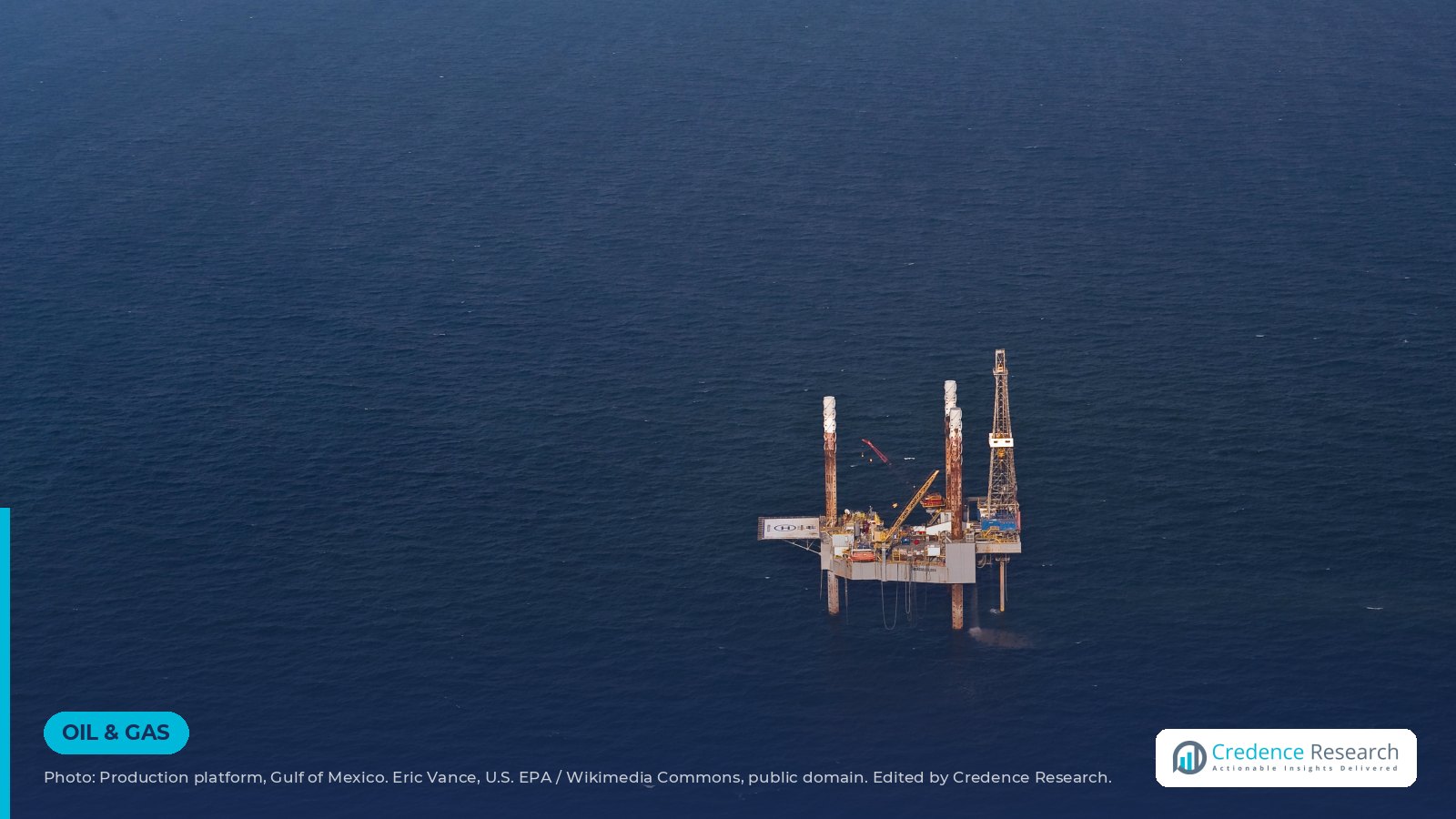
Image: Production platform in the Gulf of Mexico, by Eric Vance, U.S. Environmental Protection Agency, via Wikimedia Commons, public domain. Illustrative; not an Arena Energy facility. Cropped and edited by Credence Research.
_-_ASPECT_Flight_over_Gulfport,_Mississippi_(BP_Oil_Spill)_-_Production_platform,_Gulf_of_Mexico._USEPA_photo_by_Eric_Vance_(412-APD-668_-_DPLA_-_da869c385aa4f46cf661e2190681f166.jpg)
About the Author

Senior News Editor at Credence Research Inc