
EQT to Acquire Range Resources in All-Stock Deal, Creating $50 Billion Appalachian Gas Producer
EQT Corp. agreed on Oct. 26 to acquire Range Resources Corp. in an all-stock merger that would combine two of the largest natural gas producers in the Appalachian Basin. The companies, based in Canonsburg, Pennsylvania, and Fort Worth, Texas, said the combined business would have a pro forma enterprise value of more than $50 billion and net production above 9 billion cubic feet equivalent per day. They described the result as the largest vertically integrated natural gas producer in the United States.
Key developments
- Range shareholders will receive 0.987 EQT share for each Range share they own. EQT shareholders are expected to hold about 73% of the combined company and Range shareholders about 27%.
- The combined company expects net production of more than 9 Bcfe/d, more than 30 years of drilling inventory, nearly 3 million net acres and more than 3,700 miles of midstream pipeline.
- EQT targets about $325 million in base annual synergies within two years of closing, with a stated pathway to more than $600 million over the long term.
- Both boards approved the deal unanimously. Closing is expected in the first quarter of 2027, subject to regulatory clearances and approval by shareholders of both companies.
- Range CEO Dennis Degner and one other Range director will join the EQT board. EQT's management team, led by President and CEO Toby Rice, will run the combined company from Canonsburg.
Based on the exchange ratio, Reuters calculated an implied value of $54.91 per Range share, about 20.6% above Range's closing price on Oct. 23, and an equity value of roughly $12.8 billion. Reuters also reported that Range shares rose about 10% in premarket trading on Monday while EQT shares fell about 4.6%.
The companies said the merger would lower the combined unlevered free cash flow breakeven to less than $2 per million British thermal units at Henry Hub and generate about $20 billion of cumulative free cash flow over five years at recent strip prices. They expect credit metrics consistent with a BBB rating at closing. Both companies canceled their Oct. 28 earnings calls and will release third quarter results after the market closes on Oct. 27.
Industry background
The two companies helped build the Marcellus Shale into the most productive natural gas play in the country. Range drilled the Renz No. 1 well in Washington County, Pennsylvania, in 2004, which the company describes as the first viable Marcellus exploratory well, and followed it in 2007 with the Gulla 9H, its first successful horizontal Marcellus well. Range today focuses on the Appalachian Basin and produces a meaningful volume of natural gas liquids.
EQT took a different route to scale. It has grown through a series of acquisitions, including the 2024 purchase of its former pipeline affiliate Equitrans Midstream and the 2025 acquisition of Olympus Energy. EQT reported total sales volume of 2,382 billion cubic feet equivalent in 2025 in its annual report. The company has also signed long-term liquefied natural gas agreements, including three 20-year offtake contracts totaling 4.5 million tonnes per year and a 20-year tolling agreement for up to 2 million tonnes per year, with first volumes expected from 2030.
Industry implications
The deal tests a thesis that has gained ground across U.S. gas: buyers such as LNG exporters, utilities and large power users want suppliers that can commit volumes for decades, not quarters. EQT said the combination would make it the "partner of choice" for natural gas end users and strengthen its ability to serve demand growth in Appalachia. Its annual report names data centers and power generation as growing demand sources.
The cost argument is equally direct. A breakeven below $2 per MMBtu would give the combined producer room to keep drilling through price downturns that force higher-cost operators to cut activity. For gas buyers, that supports the reliability of long-term supply contracts. For rival producers, it raises the bar on cost competitiveness in a basin where pipeline capacity, not geology, has often limited growth. EQT also said the deal increases its natural gas liquids diversification, adding exposure beyond dry gas.
Competitive and supply chain implications
A combined EQT and Range would hold significant negotiating weight with pipeline operators, processing plants, oilfield service companies and drilling contractors in the Northeast. EQT already owns a large midstream network following the Equitrans deal. Adding Range's production to that system could help the company route more gas through infrastructure it controls and capture margin across gathering, transmission and marketing.
EQT pointed to commodities marketing, including natural gas, LNG and NGL marketing, as one source of longer-term synergies. That suggests the company plans to sell more of its gas directly into end markets rather than at regional hubs, where Appalachian prices have historically traded at a discount to Henry Hub because of takeaway constraints.
Service providers may see a mixed effect. Synergies across operations typically come from consolidated drilling schedules, longer laterals and shared pads, which can lower demand for rigs and frac crews per unit of output. Larger operators, however, also tend to sign longer service contracts, which can bring steadier work.
Regional implications
The merger concentrates a large share of Pennsylvania and West Virginia gas production in a single company headquartered in the Pittsburgh region. Keeping the headquarters in Canonsburg preserves the region's role as the corporate center of Appalachian gas. Range's Fort Worth base, where the company is currently headquartered, is likely to see the most change, although the companies have not announced workforce or office plans.
A producer with deeper inventory and a lower cost structure is better placed to supply in-region gas-fired power plants and data centers under long-term contracts. Regulators will review the transaction, though the companies did not specify which approvals are required beyond customary clearances.
Credence Research analysis
The transaction reflects a shift in how the largest U.S. gas producers see their role. Instead of competing mainly on volume and selling into volatile regional hubs, EQT is assembling a supply portfolio that can underwrite long-term contracts with LNG exporters and power developers. Combining Range's long-dated inventory with EQT's pipelines and marketing arm gives the company more control over where its gas goes and at what price.
Execution risk sits in the synergy target. The base figure of $325 million depends on overlapping operations and corporate savings that are typical in upstream mergers. The larger $600 million goal relies on marketing gains and demand-led growth that have not yet been contracted. Investors will likely watch whether EQT can convert its stated end-user strategy into signed supply deals before the merger closes, and whether the all-stock structure keeps leverage within the BBB range the companies have promised.
What comes next
- Oct. 27, 2026: EQT and Range release third quarter results after the market close.
- Coming months: Filing of a joint proxy statement and registration statement with the SEC.
- Regulatory review of the transaction and votes by shareholders of both companies.
- First quarter of 2027: Expected closing, with Degner and a second Range director joining the EQT board.
- Within two years of closing: Delivery of about $325 million in base annual synergies.
Sources
- EQT Corp. press release filed with the SEC, Oct. 26, 2026
- Range Resources investor relations: merger announcement
- EQT Corp. Form 10-K for fiscal 2025
- Range Resources: Marcellus Shale, 20 years of success
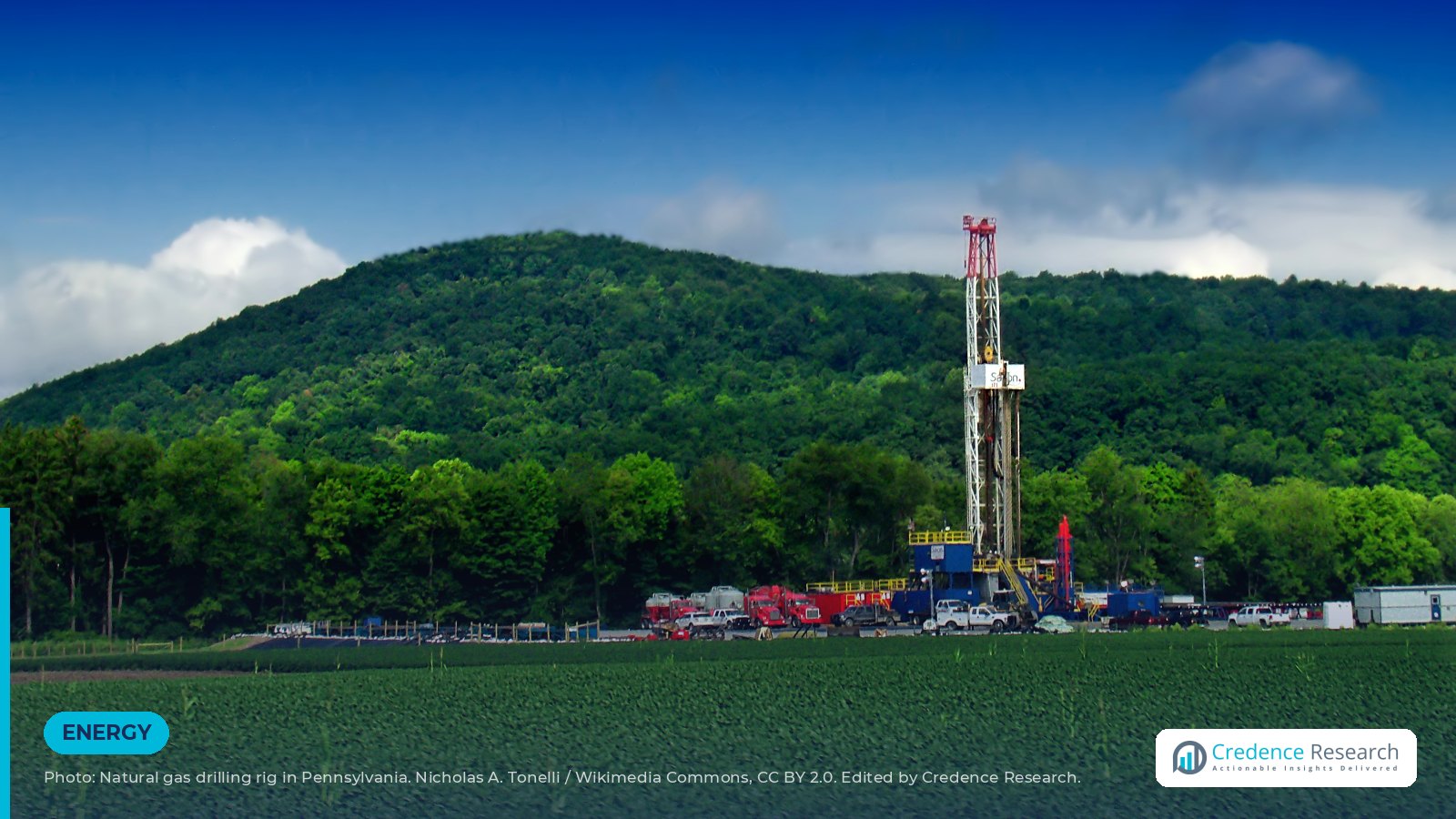
Image: Natural gas drilling rig in Pennsylvania, by Nicholas A. Tonelli via Wikimedia Commons, CC BY 2.0. Cropped and edited by Credence Research.

About the Author

Senior News Editor at Credence Research Inc