
FDA Rejects Summit's Ivonescimab in EGFR-Mutant Lung Cancer, Citing Lack of Survival Benefit
The U.S. Food and Drug Administration has declined to approve ivonescimab, the PD-1 and VEGF bispecific antibody that Summit Therapeutics licensed from China's Akeso, for patients with EGFR-mutated non-small cell lung cancer whose disease progressed after targeted therapy. Summit disclosed the complete response letter on Sunday, Nov. 15, 2026, from its Miami headquarters, one day after the agency's Nov. 14 goal date. The decision leaves the United States without an approved drug in the PD-1 and VEGF bispecific class and turns attention to Summit's larger first-line studies.
Key developments
- The FDA issued a complete response letter for the Biologics License Application seeking approval of ivonescimab plus platinum-based chemotherapy in locally advanced or metastatic EGFR-mutated non-squamous NSCLC after a third-generation EGFR tyrosine kinase inhibitor.
- According to Summit, the agency said substantial evidence of effectiveness was not established without a statistically significant improvement in overall survival, and that a progression-free survival gain alone does not support a positive benefit-risk profile.
- The application rested on the global Phase III HARMONi trial, which met its progression-free survival endpoint but missed statistical significance on overall survival in the primary analysis.
- Summit did not give a resubmission timeline. Chairman and Co-CEO Robert W. Duggan said the company was disappointed for patients and remains committed to ivonescimab, citing five positive Phase III studies run by Summit and Akeso.
Clinical and regulatory background
HARMONi enrolled patients with EGFR-mutated, non-squamous NSCLC who had already received a third-generation EGFR inhibitor such as osimertinib, a setting where chemotherapy remains the standard once targeted therapy stops working. Summit reported in May 2025 that ivonescimab plus chemotherapy cut the risk of progression or death by 48%, with a hazard ratio of 0.52 by blinded independent central review. The overall survival hazard ratio was 0.79, with a p-value of 0.057, short of the prespecified threshold. About 38% of patients were enrolled outside Asia.
Summit argued its case with later data. A September 2025 analysis with longer follow-up produced a hazard ratio of 0.78 at a nominal p-value of 0.0332, and the company's Nov. 15 statement cited a post-hoc analysis showing a survival hazard ratio of 0.76 that was consistent across Asian and Western patients. Akeso's China-only HARMONi-A study in a similar population reached statistical significance on survival, with a hazard ratio of 0.74 and median overall survival of 16.8 months versus 14.1 months for chemotherapy.
The FDA accepted the filing in January 2026 under Fast Track designation, and Summit estimated at the time that more than 14,000 U.S. patients a year are eligible for treatment in this setting. On safety, Summit said 7.3% of patients stopped ivonescimab because of treatment-related adverse events, compared with 5.0% on placebo, and treatment-related deaths were 1.8% versus 2.3%. Ivonescimab has been approved in China since May 2024, and Akeso reports more than 100,000 patients treated commercially there.
Industry implications
The letter reinforces a standard FDA oncology reviewers have stressed in recent decisions: when a trial designates overall survival as a primary endpoint and misses it, a strong progression-free survival result may not be enough, particularly for a regimen that adds toxicity to chemotherapy. Sponsors designing pivotal trials for PD-1 and VEGF combinations now have a clear signal that survival data, not surrogate endpoints, will carry the review.
The decision also tests a model that has reshaped oncology dealmaking since 2024, in which Western companies license late-stage assets from Chinese developers and rely partly on data generated in China. FDA reviewers have long questioned whether single-country data apply to U.S. patients. Summit's global HARMONi trial was meant to bridge that gap, and its survival miss means the stronger HARMONi-A data could not carry the application on its own. Endpoints News reported that analysts had largely expected the rejection.
Competitive and supply chain implications
The setback reaches beyond Summit. Bristol Myers Squibb and BioNTech are co-developing pumitamig, a PD-L1 and VEGF-A bispecific, under a June 2025 agreement that included a $1.5 billion upfront payment, $2 billion in non-contingent anniversary payments through 2028 and up to $7.6 billion in milestones. Pfizer and Merck have also licensed PD-1 and VEGF bispecifics from Chinese developers. None of these drugs is approved in the United States, where Merck's Keytruda remains the reference immunotherapy, and rivals will study Summit's letter closely as they plan their own registrational trials.
For Summit, the commercial question shifts to first-line disease. HARMONi-3 is testing ivonescimab with chemotherapy in first-line metastatic NSCLC, with squamous and non-squamous tumors analyzed separately, while HARMONi-7 compares it as a single agent in patients with high PD-L1 expression. Those studies address far larger patient populations than the post-EGFR setting. Summit's partnerships also remain in place, including combination programs with AstraZeneca and Daiichi Sankyo's datopotamab deruxtecan, AstraZeneca's sonesitatug vedotin, Revolution Medicines' RAS(ON) inhibitors, GSK and Arcus Biosciences. AstraZeneca agreed in October 2026 to make a $2 billion equity investment in Summit, giving it rights equal to about 12% of Summit's outstanding common stock.
Regional implications
In the United States, patients with EGFR-mutated disease that progresses on osimertinib keep their existing options, including chemotherapy and Johnson & Johnson's Rybrevant-based regimens. The rejection widens the gap between U.S. practice and China, where ivonescimab has been on the market for more than two years and Akeso continues to expand its label.
Europe is the next regulatory test. Ivonescimab is not approved there, and Summit holds rights in territories including the United States, Europe and Japan under its Akeso license. European regulators also weigh overall survival heavily in oncology, so the FDA's reasoning is likely to frame any future filing outside China.
Credence Research analysis
The FDA did not dispute that ivonescimab slows tumor growth. Its objection was statistical and procedural: Summit made overall survival a primary endpoint and did not meet it, and post-hoc analyses could not substitute for a prespecified result. That distinction matters for the class. The letter does not undermine the biology of combining PD-1 blockade with VEGF inhibition in one molecule, but it raises the bar for how sponsors must prove it, and it favors well-funded developers able to run large, survival-powered global trials.
The decision also lowers the value of a narrow, second-line launch as a path to U.S. market entry. Summit's commercial case now depends on HARMONi-3 and HARMONi-7 producing clear survival benefits in first-line NSCLC, where it would compete directly with Keytruda-based regimens. AstraZeneca's equity stake and combination work show that large partners still see a role for the molecule, but the timeline to any U.S. revenue has moved back, and competitors with later-stage global data may close the gap.
What comes next
- A possible Type A meeting between Summit and the FDA to discuss the letter and any path to resubmission in the post-EGFR setting.
- Readouts from HARMONi-3 in first-line squamous and non-squamous NSCLC, the study most likely to support a broader U.S. filing.
- Progress in HARMONi-7, HARMONi-GI3 in colorectal cancer and HARMONi-GU1 in urothelial cancer with enfortumab vedotin.
- Updates from rival PD-1 and VEGF bispecific programs at BMS and BioNTech, Pfizer and Merck, which will show whether their trial designs account for the FDA's survival standard.
- Any regulatory filing for ivonescimab in Europe or Japan.
Sources
- Summit Therapeutics: Update regarding the ivonescimab Biologics License Application
- Summit Therapeutics: FDA acceptance of the ivonescimab BLA
- Summit Therapeutics: HARMONi-A overall survival results
- BioNTech and Bristol Myers Squibb partnership on BNT327
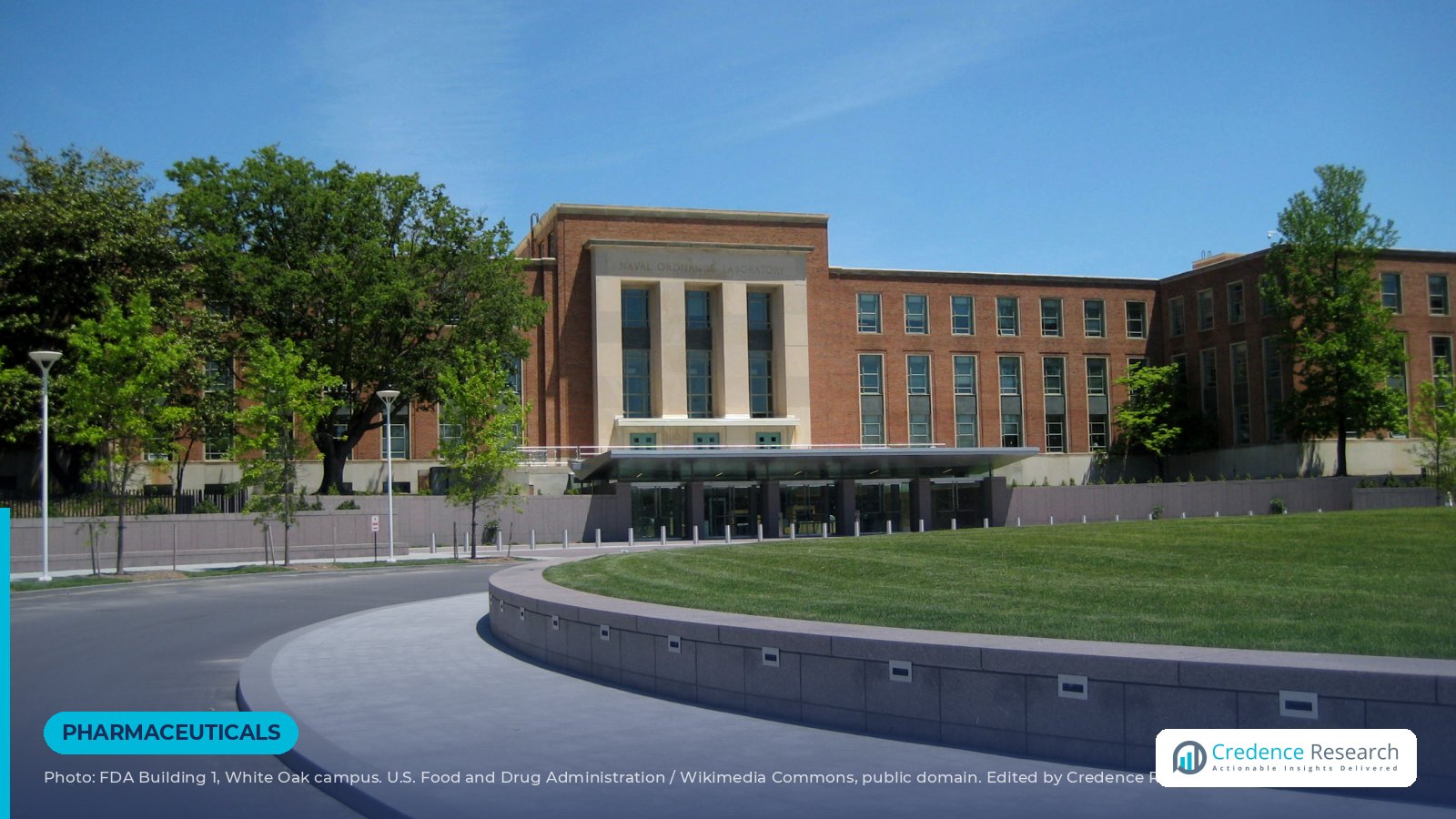
Image: FDA Building 1 at the agency's White Oak campus in Silver Spring, Maryland, by the U.S. Food and Drug Administration via Wikimedia Commons, public domain. Cropped and edited by Credence Research.

About the Author

Senior News Editor at Credence Research Inc