
Gates to Buy Out Nitta's Stakes in Five Asia-Pacific Joint Ventures, Sell Japan Unit
Gates Industrial Corporation said on Nov. 19 that it will buy out Nitta Corporation's minority stakes in their power transmission joint ventures in China, India, Thailand, South Korea and Singapore, while selling its majority stake in the partners' Japanese venture to Nitta. The Denver-based maker of belts, hoses and fluid power components said the swap ends a decades-old partnership in Asia-Pacific and leaves it with wholly owned operations in five of the region's largest industrial markets.
Key developments
- Gates will make net purchase price payments to Nitta of about $112.0 million and dividend payments of about $40.2 million, subject to post-closing adjustments, according to its Form 8-K filing.
- A Gates subsidiary will sell its 51% stake in Gates Unitta Asia Company, the Japanese joint venture, to Nitta, which will then own 100% of that business.
- Nitta will sell its 49% stakes in five non-Japan entities to Gates, including Gates Nitta Belt Company, which owns the Suzhou and Shanghai power transmission operations, plus the Thailand, India, Korea and Singapore trading units.
- At closing, the companies will sign technology license, trademark, exclusive supply and transition services agreements.
- The transaction is expected to close in the first quarter of 2027, after merger control clearance in India and Japan.
Partnership background
Gates traces its Asian joint venture, Gates Unitta, to 1971, when it teamed with Nitta to set up a new entity in Japan, according to Gates' corporate website. The venture went on to coordinate Gates' power transmission manufacturing, distribution and belt marketing across Asia, with operations listed in Singapore, China, Japan, Korea, Thailand, Malaysia, Indonesia and India. The European Rubber Journal has described the network as producing toothed belts and pulleys.
In its Nov. 19 release, Gates said it has owned 51% of each joint venture entity since 1986 and has consolidated them in its financial statements. The company credited the partnership with extending its reach into emerging economies in the region. Gates sells its products in more than 130 countries and reports two segments, Power Transmission and Fluid Power. In the third quarter of 2026, net sales reached $903.6 million, including $560.1 million from Power Transmission, according to the company's Oct. 30 results release.
The relationship has not always been smooth. In early 2023, Nitta disclosed to the Tokyo Stock Exchange that Gates had sought arbitration in Denver, alleging breaches of the shareholder and technology cooperation agreements and seeking $458 million in damages and cancellation of the joint venture agreements, the European Rubber Journal reported at the time. Nitta rejected the claims. The Nov. 19 release does not mention the arbitration, and instead describes the deal as an orderly conclusion of the partnership with a longtime partner.
Industry implications
Power transmission belts sit at the heart of conveyors, pumps, compressors, HVAC fans, agricultural machinery and automotive engines. Owning the Chinese, Indian and Southeast Asian operations outright gives Gates direct control over pricing, product launches and capital spending. Gates said full ownership will increase its strategic flexibility to pursue growth in Asia-Pacific independently.
The company also listed financial housekeeping benefits. Removing Nitta's non-controlling interest means profits from the five markets will accrue fully to Gates shareholders. Gates said the deal provides greater access to foreign cash reserves, mitigates future restructuring investments and simplifies financial reporting. The trade-off is Japan, where Gates is handing a domestic business, and part of the joint venture's revenue and profit, to Nitta.
Chief Executive Ivo Jurek said the partnership built a profitable and growing business in the region, adding that "taking full ownership in these markets gives Gates greater flexibility to pursue our growth strategy in the region." He said Gates and Nitta will work with employees, customers, suppliers and regulators to keep operations running without disruption.
Competitive and supply chain implications
The ancillary agreements suggest the split will be gradual rather than abrupt. A technology license and trademark agreement will define how each side can use shared know-how and brand names after closing, while an exclusive supply agreement points to continued product flows between the Japanese business and the rest of Gates' Asian network. Transition services will cover shared functions during the handover.
For Nitta, regaining full control of the Japanese operation gives it a standalone belt business in its home market, potentially positioning it as a more direct rival to Gates in Japan once the agreements run their course. Gates competes with global belt and drive makers in industrial and automotive aftermarkets, where brand recognition, distribution reach and local manufacturing determine share of wallet with distributors and original equipment makers.
Customers in China, India and Southeast Asia are unlikely to see immediate changes, since the plants and sales units will remain in place under Gates ownership. Over time, full control could let Gates integrate those sites more tightly into its global manufacturing footprint, standardize product lines and redirect capacity toward faster-growing segments such as industrial and data center applications.
Regional implications
China is the operational anchor of the deal. Gates Nitta Belt Company owns Gates Unitta Power Transmission (Suzhou) and Gates Unitta Power Transmission (Shanghai), which become wholly owned Gates units at closing. India, where manufacturing policy continues to encourage local production, gives Gates a fully controlled platform in one of the world's fastest-industrializing economies. The Thailand and Korea units add exposure to regional automotive and electronics supply chains, while the Singapore trading company has served as the hub for Gates' East Asia and India operations.
Japan moves in the opposite direction. Nitta will become sole owner of Gates Unitta Asia Company, consolidating the original 1971 venture under Japanese control. Regulatory reviews in India and Japan are the stated gating items. Gates' website also lists Malaysia and Indonesia among the venture's locations, and the release does not say how those operations are treated.
Credence Research analysis
The deal reads as a negotiated exit from a partnership that had been under visible strain since at least 2023. By trading its Japanese stake for full control elsewhere, Gates is concentrating on the markets with larger industrial bases and more room to expand, while giving up a mature domestic business that Nitta is better placed to run. The modest cash outlay, about $152 million combined, is small relative to Gates' quarterly sales, which lowers execution risk.
The more important shift is strategic. Joint ventures often slow decisions on capacity, product mix and pricing because both partners must agree. Removing that layer in China and India gives Gates a cleaner structure for capital allocation and potential bolt-on acquisitions in Asia. The key watch points are how smoothly the technology and trademark agreements work in practice, whether Nitta builds a competing export presence from Japan, and what Gates does with the Malaysia and Indonesia operations.
What comes next
- Merger control filings and clearance in India and Japan.
- Expected closing in the first quarter of 2027, followed by post-closing price adjustments.
- Signing of the technology license, trademark, exclusive supply and transition services agreements at closing.
- Gates' fourth-quarter 2026 results, which may provide more detail on transaction accounting and the treatment of the non-controlling interest.
- Any disclosure from Gates or Nitta on the status of the 2023 arbitration and the remaining Southeast Asian units.
Sources
- Gates Industrial: Gates to Acquire Nitta Interests in Five Asia-Pacific Markets (press release, Nov. 19, 2026)
- Gates Industrial Form 8-K, Nov. 19, 2026
- Gates: Joint Ventures
- European Rubber Journal: Nitta reports lawsuit by partners in Gates Unitta Asia JV (2023)
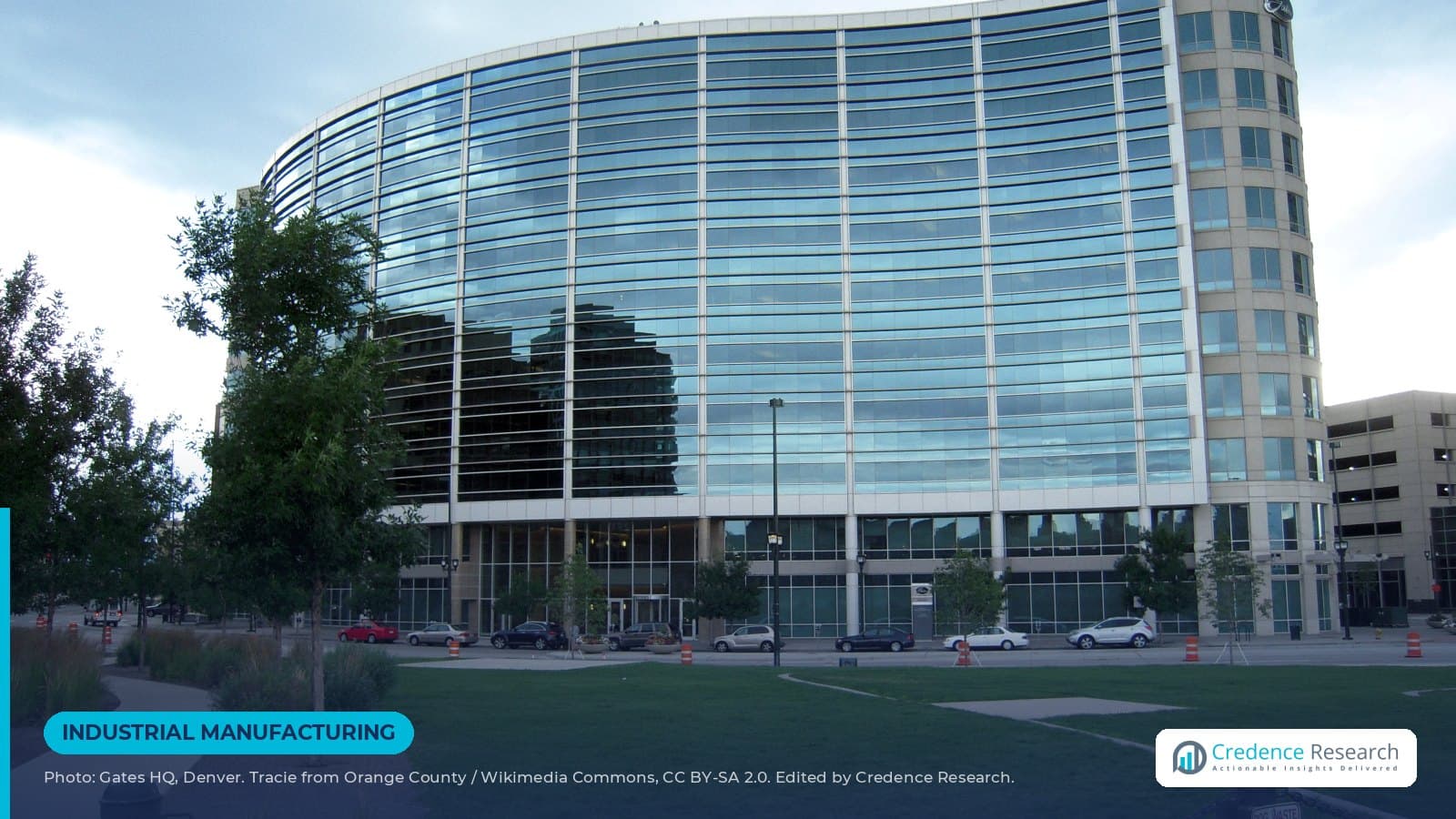
Image: Gates Corporation headquarters at 551 Wewatta Street in Denver, by Tracie from Orange County via Wikimedia Commons, CC BY-SA 2.0. Cropped and edited by Credence Research.

About the Author

Senior News Editor at Credence Research Inc