
Google Picks Blue Origin's New Glenn for First Heavy-Lift Project Suncatcher AI Satellite Launch
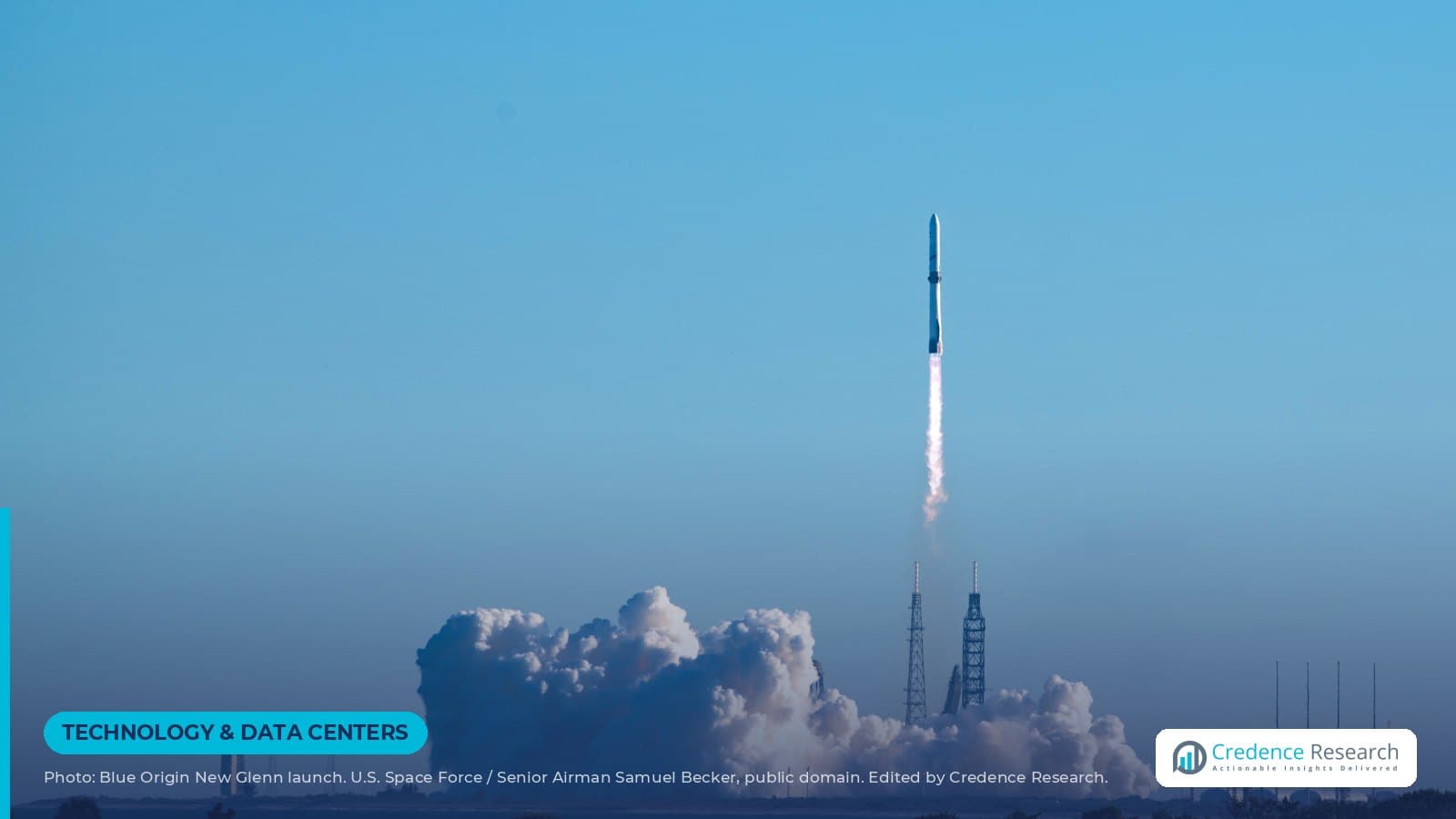
Google has booked Blue Origin's New Glenn heavy-lift rocket for the first dedicated launch of Project Suncatcher, its research effort to run artificial intelligence computing on solar-powered satellites, the company said on Nov. 19, 2026. The launch is targeted for the first quarter of 2029 and will carry Google satellites that each hold roughly the computing capacity of a data center rack into sun-synchronous orbit.
Key developments
- Google selected Blue Origin's New Glenn for the first heavy-lift launch in Project Suncatcher, according to a Nov. 19 post by Travis Beals, senior director of Paradigms of Intelligence at Google.
- The mission is targeted for the first quarter of 2029 and will place Google satellites, each with roughly the capacity of a data center rack, into sun-synchronous orbit.
- Google described the dedicated launch as a crucial milestone on its long-term roadmap and said it builds on ongoing work with other satellite and launch partners.
- The announcement follows the Oct. 1 launch of a Suncatcher prototype satellite, built with Planet, on SpaceX's Transporter-18 rideshare mission. Google said the spacecraft is operating as expected.
- Google did not disclose the number of satellites on the New Glenn flight, the value of the launch contract or the total cost of the program.
How the technology works
Project Suncatcher is Google's long-term moonshot to scale AI infrastructure in space by drawing on the abundant solar power available in orbit. In a Sept. 24 explainer, Google said satellites in low Earth orbit can receive near-constant sunlight and up to eight times more solar power than panels on Earth. The design calls for future satellites that each carry dozens of Tensor Processing Unit chips, fly in tight clusters and exchange data through laser links at very high bandwidth over short distances.
Much of the early work has focused on whether commercial AI chips can survive spaceflight. Google said it tested its Trillium TPUs in a proton beam at the University of California, Davis' Crocker Nuclear Laboratory while the chips ran AI workloads. Initial results indicate the chips can withstand a total ionizing radiation dose greater than they would receive during a five-year mission. Engineers also ran vibration tests on all three axes, because launch brings sustained acceleration of up to 10 g and individual components can experience 50 to 100 g. Cooling relies on heat pipes and radiators, which the team tested in a thermal vacuum chamber.
The program has moved in steps. Planet said in November 2025 that it would build and operate two prototype satellites for Google using the same bus as its Owl mission, with launch targeted by early 2027 to test whether two spacecraft can work in tandem over high-bandwidth crosslinks. Google's Oct. 1 prototype is now gathering in-orbit data on how the TPUs handle launch stress, radiation and thermal extremes. The New Glenn mission would be the first to put rack-scale computing hardware in orbit.
Industry implications
The agreement moves orbital computing from a research concept toward an operational schedule with a named launch vehicle and a target quarter. For the data center sector, the immediate significance is less about capacity than about direction. Electricity, grid interconnection, water and local permitting have become the main constraints on new AI campuses, and Google is now spending launch capital on an alternative that sidesteps all four, at least on paper.
The engineering questions remain large. Rack-scale satellites must reject heat without air or water cooling, operate for years without hands-on maintenance and move data to the ground fast enough to be useful for training or inference. Google's own framing is cautious. It calls Suncatcher a long-term moonshot, and its public results so far cover chip survival and thermal design rather than sustained computing performance in orbit.
Even so, the work feeds back into terrestrial engineering. Radiation-tolerant accelerators, compact liquid-free cooling and high-bandwidth optical links between tightly packed nodes are all relevant to edge sites and dense ground facilities.
Competitive and supply chain implications
The deal puts Google's program on the rocket of a company that has its own orbital computing ambitions. TechCrunch reported in March that Blue Origin had filed with the Federal Communications Commission on March 19 for Project Sunrise, a network of more than 50,000 satellites intended to perform advanced computation in orbit, with a separate planned constellation, TeraWave, serving as the communications backbone. The same report said SpaceX had filed to launch as many as a million satellites as a distributed data center. Fortune reported that Starcloud launched a satellite carrying an Nvidia H100 in November 2025.
By pairing a SpaceX rideshare for its prototype with a dedicated Blue Origin heavy-lift flight, Google is spreading its launch dependence across the two leading reusable rocket providers in the United States. That matters for a program whose economics depend on frequent, lower-cost access to orbit. New Glenn first flew in January 2025, and its ability to fly and reuse boosters at a steady cadence will shape how quickly any orbital computing operator can scale.
For suppliers, the program points to new demand in space-qualified power systems, deployable solar arrays, radiators, optical terminals and radiation testing services.
Regional implications
The work is concentrated in the United States. Blue Origin launches New Glenn from Florida, and Google ran its radiation tests at UC Davis. A successful program would reinforce the role of U.S. launch providers and the FCC as the gatekeepers for orbital computing, since spectrum and orbital licensing will determine how many satellites any operator can deploy.
For regions facing pushback over new data centers, including parts of the U.S. Southwest and Midwest, Europe and Southeast Asia, orbital computing is not a near-term substitute. A 2029 first heavy-lift launch means ground facilities will carry the AI build-out for the rest of the decade.
Credence Research analysis
Google's announcement is best read as a schedule commitment rather than a capacity commitment. The company has disclosed no satellite count, no computing target and no budget for the New Glenn mission, and its published test data covers whether chips survive rather than how efficiently they compute. What has changed is that a hyperscaler has tied its orbital computing roadmap to a specific heavy-lift vehicle and a target quarter. That gives investors, suppliers and regulators a concrete milestone against which to judge progress.
The choice of Blue Origin also signals that launch capacity, not chip supply, may become the gating resource for space-based computing. With SpaceX and Blue Origin both pursuing their own orbital data networks, Google is buying rides from potential rivals. How launch pricing and manifest priority evolve as those providers build competing constellations will be one of the most important variables for the program's long-term economics.
What comes next
- Continued in-orbit data from the Oct. 1 prototype on TPU performance under radiation and thermal stress.
- The two-satellite test with Planet, planned for 2027, to validate tandem flight and laser crosslinks.
- Disclosure of satellite count, configuration and ground station plans for the New Glenn mission.
- FCC licensing activity for Google, Blue Origin's Project Sunrise and SpaceX's orbital computing filings.
- The targeted first-quarter 2029 New Glenn launch of Google's rack-scale satellites.
Sources
- Google: We're partnering with Blue Origin on our first heavy-lift Project Suncatcher launch
- Google: Behind Project Suncatcher, our moonshot to put AI in space
- Google: Our Project Suncatcher prototype satellite is in orbit
- TechCrunch: Jeff Bezos' Blue Origin enters the space data center game
Image: Blue Origin New Glenn rocket launch, U.S. Space Force photo by Senior Airman Samuel Becker via Wikimedia Commons, public domain. Cropped and edited by Credence Research.

About the Author

Senior News Editor at Credence Research Inc