
Lambda Plans $33.1 Billion AI Data Center Campus in Lowndes County, Alabama
Lambda, the AI cloud company that markets itself as the Superintelligence Cloud, said on Nov. 4, 2026, that it plans to build the Red Clay Technology Center Campus in Lowndes County, Alabama, with an estimated investment of $33.1 billion. The campus sits on a site near U.S. Highway 80 and Alabama Highway 21 that Cloverleaf Infrastructure prepared for development, and Lambda will be its end user. Construction is scheduled to begin in the first quarter of 2027 and could run for up to five years, a timeline that places the bulk of spending later in the decade.
Key developments
- Lambda put the total estimated investment in Alabama at $33.1 billion for the Red Clay Technology Center Campus in Lowndes County.
- The company expects more than 1,000 construction jobs during development and more than 225 full-time operations, technical and support roles.
- Construction is slated to start in the first quarter of 2027 and last up to five years; final design details are still being developed.
- Alabama Power will supply electricity, pending regulatory approval, and Lambda said it will pay the full cost of power and grid infrastructure through upfront financial commitments, even if its plans change.
- Lambda and Cloverleaf will fund $10 million through a Community Benefits Agreement with the Central Alabama Community Foundation.
Industry background
Lambda was founded in 2012 by machine learning engineers and builds GPU supercomputers that customers rent for AI training and inference. The company says it serves tens of thousands of customers, from individual researchers to enterprises and hyperscalers. Since late 2025 it has announced a series of its own data center projects, including an AI factory in Kansas City, Missouri, in October 2025 and a data center in Mayes County, Oklahoma, in September 2026.
Capital has followed that shift. Lambda announced a multibillion-dollar agreement with Microsoft in November 2025 to deploy AI infrastructure built on tens of thousands of NVIDIA GPUs. In 2026 it closed a $926 million senior secured term loan B facility in August and a $1 billion senior secured fixed rate financing in October. The Alabama project is far larger than either financing, which points to a multi-year funding program spread across phases rather than a single up-front commitment.
Lowndes County, a rural county between Montgomery and Selma, has little history of large industrial projects. Cloverleaf, which assembles power-ready sites for large electricity users, had already announced the project's tax revenue projections before Lambda was named as the anchor tenant.
Industry implications
The announcement shows how independent GPU cloud providers, often called neoclouds, are now building at a scale once limited to the largest hyperscalers. A planned spend above $30 billion at one site puts Lambda alongside the campus programs of the biggest technology companies. Much of that total will likely go to GPU servers and networking installed in phases as customers sign contracts.
The project also reflects a change in how data center developers handle community and grid concerns. Lambda committed to covering the full cost of power and grid upgrades and signed the White House Ratepayer Protection Pledge in September 2026. It also plans closed-loop cooling and a partnership with N-Drip to help local farmers conserve water, with a goal of returning at least as much water as the facility uses. Commitments like these are increasingly part of the price of approval as utilities, regulators and residents push back against large loads that could raise household bills.
Competitive and supply chain implications
A campus of this size will compete for the same scarce inputs as every other large AI build: high-voltage transformers, switchgear, backup power, liquid cooling equipment and skilled electrical labor. A five-year construction window gives suppliers a long order horizon, but it also exposes Lambda to the lead times and price swings that have slowed projects across the industry. The company's choice of a utility-served site, rather than on-site generation, ties its schedule closely to Alabama Power's transmission and interconnection work.
For chip and server vendors, Red Clay is another sign that demand is broadening beyond a few hyperscale buyers. Neoclouds such as Lambda buy accelerators and complete rack systems in volume, and their growth gives NVIDIA and server makers another major channel. For rival GPU cloud operators, Lambda's move raises the bar on the scale of capacity they will need to offer to win large enterprise and model developer contracts.
Regional implications
The Southeast has become a major destination for data center investment because of available land, regulated utilities that can plan generation and transmission, and state incentive programs. Lowndes County's selection extends that trend into the Alabama Black Belt, a largely rural region with limited industrial employment. Cloverleaf projects more than $2.8 billion in local tax revenue through 2049, including more than $1.6 billion for Lowndes County Public Schools. Superintendent Samita Jeter said the school funding would support facilities, career and technical education and teacher recruitment.
The project still faces local opposition. Construction Review Online reported that Protect Lowndes County and the Alabama Rivers Alliance have sued the Lowndes County Commission. The suit alleges the commission violated Alabama's Open Meetings Act and Open Records Act in approving more than $2.7 billion in state and local tax breaks. According to the outlet, the lawsuit describes a site of about 2,200 acres with a proposed power demand of 1,500 megawatts. Lambda has not stated the campus's capacity, and the allegations have not been tested in court.
Credence Research analysis
Red Clay matters less for its headline dollar figure than for what it says about the next phase of AI infrastructure. Neocloud operators are no longer only renting space from colocation providers; they are signing up for very large campuses on greenfield sites with long build schedules. That approach can secure power ahead of competitors, but it makes the business heavily dependent on continued access to debt markets and long-term customer commitments. Lambda's recent financings, including a term loan backed by GPU deployment for an investment-grade customer, suggest lenders are willing to fund that model when contracts with strong counterparties sit behind it.
The bigger risks are execution and local consent. Lambda's ratepayer, water and design commitments respond directly to the objections that have stalled projects elsewhere, yet the pending lawsuit over the tax break votes shows that procedure can matter as much as substance. Regulatory approval of the Alabama Power service arrangement is the other key gate. If both clear in time for a first-quarter 2027 start, Red Clay could become a template for large AI campuses in rural utility territories; if not, the timeline will likely slip phase by phase rather than collapse outright.
What comes next
- Alabama regulators will review the power supply arrangement between Lambda and Alabama Power.
- A circuit court will consider the lawsuit challenging the Lowndes County Commission's tax incentive votes.
- Lambda plans to keep meeting with residents and release final design details as planning progresses.
- Construction is scheduled to begin in the first quarter of 2027 and continue for up to five years.
- The $10 million Community Benefits Agreement with the Central Alabama Community Foundation will be allocated with community input.
Sources
- Lambda: Lambda to build new data center in Lowndes County, Alabama, investing more than $33 billion in state
- Lambda: New data center in Mayes County, Oklahoma
- Alabama Reporter: Lambda to build new data center in Lowndes County
- Construction Review Online: Lambda's Alabama data center faces lawsuit over tax breaks
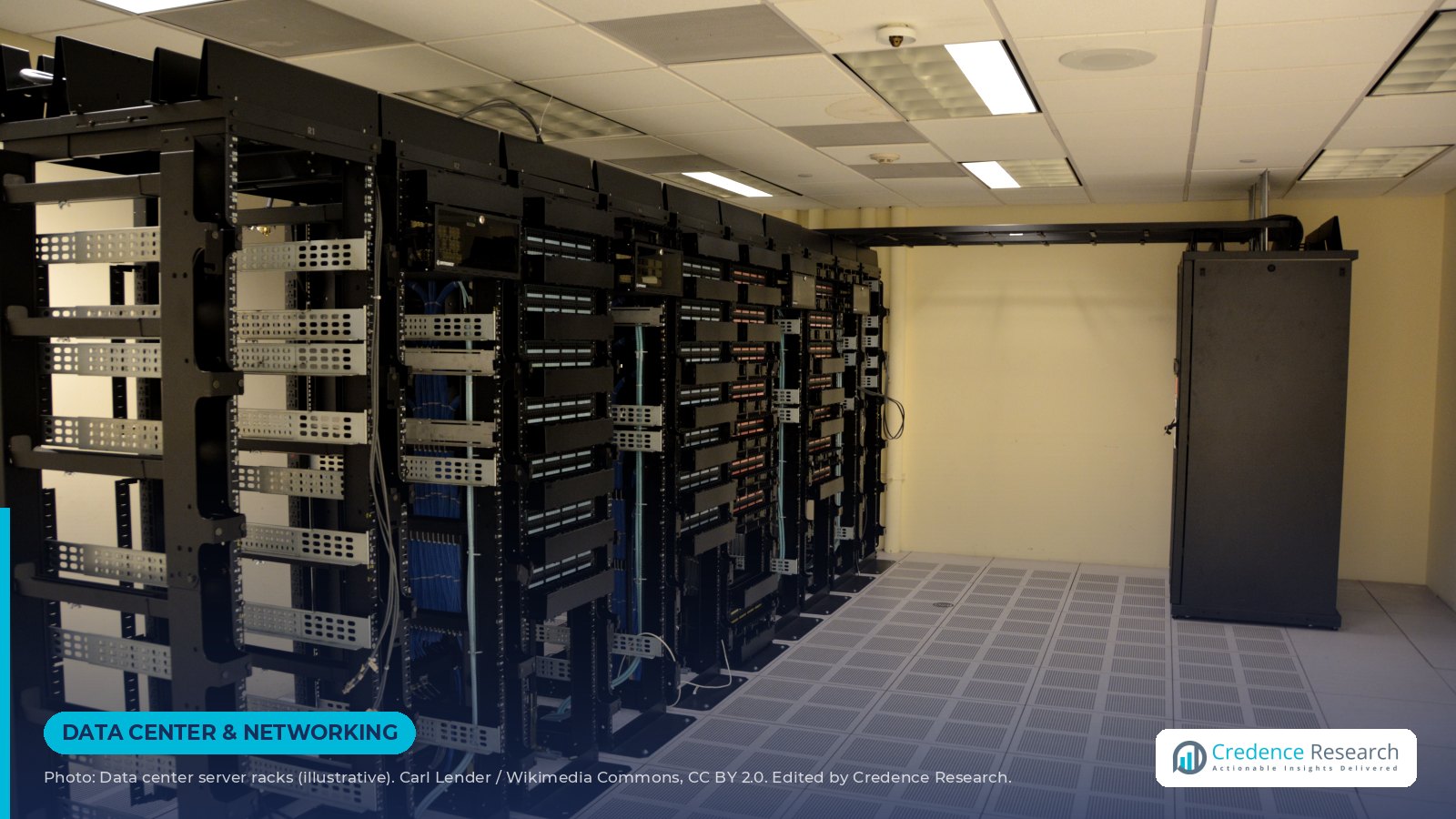
Image: Data center server racks (illustrative), by Carl Lender via Wikimedia Commons, CC BY 2.0. Cropped and edited by Credence Research.

About the Author

Senior News Editor at Credence Research Inc