
MAIRE's Nextchem to Buy Chart Industries' IPSMR LNG Process Technologies for $220 Million
Italian engineering group MAIRE said its technology arm Nextchem has signed a binding agreement to buy Chart Industries' mid-scale IPSMR and small-scale LNG process technologies for $220 million in cash. The deal, announced in Milan on Nov. 15 and presented to investors on Nov. 16, moves a liquefaction licensing business that Baker Hughes committed to sell as a condition of European approval for its takeover of Chart, which it completed in July. Nextchem will make the purchase through its U.S. subsidiary, Nextchem USA Inc.
Key developments
- Nextchem USA Inc. agreed to acquire Chart's IPSMR mid-scale liquefaction process, its upgraded IPSMR+ version, the early-stage IPDMR dual mixed refrigerant process and Chart's small-scale LNG process technologies for $220 million in cash, payable at closing.
- The perimeter includes more than 90 patents, proprietary know-how, the IPSMR trademarks and a team of about 12 professionals who are expected to join Nextchem.
- Chart will supply cold boxes for IPSMR projects under a dedicated 10-year supply agreement, giving Nextchem an integrated technology and equipment offering.
- MAIRE cited about 14 million tonnes per annum (MTPA) of historical operating references, about 57 MTPA under construction, including 30 MTPA of residual backlog, and about 90 MTPA of pre-final investment decision projects that have selected IPSMR.
- The purchase will be funded through dedicated credit facilities underwritten by BPER Banca. Closing is subject to customary regulatory approvals and is expected by the end of 2026 or in early January 2027.
How the technology works
Natural gas liquefaction cools treated gas to roughly minus 162 degrees Celsius so it can be shipped or stored as a liquid. The licensor's process design sets the refrigeration cycle, the equipment list and much of a train's efficiency, which is why the choice of technology is one of the earliest and most consequential decisions in an LNG project. Mid-scale and modular designs have gained ground as developers look for faster, repeatable builds.
According to MAIRE, IPSMR is a single mixed refrigerant process sized for roughly 0.5 to 2 MTPA per train, with a sweet spot of 1.4 to 2 MTPA. The IPSMR+ upgrade and the IPDMR concept extend the range to about 2 MTPA to more than 4 MTPA per train. Chart's small-scale technologies cover applications below 0.5 MTPA, such as peak shaving, remote and stranded gas, alternative fuels and sites without pipeline access. MAIRE positions the portfolio for modular multi-train and floating LNG projects.
The cold box is the core of a liquefaction train. It houses the heat exchangers and piping in which gas is cooled until it condenses, all within a heavily insulated structure. Chart is one of the best-known makers of brazed aluminum heat exchangers and cold boxes, so the supply agreement keeps that manufacturing link in place even as the process intellectual property changes hands.
Industry implications
The sale is the product of an antitrust remedy. Baker Hughes agreed in 2025 to buy Chart in a transaction reported at $13.6 billion. LNG Industry reported in July that the European Commission had been concerned that Baker Hughes, a leading supplier of compressor trains for LNG plants, could favor Chart's LNG business by bundling equipment, weakening interoperability with rival products or using sensitive information from competing projects. To win clearance, Baker Hughes and Chart offered to divest the IPSMR and small-scale process technology business to a buyer approved by the Commission and to keep their equipment interoperable with third parties for 10 years. Baker Hughes said on July 16 that it had completed the acquisition, making Chart a third operating segment.
For LNG developers, the outcome means that a widely selected mid-scale process will sit with an independent technology licensor that does not make rotating equipment. Project sponsors that have already selected IPSMR will want clarity on licensing terms, process guarantees and engineering support during the handover, while equipment vendors gain a neutral counterpart for compressor and driver packages.
Competitive and supply chain implications
For MAIRE, the deal fills a gap in Nextchem's gas offering. Until now the unit focused on gas treatment and purification; the Chart portfolio adds liquefaction and monetization. CEO Alessandro Bernini described the agreement as a major step in the group's technology-driven growth strategy and said it delivers on the LNG expansion goal set at MAIRE's Capital Markets Day. He also said that owning the technology lets the group engage clients earlier in the project development cycle.
That early position matters commercially. A licensor is typically involved during feasibility and front-end engineering design, when contractors are shortlisted. MAIRE expects Nextchem's licensing work to open doors for the group's engineering, procurement and execution business on later-phase work. Competing contractors that have built IPSMR plants may now find themselves working with a licensor whose parent also competes for the construction contract, a dynamic that could shape how clients structure tenders.
On the supply side, the 10-year cold-box agreement keeps Chart, and through it Baker Hughes, in the IPSMR equipment chain. MAIRE said the transaction is expected to be accretive to group margins, reflecting the asset-light nature of licensing income.
Regional implications
The acquiring entity is a U.S. company, Nextchem USA Inc., which should help preserve continuity with American clients and engineering teams as U.S. export developers weigh modular designs. The Commission's role means Brussels must also be satisfied with the buyer under the separate procedure it described in July.
For Italy, the deal extends MAIRE's international technology footprint. The group employs more than 11,500 people across about 50 countries. Small-scale LNG technologies have particular relevance in Europe, Asia and emerging markets where peak-shaving plants, bunkering and off-grid fuel supply are expanding without large pipeline networks.
Credence Research analysis
Credence Research views the transaction as a clear example of competition remedies reshaping the LNG technology landscape. Vertical integration between rotating equipment and process licensing raised enough concern in Brussels to force a carve-out, and the buyer is an engineering contractor seeking more control over the early project cycle. The key question for clients is whether a contractor-owned licensor can stay neutral enough to keep IPSMR attractive in competitive tenders. MAIRE's ability to retain the 12-person team, support existing licensees and keep the Chart cold-box link running smoothly will decide whether the pre-FID pipeline converts into licensed projects.
The price is modest compared with Baker Hughes' purchase of Chart, but the strategic value lies in references and patents rather than physical assets. A licensing franchise with operating plants, projects under construction and selections awaiting investment decisions offers recurring fees and pull-through work. Watch for whether MAIRE pairs IPSMR with its low-carbon and electrification offerings, since developers increasingly ask for electric-driven or lower-emission trains.
What comes next
- Regulatory clearances, including the European Commission's assessment of Nextchem as the remedy buyer, ahead of closing targeted for year-end 2026 or early January 2027.
- Transfer of the 90-plus patents, IPSMR trademarks and roughly 12 specialists to Nextchem.
- Start of the 10-year cold-box supply arrangement between Chart and Nextchem for IPSMR projects.
- Investment decisions on the pre-FID projects that have selected IPSMR, which will test the licensing handover.
- Further development of IPSMR+, IPDMR and integrated low-carbon LNG solutions under Nextchem.
Sources
- MAIRE: Nextchem to acquire LNG process technologies from Chart Industries for $220 million (PR Newswire)
- MAIRE press release (PDF)
- LNG Industry: Baker Hughes receives conditional approval for Chart acquisition
- Baker Hughes: Completes acquisition of Chart Industries
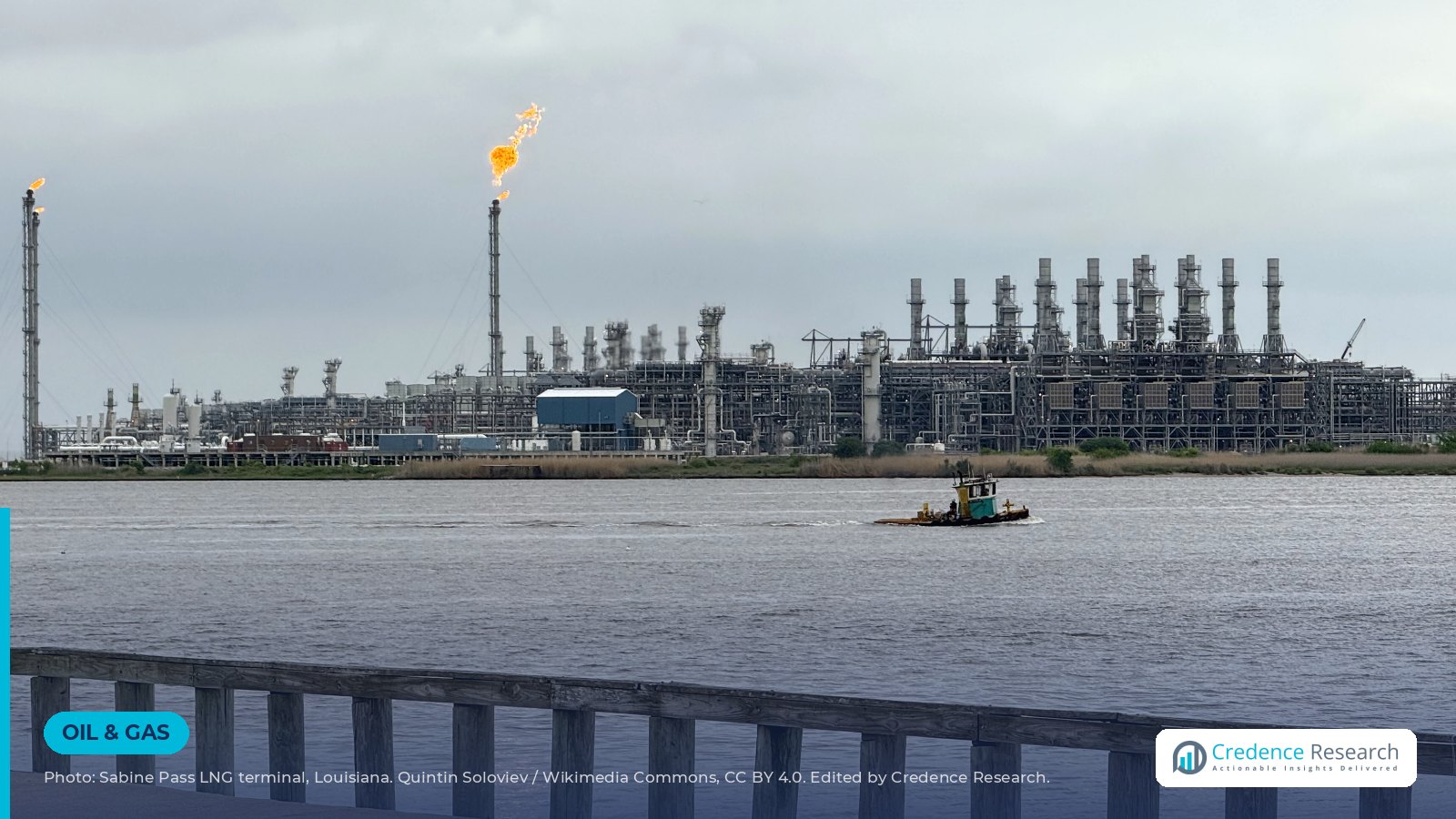
Image: Sabine Pass LNG terminal in Louisiana, shown for illustration of an LNG liquefaction facility, by Quintin Soloviev via Wikimedia Commons, CC BY 4.0. Cropped and edited by Credence Research.

About the Author

Senior News Editor at Credence Research Inc