
Mitsubishi Power to invest $490 million to double Savannah gas turbine plant
Mitsubishi Power Americas will spend $490 million to roughly double the size of its Savannah Machinery Works gas turbine plant near Pooler, Georgia, adding 450,000 square feet of manufacturing space and more than 220 jobs. Georgia Gov. Brian Kemp and the company announced the project on Oct. 23, 2026, as the Mitsubishi Heavy Industries unit signed an expansion framework agreement with the Savannah Economic Development Authority. The funding comes from parent Mitsubishi Heavy Industries, Ltd. (MHI) in Tokyo, and the added space will be used to manufacture gas turbine parts for a power equipment sector that has struggled to keep pace with orders.
Key developments
- MHI is backing a $490 million expansion of Savannah Machinery Works at 1000 Pine Meadow Drive in Chatham County, Georgia.
- The project adds 450,000 square feet to the existing 430,000-square-foot facility, which the governor's office described as doubling the company's Georgia footprint.
- Mitsubishi Power expects to create more than 220 jobs in manufacturing, operations, heavy machinery, engineering, quality, maintenance, logistics and technician roles.
- Planned upgrades include added machining capacity, advanced manufacturing technologies, improved material flow and new production infrastructure.
- No groundbreaking date has been set. The Savannah Economic Development Authority said it expects to hold a ceremony to start construction later.
Background: Mitsubishi Power's U.S. turbine base
Savannah Machinery Works was Mitsubishi Power's first complete gas turbine manufacturing plant outside Japan. The company broke ground in September 2009, during the recession, finished the 430,000-square-foot plant in September 2010 and shipped its first U.S.-built gas turbine in October 2012. In June 2023, the site marked its 50th shipment of an advanced-class gas turbine. Today it serves as a manufacturing and service center for advanced-class gas turbines, steam turbines and other power generation equipment.
The location was a selling point for the project. The plant sits near the junction of Interstates 95 and 16 with rail access and a short haul to the Port of Savannah, which matters for heavy rotating equipment that often moves as oversized cargo. Trip Tollison, president and CEO of the Savannah Economic Development Authority, called the project highly competitive and said it is among the largest investments Mitsubishi Power Americas has made. Bill Newsom, the unit's president and CEO, said in the state release that the expansion strengthens American manufacturing.
Savannah is one piece of a wider Americas investment program. The company recently expanded its Power Generation Services headquarters in Orlando, Florida, plans to open a new corporate headquarters in Lake Mary, Florida, in November and says further expansions are planned through 2028.
Industry implications
Heavy-duty gas turbines have become one of the tightest links in the power supply chain. Utilities, independent power producers and large industrial users are adding gas-fired capacity to cover rising electricity demand from data centers, manufacturing and electrification, and the three dominant original equipment makers have reported multiyear order books. Utility Dive reported in September 2025 that waits for large gas turbines had stretched from roughly 2.5 to 3 years to as long as seven years in some cases.
Mitsubishi Power did not disclose how many additional turbines or components the larger Savannah plant will produce. Even so, more domestic machining capacity for turbine parts can shorten logistics chains for U.S. projects and give the company more control over the service and parts business that follows every turbine sale. Long-term service agreements tied to installed fleets are a durable source of work for turbine makers, and a larger U.S. parts plant supports that installed base as well as new units.
Competitive and supply chain implications
The investment follows a broader capacity push among turbine makers. Bloomberg reported in August 2025 that MHI planned to double its gas turbine manufacturing capacity over about two years. GE Vernova has said it expects annualized gas turbine output to reach 20 GW by the third quarter of 2026 and 24 GW by 2028, according to Power Engineering's report on its first-quarter earnings, and that it is adding about 1,800 U.S. production workers across 2025 and 2026. Siemens Energy has expanded its Florida blades and vanes facility.
Factory floor space is only part of the bottleneck. Turbine production depends on specialized castings, forgings, high-temperature alloys and coatings, and on machinists and engineers who take years to train. An Electric Power Research Institute program manager told Utility Dive that skilled labor is the factor that most complicates expansion timelines. That makes the more than 220 Savannah roles, and the training pipeline behind them, as important as the new building. For suppliers of forgings, precision machining and inspection services in the Southeast, a larger anchor plant could translate into more local subcontracting.
Regional implications
For coastal Georgia, the project adds to an industrial base built around the Port of Savannah, a major container gateway on the U.S. East Coast. Partners on the project included the Savannah Economic Development Authority, the Georgia Department of Economic Development, Georgia Power and Georgia Quick Start, the state's workforce training program. Commissioner Pat Wilson noted that Mitsubishi Power first chose Georgia during the recession and has remained a long-term partner. No incentive package was disclosed in the announcements.
The hiring plan will compete for skilled trades in a region that has drawn large manufacturing projects in recent years, including automotive and battery plants. Georgia Quick Start's involvement suggests the state will help recruit and train workers for machining and technician roles.
Credence Research analysis
The Savannah expansion signals that MHI sees the current wave of gas turbine demand as durable enough to justify fixed U.S. capital, not just longer order books in Japan. Turbine makers were cautious about adding capacity after the gas power slump of the late 2010s, when orders fell and factories were consolidated. Committing $490 million to a parts and manufacturing plant in the United States, where gas-fired capacity additions are accelerating, suggests MHI expects demand from utilities and large power users to hold for years. It also positions the company closer to U.S. customers who increasingly weigh domestic content and delivery certainty alongside price and efficiency.
The open questions are timing and output. The company has not disclosed a construction schedule, the products the new space will make or how much added production it will support, and the first new capacity is unlikely to arrive before construction starts and equipment is installed. For developers planning gas-fired projects later this decade, the move improves the medium-term supply picture rather than near-term slot availability. The workforce element may prove the deciding factor in how quickly Savannah can ramp.
What comes next
- Mitsubishi Power and the Savannah Economic Development Authority are expected to schedule a groundbreaking ceremony to start construction.
- The company plans to open its new corporate headquarters in Lake Mary, Florida, in November 2026.
- Hiring for more than 220 positions is expected to ramp as construction progresses, with Georgia Quick Start supporting training.
- Mitsubishi Power says additional Americas expansions are planned through 2028.
- MHI's next financial results may give more detail on gas turbine orders and capacity plans.
Sources
- Office of the Governor of Georgia: Gov. Kemp: Mitsubishi Power Doubles Footprint in Chatham County
- Mitsubishi Power (Business Wire): $490 Million Investment in Savannah Facility
- Utility Dive: Gas turbine manufacturers expand capacity, but order backlog could prove stubborn
- Power Engineering: GE Vernova power equipment orders and turbine slots
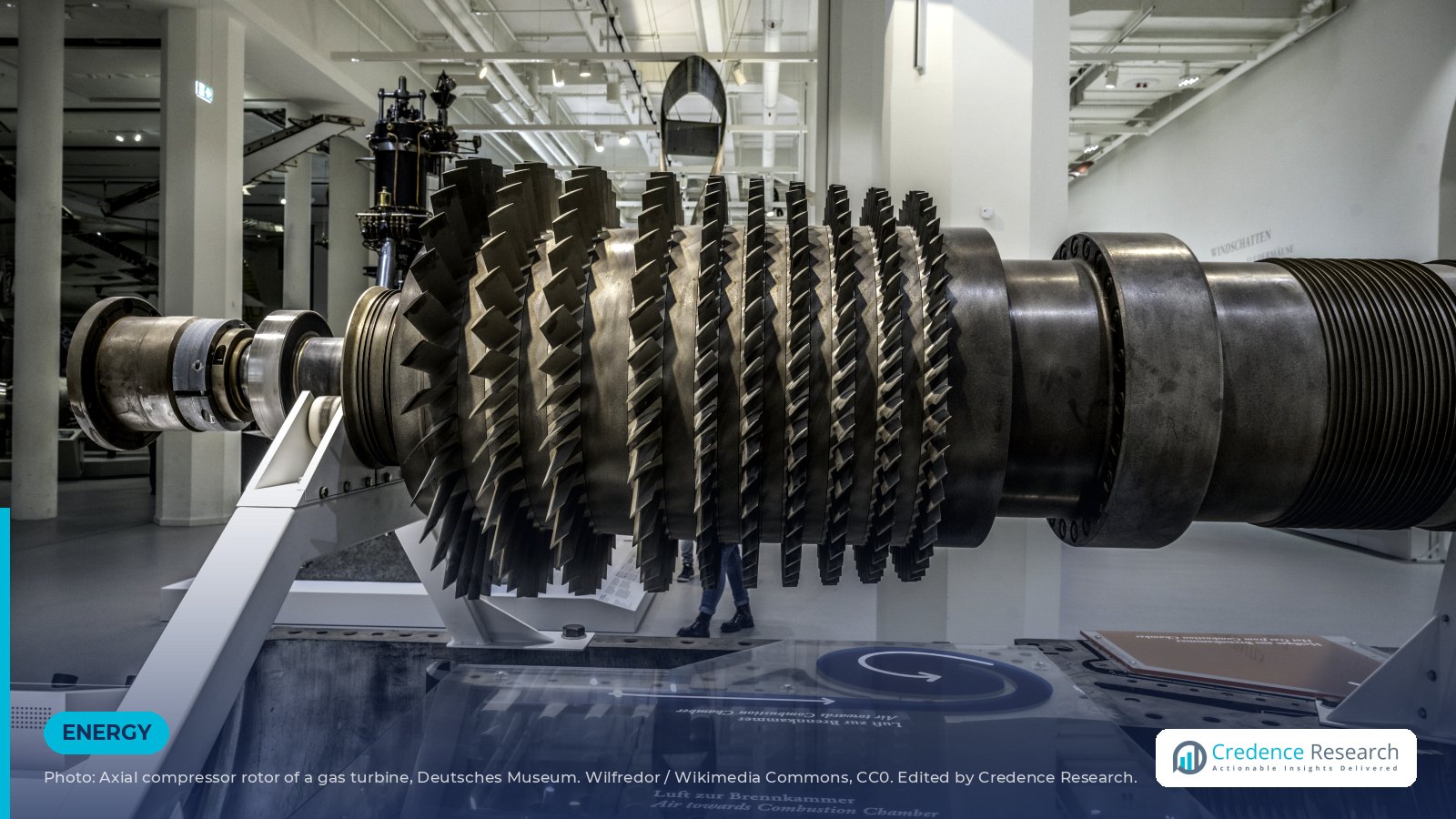
Image: Axial compressor rotor of a gas turbine at the Deutsches Museum, by Wilfredor via Wikimedia Commons, CC0. Cropped and edited by Credence Research.

About the Author

Senior News Editor at Credence Research Inc