
Niron Magnetics to Invest $1.8 Billion in Alabama Rare-Earth-Free Magnet Plant, Creating 700 Jobs
Niron Magnetics will invest $1.8 billion in a rare-earth-free permanent magnet manufacturing campus in Dothan, Alabama, the Minneapolis-based company said on Nov. 20, 2026. The 1.6-million-square-foot site at the Westgate Super Site industrial park will house Niron's first high-volume plant, rated at 10,000 tons of iron nitride magnets, and is expected to create 700 high-wage jobs within five years. Construction is scheduled to begin in 2028, with production starting in 2029.
Key developments
- Niron committed $1.8 billion to an advanced manufacturing campus in southeast Alabama, its second U.S. production site after Sartell, Minnesota.
- The Dothan plant is designed for 10,000 tons of magnets, compared with up to 1,500 tons a year at the Sartell facility due to open in 2027.
- The project is expected to create 700 high-wage jobs within five years, with construction starting in 2028 and production in 2029.
- Niron said it considered sites in 22 states before selecting the 446-acre Westgate Super Site, which has CSX rail access and earned CSX Select Site Platinum status in late 2025.
- The site was prepared with Alabama SEEDS program funding in 2024 and later received Growing Alabama Tax Credit allocations; no company-specific incentive amount was disclosed.
How the technology works
Most high-performance permanent magnets used in electric motors, generators and electronics are neodymium-iron-boron magnets, which depend on rare earth elements that are mined and processed largely outside the United States. Niron, founded in 2013, has commercialized iron nitride magnets that use abundant materials, iron and nitrogen, instead of neodymium, dysprosium or terbium. The company describes the technology as a scalable, cost-competitive alternative to conventional neodymium-based magnets.
Niron says its magnets currently serve applications in artificial intelligence infrastructure, automotive, defense, industrial equipment and consumer electronics. The company opened a pilot plant in Minneapolis in 2024 and broke ground in September 2025 on a 190,000-square-foot facility at the former Verso Paper Mill site in Sartell, which is expected to employ more than 175 people and begin operating in early 2027. Its investor base includes Stellantis, Samsung, Allison Transmission and Magna, and Manufacturing Dive reported in September 2026 that Honda had invested through its Honda Xcelerator Ventures arm.
The Dothan plan has been public in outline since March 2026, when Niron launched a formal site search for a 1.6-million-square-foot, $1.8 billion plant with Savills as its real estate advisor, according to Manufacturing Dive. The Nov. 20 announcement settles the location and confirms the construction and production timeline.
Industry implications
The Dothan project moves rare-earth-free magnets from pilot and first-plant scale toward volume manufacturing. A 10,000-ton plant is several times larger than the Sartell line and is sized to supply automotive and industrial customers that buy magnets in program-level quantities rather than for qualification samples. That scale matters for electric vehicle traction motors, robotics, wind and industrial drives, data center cooling and power equipment, all of which rely on permanent magnets.
The timeline also sets expectations. With production starting in 2029, Dothan will not ease near-term magnet supply constraints. Customers will instead watch Sartell's ramp in 2027 for evidence on yield, cost and magnetic performance in production conditions. Those results will shape how quickly automakers and equipment makers design iron nitride magnets into motors scheduled for the end of the decade.
Niron has not named customers for Dothan output, and the release did not disclose offtake agreements. Its existing investors include automakers and drivetrain suppliers, which gives the company direct access to engineering teams that qualify magnet materials.
Competitive and supply chain implications
Most U.S. magnet supply efforts aim to rebuild the rare earth chain from mining through separation, metal making and magnet sintering. Niron's approach skips that chain entirely by avoiding rare earth elements, which shortens the list of critical inputs and removes exposure to export controls on rare earth materials and processing technology. That positions iron nitride as a complement to domestic neodymium magnet projects rather than a direct replacement in every application, since motor designers select magnet grades by temperature, coercivity and size requirements.
Federal support has followed the strategic case. Manufacturing Dive reported that the Department of Defense's Office of Strategic Capital extended a conditional $150 million loan commitment for the Sartell plant in 2026. The Nov. 20 release did not mention federal financing for Dothan, and Niron has not disclosed how the $1.8 billion will be funded.
For equipment makers, a second domestic source type, independent of rare earth feedstock, adds a hedge against price spikes and licensing restrictions. Qualification cycles in automotive and defense are long, so the companies that test Sartell material in 2027 and 2028 will be best placed to secure Dothan capacity.
Regional implications
The project extends Alabama's automotive and advanced manufacturing base into the Wiregrass region of southeast Alabama, placing a strategic materials plant outside the state's established automotive corridors. Gov. Kay Ivey called the investment tremendous news for the Wiregrass and the state, and Commerce Secretary Ellen McNair said programs such as SEEDS and Growing Alabama help prepare sites for projects of this size. Dothan Mayor Mark Saliba said the plant would be built by people from the region and would let local families build their futures there.
Niron CEO Jonathan Rowntree said Alabama stood out from the first conversation and thanked state and local partners. The Westgate Super Site was assembled by the City of Dothan, Houston County, the city's Industrial Development Board and the Dothan Area Chamber of Commerce. For Minnesota, the decision confirms that the company's first full-scale plant stays in Sartell while volume production moves south.
Credence Research analysis
The Dothan commitment is a bet that iron nitride can pass from qualification into mainstream motor design before the end of the decade. The announced scale, timeline and investor list point to automotive and industrial drives as the main destination, but the absence of named customers or offtake terms means the investment still depends on Sartell proving that production magnets match pilot results. The 2028 construction start gives Niron about a year of Sartell output to secure commitments before major capital is spent.
The decision also reflects how site readiness now drives large manufacturing choices. A pre-assembled, rail-served site with state-backed preparation helped Alabama prevail in a search that covered 22 states, and it shortens permitting and site work. For buyers of permanent magnets, the more important signal is diversification: a rare-earth-free supply route that does not depend on the same mines, refineries and export licenses as conventional magnets would give procurement teams a structural hedge rather than another source of the same material.
What comes next
- Startup of the Sartell, Minnesota, plant in 2027, with capacity of up to 1,500 tons a year.
- Customer qualification results and any offtake or supply agreements tied to Dothan output.
- Disclosure of financing for the $1.8 billion campus, including any federal loan or grant support.
- Start of construction at the Westgate Super Site in 2028.
- First production at Dothan in 2029 and hiring toward 700 jobs within five years.
Sources
- Niron Magnetics: Niron Magnetics announces $1.8B investment in Alabama, creating 700 jobs (Nov. 20, 2026)
- Business Wire: Niron Magnetics breaks ground on rare-earth-free magnet facility in Sartell
- Manufacturing Dive: Niron Magnetics begins site selection for $1.8B magnetics plant (March 2026)
- Manufacturing Dive: Honda invests in U.S. maker of rare-earth-free magnets (September 2026)
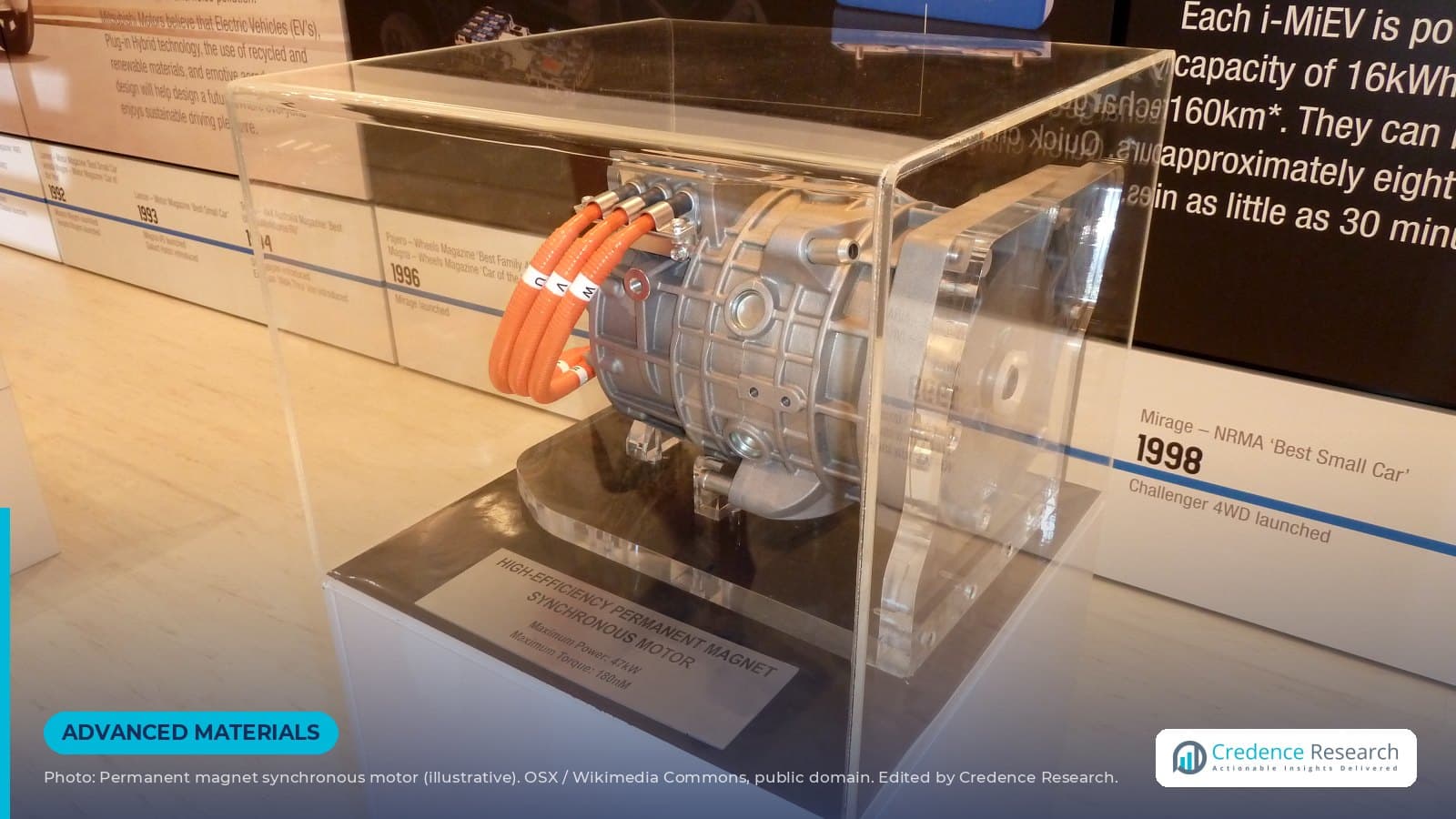
Image: Permanent magnet synchronous motor on display (illustrative), by OSX via Wikimedia Commons, public domain. Cropped and edited by Credence Research.

About the Author

Senior News Editor at Credence Research Inc