Market Overview:
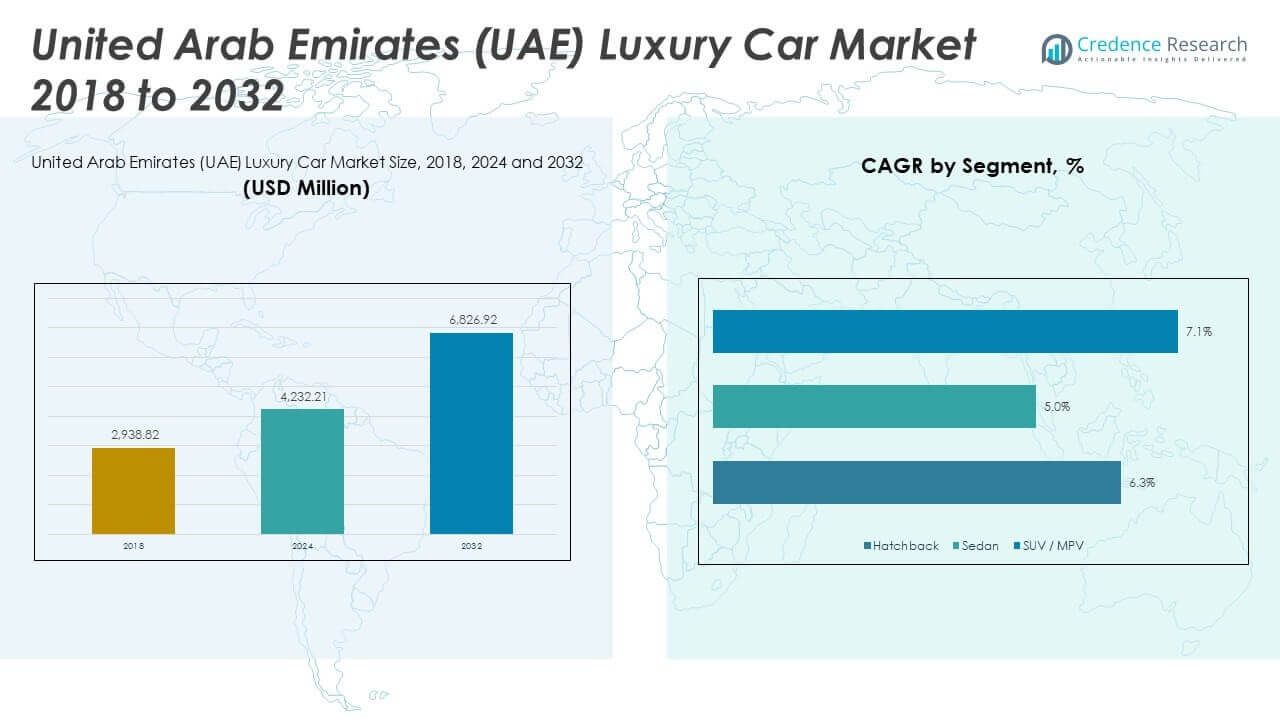
The United Arab Emirates (UAE) luxury car market, valued at USD 4,232.21 million in 2024, is projected to grow steadily at a CAGR of 5.73% to reach USD 6,826.92 million by 2032.
| REPORT ATTRIBUTE | DETAILS |
|---|---|
| Historical Period | 2020-2023 |
| Base Year | 2024 |
| Forecast Period | 2025-2032 |
| United Arab Emirates (UAE) Luxury Car Market Size 2024 | USD 4,232.21 Million |
| United Arab Emirates (UAE) Luxury Car Market, CAGR | 5.73% |
| United Arab Emirates (UAE) Luxury Car Market Size 2032 | USD 6,826.92 Million |
Several key factors underpin this growth. Firstly, the UAE is home to a rapidly growing affluent population with high disposable incomes. Luxury car ownership is often seen as a symbol of success and status among this demographic, leading to a sustained demand for high-end automotive brands.
Government policies in the UAE also play a crucial role in fostering this market growth. These policies promote economic diversification and attract foreign investment, making luxury cars more accessible through low import duties. The presence of a well-developed infrastructure in the UAE further enhances the allure of luxury car ownership, contributing to a conducive environment for market growth.
Consumer preferences are evolving towards personalized experiences and brand consciousness, further fuelling the demand for luxury cars. Emerging trends, such as the rising preference for Sport Utility Vehicles (SUVs) and the introduction of electric and hybrid vehicles, indicate the evolving landscape of luxury car ownership in the UAE.
However, the market also faces challenges. Economic fluctuations and increasing competition necessitate adaptability and innovation from luxury car manufacturers. Despite these challenges, the future outlook for the UAE luxury car market remains promising. Continued economic prosperity, evolving consumer preferences, and government initiatives supporting the growth of the automotive sector are expected to drive the market forward.
The UAE luxury car market is poised for significant growth in the coming years, driven by a combination of favourable economic conditions, government policies, and changing consumer preferences. However, to fully capitalize on these opportunities, luxury car manufacturers will need to navigate the challenges of economic fluctuations and increasing competition, and continue to innovate to meet the evolving needs and preferences of consumers.
Market Drivers:
Economic Prosperity and Rising Affluence:
The UAE’s thriving and diversified economy, driven by its strategic location and abundant oil & gas reserves, has contributed to a population with increasing disposable incomes. For instance, this affluent demographic represents a prime market for luxury car brands seeking to tap into the desire for premium experiences and elevated social status. The demand for luxury automobiles is fueled by the aspiration of owning prestigious vehicles that reflect one’s success and sophistication in the prosperous UAE society.
Shifting Consumer Preferences and Brand Appeal:
UAE consumers exhibit a growing penchant for luxury car brands, drawn to the exclusivity, prestige, and technological innovation associated with these vehicles. Beyond mere transportation, owning a luxury car symbolizes individuality and makes a bold statement of achievement. For instance, consumers aspire to align themselves with brands like Rolls Royce and Bentley that offer not just products but lifestyle experiences synonymous with luxury and refinement. Luxury Cars market unit sales are expected to reach 3.7k vehicles in 2028.
Government-Led Initiatives and Infrastructure Development:
The UAE government's focus on promoting tourism, business growth, and foreign investment has contributed to a conducive environment for luxury goods, including high-end automobiles. Extensive infrastructure development, such as world-class road networks, not only enhances the appeal of luxury cars but also provides an optimal platform for showcasing their performance and features. These initiatives align with the UAE's vision of becoming a global hub for commerce, leisure, and innovation.
Tailored Marketing Strategies and Product Diversification:
Luxury car manufacturers continuously adapt their marketing strategies to resonate with the diverse and multicultural population of the UAE. They tailor their approaches to appeal to the unique preferences and lifestyles of consumers in the region. Moreover, these brands are expanding their product portfolios to include SUVs and crossovers, catering to the practical needs and preferences of UAE drivers navigating diverse terrains and urban landscapes.
Accessibility through Leasing and Financing Options:
The popularity of leasing and financing arrangements has democratized access to luxury cars, making them attainable for a broader segment of the population. Aspirational buyers who may not afford an outright purchase can now experience luxury through flexible leasing terms. This trend aligns with the UAE's tech-savvy and brand-conscious consumer base, offering the opportunity to enjoy the latest models with ease and convenience.
Market Trends:
Shifting Preferences Towards SUVs and Performance Vehicles:
Consumers in the UAE are increasingly favoring SUVs and performance vehicles over traditional luxury sedans. For instance, the Lamborghini Urus and Porsche Cayenne, both high-performance SUVs, have seen a surge in popularity in the UAE. This trend reflects a growing desire for a blend of luxury, practicality, and power. In 2021, SUVs were the most common body type of passenger cars in the UAE with a market share of just over 50%. Manufacturers are catering to this demand by introducing high-performance SUVs and sporty sedans, further fueling market growth.
Rising Demand for Customization and Personalization:
Discerning UAE luxury car buyers seek vehicles tailored to their unique preferences. For instance, Rolls-Royce offers its customers in the UAE a nearly limitless array of customization options, from bespoke paint colors and interior trims to personalized performance packages and accessories. Another example is Ferrari, which has introduced an unprecedented level of customization for their Dubai flagship model, allowing customers to tailor every aspect of their car to personal preferences. Manufacturers are responding by offering extensive customization options, including bespoke interiors, exclusive paint colors, and personalized technology packages. This trend highlights the growing importance of a unique and personalized ownership experience in the luxury car market.
Growing Popularity of Electric and Hybrid Luxury Cars:
Increasing environmental consciousness and government incentives are driving the adoption of electric and hybrid luxury cars in the UAE. For instance, the Tesla Model S and Porsche Taycan, both luxury electric vehicles, have been well-received in the UAE. In October 2022, the share of leads for electric car listings stood at 2.77% whereas October 2023 saw the share jump to 6.25% - a significant increase of 3.48%. The UAE government has launched several initiatives to promote electric vehicles as part of its broader sustainability and environmental goals. These vehicles offer a sustainable alternative to traditional gasoline-powered models without compromising on luxury or performance. As charging infrastructure expands and battery technology improves, electric and hybrid luxury cars are expected to gain further traction in the market.
Evolving Retail Landscape and Online Presence:
The UAE luxury car market is witnessing a shift towards a more digital retail experience. Luxury car dealerships are increasingly utilizing online platforms to showcase their inventory, offer virtual consultations, and facilitate online car purchases. This digital transformation caters to the evolving preferences of tech-savvy consumers who seek a convenient and personalized car buying journey.
Focus on Enhanced After-Sales Services:
Recognizing the importance of customer satisfaction, luxury car manufacturers in the UAE are placing a greater emphasis on after-sales services. This includes offering extended warranties, personalized maintenance packages, and exclusive ownership benefits. By prioritizing exceptional after-sales care, luxury car brands aim to cultivate long-term customer loyalty and brand advocacy.
Market Restraints and Challenges:
Economic Fluctuations and High Import Duties:
The UAE's luxury car market is heavily influenced by economic conditions. Fluctuations in oil prices, a major driver of the UAE's economy, can lead to decreased consumer spending on luxury goods like cars. Additionally, high import duties levied on luxury vehicles inflate their final price tag, potentially deterring some high-net-worth individuals from making a purchase.
Shifting Consumer Preferences and Rise of Sustainable Transportation:
A growing segment of consumers, particularly younger generations, are becoming more environmentally conscious. This could lead to a shift in preference towards electric vehicles (EVs) or other sustainable transportation options, potentially impacting the sales of traditional luxury gasoline-powered cars.
Increasing Competition and Market Saturation:
The UAE luxury car market is witnessing growing competition from established players and new entrants. This intensifies competition for market share and brand loyalty. Additionally, the market may be nearing saturation in certain segments, making it challenging for manufacturers to introduce new models that significantly stand out from existing offerings.
Fluctuations in Currency Exchange Rates:
The UAE Dirham (AED) is pegged to the US Dollar (USD). Fluctuations in the exchange rate between these currencies can impact the affordability of imported luxury cars. A stronger USD can make luxury cars more expensive for UAE consumers, potentially leading to a decline in sales.
Evolving Regulations and Infrastructure for Electric Vehicles:
While the UAE is actively promoting electric vehicle adoption, the current infrastructure is still under development. This includes a limited network of charging stations and a lack of readily available spare parts and service options for EVs. Additionally, government regulations and policies concerning EVs are still evolving, creating some uncertainty for both consumers and manufacturers.
Recent Developments:
- In September 2023, Dubai Police incorporated 100 Audi RS e-tron GTs, fully electric with a 488-kilometer range, into their luxury patrol car fleet.
- In February 2023, AW Rostamani Group launched NXT Luxury, its first luxury used-car showroom in Dubai.
Segmentation Analysis:
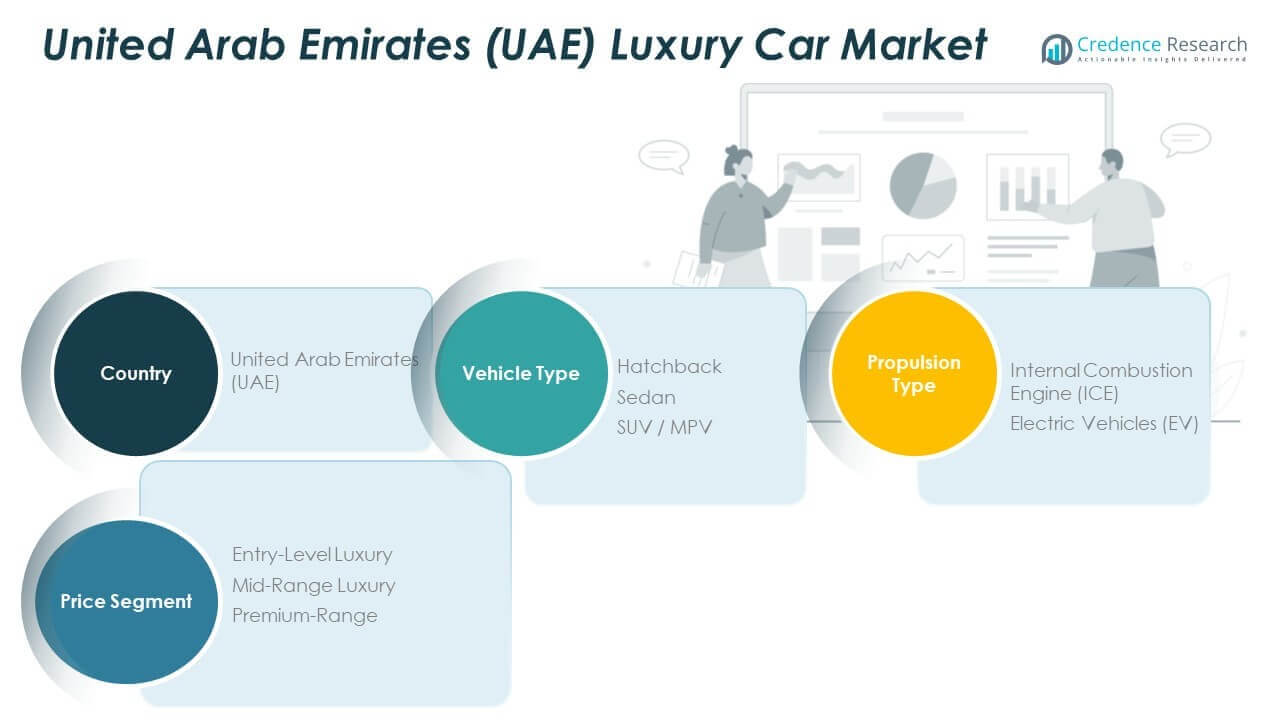
Vehicle Type:
- SUVs: The most popular segment due to a preference for spaciousness, comfort, and off-road capabilities favored by the region's terrain.
- Sedans: Still hold a significant share, particularly for premium business use and a preference for a classic luxury car experience.
- Sports Cars: A niche segment catering to driving enthusiasts seeking high performance and exclusivity.
By Propulsion:
- The market is divided into two primary segments: Internal Combustion Engine (ICE) and Electric/Hybrid vehicles. Currently, the ICE segment dominates the market due to established consumer preferences and existing infrastructure. However, the electric and hybrid segment is rapidly gaining traction, driven by increasing environmental awareness and advancements in battery technology. This shift is expected to enhance the appeal of electric luxury vehicles, making them a significant part of the market in the coming years.
By Price Segment:
- The luxury car market is also categorized into entry-level luxury, mid-level luxury, and ultra-luxury segments. The mid-level luxury segment holds the largest market share, appealing to a broad range of consumers seeking premium features without the ultra-luxury price tag. The ultra-luxury segment, while smaller, is characterized by high demand among affluent consumers, particularly in emerging markets where wealth is increasing.
Segments:
By Vehicle Type:
- Hatchback
- Sedan
- SUV/MPV
By Propulsion:
- ICE
- Electric
By Price Segment:
- Entry Level
- Mid-Range
- Premium-Range
By Region:
- Dubai
- Abu Dhabi
- Sharjah
- Rest of UAE
Key player:
- Rolls-Royce Motor Cars Limited
- BMW AG
- Koenigsegg Automotive AB
- Automobili Lamborghini S.p.A.
- W Motors
- Daimler AG
- Volkswagen AG
- Aston Martin Lagonda Limited
- Ferrari S.p.A.
- Automobiles Ettore Bugatti
Regional Analysis:
The UAE luxury car market is on the brink of significant expansion, driven by a convergence of regional factors conducive to the proliferation of high-end vehicles. With a growing population experiencing an uptick in disposable income, particularly among high-net-worth individuals, there's a burgeoning demand for luxury cars perceived as symbols of status and aspiration. This demand is further fueled by a steady influx of wealthy individuals drawn to the UAE's business opportunities and lavish lifestyle offerings. Additionally, the deeply entrenched cultural appreciation for luxury brands, coupled with supportive government policies promoting foreign investment and robust infrastructure development, creates an appealing landscape for luxury car manufacturers and dealerships. As consumer preferences continue to evolve towards personalized experiences and cutting-edge features, manufacturers have the opportunity to capitalize on this trend by offering innovative offerings tailored to the discerning tastes of UAE consumers.
Future Outlook:
- A growing affluent population in the UAE with increasing disposable income is expected to fuel demand for luxury cars.
- A shift in consumer preferences towards premium experiences, personalization, and technological advancements will drive demand for high-end vehicles with cutting-edge features.
- The UAE's supportive government policies promoting tourism and economic diversification are expected to create a positive environment for the luxury car market.
- The increasing popularity of SUVs within the luxury car segment, catering to both on-road and off-road preferences, is likely to remain a significant trend.
- A growing focus on sustainability is propelling the demand for electric and hybrid luxury cars, and government initiatives promoting electric vehicles will further accelerate this trend.
- Luxury car dealerships are expected to elevate the customer experience through personalized services, digital showrooms, and innovative marketing strategies.
- The market for pre-owned luxury cars is anticipated to witness significant growth, driven by affordability and wider options for budget-conscious buyers.
- The growing adoption of online platforms for buying and selling luxury cars is expected to offer greater convenience and wider choices for consumers.
- Luxury car manufacturers are likely to place a stronger emphasis on after-sales services like maintenance packages, extended warranties.
- The intensifying competition within the luxury car market is expected to drive innovation in design, technology, and performance.

Request a Free Sample
Fill in your details and we'll send you a free sample report.
- Sample data tables & charts
- Research methodology
Market Dynamics
Economic Prosperity and Rising Affluence
The UAE's robust and diversified economy, coupled with a growing population of high-net-worth individuals, is increasing disposable incomes and fueling demand for luxury cars as symbols of status and success.
Shifting Consumer Preferences and Brand Appeal
Consumers in the UAE are increasingly drawn to luxury car brands for their exclusivity, prestige, and technological innovation, with a strong desire for vehicles that reflect individuality and achievement.
Government-Led Initiatives and Infrastructure Development
Supportive government policies, low import duties, and world-class infrastructure make luxury car ownership more accessible and appealing, encouraging both local and foreign investment in the sector.
Accessibility through Leasing and Financing Options
Flexible leasing and financing arrangements have broadened access to luxury cars, enabling a wider segment of the population to experience premium vehicles without the need for outright purchase.
Growing Popularity of Electric and Hybrid Luxury Cars
Rising environmental awareness and government incentives are accelerating the adoption of electric and hybrid luxury vehicles, with expanding charging infrastructure and improved battery technology making these options increasingly attractive.
Need a Custom Version of This Report?
Tailor the scope, geography, or segments to your exact requirements.
- Custom geography or segment scope
- Direct access to our analyst team
Frequently Asked Questions
What is the projected growth of the UAE luxury car market?
What factors are driving the growth of the UAE luxury car market?
What are the emerging trends in the UAE luxury car market?
What challenges does the UAE luxury car market face?
Table of Content
Chapter 1 Market Segmentation
- 1.1 Segmentation Framework
- 1.1.1 Product and Service Classification
- 1.1.2 Application and End-Use Classification
- 1.1.3 Technology and Solution Classification
- 1.1.4 Customer and Distribution Channel Classification
- 1.1.5 Geographic Segmentation
- 1.1.6 Market Segment Definitions and Boundaries
- 1.2 By Propulsion
- 1.2.1 ICE
- 1.2.2 Electric
- 1.3 By Vehicle Type
- 1.3.1 Hatchback
- 1.3.2 Sedan
- 1.3.3 SUV/MPV
- 1.4 By Price Segment
- 1.4.1 Entry Level
- 1.4.2 Mid-Range
- 1.4.3 Premium-Range
Chapter 2 Introduction
- 2.1 Report Objectives and Scope
- 2.2 Product Definition and Industry Terminology
- 2.3 Market Inclusions and Exclusions
- 2.4 Research Process
- 2.4.1 Primary Research and Expert Interviews
- 2.4.2 Secondary Research and Source Review
- 2.4.3 Top-Down and Bottom-Up Estimation
- 2.4.4 Data Triangulation and Verification
- 2.5 Market Size Measurement Basis
- 2.5.1 2024: USD 4,232.21 million → 2032: USD 6,826.92 million
- 2.6 Historical and Forecast Reference Periods
- 2.6.1 Base Year: 2024
- 2.6.2 Forecast Period: 2024-2032
- 2.7 Research Assumptions and Limitations
Chapter 3 Executive Summary
- 3.1 Market Snapshot and Key Findings
- 3.2 Base-Year Market Size, 2024
- 3.3 Forecast Market Size, 2032
- 3.4 Revenue and Volume Growth Outlook
- 3.5 Key Demand and Supply Indicators
- 3.6 Leading Market Segments
- 3.7 Fastest-Growing Market Opportunities
- 3.8 Regional Performance Highlights
- 3.9 Technology and Industry Transformation
- 3.10 Competitive Landscape Summary
- 3.11 Analyst View and Strategic Implications
Chapter 4 UAE Luxury Car Market Trends and Developments
- 4.1 Historical Industry Development
- 4.2 Recent Market Trends and Developments
- 4.3 Demand and Customer Behavior Trends
- 4.4 Technology and Product Innovation
- 4.5 Artificial Intelligence, Automation and Digitalization
- 4.6 Local Manufacturing and Supply Chain Realignment
- 4.7 Industry Partnerships, Mergers and Acquisitions
- 4.8 Sustainability and Circular Economy Developments
- 4.9 Government and Private Sector Investment Trends
- 4.10 Emerging Business Models and Commercialization
- 4.11 Industry Developments and Announcements
Chapter 5 UAE Luxury Car Market Production, Supply and Demand Analysis
- 5.1 Demand Trend and Consumption Analysis
- 5.2 Demand Forecast, 2024-2032
- 5.3 Production and Output Trend
- 5.4 Production and Output Forecast, 2024-2032
- 5.5 Installed Capacity and Capacity Utilization
- 5.6 Company-Wise Production Plants and Statistics
- 5.6.1 Installed Production Capacity
- 5.6.2 Actual Production
- 5.6.3 Planned Capacity and Expansion Targets
- 5.7 Supply Chain Structure and Procurement Trends
- 5.8 Supply-Demand Gap and Bottlenecks
- 5.9 Import Dependence and Sourcing Structure
- 5.10 Contract Manufacturing and Outsourcing
- 5.11 Regional Supply and Demand Concentration
Chapter 6 UAE Luxury Car Market Pricing Analysis
- 6.1 Pricing Structure and Measurement
- 6.2 Historical Pricing Trends
- 6.3 Pricing Outlook, 2024-2032
- 6.4 Average Selling Price and Unit Economics
- 6.5 Pricing by Product and Market Segment
- 6.6 Geographic Pricing Differences
- 6.7 Key Input, Energy, Labor and Logistics Costs
- 6.8 Contract Pricing and Purchasing Models
- 6.9 Pricing Sensitivity and Competitive Positioning
- 6.10 Price, Margin and Profitability Implications
Chapter 7 UAE Luxury Car Market Dynamics
- 7.1 Market Growth Drivers
- 7.1.1 Demand-Side Drivers
- 7.1.2 Technology and Innovation Drivers
- 7.1.3 Infrastructure and Investment Drivers
- 7.1.4 Regulatory and Policy Drivers
- 7.2 Market Restraints
- 7.2.1 Cost and Affordability Constraints
- 7.2.2 Technology and Adoption Barriers
- 7.2.3 Supply Chain and Operational Constraints
- 7.3 Market Challenges
- 7.3.1 Competitive Pressure and Margin Erosion
- 7.3.2 Skills, Infrastructure and Implementation Gaps
- 7.4 Emerging Market Opportunities
- 7.5 Market Dynamics Impact and Time-Horizon Assessment
Chapter 8 UAE Luxury Car Value Chain Analysis
- 8.1 Industry Value Chain Overview
- 8.2 Upstream Suppliers and Critical Inputs
- 8.3 Technology and Component Providers
- 8.4 Manufacturing or Service Delivery
- 8.5 Distribution, Channel Partners and Integrators
- 8.6 Downstream Applications and End Users
- 8.7 Value Addition and Profit Pools
- 8.8 Vertical Integration and Outsourcing
- 8.9 Supplier Concentration and Risk
- 8.10 Supply Chain Localization and Resilience
Chapter 9 UAE Luxury Car Market Regulations and Policies
- 9.1 Relevant Laws, Standards and Compliance Frameworks
- 9.2 Product, Service, Safety and Quality Requirements
- 9.3 Government Policies, Incentives and Subsidies
- 9.4 Imports, Exports and Trade Barriers
- 9.5 Public Procurement and Local Content Requirements
- 9.6 Environmental and Sustainability Compliance
- 9.7 Upcoming Policy Changes and Market Implications
Chapter 10 UAE Luxury Car Market Hotspots and Opportunities
- 10.1 Market Opportunity Mapping and Growth Hotspots
- 10.2 High-Growth Applications and Customer Groups
- 10.3 Underserved Markets and White-Space Opportunities
- 10.4 Emerging Technology and Product Opportunities
- 10.5 New Capacity and Investment Hotspots
- 10.6 Market Entry and Expansion Opportunities
- 10.7 Distribution and Partnership Opportunities
- 10.8 Near-Term and Long-Term Commercial Potential
- 10.9 Opportunity Attractiveness and Execution Risks
Chapter 11 UAE Luxury Car Market Outlook, 2024-2032
- 11.1 Market Size and Analysis
- 11.1.1 Revenue (Market Measurement: 2024: USD 4,232.21 million → 2032: USD 6,826.92 million)
- 11.1.2 Market Volume and Quantity Sold
- 11.1.3 Historical Market Size
- 11.1.4 Base-Year Market Size, 2024
- 11.2 Market Forecast, 2024-2032
- 11.2.1 Revenue Forecast to 2032
- 11.2.2 Volume Forecast to 2032
- 11.2.3 CAGR and Year-on-Year Growth
- 11.2.4 Incremental Revenue Opportunity
- 11.3 Forecast Assumptions and Scenario Analysis
- 11.3.1 Base-Case Forecast
- 11.3.2 Optimistic and Conservative Scenarios
- 11.3.3 Technology, Pricing and Policy Sensitivities
- 11.4 Market Attractiveness and Growth Outlook
Chapter 12 UAE Luxury Car Market Segmentation and Outlook
- 12.1 Segmentation Summary and Market Shares, 2024
- 12.2 Largest and Fastest-Growing Segments
- 12.3 By Propulsion - Market Size and Forecast, 2024-2032
- 12.3.1 Segment Definition and Scope
- 12.3.2 Historical Market Size
- 12.3.3 Revenue Forecast, 2024-2032
- 12.3.4 Volume Forecast, 2024-2032
- 12.3.5 Base-Year Market Share, 2024
- 12.3.6 Segment CAGR and Growth Drivers
- 12.3.7 Subsegment Market Size and Forecast
- 12.3.7.1 ICE
- 12.3.7.2 Electric
- 12.3.8 Subsegment Pricing and Adoption Trends
- 12.3.9 Leading Suppliers and Competition
- 12.3.10 Regional Demand and Opportunities
- 12.4 By Vehicle Type - Market Size and Forecast, 2024-2032
- 12.4.1 Segment Definition and Scope
- 12.4.2 Historical Market Size
- 12.4.3 Revenue Forecast, 2024-2032
- 12.4.4 Volume Forecast, 2024-2032
- 12.4.5 Base-Year Market Share, 2024
- 12.4.6 Segment CAGR and Growth Drivers
- 12.4.7 Subsegment Market Size and Forecast
- 12.4.7.1 Hatchback
- 12.4.7.2 Sedan
- 12.4.7.3 SUV/MPV
- 12.4.8 Subsegment Pricing and Adoption Trends
- 12.4.9 Leading Suppliers and Competition
- 12.4.10 Regional Demand and Opportunities
- 12.5 By Price Segment - Market Size and Forecast, 2024-2032
- 12.5.1 Segment Definition and Scope
- 12.5.2 Historical Market Size
- 12.5.3 Revenue Forecast, 2024-2032
- 12.5.4 Volume Forecast, 2024-2032
- 12.5.5 Base-Year Market Share, 2024
- 12.5.6 Segment CAGR and Growth Drivers
- 12.5.7 Subsegment Market Size and Forecast
- 12.5.7.1 Entry Level
- 12.5.7.2 Mid-Range
- 12.5.7.3 Premium-Range
- 12.5.8 Subsegment Pricing and Adoption Trends
- 12.5.9 Leading Suppliers and Competition
- 12.5.10 Regional Demand and Opportunities
- 12.6 Segment Growth Comparison
- 12.7 Segment Attractiveness and Priority Matrix
Chapter 13 UAE Luxury Car Geographic Market Outlook, 2024-2032
- 13.1 Domestic Market Distribution and Demand Clusters
- 13.2 State- or Province-Wise Market Size and Forecast, 2024-2032
- 13.3 City and Metropolitan Market Outlook
- 13.4 Industrial, Manufacturing and Commercial Clusters
- 13.5 Geographic Concentration of Key End Users
- 13.6 Local Pricing and Purchasing Differences
- 13.7 Domestic Production Facilities and Capacity Map
- 13.8 Local Infrastructure and Project Pipeline
- 13.9 State-Level Policy and Incentive Differences
- 13.10 Subnational Investment Hotspots and Opportunities
- 13.11 Distribution and Logistics Networks
- 13.12 Domestic Competitive Footprint
Chapter 14 UAE Luxury Car Technology, Innovation and Sustainability Outlook
- 14.1 Technology Landscape and Maturity
- 14.2 Product, Process and Service Innovation
- 14.3 AI, Automation and Digital Tools in the Industry
- 14.4 Technology Adoption and Performance Benchmarking
- 14.5 Innovation Pipeline and R&D Investment
- 14.6 Patent and Intellectual Property Trends
- 14.7 Energy Efficiency and Resource Management
- 14.8 Sustainability, Recycling and Circularity
- 14.9 Technology Roadmap, 2024-2032
- 14.10 Risks of Obsolescence and Technology Substitution
Chapter 15 UAE Luxury Car Market Key Strategic Imperatives
- 15.1 Growth and Market Entry Priorities
- 15.2 High-Return Products and Segments
- 15.3 Pricing, Profitability and Cost Optimization
- 15.4 Technology Investment and Product Differentiation
- 15.5 Supply Chain Localization and Resilience
- 15.6 Distribution and Customer Acquisition
- 15.7 Partnership, Acquisition and Capacity Strategy
- 15.8 Regional Expansion Priorities
- 15.9 Short-, Medium- and Long-Term Actions
Chapter 16 Competition Outlook
- 16.1 Industry Competition Characteristics
- 16.2 Market Structure and Concentration
- 16.3 Market Share and Competitive Positioning, 2024
- 16.4 Company-Wise Revenue and Product Benchmarking
- 16.5 Production and Service Capacity Benchmarking
- 16.6 Technology, Pricing and Differentiation
- 16.7 Regional Footprint and Distribution Strength
- 16.8 Mergers, Acquisitions and Strategic Alliances
- 16.9 New Entrants and Competitive Threats
- 16.10 Porter's Five Forces and Industry Attractiveness
- 16.11 Competitive Outlook, 2024-2032
Chapter 17 Company Profiles
- 17.1 Company Coverage and Selection Criteria
- 17.2 Rolls-Royce Motor Cars Limited
- 17.2.1 Business Description
- 17.2.2 Company Ownership and Geographic Presence
- 17.2.3 Product and Service Portfolio
- 17.2.4 Manufacturing and Operating Footprint
- 17.2.5 Production Capacity and Expansion Plans
- 17.2.6 Financial Performance and Investment
- 17.2.7 Market Share and Competitive Position
- 17.2.8 Technology and Innovation Capabilities
- 17.2.9 Strategic Alliances or Partnerships
- 17.2.10 Recent Developments
- 17.2.11 Growth Strategy and Outlook
- 17.3 BMW AG
- 17.4 Koenigsegg Automotive AB
- 17.5 Automobili Lamborghini S.p.A.
- 17.6 W Motors
- 17.7 Daimler AG
- 17.8 Volkswagen AG
- 17.9 Aston Martin Lagonda Limited
- 17.10 Ferrari S.p.A.
- 17.11 Automobiles Ettore Bugatti
- 17.12 Other Relevant Market Participants
Note: Every listed company is profiled on the structure shown under the first company. The company list is preliminary and may change based on research findings, market developments, data availability and client requirements.
Chapter 18 Disclaimer
- 18.1 Research and Forecast Disclaimer
- 18.2 Data Source and Estimation Limitations
Note: The depth of individual sections depends on data availability for this market. Volume, capacity, trade and other unit-based metrics are included where applicable.