
Array and Shoals to Merge in All-Stock Deal, Pairing Solar Trackers With Electrical Infrastructure
Solar equipment suppliers ARRAY Technologies and Shoals Technologies Group agreed on Nov. 4, 2026, to combine in a stock-for-stock merger that would place tracker and foundation systems alongside electrical wiring and power delivery products under one company. ARRAY, based in Albuquerque, New Mexico, will be the legal acquirer, but Shoals shareholders, whose company is based in Portland, Tennessee, will hold about 65% of the combined business, and Shoals Chief Executive Officer Brandon Moss will lead it.
Key developments
- Each Shoals share will convert into 1.6931 ARRAY shares, a fixed ratio. ARRAY holders will own about 35% of the combined company on a basic share basis.
- The companies target more than $100 million in annual adjusted EBITDA synergies within three years of closing, including about $20 million of cost savings and about $15 million from cross-selling on a first-year run-rate basis.
- ARRAY committed to redeem $317.5 million of its Series A preferred stock, starting with $161.3 million at 93% of liquidation preference within 90 days of closing.
- Closing is expected in the first quarter of 2027, subject to votes by both sets of shareholders, Hart-Scott-Rodino clearance and Nasdaq listing approval.
- Moss will become CEO, ARRAY CEO Kevin Hostetler will become special advisor, and Brad Forth, who chairs both boards today, will chair the combined company.
How the two product lines fit together
A utility-scale solar plant depends on two sets of hardware beyond the panels and inverters. Structural balance-of-system equipment holds the modules in place and, on tracking systems, tilts them through the day to follow the sun. Electrical balance-of-system equipment collects direct current from thousands of modules and carries it to the inverters. ARRAY sells the first category, including trackers, fixed-tilt racking, foundations and software. Shoals sells the second, including wiring, cable management and power delivery systems, and it also serves battery storage and data center power customers.
The joint release says only about 20% of projects served by the two companies in 2025 and 2026 used products from both. Management argues that a single design package, coordinated purchasing and an integrated warranty can lower installation costs and simplify project delivery. The companies also cite engineering experience across more than 250 gigawatts of projects.
The two businesses arrive with different recent results. Shoals reported third-quarter revenue of $195.3 million, up 43.8% from a year earlier, while its gross margin fell to 31.9% from 37.0% on facility ramp-up inefficiencies, product mix and quality-related rework. ARRAY reported third-quarter revenue of $330.2 million, down from $393.5 million, and attributed a cut to its 2026 revenue guidance to shifts in project delivery timing. Its order book nonetheless reached a record $2.6 billion at Sept. 30, up 42% from a year earlier, against $791.7 million of backlog and awarded orders at Shoals.
Industry implications
The deal moves integration to the center of how large solar plants are bought. Developers and engineering contractors have traditionally assembled structural and electrical packages from separate vendors, then managed the interfaces between them on site. A supplier that can engineer both sides of the system offers a simpler alternative. Whether customers want that bundle, or prefer to keep competitive bidding on each package, is the main question the merger will test.
The transaction also widens the combined company's exposure beyond solar. The release cites battery storage and data center infrastructure as growth areas, and Shoals attributed part of its backlog growth to emerging battery storage demand. Neither company disclosed a data center revenue figure, so the size of that opportunity remains unquantified in the deal documents.
Competitive and supply chain implications
The merger responds to a pattern already visible among rivals. PV Tech reported in December 2025 that Nextpower, formerly Nextracker, had bought foundation company Ojjo and electrical balance-of-system supplier Bentek, among others, and had reported record sales in that electrical line. The same report said GameChange Solar now includes foundations in more than 85% of its tracker deliveries. ARRAY took its own step by acquiring Ohio-based APA Solar, a racking and foundations company, in a deal PV Tech said helps it access Section 45X domestic manufacturing tax credits.
For suppliers and customers, consolidation carries two practical effects. Independent electrical vendors may face a larger rival able to offer package pricing, and tracker buyers that source wiring from Shoals could find themselves buying from a competitor's parent. Procurement teams will want to see how open the combined company remains to mixing its products with third-party equipment.
Shoals also brings about $1.6 billion of tax amortization and $237 million of net operating losses as of Sept. 30. The companies do not expect material cash taxes in 2027, which would leave more cash for debt reduction. Estimated pro forma net debt stands at $873.3 million at the end of 2026, or about 2.6 times adjusted EBITDA, with a target below 2 times by the end of 2027.
Regional implications
The effects are concentrated in the United States, where both companies are based. The merger agreement places corporate headquarters in Albuquerque, with corporate offices in Chandler, Arizona, and the filing does not spell out the long-term role of the Portland, Tennessee, base. The joint release gives no facility count or manufacturing locations.
The release refers to an enhanced global footprint and to ARRAY's use of domestic manufacturing alongside a diversified global supply chain, but it names no international markets. Any change to plant locations would matter to developers seeking domestic content, so the integration plan will draw attention in the states where the companies produce equipment.
Credence Research analysis
The governance terms are as telling as the product logic. ARRAY is the legal parent and keeps the Albuquerque headquarters, yet Shoals holders get the majority stake and Shoals' chief executive gets the top job. That structure suggests the combined company wants to present itself as a new platform rather than a tracker maker with an electrical add-on. Forth's position as chairman of both boards also explains why the process used a separate ARRAY special committee advised by Lazard, and why Forth did not take part in the board votes.
The financial case rests more on cross-selling than on overlap removal. First-year cost savings of about $20 million are modest against a target above $100 million, which means most of the promised value must come from persuading customers to buy more from one supplier over time. Execution risk is real: ARRAY has just reduced its 2026 outlook on delivery timing, and Shoals is working through margin pressure tied to rework and factory ramp-up. The most useful early indicator will be the share of new awards that include both product lines, measured against the 20% baseline the companies have now put on record.
What comes next
- ARRAY plans to file a Form S-4 with a joint proxy statement and prospectus, with more financial detail expected by year-end.
- ARRAY stockholders must approve the share issuance, and Shoals shareholders must adopt the merger agreement.
- The Hart-Scott-Rodino waiting period must expire or terminate before closing.
- The companies plan to announce a new corporate name and ticker in the coming months.
- The outside date is May 4, 2027, extending automatically to Nov. 4, 2027, if only antitrust or Nasdaq listing conditions remain open.
Sources
- ARRAY and Shoals joint merger release, SEC Exhibit 99.1
- ARRAY Technologies Form 8-K on the merger agreement
- Shoals third-quarter 2026 results, SEC exhibit
- ARRAY third-quarter 2026 results
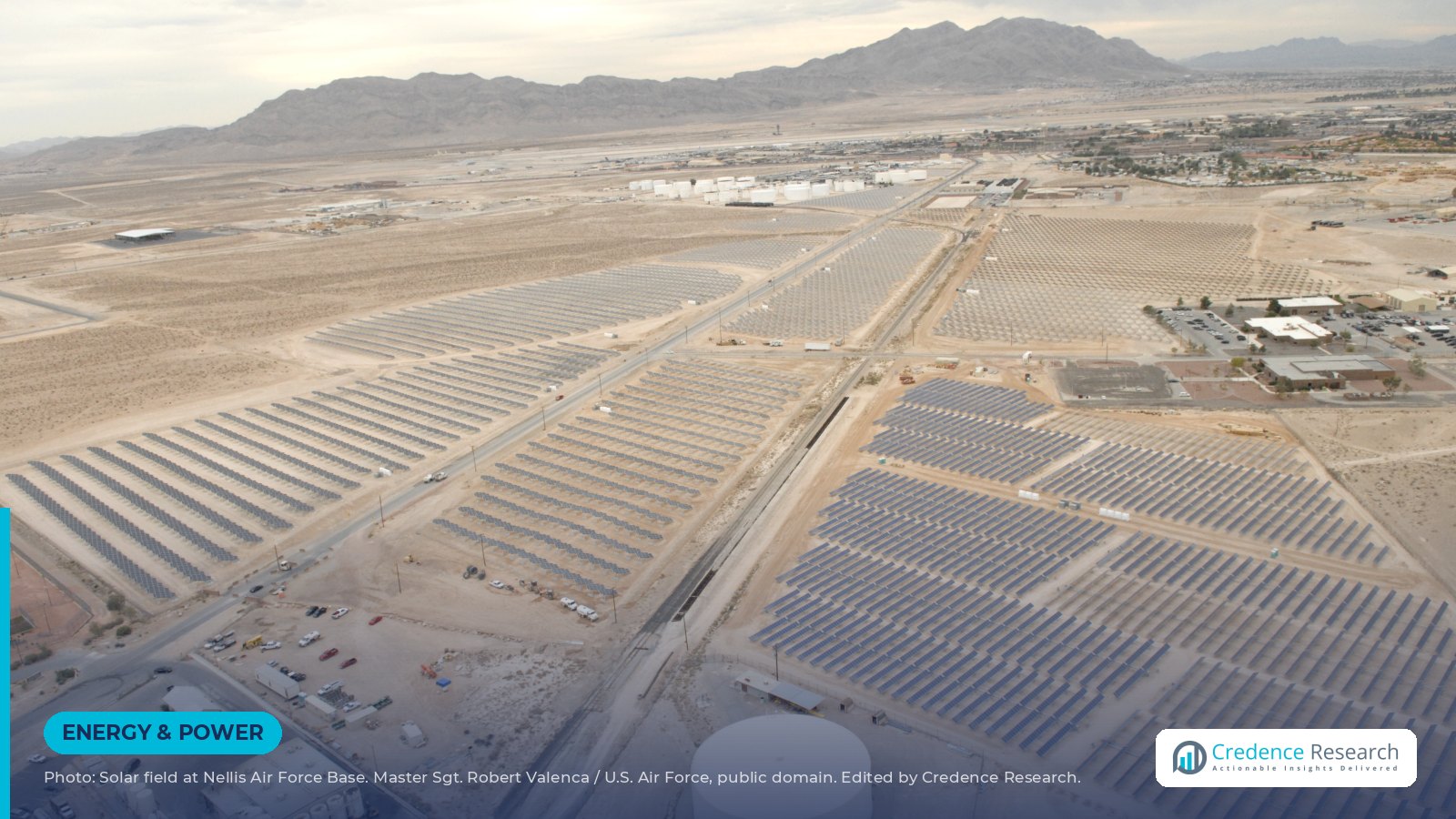
Image: Solar field at Nellis Air Force Base, Nevada, by Master Sgt. Robert Valenca, U.S. Air Force, via Wikimedia Commons, public domain. Cropped and edited by Credence Research.

About the Author

Senior News Editor at Credence Research Inc