Market Overview:
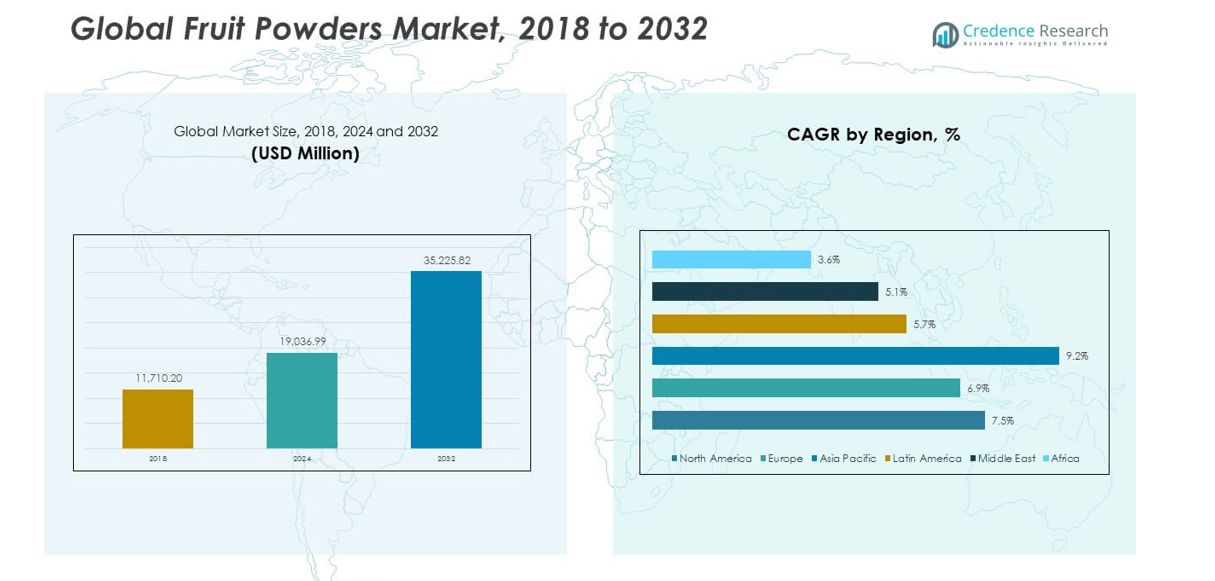
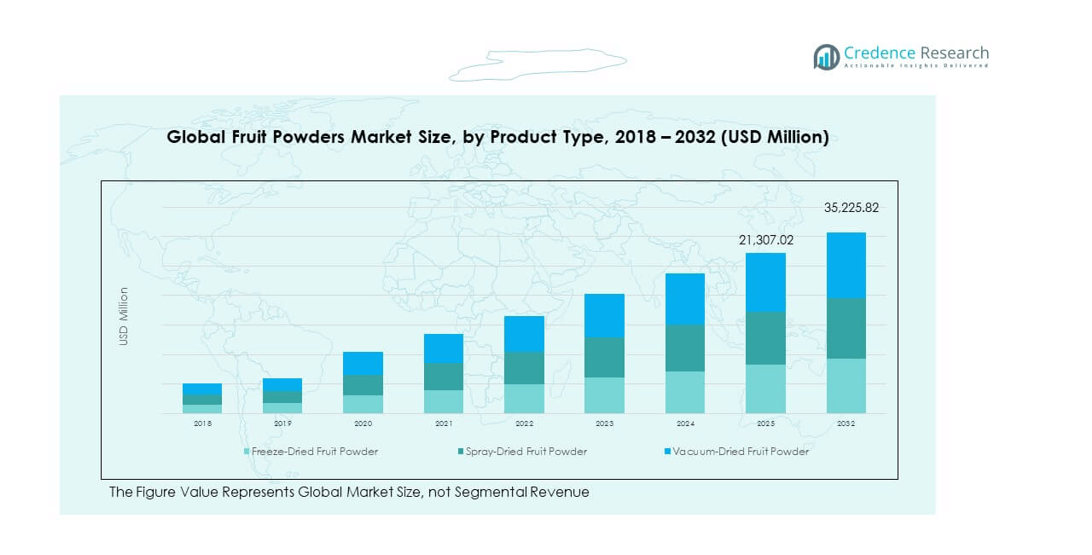
The Global Fruit Powders Market size was valued at USD 11,710.20 million in 2018 to USD 19,036.99 million in 2024 and is anticipated to reach USD 35,225.82 million by 2032, at a CAGR of 7.45% during the forecast period.
| REPORT ATTRIBUTE |
DETAILS |
| Historical Period |
2020-2023 |
| Base Year |
2024 |
| Forecast Period |
2025-2032 |
| Fruit Powders Market Size 2024 |
USD 19,036.99 million |
| Fruit Powders Market, CAGR |
7.45% |
| Fruit Powders Market Size 2032 |
USD 35,225.82 million |
The growth of the global fruit powders market is largely driven by the increasing demand for natural and convenient food options. As consumers are becoming more health-conscious, fruit powders offer a simple solution for adding nutritional value to various food products. They are rich in antioxidants, vitamins, and fiber, which contribute to overall well-being. Additionally, the growing popularity of plant-based diets and functional foods is fueling the demand for fruit powders as a natural ingredient in smoothies, snacks, and supplements.
North America and Europe dominate the global fruit powders market, supported by high consumer awareness and the growing trend toward organic and clean-label products. Emerging regions like Asia-Pacific, especially countries like India and China, are experiencing rapid growth in demand for fruit powders due to an increasing focus on health and wellness among the urban population. The expanding food and beverage industry in these regions also contributes significantly to market growth.
Market Insights:
- The Global Fruit Powders Market was valued at USD 11,710.20 million in 2018, USD 19,036.99 million in 2024, and is projected to reach USD 35,225.82 million by 2032, growing at a CAGR of 7.45% during the forecast period.
- Europe holds the largest regional share of the global market at 39.3%, driven by the region’s strong demand for clean-label and organic products. North America follows with a 25.4% share, supported by the growing health-conscious consumer base, while Asia Pacific accounts for 21.7%, benefiting from urbanization and increasing health awareness.
- Asia Pacific is the fastest-growing region, with a CAGR of 9.2%. The region’s share is expanding due to rising disposable incomes, increased urbanization, and growing interest in plant-based and health-focused products.
- Freeze-dried fruit powder holds a significant share in the market, leading product categories due to its higher nutritional value and preservation of natural flavors. Spray-dried fruit powder follows, widely used for cost-effective mass production.
- The vacuum-dried fruit powder segment is also growing steadily, contributing to market diversity, with increasing demand for high-quality fruit powders in both beverages and food applications.
Access crucial information at unmatched prices!
Request your sample report today & start making informed decisions powered by Credence Research Inc.!
Download Sample
Market Drivers:
Rising Health Consciousness Among Consumers
The global fruit powders market is witnessing strong growth due to the rising awareness of health and wellness among consumers. As people become more concerned with their diets, they seek natural and nutrient-rich ingredients. Fruit powders provide an easy way to incorporate essential vitamins, antioxidants, and fiber into daily meals. These powders serve as a healthy alternative to traditional food additives, offering significant nutritional benefits without the need for preservatives. Their versatility in applications like smoothies, supplements, and snack bars further boosts their demand in the market.
- For instance, Paradise Fruits, a leading manufacturer, has capitalized on this trend by introducing a range of high-quality fruit powders rich in antioxidants, catering to the growing demand for healthier snacks and drinks. These powders serve as a healthy alternative to traditional food additives, offering significant nutritional benefits without the need for preservatives.
Growing Preference for Natural Ingredients in Food Products
The increasing demand for clean-label products has driven the shift towards natural ingredients, such as fruit powders. Consumers are moving away from synthetic and artificial additives, favoring products with natural, recognizable ingredients. Fruit powders align perfectly with this trend, offering the goodness of whole fruits in a convenient and stable form. They allow manufacturers to meet consumer expectations for transparency and quality, contributing to the global fruit powders market’s growth. The clean-label movement, particularly in Europe and North America, plays a significant role in boosting this demand.
- For instance, Kanegrade Ltd has emphasized its commitment to natural fruit powders by sourcing fruits from sustainably managed farms and offering products with minimal processing. This approach aligns perfectly with consumer expectations for transparency and quality, contributing to the global fruit powders market’s growth.
Expansion of Plant-Based and Vegan Diets
The growing popularity of plant-based and vegan diets has directly impacted the demand for fruit powders. These diets often rely on plant-based ingredients to replace animal-based products, and fruit powders are an excellent source of essential nutrients for those following such diets. With the increasing adoption of plant-based lifestyles, fruit powders are becoming an integral part of vegan smoothies, snacks, and meal replacements. The market benefits from this shift as consumers look for plant-derived products that provide both nutrition and taste.
Increased Usage in Functional Foods and Beverages
The demand for functional foods and beverages is driving growth in the global fruit powders market. Functional foods, which provide additional health benefits beyond basic nutrition, often include fruit powders as key ingredients. These powders are used to enhance the nutritional profile of products such as energy drinks, protein powders, and fortified cereals. As consumers seek foods that offer more than just calories, fruit powders provide an attractive solution due to their high concentration of vitamins, minerals, and antioxidants, boosting their popularity in the functional foods sector.
Market Trends:
Surge in Demand for Organic Fruit Powders
There is a notable trend toward organic fruit powders within the global market. Organic food products have gained significant traction due to consumers’ preference for foods that are free from pesticides and chemicals. As the organic movement continues to grow, fruit powders made from organically grown fruits are seeing increased demand. These powders appeal to health-conscious consumers who prioritize sustainability and purity in their food choices. The growth in organic certifications and the increasing availability of organic fruit powder options are expected to further enhance the market’s expansion.
- For instance, European Freeze Dry ApS has expanded its organic fruit powder range to meet the increasing consumer demand for pesticide-free, eco-friendly products. These powders appeal to health-conscious consumers who prioritize sustainability and purity in their food choices.
Technological Advancements in Fruit Powder Production
Advances in fruit powder production technologies have led to higher-quality products with improved shelf life and nutritional retention. Innovations such as freeze-drying and spray drying techniques have enhanced the texture, taste, and effectiveness of fruit powders. These technologies help preserve the natural flavors, colors, and nutritional benefits of the fruits. The ability to scale production efficiently while maintaining product quality has made fruit powders a more viable option for manufacturers, thereby driving growth in the global fruit powders market.
- For instance, Milne MicroDried has improved its freeze-drying technology to preserve the nutritional content and flavor profile of its fruit powders, giving them a longer shelf life without compromising their natural qualities.
Integration of Fruit Powders in Beauty and Personal Care Products
A new trend emerging in the global fruit powders market is the integration of fruit powders into beauty and personal care products. Consumers are increasingly seeking natural ingredients in skincare and cosmetics due to their perceived safety and effectiveness. Fruit powders, known for their antioxidant and anti-inflammatory properties, are being incorporated into lotions, face masks, and other personal care items. This trend is opening new avenues for fruit powder applications, expanding the market beyond food and beverages.
Customization and Functional Enhancements in Fruit Powders
Consumers are increasingly looking for customized fruit powders that meet specific dietary needs and preferences. This trend has led to the development of fruit powders with added functional ingredients such as protein, fiber, or probiotics. These specialized powders cater to various health-conscious groups, including those with dietary restrictions or fitness goals. The ability to offer personalized fruit powder blends with additional health benefits is a significant trend that is helping to expand the global fruit powders market, attracting a wider consumer base.
Market Challenges Analysis:
Quality Control and Consistency in Production
A major challenge faced by the global fruit powders market is maintaining consistent quality in production. Fruit powders are highly susceptible to variations in fruit quality, which can impact the final product’s taste, color, and nutritional value. Additionally, the delicate nature of the powdering process requires precise control over temperature, moisture, and drying time. Any deviation can result in inconsistent quality, making it difficult for producers to maintain high standards across batches. Companies must invest in advanced technology and quality control systems to address this challenge.
Supply Chain and Raw Material Constraints
The availability and cost of raw materials pose another challenge to the global fruit powders market. The sourcing of high-quality fruits, particularly for organic fruit powders, can be unpredictable due to climate change, weather conditions, and regional agricultural limitations. Fluctuating fruit prices and potential supply chain disruptions can lead to production delays or increased costs. As the demand for fruit powders grows, suppliers will need to secure reliable and sustainable raw material sources to ensure long-term market stability.
Market Opportunities:
Growth in Emerging Markets
The global fruit powders market presents significant opportunities in emerging regions, particularly in Asia-Pacific, where urbanization and increased health awareness are driving the demand for functional foods. As disposable incomes rise and access to international food products improves, consumers in these regions are adopting healthier eating habits, including the use of fruit powders in their diets. The increasing middle-class population and demand for premium products in these markets offer substantial growth prospects for companies in the global fruit powders market.
Expansion of E-Commerce Platforms for Fruit Powders
With the rise of online shopping, the global fruit powders market has an opportunity to expand through e-commerce platforms. The convenience of online purchasing allows consumers to explore a wider range of fruit powder options, often at competitive prices. This shift is particularly beneficial for small and medium-sized companies that may not have the resources to distribute through traditional retail channels. By leveraging e-commerce, fruit powder producers can reach a global audience, driving sales and increasing market penetration.
Market Segmentation Analysis:
By Product Type Segment
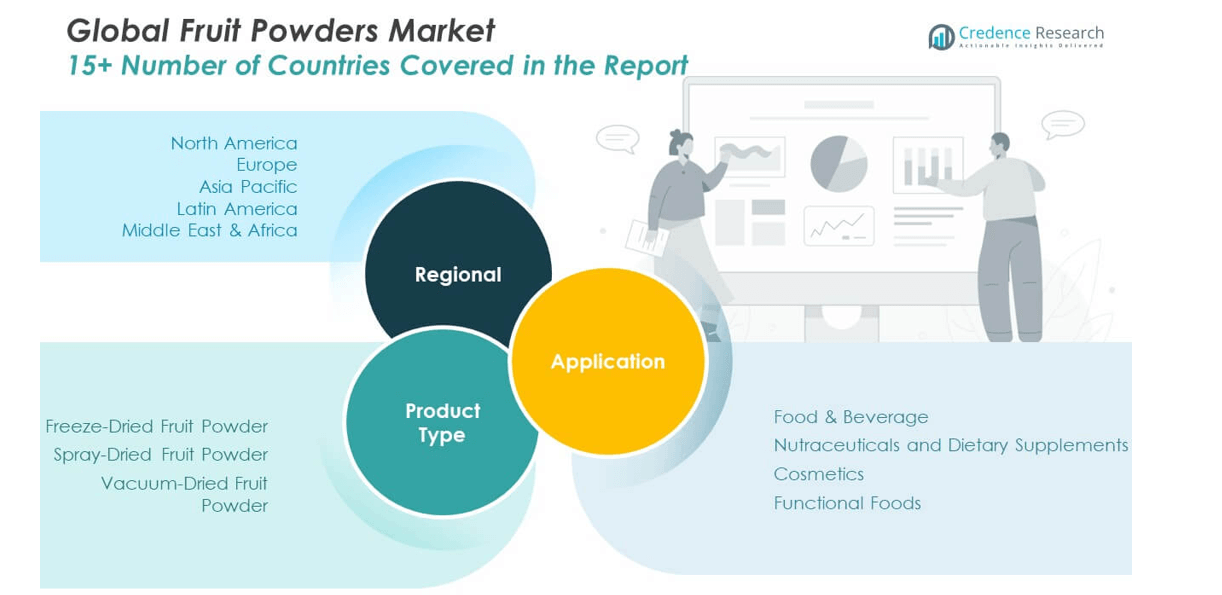
The global fruit powders market is segmented into freeze-dried, spray-dried, and vacuum-dried fruit powders, each catering to different consumer needs. Freeze-dried fruit powder retains the highest nutritional value, as it involves minimal heat, preserving vitamins and antioxidants. It is commonly used in premium products where quality is paramount. Spray-dried fruit powder, while slightly less nutrient-dense, offers cost-effectiveness and versatility, making it ideal for large-scale food and beverage applications. Vacuum-dried fruit powder strikes a balance between quality and cost, offering better preservation of flavor and color compared to spray drying. It is used in products requiring enhanced flavor without compromising on shelf life.
- For instance, Milne MicroDried uses advanced Radiant Energy Vacuum (REV)technology (a form of vacuum-microwave dehydration) to preserve the nutritional integrity of its fruit powders, ensuring they retain a high concentration of antioxidants and vibrant color. It is commonly used in premium products where quality is paramount. Kanegrade Ltd employs spray-drying technology for fruit powders, providing a more cost-effective solution for mass production of smoothies and snack bars.
By Application Segment
The global fruit powders market sees significant applications across food & beverage, nutraceuticals and dietary supplements, cosmetics, and functional foods. In the food and beverage sector, fruit powders are popular for smoothies, snacks, and baked goods due to their ability to add natural flavor and nutrition. Nutraceuticals and dietary supplements benefit from fruit powders’ high concentration of vitamins and antioxidants, appealing to health-conscious consumers. The cosmetics industry incorporates fruit powders for their antioxidant and anti-aging properties, while the functional foods segment uses them to enhance the nutritional content of products such as fortified cereals and energy bars. Each application leverages the unique benefits of fruit powders to meet diverse consumer demands for health, convenience, and flavor.
- For instance, Paradise Fruits supplies fruit powders for beverages, with a focus on clean-label solutions that meet the growing demand for natural and nutritious drinks. Nutraceuticals and dietary supplements benefit from fruit powders’ high concentration of vitamins and antioxidants, appealing to health-conscious consumers.
Segmentation:
By Product Type Segment
- Freeze-Dried Fruit Powder
- Spray-Dried Fruit Powder
- Vacuum-Dried Fruit Powder
By Application Segment
- Food & Beverage
- Nutraceuticals and Dietary Supplements
- Cosmetics
- Functional Foods
By Region Segment
- North America
- Europe
- Germany
- France
- U.K.
- Italy
- Spain
- Rest of Europe
- Asia Pacific
- China
- Japan
- India
- South Korea
- South-east Asia
- Rest of Asia Pacific
- Latin America
- Brazil
- Argentina
- Rest of Latin America
- Middle East & Africa
- GCC Countries
- South Africa
- Rest of the Middle East and Africa
Regional Analysis:
North America Fruit Powders Market
The North America Fruit Powders Market size was valued at USD 3,424.72 million in 2018 to USD 5,481.15 million in 2024 and is anticipated to reach USD 10,184.52 million by 2032, at a CAGR of 7.5% during the forecast period. North America holds a significant market share of approximately 25.4% in the global fruit powders market due to increasing demand for functional foods and beverages. The growing health consciousness among consumers in the U.S. and Canada is driving the consumption of fruit powders in dietary supplements and smoothies. The strong presence of leading manufacturers and an established distribution network further support market growth in this region. The demand for organic fruit powders and plant-based products is also increasing, which strengthens the regional market. North America is expected to maintain its dominant position in the global market, benefiting from ongoing innovations in food and beverage formulations.
Europe Fruit Powders Market
The Europe Fruit Powders Market size was valued at USD 5,109.69 million in 2018 to USD 8,112.01 million in 2024 and is anticipated to reach USD 14,446.75 million by 2032, at a CAGR of 6.9% during the forecast period. Europe accounts for a significant share of approximately 39.3% of the global market due to the growing demand for clean-label, organic, and functional food products. The region is characterized by a mature consumer base that values quality and sustainability. As consumers in countries like Germany, France, and the UK focus more on health and wellness, the use of fruit powders in dietary supplements, smoothies, and functional foods has expanded. Europe’s robust regulatory environment, which promotes the use of natural ingredients, supports the region’s market growth.
Asia Pacific Fruit Powders Market
The Asia Pacific Fruit Powders Market size was valued at USD 2,182.14 million in 2018 to USD 3,854.61 million in 2024 and is anticipated to reach USD 8,106.17 million by 2032, at a CAGR of 9.2% during the forecast period. Asia Pacific holds a market share of approximately 21.7%, and it is the fastest-growing region in the global fruit powders market. The rapid urbanization and rising middle-class population in Asia-Pacific are key drivers for the region’s growth. Countries like China, India, and Japan are seeing an increase in health-conscious consumers who are adopting fruit powders in their diets. The demand for functional foods and beverages, especially among younger generations, is also contributing to the region’s rapid market expansion. Asia-Pacific is projected to witness the fastest growth rate, supported by growing demand in emerging markets.
Latin America Fruit Powders Market
The Latin America Fruit Powders Market size was valued at USD 529.71 million in 2018 to USD 849.95 million in 2024 and is anticipated to reach USD 1,383.93 million by 2032, at a CAGR of 5.7% during the forecast period. Latin America holds a market share of approximately 4.6%, and it is gradually emerging as a key market for fruit powders due to increasing consumer awareness of health benefits. Brazil, as the largest market in the region, drives much of the demand for fruit powders in beverages and nutritional supplements. Growing disposable incomes and expanding urban populations are fueling the demand for natural and functional food ingredients. While the market is still developing, it holds significant potential, especially as demand for organic and clean-label products increases.
Middle East Fruit Powders Market
The Middle East Fruit Powders Market size was valued at USD 320.22 million in 2018 to USD 474.77 million in 2024 and is anticipated to reach USD 737.60 million by 2032, at a CAGR of 5.1% during the forecast period. The Middle East holds a market share of approximately 2.7%, and it is witnessing growth in demand for fruit powders due to a shift towards healthier and more convenient food options. In countries like the UAE and Saudi Arabia, there is an increasing preference for natural, nutritious food ingredients in snacks and beverages. The region’s strong growth in the food and beverage sector and growing interest in functional foods are contributing to the market’s expansion. The region’s market is projected to grow steadily, with increasing investments in product innovation.
Africa Fruit Powders Market
The Africa Fruit Powders Market size was valued at USD 143.72 million in 2018 to USD 264.51 million in 2024 and is anticipated to reach USD 366.85 million by 2032, at a CAGR of 3.6% during the forecast period. Africa holds a market share of approximately 1.3%, and the market is still in its early stages but holds promising potential due to growing health awareness. As disposable incomes rise and urban populations increase, consumers in South Africa, Egypt, and other countries are beginning to demand more nutritious food products. However, the market faces challenges in terms of infrastructure and product availability. Despite this, the market is expected to expand steadily over the forecast period, particularly as consumer preferences shift toward healthier, plant-based ingredients.
Shape Your Report to Specific Countries or Regions & Enjoy 30% Off!
Key Player Analysis:
- Kanegrade Ltd
- Döhler Group
- Paradise Fruits
- Chaucer Foods Ltd
- FutureCeuticals
- Milne MicroDried
- Aarkay Food Products Ltd
- The Green Labs LLC
- Nexira
- European Freeze Dry ApS
Competitive Analysis:
The competitive landscape of the Global Fruit Powders Market is characterized by the presence of both established players and emerging companies. Leading manufacturers, such as Kanegrade Ltd, Döhler Group, and Paradise Fruits, dominate the market with a diverse product portfolio, including organic and functional fruit powders. These companies continually innovate to meet consumer demand for clean-label, sustainable, and nutrient-rich ingredients. They focus on enhancing product quality through advanced processing techniques such as freeze-drying and spray-drying. The competitive environment also includes regional players who offer competitive pricing strategies. Market expansion, product differentiation, and strategic partnerships are key drivers for companies aiming to strengthen their position in the market.
Recent Developments:
- March 28, 2025, Döhler North America completed the strategic acquisition of Premier Juices, strengthening its offerings in natural fruit-based products and solutions across the beverage, food, and life science & nutrition industries. The acquisition enhanced Döhler’s portfolio with Premier Juices’ expertise in fruit products including lemon, lime, mango, passion fruit, pineapple, guava, cranberry, grapefruit, and apple, along with integrated blending, packaging, and quality control solutions.
- In March 19, 2025, Milne MicroDried signed a definitive agreement with BranchOut Food Inc. to integrate BranchOut’s GentleDry™ technology into MicroDried’s premium dried fruit and vegetable ingredient portfolio. The partnership generated $5-6 million in projected annual ingredient sales, with initial ingredient orders already in production at BranchOut’s 50,000 square foot facility in Peru.
- In April 2024, Thrive Freeze Dry signed a definitive agreement to acquire Paradiesfrucht GmbH (Paradise Fruits), a global manufacturer of freeze-dried fruits, fruit preparations, yogurts, drops, powders, and granulates with facilities in Salzwedel and Immekath, Germany. The transaction was expected to close in 2024.
Report Coverage:
The research report offers an in-depth analysis based on product types, applications, and regional markets. It details leading market players, providing an overview of their business, product offerings, investments, revenue streams, and key applications. Additionally, the report includes insights into the competitive environment, SWOT analysis, current market trends, as well as the primary drivers and constraints. Furthermore, it discusses various factors that have driven market expansion in recent years. The report also explores market dynamics, regulatory scenarios, and technological advancements that are shaping the industry. It assesses the impact of external factors and global economic changes on market growth. Lastly, it provides strategic recommendations for new entrants and established companies to navigate the complexities of the market.
Future Outlook:
- Growing demand for organic and functional fruit powders will drive market expansion.
- Increasing adoption of fruit powders in nutraceuticals and dietary supplements.
- Rising health consciousness will boost the demand for clean-label products.
- Technological innovations will improve fruit powder processing techniques.
- E-commerce growth will enhance distribution channels for fruit powder products.
- Asia-Pacific will emerge as a significant market due to urbanization and health trends.
- Companies will focus on product innovation to cater to vegan and plant-based diets.
- Expanding retail channels in emerging markets will drive regional growth.
- Market players will adopt sustainability practices to align with consumer preferences.
- Strategic partnerships will play a key role in expanding market reach.



