
Market Overview:
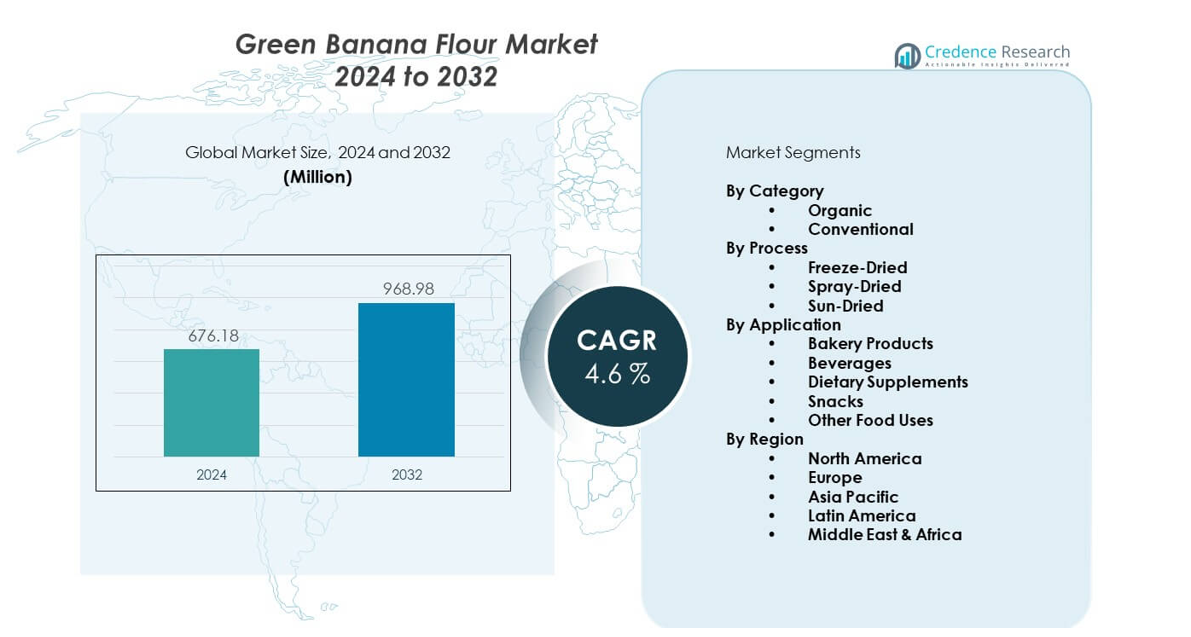
The Green Banana Flour Market is projected to grow from USD 676.18 million in 2024 to an estimated USD 968.98 million by 2032, with a compound annual growth rate (CAGR) of 4.6% from 2024 to 2032. Demand rises due to its clean-label appeal, gluten-free profile, and wide use in bakery, snacks, and dietary supplements. Growth also reflects stronger adoption in sports nutrition and gut-health products due to high resistant starch content.
| REPORT ATTRIBUTE | DETAILS |
|---|---|
| Historical Period | 2020-2023 |
| Base Year | 2024 |
| Forecast Period | 2025-2032 |
| Green Banana Flour Market Size 2024 | USD 676.18 million |
| Green Banana Flour Market, CAGR | 4.6% |
| Green Banana Flour MarketSize 2032 | USD 968.98 million |
Growing focus on healthy and natural ingredients drives wider use in food production. Brands adopt green banana flour to replace wheat and synthetic thickeners in everyday items. Manufacturers benefit from strong interest in fiber-rich alternatives for better digestion. The rising vegan and paleo population boosts clean-label demand. Food processors use this flour to lower sugar loads in new products. Expanding awareness of low-GI diets further supports steady growth.
North America and Europe lead adoption due to strong gluten-free demand and high clean-label awareness. These regions benefit from large functional food industries and rising preference for plant-based products. Asia Pacific emerges as a fast-growing market driven by large banana production, wider access to raw materials, and rising health-focused consumers. Latin America holds steady growth momentum supported by its strong agricultural base. The Middle East and Africa show improving adoption as awareness of natural flours expands across foodservice and packaged food categories.
Market Insights:
- The Green banana flour market is valued at USD 676.18 million in 2024 and is projected to reach USD 968.98 million by 2032, growing at a 6% CAGR driven by rising clean-label and gluten-free demand.
- North America (32%), Europe (28%), and Asia Pacific (30%) lead the market due to strong product awareness, regulatory support for clean-label foods, and large-scale raw material availability.
- Asia Pacific is the fastest-growing region with 30% share, supported by abundant banana cultivation, cost-effective processing, and expanding health-conscious consumer segments.
- The bakery products segment holds the largest share at about 35%, driven by strong demand for gluten-free and alternative flour formulations.
- Organic and conventional categories together shape segment distribution, with conventional holding nearly 60% share due to broader industrial usage and cost efficiency.
Market Drivers:
Rising Use of Clean-Label and Gluten-Free Ingredients Across Food Categories
The Green banana flour market grows due to rising interest in natural ingredients. Food producers shift toward wheat alternatives for cleaner formulations. The flour offers a natural source of resistant starch that strengthens digestive health claims. Brands adopt this ingredient to reduce synthetic binders in bakery and snack items. Growing intolerance to gluten supports faster demand from health-focused buyers. It helps producers meet strict labelling norms in major food markets. Fitness consumers prefer products with lower sugar impact. Strong preference for plant-based ingredients pushes wider product development.
- For instance, Myprotein lists under 2 g of sugar per serving across many functional baking mixes, verified on its official product pages. Strong interest in plant-based ingredients pushes wide product development.
Expansion of Functional Food and Beverage Applications in Growth-Oriented Industries
The Green banana flour market sees strong traction from the functional food segment. Manufacturers use the flour to improve fiber levels in beverages and powdered mixes. It brings a mild flavor profile that works well across multiple food systems. Diet-focused brands use it to support weight-control formulas. Growth in sports nutrition strengthens demand for high-resistant starch sources. Companies test new formulations to improve texture in protein bars. It supports better stability in dry-mix products. Rising interest in natural performance ingredients expands its industrial relevance.
- For instance, Clif Bar continues to use plant-based, organic ingredients in its products and has previously announced minor recipe changes to reduce sugar in some bars and new product launches like the BUILDERS Reduced Sugar Crispy Protein bars in recent years.
Growing Consumer Demand for Low-Glycemic and High-Fiber Alternatives in Daily Diets
The Green banana flour market expands due to interest in low-GI diets. Health-conscious users value the slow-digesting starch profile. Food brands replace refined flour with greener ingredients to improve nutritional value. It supports blood sugar control in new product lines. Producers focus on gut wellness trends that require natural fiber sources. Weight-control programs use the flour to extend satiety. Restaurants experiment with gluten-free menu items to meet rising demand. Clean lifestyle diets help build steady market momentum.
Strong Adoption in Vegan, Paleo, and Plant-Based Product Development Across Regions
The Green banana flour market benefits from the rise of plant-based lifestyles. Developers seek fruit-based flours that maintain label simplicity. The flour supports paleo, vegan, and allergen-free formulation needs. Growing use in protein-rich plant mixes boosts its adoption. It helps create nutrient-dense snacks with fewer artificial fillers. Regional brands invest in natural flours to meet lifestyle-led preferences. Food start-ups experiment with grain-free mixes for premium consumers. Broader wellness movements support long-term product uptake.
Market Trends:
Rising Innovation in Bakery, Snack, and Dessert Applications with Texture-Focused Formulations
The Green banana flour market follows strong innovation in new textures. Brands experiment with the flour to build denser bakery structures. Developers focus on replacing refined ingredients for better health appeal. It supports dessert mixes that require stable viscosity. Snack brands explore fruit-based powders for next-gen clean products. Dairy alternatives adopt the flour to stabilize plant-based textures. Low-allergen formulations gain ground with wider flour use. Producers fine-tune blending ratios to meet evolving consumer expectations.
- For instance, Danone’s Alpro brand offers over 130 plant-based products worldwide and uses natural plant fibers to maintain stable texture. Low-allergen formulations gain share. Producers refine blends to match evolving expectations.
Expansion of Prebiotic and Gut-Health Positioning Across Retail and Foodservice Segments
The Green banana flour market aligns with the rise of gut-health messaging. Brands highlight resistant starch for digestive balance. Retailers promote products with natural prebiotic benefits. Foodservice chains include high-fiber options to satisfy healthy diners. It supports claims that resonate strongly with wellness-driven consumers. New launches feature improved microbiome support. Dieticians express interest in fruit-based functional ingredients. Awareness of natural digestive aids increases product visibility.
- For instance, Pret A Manger has significantly expanded its plant-based and "bowl" offerings as part of its menu innovation strategy, particularly since acquiring rival chain EAT in 2019 to convert many of its sites into "Veggie Pret" locations.
Growing Penetration in Infant Nutrition, Elderly Nutrition, and Clinical Food Applications
The Green banana flour market gains traction in specialized nutrition. Infant food producers explore natural fruit flours for gentle digestion. Elderly nutrition brands value mild flavors and high fiber levels. It offers stability for clinical food formulations. Hospitals seek clean carbohydrate sources for dietary programs. Manufacturers design simple ingredient lists to meet strict standards. Powdered meals incorporate the flour for smoother textures. Regulatory clarity in several regions supports broader adoption.
Shift Toward Sustainable Sourcing and Upcycling of Banana Byproducts for New Product Lines
The Green banana flour market aligns with sustainability-driven innovation. Producers upcycle unripe bananas to lower waste levels. Factories explore energy-efficient drying systems for greener output. It helps reduce environmental pressure in banana-growing regions. Brands market the ingredient as a low-impact alternative. Eco-conscious consumers support products with reduced waste footprints. Supply chains incorporate better traceability systems. Sustainability certifications gain importance in product branding.
Market Challenges Analysis:
Limited Processing Infrastructure and High Production Complexity Across Key Banana-Growing Regions
The Green banana flour market faces hurdles due to limited processing capacity. Producers handle high moisture content that demands advanced drying systems. Investment requirements reduce entry from small firms. It limits regional coverage in emerging markets. Supply chain delays occur when processing plants run below scale. Farmers struggle with inconsistent raw material transport. Product quality swings when handling practices vary. Technical expertise shortages slow broader adoption.
Low Consumer Awareness and Limited Standardization Across International Food Markets
The Green banana flour market faces gaps in consumer understanding. Buyers remain unfamiliar with the flour’s functional benefits. Regional markets lack unified quality standards. It restricts faster penetration in mainstream categories. Brands struggle with marketing costs to educate users. Retail visibility varies by country due to slow shelf adoption. Food manufacturers test limited volumes before scaling. Confusion with regular banana powder creates further delays.
Market Opportunities:
Expansion in High-Value Functional Food Categories Across Health-Focused Consumer Groups
The Green banana flour market holds strong opportunities in new functional foods. Developers use the flour to support metabolic health formulas. It aligns with diet plans seeking natural fiber. Brands expand plant-based lines with fruit-derived ingredients. Health stores highlight the flour’s nutritional profile. Snack makers test energy-dense concepts with clean labels. Demand rises for nutrient-rich mixes with simple formulations. Broader wellness interest supports rapid category expansion.
Rising Adoption in Bakery, Sports Nutrition, and Specialty Dietary Segments Across Global Markets
The Green banana flour market benefits from growing use in protein snacks. Athletes prefer natural carbohydrate sources for gut comfort. It supports grain-free mixes for allergen-sensitive buyers. Bakeries integrate the flour into premium gluten-free goods. Regional producers explore export opportunities for niche ingredients. Diet food manufacturers value smooth blending performance. Growing foodservice innovation encourages wider adoption. Lifestyle-driven demand strengthens long-term market potential.
Market Segmentation Analysis:
By Category
The Green banana flour market divides into organic and conventional segments. Organic flour gains strong attention from clean-label buyers and premium food brands. It offers chemical-free sourcing that supports wellness-focused positioning. Conventional flour secures higher share in industrial and bulk applications due to stable pricing. It supports bakery and snack manufacturers that need scalable volumes. Organic varieties expand across health stores and specialty channels. Conventional grades maintain broader distribution in mainstream markets. Both categories support diverse formulation needs across food sectors.
By Process
The market includes freeze-dried, spray-dried, and sun-dried formats. Freeze-dried flour offers high nutrient retention and suits clinical and premium applications. It provides fine texture with strong stability in powdered mixes. Spray-dried flour supports large-scale industrial use due to consistent output. Sun-dried flour attracts small producers with traditional processing benefits. It appeals to cost-sensitive markets with simple production requirements. Freeze-dried variants expand across sports nutrition formulations. Spray-dried types dominate commercial supply chains.
- For instance, GEA Group’s spray dryers operate in 65+ countries and support capacities above 1,000 kg/h, confirmed in equipment specifications.
By Application
Key applications include bakery products, beverages, dietary supplements, snacks, and other food uses. Bakery items drive strong consumption due to rising interest in gluten-free mixes. Beverages adopt the flour for fiber enrichment and natural thickening. Dietary supplements use the ingredient for resistant starch content. Snacks incorporate the flour to enhance texture in clean-label launches. Other food uses span sauces, infant nutrition, and functional food lines. It supports versatile performance across dry and wet formulations.
Segmentation:
By Category
- Organic
- Conventional
By Process
- Freeze-Dried
- Spray-Dried
- Sun-Dried
By Application
- Bakery Products
- Beverages
- Dietary Supplements
- Snacks
- Other Food Uses
By Region
- North America
- U.S.
- Canada
- Mexico
- Europe
- Germany
- France
- U.K.
- Italy
- Spain
- Rest of Europe
- Asia Pacific
- China
- Japan
- India
- South Korea
- South-east Asia
- Rest of Asia Pacific
- Latin America
- Brazil
- Argentina
- Rest of Latin America
- Middle East & Africa
- GCC Countries
- South Africa
- Rest of the Middle East and Africa
Regional Analysis:
North America
The Green banana flour market shows strong presence in North America, holding around 32% share. Demand grows due to high adoption of gluten-free and clean-label products. Consumers prefer natural fiber sources that support digestive wellness. It gains traction in bakery mixes and sports nutrition categories. Food companies expand formulations to meet rising health-focused trends. Retailers support the category with wider shelf placement. The region maintains steady growth due to strong product awareness.
Europe
Europe accounts for nearly 28% share of the Green banana flour market. The region benefits from strict clean-label standards that support natural ingredient adoption. It gains solid demand from bakery producers targeting wheat-free alternatives. Functional food developers use the flour for fiber enrichment and low-GI claims. Rising vegetarian and plant-based diets strengthen category acceptance. It sees wider use in meal replacement and wellness beverages. Regional manufacturers invest in high-quality processing to match regulatory expectations.
Asia Pacific, Latin America, and Middle East & Africa
Asia Pacific leads global production with about 30% share supported by strong banana cultivation. Local processors benefit from easy access to raw materials and cost-effective sourcing. Latin America holds roughly 7% share and supplies both regional and export markets. It strengthens its role in industrial-scale production due to favorable climate and crop availability. Middle East & Africa account for about 3% share with rising interest in functional flours. The Green banana flour market grows in these regions due to expanding health awareness. It gains visibility through bakery, beverage, and supplement categories across emerging markets.
Key Player Analysis:
- Natural Evolution Pty Ltd
- International Agriculture Group (IAG)
- Kanegrade Ltd
- Woodland Foods
- Stawi Foods and Fruits Limited
- Made’s Green Banana Flour Co.
- Pereg Gourmet Natural Foods
- Slingan Pty Ltd
- Absolute Organic
- Now Health Group (Now Foods)
Competitive Analysis:
The Green banana flour market features a mix of regional producers and specialized health-focused brands that compete on purity, processing quality, and distribution reach. Leading companies strengthen their portfolios with clean-label ingredients and stable supply chains. It sees active product differentiation based on nutrient retention and flavor consistency. Smaller firms focus on organic and premium variants to secure niche demand. Larger processors expand global distribution through retail, specialty stores, and online platforms. Innovation in drying methods helps companies improve texture and nutritional profiles. Stronger emphasis on sustainability enhances brand positioning across major markets.
Recent Developments:
- In November 2025, Natural Evolution Pty Ltd showcased the continued innovation and versatility of its green banana flour, highlighting breakthrough research into the product's antimicrobial and phytochemical properties for use in new ingredient and ointment formulations, reinforcing its leadership in the pharmaceutical-grade banana flour segment.
Report Coverage:
The research report offers an in-depth analysis based on By Category and By Process. It details leading market players, providing an overview of their business, product offerings, investments, revenue streams, and key applications. Additionally, the report includes insights into the competitive environment, SWOT analysis, current market trends, as well as the primary drivers and constraints. Furthermore, it discusses various factors that have driven market expansion in recent years. The report also explores market dynamics, regulatory scenarios, and technological advancements that are shaping the industry. It assesses the impact of external factors and global economic changes on market growth. Lastly, it provides strategic recommendations for new entrants and established companies to navigate the complexities of the market.
Future Outlook:
- Demand for clean-label ingredients is expected to rise across key food categories.
- New product launches will strengthen adoption in gluten-free bakery lines.
- Resistant starch benefits will drive interest from health and wellness brands.
- Organic variants may gain stronger penetration in premium retail channels.
- Process innovations will improve texture and nutritional stability.
- Major producers may expand supply capacity in banana-growing regions.
- Wider acceptance in beverages and supplements will support long-term growth.
- Growing plant-based diets will improve product positioning globally.
- Sustainability-focused consumers may favor upcycled banana-based flours.
- Foodservice chains could expand use in healthy meal and snack offerings.

Request a Free Sample
Fill in your details and we'll send you a free sample report.
- Sample data tables & charts
- Research methodology
Market Dynamics
Rising Use of Clean-Label and Gluten-Free Ingredients
Food producers are increasingly replacing wheat and synthetic thickeners with green banana flour to meet consumer demand for clean-label and gluten-free products. This shift is driven by growing awareness of food sensitivities and the desire for natural, minimally processed ingredients.
Expansion of Functional Food and Beverage Applications
Green banana flour is being adopted in functional foods and beverages due to its high resistant starch content, which supports digestive health and weight management. Manufacturers leverage its mild flavor and fiber enrichment properties to innovate in sports nutrition, protein bars, and dietary supplements.
Growing Consumer Demand for Low-Glycemic and High-Fiber Alternatives
Health-conscious consumers are seeking low-GI and high-fiber foods to support blood sugar control and digestive wellness. Green banana flour’s slow-digesting starch profile and natural fiber content make it an attractive ingredient for bakery, snack, and wellness products.
Strong Adoption in Vegan, Paleo, and Plant-Based Product Development
The rise of vegan, paleo, and plant-based diets is fueling demand for fruit-based, allergen-free flours like green banana flour. Its compatibility with these dietary trends supports its use in premium, nutrient-dense snacks and clean-label formulations across global markets.
Shift Toward Sustainable Sourcing and Upcycling
Producers are upcycling unripe bananas and adopting energy-efficient processing methods to reduce waste and environmental impact. Sustainability-focused consumers and brands are increasingly favoring green banana flour as a low-impact, traceable alternative in food production.
Need a Custom Version of This Report?
Tailor the scope, geography, or segments to your exact requirements.
- Custom geography or segment scope
- Direct access to our analyst team
Frequently Asked Questions
What is the current market size for the Green banana flour market, and what is its projected size in 2032?
At what Compound Annual Growth Rate is the Green banana flour market projected to grow between 2024 and 2032?
Which segment is expected to post the highest CAGR during the forecast period?
Who are the major players in the global green banana flour market?
What are the major market drivers of the green banana flour industry?
What are the major market restraints of the green banana flour industry?
What are the major market opportunities of the green banana flour industry
Who are the leading companies in the Green banana flour market?
Table of Content
Chapter 1 Market Segmentation
- 1.1 Segmentation Framework
- 1.1.1 Product and Service Classification
- 1.1.2 Application and End-Use Classification
- 1.1.3 Technology and Solution Classification
- 1.1.4 Customer and Distribution Channel Classification
- 1.1.5 Geographic Segmentation
- 1.1.6 Market Segment Definitions and Boundaries
- 1.2 By Process
- 1.2.1 Freeze-Dried
- 1.2.2 Spray-Dried
- 1.2.3 Sun-Dried
- 1.3 By Category
- 1.3.1 Organic
- 1.3.2 Conventional
- 1.4 By Application
- 1.4.1 Bakery Products
- 1.4.2 Beverages
- 1.4.3 Dietary Supplements
- 1.4.4 Snacks
- 1.4.5 Other Food Uses
Chapter 2 Introduction
- 2.1 Report Objectives and Scope
- 2.2 Product Definition and Industry Terminology
- 2.3 Market Inclusions and Exclusions
- 2.4 Research Process
- 2.4.1 Primary Research and Expert Interviews
- 2.4.2 Secondary Research and Source Review
- 2.4.3 Top-Down and Bottom-Up Estimation
- 2.4.4 Data Triangulation and Verification
- 2.5 Market Size Measurement Basis
- 2.5.1 2024: USD 676.18 million → 2032: USD 968.98 million
- 2.6 Historical and Forecast Reference Periods
- 2.6.1 Base Year: 2024
- 2.6.2 Forecast Period: 2024-2032
- 2.7 Research Assumptions and Limitations
Chapter 3 Executive Summary
- 3.1 Market Snapshot and Key Findings
- 3.2 Base-Year Market Size, 2024
- 3.3 Forecast Market Size, 2032
- 3.4 Revenue and Volume Growth Outlook
- 3.5 Key Demand and Supply Indicators
- 3.6 Leading Market Segments
- 3.7 Fastest-Growing Market Opportunities
- 3.8 Regional Performance Highlights
- 3.9 Technology and Industry Transformation
- 3.10 Competitive Landscape Summary
- 3.11 Analyst View and Strategic Implications
Chapter 4 Global Green Banana Flour Market Trends and Developments
- 4.1 Historical Industry Development
- 4.2 Recent Market Trends and Developments
- 4.3 Demand and Customer Behavior Trends
- 4.4 Technology and Product Innovation
- 4.5 Artificial Intelligence, Automation and Digitalization
- 4.6 Local Manufacturing and Supply Chain Realignment
- 4.7 Industry Partnerships, Mergers and Acquisitions
- 4.8 Sustainability and Circular Economy Developments
- 4.9 Government and Private Sector Investment Trends
- 4.10 Emerging Business Models and Commercialization
- 4.11 Industry Developments and Announcements
Chapter 5 Global Green Banana Flour Market Production, Supply and Demand Analysis
- 5.1 Demand Trend and Consumption Analysis
- 5.2 Demand Forecast, 2024-2032
- 5.3 Production and Output Trend
- 5.4 Production and Output Forecast, 2024-2032
- 5.5 Installed Capacity and Capacity Utilization
- 5.6 Company-Wise Production Plants and Statistics
- 5.6.1 Installed Production Capacity
- 5.6.2 Actual Production
- 5.6.3 Planned Capacity and Expansion Targets
- 5.7 Supply Chain Structure and Procurement Trends
- 5.8 Supply-Demand Gap and Bottlenecks
- 5.9 Import Dependence and Sourcing Structure
- 5.10 Contract Manufacturing and Outsourcing
- 5.11 Regional Supply and Demand Concentration
Chapter 6 Global Green Banana Flour Market Pricing Analysis
- 6.1 Pricing Structure and Measurement
- 6.2 Historical Pricing Trends
- 6.3 Pricing Outlook, 2024-2032
- 6.4 Average Selling Price and Unit Economics
- 6.5 Pricing by Product and Market Segment
- 6.6 Geographic Pricing Differences
- 6.7 Key Input, Energy, Labor and Logistics Costs
- 6.8 Contract Pricing and Purchasing Models
- 6.9 Pricing Sensitivity and Competitive Positioning
- 6.10 Price, Margin and Profitability Implications
Chapter 7 Global Green Banana Flour Market Dynamics
- 7.1 Market Growth Drivers
- 7.1.1 Demand-Side Drivers
- 7.1.2 Technology and Innovation Drivers
- 7.1.3 Infrastructure and Investment Drivers
- 7.1.4 Regulatory and Policy Drivers
- 7.2 Market Restraints
- 7.2.1 Cost and Affordability Constraints
- 7.2.2 Technology and Adoption Barriers
- 7.2.3 Supply Chain and Operational Constraints
- 7.3 Market Challenges
- 7.3.1 Competitive Pressure and Margin Erosion
- 7.3.2 Skills, Infrastructure and Implementation Gaps
- 7.4 Emerging Market Opportunities
- 7.5 Market Dynamics Impact and Time-Horizon Assessment
Chapter 8 Global Green Banana Flour Value Chain Analysis
- 8.1 Industry Value Chain Overview
- 8.2 Upstream Suppliers and Critical Inputs
- 8.3 Technology and Component Providers
- 8.4 Manufacturing or Service Delivery
- 8.5 Distribution, Channel Partners and Integrators
- 8.6 Downstream Applications and End Users
- 8.7 Value Addition and Profit Pools
- 8.8 Vertical Integration and Outsourcing
- 8.9 Supplier Concentration and Risk
- 8.10 Supply Chain Localization and Resilience
Chapter 9 Global Green Banana Flour Market Regulations and Policies
- 9.1 Relevant Laws, Standards and Compliance Frameworks
- 9.2 Product, Service, Safety and Quality Requirements
- 9.3 Government Policies, Incentives and Subsidies
- 9.4 Imports, Exports and Trade Barriers
- 9.5 Public Procurement and Local Content Requirements
- 9.6 Environmental and Sustainability Compliance
- 9.7 Upcoming Policy Changes and Market Implications
Chapter 10 Global Green Banana Flour Market Hotspots and Opportunities
- 10.1 Market Opportunity Mapping and Growth Hotspots
- 10.2 High-Growth Applications and Customer Groups
- 10.3 Underserved Markets and White-Space Opportunities
- 10.4 Emerging Technology and Product Opportunities
- 10.5 New Capacity and Investment Hotspots
- 10.6 Market Entry and Expansion Opportunities
- 10.7 Distribution and Partnership Opportunities
- 10.8 Near-Term and Long-Term Commercial Potential
- 10.9 Opportunity Attractiveness and Execution Risks
Chapter 11 Global Green Banana Flour Market Outlook, 2024-2032
- 11.1 Market Size and Analysis
- 11.1.1 Revenue (Market Measurement: 2024: USD 676.18 million → 2032: USD 968.98 million)
- 11.1.2 Market Volume and Quantity Sold
- 11.1.3 Historical Market Size
- 11.1.4 Base-Year Market Size, 2024
- 11.2 Market Forecast, 2024-2032
- 11.2.1 Revenue Forecast to 2032
- 11.2.2 Volume Forecast to 2032
- 11.2.3 CAGR and Year-on-Year Growth
- 11.2.4 Incremental Revenue Opportunity
- 11.3 Forecast Assumptions and Scenario Analysis
- 11.3.1 Base-Case Forecast
- 11.3.2 Optimistic and Conservative Scenarios
- 11.3.3 Technology, Pricing and Policy Sensitivities
- 11.4 Market Attractiveness and Growth Outlook
Chapter 12 Global Green Banana Flour Market Segmentation and Outlook
- 12.1 Segmentation Summary and Market Shares, 2024
- 12.2 Largest and Fastest-Growing Segments
- 12.3 By Process - Market Size and Forecast, 2024-2032
- 12.3.1 Segment Definition and Scope
- 12.3.2 Historical Market Size
- 12.3.3 Revenue Forecast, 2024-2032
- 12.3.4 Volume Forecast, 2024-2032
- 12.3.5 Base-Year Market Share, 2024
- 12.3.6 Segment CAGR and Growth Drivers
- 12.3.7 Subsegment Market Size and Forecast
- 12.3.7.1 Freeze-Dried
- 12.3.7.2 Spray-Dried
- 12.3.7.3 Sun-Dried
- 12.3.8 Subsegment Pricing and Adoption Trends
- 12.3.9 Leading Suppliers and Competition
- 12.3.10 Regional Demand and Opportunities
- 12.4 By Category - Market Size and Forecast, 2024-2032
- 12.4.1 Segment Definition and Scope
- 12.4.2 Historical Market Size
- 12.4.3 Revenue Forecast, 2024-2032
- 12.4.4 Volume Forecast, 2024-2032
- 12.4.5 Base-Year Market Share, 2024
- 12.4.6 Segment CAGR and Growth Drivers
- 12.4.7 Subsegment Market Size and Forecast
- 12.4.7.1 Organic
- 12.4.7.2 Conventional
- 12.4.8 Subsegment Pricing and Adoption Trends
- 12.4.9 Leading Suppliers and Competition
- 12.4.10 Regional Demand and Opportunities
- 12.5 By Application - Market Size and Forecast, 2024-2032
- 12.5.1 Segment Definition and Scope
- 12.5.2 Historical Market Size
- 12.5.3 Revenue Forecast, 2024-2032
- 12.5.4 Volume Forecast, 2024-2032
- 12.5.5 Base-Year Market Share, 2024
- 12.5.6 Segment CAGR and Growth Drivers
- 12.5.7 Subsegment Market Size and Forecast
- 12.5.7.1 Bakery Products
- 12.5.7.2 Beverages
- 12.5.7.3 Dietary Supplements
- 12.5.7.4 Snacks
- 12.5.7.5 Other Food Uses
- 12.5.8 Subsegment Pricing and Adoption Trends
- 12.5.9 Leading Suppliers and Competition
- 12.5.10 Regional Demand and Opportunities
- 12.6 Segment Growth Comparison
- 12.7 Segment Attractiveness and Priority Matrix
Chapter 13 Global Green Banana Flour End-Use and Application Market Outlook
- 13.1 End-Use Industry and Customer Demand Structure
- 13.2 Leading Applications and Customer Groups
- 13.3 End-Use Market Size, Share and Forecast
- 13.4 Major End-Use Industry Deep Dives
- 13.4.1 Customer Requirements and Use Cases
- 13.4.2 Demand and Replacement Cycles
- 13.4.3 Technical and Regulatory Considerations
- 13.4.4 Purchasing and Procurement Models
- 13.4.5 Leading Vendors and Distribution Channels
- 13.4.6 Forecast and Commercial Opportunities
- 13.5 Emerging Applications and Cross-Segment Demand
- 13.6 End-Use Industry Investment Priorities
Chapter 14 Global Green Banana Flour Geographic Market Outlook, 2024-2032
- 14.1 Regional Market Size and Share, 2024
- 14.2 Regional Market Forecast, 2024-2032
- 14.3 Regional Pricing, Production and Demand Differences
- 14.4 North America
- 14.4.1 United States
- 14.4.2 Canada
- 14.4.3 Mexico
- 14.5 Europe
- 14.5.1 Germany
- 14.5.2 France
- 14.5.3 Italy
- 14.5.4 United Kingdom
- 14.5.5 Spain
- 14.5.6 Poland
- 14.5.7 Russia
- 14.5.8 Netherlands
- 14.5.9 Belgium
- 14.5.10 Sweden
- 14.5.11 Denmark
- 14.5.12 Norway
- 14.5.13 Rest of Europe
- 14.6 Asia Pacific
- 14.6.1 China
- 14.6.2 India
- 14.6.3 Japan
- 14.6.4 South Korea
- 14.6.5 Thailand
- 14.6.6 Indonesia
- 14.6.7 Vietnam
- 14.6.8 Malaysia
- 14.6.9 Australia
- 14.6.10 Rest of Asia Pacific
- 14.7 Latin America
- 14.7.1 Brazil
- 14.7.2 Argentina
- 14.7.3 Colombia
- 14.7.4 Chile
- 14.7.5 Rest of Latin America
- 14.8 Middle East
- 14.8.1 Saudi Arabia
- 14.8.2 United Arab Emirates
- 14.8.3 Turkey
- 14.8.4 Israel
- 14.8.5 Iran
- 14.8.6 Rest of the Middle East
- 14.9 Africa
- 14.9.1 South Africa
- 14.9.2 Egypt
- 14.9.3 Nigeria
- 14.9.4 Morocco
- 14.9.5 Rest of Africa
- 14.10 Regional Investment, Policy and Supply Chain Differences
- 14.11 Regional Competitive Landscape
- 14.12 Geographic Growth Hotspots
Chapter 15 Global Green Banana Flour Technology, Innovation and Sustainability Outlook
- 15.1 Technology Landscape and Maturity
- 15.2 Product, Process and Service Innovation
- 15.3 AI, Automation and Digital Tools in the Industry
- 15.4 Technology Adoption and Performance Benchmarking
- 15.5 Innovation Pipeline and R&D Investment
- 15.6 Patent and Intellectual Property Trends
- 15.7 Energy Efficiency and Resource Management
- 15.8 Sustainability, Recycling and Circularity
- 15.9 Technology Roadmap, 2024-2032
- 15.10 Risks of Obsolescence and Technology Substitution
Chapter 16 Global Green Banana Flour Market Key Strategic Imperatives
- 16.1 Growth and Market Entry Priorities
- 16.2 High-Return Products and Segments
- 16.3 Pricing, Profitability and Cost Optimization
- 16.4 Technology Investment and Product Differentiation
- 16.5 Supply Chain Localization and Resilience
- 16.6 Distribution and Customer Acquisition
- 16.7 Partnership, Acquisition and Capacity Strategy
- 16.8 Regional Expansion Priorities
- 16.9 Short-, Medium- and Long-Term Actions
Chapter 17 Competition Outlook
- 17.1 Industry Competition Characteristics
- 17.2 Market Structure and Concentration
- 17.3 Market Share and Competitive Positioning, 2024
- 17.4 Company-Wise Revenue and Product Benchmarking
- 17.5 Production and Service Capacity Benchmarking
- 17.6 Technology, Pricing and Differentiation
- 17.7 Regional Footprint and Distribution Strength
- 17.8 Mergers, Acquisitions and Strategic Alliances
- 17.9 New Entrants and Competitive Threats
- 17.10 Porter's Five Forces and Industry Attractiveness
- 17.11 Competitive Outlook, 2024-2032
Chapter 18 Company Profiles
- 18.1 Company Coverage and Selection Criteria
- 18.2 Natural Evolution Pty Ltd
- 18.2.1 Business Description
- 18.2.2 Company Ownership and Geographic Presence
- 18.2.3 Product and Service Portfolio
- 18.2.4 Manufacturing and Operating Footprint
- 18.2.5 Production Capacity and Expansion Plans
- 18.2.6 Financial Performance and Investment
- 18.2.7 Market Share and Competitive Position
- 18.2.8 Technology and Innovation Capabilities
- 18.2.9 Strategic Alliances or Partnerships
- 18.2.10 Recent Developments
- 18.2.11 Growth Strategy and Outlook
- 18.3 International Agriculture Group (IAG)
- 18.4 Kanegrade Ltd
- 18.5 Woodland Foods
- 18.6 Stawi Foods and Fruits Limited
- 18.7 Made’s Green Banana Flour Co.
- 18.8 Pereg Gourmet Natural Foods
- 18.9 Slingan Pty Ltd
- 18.10 Absolute Organic
- 18.11 Now Health Group (Now Foods)
- 18.12 Other Relevant Market Participants
Note: Every listed company is profiled on the structure shown under the first company. The company list is preliminary and may change based on research findings, market developments, data availability and client requirements.
Chapter 19 Disclaimer
- 19.1 Research and Forecast Disclaimer
- 19.2 Data Source and Estimation Limitations
Note: The depth of individual sections depends on data availability for this market. Volume, capacity, trade and other unit-based metrics are included where applicable.

