
Quick answer
A cannabis processing plant is a licensed facility that dries, cures, trims, extracts and packages cannabis for medical or adult-use markets where the law permits it. This overview models a greenfield EU GMP plant handling 20 tonnes of dried cannabis a year, with estimated CapEx of USD 6–12 million. Gross margin is estimated at 20–28% on assumed prices, with payback at 3–5 years. Licensing, price compression and working capital are the main risks.
Viable only for a licensed operator in a legal market with GMP certification, contracted supply and offtake from importers or pharmacies; an unlicensed or commodity-flower model is not viable and, in most countries, not legal.
Cannabis plant: key highlights
| Parameter | Indicative value | Note |
|---|---|---|
| Plant capacity | 20 tonnes of dried cannabis input per year | About 60% finished as packaged medical flower and 40% extracted into oils and concentrates |
| Total CapEx | USD 6–12 million | Greenfield EU GMP design, scaled from an August 2026 German facility listing; excludes working capital |
| Raw material share of operating cost | 70–80% | Purchased licensed cannabis dominates, and its price moves with the GMP premium |
| Gross margin | 20–28% | At assumed prices of USD 2.9–4.4 per gram for packaged GMP flower and matched input costs |
| Payback period | 3–5 years | At 80% utilization with an assumed 18-month licensing and ramp-up period; working capital adds one to two years |
| IRR | Available in report | Post-tax, 10-year model |
| Break-even | Available in report | Capacity utilization basis |
Ranges assume a licensed greenfield plant handling 20 tonnes of dried cannabis a year, EU GMP design, 80% utilization and 2026 prices. Selling prices, input costs, overheads, land rates and a 25% tax rate are assumed. Conversions use assumed rates of USD 1.15 per euro and USD 0.73 per Canadian dollar. CapEx excludes working capital and is scaled from one unverified facility listing. The full report can be customized to any country or region where processing is legal.
What is cannabis processing?
Cannabis processing is the licensed, post-harvest stage that turns the dried flowering heads of cannabis sativa into finished medical or adult-use products. A processing plant receives cannabis from licensed growers, finishes drying and curing, trims, cleans and packages flower, and extracts cannabinoids such as THC and CBD into oils, resins and concentrates that are standardized and formulated into dosage forms. Legality varies by country, and in most of the world processing cannabis without a license is prohibited. Industrial hemp sits under a separate legal framework.
Customs classification depends on the product. This overview models an extraction-led plant, so its main code is HS 1302.19, vegetable saps and extracts not elsewhere specified, which Canada's customs tariff splits out as an item for extracts of cannabis. Cannabis resin is classed separately under 1301.90. Canada classes dried cannabis under 1211.90, plants used mainly in pharmacy, while U.S. Customs ruled in July 2026 that dried hemp flowers belong under 1404.90. Hemp fiber falls under heading 53.02.
Buyers include pharmacies, importers and wholesalers in medical markets, licensed distributors and retailers in adult-use markets, and makers of edibles, vapes and topicals, a segment tracked in Credence Research's cannabis extract market analysis.
Cannabis market overview and global demand
Credence Research values the global legal cannabis market at USD 39.84 billion in 2025 and projects USD 89.25 billion by 2035, an 8.4% CAGR. Extracts are worth about USD 14.5 billion in 2025, based on Credence Research's USD 12.4 billion for 2024 and a 17.1% CAGR.
Canada remains the largest federally legal producer. Health Canada data show 328,654 square meters of licensed processing area in June 2026. Licensed producers made about 2,245 tonnes of unpackaged dried cannabis in 2024, on the regulator's monthly figures, and destroyed 11% of production in the second quarter of 2026, a sign of surplus.
Germany is the main import market for medical cannabis. Its imports passed 200 tonnes in 2025, up from about 73 tonnes in 2024, after an April 2024 law took medical cannabis out of the narcotics act, according to BfArM figures reported by MMJ Daily. Canada supplied about 93 tonnes, or 46%, and Portugal about 55 tonnes. Canadian exports to all markets reached an estimated 240 tonnes in 2025, with Australia, the U.K. and Israel other key outlets.
Demand is shifting toward extracts, as adult-use consumers move to vapes, edibles and beverages and prescribers favor standardized dosing. That rewards plants able to extract and formulate to pharmaceutical standards. Price pressure is the main risk, since Canadian oversupply has pushed some domestic wholesale flower below CAD 1 per gram.
Cannabis manufacturing process in a licensed facility
The modeled plant buys dried cannabis from licensed cultivators under supply contracts, then finishes about 60% of it as packaged medical flower and extracts the rest into oils and concentrates. Every step runs under documented, audited procedures.
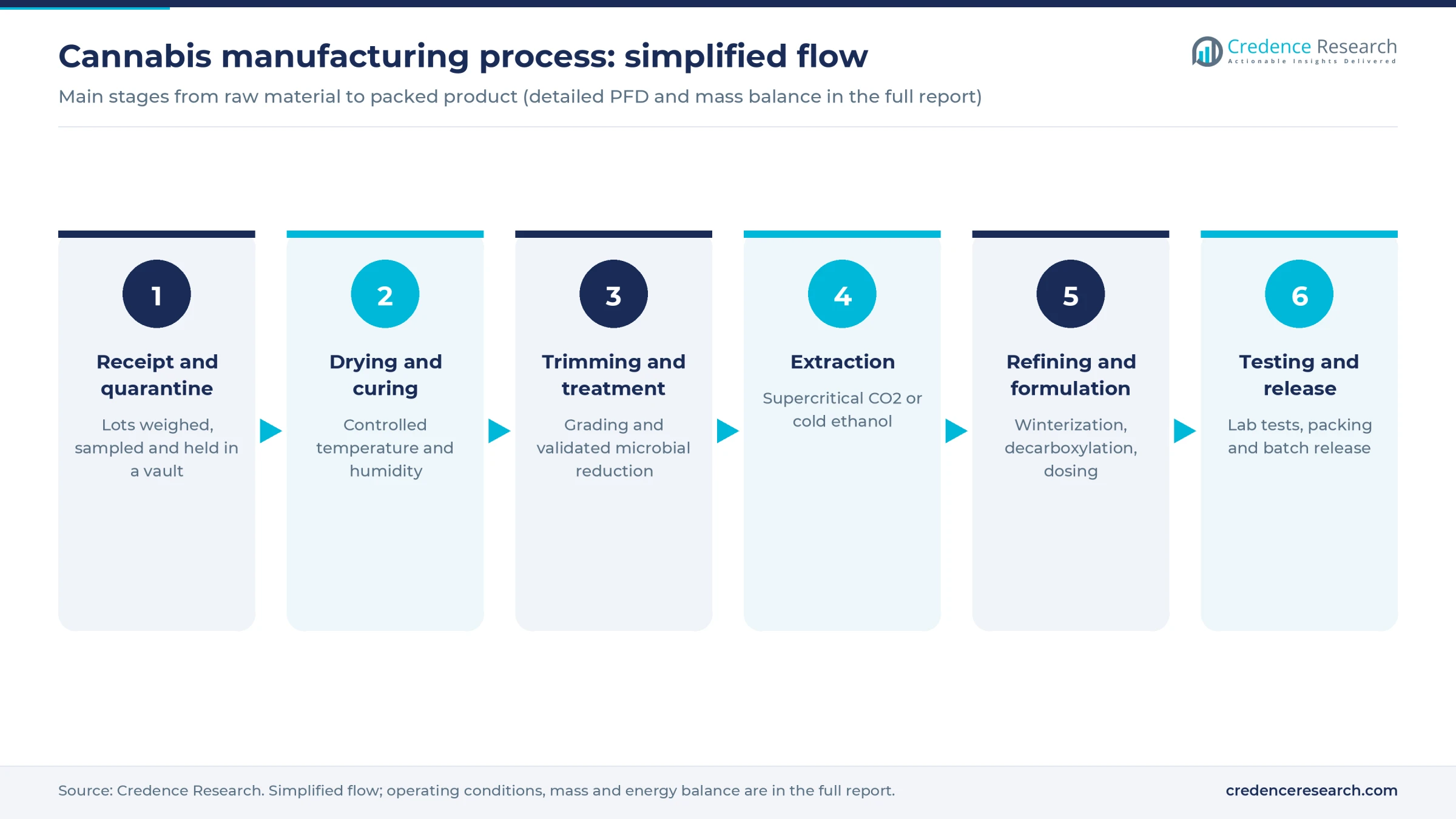
- Receipt and quarantine. Each lot arrives with transfer or import documents, is weighed against the manifest, sampled and held in a secure vault until tests clear it.
- Drying and curing. Flower that arrives with residual moisture is finished in rooms with tight temperature and humidity control. Slow, even curing protects terpenes and keeps water activity low enough to prevent mold.
- Trimming and microbial reduction. Machines or staff remove stems and leaf, and lots are graded. Medical markets set strict microbial limits, so many processors treat flower by contract irradiation or validated in-house methods before release.
- Extraction. Lower-grade flower and trim go to supercritical CO2 or cold ethanol extraction. CO2 systems avoid flammable solvents but cost more, while ethanol lines handle larger volumes at lower cost per kilogram.
- Refining and formulation. Crude extract is filtered to remove waxes, cleared of solvent, decarboxylated where active THC is wanted and, for some products, distilled. It is then blended with carrier oils to a fixed cannabinoid content per milliliter.
- Testing, packing and release. Labs test potency, microbes, pesticides, heavy metals and residual solvents. Product is filled into child-resistant packs with mandated labels, and in GMP plants a qualified person signs off each batch.
Yield and loss management set the economics. Moisture loss during curing, trim waste and out-of-specification lots all reduce saleable output, and lost material must be recorded and destroyed under supervision. Plants with validated processes and stable specifications tend to win long-term contracts with importers and pharmacy wholesalers.
Cannabis processing plant setup cost
This overview models a greenfield licensed processing plant handling 20 tonnes of dried cannabis input a year, designed to EU GMP standards, at an estimated total CapEx of USD 6–12 million. The range rests on one benchmark and is indicative.
A German listing posted in August 2026 offered an EU GMP-designed processing facility of about 3,000 square meters in Lower Saxony for EUR 5 million, covering the operating company, its licenses and the real estate with the building shell about 80% complete, plus a cryogenic extraction system valued at EUR 1.2 million and distillation and lab equipment. Its BfArM narcotics storage permit and wholesale license were only at application stage, and the seller put remaining capex at EUR 4.6 million. The listing is unverified, and an asking price is not a build cost. Read as a total of about EUR 9.6 million, or USD 11 million at an assumed USD 1.15 per euro, for an extraction rating of about 38 tonnes a year, and scaled to this plant's 20-tonne throughput with an assumed 0.6 cost exponent, it gives about USD 7.5 million. An assumed USD 1–2 million for flower finishing and packaging rooms, and assumed regional factors of 0.75 for Latin American or Asian sites and 1.2 for North American or EU sites, give USD 6.6–11 million, rounded to USD 6–12 million.
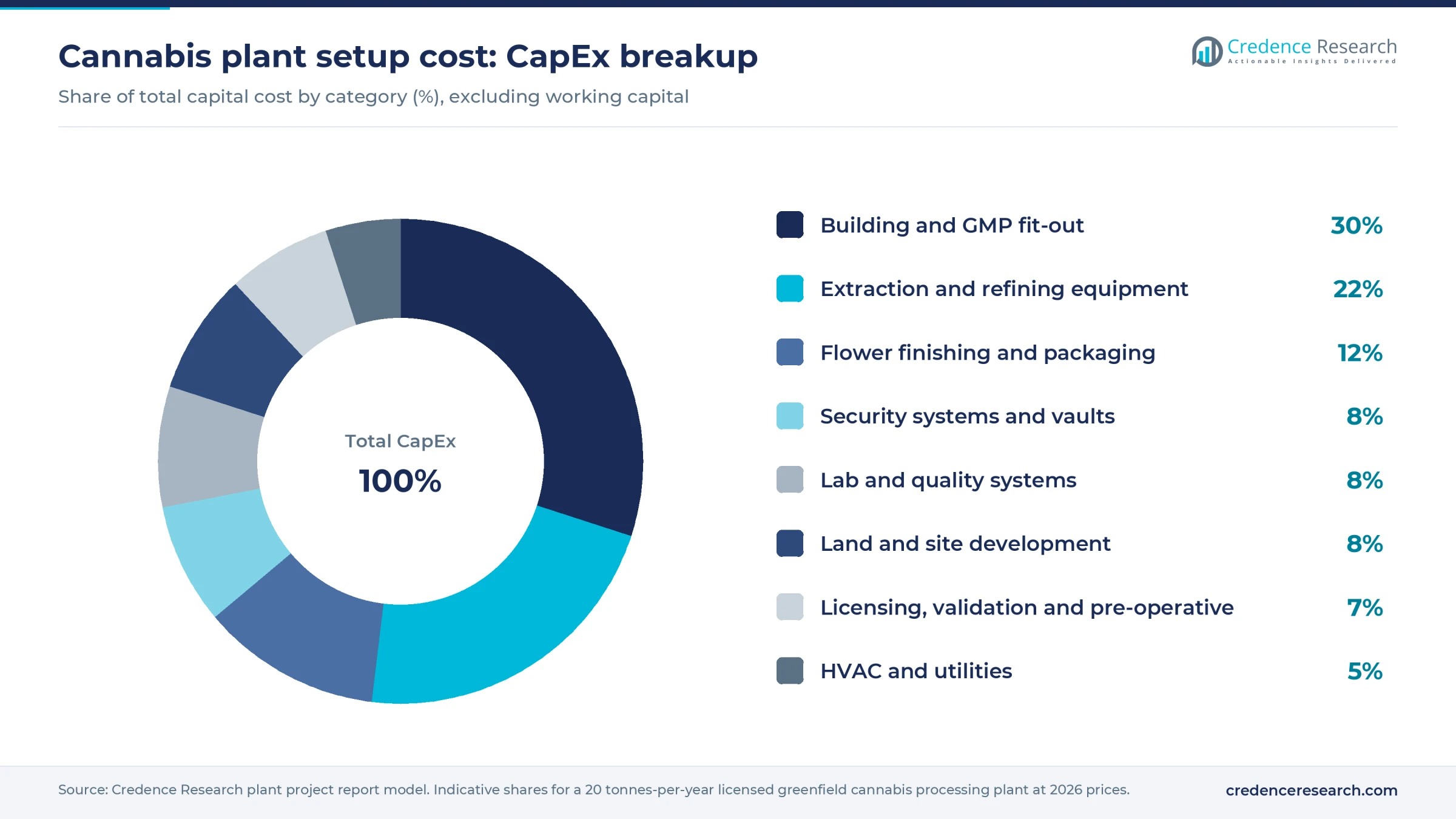
Worked example, land and site development. The plant needs an assumed 6,000–10,000 square meters for the building, secure parking and a fenced perimeter. At an assumed USD 20–50 per square meter in an Asian or Latin American industrial park, the plot costs USD 0.12–0.5 million. At an assumed USD 40–100 at a North American or EU site, it costs USD 0.24–1 million. Fencing, perimeter cameras and access control add an assumed USD 0.2–0.4 million, so this row usually runs 5–12% of CapEx.
Working capital adds an estimated USD 6–10 million, because licensed input must be bought, tested and held before release.
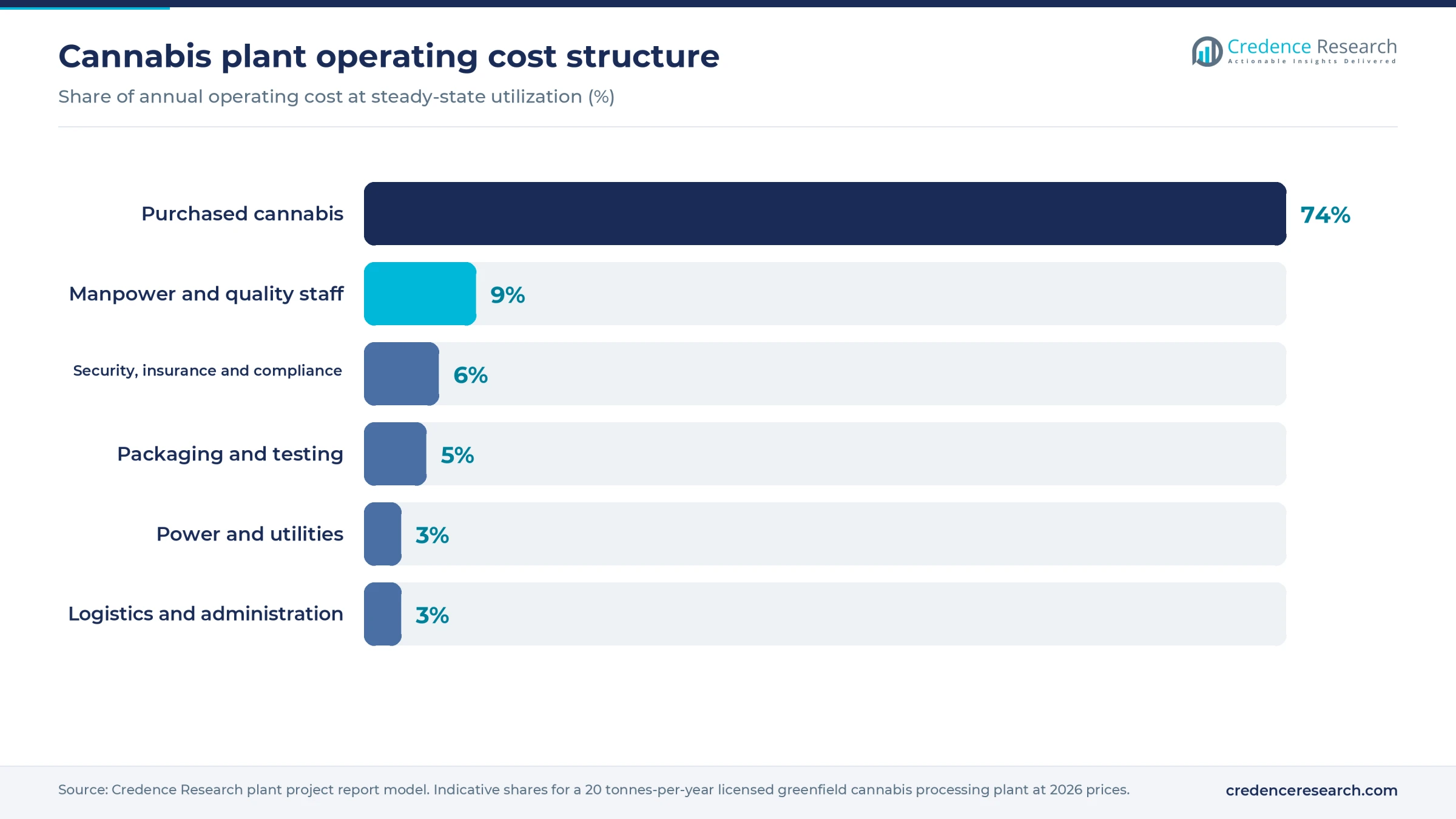
Purchased cannabis dominates operating cost, so supply contracts and price clauses matter more than equipment savings. The full report can be customized to any country's costs and licensing regime.
Machinery and raw materials for a cannabis processing plant
The main machinery groups are listed below; capacities, specifications and quotations are available in the report.
- Post-harvest: climate-controlled drying and curing rooms, dehumidifiers, trimmers and grading tables
- Extraction: supercritical CO2 or cryogenic ethanol extractors, centrifuges and solvent recovery
- Refining: winterization filters, falling film or rotary evaporators, decarboxylation reactors and short-path or wiped-film stills
- Formulation and filling: mixers, homogenizers, oil and capsule filling, jar filling with nitrogen flushing and labeling
- Quality: HPLC, GC-MS, moisture analyzers and microbial testing
- Security and utilities: vaults, CCTV, access control, odor-filtered HVAC and explosion-rated rooms where solvents are used
Input must come from licensed growers, and cross-border supply needs import and export permits for each shipment under the UN drug conventions. Canada is the largest exporter of medical flower, and Portugal has become Europe's main GMP supply base. Colombia, Australia, North Macedonia, Denmark, South Africa and Lesotho also export licensed medical cannabis, while U.S. state-licensed product cannot legally cross state lines. Hemp biomass for CBD comes mainly from China, Canada, France and the U.S., under separate hemp rules.
European buyers usually require GACP-certified cultivation, so a plant serving them must audit its growers rather than buy on price alone. Packaging suppliers are tracked in Credence Research's cannabis packaging equipment study.
Cannabis business profit margin and ROI
Gross margin after purchased cannabis and direct conversion is estimated at 20–28% at 80% utilization. The model assumes packaged flower sells for USD 2.9–4.4 per gram and extract output brings USD 1.2–2.0 per gram of input, against assumed input costs of USD 1.8–2.8 per gram for GMP-grade flower and USD 0.5–1.0 for extraction material. After assumed overheads of USD 3–5 million a year for quality staff, security and compliance, and an assumed 25% tax, cash profit of about USD 4.5–6.5 million gives a typical payback of 3–5 years, including an assumed 18-month licensing and ramp-up period. Working capital lengthens that by one to two years, and with low prices and high input costs payback runs past 10 years.
The flower price rests on export trade. Canadian medical flower sold into Germany at roughly CAD 3–6 per gram wholesale, about USD 2.2–4.4 at the assumed rate, while some Canadian domestic wholesale flower fell below CAD 1 per gram. The model uses the upper part of the export band because a GMP plant sells packaged, released product. That GMP premium is the main source of margin, and it can narrow as certified capacity grows.
A 10% fall in selling prices without a matching drop in input costs cuts gross margin by about 8 percentage points.
| Metric | Value |
|---|---|
| Project IRR (post-tax) | Available in report |
| NPV | Available in report |
| Return on investment | Available in report |
| DSCR | Available in report |
| Break-even utilization | Available in report |
How to start a cannabis processing business, licenses and approvals
Cannabis is controlled under the UN Single Convention on Narcotic Drugs, and most countries still prohibit commercial production and processing. Where it is legal, a plant needs a cannabis-specific license before handling any product, plus business and tax registration, land use and building permits that meet setback rules, an environmental permit for solvents, odor and waste, fire and worker safety approval, security clearance for owners and key staff, GMP certification for medicines, and import and export permits for each shipment. Industrial hemp, at 0.3% THC or less, is licensed under separate agriculture rules.
| Market | Cannabis processing | Hemp and other rules |
|---|---|---|
| Canada | Health Canada standard or micro-processing license under the cannabis Act and cannabis Regulations, with micro-processing capped at 2,400 kg of dried cannabis a year; Canada Revenue Agency cannabis license for excise duty and stamps | Industrial hemp license, though extracting CBD from hemp flowers needs a cannabis processing license |
| Germany (EU) | BfArM license under Section 4 of the Medical cannabis Act for manufacturing, trade, import and export; manufacturing authorization from the state authority under the Medicinal Products Act; EU GMP certificate | Adult-use limited to home growing and nonprofit associations, with no commercial sales; EU hemp rules require listed varieties at 0.3% THC or less |
| United States | Processing or manufacturing license from the state cannabis regulator; since April 28, 2026, marijuana under a state medical license is in federal Schedule III and licensees can seek DEA registration, while adult-use marijuana remains in Schedule I | Hemp under USDA rules; a narrowed federal hemp definition, with a 0.4 mg total THC cap per container for final products, takes effect Dec. 11, 2026 |
The U.S. change came through a Justice Department order effective April 28, 2026. A hearing on moving all marijuana to Schedule III was stayed on Sept. 29, 2026.
Key cannabis processors and recent developments
Canadian licensed producers lead global medical supply. Tilray Brands, Canopy Growth, Aurora cannabis, Organigram, SNDL and Village Farms run large processing operations, and several hold EU GMP sites or certified supply chains. In the U.S., multistate operators such as Curaleaf, Trulieve and Green Thumb Industries process under separate licenses in each state. Bedrocan supplies the Dutch government's medicinal cannabis program, and Demecan grows and processes in Germany. Smaller GMP processors in Portugal, Colombia and Australia are a new plant's closest rivals, alongside the labs tracked in Credence Research's cannabis testing services study.
- August 2026. Tilray raised annual cultivation capacity to about 275 tonnes from 210 tonnes across Quebec and Portugal, with the Quebec site targeting EU GMP certification within 12 months.
- October 2026. Canopy Growth's Smiths Falls, Ontario, facility received EU GMP certification from Germany's Tübingen regional authority covering softgel manufacturing and primary packaging of softgels, oral liquids and dried flower.
- October 2026. Aurora cannabis completed an EU GMP expansion of its site in Leuna, Germany, renamed Aurora Horizon, which it expects to more than double annual flower output.
What's inside the Cannabis project report PDF
The report runs to 21 chapters. Open a chapter to see its sections.
1. Preface
2. Scope and Methodology
- 2.1 Objectives of the Study
- 2.2 Stakeholders
- 2.3 Research Methodology
- 2.4 Data Sources and Key Assumptions
3. Executive Summary
- 3.1 Market Snapshot
- 3.2 Project at a Glance (Capacity, CapEx, OpEx)
- 3.3 Key Financial Indicators (IRR, NPV, Payback, Break-even)
- 3.4 Feasibility Verdict
4. Product Overview
- 4.1 Cannabis Definition and Properties
- 4.2 Grades and Specifications (BIS / ISO / ASTM)
- 4.3 HS Code and Classification
- 4.4 Key Applications
- 4.5 Substitutes
5. Global Cannabis Market
- 5.1 Market Overview
- 5.2 Historical and Current Market Performance (Volume and Value)
- 5.3 Market Breakup by Grade / Type
- 5.4 Market Breakup by End-Use Industry
- 5.5 Market Breakup by Region
- 5.6 Market Drivers, Restraints and Trends
- 5.7 Value Chain Analysis
- 5.8 Market Forecast
6. Target Country Cannabis Market Analysis
- 6.1 Demand and Supply Analysis
- 6.2 Installed Capacity vs Demand Gap
- 6.3 Import Dependence
- 6.4 Demand Forecast by End-Use
7. Trade Analysis
- 7.1 Imports by Volume, Value and Country
- 7.2 Exports by Volume, Value and Country
- 7.3 Trade Balance and Opportunities
8. Price Analysis
- 8.1 Historical Cannabis Price Trends by Region
- 8.2 Raw Material / Feedstock Price Trends and Linkage
- 8.3 Price Forecast
- 8.4 Margins Across the Value Chain
9. Competitive Landscape
- 9.1 Market Structure
- 9.2 Key Players and Installed Capacities
- 9.3 Profiles of Key Players
- 9.4 Recent Developments (Expansions, M&A, New Plants)
10. Manufacturing Process and Technology
- 10.1 Comparison of Technology Routes
- 10.2 Selected Route and Process Flow Diagram
- 10.3 Unit Operations Involved
- 10.4 Chemical Reactions Involved
- 10.5 Mass Balance and Raw Material Requirements
- 10.6 Energy Balance
- 10.7 Quality Assurance Criteria and Technical Tests
- 10.8 By-products and Waste Handling
- 10.9 Technology Licensors / Providers
11. Project Details, Requirements and Costs
- 11.1 Land, Location and Site Development
- 11.1.1 Site Selection Criteria
- 11.1.2 Location Analysis
- 11.1.3 Land Requirement and Costs
- 11.1.4 Site Development Costs
- 11.2 Plant Layout
- 11.2.1 Layout Principles
- 11.2.2 Proposed Layout
- 11.2.3 Factors Influencing Layout
- 11.3 Civil Works and Buildings
- 11.4 Plant Machinery
- 11.4.1 Machinery Requirements and Specifications
- 11.4.2 Machinery Costs
- 11.4.3 Machinery Suppliers
- 11.5 Raw Materials
- 11.5.1 Requirements per Tonne of Output
- 11.5.2 Procurement and Sourcing
- 11.5.3 Costs
- 11.5.4 Suppliers
- 11.6 Packaging
- 11.6.1 Packaging Requirements
- 11.6.2 Packaging Costs
- 11.6.3 Packaging Suppliers
- 11.7 Storage and Material Handling
- 11.8 Transportation Requirements and Costs
- 11.9 Utilities
- 11.9.1 Power Requirements and Costs
- 11.9.2 Water Requirements and Costs
- 11.9.3 Steam, Fuel and Other Utilities
- 11.10 Manpower Requirements and Wages
12. Environment, Health, Safety and Sustainability
- 12.1 Effluent and Emissions Management
- 12.2 Hazard Classification and Safety Measures
- 12.3 Carbon Footprint
- 12.4 Green / Low-Carbon Process Options
13. Regulatory Procedures, Approvals and Certifications
- 13.1 Licences and Registrations
- 13.2 Environmental Clearances
- 13.3 Product Certifications (BIS, REACH, etc.)
- 13.4 Approval Timeline
14. Project Implementation Schedule
15. Project Economics
- 15.1 Capital Cost of the Project
- 15.2 Techno-Economic Parameters
- 15.3 Capacity Utilization and Ramp-up
- 15.4 Product Pricing and Margins
- 15.5 Income Projections
- 15.6 Expenditure Projections
- 15.7 Working Capital Requirement
- 15.8 Taxation
- 15.9 Depreciation
16. Financial Analysis
- 16.1 Projected Profit and Loss Account
- 16.2 Projected Cash Flow Statement
- 16.3 Projected Balance Sheet
- 16.4 Liquidity Analysis
- 16.5 Profitability Analysis (Payback, NPV, IRR, ROI)
- 16.6 Break-even Analysis
- 16.7 Debt Service Coverage Ratio (DSCR)
- 16.8 Sensitivity Analysis
- 16.9 Scenario and Uncertainty Analysis
17. Funding and Incentives
- 17.1 Means of Finance and Debt-Equity Structure
- 17.2 Loans and Financial Assistance
- 17.3 Government Schemes and Subsidies (PLI, State Policies)
18. Risk Assessment
- 18.1 Key Success Factors
- 18.2 Key Risk Factors
- 18.3 Risk Mitigation
19. Strategic Recommendations
20. Case Study of a Successful Venture
21. Appendix
- 21.1 Detailed Assumptions
- 21.2 Abbreviations
- 21.3 List of Tables and Figures
- 21.4 Sources
This page vs. the full report
| Data point | On this page (free) | In the full report |
|---|---|---|
| Total CapEx | One rounded range at one capacity | Exact figure at three capacities with a line-item breakup |
| CapEx breakup | Category shares (%) only | Cost, quantity and supplier for every machine |
| Operating cost | Share of raw materials, utilities and labor | Per-unit cost sheet with each input price and consumption |
| Profitability | Gross margin range and payback band | Exact IRR, NPV, ROI, break-even and DSCR |
| Financial statements | List of what is included | 10-year P&L, cash flow, balance sheet and Excel model |
| Sensitivity | One directional line | Full sensitivity and scenario tables |
| Process | Simplified flow diagram | Detailed process flow, mass and energy balance, operating conditions |
| Machinery | Names of the main machines | Specifications, capacity, cost and supplier list |
| Market | Headline size, growth and global demand | Segment, region, trade and price forecast tables |
| Suppliers and buyers | Supplier types and sourcing hubs | Named suppliers and buyers |
Cannabis project report: FAQs
How much does it cost to set up a cannabis processing plant?
Is it legal to set up a cannabis processing plant?
What is the HS code for cannabis extracts?
What profit margin does a cannabis processing plant earn?
How long is the payback period for a cannabis processing plant?
How does hemp processing differ from cannabis processing?
Which extraction method suits a new cannabis plant?

About the analyst
Shweta Bisht, Healthcare & Biotech Analyst
Shweta is a healthcare and biotech researcher with strong analytical skills in chemical and agri domains.
Related market research
- Legal Cannabis Market Size, Share, Growth and Forecast, 2025-2035
- Cannabis Extract Market Size, Growth, Share and Forecast 2032
- Medicinal Cannabis Market Size, Growth, Share and Forecast 2032
- Cannabis Testing Services Market Size, Growth & Forecast 2032
- Cannabis Packaging Equipment Market Size, Growth & Forecast 2032
- Cannabidiol Market Size, Growth & Forecast to 2032
More plant project reports
- Generic Injectables Manufacturing Plant Project Report (DPR) 2026
- Vinyl Chloride Manufacturing Plant Project Report (DPR) 2026
- Rice Bran Oil Processing Plant Project Report (DPR) 2026
- Neopentyl Glycol Manufacturing Plant Project Report (DPR) 2026
- Citric Acid Manufacturing Plant Project Report (DPR) 2026
- Castor Oil Processing Plant Project Report (DPR) 2026