
Quick answer
An extruded snacks plant cooks corn, rice or potato mixes under pressure, forces them through a die, then dries or fries, seasons and packs the pieces. This overview models 10,000 tonnes a year, with estimated CapEx of USD 12–35 million by region and specification. Gross margin is estimated at 18–30%, and payback at 6–13 years at 75% utilization. Seasoning, packaging and retail reach decide returns more than the extruder does.
Viable for operators with an established brand, retail distribution or contract-packing volume; an unbranded new entrant selling low-priced small packs against incumbents faces thin margins and a long payback.
Extruded Snacks plant: key highlights
| Parameter | Indicative value | Note |
|---|---|---|
| Plant capacity | 10,000 tonnes a year | Two lines of about 0.85 tonne an hour of finished product, 20 hours a day over 300 days |
| Total CapEx | USD 12–35 million | Greenfield, scaled from disclosed snack plants; excludes working capital. Potato chip builds scale higher |
| Raw material share of operating cost | 45–55% | Grits, oil and seasoning, excluding packaging, which adds an estimated 20–25% |
| Gross margin | 18–30% | At an assumed USD 2.00–3.40 per kg ex-factory price, before selling costs and overheads |
| Payback period | 6–13 years | At 75% utilization, including an assumed one-year ramp-up; weak price and high-CapEx pairings fall outside this band |
| IRR | Available in report | Post-tax, 10-year model |
| Break-even | Available in report | Capacity utilization basis |
Ranges assume a greenfield plant making 10,000 tonnes a year, 300 operating days, 75% utilization and 2026 prices. The ex-factory price of USD 2.00–3.40 per kg, grits at USD 380–520 per tonne, seasoning prices, packaging, conversion, selling costs, tax and land rates are assumed. Rupees convert at an assumed 95 per USD. CapEx excludes working capital. The full report can be customized to any country or region.
What are extruded snacks?
Extruded snacks are shaped, crunchy foods made by cooking a moist starch mix under heat and pressure inside a screw barrel, then forcing it through a die. When the hot mass leaves the die, the sudden pressure drop flashes water into steam and the piece expands. Corn curls, puffs, rings and sticks are the familiar forms, and rice, wheat, potato and legume mixes are common alternatives.
Producers work in two main formats. Direct-expanded pieces puff at the die and go straight to seasoning. Pellets leave the extruder dense and shelf-stable, then expand later in a fryer or hot air, so one pellet plant can supply many regional finishers.
There is no single Harmonized System code. Savory extruded products generally fall in subheading 1905.90: a U.K. advance tariff ruling valid to 2028 placed extruded corn and potato snacks in 1905 90 55, and a U.S. Customs ruling put puffed corn snacks in 1905.90. Swelled cereal products, including a sweet-spiced puffed corn snack in another U.S. ruling, can fall in 1904.10, so exporters should seek a ruling. Buyers are grocery chains, convenience stores, vending operators, small neighborhood shops and brand owners that outsource production.
Extruded snacks market overview and global demand
Credence Research does not publish a stand-alone value for extruded snacks, so the wider category gives the best sense of scale. The global savory snacks market is valued at about USD 233.8 billion in 2025, derived from Credence Research's USD 222.2 billion for 2024 and a 5.22% CAGR to 2032. Extruded products are one part of that total, alongside potato chips, nuts, tortilla chips and traditional regional snacks.
Extruded pieces hold a particular place in low-priced small packs, since expansion gives a large-looking bag from little raw material. Indian producer Prataap Snacks' investor presentation for the June 2026 quarter lists rings, puffs and sticks as a core category, and such packs are common across other emerging markets. In wealthier markets, growth depends more on baked, protein and whole grain claims that extrusion handles well.
Trade data give only a partial view, because snacks are bulky and mostly made near where they sell. Trade statistics for heading 19.04 show world exports of about USD 8.27 billion in 2023, led by Germany, the U.S., the U.K., Poland and Spain, with the U.S. taking 11.7% of imports. That heading is dominated by breakfast cereals, and many savory extruded goods sit in the much larger heading 19.05, so neither gives a clean snack figure.
Raw material supply is ample at present. Rural Voice reported in September 2026 that the FAO forecast 2026 world maize production at 1,309 million tonnes. Competition, not ingredient scarcity, is the main constraint. Large brand owners hold shelf space and advertising budgets, so a new plant should test its route to market before committing to capacity.
Extruded snacks manufacturing process
Most of the product's value is created in a few seconds inside the barrel, and small swings in moisture or grit size show up immediately as dense or misshapen pieces. Later stages then add the flavor and most of the cost. The steps below describe a direct-expanded corn curl or puff.
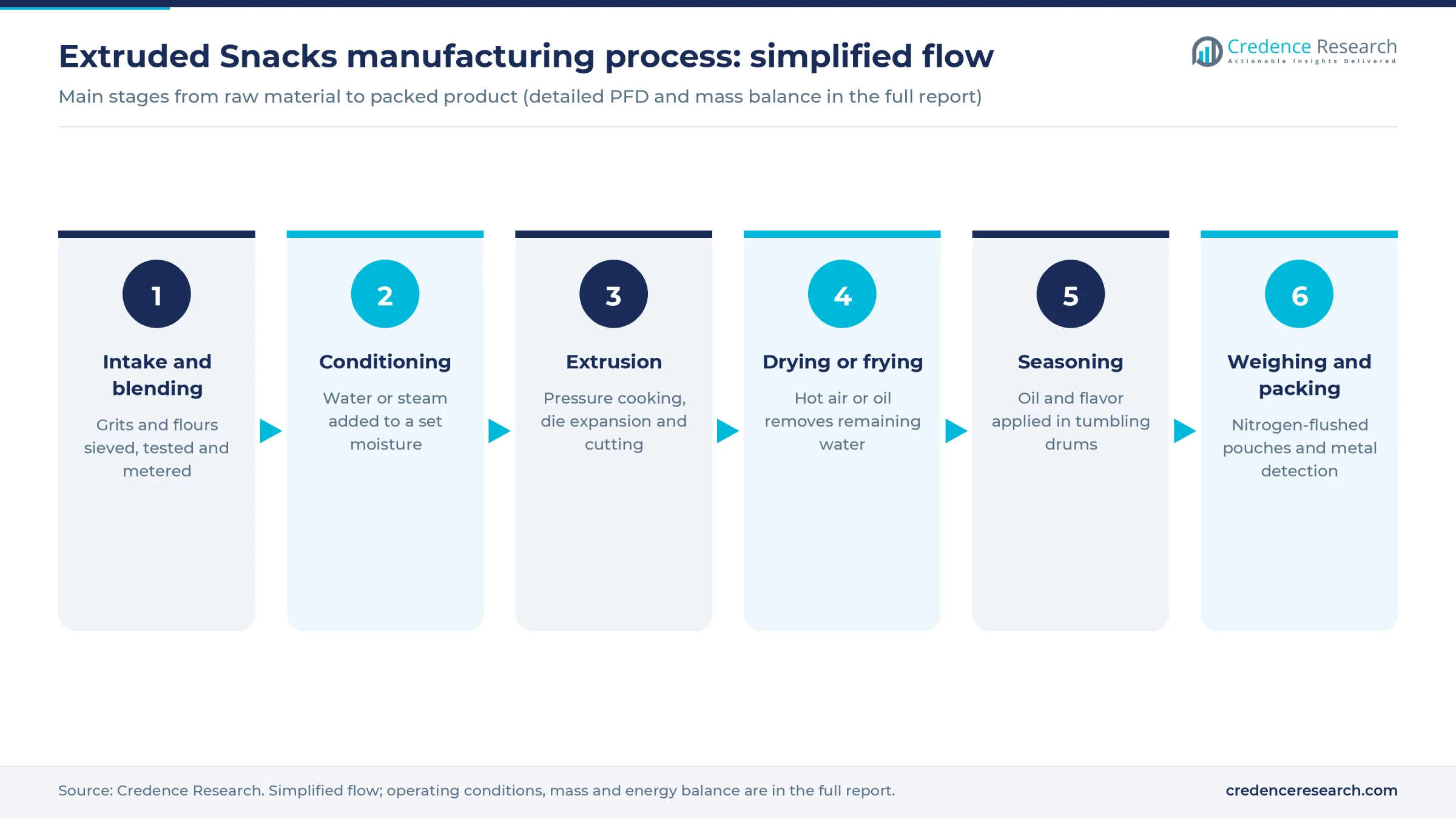
- Intake and blending. Corn grits, rice flour or other dry ingredients are received, sieved and tested for particle size and moisture, because uneven grits give uneven expansion.
- Conditioning. Water, and sometimes steam, is metered into the mix. Baker Perkins gives a working range of 12–35% moisture for single-screw machines and 6–50% for twin-screw machines.
- Extrusion. Friction and barrel heat gelatinize the starch under pressure. The melt exits through the die, expands, and a rotating knife cuts it to length.
- Drying, baking or frying. Hot air removes the remaining water to give a crisp, stable piece. Frying costs more oil but adds flavor and a richer bite.
- Seasoning. Tumbling drums apply oil and a seasoning such as cheese, chili or masala. Dosing accuracy matters, since seasoning is among the costliest inputs.
- Weighing and packing. Multi-head weighers fill metallized film pouches, often flushed with nitrogen, followed by metal detection, check-weighing and case packing.
Machine choice is the main early decision. Baker Perkins compares the two types: single-screw units reach 100–500 kg an hour and suit free-flowing maize grits, while twin-screw units reach up to 1,500 kg an hour at 1.5–2.5 times the relative cost per unit of capacity. Twin screws also handle fine flours and starches, and they clean themselves, which suits plants with many recipes. Allergen changeovers still interrupt the line, since dairy-based seasoning residue is hard to remove from drums. Seasoning rooms also need dust control.
Extruded snacks plant setup cost
This overview models a greenfield plant making 10,000 tonnes a year at an estimated total CapEx of USD 12–35 million. Disclosed projects were scaled with an assumed 0.7 power rule, since capacity costs rise less than proportionally.
The low end comes from Prataap Snacks, whose board approved up to 4.25 billion rupees for a 60,000-tonne plant near Indore, India, reported in February 2026. At an assumed 95 rupees per USD, that is about USD 45 million, or about USD 12.7 million scaled to 10,000 tonnes. The top reflects PepsiCo's USD 90 million plant in Vietnam, announced in 2024 for over 20,000 tonnes of snacks a year, which scales to about USD 55 million. An assumed 40% discount removes potato receiving, washing and peeling, which an extrusion-only plant skips, giving about USD 33 million.
Potato builds in high-cost locations sit far above this range. Taste of Maine reported about USD 75 million for a four-kettle chip plant, which could reach up to 14 million pounds, or about 6,350 tonnes, only after doubling to eight kettles. An existing building can cut the bill sharply, and a contract-packing start needs less brand spending.
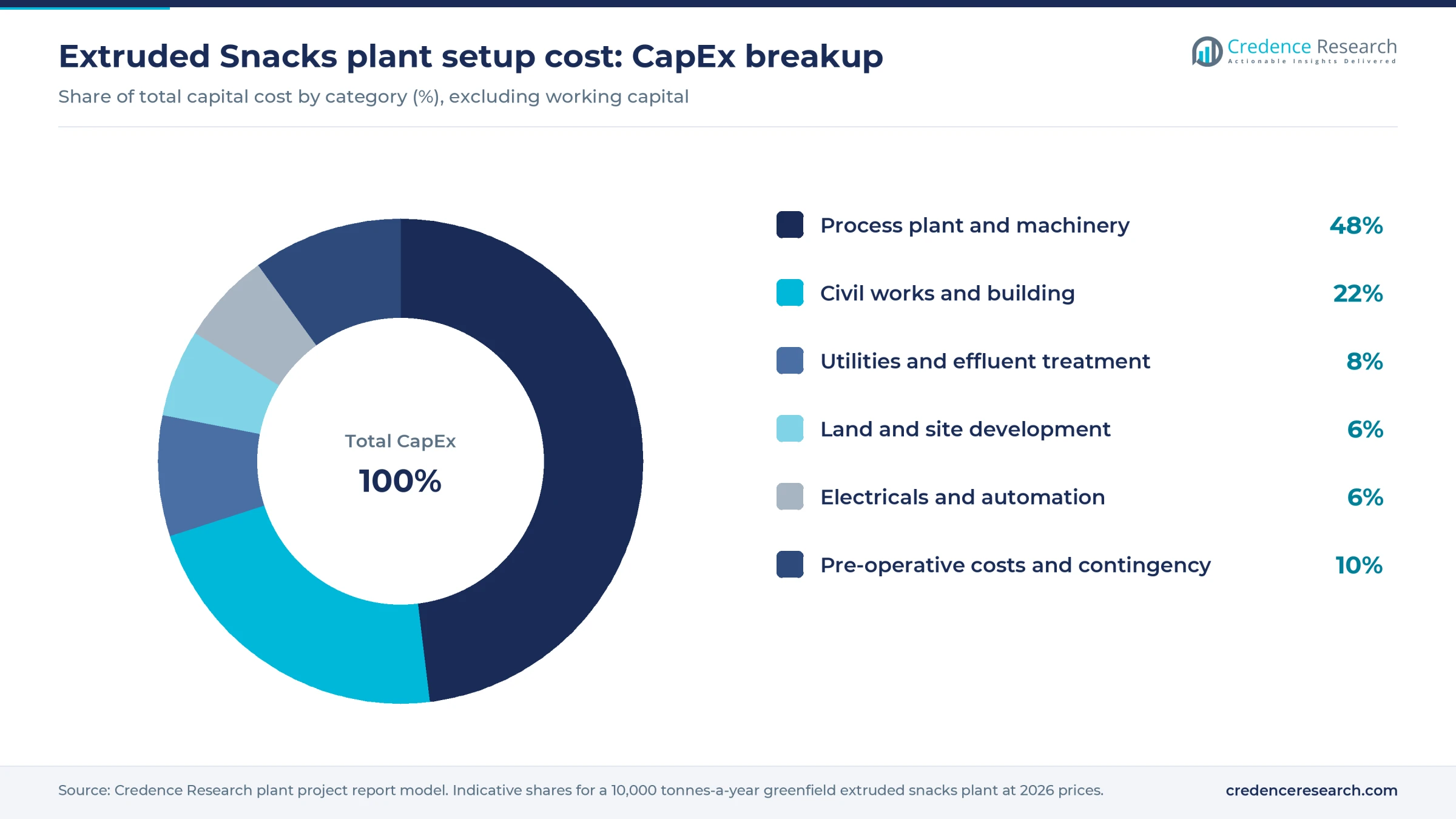
Worked example, land and site development. The plant needs an assumed 20,000–30,000 square meters; PepsiCo's Vietnam site covers 8 hectares for twice the output. At an assumed USD 20–50 per square meter in an Asian industrial park, the plot costs about USD 0.4–1.5 million. At an assumed USD 30–80 at a U.S. or EU site, it costs about USD 0.6–2.4 million. Site works add an assumed USD 0.2–0.6 million, so this row usually runs 5–9% of CapEx.
Working capital adds an estimated USD 1.5–3 million, mainly trade receivables, seasoning stock and printed film.
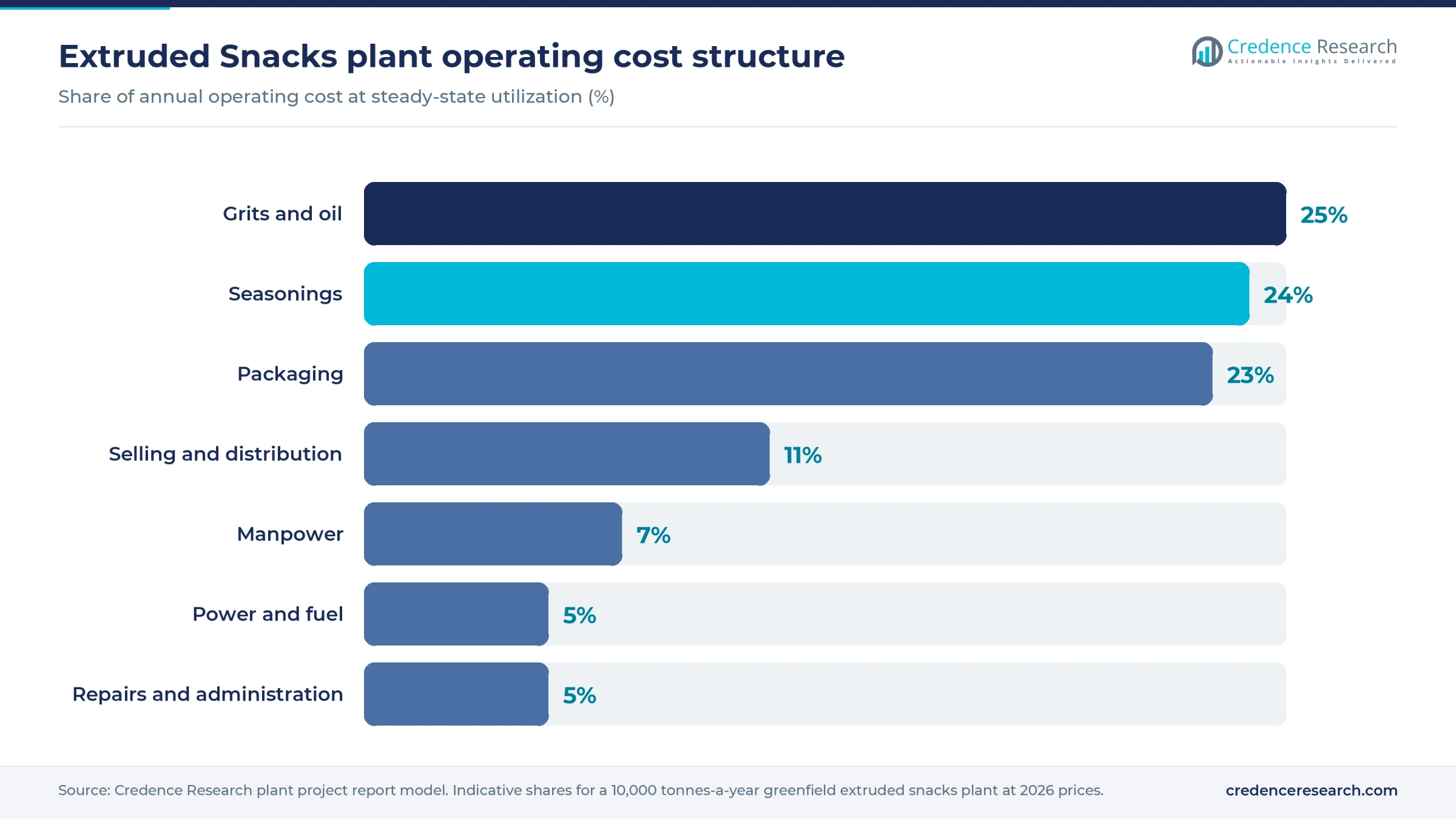
Seasoning and packaging together take more of the budget than grits, oil and conversion combined, which is unusual for a grain-based food.
Machinery and raw materials for an extruded snacks plant
The main machinery groups are listed below; capacities, specifications and quotations are available in the report. Credence Research covers the supply side in its snacks processing machinery analysis.
- Dry handling: grit silos, sieves, gravimetric feeders and pre-conditioners
- Extrusion: single-screw or twin-screw extruders, die assemblies, rotary cutters and pneumatic conveying
- Thermal stage: multi-zone dryers or toasters, and continuous fryers with oil filtration where the recipe needs them
- Flavoring: oil slurry tanks, spray systems, tumbling drums and seasoning applicators
- Packing: multi-head weighers, form-fill-seal baggers, nitrogen supply, metal detectors, check-weighers and case packers
- Utilities: boilers or thermal oil heaters, compressed air, dust collection and effluent treatment
Yellow corn grits come from dry millers close to major maize belts in the U.S., Brazil, Argentina, China, Ukraine, the EU and India. Maize itself was about USD 237 per tonne in September 2026, according to the IMF series carried by FRED, and grits are assumed at USD 380–520 per tonne delivered. Frying and coating oils are led by palm oil from Indonesia and Malaysia, at about USD 1,120 per tonne in October 2026 on World Bank data. The corn ingredients market and seasoning market are the two supply chains to watch. Cheese powders follow dairy prices in the EU, New Zealand and the U.S., while metallized film adds resin-linked price risk.
Extruded snacks business profit margin and ROI
Gross margin, after ingredients, packaging and direct conversion, is estimated at 18–30% at an assumed ex-factory price of USD 2.00–3.40 per kg. Modeled direct cost is about USD 1.65–2.40 per kg. The low end reflects small-pack emerging-market selling at USD 2.00–2.40, and the high end reflects branded or contract supply in wealthier markets at USD 3.00–3.40.
A real benchmark supports the low end. Prataap Snacks reported raw material cost near 72.8% of operating income and gross margin of 27.2% in the June 2026 quarter, before any conversion cost, with packaging laminate up about 20% from a year earlier.
Selling 7,500 tonnes at 75% utilization gives revenue of about USD 15–25.5 million. After selling costs and overheads of an assumed 8–12% of revenue and an assumed 22% tax, cash profit runs about USD 0.9–3.8 million. Including a one-year ramp-up, a USD 12 million plant at USD 2.3 million takes about 6 years, and a USD 35 million plant at USD 3.1 million takes about 12. Weaker pairings fall outside the band: USD 18 million at USD 0.9 million would need about 21 years.
Oil prices can move margins within a quarter. A USD 200 per tonne rise, at 0.2 kg of oil per kg of product, adds about USD 0.04 per kg, or about 1.5 points of margin at USD 2.60 if not passed on.
| Metric | Value |
|---|---|
| Project IRR (post-tax) | Available in report |
| NPV | Available in report |
| Return on investment | Available in report |
| DSCR | Available in report |
| Break-even utilization | Available in report |
How to start an extruded snacks business, licenses and approvals
An extruded snacks plant needs approvals in six areas wherever it is built. These are business and tax registration; land use, zoning and building permits; an environmental permit covering dryer or fryer exhaust, odor and oily wash water; occupational safety approvals, including controls for combustible grain and seasoning dust; food business registration or licensing with a documented food safety plan; and customs registration if it exports. Retail chains and brand owners commonly also ask for FSSC 22000 or BRCGS certification. Allergen labeling deserves early attention because many seasonings contain milk, soy or wheat.
| Market | Food and product | Environment and safety |
|---|---|---|
| United States | FDA food facility registration; preventive controls under 21 CFR 117; nutrition and allergen labeling under 21 CFR 101 and federal allergen law | State or local air permits where fryers or dryers reach thresholds; local wastewater pretreatment approval; OSHA workplace rules, including combustible dust hazards |
| European Union | Food business registration and HACCP under Regulation (EC) No 852/2004; labeling under Regulation (EU) No 1169/2011; acrylamide measures under Regulation (EU) 2017/2158 for potato-dough snacks | National environmental and building permits; ATEX Directive 1999/92/EC duties for explosive dust atmospheres |
| India | FSSAI central license, generally required above 500 million rupees of annual turnover since April 2026, plus FSSAI labeling rules | State pollution control board consents to establish and operate; factory license |
Key extruded snacks manufacturers and recent developments
PepsiCo has the widest reach, with Frito-Lay's Cheetos, Walkers' Wotsits in the U.K., Kurkure in India and Twisties in Australia. Other producers include Wise Foods and W.T. Hawkins in North America and Meiji in Japan. Prataap Snacks and DFM Foods, which added a 10,000-tonne extrusion line in 2017, are prominent Indian makers. Recent moves point to consolidation among brand owners and automated capacity in growth markets.
- July 2026. Intersnack agreed to take Utz Brands private at an enterprise value of about USD 2.9 billion, with closing expected in the fourth quarter of 2026.
- September 2026. Food Processing reported that Colombia's president announced USD 1 billion of investment over five years, including plants in Funza and Guarne, and linked it to PepsiCo, which had not confirmed it.
- October 2026. Free Press Journal reported that Prataap Snacks had started site development near Indore and planned to order long-lead machinery for a new plant. Its investor presentation describes a plan to consolidate seven smaller Indore units into one site.
What's inside the Extruded Snacks project report PDF
The report runs to 21 chapters. Open a chapter to see its sections.
1. Preface
2. Scope and Methodology
- 2.1 Objectives of the Study
- 2.2 Stakeholders
- 2.3 Research Methodology
- 2.4 Data Sources and Key Assumptions
3. Executive Summary
- 3.1 Market Snapshot
- 3.2 Project at a Glance (Capacity, CapEx, OpEx)
- 3.3 Key Financial Indicators (IRR, NPV, Payback, Break-even)
- 3.4 Feasibility Verdict
4. Product Overview
- 4.1 Extruded Snacks Definition and Properties
- 4.2 Grades and Specifications (BIS / ISO / ASTM)
- 4.3 HS Code and Classification
- 4.4 Key Applications
- 4.5 Substitutes
5. Global Extruded Snacks Market
- 5.1 Market Overview
- 5.2 Historical and Current Market Performance (Volume and Value)
- 5.3 Market Breakup by Grade / Type
- 5.4 Market Breakup by End-Use Industry
- 5.5 Market Breakup by Region
- 5.6 Market Drivers, Restraints and Trends
- 5.7 Value Chain Analysis
- 5.8 Market Forecast
6. Target Country Extruded Snacks Market Analysis
- 6.1 Demand and Supply Analysis
- 6.2 Installed Capacity vs Demand Gap
- 6.3 Import Dependence
- 6.4 Demand Forecast by End-Use
7. Trade Analysis
- 7.1 Imports by Volume, Value and Country
- 7.2 Exports by Volume, Value and Country
- 7.3 Trade Balance and Opportunities
8. Price Analysis
- 8.1 Historical Extruded Snacks Price Trends by Region
- 8.2 Raw Material / Feedstock Price Trends and Linkage
- 8.3 Price Forecast
- 8.4 Margins Across the Value Chain
9. Competitive Landscape
- 9.1 Market Structure
- 9.2 Key Players and Installed Capacities
- 9.3 Profiles of Key Players
- 9.4 Recent Developments (Expansions, M&A, New Plants)
10. Manufacturing Process and Technology
- 10.1 Comparison of Technology Routes
- 10.2 Selected Route and Process Flow Diagram
- 10.3 Unit Operations Involved
- 10.4 Chemical Reactions Involved
- 10.5 Mass Balance and Raw Material Requirements
- 10.6 Energy Balance
- 10.7 Quality Assurance Criteria and Technical Tests
- 10.8 By-products and Waste Handling
- 10.9 Technology Licensors / Providers
11. Project Details, Requirements and Costs
- 11.1 Land, Location and Site Development
- 11.1.1 Site Selection Criteria
- 11.1.2 Location Analysis
- 11.1.3 Land Requirement and Costs
- 11.1.4 Site Development Costs
- 11.2 Plant Layout
- 11.2.1 Layout Principles
- 11.2.2 Proposed Layout
- 11.2.3 Factors Influencing Layout
- 11.3 Civil Works and Buildings
- 11.4 Plant Machinery
- 11.4.1 Machinery Requirements and Specifications
- 11.4.2 Machinery Costs
- 11.4.3 Machinery Suppliers
- 11.5 Raw Materials
- 11.5.1 Requirements per Tonne of Output
- 11.5.2 Procurement and Sourcing
- 11.5.3 Costs
- 11.5.4 Suppliers
- 11.6 Packaging
- 11.6.1 Packaging Requirements
- 11.6.2 Packaging Costs
- 11.6.3 Packaging Suppliers
- 11.7 Storage and Material Handling
- 11.8 Transportation Requirements and Costs
- 11.9 Utilities
- 11.9.1 Power Requirements and Costs
- 11.9.2 Water Requirements and Costs
- 11.9.3 Steam, Fuel and Other Utilities
- 11.10 Manpower Requirements and Wages
12. Environment, Health, Safety and Sustainability
- 12.1 Effluent and Emissions Management
- 12.2 Hazard Classification and Safety Measures
- 12.3 Carbon Footprint
- 12.4 Green / Low-Carbon Process Options
13. Regulatory Procedures, Approvals and Certifications
- 13.1 Licences and Registrations
- 13.2 Environmental Clearances
- 13.3 Product Certifications (BIS, REACH, etc.)
- 13.4 Approval Timeline
14. Project Implementation Schedule
15. Project Economics
- 15.1 Capital Cost of the Project
- 15.2 Techno-Economic Parameters
- 15.3 Capacity Utilization and Ramp-up
- 15.4 Product Pricing and Margins
- 15.5 Income Projections
- 15.6 Expenditure Projections
- 15.7 Working Capital Requirement
- 15.8 Taxation
- 15.9 Depreciation
16. Financial Analysis
- 16.1 Projected Profit and Loss Account
- 16.2 Projected Cash Flow Statement
- 16.3 Projected Balance Sheet
- 16.4 Liquidity Analysis
- 16.5 Profitability Analysis (Payback, NPV, IRR, ROI)
- 16.6 Break-even Analysis
- 16.7 Debt Service Coverage Ratio (DSCR)
- 16.8 Sensitivity Analysis
- 16.9 Scenario and Uncertainty Analysis
17. Funding and Incentives
- 17.1 Means of Finance and Debt-Equity Structure
- 17.2 Loans and Financial Assistance
- 17.3 Government Schemes and Subsidies (PLI, State Policies)
18. Risk Assessment
- 18.1 Key Success Factors
- 18.2 Key Risk Factors
- 18.3 Risk Mitigation
19. Strategic Recommendations
20. Case Study of a Successful Venture
21. Appendix
- 21.1 Detailed Assumptions
- 21.2 Abbreviations
- 21.3 List of Tables and Figures
- 21.4 Sources
This page vs. the full report
| Data point | On this page (free) | In the full report |
|---|---|---|
| Total CapEx | One rounded range at one capacity | Exact figure at three capacities with a line-item breakup |
| CapEx breakup | Category shares (%) only | Cost, quantity and supplier for every machine |
| Operating cost | Share of raw materials, utilities and labor | Per-unit cost sheet with each input price and consumption |
| Profitability | Gross margin range and payback band | Exact IRR, NPV, ROI, break-even and DSCR |
| Financial statements | List of what is included | 10-year P&L, cash flow, balance sheet and Excel model |
| Sensitivity | One directional line | Full sensitivity and scenario tables |
| Process | Simplified flow diagram | Detailed process flow, mass and energy balance, operating conditions |
| Machinery | Names of the main machines | Specifications, capacity, cost and supplier list |
| Market | Headline size, growth and global demand | Segment, region, trade and price forecast tables |
| Suppliers and buyers | Supplier types and sourcing hubs | Named suppliers and buyers |
Extruded Snacks project report: FAQs
How much does it cost to set up an extruded snacks plant?
Is a single-screw or twin-screw extruder better for snacks?
What profit margin can an extruded snacks plant earn?
Why do seasoning and packaging matter so much?
Which licenses does an extruded snacks plant need?
What is the difference between direct-expanded snacks and pellets?
Which HS code applies to extruded snacks?

About the analyst
Priyanka Mor, Senior Consultant
Senior Consultant at Credence Research Inc directing strategic market advisory, cross-border commercial due diligence and enterprise intelligence frameworks for global B2B clients. Combines quantitative modeling with executive advisory, translating macroeconomic variables and supply chain data into go-to-market blueprints, M&A screenings and competitive war-gaming strategies.
Related market research
- Savory Snacks Market Size, Share, Growth and Forecast 2032
- Snacks Processing Machinery Market Size, Share & Growth Report 2032
- Corn Ingredients Market Size, Share, Growth and Forecast 2032
- Seasoning Market Size, Growth, Trends, Share and Forecast 2032
- Flexible Packaging Machinery Market Size, Growth and Forecast 2032
- Popcorn Market Size, Share, Trends, Growth and Forecast 2032
More plant project reports
- Garlic Powder Manufacturing Plant Project Report (DPR) 2026
- Bread Manufacturing Plant Project Report (DPR) 2026
- Chocolate Manufacturing Plant Project Report (DPR) 2026
- Cheese Manufacturing Plant Project Report (DPR) 2026
- Camel Dairy Processing Plant Project Report (DPR) 2026
- Vinegar Manufacturing Plant Project Report (DPR) 2026