
Quick answer
A garlic powder plant breaks bulbs into cloves, peels and slices them, dries them to about 5–6% moisture and mills them into powder and granules. This overview models a greenfield plant making 3,000 tonnes a year, with estimated CapEx of USD 5–20 million by build standard and region. Gross margin is estimated at 12–30% on an assumed specification-grade mix, with payback at 4–12 years. Plain bulk product at recent Chinese prices may not cover modeled costs.
Viable for processors with low-cost contracted garlic and audited, sterilized grades; a plant competing with Chinese bulk flakes on price alone may not cover its modeled costs.
Garlic Powder plant: key highlights
| Parameter | Indicative value | Note |
|---|---|---|
| Plant capacity | 3,000 tonnes of finished product per year | About 12 tonnes a day over 250 operating days, using 9,000–12,000 tonnes of fresh bulbs at full capacity |
| Total CapEx | USD 5–20 million | Greenfield; low end a basic build in a low-cost region, high end a fuller specification; U.S. or EU sites may exceed it; excludes working capital |
| Raw material share of operating cost | 60–72% | Modeled at 3–4 kg of fresh bulbs per kg of product |
| Gross margin | 12–30% | At an assumed USD 2.4–3.6 per kg blended price and assumed USD 0.30–0.50 per kg processing-grade garlic |
| Payback period | 4–12 years | At 80% utilization, post-tax at an assumed 20%, including a one-year ramp-up; weak price and high-CapEx pairings fall outside this band |
| IRR | Available in report | Post-tax, 10-year model |
| Break-even | Available in report | Capacity utilization basis |
Ranges assume a 3,000 tonnes-per-year greenfield plant, 250 operating days, 80% utilization and 2026 prices. The blended price of USD 2.4–3.6 per kg, garlic at USD 0.30–0.50 per kg and land rates are assumed. Conversions use assumed rates of USD 1.10 per euro, 7.1 yuan and 45 rupees (1999 profile) per USD. CapEx is scaled from disclosed projects and excludes working capital. The full report can be customized to any country or region.
What is garlic powder?
Garlic powder is a dry, free-flowing seasoning made by dehydrating peeled cloves of Allium sativum and milling them. Food makers use it because it gives a repeatable garlic note without peeling, cold chain or the short shelf life of fresh cloves.
A dehydration line rarely makes powder alone. ISO 5560, the international specification for dehydrated garlic, recognizes slices, flakes or pieces, grits and powder, with powder defined as 95% passing a 250-micron sieve. The Netherlands' import promotion agency reports flakes and granules selling 5–20% above powder and organic lots at a premium of about 30%.
Dried garlic, including powder, is classified under Harmonized System subheading 0712.90, the residual code for other dried vegetables, and national schedules add digits to separate it, such as U.S. 0712.90.40. End uses include seasoning blends, sausages and cured meat, snack coatings, sauces, instant noodles, ready meals and retail spice jars, with a smaller outlet in dietary supplements.
Garlic powder market overview and global demand
No Credence Research report sizes garlic powder alone, so this overview pairs adjacent categories with physical trade data. Credence Research values the global seasoning market at about USD 46.9 billion in 2025, based on its USD 44.7 billion for 2024 and a 4.9% CAGR. Its dehydrated food study puts that broader category at USD 47.5 billion in 2023, with a 7% CAGR.
The defining fact of this market is Chinese concentration. FAO figures republished in public country tables show world garlic output of about 29.1 million tonnes in 2022, with China at 21.3 million and India at 3.2 million, followed by Bangladesh, Egypt and Spain. Chinese customs figures cited in the trade press show record 2025 exports of all garlic forms at about 2.25 million tonnes.
In dried garlic specifically, a Dutch government market study updated in October 2025 estimates that China supplies 80% of the world market and shipped more than 63,000 tonnes to Europe in 2024. Egypt followed at 6,980 tonnes and India at 4,640 tonnes, with India's volume about doubling since 2020. Trade listings name the U.S., Germany, the Netherlands, Japan and the U.K. as major importers.
That structure sets the entry case. A new plant outside China rarely wins on bulk price, so it sells on origin diversification, residue control and audited safety, which is what industrial buyers in the European spice trade and North America increasingly specify.
Garlic powder manufacturing process
Garlic is easier to dry than most vegetables but harder to prepare. Fresh cloves hold about 58.6% water according to USDA data, far less than onions, so evaporation is modest. The cost and the hygiene risk sit in the steps before the dryer.
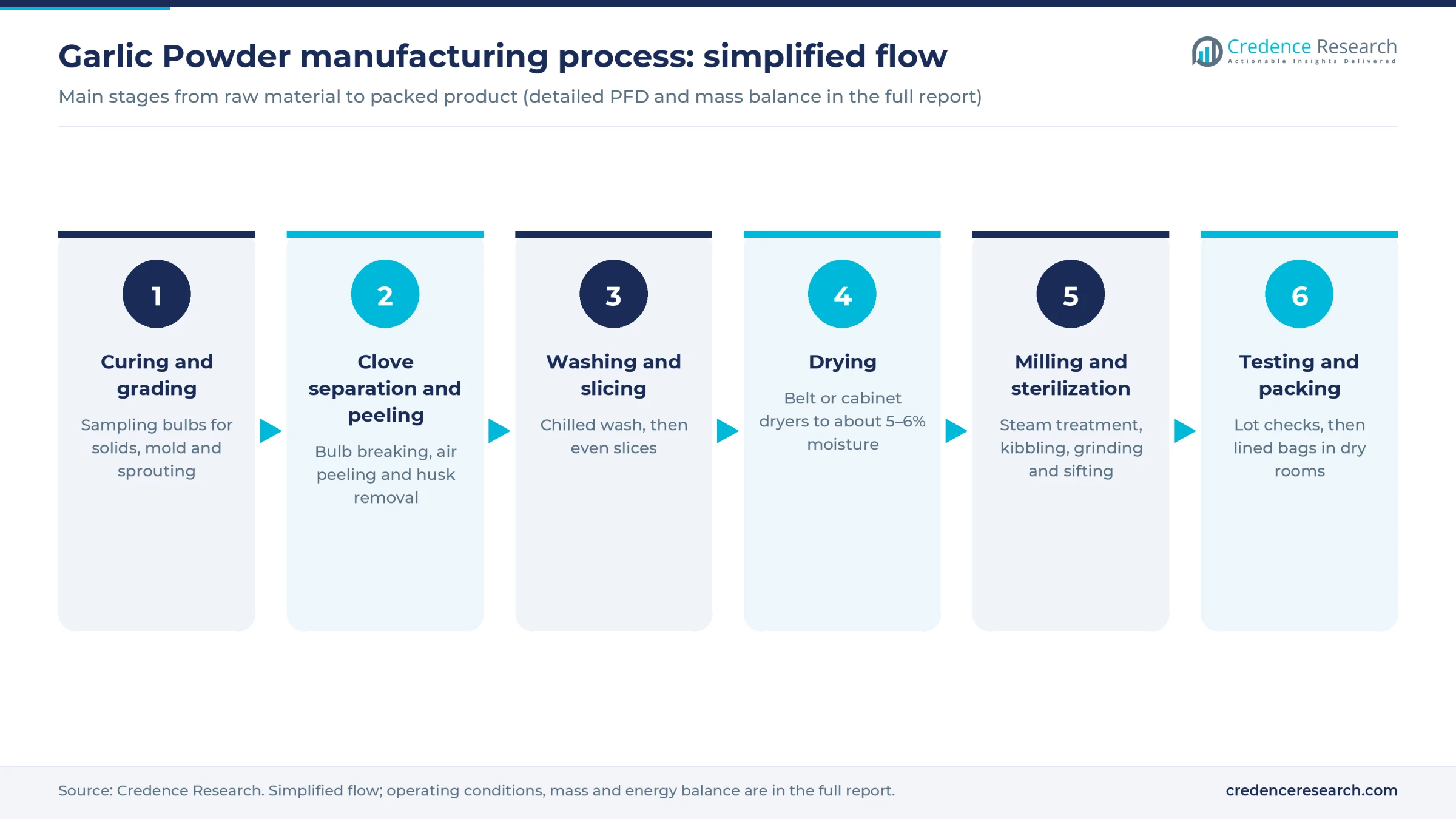
- Curing and grading. Bulbs are field-cured or held in ventilated stores, then sampled for solids, mold and sprouting. Small bulbs are often acceptable here, since appearance matters less than solids.
- Clove separation and peeling. Rubber-roll or air-impact breakers split bulbs, and compressed-air peelers strip the skins. Air classifiers carry husk away, and optical or hand sorting removes bruised cloves.
- Washing and slicing. Cloves are washed in chilled potable water and sliced to an even thickness. Cutting releases the enzyme reaction that creates pungent allicin, so holding times matter for flavor and color.
- Drying. Belt or cabinet dryers run at moderate air temperatures. A Thai study found drying at 60°C took 270–300 minutes for chopped and sliced garlic against 540–630 minutes at 40°C, reaching about 5.4–5.7% moisture, though heat and small pieces shifted color.
- Milling and sterilization. Flakes are kibbled, then ground and sifted to grade. Saturated steam at 100°C or above for several minutes is the validated route to the microbial standard that buyers want.
- Testing and packing. Lots pass moisture, pungency, microbial and metal checks, then go into lined bags or cartons in a low-humidity room, because powder cakes readily.
Yield drives the economics of the plant. With USDA's 41.4% solids, an assumed 75–85% clove recovery, 6% finished moisture and 5–10% process loss, the mass balance gives about 2.8–3.4 kg of bulbs per kg of product. Lower-solids lots push that higher, so this overview models 3–4 kg.
Garlic powder plant setup cost
This overview models a greenfield plant making 3,000 tonnes of powder, granules and flakes a year, about 12 tonnes a day, at an estimated total CapEx of USD 5–20 million. No disclosed plant makes garlic powder alone at this size, so the range scales mixed dehydration benchmarks with a 0.7 power rule and escalates older figures to 2026 prices.
At the low end, An undated trade report said Qingdao Wanlin Food planned a USD 30 million first phase of 50,000 tonnes a year of dehydrated vegetables, including garlic, in Kazakhstan's Turkestan Region. That scales to about USD 4.2 million, although the deal was only a memorandum and the tonnage may not mean finished product. An Indian government institute's profile with 1998–99 data, at 60 tonnes a year and about 1.8 million rupees of fixed capital, scales to only about USD 1.3 million, and it is a guide to the floor for a small, basic build.
At the upper end, IFC listed EUR 18 million, including a 760-hectare farm, for Senegal's 5,000-tonne SAF Ingredients onion plant, which scales to about USD 13–15 million after an assumed farm allowance. Press reports later put the completed project at USD 35.4 million for 4,000 tonnes, which scales to about USD 29 million before any farm allowance, so a full-specification build can exceed this range. Olam paid USD 30.8 million in 2012 for an Egyptian dehydrator with 10,800 tonnes of capacity, which scales to about USD 15 million. Garlic evaporates less water per kilogram than those onion lines, but it needs peeling and sterilization equipment. An in-house steam sterilizer alone can cost up to EUR 1 million.
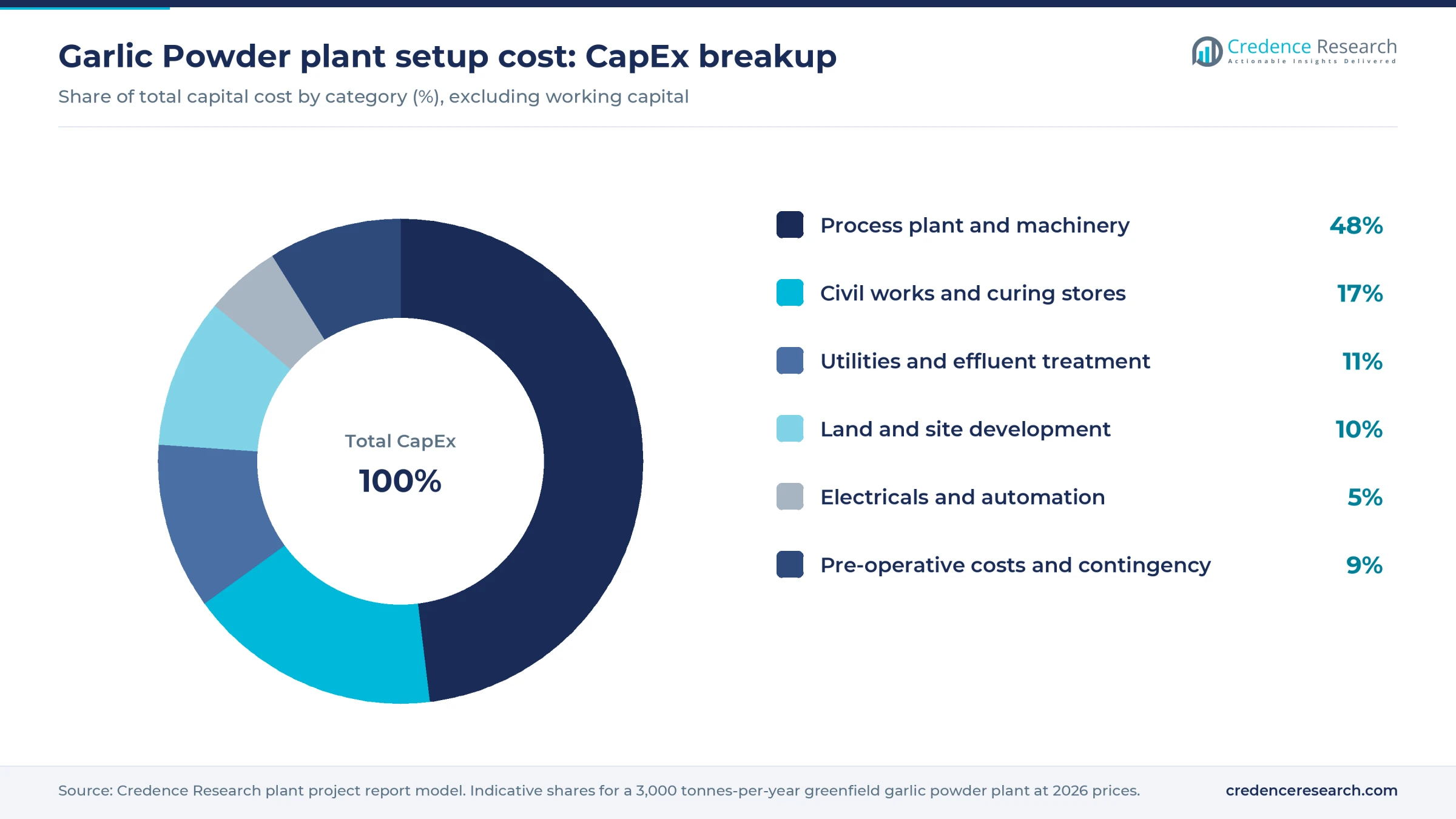
Worked example, land and site development. The plant needs an assumed 15,000–25,000 square meters, including curing stores and effluent treatment. At an assumed USD 20–50 per square meter in an Asian industrial park, the plot costs about USD 0.3–1.25 million. At an assumed USD 30–80 at a U.S. or EU site, it costs about USD 0.45–2 million. Site works add an assumed USD 0.1–0.3 million, so this row usually runs 8–15% of CapEx.
Working capital adds an estimated USD 1.5–3 million, since the crop is bought once a year while sales run across twelve months.
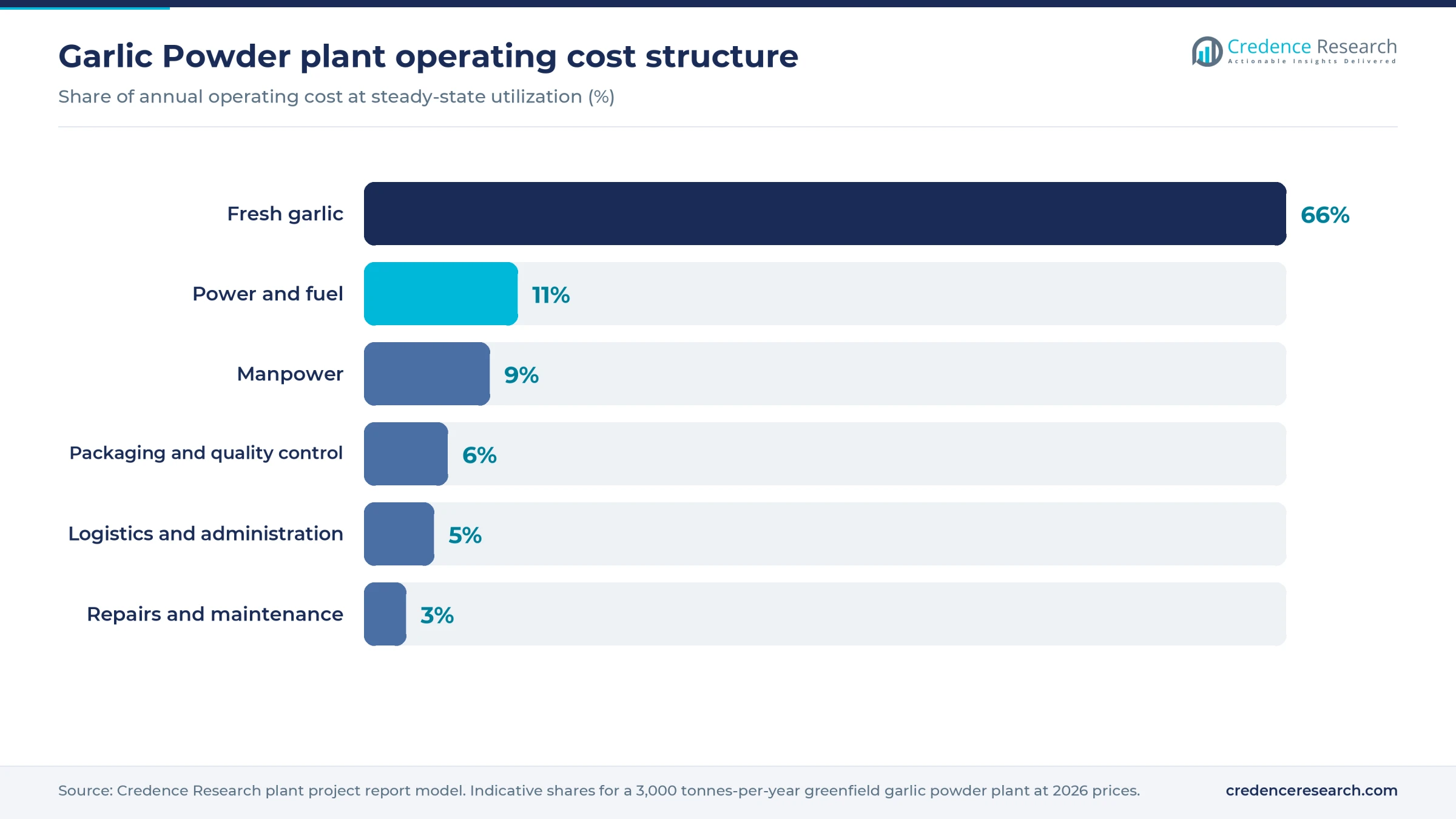
Garlic dominates operating cost, far more than energy, which reverses part of the logic of onion dehydration.
Machinery and raw materials for a garlic powder plant
The main machinery groups are listed below; capacities, specifications and quotations are available in the report.
- Intake: bulb hoppers, ventilated curing stores, graders and sorting belts
- Preparation: bulb breakers, air peelers, husk classifiers, optical sorters, clove washers and slicers
- Drying: multi-zone belt or cabinet dryers, heat pumps or air heaters and final bin dryers
- Finishing: steam sterilizers, kibblers, pin mills, roasters, sifters, metal detectors and bagging lines
- Quality: moisture and water activity meters, pungency tests, colorimeters and a microbiology lab
- Utilities: boilers, dust collection, dehumidified packing rooms and effluent treatment with odor control
Fresh bulbs are the core input, and the plant should sit inside a growing belt. China's cluster centers on Jinxiang in Shandong, with Jiangsu and Henan close behind. India's crop is about 80% from Madhya Pradesh and Rajasthan, Egypt draws on the Nile Valley, Spain is Europe's main grower and California supplies contract crops to U.S. dehydrators.
Price swings are severe across seasons. Chinese origin prices ran about 9.23 yuan per kg in early 2025, then about 5 yuan by mid-year as the crop grew, according to Chinese trade reports. Plants therefore need stores or forward contracts for a full season. Skins and husks also need an outlet, or they become a disposal cost.
Garlic powder business profit margin and ROI
For the modeled plant, gross margin after garlic and direct conversion costs is estimated at 12–30%, at an assumed blended price of USD 2.4–3.6 per kg. Payback runs 4–12 years, including a one-year ramp-up, and the shorter end needs a low-cost build and firm pricing. The modeled unit cost is about USD 1.6–2.5 per kg, including garlic at an assumed USD 0.30–0.50 per kg.
The price basis is the European study's bulk range of EUR 2,500–3,500 per tonne CIF in 2024, or about USD 2.75–3.85 per kg, with Germany averaging EUR 3,900. Yet trade listings show sampled Chinese flake shipments at about USD 1.96 per kg and minced at USD 2.20 in May 2026. At those prices, plain bulk product may not cover modeled costs, so the plant needs sterilized, roasted, organic or origin-specific grades.
Revenue of about USD 5.8–8.6 million on 2,400 tonnes supports gross profit of about USD 0.7–2.6 million, before assumed overheads of USD 0.3–0.5 million. Garlic cost is the sharpest swing factor: a USD 0.05 per kg rise that cannot be passed through cuts gross margin by about 6 percentage points. The modeled garlic cost assumes small, processing-grade bulbs, not table garlic. Stored Chinese garlic at about 4.6–5.7 yuan per kg in October 2025, about USD 0.65–0.80, would cost USD 2.30–2.80 per kg of product at 3.5 kg, pushing margin below the modeled range at most assumed prices.
| Metric | Value |
|---|---|
| Project IRR (post-tax) | Available in report |
| NPV | Available in report |
| Return on investment | Available in report |
| DSCR | Available in report |
| Break-even utilization | Available in report |
How to start a garlic powder business, licenses and approvals
A garlic powder plant needs approvals in six areas wherever it is built. These are business and tax registration; land use, zoning and building permits; an environmental permit covering wash water, husk waste, dryer stacks and strong odor; occupational safety approvals, including combustible dust controls in milling; food facility registration with a documented safety plan; and customs registration for export. Industrial buyers also commonly ask for FSSC 22000, BRCGS or IFS Food certification, plus kosher, halal or organic certificates, and the certification alone can cost tens of thousands of euros.
| Market | Food and product | Environment and safety |
|---|---|---|
| United States | FDA food facility registration and preventive controls under 21 CFR 117; importers must meet FDA's Foreign Supplier Verification Program | State air permit; NPDES or local pretreatment permit; OSHA rules, including combustible dust enforcement |
| European Union | Food business registration under Regulation (EC) No 852/2004; traceability under Regulation (EC) No 178/2002; pesticide limits under Regulation (EC) No 396/2005, listed under fresh garlic code 0220010 | National environmental permit, with this plant's output below the Industrial Emissions Directive's 300-tonne daily threshold for vegetable materials; ATEX rules for explosive dust |
| India | FSSAI central license, which applies to exporters; importer-exporter code; Spices Board certificate of registration as an exporter (CRES), since garlic is a scheduled spice | State pollution control board consents to establish and operate; factory license and boiler registration |
European buyers require Salmonella to be absent, and the same study cites limits of 0.050 mg per kg for lead and 5 micrograms per kg for aflatoxin B1, so a plant should validate its sterilization step before the first export shipment.
Key garlic powder manufacturers and recent developments
Olam, whose ingredients arm trades as ofi, is described by the Dutch study as the world's largest dried garlic producer, with a factory in China. Sensient Technologies is the second-largest U.S. producer of dehydrated onion and garlic by its own account (FY2025 10-K). China's many exporters include Qingdao Wanlin Food and Jining Fenduni Foodstuff. India's field includes Pardes Dehydration, Mahesh Agro Food Industries and Bagora Dehydrates, Egypt's includes UD Crops and Norica Food, and Nateco Impex of Uzbekistan and ACM INT of Serbia are newer sources.
- February 2026. Chinese trade reports put 2025 garlic exports of all forms at a record of about 2.25 million tonnes, with the average price down about 17% to USD 1,078 per tonne, which keeps pressure on rival origins.
- August 2026. Trade reports put Chinese flake stocks from the prior crop at about 200,000 tonnes, a six-year low, with flake prices rising and irradiation costs expected to climb about 8%. Ofi reported better-than-expected Chinese yields, so total production remains high.
What's inside the Garlic Powder project report PDF
The report runs to 21 chapters. Open a chapter to see its sections.
1. Preface
2. Scope and Methodology
- 2.1 Objectives of the Study
- 2.2 Stakeholders
- 2.3 Research Methodology
- 2.4 Data Sources and Key Assumptions
3. Executive Summary
- 3.1 Market Snapshot
- 3.2 Project at a Glance (Capacity, CapEx, OpEx)
- 3.3 Key Financial Indicators (IRR, NPV, Payback, Break-even)
- 3.4 Feasibility Verdict
4. Product Overview
- 4.1 Garlic Powder Definition and Properties
- 4.2 Grades and Specifications (BIS / ISO / ASTM)
- 4.3 HS Code and Classification
- 4.4 Key Applications
- 4.5 Substitutes
5. Global Garlic Powder Market
- 5.1 Market Overview
- 5.2 Historical and Current Market Performance (Volume and Value)
- 5.3 Market Breakup by Grade / Type
- 5.4 Market Breakup by End-Use Industry
- 5.5 Market Breakup by Region
- 5.6 Market Drivers, Restraints and Trends
- 5.7 Value Chain Analysis
- 5.8 Market Forecast
6. Target Country Garlic Powder Market Analysis
- 6.1 Demand and Supply Analysis
- 6.2 Installed Capacity vs Demand Gap
- 6.3 Import Dependence
- 6.4 Demand Forecast by End-Use
7. Trade Analysis
- 7.1 Imports by Volume, Value and Country
- 7.2 Exports by Volume, Value and Country
- 7.3 Trade Balance and Opportunities
8. Price Analysis
- 8.1 Historical Garlic Powder Price Trends by Region
- 8.2 Raw Material / Feedstock Price Trends and Linkage
- 8.3 Price Forecast
- 8.4 Margins Across the Value Chain
9. Competitive Landscape
- 9.1 Market Structure
- 9.2 Key Players and Installed Capacities
- 9.3 Profiles of Key Players
- 9.4 Recent Developments (Expansions, M&A, New Plants)
10. Manufacturing Process and Technology
- 10.1 Comparison of Technology Routes
- 10.2 Selected Route and Process Flow Diagram
- 10.3 Unit Operations Involved
- 10.4 Chemical Reactions Involved
- 10.5 Mass Balance and Raw Material Requirements
- 10.6 Energy Balance
- 10.7 Quality Assurance Criteria and Technical Tests
- 10.8 By-products and Waste Handling
- 10.9 Technology Licensors / Providers
11. Project Details, Requirements and Costs
- 11.1 Land, Location and Site Development
- 11.1.1 Site Selection Criteria
- 11.1.2 Location Analysis
- 11.1.3 Land Requirement and Costs
- 11.1.4 Site Development Costs
- 11.2 Plant Layout
- 11.2.1 Layout Principles
- 11.2.2 Proposed Layout
- 11.2.3 Factors Influencing Layout
- 11.3 Civil Works and Buildings
- 11.4 Plant Machinery
- 11.4.1 Machinery Requirements and Specifications
- 11.4.2 Machinery Costs
- 11.4.3 Machinery Suppliers
- 11.5 Raw Materials
- 11.5.1 Requirements per Tonne of Output
- 11.5.2 Procurement and Sourcing
- 11.5.3 Costs
- 11.5.4 Suppliers
- 11.6 Packaging
- 11.6.1 Packaging Requirements
- 11.6.2 Packaging Costs
- 11.6.3 Packaging Suppliers
- 11.7 Storage and Material Handling
- 11.8 Transportation Requirements and Costs
- 11.9 Utilities
- 11.9.1 Power Requirements and Costs
- 11.9.2 Water Requirements and Costs
- 11.9.3 Steam, Fuel and Other Utilities
- 11.10 Manpower Requirements and Wages
12. Environment, Health, Safety and Sustainability
- 12.1 Effluent and Emissions Management
- 12.2 Hazard Classification and Safety Measures
- 12.3 Carbon Footprint
- 12.4 Green / Low-Carbon Process Options
13. Regulatory Procedures, Approvals and Certifications
- 13.1 Licences and Registrations
- 13.2 Environmental Clearances
- 13.3 Product Certifications (BIS, REACH, etc.)
- 13.4 Approval Timeline
14. Project Implementation Schedule
15. Project Economics
- 15.1 Capital Cost of the Project
- 15.2 Techno-Economic Parameters
- 15.3 Capacity Utilization and Ramp-up
- 15.4 Product Pricing and Margins
- 15.5 Income Projections
- 15.6 Expenditure Projections
- 15.7 Working Capital Requirement
- 15.8 Taxation
- 15.9 Depreciation
16. Financial Analysis
- 16.1 Projected Profit and Loss Account
- 16.2 Projected Cash Flow Statement
- 16.3 Projected Balance Sheet
- 16.4 Liquidity Analysis
- 16.5 Profitability Analysis (Payback, NPV, IRR, ROI)
- 16.6 Break-even Analysis
- 16.7 Debt Service Coverage Ratio (DSCR)
- 16.8 Sensitivity Analysis
- 16.9 Scenario and Uncertainty Analysis
17. Funding and Incentives
- 17.1 Means of Finance and Debt-Equity Structure
- 17.2 Loans and Financial Assistance
- 17.3 Government Schemes and Subsidies (PLI, State Policies)
18. Risk Assessment
- 18.1 Key Success Factors
- 18.2 Key Risk Factors
- 18.3 Risk Mitigation
19. Strategic Recommendations
20. Case Study of a Successful Venture
21. Appendix
- 21.1 Detailed Assumptions
- 21.2 Abbreviations
- 21.3 List of Tables and Figures
- 21.4 Sources
This page vs. the full report
| Data point | On this page (free) | In the full report |
|---|---|---|
| Total CapEx | One rounded range at one capacity | Exact figure at three capacities with a line-item breakup |
| CapEx breakup | Category shares (%) only | Cost, quantity and supplier for every machine |
| Operating cost | Share of raw materials, utilities and labor | Per-unit cost sheet with each input price and consumption |
| Profitability | Gross margin range and payback band | Exact IRR, NPV, ROI, break-even and DSCR |
| Financial statements | List of what is included | 10-year P&L, cash flow, balance sheet and Excel model |
| Sensitivity | One directional line | Full sensitivity and scenario tables |
| Process | Simplified flow diagram | Detailed process flow, mass and energy balance, operating conditions |
| Machinery | Names of the main machines | Specifications, capacity, cost and supplier list |
| Market | Headline size, growth and global demand | Segment, region, trade and price forecast tables |
| Suppliers and buyers | Supplier types and sourcing hubs | Named suppliers and buyers |
Garlic Powder project report: FAQs
How much does it cost to set up a garlic powder plant?
How many kilograms of garlic make 1 kg of garlic powder?
What profit margin can a garlic powder plant earn?
Can a new plant compete with Chinese dried garlic?
Which licenses does a garlic powder plant need?
Why is steam sterilization important for garlic powder?
Where should a garlic powder plant be located?

About the analyst
Priyanka Mor, Senior Consultant
Senior Consultant at Credence Research Inc directing strategic market advisory, cross-border commercial due diligence and enterprise intelligence frameworks for global B2B clients. Combines quantitative modeling with executive advisory, translating macroeconomic variables and supply chain data into go-to-market blueprints, M&A screenings and competitive war-gaming strategies.
Related market research
- Seasoning Market Size, Growth, Trends, Share and Forecast 2032
- Dehydrated Food Market Size, Growth & Forecast to 2032
- Europe Spices Market Size, Growth & Forecast 2032
- Organic Spice Market Size, Share, Growth and Forecast 2032
- North America Spices Market Size, Growth and Forecast 2032
- Asia Pacific Seasoning and Spices Market Size, Share, Growth and Forecast, 2025-2035
More plant project reports
- Extruded Snacks Manufacturing Plant Project Report (DPR) 2026
- Bread Manufacturing Plant Project Report (DPR) 2026
- Chocolate Manufacturing Plant Project Report (DPR) 2026
- Cheese Manufacturing Plant Project Report (DPR) 2026
- Camel Dairy Processing Plant Project Report (DPR) 2026
- Vinegar Manufacturing Plant Project Report (DPR) 2026