
Quick answer
A guar gum powder plant splits guar seed, removes the husk and germ, then hydrates, flakes and mills the endosperm into a thickening powder. This overview models a greenfield seed-to-powder plant making 10,000 tonnes a year, with estimated CapEx of USD 5–25 million by cost region and grade. Gross margin is estimated at 8–18% on a specialty-weighted mix at March–September 2026 seed prices, with payback at 4–12 years. October seed quotes could erase that margin.
Viable for processors with seed access, storage finance and qualified food or fast-hydrating grades; a commodity-only plant buying seed at spot prices has little margin to protect it, and October 2026 seed quotes could erase the modeled margin until powder prices catch up.
Guar Gum Powder plant: key highlights
| Parameter | Indicative value | Note |
|---|---|---|
| Plant capacity | 10,000 tonnes of powder per year | About 33 tonnes a day over 300 operating days, using about 34,000 tonnes of seed |
| Total CapEx | USD 5–25 million | Greenfield; low end an Asian industrial-grade build, high end a food-grade plant at a U.S. or EU site |
| Raw material share of operating cost | 75–85% | Seed net of by-product credit; about 3.4 kg of seed per kg of powder |
| Gross margin | 8–18% | After net seed and conversion costs, at an assumed USD 1.5–2.1 per kg and March–September 2026 seed; October quotes could erase it |
| Payback period | 4–12 years | From commissioning, at March–September 2026 seed prices, before financing costs on seed inventory |
| IRR | Available in report | Post-tax, 10-year model |
| Break-even | Available in report | Capacity utilization basis |
Ranges assume a 10,000 tonnes-per-year greenfield seed-to-powder plant, 300 operating days, 85% utilization and 2026 prices. Blended powder price of USD 1.5–2.1 per kg and by-product value of USD 0.35–0.50 per kg are assumed; seed uses March–September 2026 Indian spot quotes at an assumed 90 rupees per USD. CapEx is scaled from disclosed projects and listed equipment prices and excludes working capital. The full report can be customized to any country or region.
What is guar gum powder?
Guar gum powder is a galactomannan thickener milled from the endosperm of the guar seed, Cyamopsis tetragonoloba. It hydrates in cold water and builds high viscosity at low doses, which is why buyers judge it on viscosity, hydration speed and particle size rather than on weight alone.
Grades split by end use. Fast-hydrating and slurry grades, along with chemically modified hydroxypropyl and carboxymethyl hydroxypropyl types, gel the fluids that carry sand in hydraulic fracturing. Food grades thicken ice cream, sauces, bakery mixes and beverages and carry the EU additive number E 412. Other grades serve textile printing, paper, explosives, mining, cosmetics and pharmaceuticals, while partially hydrolyzed types are sold as soluble fiber. Guar gum competes with other texturants tracked in the food thickeners market, including locust bean, tara and xanthan gums, so sharp price spikes push users to switch. Guar gum falls under Harmonized System subheading 1302.32, mucilages and thickeners derived from locust beans, locust bean seeds or guar seeds.
Guar gum powder market overview and global demand
Credence Research's global market study covers demand by grade and application. This overview sizes the plant on tonnage and export value, the firmer public measures for a bulk-traded gum.
Supply is unusually concentrated. India's agricultural export authority, APEDA, says India grows about 80% of the world's guar, with about 72% of that from Rajasthan. It reports fiscal 2025 exports of about 474,500 tonnes worth USD 550 million, with Germany, the U.S., Russia, Norway and China the top destinations in 2025-26. That tonnage may cover more than milled gum: a Mumbai supplier tallied 247,315 tonnes of gum plus 80,299 tonnes of splits for calendar 2024. The implied export value therefore ranges from about USD 1.16 to 1.68 per kg.
APEDA says about 90% of processed gum is exported and about 90% of exports go to oil drilling and shale gas, so demand tracks North American well completions more than food consumption. Pakistan is the second-largest grower, and Texas A&M material shows the U.S. imports about 90% of its needs, despite local crops in Texas and Oklahoma.
The crop is rain-fed, so output swings widely. A March 2026 broker note put 2025 guar area at about 2.45 million hectares, down from 2.72 million, without saying whether that covers India or only Rajasthan. Sowing is decided each July against competing crops, and this volatility shapes every plant decision, from storage to contract length.
Guar gum powder manufacturing process
Production is mechanical and thermal rather than chemical, unless derivatives are made. The plant separates a seed that is about 40% endosperm, 45% germ and 15% husk, according to Texas A&M crop material, and then turns the endosperm into a controlled powder.
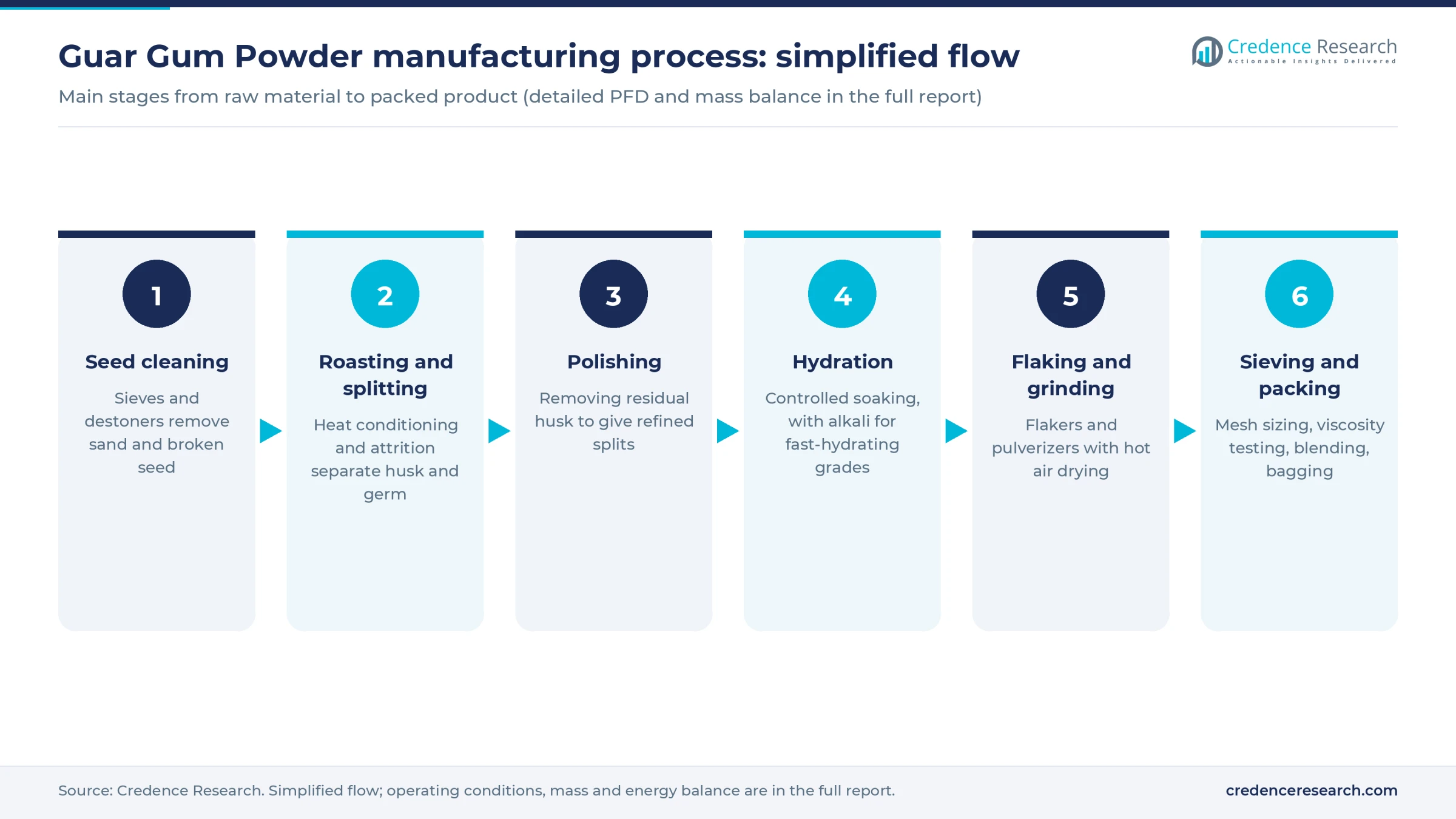
- Seed cleaning. Sieves and destoners remove sand, stalks and broken seed. Moisture and foreign matter are tested at intake, since poor seed lowers both yield and viscosity.
- Roasting and splitting. Seed is heat-conditioned to loosen the husk, then cracked in attrition mills. The germ, which is softer, breaks into fine fractions that sieves remove, leaving endosperm halves called splits.
- Polishing. Further attrition and aspiration remove adhering husk and germ. Purity at this stage sets the gum content, protein level and color of the final product.
- Hydration. Refined splits are soaked with controlled water, sometimes with alkali for fast-hydrating oilfield grades, and held until they soften evenly.
- Flaking and grinding. Softened splits pass through flakers and then pulverizers with hot air. Drying and milling occur together, as heat can damage the polymer and cut viscosity.
- Sieving, blending and packing. Powder is classified by mesh, tested for viscosity at set hydration times and blended to specification. Food grades also pass microbial and contaminant tests before packing in bags or bulk sacks.
Yield decides the economics. A dated APEDA profile gives about 29% splits, 30–35% korma and 35–40% churi from seed, and Texas A&M cites about 28% extractable gum, so the model uses about 3.4 kg of seed per kg of powder. Korma, the protein-rich germ meal, and churi, the husk and germ blend, go to cattle feed and feed mills. Their income is a material offset, so a plant must have a feed outlet from day one. Fine dust is a further design issue, since it creates explosion risk and product loss at every transfer point.
Guar gum powder plant setup cost
This overview models a greenfield seed-to-powder plant making 10,000 tonnes a year, about 33 tonnes a day, at an estimated total CapEx of USD 5–25 million. Real plants bracket that scale. B.D. Guar in Gujarat cites 12,000 tonnes a year of capacity, Agro Gums cites 45 tonnes a day and Guar Resources in the U.S. cites 15.5 million pounds, about 7,000 tonnes.
Few guar plants disclose cost per tonne, so the range is built from two directions. The low end starts with Indian supplier listings of about USD 85,000–110,000 for a 1–2 tonnes-per-hour grinding line. Two lines, then assumed allowances for splitting, hydration, drying, dust control and installation, reach about USD 2–4 million of process plant, and buildings and utilities bring an Asian build to about USD 5–10 million. The high end draws on Lucid Colloids' USD 46 million expansion budget from 2014, which aimed to double capacity through two splitting plants and a food-grade plant in Gujarat. Lucid's added tonnage is undisclosed, so an assumed 20,000–40,000 tonnes was used, then scaled and escalated to about USD 15–25 million at a higher-spec site.
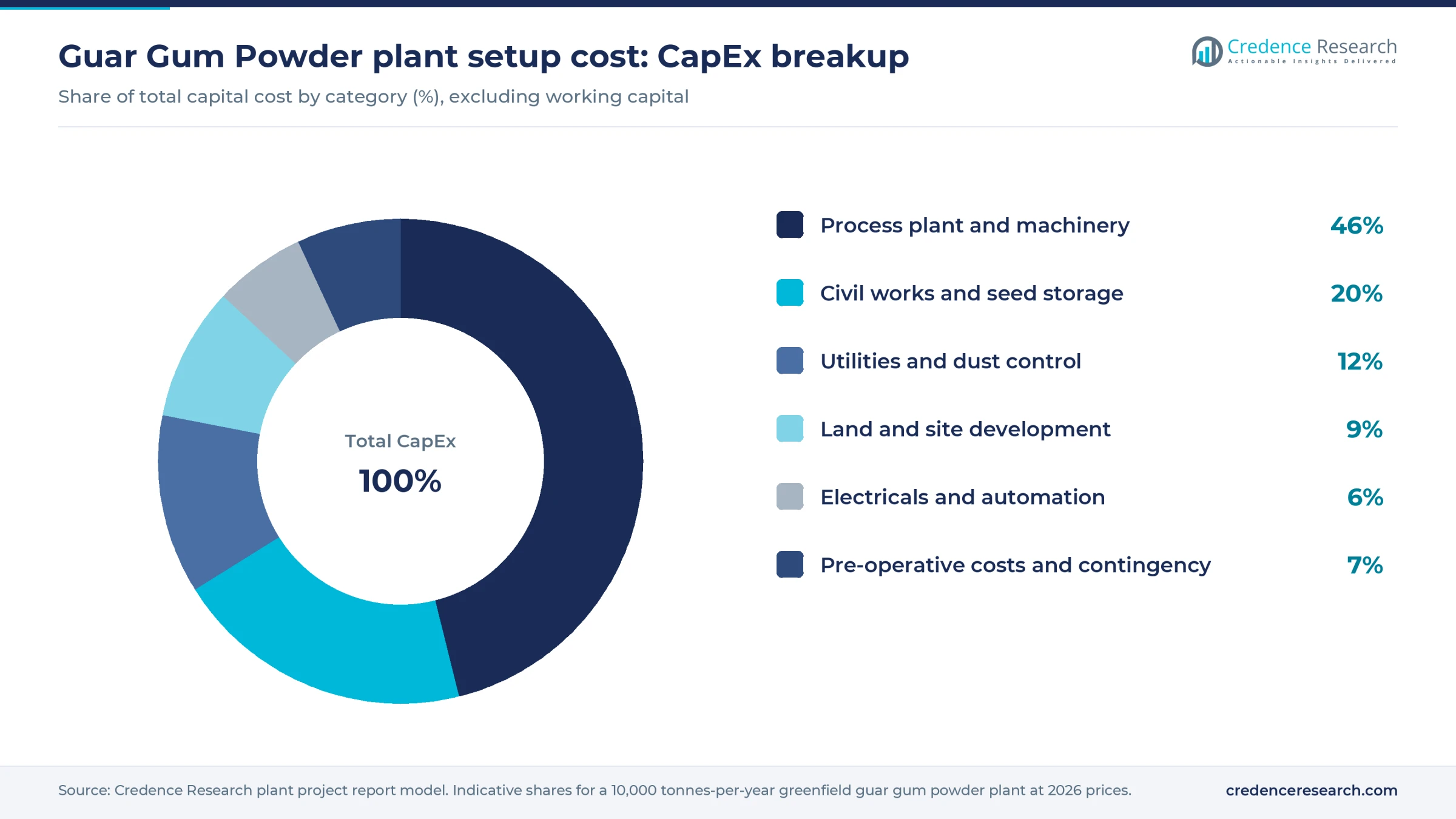
Worked example, land and site development. The plant needs an assumed 20,000–30,000 square meters, including seed storage. At an assumed USD 20–60 per square meter in an Asian industrial park, the plot costs about USD 0.4–1.8 million, and at an assumed USD 30–80 at a U.S. or EU site, about USD 0.6–2.4 million. Site works add an assumed USD 0.2–0.6 million, so this row usually runs 5–15% of CapEx.
Working capital is the surprise. Guar is harvested once a year, and 3–6 months of seed plus receivables could tie up an estimated USD 6–13 million, which can exceed the plant itself at the low end.
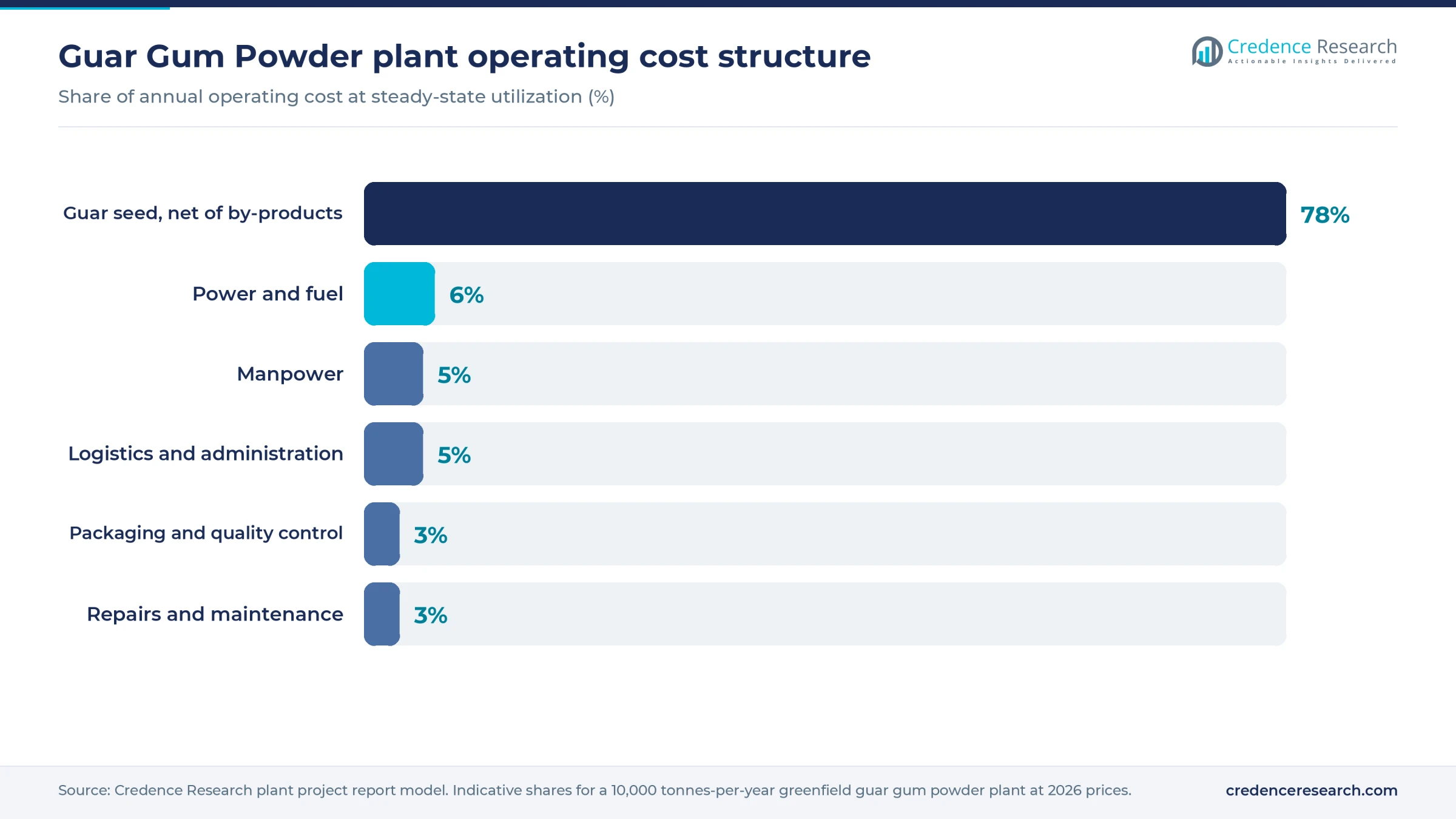
Net seed cost dwarfs every other operating line. Energy for drying and milling comes next, well behind seed.
Machinery and raw materials for a guar gum powder plant
The main machinery groups are listed below; capacities, specifications and quotations are available in the report.
- Seed handling: intake pits, silos or warehouses, cleaners, destoners, gravity separators
- Splitting: roasters, attrition mills, sifters, aspirators, polishers, by-product conveying
- Hydration and milling: hydrators, flakers, pulverizers or impact mills with hot air drying, cyclones and bag filters
- Finishing: sifters, blenders, metal detectors, bagging and bulk sack lines
- Quality: viscometers, moisture and protein testing, microbiology for food grades
- Utilities: hot air generator or boiler, compressed air, water treatment, explosion venting and dust control
Guar seed is the main input, with India dominant. Rajasthan leads, and Haryana and Gujarat follow, according to APEDA material. Pakistan's Punjab and Sindh provide the second origin, while the U.S. Southern Plains supply smaller contracted volumes. A plant outside these regions usually buys refined splits instead, which cuts by-product handling and machinery but gives up the milling margin and leaves supply exposed to Indian offers.
Seed is priced on viscosity potential, purity and moisture. Plants also buy packaging, process water, boiler fuel and, for fast-hydrating grades, small amounts of alkali. Competition for seed is seasonal, as millers and stockists bid at harvest in October and November. Water use is low compared with wet-process hydrocolloids, which is a real siting advantage in dry regions.
Guar gum powder business profit margin and ROI
For the modeled plant, gross margin after net seed and direct conversion costs is estimated at 8–18%, at an assumed blended price of USD 1.5–2.1 per kg. Payback runs 4–12 years after commissioning, with the shorter end needing a low-cost build and a strong grade mix. These estimates use seed at about USD 0.59–0.74 per kg, quoted from March to September 2026. At the October quotes of USD 0.78–0.87, seed and conversion costs could absorb most or all of the assumed price.
Revenue of about USD 13–18 million on 8,500 tonnes supports gross profit of about USD 1–3 million, before assumed overheads of USD 0.5–1 million. That thin base is why a USD 25 million food-grade build needs long customer contracts or specialty sales to clear in about 12 years. Plain commodity powder fails the test: at Jodhpur spot gum of about USD 1.1–1.5 per kg in 2026, seed and conversion costs can absorb the entire price.
Three factors drive results. Seed comes first: a USD 50 per tonne seed rise that cannot be passed through cuts gross margin by about 9 percentage points. Grade mix is next, since organic and food-grade products command premiums. Trade publication Commodity Board listed organic powder near EUR 4 per kg FOB India in October 2026. By-product value is third, and each USD 0.05 per kg change in korma and churi moves cost by about USD 0.11 per kg of powder. Oilfield buying is the main demand risk, because shale activity can drop quickly.
| Metric | Value |
|---|---|
| Project IRR (post-tax) | Available in report |
| NPV | Available in report |
| Return on investment | Available in report |
| DSCR | Available in report |
| Break-even utilization | Available in report |
How to start a guar gum powder business, licenses and approvals
A guar gum powder plant needs approvals in six areas wherever it is built. These are business and tax registration; land use, zoning and building permits; an environmental permit covering dust, boiler stacks and modest wastewater; occupational safety approvals, particularly for combustible dust; food additive and facility registration for food grades, plus feed registration for korma and churi; and customs registration for export. Oilfield grades are mainly governed by customer specifications, while chemically modified derivatives can trigger chemical inventory rules.
| Market | Food and feed | Environment and safety |
|---|---|---|
| United States | FDA food facility registration and 21 CFR 117; guar gum affirmed as generally recognized as safe under 21 CFR 184.1339; FDA feed facility rules for meal sold as animal feed | State air permit for dust and combustion; NPDES or local pretreatment permit; OSHA rules and combustible dust enforcement |
| European Union | Food business registration under Regulation (EC) No 852/2004; E 412 specifications in Regulation (EU) No 231/2012, as amended; feed registration under Regulation (EC) No 183/2005 | National environmental permit, with this plant's finished output below the Industrial Emissions Directive's 300-tonne daily threshold for vegetable raw materials; ATEX rules for explosive atmospheres |
| India | FSSAI license, central at this plant's turnover under thresholds revised in April 2026; APEDA registration and an importer-exporter code for export | State pollution control board consents to establish and operate; factory license and boiler registration |
Indian guar gum shipped to the EU also falls under Implementing Regulation (EU) 2019/1793, which repealed Regulation (EU) 2015/175. A 2024 amendment set checks for pentachlorophenol and dioxins at 30% of consignments, so exporters should confirm the current rate. Food customers commonly require FSSC 22000, kosher and halal certification.
Key guar gum powder manufacturers and recent developments
Indian processors anchor global supply, including Vikas WSP, Hindustan Gum & Chemicals, Lucid Colloids, Sunita Hydrocolloids, B.D. Guar and Agro Gums. Rantec and Guar Resources serve U.S. customers, and Syensqo and Ashland convert guar into specialty derivatives. Buyers often compare these suppliers with the wider hydrocolloids market.
- January 2026. The European Commission adopted Regulation (EU) 2026/196, applying from August 2026, which tightened E 412 specifications and withdrew authorization for guar gum in infant formula and special medical foods for infants.
- June 2026. Rantec reported that the current 10% U.S. Section 122 tariffs would expire on July 24, with proposed tariffs of 10–12.5% covering India and Pakistan.
- October 2026. Commodity Board estimated India's crop at 3.6–3.7 million bags, about half the prior 7–7.2 million bags. Seed rose to about USD 0.78–0.87 per kg in selected markets, from about USD 0.59 in Jodhpur in March. These are trade estimates, not official figures.
What's inside the Guar Gum Powder project report PDF
The report runs to 21 chapters. Open a chapter to see its sections.
1. Preface
2. Scope and Methodology
- 2.1 Objectives of the Study
- 2.2 Stakeholders
- 2.3 Research Methodology
- 2.4 Data Sources and Key Assumptions
3. Executive Summary
- 3.1 Market Snapshot
- 3.2 Project at a Glance (Capacity, CapEx, OpEx)
- 3.3 Key Financial Indicators (IRR, NPV, Payback, Break-even)
- 3.4 Feasibility Verdict
4. Product Overview
- 4.1 Guar Gum Powder Definition and Properties
- 4.2 Grades and Specifications (BIS / ISO / ASTM)
- 4.3 HS Code and Classification
- 4.4 Key Applications
- 4.5 Substitutes
5. Global Guar Gum Powder Market
- 5.1 Market Overview
- 5.2 Historical and Current Market Performance (Volume and Value)
- 5.3 Market Breakup by Grade / Type
- 5.4 Market Breakup by End-Use Industry
- 5.5 Market Breakup by Region
- 5.6 Market Drivers, Restraints and Trends
- 5.7 Value Chain Analysis
- 5.8 Market Forecast
6. Target Country Guar Gum Powder Market Analysis
- 6.1 Demand and Supply Analysis
- 6.2 Installed Capacity vs Demand Gap
- 6.3 Import Dependence
- 6.4 Demand Forecast by End-Use
7. Trade Analysis
- 7.1 Imports by Volume, Value and Country
- 7.2 Exports by Volume, Value and Country
- 7.3 Trade Balance and Opportunities
8. Price Analysis
- 8.1 Historical Guar Gum Powder Price Trends by Region
- 8.2 Raw Material / Feedstock Price Trends and Linkage
- 8.3 Price Forecast
- 8.4 Margins Across the Value Chain
9. Competitive Landscape
- 9.1 Market Structure
- 9.2 Key Players and Installed Capacities
- 9.3 Profiles of Key Players
- 9.4 Recent Developments (Expansions, M&A, New Plants)
10. Manufacturing Process and Technology
- 10.1 Comparison of Technology Routes
- 10.2 Selected Route and Process Flow Diagram
- 10.3 Unit Operations Involved
- 10.4 Chemical Reactions Involved
- 10.5 Mass Balance and Raw Material Requirements
- 10.6 Energy Balance
- 10.7 Quality Assurance Criteria and Technical Tests
- 10.8 By-products and Waste Handling
- 10.9 Technology Licensors / Providers
11. Project Details, Requirements and Costs
- 11.1 Land, Location and Site Development
- 11.1.1 Site Selection Criteria
- 11.1.2 Location Analysis
- 11.1.3 Land Requirement and Costs
- 11.1.4 Site Development Costs
- 11.2 Plant Layout
- 11.2.1 Layout Principles
- 11.2.2 Proposed Layout
- 11.2.3 Factors Influencing Layout
- 11.3 Civil Works and Buildings
- 11.4 Plant Machinery
- 11.4.1 Machinery Requirements and Specifications
- 11.4.2 Machinery Costs
- 11.4.3 Machinery Suppliers
- 11.5 Raw Materials
- 11.5.1 Requirements per Tonne of Output
- 11.5.2 Procurement and Sourcing
- 11.5.3 Costs
- 11.5.4 Suppliers
- 11.6 Packaging
- 11.6.1 Packaging Requirements
- 11.6.2 Packaging Costs
- 11.6.3 Packaging Suppliers
- 11.7 Storage and Material Handling
- 11.8 Transportation Requirements and Costs
- 11.9 Utilities
- 11.9.1 Power Requirements and Costs
- 11.9.2 Water Requirements and Costs
- 11.9.3 Steam, Fuel and Other Utilities
- 11.10 Manpower Requirements and Wages
12. Environment, Health, Safety and Sustainability
- 12.1 Effluent and Emissions Management
- 12.2 Hazard Classification and Safety Measures
- 12.3 Carbon Footprint
- 12.4 Green / Low-Carbon Process Options
13. Regulatory Procedures, Approvals and Certifications
- 13.1 Licences and Registrations
- 13.2 Environmental Clearances
- 13.3 Product Certifications (BIS, REACH, etc.)
- 13.4 Approval Timeline
14. Project Implementation Schedule
15. Project Economics
- 15.1 Capital Cost of the Project
- 15.2 Techno-Economic Parameters
- 15.3 Capacity Utilization and Ramp-up
- 15.4 Product Pricing and Margins
- 15.5 Income Projections
- 15.6 Expenditure Projections
- 15.7 Working Capital Requirement
- 15.8 Taxation
- 15.9 Depreciation
16. Financial Analysis
- 16.1 Projected Profit and Loss Account
- 16.2 Projected Cash Flow Statement
- 16.3 Projected Balance Sheet
- 16.4 Liquidity Analysis
- 16.5 Profitability Analysis (Payback, NPV, IRR, ROI)
- 16.6 Break-even Analysis
- 16.7 Debt Service Coverage Ratio (DSCR)
- 16.8 Sensitivity Analysis
- 16.9 Scenario and Uncertainty Analysis
17. Funding and Incentives
- 17.1 Means of Finance and Debt-Equity Structure
- 17.2 Loans and Financial Assistance
- 17.3 Government Schemes and Subsidies (PLI, State Policies)
18. Risk Assessment
- 18.1 Key Success Factors
- 18.2 Key Risk Factors
- 18.3 Risk Mitigation
19. Strategic Recommendations
20. Case Study of a Successful Venture
21. Appendix
- 21.1 Detailed Assumptions
- 21.2 Abbreviations
- 21.3 List of Tables and Figures
- 21.4 Sources
This page vs. the full report
| Data point | On this page (free) | In the full report |
|---|---|---|
| Total CapEx | One rounded range at one capacity | Exact figure at three capacities with a line-item breakup |
| CapEx breakup | Category shares (%) only | Cost, quantity and supplier for every machine |
| Operating cost | Share of raw materials, utilities and labor | Per-unit cost sheet with each input price and consumption |
| Profitability | Gross margin range and payback band | Exact IRR, NPV, ROI, break-even and DSCR |
| Financial statements | List of what is included | 10-year P&L, cash flow, balance sheet and Excel model |
| Sensitivity | One directional line | Full sensitivity and scenario tables |
| Process | Simplified flow diagram | Detailed process flow, mass and energy balance, operating conditions |
| Machinery | Names of the main machines | Specifications, capacity, cost and supplier list |
| Market | Headline size, growth and India demand trend | Segment, region, trade and price forecast tables |
| Suppliers and buyers | Supplier types and sourcing hubs | Named suppliers and buyers |
Guar Gum Powder project report: FAQs
How much does it cost to set up a guar gum powder plant?
How much guar seed is needed to make guar gum powder?
What profit margin can a guar gum powder plant earn?
Why do guar gum prices swing so sharply?
Which licenses does a guar gum powder plant need?
Should a new plant start from seed or refined splits?
Who buys guar gum powder?

About the analyst
Priyanka Mor, Senior Consultant
Senior Consultant at Credence Research Inc directing strategic market advisory, cross-border commercial due diligence and enterprise intelligence frameworks for global B2B clients. Combines quantitative modeling with executive advisory, translating macroeconomic variables and supply chain data into go-to-market blueprints, M&A screenings and competitive war-gaming strategies.
Related market research
- Guar Gum Powder Market Size, Share, Growth and Forecast 2030
- Food Thickeners Market Size, Share, Growth and Forecast 2032
- Hydrocolloids Market Size, Share, Growth and Forecast 2032
- Food Hydrocolloids Market Size, Trends, Share and Forecast 2032
- Hydraulic Fracturing Market Size, Growth & Forecast 2032
- Natural Gum Market Size, Trends, Share, Growth & Forecast 2032
More plant project reports
- Fruit Juice Processing Plant Project Report (DPR) 2026
- Shrimp Processing Plant Project Report (DPR) 2026
- Instant Coffee Manufacturing Plant Project Report (DPR) 2026
- Pectin Manufacturing Plant Project Report (DPR) 2026
- Parboiled White Rice Processing Plant Project Report (DPR) 2026
- Potato Processing Plant Prefeasibility Report 2026