
Quick answer
A hummus plant cooks chickpeas, grinds them with tahini, lemon and garlic, then fills chilled tubs that are usually high-pressure processed. This overview models a greenfield plant making 5,000 tonnes a year, with estimated CapEx of USD 10–25 million depending on cost region and automation. Gross margin is estimated at 22–38%, with payback at 3–10 years, because labor, tahini and retailer pricing set most of the economics.
Viable for a plant with a named retail or foodservice contract within chilled delivery range, but risky as a speculative branded launch against entrenched leaders and own-label specialists.
Hummus plant: key highlights
| Parameter | Indicative value | Note |
|---|---|---|
| Plant capacity | 5,000 tonnes a year | About 3,750 tonnes sold at 75% utilization, two 500 kg/h lines |
| Total CapEx | USD 10–25 million | Greenfield chilled plant with HPP, excludes USD 1.5–2.5 million working capital |
| Raw material share of operating cost | 22–30% | Chickpeas, tahini, oil and seasonings; packaging adds about 13% |
| Gross margin | 22–38% | After ingredients, packaging and direct conversion |
| Payback period | 3–10 years | Includes about one year of ramp-up; depends on site cost and label mix |
| IRR | Available in report | Post-tax, 10-year model |
| Break-even | Available in report | Capacity utilization basis |
Ranges assume a 5,000-tonne-a-year greenfield chilled hummus plant with its own HPP vessel, two shifts on 300 days, 75% utilization and 2026 prices, in an Asian or Middle Eastern industrial park at the low end and a U.S. or EU site at the high end. The net selling price of USD 4.00–5.00 per kg and all ingredient, packaging, wage and land rates are assumed. The full report can be customized to any country or region.
What is hummus?
Hummus is a cold, spreadable dip made by cooking chickpeas until soft and grinding them with tahini, which is sesame seed paste, plus lemon juice or citric acid, garlic, salt and often oil. Industrial plants mostly sell it chilled in sealed tubs with a shelf life of several weeks, and some also make shelf-stable canned or pouched versions and frozen bulk packs for foodservice.
Product lines range from classic and extra-tahini recipes to roasted red pepper, garlic, pine nut and dessert flavors, plus single-serve snack cups. Most chilled hummus sold in North America and Europe is high-pressure processed or made with preservatives and kept below 5°C, because the paste is only mildly acidic and moist enough to support Listeria if hygiene slips.
For customs, hummus falls under Harmonized System subheading 2005.99, other vegetables prepared or preserved otherwise than by vinegar or acetic acid, not frozen. A UK advance tariff ruling valid from July 2026 places a chickpea and sesame paste dip in 500 g pots under that subheading, while frozen product usually moves to 2004.90. Buyers are supermarket chains, many of them buying own-label, along with deli counters, airlines, meal-kit firms and restaurant groups.
Hummus market overview and global demand
Credence Research values the global hummus market at USD 4.29 billion in 2023 and projects USD 10.13 billion by 2032, an 11.35% CAGR from 2024. Carried forward at that rate, the market would be about USD 5.3 billion in 2025, a figure derived from the 2023 base rather than separately reported. North America and Europe hold most of the value. Credence Research puts the U.S. hummus market at USD 1.15 billion and the Europe hummus market at USD 1.22 billion in 2023, so the two regions held about 55% of the global total.
Growth has not been even across brands. Israeli business press reported in September 2024 that Sabra, the U.S. category leader, had seen its share fall from about 60% to 36.6%, with second-quarter sales down 5.5%. Smaller brands with fresher recipes and supermarket own-label lines took much of that shelf space. In the UK, one of Europe's largest markets, most supermarket hummus is own-label and made by chilled food specialists. Demand in the Middle East is large but served mainly by restaurants and fresh local makers, and packaged hummus remains a niche import category in most of Asia.
Ingredient trade shows where supply comes from. USDA Foreign Agricultural Service data show Australia as the largest chickpea exporter in 2022 at USD 338 million, followed by India at USD 226 million, Canada at USD 203 million and Turkey at USD 187 million. India is by far the largest grower, at 11.9 million tons in 2021, but consumes nearly all of its crop. Pakistan and the European Union were the largest importers in 2022, with 22% and 11% of world import value.
For a new plant, the practical point is that hummus is a regional, chilled business. Short shelf life and refrigerated freight keep most product within about a day's drive of the factory, so a nearby retail or foodservice contract matters more than the global growth rate.
Hummus manufacturing process
The modeled plant runs two cooked-chickpea lines of about 500 kg an hour each, with high-pressure processing after packing. Plants can start from dried chickpeas or from frozen or canned cooked chickpeas. Dried beans cost less but add soaking tanks, cookers and a day of lead time, while bought-in cooked chickpeas suit smaller plants.
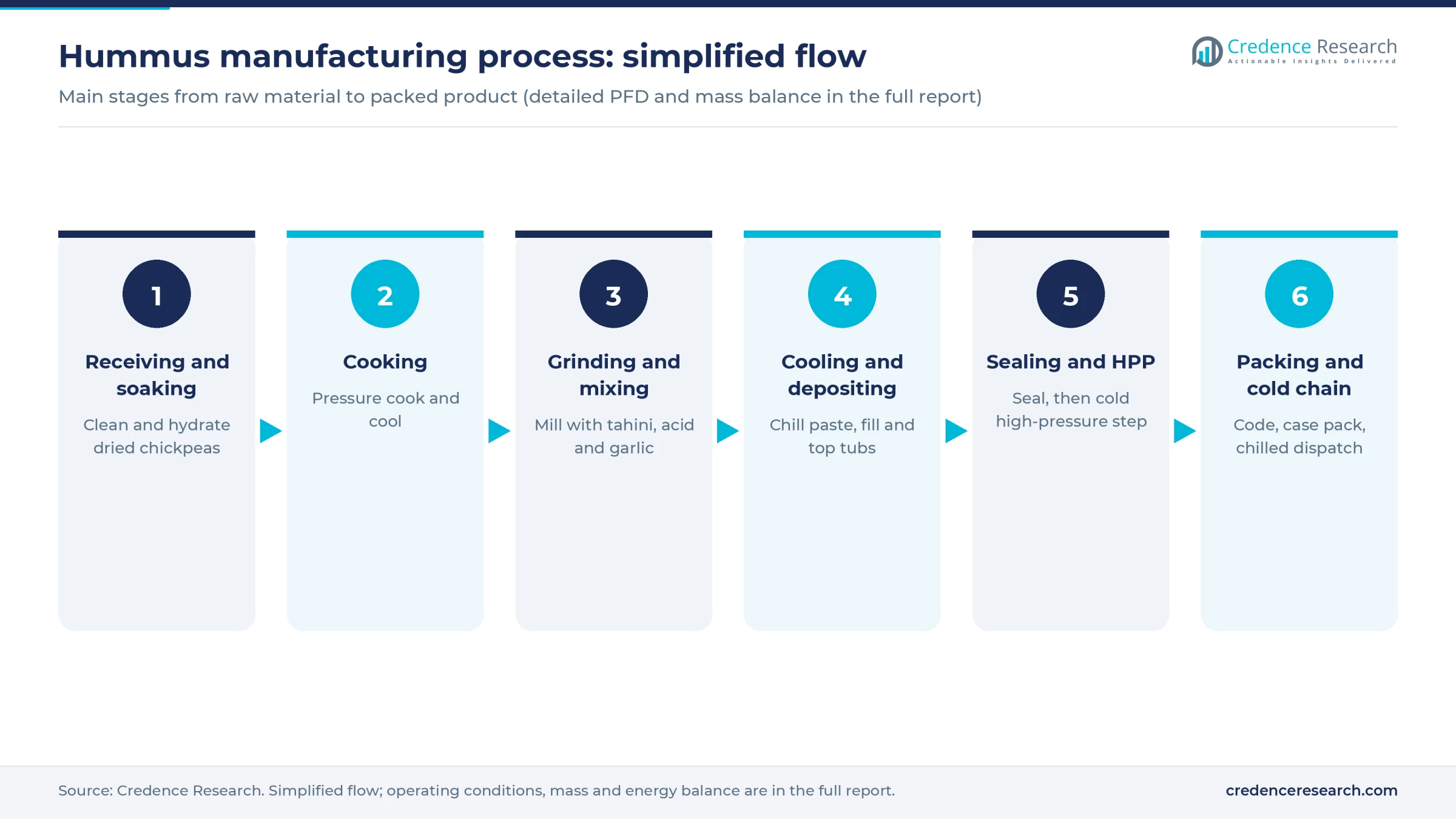
- Receiving and soaking. Dried kabuli chickpeas are cleaned of stones and split seeds, then soaked for 8–16 hours, roughly doubling in weight. Tahini, oil, lemon juice concentrate and spices are stored with allergen segregation, since sesame is a declared allergen in the U.S. and EU.
- Cooking. Soaked chickpeas are pressure cooked or blanched until soft, then cooled quickly. Cook time controls texture and yield, and overcooking gives a gluey paste.
- Grinding and mixing. Cooked chickpeas go to a colloid mill or high-shear vacuum mixer with tahini, acid, salt and garlic. Vacuum mixing limits air and oxidation, and the acid lowers pH to slow spoilage.
- Cooling and depositing. The paste is chilled below 5°C in a scraped-surface or continuous cooler, then dosed into tubs and topped with oil, pine nuts or peppers.
- Sealing and high-pressure processing. Tubs are film-sealed and lidded, then held at about 6,000 bar for a few minutes. This cold pressure step inactivates Listeria and spoilage organisms without heat, extending chilled shelf life without preservatives.
- Coding, packing and cold chain. Packs are coded, metal-detected, case packed and shipped in refrigerated trucks.
Hygiene drives the layout of a hummus plant. Raw and cooked zones are separated, the high-care area after cooking runs under positive air pressure, and environmental swabbing for Listeria is routine, because chilled dip recalls in the U.S. have involved the bacterium found in plant environments. Plants without HPP rely on preservatives such as potassium sorbate, or on hot filling, and accept a shorter shelf life. Recipes, yields and cook parameters are in the full report.
Hummus plant setup cost
This overview models a greenfield plant rated at 5,000 tonnes a year, roughly 11 million pounds, running two shifts on 300 days and selling about 3,750 tonnes at 75% utilization. Estimated CapEx is USD 10–25 million before about USD 1.5–2.5 million of working capital. The low end reflects an Asian or Middle Eastern industrial park and the high end a U.S. or EU site with full automation.
The range is checked against disclosed U.S. plants. Cedar's Foods reportedly spent USD 100 million in 2019 on a 125,000-square-foot facility that lifted annual output from 104 million to 208 million pounds, about USD 2,100 per added tonne of yearly capacity. Scaled down to 5,000 tonnes by the six-tenths rule, that implies about USD 26 million at 2019 prices, a ceiling because the plant is heavily automated and far larger. Virginia's investment agency puts Sabra's spending on its Chesterfield County plant at USD 250 million from 2010 to 2018, for a design capacity of 10,000 tons a month, which scales to a higher ceiling of about USD 39 million. From below, a custom U.S. line that hydrates, cooks, mashes, mixes and packs was reported at USD 1.6 million in 2022. The model assumes USD 4–10 million for process, HPP and packing equipment, a judgment rather than a disclosed figure.
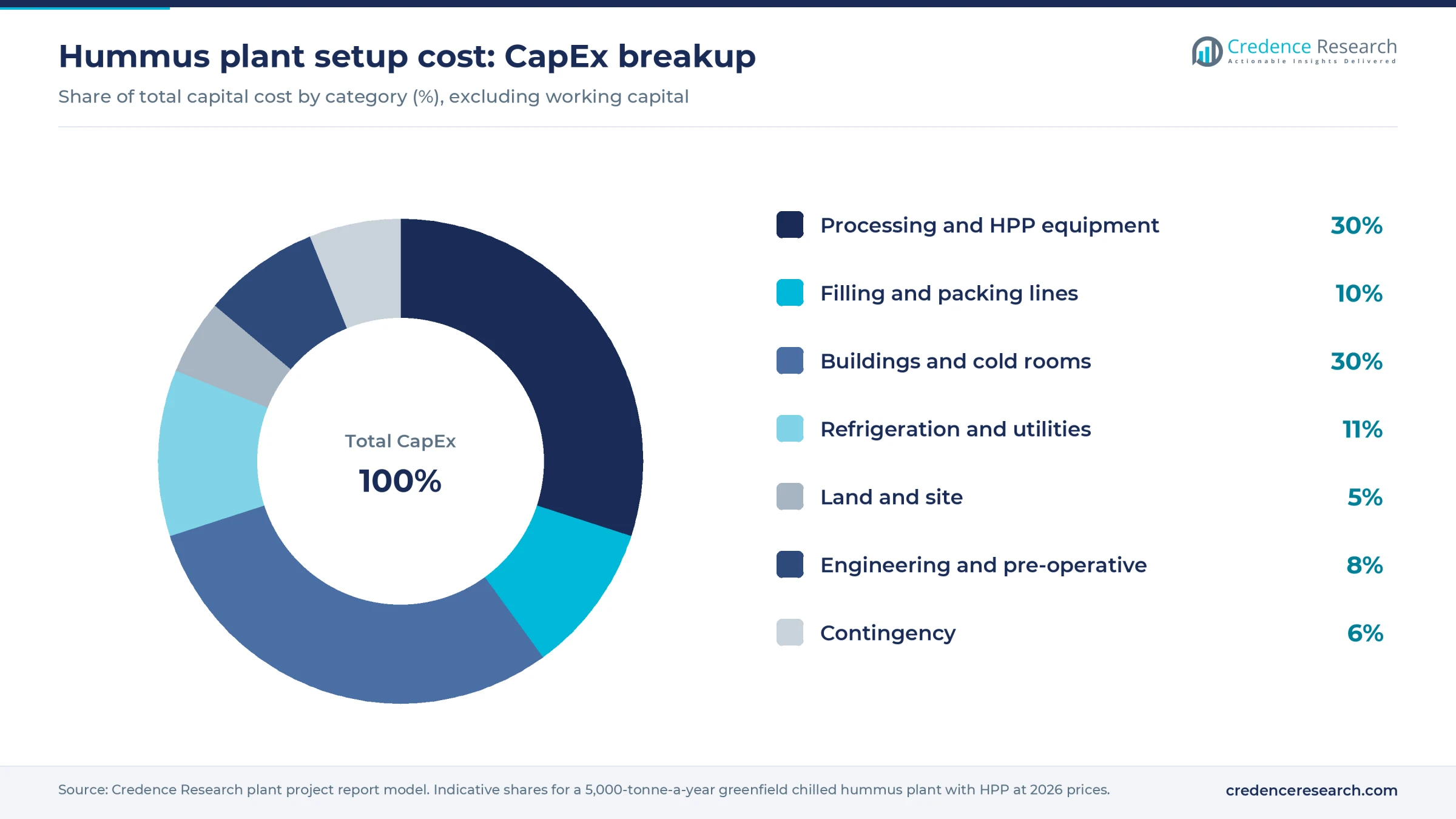
Equipment takes 40% of CapEx, followed closely by hygienic buildings and cold rooms. Land shows how location moves the total. At an assumed 12,000 square meters, a plot costs about USD 360,000–720,000 at an assumed USD 30–60 per square meter in an Asian industrial park, and USD 720,000–1.4 million at an assumed USD 60–120 on a U.S. or EU site.
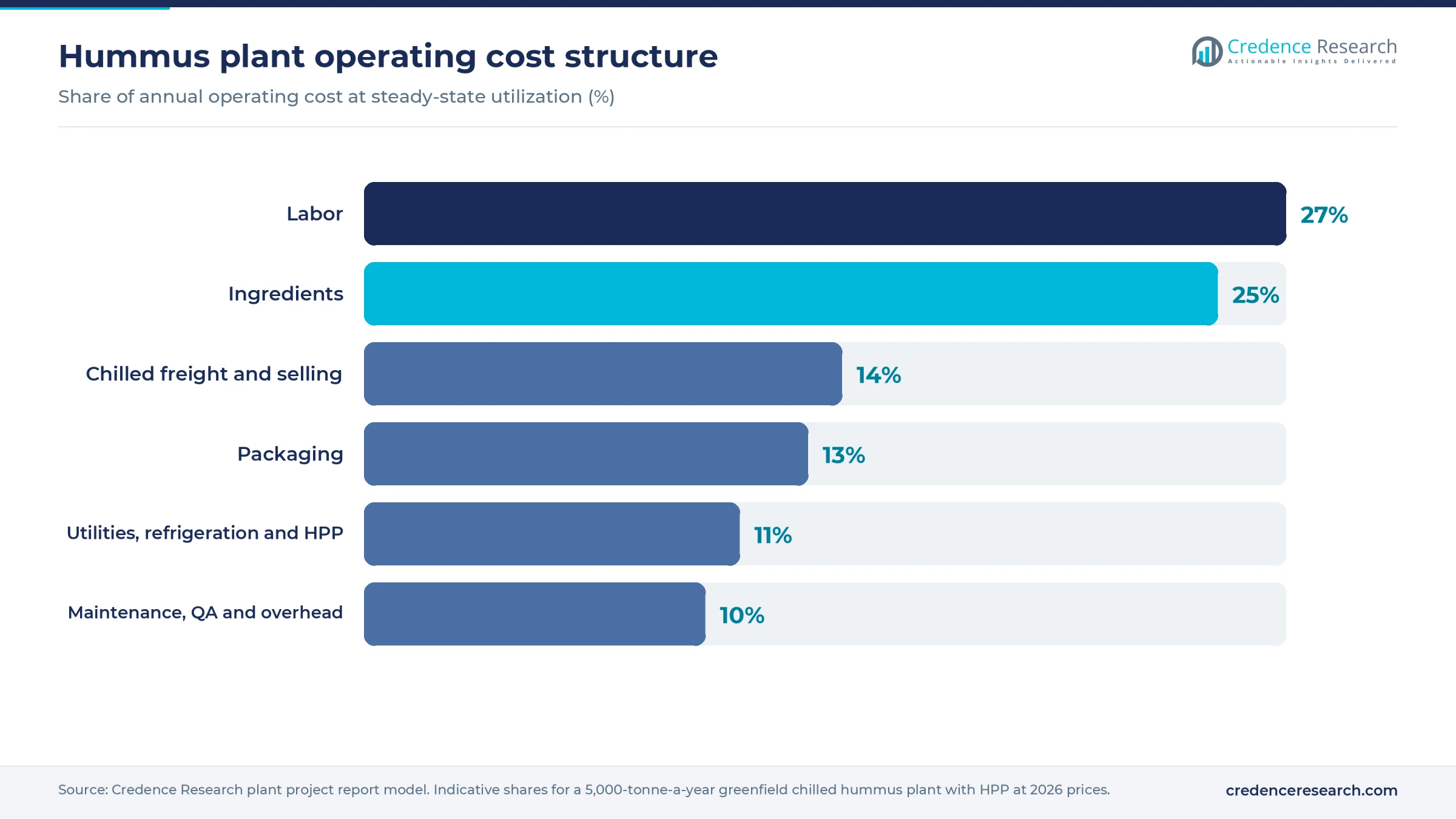
Labor is the largest operating cost at this size, because topping, packing and nightly sanitation stay labor intensive. Ingredients come next, with tahini costing more per tub than the chickpeas themselves. The full report can be customized to any country or region.
Machinery and raw materials for a hummus plant
The core machinery for a cooked-chickpea line is mostly hygienic stainless steel:
- Bean cleaner, destoner and soaking tanks
- Batch pressure cookers or a continuous blancher, with a cooling conveyor
- Colloid mill or high-shear vacuum mixer, with tahini and oil dosing
- Paste cooler, buffer tanks and positive displacement pumps
- Rotary or inline cup fillers, topping depositors, film sealers and lidders
- High-pressure processing vessel, metal detector, checkweigher, case packer and palletizer
- Clean-in-place skid, ammonia or glycol refrigeration, cold rooms, boiler and effluent treatment
Machine costs and specifications are in the full report. HPP is the swing decision in the machinery budget. Owning a vessel costs millions but frees the plant from toll processors and preservatives, while smaller makers often truck product to a shared HPP center.
Raw material sourcing for hummus is global. Kabuli chickpeas, the large cream-colored type preferred for hummus, come mainly from the United States, Canada, Mexico, Turkey, Russia and Argentina, while Australia ships mostly smaller desi types to South Asia. Sesame seed is grown mainly in Sudan, India, Myanmar, Tanzania, Nigeria and Ethiopia, and much of it is milled into tahini in Israel, Turkey and Lebanon, a supply chain covered in the Middle East and Africa tahini market report. Olive and canola oil, citric acid and garlic are widely traded, while tubs, film and cartons are usually bought locally to save freight.
Hummus business profit margin and ROI
Margin in hummus depends on who owns the label. Branded makers earn more per tub but spend heavily on trade promotion, while own-label suppliers win volume at prices supermarkets set. The model assumes a blended net ex-factory price of USD 4.00–5.00 per kg for private-label and foodservice packs, which yields about USD 15–19 million of annual sales on 3,750 tonnes.
Assumed direct cost is about USD 3.10 per kg, covering ingredients near USD 0.90, packaging near USD 0.50, and labor, energy, HPP and quality control near USD 1.70. That gives an estimated gross margin of 22–38%. After overheads, selling cost and chilled freight at about 14% of sales, cash profit is an estimated USD 1.3–4.5 million a year.
Payback is estimated at 3–10 years including about a year of ramp-up. A high-cost site that only earns the low-end margin falls outside that band and would be hard to finance, which is one reason many new brands start in leased space or with co-packers.
Selling price is the sensitive variable. A 10% price cut takes about 7–9 percentage points from gross margin, while a 20% rise in tahini cost takes about 2 points.
| Metric | Value |
|---|---|
| IRR | Available in report |
| NPV | Available in report |
| ROI | Available in report |
| DSCR | Available in report |
How to start a hummus business, licenses and approvals
Starting a hummus plant follows a common sequence in most countries: register the business and tax accounts, confirm zoning and building permits, and obtain an environmental permit or discharge consent for wash water high in starch and protein. Next come occupational safety and pressure vessel approvals for the boiler, cookers and HPP unit, food facility registration or licensing, a hazard-based food safety plan with Listeria environmental monitoring, sesame allergen labeling, and import-export registration if the plant ships abroad.
| Market | Food and product rules | Site and other permits |
|---|---|---|
| United States | FDA food facility registration; good manufacturing practice and preventive controls under 21 CFR Part 117; sesame a major allergen since January 2023 under the FASTER Act | Local zoning and building permits; wastewater pretreatment permit from the local utility; OSHA rules; shelf-stable canned hummus also needs FDA process filing under 21 CFR Part 108 |
| European Union | Food business registration or approval under Regulation (EC) No 852/2004; Listeria criteria for ready-to-eat foods under Regulation (EC) No 2073/2005; sesame listed as an allergen under Regulation (EU) No 1169/2011 | National environmental and building permits; national worker safety and pressure equipment rules |
| India | FSSAI license, under the proprietary food category since no specific hummus standard exists; Legal Metrology packer registration | State pollution control board consents to establish and operate; factory license and boiler registration; Import Export Code for exports |
Retail buyers usually also require GFSI-benchmarked certification such as BRCGS or SQF, plus kosher or halal where relevant. Requirements vary locally, and the full report lists the steps for a chosen country.
Key hummus manufacturers and recent developments
Supply is concentrated among a few chilled food specialists. Sabra Dipping Company, wholly owned by PepsiCo after a buyout of Strauss Group's half announced in November 2024, runs a large plant in Chesterfield County, Virginia. Cedar's Foods in Massachusetts makes branded, private-label and co-manufactured hummus. Lakeview Farms owns the Tribe brand, and Ithaca hummus has its products made by co-packer LiDestri Foods. In the UK, Bakkavor makes own-label dips for supermarkets and bought the Moorish houmous brand in 2024, while Strauss still makes hummus in Israel under its Achla brand.
Two developments from 2026 show where the industry is moving:
- January 2026. Greencore completed its GBP 1.2 billion takeover of Bakkavor, putting one of the UK's biggest own-label dip makers inside a convenience food group with 36 manufacturing sites.
- January 2026. Little Sesame opened a 23,600-square-foot factory in Capitol Heights, Maryland, able to run four lines and projected to lift output from 4 million to 20 million pounds a year at full capacity.
What's inside the Hummus project report PDF
The report runs to 21 chapters. Open a chapter to see its sections.
1. Preface
2. Scope and Methodology
- 2.1 Objectives of the Study
- 2.2 Stakeholders
- 2.3 Research Methodology
- 2.4 Data Sources and Key Assumptions
3. Executive Summary
- 3.1 Market Snapshot
- 3.2 Project at a Glance (Capacity, CapEx, OpEx)
- 3.3 Key Financial Indicators (IRR, NPV, Payback, Break-even)
- 3.4 Feasibility Verdict
4. Product Overview
- 4.1 Hummus Definition and Properties
- 4.2 Grades and Specifications (BIS / ISO / ASTM)
- 4.3 HS Code and Classification
- 4.4 Key Applications
- 4.5 Substitutes
5. Global Hummus Market
- 5.1 Market Overview
- 5.2 Historical and Current Market Performance (Volume and Value)
- 5.3 Market Breakup by Grade / Type
- 5.4 Market Breakup by End-Use Industry
- 5.5 Market Breakup by Region
- 5.6 Market Drivers, Restraints and Trends
- 5.7 Value Chain Analysis
- 5.8 Market Forecast
6. Target Country Hummus Market Analysis
- 6.1 Demand and Supply Analysis
- 6.2 Installed Capacity vs Demand Gap
- 6.3 Import Dependence
- 6.4 Demand Forecast by End-Use
7. Trade Analysis
- 7.1 Imports by Volume, Value and Country
- 7.2 Exports by Volume, Value and Country
- 7.3 Trade Balance and Opportunities
8. Price Analysis
- 8.1 Historical Hummus Price Trends by Region
- 8.2 Raw Material / Feedstock Price Trends and Linkage
- 8.3 Price Forecast
- 8.4 Margins Across the Value Chain
9. Competitive Landscape
- 9.1 Market Structure
- 9.2 Key Players and Installed Capacities
- 9.3 Profiles of Key Players
- 9.4 Recent Developments (Expansions, M&A, New Plants)
10. Manufacturing Process and Technology
- 10.1 Comparison of Technology Routes
- 10.2 Selected Route and Process Flow Diagram
- 10.3 Unit Operations Involved
- 10.4 Chemical Reactions Involved
- 10.5 Mass Balance and Raw Material Requirements
- 10.6 Energy Balance
- 10.7 Quality Assurance Criteria and Technical Tests
- 10.8 By-products and Waste Handling
- 10.9 Technology Licensors / Providers
11. Project Details, Requirements and Costs
- 11.1 Land, Location and Site Development
- 11.1.1 Site Selection Criteria
- 11.1.2 Location Analysis
- 11.1.3 Land Requirement and Costs
- 11.1.4 Site Development Costs
- 11.2 Plant Layout
- 11.2.1 Layout Principles
- 11.2.2 Proposed Layout
- 11.2.3 Factors Influencing Layout
- 11.3 Civil Works and Buildings
- 11.4 Plant Machinery
- 11.4.1 Machinery Requirements and Specifications
- 11.4.2 Machinery Costs
- 11.4.3 Machinery Suppliers
- 11.5 Raw Materials
- 11.5.1 Requirements per Tonne of Output
- 11.5.2 Procurement and Sourcing
- 11.5.3 Costs
- 11.5.4 Suppliers
- 11.6 Packaging
- 11.6.1 Packaging Requirements
- 11.6.2 Packaging Costs
- 11.6.3 Packaging Suppliers
- 11.7 Storage and Material Handling
- 11.8 Transportation Requirements and Costs
- 11.9 Utilities
- 11.9.1 Power Requirements and Costs
- 11.9.2 Water Requirements and Costs
- 11.9.3 Steam, Fuel and Other Utilities
- 11.10 Manpower Requirements and Wages
12. Environment, Health, Safety and Sustainability
- 12.1 Effluent and Emissions Management
- 12.2 Hazard Classification and Safety Measures
- 12.3 Carbon Footprint
- 12.4 Green / Low-Carbon Process Options
13. Regulatory Procedures, Approvals and Certifications
- 13.1 Licences and Registrations
- 13.2 Environmental Clearances
- 13.3 Product Certifications (BIS, REACH, etc.)
- 13.4 Approval Timeline
14. Project Implementation Schedule
15. Project Economics
- 15.1 Capital Cost of the Project
- 15.2 Techno-Economic Parameters
- 15.3 Capacity Utilization and Ramp-up
- 15.4 Product Pricing and Margins
- 15.5 Income Projections
- 15.6 Expenditure Projections
- 15.7 Working Capital Requirement
- 15.8 Taxation
- 15.9 Depreciation
16. Financial Analysis
- 16.1 Projected Profit and Loss Account
- 16.2 Projected Cash Flow Statement
- 16.3 Projected Balance Sheet
- 16.4 Liquidity Analysis
- 16.5 Profitability Analysis (Payback, NPV, IRR, ROI)
- 16.6 Break-even Analysis
- 16.7 Debt Service Coverage Ratio (DSCR)
- 16.8 Sensitivity Analysis
- 16.9 Scenario and Uncertainty Analysis
17. Funding and Incentives
- 17.1 Means of Finance and Debt-Equity Structure
- 17.2 Loans and Financial Assistance
- 17.3 Government Schemes and Subsidies (PLI, State Policies)
18. Risk Assessment
- 18.1 Key Success Factors
- 18.2 Key Risk Factors
- 18.3 Risk Mitigation
19. Strategic Recommendations
20. Case Study of a Successful Venture
21. Appendix
- 21.1 Detailed Assumptions
- 21.2 Abbreviations
- 21.3 List of Tables and Figures
- 21.4 Sources
This page vs. the full report
| Data point | On this page (free) | In the full report |
|---|---|---|
| Total CapEx | One rounded range at one capacity | Exact figure at three capacities with a line-item breakup |
| CapEx breakup | Category shares (%) only | Cost, quantity and supplier for every machine |
| Operating cost | Share of raw materials, utilities and labor | Per-unit cost sheet with each input price and consumption |
| Profitability | Gross margin range and payback band | Exact IRR, NPV, ROI, break-even and DSCR |
| Financial statements | List of what is included | 10-year P&L, cash flow, balance sheet and Excel model |
| Sensitivity | One directional line | Full sensitivity and scenario tables |
| Process | Simplified flow diagram | Detailed process flow, mass and energy balance, operating conditions |
| Machinery | Names of the main machines | Specifications, capacity, cost and supplier list |
| Market | Headline size, growth and global demand | Segment, region, trade and price forecast tables |
| Suppliers and buyers | Supplier types and sourcing hubs | Named suppliers and buyers |
Hummus project report: FAQs
How much does a hummus manufacturing plant cost?
What is the profit margin in hummus manufacturing?
How long is the payback for a hummus plant?
Which raw materials does a hummus plant need?
Is high-pressure processing necessary for hummus?
What licenses does a hummus plant need?

About the analyst
Priyanka Mor, Senior Consultant
Senior Consultant at Credence Research Inc directing strategic market advisory, cross-border commercial due diligence and enterprise intelligence frameworks for global B2B clients. Combines quantitative modeling with executive advisory, translating macroeconomic variables and supply chain data into go-to-market blueprints, M&A screenings and competitive war-gaming strategies.
Related market research
- Hummus Market Size, Growth, Share and Forecast 2032
- U.S. Hummus Market Size, Growth, Share and Forecast 2032
- Europe Hummus Market Size, Growth, Share and Forecast 2032
- United Kingdom Hummus Market Size, Growth and Forecast 2032
- Middle East & Africa Tahini Market Size, Growth and Forecast 2032
- Chickpea Protein Market Size, Growth, Share and Forecast 2032
More plant project reports
- Nachos Manufacturing Plant Project Report (DPR) 2026
- Whey Protein Manufacturing Plant Project Report (DPR) 2026
- Ice Cream Cone Manufacturing Plant Project Report (DPR) 2026
- Soda Water Manufacturing Plant Project Report (DPR) 2026
- Garlic Powder Manufacturing Plant Project Report (DPR) 2026
- Extruded Snacks Manufacturing Plant Project Report (DPR) 2026