| REPORT ATTRIBUTE | DETAILS |
|---|---|
| Historical Period | 2019-2022 |
| Base Year | 2023 |
| Forecast Period | 2024-2032 |
| Europe Hummus Market Size 2023 | USD 1,220.07 million |
| Europe Hummus Market, CAGR | 10.63% |
| Europe Hummus Market Size 2032 | USD 2,737.52 million |
Market Overview
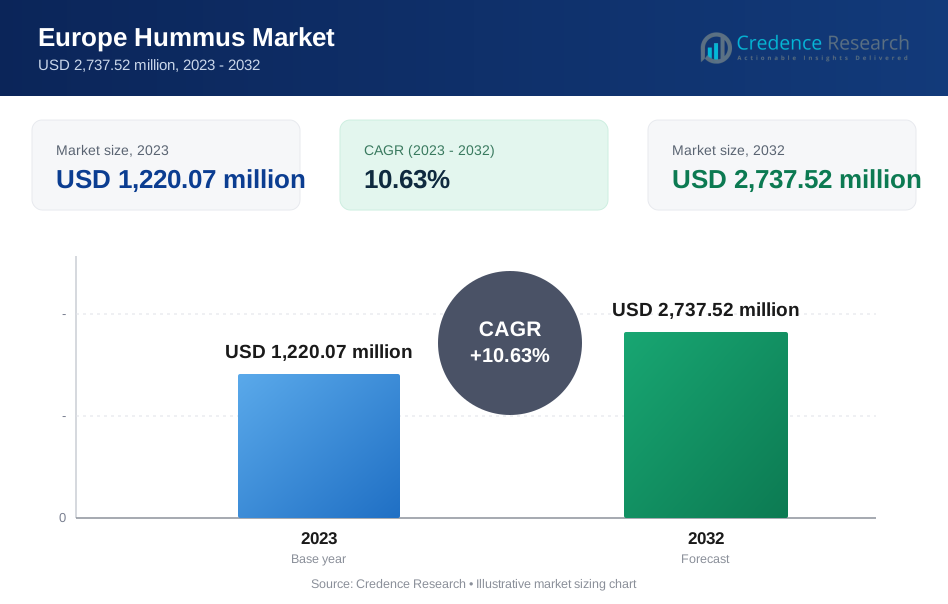
The Europe Hummus Market is projected to grow from USD 1,220.07 million in 2023 to an estimated USD 2,737.52 million by 2032, reflecting a compound annual growth rate (CAGR) of 10.63% from 2024 to 2032. This significant expansion highlights the growing consumer preference for plant-based, healthy, and convenient food options across the region.
Key drivers of this growth include a shift in consumer preferences toward natural and organic products and the increasing awareness of the health benefits of hummus, such as being rich in protein, fiber, and essential nutrients. Emerging trends such as flavor innovations, clean-label product offerings, and the rise of veganism further contribute to the growing adoption of hummus. Additionally, the expansion of distribution channels, including online platforms and supermarkets, has enhanced accessibility for a broader customer base.
Geographically, Western Europe, including countries like the United Kingdom, Germany, and France, dominates the market due to high awareness of plant-based diets and established retail infrastructure. Eastern Europe also shows significant potential, driven by increasing urbanization and disposable incomes. Prominent players in the Europe hummus market include Sabra Dipping Co., Obela, Bakkavor Group, and Nestlé, among others, who focus on product innovation and strategic collaborations to maintain a competitive edge in the dynamic marketplace.
Market Insights
- The Europe Hummus Market is expected to grow from USD 1,220.07 million in 2023 to USD 2,737.52 million by 2032, with a CAGR of 10.63%.
- The increasing consumer shift towards plant-based, protein-rich, and healthy snack options is a major driver of market growth.
- Rising popularity of flavor variations and clean-label, organic products are driving product diversification and consumer interest.
- Western Europe, particularly the UK, Germany, and France, leads the market, with growing adoption in Eastern Europe due to urbanization and rising incomes.
- Increased competition from both large multinational players and smaller niche brands focusing on specialty products is intensifying market dynamics.
- Volatility in raw material prices and ingredient shortages, such as chickpeas and tahini, pose significant challenges for manufacturers.
- The growing popularity of online retail channels enhances hummus accessibility, helping brands reach a broader and more diverse customer base.
Market Drivers
Growing Consumer Preference for Health-Conscious and Plant-Based Foods
The increasing focus on health and wellness among European consumers is a primary driver of the hummus market's growth. Hummus, a nutrient-rich dip made from chickpeas, tahini, olive oil, and other wholesome ingredients, is recognized for its high protein, fiber, and healthy fat content. This aligns with the growing demand for functional foods that offer nutritional benefits. For instance, approximately 38% of European consumers identify as flexitarians, vegetarians, or vegans, reflecting a significant shift towards plant-based diets. This transition is largely driven by a desire for healthier eating habits and awareness of the nutritional benefits associated with plant-based foods. Hummus has become a popular choice for snacking and meal preparation as more consumers actively seek vegetarian alternatives.Additionally, the rise of e-commerce has enhanced accessibility to health-focused products. Online sales of hummus have surged, mirroring a broader trend where consumers prefer the convenience of purchasing healthy foods online. This shift aligns with the demand for ready-to-eat options that cater to busy lifestyles while meeting health-conscious criteria. As consumers increasingly prioritize health and sustainability, hummus stands out as a versatile and nutritious choice that meets their evolving dietary preferences.
Expansion of Distribution Channels and Enhanced Accessibility
The proliferation of modern retail formats, including supermarkets, hypermarkets, and convenience stores, has improved the availability of hummus across Europe. The rapid growth of e-commerce platforms has further enhanced accessibility, enabling consumers to purchase hummus conveniently online. For example, online sales have seen significant increases as busy consumers turn to digital shopping for quick meal solutions. Retailers are leveraging these platforms to expand their market presence and reach a wider audience.Moreover, the inclusion of hummus in ready-to-eat and pre-packaged meal sections in stores caters to urban consumers seeking quick and healthy food options. The convenience factor is crucial; many people are looking for nutritious snacks that fit into their fast-paced lifestyles. As a result, hummus has gained popularity not only as a traditional dip but also as an integral part of modern meal solutions. This enhanced distribution strategy ensures that hummus remains accessible to a diverse consumer base, further solidifying its place in the health-conscious food market.
Innovative Product Offerings and Flavors
Product innovation is a critical factor driving the growth of the hummus market in Europe. Manufacturers are introducing various flavors such as roasted red pepper, caramelized onion, and spicy jalapeño to cater to diverse taste preferences. This innovation is crucial as it not only attracts new customers but also retains existing ones by offering unique options that enhance their snacking experience. In addition to flavor variety, clean-label and organic variants have gained traction due to consumer demand for transparency and natural ingredients in food products. The introduction of single-serve and portable packaging addresses the needs of on-the-go consumers who seek convenient yet nutritious snacks. These innovations foster customer loyalty by providing appealing choices that align with health-conscious lifestyles. As manufacturers continue to explore new formulations and packaging solutions, the hummus market is poised for sustained growth driven by consumer interest in diverse and innovative food offerings.
Rising Awareness of Mediterranean Diets and Cultural Influence
The increasing popularity of the Mediterranean diet has significantly influenced hummus consumption in Europe. This diet emphasizes fresh, natural ingredients associated with reduced risks of chronic diseases such as heart disease and diabetes. Hummus, as a traditional Mediterranean food rich in nutrients, has become a staple for health-conscious individuals following this dietary trend.Furthermore, cultural exchange and tourism within Europe have introduced hummus to a broader audience, leading to its widespread acceptance as a versatile food product. The growing interest in Mediterranean cuisine highlights not only its health benefits but also its culinary appeal. As more consumers embrace this diet's principles-favoring whole foods over processed options-hummus fits seamlessly into their eating habits. This cultural influence enhances hummus's popularity beyond traditional boundaries, making it an essential component of contemporary European diets focused on health and wellness.
Market Trends
Increasing Demand for Organic and Clean-Label Products
The rise in consumer demand for organic and clean-label products is significantly shaping the hummus market in Europe. For instance, a recent study indicated that over 52% of food and beverage launches in Europe featured ethical claims, reflecting a growing preference for transparency and natural ingredients. This trend aligns with the increasing consumer awareness of health and environmental issues, prompting many shoppers to scrutinize product labels for artificial additives. As a result, brands are responding by launching certified organic hummus variants that emphasize ethical sourcing practices. Notably, the organic segment is projected to witness substantial growth, driven by consumers' desire for products that are free from synthetic pesticides and genetically modified organisms. This shift is particularly evident among millennials and health-conscious individuals who prioritize sustainability in their food choices. Moreover, the U.S. Department of Agriculture's organic label has become a key influence on consumer purchases, providing reassurance regarding product quality and authenticity. This trend underscores the importance of aligning product offerings with evolving consumer values centered around health and environmental responsibility.
Innovative Flavors and Product Diversification
Flavor innovation is transforming the hummus market landscape as consumers increasingly seek unique taste experiences. For instance, recent market data shows that diverse flavor profiles such as roasted garlic, spicy jalapeño, and even dessert-inspired options like chocolate hummus are gaining traction among adventurous eaters. This shift towards flavor experimentation caters to evolving consumer preferences and attracts new customer segments looking for exciting culinary experiences. Additionally, brands are diversifying their product portfolios by introducing hummus-based snacks, including chips and dips, which further enhances market penetration. The popularity of Mediterranean cuisine has also fueled this trend, as consumers become more open to trying authentic flavors from different cultures. As a result, manufacturers are not only focusing on traditional flavors but also exploring fusion options that blend global culinary influences. This approach not only satisfies existing hummus aficionados but also intrigues newcomers who may have previously overlooked this versatile product, thereby driving overall market growth.
Market Challenges
Supply Chain Disruptions and Ingredient Sourcing
One of the significant challenges facing the Europe hummus market is the disruption in global supply chains, particularly concerning the sourcing of key ingredients such as chickpeas, tahini, and olive oil. For instance, global supply chain disruptions have led to a notable decrease in chickpea availability, with projections indicating a 20% drop in global chickpea supplies due to adverse climatic conditions and geopolitical tensions, particularly the ongoing conflict between Russia and Ukraine. This situation has resulted in increased prices and scarcity of chickpeas, essential for hummus production. Additionally, logistical issues such as shipping delays have compounded these challenges, forcing manufacturers to seek alternative sourcing strategies that may not always be viable or cost-effective. The reliance on international suppliers for specific ingredients can lead to delays in production and distribution, resulting in inventory shortages. This volatility makes it difficult for manufacturers to maintain consistent product availability, potentially affecting their competitiveness in the market. To address these challenges, companies are increasingly looking to diversify their supplier base and explore local sourcing options; however, the overall instability of global supply chains remains a persistent concern.
Intense Competition and Market Saturation
The European hummus market is becoming increasingly saturated, with numerous brands competing for market share. Established players and new entrants are continuously innovating with product flavors, packaging formats, and marketing strategies to differentiate themselves. For example, the number of hummus brands has surged, leading to intense rivalry among established players and newcomers alike. This saturation has made it difficult for smaller brands to gain traction and build consumer loyalty. As a result, many companies are compelled to engage in aggressive pricing strategies and promotional activities to maintain market share. The oversupply of hummus products has led to pricing wars that threaten profit margins across the industry. Smaller players face significant challenges in attracting consumers amidst the growing number of options available on retail shelves. Consequently, companies must focus on innovation, quality improvement, and targeted marketing strategies to stand out in an increasingly crowded marketplace while navigating the pressures of competition that could erode profitability.
Market Opportunities
Rising Demand for Convenient, Healthy Snacks
As consumers increasingly seek healthier, on-the-go snack options, there is a growing opportunity for hummus manufacturers to tap into the convenience snack market. With its rich nutritional profile-high in protein, fiber, and healthy fats-hummus is well-positioned to cater to the rising demand for nutritious alternatives to traditional snack foods. The introduction of single-serve packaging, portable snack packs, and meal kits can address the evolving preferences of busy, health-conscious consumers, particularly millennials and working professionals. For instance, a significant portion of consumers now actively seek snacks that are not only healthy but also convenient to consume. This trend has led to innovations in product offerings, such as single-serve hummus packages designed for on-the-go consumption. As a result, brands have reported a noticeable increase in sales of these portable snack options, reflecting the growing preference for quick yet nutritious food choices. Expanding the availability of hummus in convenient formats at retail outlets, convenience stores, and online platforms presents a significant growth opportunity, as consumers seek both health and convenience in their food choices.
Expansion into New Geographies and Emerging Markets
While the hummus market is well-established in Western Europe, there remains considerable growth potential in Eastern European countries and other emerging markets. As consumer awareness of plant-based and Mediterranean diets continues to spread, these regions present untapped opportunities for hummus brands to increase their market penetration. Moreover, as urbanization and disposable incomes rise, the demand for premium and healthy food products is expected to grow. For example, as urbanization progresses and disposable incomes rise in these regions, there is an increasing interest in Mediterranean diets. A notable example is the introduction of localized hummus products tailored to regional tastes, which has successfully attracted consumers in emerging markets. This strategy has enabled brands to penetrate new markets effectively and capitalize on the rising awareness of plant-based diets. By focusing on strategic marketing campaigns and localizing product offerings to meet regional preferences, brands can successfully expand their reach into these growing markets, further driving overall market growth.
Market Segmentation Analysis
By Product
The Europe hummus market is characterized by several product variations, with classic hummus remaining the dominant segment due to its traditional, widely accepted flavor and appeal to health-conscious consumers. Roasted garlic hummus has gained popularity for its bold, savory twist, catering to those seeking complex flavors and gourmet alternatives. White bean hummus, made from cannellini beans, offers a smoother texture and milder taste, attracting health-conscious consumers with its lower-calorie profile. Black olive hummus, with its earthy olive flavors, is appealing to those who enjoy Mediterranean-inspired, savory tastes. Additionally, the "Others" segment includes niche varieties such as spicy, beetroot, and avocado hummus, appealing to adventurous consumers seeking innovative and diverse flavor options. This segment is expected to expand as the market continues to diversify and cater to regional and consumer-specific preferences.
By Packaging Type
In the European hummus market, packaging formats vary to cater to different consumer needs. Tubs and cups are the most widely used due to their convenience and cost-effectiveness, making them ideal for regular consumption, especially in larger quantities. This packaging type remains in high demand for its versatility and suitability for families. Jars and bottles, often associated with premium and artisanal products, are becoming increasingly popular for gourmet and organic hummus offerings. The eco-friendly appeal of glass packaging further attracts environmentally conscious consumers. Additionally, non-traditional formats like squeezable pouches and single-serve containers are gaining traction, particularly among on-the-go consumers who prioritize convenience and portion control. As lifestyles become busier, demand for these portable packaging solutions is expected to rise.
Segments
Based on product
- Classic Latin America Hummus
- Roasted Garlic Latin America Hummus
- White Bean Latin America Hummus
- Black Olive Latin America Hummus
- Others
Based on Packaging type
- Tubs & Cups
- Jars & Bottles
- Others
Based on Ingredient type
- Chickpeas
- Tahini
- Olive Oil
- Garlic
- Others
Based on Distribution channel
- Supermarkets & Hypermarkets
- Convenience Stores
- Grocery Stores
- Online Retailers
- Others
Based on region
- Western Europe
- Eastern Europe
- Southern Europe
- Others (Rest of Europe)
Regional Analysis
Western Europe (45%)
Western Europe holds the largest share of the European hummus market, accounting for approximately 45% of the total market share. Countries such as the United Kingdom, Germany, and France dominate this region due to their strong retail infrastructure, high consumer awareness, and growing preference for Mediterranean and plant-based diets. The rising adoption of healthy eating habits and the increasing availability of hummus in supermarkets, hypermarkets, and online stores have contributed significantly to market growth. Additionally, the region benefits from the increasing popularity of hummus as a versatile ingredient in both traditional and innovative dishes. The established demand for plant-based, protein-rich snacks has further accelerated hummus consumption in this region.
Southern Europe (30%)
Southern Europe accounts for approximately 30% of the market share, with countries like Greece, Spain, and Italy leading the demand for hummus. This region has a long history of consuming Mediterranean foods, making hummus a natural fit within the local culinary landscape. The growing recognition of hummus as a healthy, plant-based alternative to traditional spreads and dips has led to increased consumption. While hummus is already well-integrated into local diets, its popularity continues to rise due to the expanding awareness of the Mediterranean diet's health benefits. Southern Europe’s affinity for olive oil-based products and rich, savory flavors makes hummus an appealing choice for a broad demographic.
Key players
- Bakkavor Group Plc
- Obela
- Sabra Dipping Co. LLC
- Moorish
- Deldiche N.V.
- MeToo! Foods
- Lazy Foods
- Labeyrie Fine Foods
- Beliès
- Orexis Fresh Foods Ltd
Competitive Analysis
The Europe hummus market is highly competitive, with key players focusing on innovation, quality, and sustainability to maintain market share. Companies like Bakkavor Group Plc, Obela, and Sabra Dipping Co. LLC dominate the market with extensive product portfolios and strong brand recognition. These companies continually invest in expanding their flavor offerings, packaging solutions, and distribution networks to meet the diverse needs of European consumers. Smaller brands, such as Moorish and MeToo! Foods, leverage niche market strategies, often focusing on organic, clean-label, or gourmet products to differentiate themselves. Meanwhile, companies like Labeyrie Fine Foods and Beliès emphasize premium, high-quality hummus options to cater to the growing demand for artisanal and specialty products. Overall, the competitive landscape is marked by continuous product innovation, strategic alliances, and targeted marketing campaigns to appeal to health-conscious and flavor-seeking consumers.
Recent Developments
- In January 2025, Bakkavor Group announced a significant increase in its revenue, reporting a growth of 4.0% to GBP 2.29 billion for the financial year ending December 28, 2024. This growth was driven by strong demand in the UK, where revenue rose by 5.2%. The company highlighted its successful product innovations and quality service, particularly during the Christmas peak period. Looking ahead, Bakkavor anticipates an annualized impact of around GBP 15 million due to increased national insurance contributions for UK employers, but expects to mitigate these costs through price recovery and efficiency improvements. The company is set to release its full financial results for 2024 on March 4, 2025, indicating a positive outlook for continued growth in the hummus segment and other fresh prepared foods.
- In September 2023, Sabra Dipping Co. launched a new line of flavored hummus products, including Buffalo Hummus made with Frank's RedHot sauce and BBQ Hummus inspired by Stubb's Texas-style barbecue. This product expansion aims to cater to the growing consumer demand for innovative and diverse flavors in the hummus market. The introduction of these flavors reflects a strategic effort to attract health-conscious consumers who are looking for convenient and flavorful snacking options. Sabra's continued focus on flavor innovation is expected to bolster its market presence in Europe as it aligns with current trends favoring plant-based and healthy snack alternatives.
- As of August 2024, Orexis Fresh Foods Ltd has been recognized as a leading producer in the chilled ready-to-eat market, including hummus products. The company has reported significant growth in its exports to Europe, focusing on high-quality dips and tapenades. Orexis aims to maintain steady growth by emphasizing organic production and premium quality ingredients. Their commitment to food safety and quality assurance has positioned them favorably within the competitive hummus market. Orexis continues to innovate with new flavors and product lines that cater to evolving consumer preferences for healthful snacks across Europe.
- In January 2025, Moorish announced plans to expand its product range by introducing new flavors of hummus that align with current health trends. The company aims to leverage the increasing popularity of Mediterranean cuisine and plant-based diets among European consumers. By diversifying its offerings, Moorish seeks to capture a larger share of the growing hummus market in Europe, which is driven by rising health consciousness and demand for nutritious snacks.
- As of December 2024, Lazy Foods has recently focused on enhancing its distribution channels across Europe. The company is working on partnerships with major retailers to increase the availability of its hummus products in supermarkets and online platforms. This strategic move aims to meet the rising consumer demand for convenient and healthy snacks while ensuring that Lazy Foods remains competitive within the expanding hummus market.
- In late 2024, Labeyrie Fine Foods announced a new marketing campaign aimed at promoting its premium hummus products throughout Europe. The campaign emphasizes the health benefits of hummus as a plant-based protein source and highlights the brand's commitment to using high-quality ingredients. This initiative is expected to enhance brand awareness and drive sales growth amid increasing competition in the European hummus market.
- As of January 2025, Deldiche N.V., has reported an increase in production capacity for its hummus line to meet rising consumer demand across Europe. The company is focusing on sustainable sourcing practices while expanding its product offerings with new flavors that cater to regional tastes. This development aligns with broader market trends favoring healthier snack options and reflects Deldiche's commitment to innovation within the hummus segment.
- Since late 2024, MeToo! Foods has been actively engaging in social media marketing campaigns aimed at promoting its range of organic hummus products. By leveraging digital platforms, MeToo! seeks to connect with health-conscious consumers who prioritize organic and sustainable food choices. This approach is part of their strategy to increase brand visibility and capture a larger share of the European hummus market.
- As of December 2024, Beliès has recently expanded its distribution network across Europe focusing on increasing accessibility for its gourmet hummus products. The company aims to tap into niche markets that appreciate high-quality dips while catering to growing consumer preferences for artisanal food products. This strategic expansion is expected to enhance Beliès' presence in the competitive hummus landscape.
Market Concentration and Characteristics
The Europe hummus market exhibits moderate concentration, with a mix of large multinational companies and smaller regional players competing for market share. Major players like Sabra Dipping Co. LLC, Bakkavor Group Plc, and Obela dominate the market due to their broad distribution networks, strong brand recognition, and extensive product offerings. However, the market is also characterized by a growing number of niche brands, such as Moorish and MeToo! Foods, that focus on specialized segments, including organic, clean-label, or gourmet hummus. This diverse mix of players leads to a competitive environment where product innovation, differentiation through flavors, packaging, and health-oriented offerings play a crucial role. The market's characteristics include a steady demand for traditional varieties, as well as an increasing appetite for new, diverse, and premium hummus products catering to evolving consumer preferences for plant-based and health-conscious foods.
Report Coverage
The research report offers an in-depth analysis based on product, Packaging type, Ingredient type, Distribution channel and Region. It details leading market players, providing an overview of their business, product offerings, investments, revenue streams, and key applications. Additionally, the report includes insights into the competitive environment, SWOT analysis, current market trends, as well as the primary drivers and constraints. Furthermore, it discusses various factors that have driven market expansion in recent years. The report also explores market dynamics, regulatory scenarios, and technological advancements that are shaping the industry. It assesses the impact of external factors and global economic changes on market growth. Lastly, it provides strategic recommendations for new entrants and established companies to navigate the complexities of the market.
Future Outlook
- The Europe hummus market is expected to continue its upward trajectory, driven by increasing consumer awareness of plant-based, healthy, and protein-rich foods. Demand for hummus as a snack and ingredient in meals will remain strong.
- Manufacturers will expand their product portfolios with new flavors, organic variants, and healthier options, catering to evolving taste preferences and dietary requirements. Innovations like high-protein and low-fat hummus are set to attract health-conscious consumers.
- The growing trend towards veganism and plant-based eating will fuel the demand for hummus, as it aligns with these dietary preferences. This shift is expected to strengthen hummus’s position in the broader plant-based food category.
- Premium and artisanal hummus offerings, made with organic ingredients and unique flavors, will capture a larger share of the market. Consumers increasingly seek gourmet, high-quality options that offer differentiation.
- E-commerce platforms will play a significant role in expanding hummus’s reach across Europe. The convenience of purchasing hummus online, along with home delivery options, will drive sales growth.
- As sustainability becomes a priority for consumers, manufacturers will adopt eco-friendly packaging solutions. Recyclable and biodegradable packaging will be critical for capturing environmentally conscious buyers.
- Eastern European countries will see a surge in hummus consumption as urbanization and disposable incomes rise. These regions present untapped growth opportunities for hummus brands to expand into.
- Hummus will benefit from the increasing demand for functional foods that offer health benefits, such as gut health and heart health. Its nutritional profile will continue to position it as a desirable choice among health-focused consumers.
- Single-serve and portable packaging formats will gain prominence, appealing to busy, on-the-go consumers who seek convenient and nutritious snack options. These formats will cater to a growing demand for convenience.
- The competitive landscape will intensify, with both large corporations and smaller niche players vying for market share. Strategic product innovations and differentiated marketing strategies will be key to success in the evolving market.
Request a Free Sample
Fill in your details and we'll send you a free sample report.
- Sample data tables & charts
- Research methodology
Market Dynamics
Growing Consumer Preference for Health-Conscious and Plant-Based Foods
European consumers are increasingly seeking nutritious, plant-based foods, and hummus fits this demand due to its high protein, fiber, and healthy fat content. The rise in flexitarian, vegetarian, and vegan diets is directly boosting hummus consumption as a healthy snack and meal component.
Expansion of Distribution Channels and Enhanced Accessibility
The proliferation of modern retail formats and rapid growth of e-commerce have made hummus more accessible across Europe. Placement in supermarkets, convenience stores, and online platforms ensures that a wide range of consumers can easily purchase hummus, supporting market growth.
Innovative Product Offerings and Flavors
Manufacturers are introducing new flavors, clean-label, and organic variants to cater to diverse consumer preferences. This product innovation attracts new customers and retains existing ones, driving repeat purchases and expanding the market.
Rising Awareness of Mediterranean Diets and Cultural Influence
The popularity of the Mediterranean diet, known for its health benefits, has increased the appeal of hummus as a staple food. Cultural exchange and tourism have further introduced hummus to broader audiences, embedding it in contemporary European diets.
Convenience and On-the-Go Snacking Trends
Busy lifestyles are fueling demand for convenient, healthy snacks. Single-serve and portable hummus packaging formats are meeting this need, making hummus an attractive option for consumers seeking nutritious food on the go.
Need a Custom Version of This Report?
Tailor the scope, geography, or segments to your exact requirements.
- Custom geography or segment scope
- Direct access to our analyst team
Frequently Asked Questions
What is the market size of the Europe Hummus Market in 2023 and 2032?
What are the key drivers of growth in the Europe Hummus Market?
Which regions dominate the Europe Hummus Market?
What are the emerging trends in the Europe Hummus Market?
Who are the key players in the Europe Hummus Market?
Table of Content
Chapter 1 Market Segmentation
- 1.1 Segmentation Framework
- 1.1.1 Product and Service Classification
- 1.1.2 Application and End-Use Classification
- 1.1.3 Technology and Solution Classification
- 1.1.4 Customer and Distribution Channel Classification
- 1.1.5 Geographic Segmentation
- 1.1.6 Market Segment Definitions and Boundaries
- 1.2 By Product
- 1.2.1 Classic Hummus
- 1.2.2 Roasted Garlic Hummus
- 1.2.3 White Bean Hummus
- 1.2.4 Black Olive Hummus
- 1.2.5 Others (e.g., spicy, beetroot, avocado)
- 1.3 By Packaging Type
- 1.3.1 Tubs & Cups
- 1.3.2 Jars & Bottles
- 1.3.3 Others (e.g., squeezable pouches, single-serve containers)
- 1.4 By Ingredient Type
- 1.4.1 Chickpeas
- 1.4.2 Tahini
- 1.4.3 Olive Oil
- 1.4.4 Garlic
- 1.4.5 Others
Chapter 2 Introduction
- 2.1 Report Objectives and Scope
- 2.2 Product Definition and Industry Terminology
- 2.3 Market Inclusions and Exclusions
- 2.4 Research Process
- 2.4.1 Primary Research and Expert Interviews
- 2.4.2 Secondary Research and Source Review
- 2.4.3 Top-Down and Bottom-Up Estimation
- 2.4.4 Data Triangulation and Verification
- 2.5 Market Size Measurement Basis
- 2.5.1 2023: USD 1,220.07 million → 2032: USD 2,737.52 million
- 2.6 Historical and Forecast Reference Periods
- 2.6.1 Base Year: 2023
- 2.6.2 Forecast Period: 2023-2032
- 2.7 Research Assumptions and Limitations
Chapter 3 Executive Summary
- 3.1 Market Snapshot and Key Findings
- 3.2 Base-Year Market Size, 2023
- 3.3 Forecast Market Size, 2032
- 3.4 Revenue and Volume Growth Outlook
- 3.5 Key Demand and Supply Indicators
- 3.6 Leading Market Segments
- 3.7 Fastest-Growing Market Opportunities
- 3.8 Regional Performance Highlights
- 3.9 Technology and Industry Transformation
- 3.10 Competitive Landscape Summary
- 3.11 Analyst View and Strategic Implications
Chapter 4 Europe Hummus Market Trends and Developments
- 4.1 Historical Industry Development
- 4.2 Recent Market Trends and Developments
- 4.3 Demand and Customer Behavior Trends
- 4.4 Technology and Product Innovation
- 4.5 Artificial Intelligence, Automation and Digitalization
- 4.6 Local Manufacturing and Supply Chain Realignment
- 4.7 Industry Partnerships, Mergers and Acquisitions
- 4.8 Sustainability and Circular Economy Developments
- 4.9 Government and Private Sector Investment Trends
- 4.10 Emerging Business Models and Commercialization
- 4.11 Industry Developments and Announcements
Chapter 5 Europe Hummus Market Production, Supply and Demand Analysis
- 5.1 Demand Trend and Consumption Analysis
- 5.2 Demand Forecast, 2023-2032
- 5.3 Production and Output Trend
- 5.4 Production and Output Forecast, 2023-2032
- 5.5 Installed Capacity and Capacity Utilization
- 5.6 Company-Wise Production Plants and Statistics
- 5.6.1 Installed Production Capacity
- 5.6.2 Actual Production
- 5.6.3 Planned Capacity and Expansion Targets
- 5.7 Supply Chain Structure and Procurement Trends
- 5.8 Supply-Demand Gap and Bottlenecks
- 5.9 Import Dependence and Sourcing Structure
- 5.10 Contract Manufacturing and Outsourcing
- 5.11 Regional Supply and Demand Concentration
Chapter 6 Europe Hummus Market Pricing Analysis
- 6.1 Pricing Structure and Measurement
- 6.2 Historical Pricing Trends
- 6.3 Pricing Outlook, 2023-2032
- 6.4 Average Selling Price and Unit Economics
- 6.5 Pricing by Product and Market Segment
- 6.6 Geographic Pricing Differences
- 6.7 Key Input, Energy, Labor and Logistics Costs
- 6.8 Contract Pricing and Purchasing Models
- 6.9 Pricing Sensitivity and Competitive Positioning
- 6.10 Price, Margin and Profitability Implications
Chapter 7 Europe Hummus Market Dynamics
- 7.1 Market Growth Drivers
- 7.1.1 Demand-Side Drivers
- 7.1.2 Technology and Innovation Drivers
- 7.1.3 Infrastructure and Investment Drivers
- 7.1.4 Regulatory and Policy Drivers
- 7.2 Market Restraints
- 7.2.1 Cost and Affordability Constraints
- 7.2.2 Technology and Adoption Barriers
- 7.2.3 Supply Chain and Operational Constraints
- 7.3 Market Challenges
- 7.3.1 Competitive Pressure and Margin Erosion
- 7.3.2 Skills, Infrastructure and Implementation Gaps
- 7.4 Emerging Market Opportunities
- 7.5 Market Dynamics Impact and Time-Horizon Assessment
Chapter 8 Europe Hummus Value Chain Analysis
- 8.1 Industry Value Chain Overview
- 8.2 Upstream Suppliers and Critical Inputs
- 8.3 Technology and Component Providers
- 8.4 Manufacturing or Service Delivery
- 8.5 Distribution, Channel Partners and Integrators
- 8.6 Downstream Applications and End Users
- 8.7 Value Addition and Profit Pools
- 8.8 Vertical Integration and Outsourcing
- 8.9 Supplier Concentration and Risk
- 8.10 Supply Chain Localization and Resilience
Chapter 9 Europe Hummus Market Regulations and Policies
- 9.1 Relevant Laws, Standards and Compliance Frameworks
- 9.2 Product, Service, Safety and Quality Requirements
- 9.3 Government Policies, Incentives and Subsidies
- 9.4 Imports, Exports and Trade Barriers
- 9.5 Public Procurement and Local Content Requirements
- 9.6 Environmental and Sustainability Compliance
- 9.7 Upcoming Policy Changes and Market Implications
Chapter 10 Europe Hummus Market Hotspots and Opportunities
- 10.1 Market Opportunity Mapping and Growth Hotspots
- 10.2 High-Growth Applications and Customer Groups
- 10.3 Underserved Markets and White-Space Opportunities
- 10.4 Emerging Technology and Product Opportunities
- 10.5 New Capacity and Investment Hotspots
- 10.6 Market Entry and Expansion Opportunities
- 10.7 Distribution and Partnership Opportunities
- 10.8 Near-Term and Long-Term Commercial Potential
- 10.9 Opportunity Attractiveness and Execution Risks
Chapter 11 Europe Hummus Market Outlook, 2023-2032
- 11.1 Market Size and Analysis
- 11.1.1 Revenue (Market Measurement: 2023: USD 1,220.07 million → 2032: USD 2,737.52 million)
- 11.1.2 Market Volume and Quantity Sold
- 11.1.3 Historical Market Size
- 11.1.4 Base-Year Market Size, 2023
- 11.2 Market Forecast, 2023-2032
- 11.2.1 Revenue Forecast to 2032
- 11.2.2 Volume Forecast to 2032
- 11.2.3 CAGR and Year-on-Year Growth
- 11.2.4 Incremental Revenue Opportunity
- 11.3 Forecast Assumptions and Scenario Analysis
- 11.3.1 Base-Case Forecast
- 11.3.2 Optimistic and Conservative Scenarios
- 11.3.3 Technology, Pricing and Policy Sensitivities
- 11.4 Market Attractiveness and Growth Outlook
Chapter 12 Europe Hummus Market Segmentation and Outlook
- 12.1 Segmentation Summary and Market Shares, 2023
- 12.2 Largest and Fastest-Growing Segments
- 12.3 By Product - Market Size and Forecast, 2023-2032
- 12.3.1 Segment Definition and Scope
- 12.3.2 Historical Market Size
- 12.3.3 Revenue Forecast, 2023-2032
- 12.3.4 Volume Forecast, 2023-2032
- 12.3.5 Base-Year Market Share, 2023
- 12.3.6 Segment CAGR and Growth Drivers
- 12.3.7 Subsegment Market Size and Forecast
- 12.3.7.1 Classic Hummus
- 12.3.7.2 Roasted Garlic Hummus
- 12.3.7.3 White Bean Hummus
- 12.3.7.4 Black Olive Hummus
- 12.3.7.5 Others (e.g., spicy, beetroot, avocado)
- 12.3.8 Subsegment Pricing and Adoption Trends
- 12.3.9 Leading Suppliers and Competition
- 12.3.10 Regional Demand and Opportunities
- 12.4 By Packaging Type - Market Size and Forecast, 2023-2032
- 12.4.1 Segment Definition and Scope
- 12.4.2 Historical Market Size
- 12.4.3 Revenue Forecast, 2023-2032
- 12.4.4 Volume Forecast, 2023-2032
- 12.4.5 Base-Year Market Share, 2023
- 12.4.6 Segment CAGR and Growth Drivers
- 12.4.7 Subsegment Market Size and Forecast
- 12.4.7.1 Tubs & Cups
- 12.4.7.2 Jars & Bottles
- 12.4.7.3 Others (e.g., squeezable pouches, single-serve containers)
- 12.4.8 Subsegment Pricing and Adoption Trends
- 12.4.9 Leading Suppliers and Competition
- 12.4.10 Regional Demand and Opportunities
- 12.5 By Ingredient Type - Market Size and Forecast, 2023-2032
- 12.5.1 Segment Definition and Scope
- 12.5.2 Historical Market Size
- 12.5.3 Revenue Forecast, 2023-2032
- 12.5.4 Volume Forecast, 2023-2032
- 12.5.5 Base-Year Market Share, 2023
- 12.5.6 Segment CAGR and Growth Drivers
- 12.5.7 Subsegment Market Size and Forecast
- 12.5.7.1 Chickpeas
- 12.5.7.2 Tahini
- 12.5.7.3 Olive Oil
- 12.5.7.4 Garlic
- 12.5.7.5 Others
- 12.5.8 Subsegment Pricing and Adoption Trends
- 12.5.9 Leading Suppliers and Competition
- 12.5.10 Regional Demand and Opportunities
- 12.6 Segment Growth Comparison
- 12.7 Segment Attractiveness and Priority Matrix
Chapter 13 Europe Hummus Geographic Market Outlook, 2023-2032
- 13.1 Regional Market Size and Country-Level Shares, 2023
- 13.2 Country Market Size Comparison, 2023
- 13.3 Country Market Forecasts, 2023-2032
- 13.4 Subregional Industrial and Demand Clusters
- 13.5 Intra-Regional Pricing and Cost Differences
- 13.6 Cross-Border Trade and Supply Networks
- 13.7 Regional Supply and Demand Balances
- 13.8 Country Opportunity Comparison and Prioritization
Note: Every listed country is covered on the structure shown under the first country.
Chapter 14 Europe Hummus Technology, Innovation and Sustainability Outlook
- 14.1 Technology Landscape and Maturity
- 14.2 Product, Process and Service Innovation
- 14.3 AI, Automation and Digital Tools in the Industry
- 14.4 Technology Adoption and Performance Benchmarking
- 14.5 Innovation Pipeline and R&D Investment
- 14.6 Patent and Intellectual Property Trends
- 14.7 Energy Efficiency and Resource Management
- 14.8 Sustainability, Recycling and Circularity
- 14.9 Technology Roadmap, 2023-2032
- 14.10 Risks of Obsolescence and Technology Substitution
Chapter 15 Europe Hummus Market Key Strategic Imperatives
- 15.1 Growth and Market Entry Priorities
- 15.2 High-Return Products and Segments
- 15.3 Pricing, Profitability and Cost Optimization
- 15.4 Technology Investment and Product Differentiation
- 15.5 Supply Chain Localization and Resilience
- 15.6 Distribution and Customer Acquisition
- 15.7 Partnership, Acquisition and Capacity Strategy
- 15.8 Regional Expansion Priorities
- 15.9 Short-, Medium- and Long-Term Actions
Chapter 16 Competition Outlook
- 16.1 Industry Competition Characteristics
- 16.2 Market Structure and Concentration
- 16.3 Market Share and Competitive Positioning, 2023
- 16.4 Company-Wise Revenue and Product Benchmarking
- 16.5 Production and Service Capacity Benchmarking
- 16.6 Technology, Pricing and Differentiation
- 16.7 Regional Footprint and Distribution Strength
- 16.8 Mergers, Acquisitions and Strategic Alliances
- 16.9 New Entrants and Competitive Threats
- 16.10 Porter's Five Forces and Industry Attractiveness
- 16.11 Competitive Outlook, 2023-2032
Chapter 17 Company Profiles
- 17.1 Company Coverage and Selection Criteria
- 17.2 Bakkavor Group Plc
- 17.2.1 Business Description
- 17.2.2 Company Ownership and Geographic Presence
- 17.2.3 Product and Service Portfolio
- 17.2.4 Manufacturing and Operating Footprint
- 17.2.5 Production Capacity and Expansion Plans
- 17.2.6 Financial Performance and Investment
- 17.2.7 Market Share and Competitive Position
- 17.2.8 Technology and Innovation Capabilities
- 17.2.9 Strategic Alliances or Partnerships
- 17.2.10 Recent Developments
- 17.2.11 Growth Strategy and Outlook
- 17.3 Obela
- 17.4 Sabra Dipping Co. LLC
- 17.5 Moorish
- 17.6 Deldiche N.V.
- 17.7 MeToo! Foods
- 17.8 Lazy Foods
- 17.9 Labeyrie Fine Foods
- 17.10 Beliès
- 17.11 Orexis Fresh Foods Ltd
- 17.12 Other Relevant Market Participants
Note: Every listed company is profiled on the structure shown under the first company. The company list is preliminary and may change based on research findings, market developments, data availability and client requirements.
Chapter 18 Disclaimer
- 18.1 Research and Forecast Disclaimer
- 18.2 Data Source and Estimation Limitations
Note: The depth of individual sections depends on data availability for this market. Volume, capacity, trade and other unit-based metrics are included where applicable.