
Quick answer
A nachos plant makes tortilla chips by cooking corn in limewater, milling it into masa, then sheeting, toasting, frying, seasoning and packing the pieces. This overview models 6,000 tonnes a year on two lines, with estimated CapEx of USD 8–16 million depending on location. Gross margin is estimated at 20–32%, and payback at 5–11 years at 75% utilization. Oil cost, wastewater handling and a secure foodservice or private-label buyer decide returns.
Viable for operators that already hold a foodservice, restaurant-chain or private-label supply contract; a new retail brand fighting incumbents for shelf space faces a slow ramp-up and a payback at the long end of the band.
Nachos plant: key highlights
| Parameter | Indicative value | Note |
|---|---|---|
| Plant capacity | 6,000 tonnes a year | Two lines of about 500 kg an hour of finished chips, 20 hours a day over 300 days |
| Total CapEx | USD 8–16 million | Greenfield, scaled from disclosed Mexican and U.S. tortilla and chip plants; excludes working capital |
| Raw material share of operating cost | 38–46% | Corn, lime, frying oil and seasoning; packaging adds an estimated 18–22% |
| Gross margin | 20–32% | At an assumed USD 1.90–3.00 per kg ex-factory price, before selling costs and overheads |
| Payback period | 5–11 years | At 75% utilization, including an assumed one-year ramp-up; a high-cost plant with weak retail volume falls outside |
| IRR | Available in report | Post-tax, 10-year model |
| Break-even | Available in report | Capacity utilization basis |
Ranges assume a greenfield plant making 6,000 tonnes of tortilla chips a year, 300 operating days, 75% utilization and 2026 prices. Ex-factory prices of USD 1.90–3.00 per kg, food corn at USD 280–380 per tonne, oil, packaging, conversion, selling costs, a 22% tax rate and land rates are assumed. Pesos convert at the rate in the cited release. CapEx excludes working capital. The full report can be customized to any country or region.
What are nachos?
In factory terms, nachos are tortilla chips: triangles or rounds cut from a dough of corn that has been cooked in limewater, then toasted, fried or baked and salted. The same word names the restaurant dish of chips topped with melted cheese, beans and jalapeños, and that serving occasion, together with salsa and dips, drives most of the volume a plant sells.
Restaurant-style chips are thin, lightly salted and shipped in large bags or bulk cases to foodservice operators. Retail snack chips are thicker, often coated with cheese or chili seasoning, and sold in printed pouches. Rolled, blue corn and organic versions add niche lines.
Fried tortilla chips generally fall in Harmonized System subheading 1905.90. A binding tariff decision published in December 2023 placed taco-flavored triangular corn chips in 1905 90 55, and U.S. Customs has classified corn chips and similar crisp savory snacks in 1905.90.9030. Buyers include grocery chains, Mexican restaurant groups, cinemas, stadium caterers and brand owners that outsource production.
Nachos market overview and global demand
Credence Research does not size nachos as a separate category, so the closest live benchmarks frame the opportunity. Its savory snacks analysis points to about USD 233.8 billion in 2025, derived from a 2024 value of USD 222.2 billion carried forward at the report's 5.22% CAGR. Tortilla chips compete inside that total with potato crisps, nuts and extruded pieces. The key ingredient market is smaller and slower: the nixtamalized corn flour market works out to roughly USD 3.18 billion in 2025, based on Credence Research's USD 3.1 billion for 2024 and a 2.7% CAGR.
North America is still the center of demand. The U.S. is both the largest consumer and a leading producer, while Mexico contributes white corn, masa expertise and much of the brand heritage. Europe has become a solid second market, with private-label tortilla chips standard in British, German and Benelux supermarkets and supplied from plants in Belgium, Hungary and the U.K. Asia, the Middle East and Australia still import many Tex-Mex kits and chips.
Trade figures do not isolate the product. Subheading 1905.90 spans all bakers' wares, from crackers to wafers. In 2024, Canada, Germany, Italy, the U.S. and Belgium led its exports, and the U.S. was the largest importer at about USD 7.8 billion. Chips are light and bulky, so most volume is made within a short truck haul of where it sells.
Corn supply looks comfortable for now, as the FAO Cereal Supply and Demand Brief of Nov. 6, 2026 projects world maize trade rising by about 4.5 million tonnes, or 2.2%, helped by Argentine exportable supplies, with maize inventories expected to build in South America.
Nachos manufacturing process
The defining step is nixtamalization, and the first design choice is whether to do it at all. A plant can cook whole corn in limewater on site, which gives the coarse, toasty masa that restaurant chips are known for, or it can buy dry nixtamalized corn flour and simply rehydrate it. The flour route saves cookers, steep tanks and mills and avoids alkaline wastewater, but it pays a premium for the flour and gives a more uniform, less distinctive chip. The steps below follow the whole-corn route.
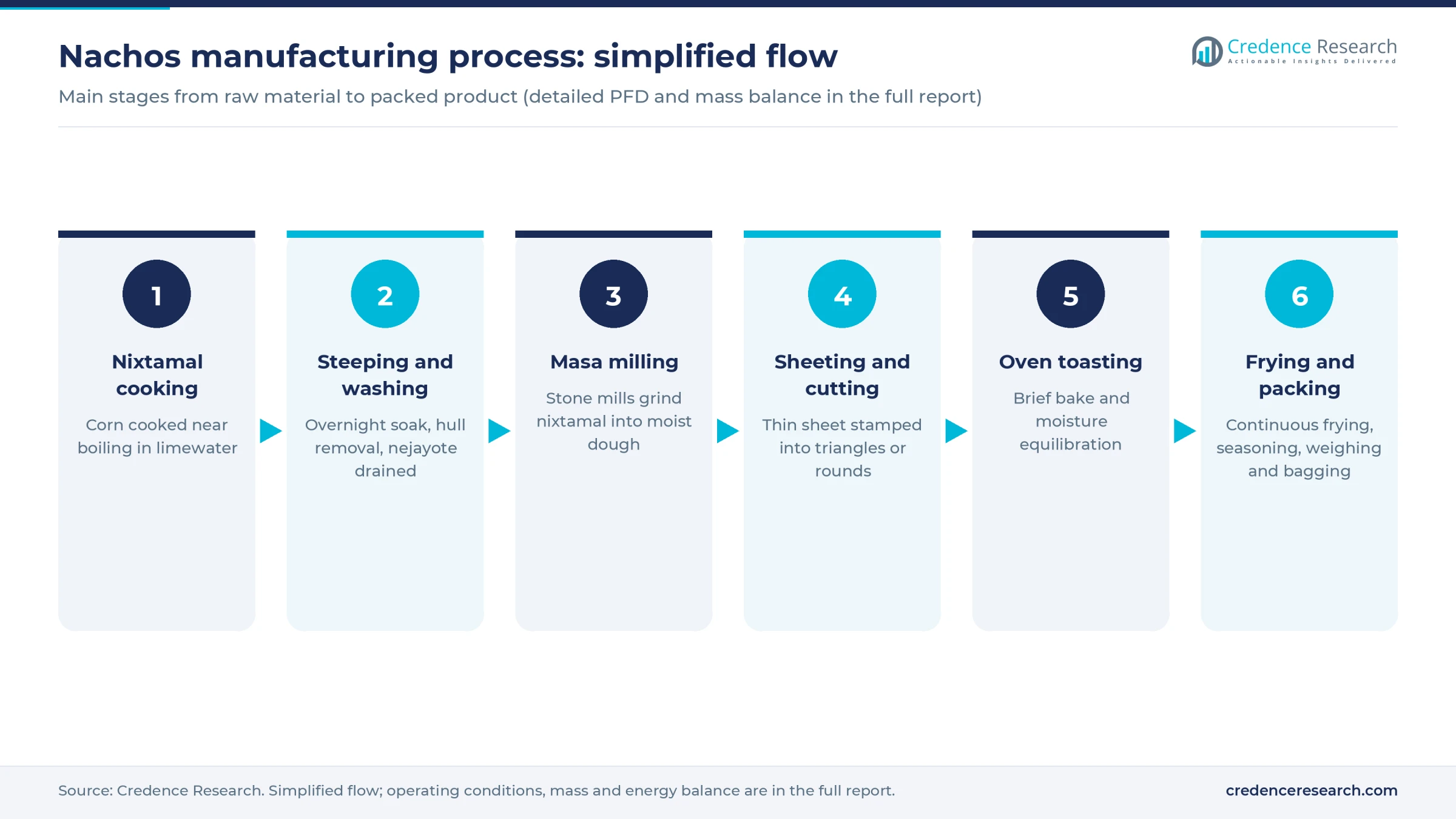
- Cooking. Cleaned white or yellow dent corn is heated close to boiling with food-grade calcium hydroxide. A U.S. patent describing conventional practice cites 1–5% lime in steam-jacketed kettles.
- Steeping and washing. The batch soaks for about 8–18 hours to loosen the hull, then is washed. The drained liquor, called nejayote, is highly alkaline and full of solids, and up to 15% of the corn's weight can be lost during cooking and washing.
- Milling. Stone or plate mills grind the washed corn, known as nixtamal, into moist masa. Grind fineness sets texture.
- Sheeting and cutting. Rollers press the masa into a thin sheet, and a cutter roll stamps triangles, rounds or strips.
- Toasting. A multi-tier gas oven briefly bakes the pieces to drive off surface water, which limits blistering and oil uptake, and an equilibration conveyor lets moisture even out.
- Frying, seasoning and packing. A continuous fryer finishes the chip to low moisture, a drum applies salt or seasoning, and weighers fill bags or bulk cases after metal detection.
Frying is where cost and quality meet. Fried tortilla chips typically finish with roughly a fifth to a quarter of their weight as oil, so fryer temperature, dwell time and oil turnover decide both flavor and margin. Acrylamide forms in browned corn as it does in potato products, so producers watch chip color and frying conditions closely.
Nachos plant setup cost
The model plant makes 6,000 tonnes of chips a year on two lines and is estimated to cost USD 8–16 million before working capital. Both ends come from disclosed North American projects, scaled with an assumed 0.7 capacity exponent because equipment and buildings cost less per tonne as output rises.
The low end reflects Mexican costs. Gruma's Mission Foods México announced 792 million pesos, about USD 46.5 million, in February 2024 for a new snack center and an expanded Puebla complex totaling 70,200 tonnes a year of tortillas, tostadas and fried snacks. Scaled to 6,000 tonnes, that implies about USD 8.3 million, a floor because part of the work used an existing site.
The high end reflects U.S. costs. Easy Foods' planned tortilla and corn chip plant in Sherman, Texas, approved for local incentives in August 2024, was reported at USD 50 million for nearly 200,000 square feet. Its output was not disclosed, so about 33,000 tonnes a year is assumed from the floor-space density of Mission's Plainfield, Indiana, plant, rated at 187 million pounds in about 511,000 square feet. Scaling gives roughly USD 15 million.
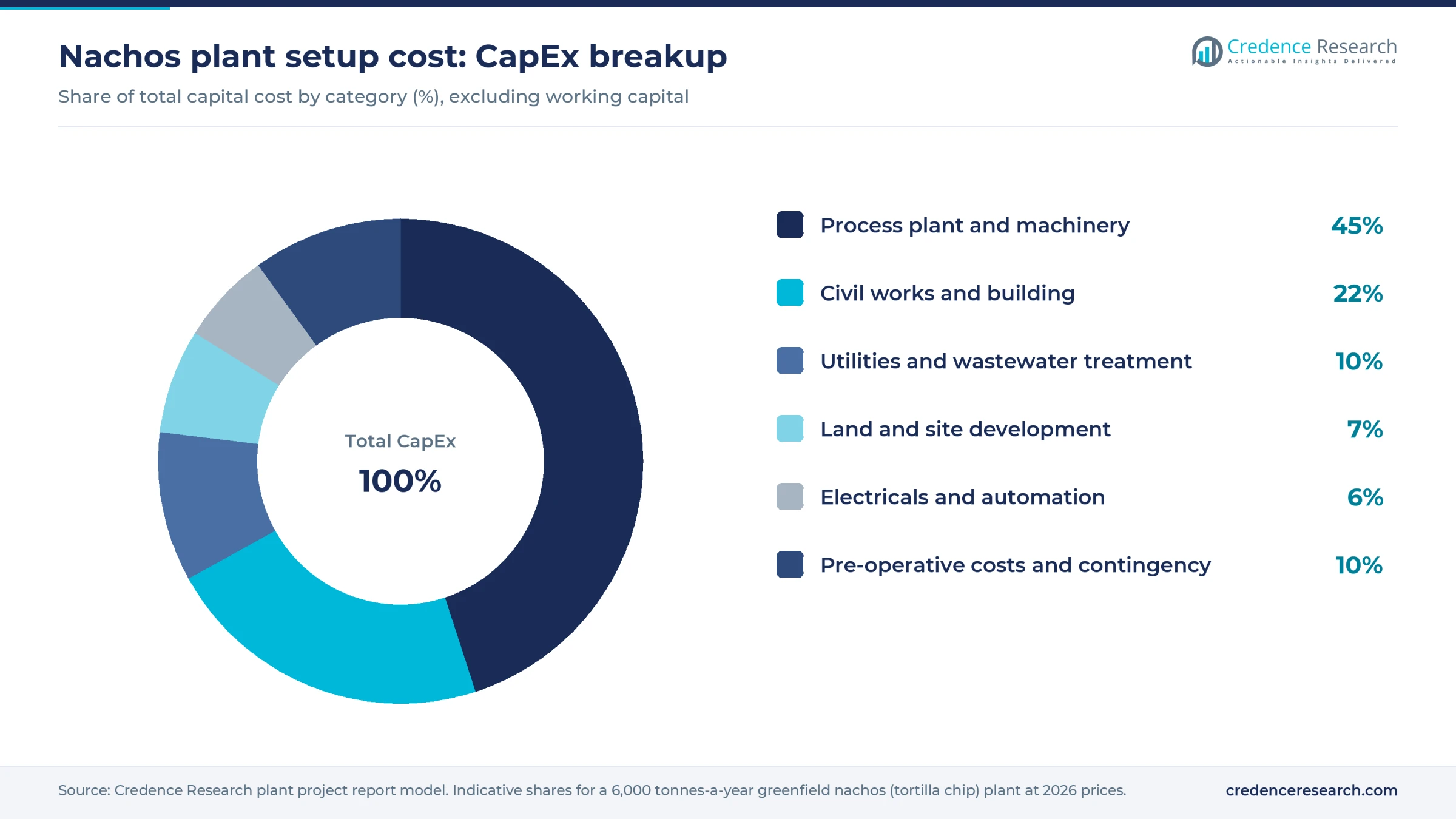
Worked example, land and site development. The plant is assumed to need 15,000–25,000 square meters. At an assumed USD 20–50 per square meter in a Latin American or Asian industrial park, land costs about USD 0.3–1.25 million. At an assumed USD 30–80 at a U.S. or EU site, it costs about USD 0.45–2.0 million. Access roads, drainage and a wastewater treatment pad add an assumed USD 0.15–0.4 million, so this row runs about 5–15% of CapEx depending on location.
Working capital adds an estimated USD 1–2 million, mostly corn stocks, oil, film and receivables. Buying masa flour instead of cooking whole corn can trim an assumed 10–15% from CapEx.
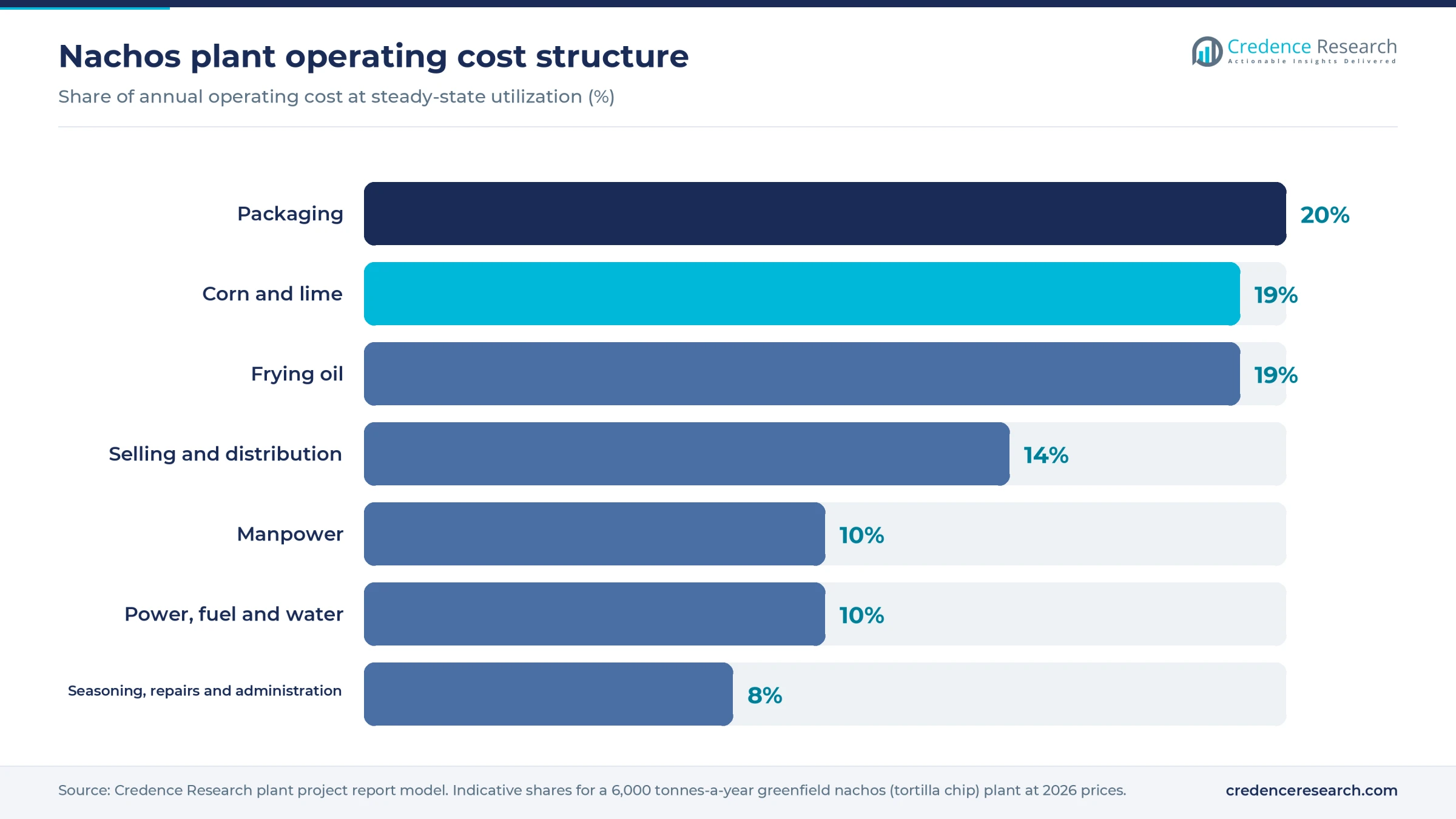
Corn, oil and packaging each take about a fifth of operating cost, so no single input dominates the budget.
Machinery and raw materials for a nachos plant
The core equipment groups are listed below; ratings, layouts and quotations are available in the report. Credence Research tracks the supplier base in its snacks processing machinery report.
- Corn handling: silos, cleaners, destoners and weigh hoppers
- Nixtamal section: batch kettles or continuous cookers, lime dosing, steep tanks, washers and hydrosieves
- Masa section: stone mills, masa mixers and sheeter-cutters with interchangeable die rolls
- Thermal section: three-tier toasting ovens, equilibrators and continuous fryers with oil filtration, heat exchangers and fume hoods
- Finishing: seasoning drums, multi-head weighers, form-fill-seal baggers, metal detectors and case packers
- Utilities: steam boilers, gas trains, compressed air, and pH neutralization with solids recovery for nejayote
Food-grade white corn, preferred for traditional chips, comes mainly from Mexico, the U.S. Plains states and South Africa, while yellow corn is widely available from the U.S., Brazil, Argentina, Ukraine and China. The World Bank maize benchmark stood at USD 227 per tonne in October 2026, and identity-preserved food corn is assumed at USD 280–380 delivered. Frying oil, often high-oleic sunflower, corn, canola or palm blends, is sourced from the EU and Black Sea region, North America, Argentina and Southeast Asia; one option is covered in the corn oil market report. Food-grade lime is a minor cost, while printed bag film tracks resin prices.
Nachos business profit margin and ROI
Gross margin, after corn, oil, seasoning, packaging and direct conversion, is estimated at 20–32%. Modeled direct cost runs about USD 1.45–2.10 per kg, with bulk foodservice cases at the low end and printed retail bags at the high end.
Traded prices anchor the range, and transaction unit prices for tortilla chips ran about USD 3.5–3.8 per kg from the U.S. and USD 3.8–4.5 from Mexico between December 2025 and May 2026. Those figures carry export packing and established-brand premiums, so a new plant is assumed to realize USD 1.90–2.30 per kg ex-factory on foodservice cases and USD 2.60–3.00 on retail and private-label bags.
At 75% utilization, 4,500 tonnes sold yields revenue of about USD 8.6–13.5 million. After assumed selling and overhead costs of 6–12% of revenue and an assumed 22% tax, cash profit is about USD 0.8–2.3 million. Allowing a one-year ramp-up, payback falls at roughly 5–11 years. A USD 8 million plant earning USD 1.9 million recovers its cost in about 5 years, while a USD 16 million plant at USD 1.6 million needs about 11.
Oil is the swing input: a USD 200 per tonne rise, at 0.25 kg of oil per kg of chips, adds about USD 0.05 per kg, close to 2 points of margin at USD 2.50.
| Metric | Value |
|---|---|
| Project IRR (post-tax) | Available in report |
| NPV | Available in report |
| Return on investment | Available in report |
| DSCR | Available in report |
| Break-even utilization | Available in report |
How to start a nachos business, licenses and approvals
A nachos plant follows a similar approval path in most countries: business and tax registration; zoning, building and fire permits; an environmental permit covering fryer and oven exhaust; a wastewater discharge consent, which matters more here than in most snack plants because nejayote is alkaline and solids-rich; occupational safety approvals for hot oil, steam and gas firing; food business registration or licensing backed by a hazard-based food safety plan; and customs registration for exports. The lime must be food grade. Retail buyers usually expect a GFSI-benchmarked certificate such as BRCGS, SQF or FSSC 22000, and gluten-free or non-GMO claims need verified sourcing.
| Market | Food and product | Environment and safety |
|---|---|---|
| United States | FDA food facility registration; preventive controls under 21 CFR 117; labeling under 21 CFR 101; calcium hydroxide affirmed as GRAS under 21 CFR 184.1205 | Industrial user pretreatment permit from the local sewer authority under EPA pretreatment rules (40 CFR 403); state air permits where fryer emissions require one; OSHA workplace standards |
| European Union | Food business registration under Regulation (EC) No 852/2004; labeling under Regulation (EU) No 1169/2011; calcium hydroxide (E 526) authorized under Regulation (EC) No 1333/2008 | Prior authorization of industrial discharges to sewers under national rules implementing the Urban Waste Water Treatment Directive; national environmental and building permits |
| India | FSSAI state or central license, depending on turnover, under the Food Safety and Standards Act, 2006, plus FSSAI labeling rules | State pollution control board consent to establish and consent to operate; factory license under state factories rules |
Key nachos manufacturers and recent developments
PepsiCo's Frito-Lay leads with Tostitos, Doritos and Santitas and, since early 2025, the grain-free Siete brand. Gruma's Mission Foods sells chips alongside tortillas across the Americas, Europe and Asia, and Grupo Bimbo's Barcel makes Takis rolled tortilla chips. Utz Brands owns On The Border, Paulig's Santa Maria and Poco Loco brands serve Europe from Belgium, and Hungary's SUGO Food, owned by Belgium's Roger&Roger, is described as Europe's second-largest tortilla chip maker. Private-label co-packers fill much of the remaining shelf.
- March 2026. CK Snacks, owned by Nexus Capital Management, acquired Keystone Food Products of Easton, Pa., a maker of masa and cooked-corn tortilla chips, giving the combined business three U.S. plants.
- April 2026. PepsiCo opened a plant in Celaya, Mexico, with three lines for Sabritas, Doritos, Cheetos and Ruffles and 66,500 tonnes of annual capacity, part of an investment exceeding USD 467 million.
- July 2026. Intersnack agreed to take Utz private in a deal valued at about USD 2.9 billion. Utz said on Nov. 6, 2026, that all regulatory conditions had been met, with a shareholder vote set for Nov. 13.
What's inside the Nachos project report PDF
The report runs to 21 chapters. Open a chapter to see its sections.
1. Preface
2. Scope and Methodology
- 2.1 Objectives of the Study
- 2.2 Stakeholders
- 2.3 Research Methodology
- 2.4 Data Sources and Key Assumptions
3. Executive Summary
- 3.1 Market Snapshot
- 3.2 Project at a Glance (Capacity, CapEx, OpEx)
- 3.3 Key Financial Indicators (IRR, NPV, Payback, Break-even)
- 3.4 Feasibility Verdict
4. Product Overview
- 4.1 Nachos Definition and Properties
- 4.2 Grades and Specifications (BIS / ISO / ASTM)
- 4.3 HS Code and Classification
- 4.4 Key Applications
- 4.5 Substitutes
5. Global Nachos Market
- 5.1 Market Overview
- 5.2 Historical and Current Market Performance (Volume and Value)
- 5.3 Market Breakup by Grade / Type
- 5.4 Market Breakup by End-Use Industry
- 5.5 Market Breakup by Region
- 5.6 Market Drivers, Restraints and Trends
- 5.7 Value Chain Analysis
- 5.8 Market Forecast
6. Target Country Nachos Market Analysis
- 6.1 Demand and Supply Analysis
- 6.2 Installed Capacity vs Demand Gap
- 6.3 Import Dependence
- 6.4 Demand Forecast by End-Use
7. Trade Analysis
- 7.1 Imports by Volume, Value and Country
- 7.2 Exports by Volume, Value and Country
- 7.3 Trade Balance and Opportunities
8. Price Analysis
- 8.1 Historical Nachos Price Trends by Region
- 8.2 Raw Material / Feedstock Price Trends and Linkage
- 8.3 Price Forecast
- 8.4 Margins Across the Value Chain
9. Competitive Landscape
- 9.1 Market Structure
- 9.2 Key Players and Installed Capacities
- 9.3 Profiles of Key Players
- 9.4 Recent Developments (Expansions, M&A, New Plants)
10. Manufacturing Process and Technology
- 10.1 Comparison of Technology Routes
- 10.2 Selected Route and Process Flow Diagram
- 10.3 Unit Operations Involved
- 10.4 Chemical Reactions Involved
- 10.5 Mass Balance and Raw Material Requirements
- 10.6 Energy Balance
- 10.7 Quality Assurance Criteria and Technical Tests
- 10.8 By-products and Waste Handling
- 10.9 Technology Licensors / Providers
11. Project Details, Requirements and Costs
- 11.1 Land, Location and Site Development
- 11.1.1 Site Selection Criteria
- 11.1.2 Location Analysis
- 11.1.3 Land Requirement and Costs
- 11.1.4 Site Development Costs
- 11.2 Plant Layout
- 11.2.1 Layout Principles
- 11.2.2 Proposed Layout
- 11.2.3 Factors Influencing Layout
- 11.3 Civil Works and Buildings
- 11.4 Plant Machinery
- 11.4.1 Machinery Requirements and Specifications
- 11.4.2 Machinery Costs
- 11.4.3 Machinery Suppliers
- 11.5 Raw Materials
- 11.5.1 Requirements per Tonne of Output
- 11.5.2 Procurement and Sourcing
- 11.5.3 Costs
- 11.5.4 Suppliers
- 11.6 Packaging
- 11.6.1 Packaging Requirements
- 11.6.2 Packaging Costs
- 11.6.3 Packaging Suppliers
- 11.7 Storage and Material Handling
- 11.8 Transportation Requirements and Costs
- 11.9 Utilities
- 11.9.1 Power Requirements and Costs
- 11.9.2 Water Requirements and Costs
- 11.9.3 Steam, Fuel and Other Utilities
- 11.10 Manpower Requirements and Wages
12. Environment, Health, Safety and Sustainability
- 12.1 Effluent and Emissions Management
- 12.2 Hazard Classification and Safety Measures
- 12.3 Carbon Footprint
- 12.4 Green / Low-Carbon Process Options
13. Regulatory Procedures, Approvals and Certifications
- 13.1 Licences and Registrations
- 13.2 Environmental Clearances
- 13.3 Product Certifications (BIS, REACH, etc.)
- 13.4 Approval Timeline
14. Project Implementation Schedule
15. Project Economics
- 15.1 Capital Cost of the Project
- 15.2 Techno-Economic Parameters
- 15.3 Capacity Utilization and Ramp-up
- 15.4 Product Pricing and Margins
- 15.5 Income Projections
- 15.6 Expenditure Projections
- 15.7 Working Capital Requirement
- 15.8 Taxation
- 15.9 Depreciation
16. Financial Analysis
- 16.1 Projected Profit and Loss Account
- 16.2 Projected Cash Flow Statement
- 16.3 Projected Balance Sheet
- 16.4 Liquidity Analysis
- 16.5 Profitability Analysis (Payback, NPV, IRR, ROI)
- 16.6 Break-even Analysis
- 16.7 Debt Service Coverage Ratio (DSCR)
- 16.8 Sensitivity Analysis
- 16.9 Scenario and Uncertainty Analysis
17. Funding and Incentives
- 17.1 Means of Finance and Debt-Equity Structure
- 17.2 Loans and Financial Assistance
- 17.3 Government Schemes and Subsidies (PLI, State Policies)
18. Risk Assessment
- 18.1 Key Success Factors
- 18.2 Key Risk Factors
- 18.3 Risk Mitigation
19. Strategic Recommendations
20. Case Study of a Successful Venture
21. Appendix
- 21.1 Detailed Assumptions
- 21.2 Abbreviations
- 21.3 List of Tables and Figures
- 21.4 Sources
This page vs. the full report
| Data point | On this page (free) | In the full report |
|---|---|---|
| Total CapEx | One rounded range at one capacity | Exact figure at three capacities with a line-item breakup |
| CapEx breakup | Category shares (%) only | Cost, quantity and supplier for every machine |
| Operating cost | Share of raw materials, utilities and labor | Per-unit cost sheet with each input price and consumption |
| Profitability | Gross margin range and payback band | Exact IRR, NPV, ROI, break-even and DSCR |
| Financial statements | List of what is included | 10-year P&L, cash flow, balance sheet and Excel model |
| Sensitivity | One directional line | Full sensitivity and scenario tables |
| Process | Simplified flow diagram | Detailed process flow, mass and energy balance, operating conditions |
| Machinery | Names of the main machines | Specifications, capacity, cost and supplier list |
| Market | Headline size, growth and global demand | Segment, region, trade and price forecast tables |
| Suppliers and buyers | Supplier types and sourcing hubs | Named suppliers and buyers |
Nachos project report: FAQs
How much does it cost to set up a nachos plant?
Should a new plant cook whole corn or buy masa flour?
What profit margin can a nachos business earn?
How much oil does a tortilla chip absorb?
Which licenses does a nachos plant need?
Which HS code applies to nachos and tortilla chips?
Who buys tortilla chips in bulk?

About the analyst
Priyanka Mor, Senior Consultant
Senior Consultant at Credence Research Inc directing strategic market advisory, cross-border commercial due diligence and enterprise intelligence frameworks for global B2B clients. Combines quantitative modeling with executive advisory, translating macroeconomic variables and supply chain data into go-to-market blueprints, M&A screenings and competitive war-gaming strategies.
Related market research
- Savory Snacks Market Size, Share, Growth and Forecast 2032
- Nixtamalized Corn Flour Market Size, Growth and Forecast 2032
- Snacks Processing Machinery Market Size, Share & Growth Report 2032
- Corn Oil Market Size, Share, Trends, Growth and Forecast 2032
- Tortilla Bread Market Size, Share, Growth and Forecast 2032
- Baked Chips Market Size, Growth, Share and Forecast 2032
More plant project reports
- Hummus Manufacturing Plant Project Report (DPR) 2026
- Whey Protein Manufacturing Plant Project Report (DPR) 2026
- Ice Cream Cone Manufacturing Plant Project Report (DPR) 2026
- Soda Water Manufacturing Plant Project Report (DPR) 2026
- Garlic Powder Manufacturing Plant Project Report (DPR) 2026
- Extruded Snacks Manufacturing Plant Project Report (DPR) 2026