
Quick answer
An LED street light plant making about 150,000 roadway luminaires a year, with in-house aluminum die casting, powder coating, LED board assembly and photometric testing, needs total CapEx of roughly USD 2.5–4.6 million on an Asian industrial site, including land and working capital margin. Gross margin typically runs 18–27% of ex-factory price, and payback falls in a 4–7 year band at 70–75% utilization, shorter for plants with a steady municipal tender or OEM book.
Feasible for entrants with a municipal tender pipeline, an OEM contract or a smart-ready product line; a plant that sells only low-specification fixtures on price faces long payback and heavy warranty exposure.
LED Street Light plant: key highlights
| Parameter | Indicative value | Note |
|---|---|---|
| Plant capacity | 150,000 luminaires per year | About 500 a day, two shifts, 300 working days, 20–200 W mix |
| Total CapEx | USD 2.5–4.6 million | Asian industrial site; land, shed, die casting, coating, SMT, lab, working capital margin |
| Raw material share of operating cost | 72–78% | LED boards, drivers, aluminum alloy, optics, surge protection, glass |
| Gross margin | 18–27% | On ex-factory price after materials and direct conversion |
| Payback period | 4–7 years | At 70–75% utilization from year two, including ramp-up |
| IRR | Available in report | Post-tax, 10-year model |
| Break-even | Available in report | Capacity utilization basis |
Ranges assume a 150,000 luminaires a year plant (20–200 W, average near 70 W) on 6,000 sq m in an Asian industrial park, a 3,500 sq m shed, in-house die casting and powder coating, bought-in drivers, one LED SMT line, 2026 prices, 70–75% utilization from year two, assumed land and building rates and an assumed blended ex-factory price of USD 50–85 per luminaire. U.S. or EU sites cost more. The full report can be customized to any country.
What is an LED street light?
An LED street light is an outdoor luminaire that lights roads, streets, highways, parking areas and pathways using arrays of light-emitting diodes instead of high-pressure sodium, metal halide or mercury lamps. A typical unit has a die-cast aluminum housing that doubles as the heat sink, an LED board with secondary lenses that shape the beam along the carriageway, a constant-current driver, a surge protection device, a tempered glass or polycarbonate cover, and a pole-top or side-entry mounting bracket.
Products are graded by wattage, usually 20–300 W, by efficacy in lumens per watt, by light distribution type for different road widths, by ingress protection rating, typically IP65 or IP66, and by impact rating. Color temperature has moved toward 3,000 K or warmer in many cities to cut glare and skyglow. Smart-ready models carry a seven-pin NEMA or Zhaga socket for photocells and wireless control nodes. Under the Harmonized System, mains-powered LED street lights fall under subheading 9405.42, luminaires designed solely for LED light sources, while solar-powered versions use 9405.41. Buyers are city governments, highway agencies, electric utilities, industrial estates, airports and the contractors that build roads for them.
LED street light market overview and global demand
Credence Research values the street and roadway lighting market at USD 11,386 million in 2024 and projects USD 16,192 million by 2032, a 4.5% CAGR. That implies about USD 11.9 billion in 2025, a figure derived from the 2024 value and the CAGR rather than reported separately. The broader outdoor lighting market adds area, flood and architectural fixtures that many street light plants also make.
Demand comes from two sources: conversion of the remaining sodium and metal halide stock, and a growing replacement cycle for first-generation LED fixtures installed in the early 2010s. In the United States, a Department of Energy adoption study, published in August 2020, counted 49.7 million street and roadway installations in 2018, of which 48.6% were LED, up from 28.0% in 2016. India ran one of the largest public retrofits anywhere. A government note dated January 2025 says Energy Efficiency Services Ltd. had installed more than 13.4 million LED streetlights for urban and village bodies, saving about 9,001 million kWh a year.
Buying is concentrated in public tenders, so specifications drive the market more than retail brands do. Cities increasingly ask for networked controls, dimming schedules, warmer color and 10 kV surge protection, and Buy America rules in the United States favor locally assembled fixtures on federally funded road work. Africa, Southeast Asia, the Middle East and Latin America still have large shares of legacy lamps, while Europe and North America are moving into smart upgrades and second-round replacement.
LED street light manufacturing process
Unlike bulbs, a street light is a heavy metal product with electronics inside, so the housing line sets plant layout and much of the investment. Most mid-size makers cast their own housings, build LED boards on an SMT line and buy drivers from specialist suppliers, since driver design and certification are a separate business.
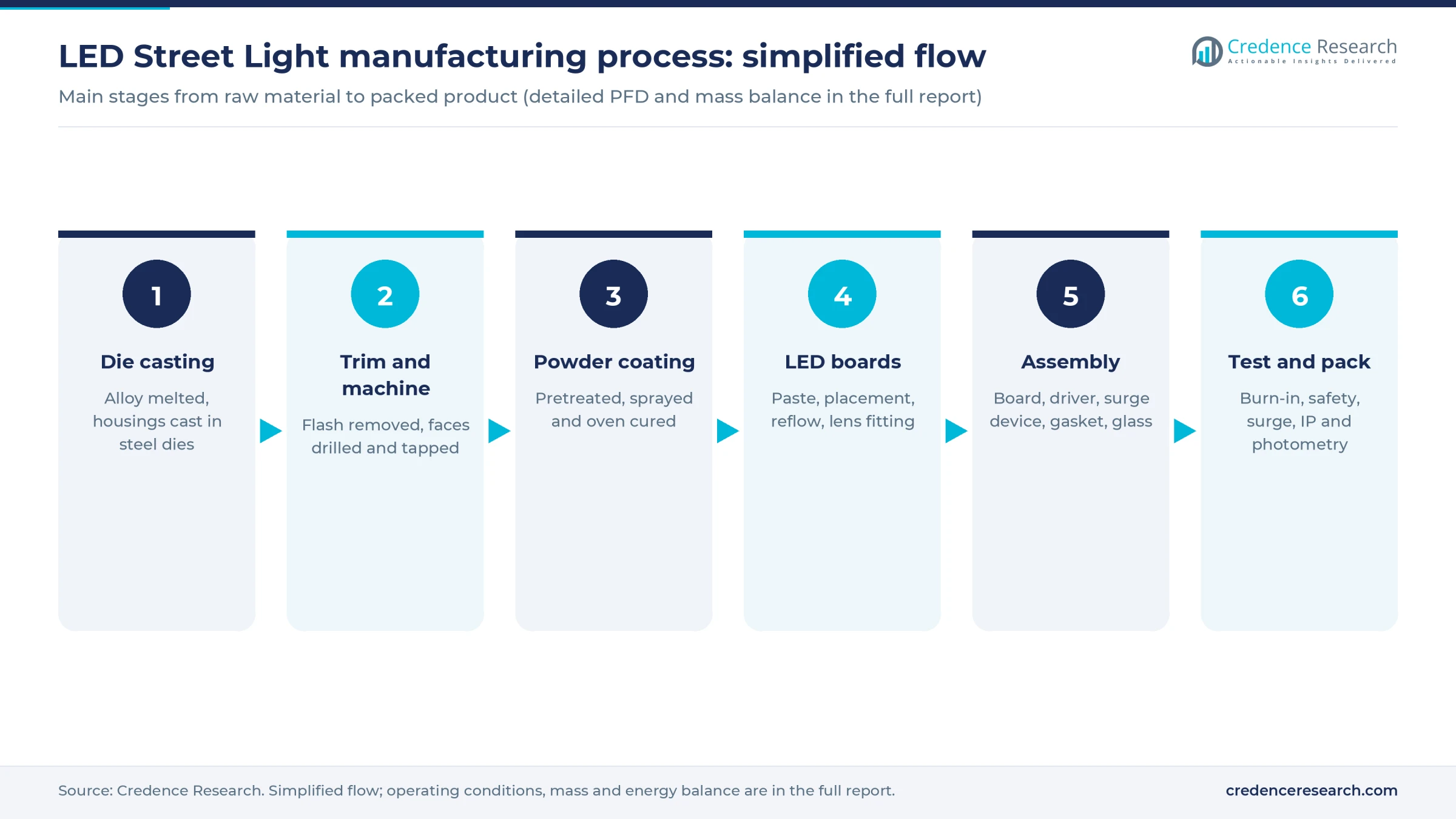
- Die casting. Aluminum alloy ingot is melted in a holding furnace and injected into steel dies on cold chamber high-pressure die casting machines. Each housing family needs its own die, and die life and porosity control decide scrap rates.
- Trimming and machining. Trim presses remove runners and flash, then CNC or drilling stations machine mounting faces, gland holes and gasket grooves. Shot blasting or vibratory finishing prepares the surface.
- Pretreatment and powder coating. Housings pass through degreasing and conversion coating, then electrostatic powder booths and a curing oven. Coating thickness and adhesion are tested because coastal and highway sites are corrosive.
- LED board assembly. Solder paste is printed on long metal-core boards, LEDs are placed and reflowed, and boards are optically inspected. Lens arrays are fixed over the LEDs to produce the required road distribution.
- Final assembly. Boards are mounted on the housing with thermal interface material, and the driver, surge protector, control socket, wiring and gaskets are fitted. The glass cover is sealed and the unit closed.
- Testing and packing. Every luminaire is burned in and checked for insulation, earth continuity, power and power factor. Samples go through ingress, surge, thermal and photometric tests before units are labeled and packed.
Most field failures trace back to water entry, poor heat transfer or surge damage, so gasket fit, thermal paste coverage and surge testing deserve as much attention as light output. Municipal buyers often hold warranty claims for five to 10 years.
LED street light plant setup cost
For a plant rated at 150,000 luminaires a year, about 500 a day on two shifts, total project cost lands at roughly USD 2.5–4.6 million in an Asian industrial park, the cost region used for this range. The spread comes mainly from building cost, the number of housing dies and whether die casting machines are bought new. The full report can be customized to any country, and U.S. or EU sites typically cost well above this range (assumed).
Land shows how the estimate is built. Die casting, coating, assembly, stores and truck access need about 6,000 sq m. At an assumed USD 30–70 per sq m on a serviced industrial estate, land costs about USD 180,000–420,000. Leasing removes that line and adds rent to operating cost instead.
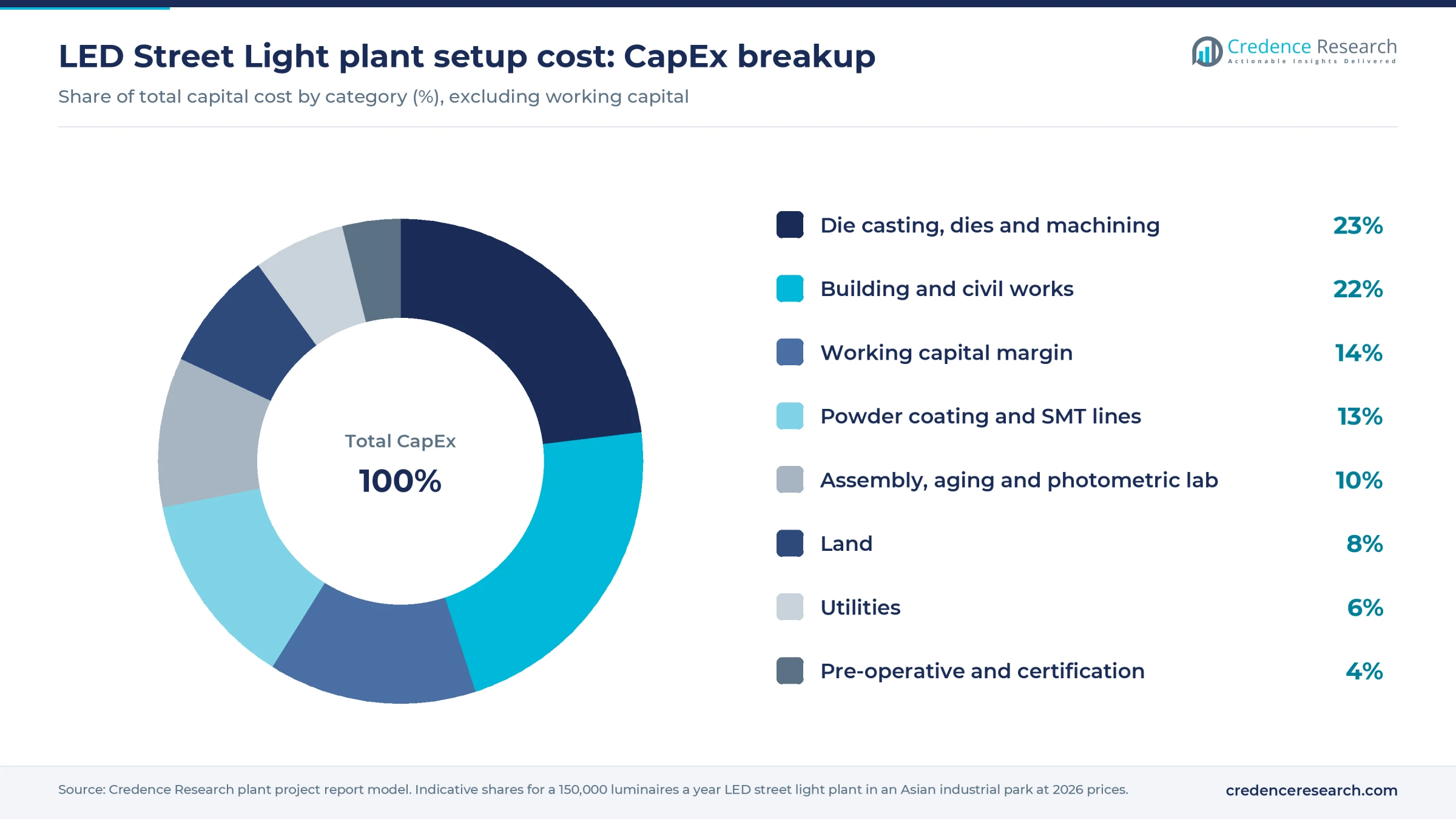
A 3,500 sq m shed with a foundry bay, coating hall and clean assembly area takes about 22% of CapEx. The die casting cell, with two cold chamber machines, a melting and holding furnace, trim presses and six to eight housing dies, is the largest machinery block and, with machining, takes about 23%. Powder coating and the LED SMT line take about 13%, assembly, aging and the photometric lab about 10%, utilities about 6%, pre-operative costs and certification about 4%, and the working capital margin about 14%. Land accounts for the remaining 8% at the midpoint. Itemized machinery costs and quotations are available in the report.
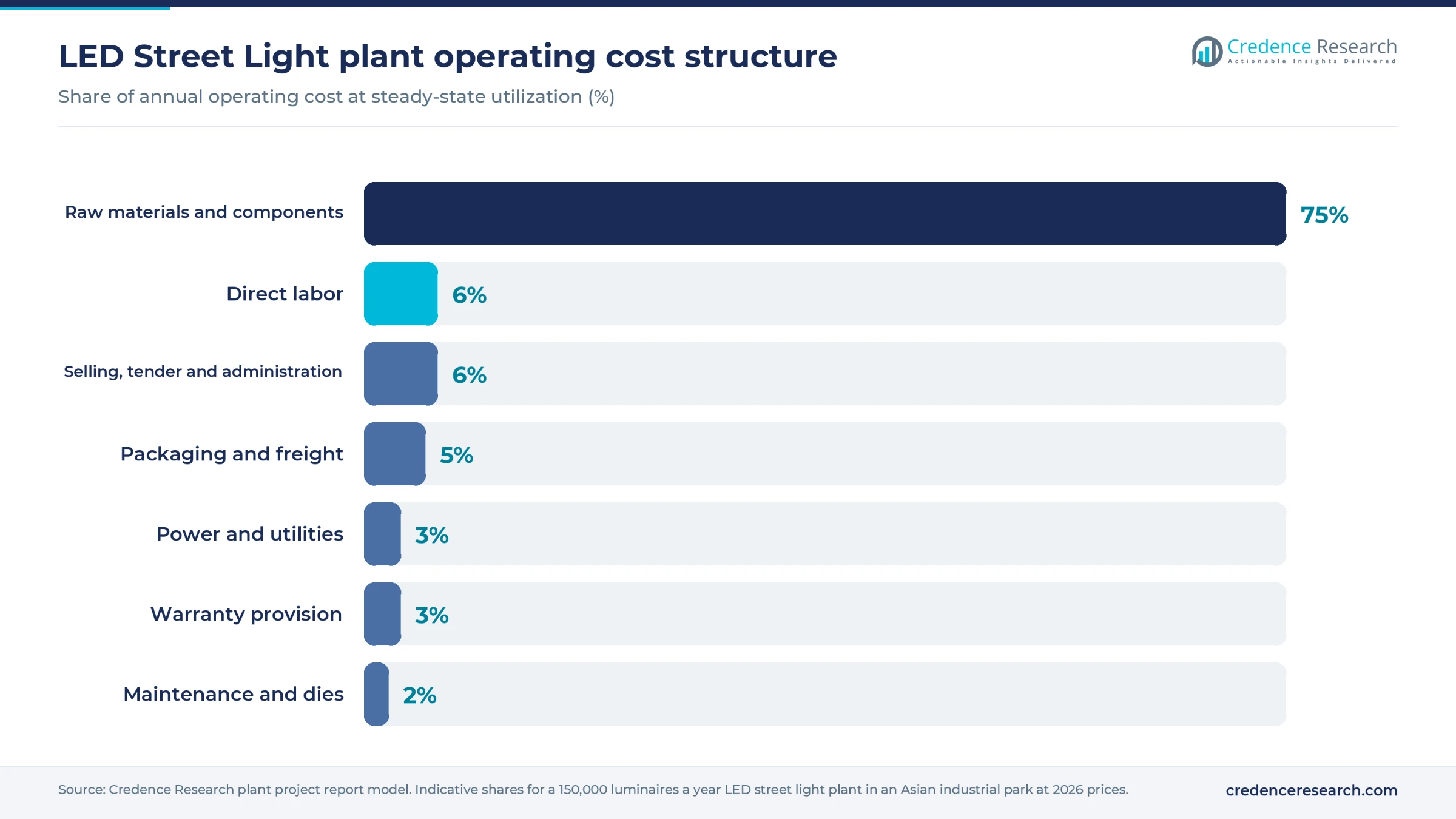
Operating cost is led by bought drivers and LEDs, with aluminum the next swing item. Long municipal payment cycles raise working capital needs more than in retail lighting.
Machinery and raw materials for an LED street light plant
The machinery list starts with cold chamber die casting machines, usually one in the 600–800 ton range for large housings and a smaller unit for covers and brackets, plus a melting furnace, die temperature controllers, trim presses, CNC drilling and tapping stations and a shot blasting machine. The finishing line needs a pretreatment tunnel, powder booths with recovery and a curing oven. Electronics assembly uses a stencil printer, an LED pick-and-place machine able to handle long boards, a reflow oven and optical inspection. Final assembly needs torque tools, gasket dispensing, burn-in racks, hipot and earth testers and a packing line. The lab should hold an integrating sphere, a goniophotometer for road distribution files, a surge generator, an ingress test chamber and a salt spray cabinet.
Main inputs are aluminum die casting alloy, LED packages, metal-core boards, drivers, surge protectors, polycarbonate or PMMA lens arrays, tempered glass, silicone gaskets, stainless fasteners, powder paint, cable glands and control sockets. The LED driver market sets one of the largest cost lines.
Sourcing for these inputs is global. China smelted about 45 million of the world's roughly 74 million metric tons of primary aluminum in 2025, the U.S. Geological Survey estimates, followed by India, Russia, Canada and the United Arab Emirates. LED packages and drivers come mainly from China and Taiwan, with higher-specification parts from Japan, South Korea and Europe. Glass, lenses and gaskets are widely available in Asia.
LED street light business profit margin and ROI
Margin depends on tender pricing, certification level and how much of the bill of materials a plant controls. In a 2025 Los Angeles County road contract, bidders quoted about USD 550–865 for a furnished and installed 200-watt-equivalent LED luminaire, a figure that includes contractor labor and markup and so sits far above ex-factory value. This range assumes a blended ex-factory price of USD 50–85 per luminaire for certified products sold into Asia, the Middle East and Africa (assumed). With materials at an assumed 64–71% of sales and direct conversion at 9–11%, gross margin comes to about 18–27%.
At 70% utilization the plant ships about 105,000 luminaires, giving sales of about USD 5.3–8.9 million. After freight, warranty provision, tender and selling costs and administration of 11–14% of sales, central-case cash profit of about USD 500,000–950,000 supports a payback of 4–7 years on a midpoint investment near USD 3.5 million, including ramp-up. Long receivables from city governments, warranty claims and lost tenders are the main risks.
| Metric | Value |
|---|---|
| Gross margin | 18–27% |
| Payback period | 4–7 years |
| IRR (post-tax) | Available in report |
| NPV | Available in report |
| ROI | Available in report |
| DSCR | Available in report |
Aluminum is the clearest commodity exposure: if the cast housing is about 17% of the material bill (assumed), a 20% rise in alloy price without a contract price revision cuts gross margin by about 2 percentage points.
How to start an LED street light business, licenses and approvals
A new plant needs business and tax registration, land use and building permits, an environmental permit or consent, fire and occupational safety approval, and import-export registration for components. Die casting and powder coating make this plant more permit-heavy than a pure assembly unit, since melting furnaces, dust, curing ovens and pretreatment wastewater need air and water controls. Product approvals cover electrical safety for outdoor luminaires, electromagnetic compatibility, restricted substances and, for public buyers, photometric and surge performance backed by accredited test reports.
| Market | Product safety and EMC | Procurement and performance |
|---|---|---|
| United States | Listing by a nationally recognized testing laboratory to UL 1598 for luminaires, wet location, with UL 8750 for the LED equipment; FCC Part 15 limits on interference | ANSI C136 roadway standards, including the C136.41 control receptacle; DesignLights Consortium listing for utility rebates; Build America, Buy America rules on federally funded projects |
| European Union | CE marking under the Low Voltage Directive 2014/35/EU and EMC Directive 2014/30/EU, tested to EN 60598-2-3 for road and street lighting, plus RoHS 2011/65/EU and WEEE registration | Ecodesign Regulation (EU) 2019/2020 for the light sources and control gear used; public tenders often follow EU green public procurement criteria |
| India | Bureau of Indian Standards registration under the Compulsory Registration Scheme to IS 10322 (Part 5/Sec 3), with the 2026 revision mandatory from Feb. 2, 2027 | Municipal and state tenders set efficacy, surge and warranty terms |
Applicants should confirm the current version of each standard before freezing a design, since tender documents often cite specific editions.
Key LED street light manufacturers and recent developments
The field mixes global lighting groups with specialist outdoor makers. Leading names include Signify in the Netherlands, Schréder in Belgium, Acuity Brands with its Holophane line and Current Lighting in the United States, Cyclone Lighting in Canada, Thorn of Zumtobel Group in Austria, Leotek in Taiwan and the United States, and Bajaj Electricals, Havells and Wipro Lighting in India. Large Chinese export makers supply many lower-cost tenders.
- April 2026. Schréder agreed to buy NLS Lighting, a Los Angeles maker of roadway, area and sports luminaires and poles that will keep operating under its current leadership.
- June 2026. Schréder acquired EdgeMachines, an Australian developer of low-power sensors and edge AI that fit standard street lighting sockets, after a year of joint city projects.
- July 2026. Orion Energy Systems launched an LED roadway luminaire assembled in Manitowoc, Wisconsin, with a die-cast housing, 10 kV surge protection and Buy America compliance.
These moves point to two openings for a new plant: U.S. demand for locally assembled fixtures on public projects, and a shift toward networked streetlights tracked in the smart lighting market. Both reward makers that design housings for sensors and control nodes from the start.
What's inside the LED Street Light project report PDF
The report runs to 21 chapters. Open a chapter to see its sections.
1. Preface
2. Scope and Methodology
- 2.1 Objectives of the Study
- 2.2 Stakeholders
- 2.3 Research Methodology
- 2.4 Data Sources and Key Assumptions
3. Executive Summary
- 3.1 Market Snapshot
- 3.2 Project at a Glance (Capacity, CapEx, OpEx)
- 3.3 Key Financial Indicators (IRR, NPV, Payback, Break-even)
- 3.4 Feasibility Verdict
4. Product Overview
- 4.1 LED Street Light Definition and Properties
- 4.2 Grades and Specifications (BIS / ISO / ASTM)
- 4.3 HS Code and Classification
- 4.4 Key Applications
- 4.5 Substitutes
5. Global LED Street Light Market
- 5.1 Market Overview
- 5.2 Historical and Current Market Performance (Volume and Value)
- 5.3 Market Breakup by Grade / Type
- 5.4 Market Breakup by End-Use Industry
- 5.5 Market Breakup by Region
- 5.6 Market Drivers, Restraints and Trends
- 5.7 Value Chain Analysis
- 5.8 Market Forecast
6. Target Country LED Street Light Market Analysis
- 6.1 Demand and Supply Analysis
- 6.2 Installed Capacity vs Demand Gap
- 6.3 Import Dependence
- 6.4 Demand Forecast by End-Use
7. Trade Analysis
- 7.1 Imports by Volume, Value and Country
- 7.2 Exports by Volume, Value and Country
- 7.3 Trade Balance and Opportunities
8. Price Analysis
- 8.1 Historical LED Street Light Price Trends by Region
- 8.2 Raw Material / Feedstock Price Trends and Linkage
- 8.3 Price Forecast
- 8.4 Margins Across the Value Chain
9. Competitive Landscape
- 9.1 Market Structure
- 9.2 Key Players and Installed Capacities
- 9.3 Profiles of Key Players
- 9.4 Recent Developments (Expansions, M&A, New Plants)
10. Manufacturing Process and Technology
- 10.1 Comparison of Technology Routes
- 10.2 Selected Route and Process Flow Diagram
- 10.3 Unit Operations Involved
- 10.4 Chemical Reactions Involved
- 10.5 Mass Balance and Raw Material Requirements
- 10.6 Energy Balance
- 10.7 Quality Assurance Criteria and Technical Tests
- 10.8 By-products and Waste Handling
- 10.9 Technology Licensors / Providers
11. Project Details, Requirements and Costs
- 11.1 Land, Location and Site Development
- 11.1.1 Site Selection Criteria
- 11.1.2 Location Analysis
- 11.1.3 Land Requirement and Costs
- 11.1.4 Site Development Costs
- 11.2 Plant Layout
- 11.2.1 Layout Principles
- 11.2.2 Proposed Layout
- 11.2.3 Factors Influencing Layout
- 11.3 Civil Works and Buildings
- 11.4 Plant Machinery
- 11.4.1 Machinery Requirements and Specifications
- 11.4.2 Machinery Costs
- 11.4.3 Machinery Suppliers
- 11.5 Raw Materials
- 11.5.1 Requirements per Tonne of Output
- 11.5.2 Procurement and Sourcing
- 11.5.3 Costs
- 11.5.4 Suppliers
- 11.6 Packaging
- 11.6.1 Packaging Requirements
- 11.6.2 Packaging Costs
- 11.6.3 Packaging Suppliers
- 11.7 Storage and Material Handling
- 11.8 Transportation Requirements and Costs
- 11.9 Utilities
- 11.9.1 Power Requirements and Costs
- 11.9.2 Water Requirements and Costs
- 11.9.3 Steam, Fuel and Other Utilities
- 11.10 Manpower Requirements and Wages
12. Environment, Health, Safety and Sustainability
- 12.1 Effluent and Emissions Management
- 12.2 Hazard Classification and Safety Measures
- 12.3 Carbon Footprint
- 12.4 Green / Low-Carbon Process Options
13. Regulatory Procedures, Approvals and Certifications
- 13.1 Licences and Registrations
- 13.2 Environmental Clearances
- 13.3 Product Certifications (BIS, REACH, etc.)
- 13.4 Approval Timeline
14. Project Implementation Schedule
15. Project Economics
- 15.1 Capital Cost of the Project
- 15.2 Techno-Economic Parameters
- 15.3 Capacity Utilization and Ramp-up
- 15.4 Product Pricing and Margins
- 15.5 Income Projections
- 15.6 Expenditure Projections
- 15.7 Working Capital Requirement
- 15.8 Taxation
- 15.9 Depreciation
16. Financial Analysis
- 16.1 Projected Profit and Loss Account
- 16.2 Projected Cash Flow Statement
- 16.3 Projected Balance Sheet
- 16.4 Liquidity Analysis
- 16.5 Profitability Analysis (Payback, NPV, IRR, ROI)
- 16.6 Break-even Analysis
- 16.7 Debt Service Coverage Ratio (DSCR)
- 16.8 Sensitivity Analysis
- 16.9 Scenario and Uncertainty Analysis
17. Funding and Incentives
- 17.1 Means of Finance and Debt-Equity Structure
- 17.2 Loans and Financial Assistance
- 17.3 Government Schemes and Subsidies (PLI, State Policies)
18. Risk Assessment
- 18.1 Key Success Factors
- 18.2 Key Risk Factors
- 18.3 Risk Mitigation
19. Strategic Recommendations
20. Case Study of a Successful Venture
21. Appendix
- 21.1 Detailed Assumptions
- 21.2 Abbreviations
- 21.3 List of Tables and Figures
- 21.4 Sources
This page vs. the full report
| Data point | On this page (free) | In the full report |
|---|---|---|
| Total CapEx | One rounded range at one capacity | Exact figure at three capacities with a line-item breakup |
| CapEx breakup | Category shares (%) only | Cost, quantity and supplier for every machine |
| Operating cost | Share of raw materials, utilities and labor | Per-unit cost sheet with each input price and consumption |
| Profitability | Gross margin range and payback band | Exact IRR, NPV, ROI, break-even and DSCR |
| Financial statements | List of what is included | 10-year P&L, cash flow, balance sheet and Excel model |
| Sensitivity | One directional line | Full sensitivity and scenario tables |
| Process | Simplified flow diagram | Detailed process flow, mass and energy balance, operating conditions |
| Machinery | Names of the main machines | Specifications, capacity, cost and supplier list |
| Market | Headline size, growth and global demand | Segment, region, trade and price forecast tables |
| Suppliers and buyers | Supplier types and sourcing hubs | Named suppliers and buyers |
LED Street Light project report: FAQs
How much does it cost to set up an LED street light manufacturing plant?
Should an LED street light plant cast its own housings?
What certifications does an LED street light need?
What is the profit margin in LED street light manufacturing?
What is the payback period for an LED street light plant?
Who buys LED street lights?
How do smart controls affect an LED street light plant?

About the analyst
Amit Jain, Senior Consultant – ICT & Emerging Technologies
Strategic market intelligence and consulting leader at Credence Research Inc with 20+ years across the global ICT sector, specializing in quantitative market sizing, technology lifecycle forecasting, competitive intelligence and commercial due diligence for enterprise clients worldwide.
Related market research
- Street and Roadway Lighting Market Size, Share and Forecast 2032
- Outdoor Lighting Market Size, Share, Growth and Forecast 2032
- LED Driver Market Size, Growth, Share and Forecast 2032
- Smart Lighting Market Size, Share and Growth Report 2032
- Aluminum Die Casting Market Size, Growth, Share and Forecast 2032
- LED Lights Market Size, Growth, Trend, Share and Forecast 2032
More plant project reports
- TFT LCD Manufacturing Plant Project Report (DPR) 2026
- LED Light Manufacturing Plant Project Report (DPR) 2026
- Urea Manufacturing Plant Project Report (DPR) 2026
- Green Beans Processing Plant Project Report (DPR) 2026
- Methacrylic Acid Manufacturing Plant Project Report (DPR) 2026
- Canola Oil Processing Plant Project Report (DPR) 2026