
Quick answer
A canola oil processing plant flakes, presses and solvent-extracts low erucic rapeseed to make oil for food and biofuel markets plus protein meal for livestock feed. A greenfield plant crushing 1,000 tonnes a day, about 300,000 tonnes a year, with a refinery costs an estimated USD 160–240 million at a North American or EU site. Gross margin over seed runs about 15–26% on board crush margins, and payback takes roughly 3–10 years.
Feasible at scale for an operator with seed origination inside a major growing region and outlets in both food and renewable fuel; the plant lives on the crush spread, so margin swings and trade policy are the main risks.
Canola Oil plant: key highlights
| Parameter | Indicative value | Note |
|---|---|---|
| Plant capacity | 1,000 tonnes of canola seed per day | 330 days at 90% utilization; about 300,000 tonnes of seed, 125,000 tonnes of oil and 172,000 tonnes of meal a year |
| Total CapEx | USD 160–240 million | Prepress solvent extraction with refinery, meal pelleting and rail loop at a North American or EU greenfield site; working capital extra |
| Raw material share of operating cost | 89–94% | Delivered canola seed at October 2025 and October 2026 futures prices |
| Gross margin | 15–26% | Oil and meal value less seed, before processing, based on the ICE board crush margin |
| Payback period | 3–10 years | Pre-tax, at 2025–2026 board margins; 4–8 years at USD 200 million mid-case CapEx |
| IRR | Available in report | Post-tax, 10-year model |
| Break-even | Available in report | Capacity utilization basis |
Ranges assume a 1,000 tonne per day prepress solvent extraction plant with refinery, 330 days at 90% utilization, a greenfield North American or EU site, 2026 prices, oil and meal yields of 42% and 58%, assumed processing cost of USD 40–55 per tonne of seed, Canadian dollar values converted at the USD rates quoted with each margin, and CapEx scaled from two disclosed plants. Customizable to any country.
What is canola oil?
Canola oil is the light, mild edible oil pressed and extracted from the seed of canola, a group of Brassica napus, Brassica rapa and Brassica juncea varieties bred in Canada in the 1970s to carry very little erucic acid and few glucosinolates. The name, first registered as a Canadian trademark, applies to seed whose oil has less than 2% erucic acid and whose meal holds less than 30 micromoles of glucosinolates per gram. Europe sells the same crop as double-low or 00 rapeseed.
The oil is about 7% saturated fat and is rich in oleic acid and alpha-linolenic omega-3. Most is sold refined, bleached and deodorized for frying, dressings, mayonnaise, margarine and bakery fats, while high-oleic varieties serve restaurant fryers and a growing share feeds biodiesel and renewable diesel plants. Under the Harmonized System, crude low erucic acid rape or colza oil falls under HS code 151411 and refined or other grades under HS code 151419, with low erucic defined as an erucic acid content below 2% by weight. Seed trades under HS code 120510 and the protein-rich meal, the main co-product, under HS code 230641.
Canola oil market overview and global demand
Canola is the core of the wider rapeseed oil market, which Credence Research valued at USD 25.6 billion in 2024. Carried forward at its 5.16% CAGR, that implies about USD 27.0 billion in 2025, on the way to a forecast USD 38.2 billion by 2032 in its global rapeseed oil market report.
Physical volumes are rising steadily, and the USDA Foreign Agricultural Service's November 2026 oilseeds outlook puts world rapeseed production at 100.25 million tons for 2026/27, up from 96.04 million, and rapeseed oil output at 38.25 million tons, up from 36.65 million. Canada, at 22.5 million tons of seed, the European Union at 19.75 million, China at 16.2 million and India at 12.4 million lead the crop, and Australia is forecast to export 6.5 million tons of seed.
Trade in the oil is concentrated. World rapeseed oil exports are forecast at 8.86 million tons in 2026/27, of which Canada supplies about 3.9 million tons, much of it to the United States, while China is the largest importer at about 2.25 million tons. Canada is crushing more of its own crop, and Agriculture and Agri-Food Canada forecast a record 13 million tons of domestic crush for 2026/27 against 7.5 million tons of seed exports in May 2026, and installed crush capacity has climbed to about 15 million tons a year.
Fuel policy is the swing factor. Renewable diesel and biodiesel plants in North America and Europe compete with food buyers for canola oil, a demand stream covered in the hydrotreated vegetable oil market analysis, while Chinese tariff decisions on Canadian seed and meal shift how much of the crop is exported rather than crushed near the farm.
Canola oil manufacturing process
Most large canola plants rely on prepress solvent extraction, because seed this rich in oil cannot be stripped economically by pressing alone. Screw presses take out most of the oil, and hexane recovers nearly all of what remains, leaving meal with only a small residue.
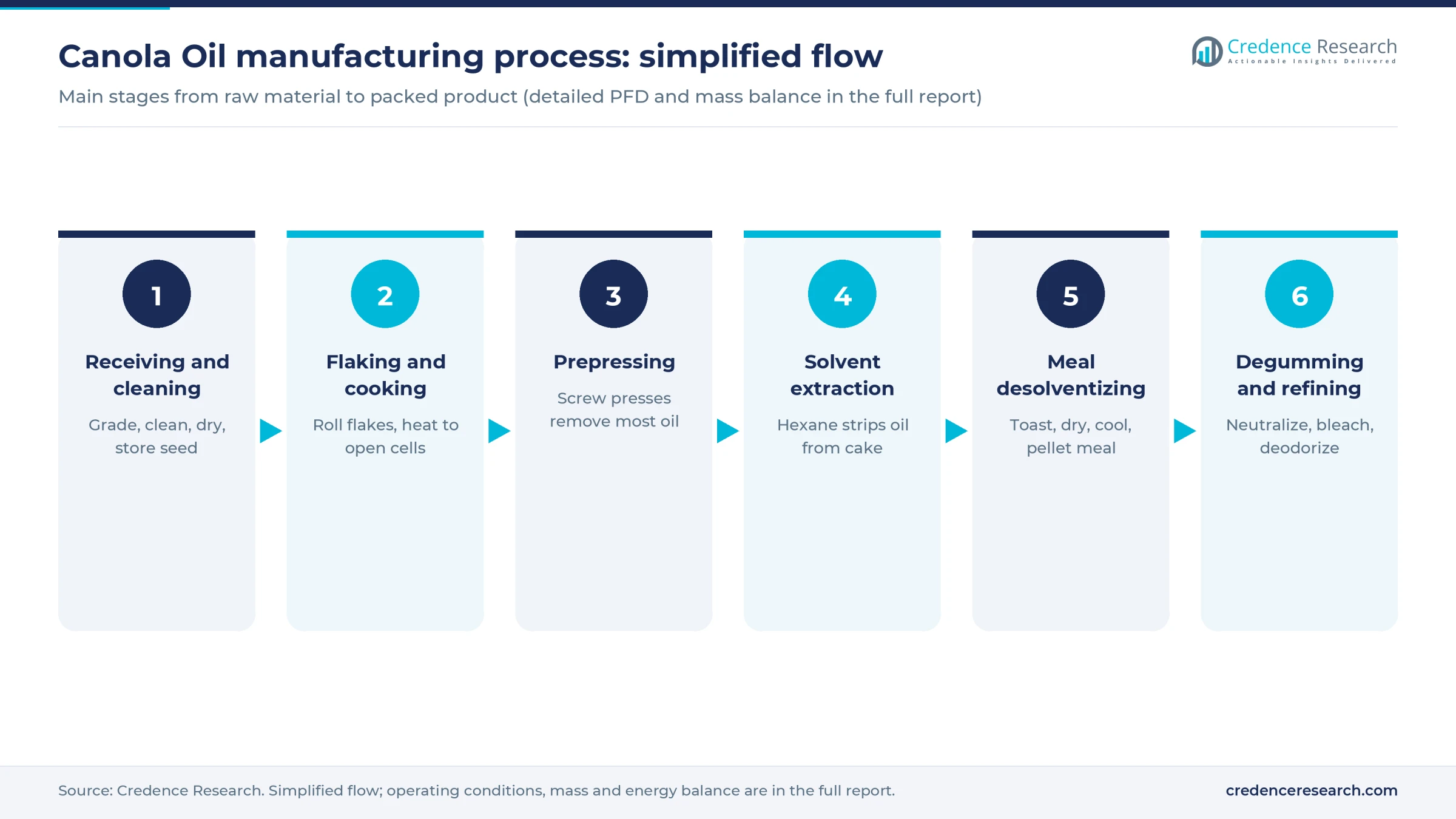
- Receiving, cleaning and drying. Trucks or rail cars unload into pits, seed is sampled for grade, moisture and green seed, cleaned of dockage and dried to safe storage moisture before it goes to silos.
- Conditioning and flaking. Warmed seed passes through roller mills that press it into thin flakes, rupturing the oil cells so the oil can flow out.
- Cooking. Stacked cookers heat the flakes, which coagulates protein, deactivates the myrosinase enzyme that would break glucosinolates into sulfur off-flavors, and lowers oil viscosity.
- Prepressing. Screw presses squeeze out roughly 60–70% of the oil and form a press cake with about 16–20% oil remaining, design figures assumed here.
- Solvent extraction and desolventizing. Hexane washes the cake in a continuous extractor, the miscella is distilled to recover oil and solvent, and a desolventizer-toaster strips hexane from the meal before it is dried, cooled and often pelleted.
- Degumming and refining. Crude oil is water or acid degummed, with gums often returned to the meal, then neutralized, bleached and deodorized into food-grade oil, or shipped degummed to biofuel plants.
Yields set the economics, and Canadian plants crushed 8.1 million tons of seed in the crop year to March 31, 2026, producing 3.4 million tons of oil and 4.7 million tons of meal, according to Agriculture and Agri-Food Canada, which implies about 42% oil and 58% meal by weight. Chlorophyll is the main processing headache: frost-damaged green seed needs more bleaching clay and raises refining losses, so receiving labs grade it before purchase.
Canola oil plant setup cost
Indicative CapEx for a greenfield prepress solvent extraction plant crushing 1,000 tonnes of canola a day, about 300,000 tonnes a year, with a refinery, meal pelleting and rail loading, is USD 160–240 million at a North American or EU site. Two disclosed projects anchor the range. Cargill announced its Regina, Saskatchewan, plant at 350 million Canadian dollars for 1 million tonnes a year in 2021 and later reported overruns it has not quantified. Scaled down with a standard 0.6 capacity exponent, an assumed 20% cost escalation and an assumed USD 15–25 million refinery, that project points to about USD 180–195 million. The Hallock, Minnesota, plant, built for USD 168 million from 2011 with a refinery and a rail loop to crush about 350,000 tonnes a year, points to about USD 220 million after scaling and an assumed 45% escalation.
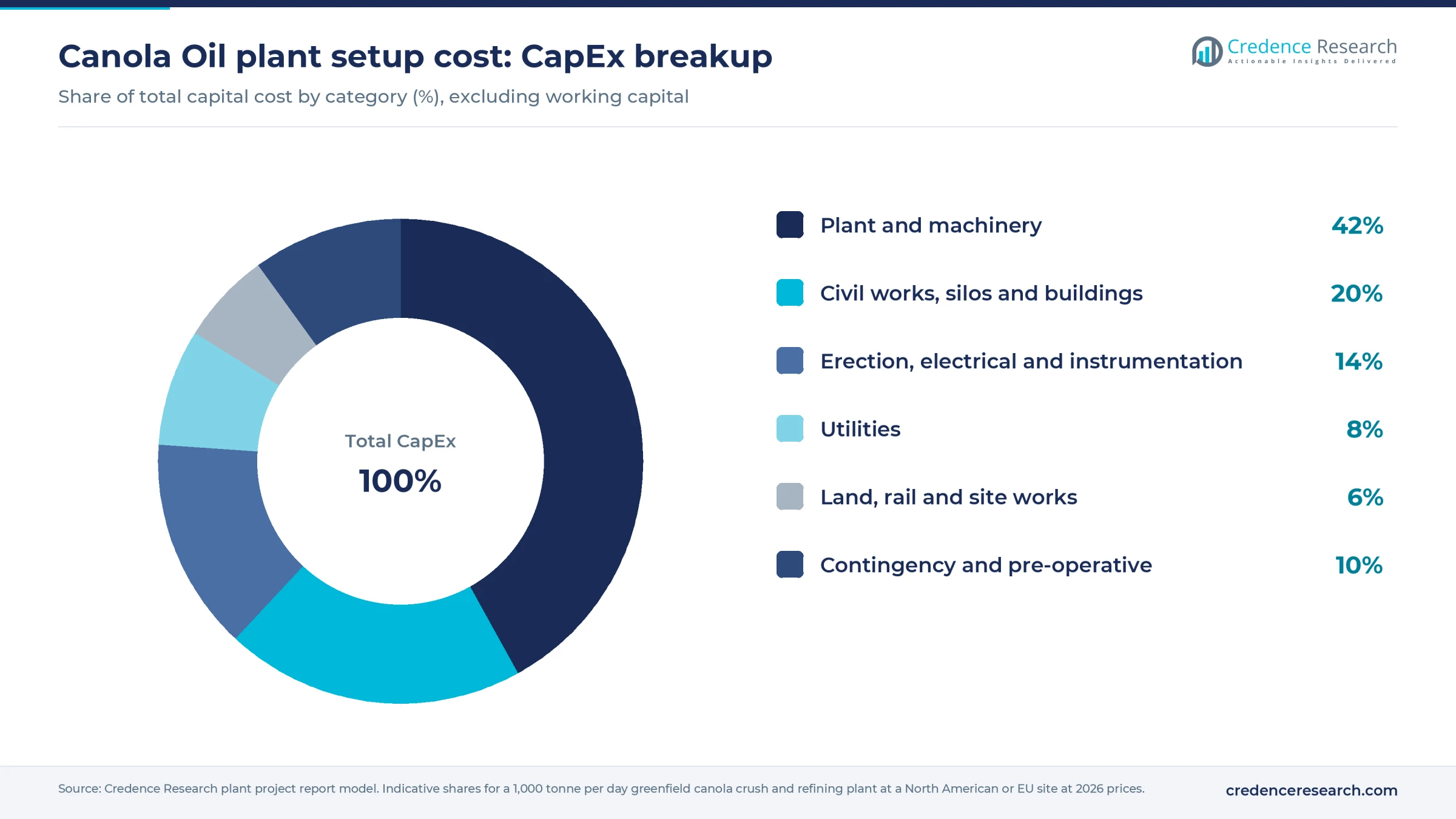
Within fixed CapEx, plant and machinery take about 42%, civil works, silos and buildings 20%, erection, electrical and instrumentation 14%, contingency and pre-operative costs 10%, utilities such as boilers and cooling towers 8%, and land, rail and site works 6%. Seed, oil and meal stocks need assumed working capital of USD 15–25 million, held outside CapEx.
Land and site works are the line shown in full. A crush plant with silos and a unit-train loop needs about 20 hectares. At an assumed USD 10–40 per square meter for Prairie or Midwest industrial land, the plot costs USD 2–8 million, and an assumed USD 6–10 million of rail track, roads and drainage brings the line to USD 8–18 million, about 6% of mid-case CapEx.
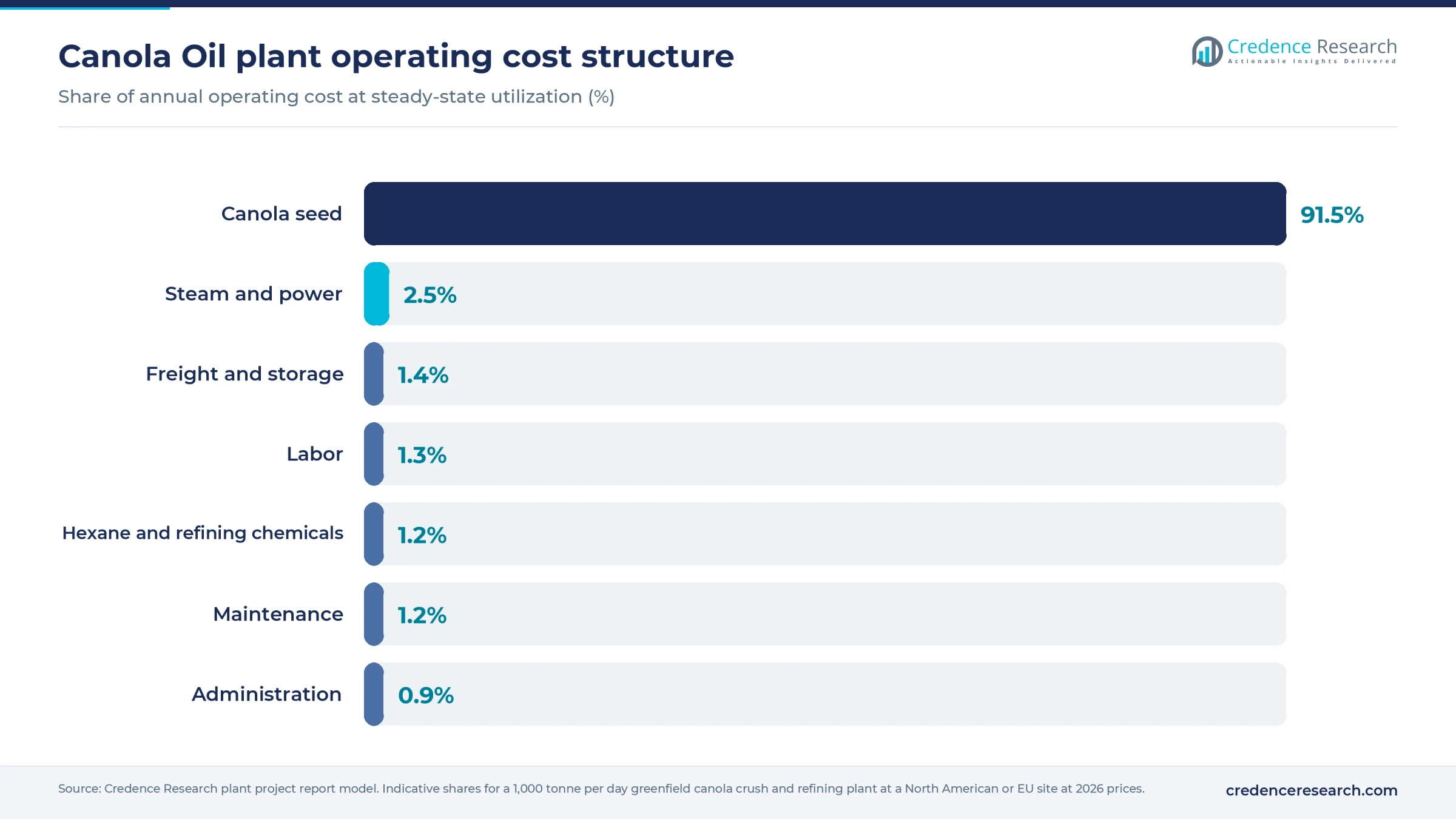
Seed dominates operating cost at about 91.5% at mid-case prices, followed by steam and power at 2.5%, freight and storage at 1.4%, labor at 1.3%, hexane, bleaching clay and refining chemicals at 1.2%, maintenance at 1.2% and administration at 0.9%, all assumed planning shares. Asian sites with regionally built machinery cost less, and the full report can be customized to any country.
Machinery and raw materials for a canola oil plant
The seed end of the plant comprises truck and rail receiving pits, sampling probes, a grain dryer, cleaners, steel silos and conveyors. Preparation uses conditioners, flaking mills and vertical stack cookers, followed by heavy screw presses. The extraction building holds a hexane extractor, a desolventizer-toaster-dryer-cooler, miscella distillation, solvent recovery and nitrogen blanketing, with meal grinders, pellet mills and load-out. Oil moves through degumming centrifuges into a refinery with neutralization, bleaching, filtration and a deodorizer, then to a tank farm and bulk or bottle loading. Price and lead-time trends appear in the oilseed extraction equipment market report, and machine costs and supplier lists are held for the full report.
Seed is the only major input, and plants are built inside growing regions because each tonne of oil needs about 2.4 tonnes of seed and meal sells mainly to nearby livestock feeders. Saskatchewan, Alberta and Manitoba supply the largest exportable surplus, and North Dakota grows most U.S. canola. In Europe, France, Germany and Poland lead winter oilseed rape, with Ukraine and Romania as exporters. Western Australia and New South Wales grow largely for export, and China's Yangtze basin supplies domestic crushers. Seed pricing across these regions is tracked in the canola seed market analysis. Hexane, bleaching clay, phosphoric acid and caustic soda come from chemical distributors.
Canola oil business profit margin and ROI
Canola crushers earn a spread, not a markup. Gross margin here means oil and meal value less seed cost, before processing. The ICE Canadian canola board crush margin, which values oil and meal from soybean oil and meal futures at a 40% oil and 60% meal split and subtracts canola futures, stood at 296 Canadian dollars per tonne on Oct. 7, 2026, against 193 dollars a year earlier, according to The Western Producer. With seed at an assumed 826 dollars and 614 dollars on those dates, the spread equals 24–26% of product value. Over a longer cycle, with an assumed margin of 120 dollars on 700-dollar seed, it drops to about 15%, so the page uses a 15–26% range.
The board margin is an index, not a plant's realized income, since actual returns depend on oil yield, canola meal's discount to soybean meal and local basis. Taking the 2025 and 2026 margins at their quoted U.S. dollar values of USD 138 and USD 208 per tonne and deducting assumed processing costs of USD 40–55 per tonne, a 1,000 tonne per day plant would generate cash profit of about USD 25–50 million a year. On USD 160–240 million of CapEx that gives a pre-tax payback of about 3–10 years, or 4–8 years at mid-case cost. Each 50-dollar change in the Canadian margin moves cash profit by about USD 10 million a year, so a return to long-run margins pushes payback well past a decade.
| Return metric | Value |
|---|---|
| IRR | Available in report |
| NPV | Available in report |
| ROI | Available in report |
| DSCR | Available in report |
How to start a canola oil business, licenses and approvals
A canola crusher handles hexane, food, feed and farmers' grain, so its approvals are broader than a typical oil mill's.
- Business registration and tax identification.
- Land use or zoning approval and building permits.
- Air and environmental permits covering hexane emissions, boiler stacks, dust and wastewater.
- Fire, explosion and process safety approvals for solvent storage and the extraction area.
- Food facility registration or licensing for oil, and feed registration for meal.
- Grain buying or elevator licensing where the plant buys seed directly from growers.
- Export and import registration.
Requirements change, so each approval should be confirmed locally.
| Market | Key approvals for a canola oil plant |
|---|---|
| United States | FDA food facility registration and the FSMA preventive controls rules for human food (oil) and animal food (meal); low erucic acid rapeseed oil is affirmed as GRAS under 21 CFR 184.1555; hexane emissions fall under the EPA NESHAP for solvent extraction for vegetable oil production, 40 CFR Part 63 Subpart GGGG, alongside a state air permit |
| European Union | Food business registration under Regulation (EC) No 852/2004 and feed business registration under Regulation (EC) No 183/2005; erucic acid capped at 20 g/kg in vegetable oils under Regulation (EU) 2023/915; an integrated permit under the Industrial Emissions Directive 2010/75/EU for plants turning vegetable raw materials into more than 300 tonnes of finished product a day |
| Canada | Process elevator licence from the Canadian Grain Commission for a plant receiving grain for processing; Safe Food for Canadians licence from the Canadian Food Inspection Agency for oil sold across provinces or exported; canola meal under the Feeds Act and Feeds Regulations; provincial environmental approval, such as from Saskatchewan's Ministry of Environment |
Key canola oil manufacturers and recent developments
Canola processing is concentrated among agribusiness majors that own seed origination, crushing and refining. Cargill, Richardson International, Louis Dreyfus Company (LDC), Bunge, which absorbed Viterra in 2025, and ADM run most Canadian and U.S. crush capacity, while ADM, Bunge, Cargill and Saipol, part of France's Avril group, operate large rapeseed crushers in Europe. In China, COFCO and Wilmar's Yihai Kerry crush imported and domestic seed, and in Australia firms such as MSM Milling supply domestic buyers. Bottled canola oil competes in the edible oils and fats market against soybean, sunflower and palm oil.
Three developments in 2026 show the direction:
- March 2026. China cut its combined tariff on Canadian canola seed to 14.9% from almost 85% and suspended duties on canola meal through the end of 2026, Global Affairs Canada said.
- April 2026. Cargill opened its Regina plant, which can crush up to 1 million tonnes of seed a year for food and low-carbon fuel markets.
- July 2026. LDC brought online an expansion at Yorkton, Saskatchewan, that more than doubled the site's capacity to over 2 million tonnes a year, with two independent crushing and refining lines.
What's inside the Canola Oil project report PDF
The report runs to 21 chapters. Open a chapter to see its sections.
1. Preface
2. Scope and Methodology
- 2.1 Objectives of the Study
- 2.2 Stakeholders
- 2.3 Research Methodology
- 2.4 Data Sources and Key Assumptions
3. Executive Summary
- 3.1 Market Snapshot
- 3.2 Project at a Glance (Capacity, CapEx, OpEx)
- 3.3 Key Financial Indicators (IRR, NPV, Payback, Break-even)
- 3.4 Feasibility Verdict
4. Product Overview
- 4.1 Canola Oil Definition and Properties
- 4.2 Grades and Specifications (BIS / ISO / ASTM)
- 4.3 HS Code and Classification
- 4.4 Key Applications
- 4.5 Substitutes
5. Global Canola Oil Market
- 5.1 Market Overview
- 5.2 Historical and Current Market Performance (Volume and Value)
- 5.3 Market Breakup by Grade / Type
- 5.4 Market Breakup by End-Use Industry
- 5.5 Market Breakup by Region
- 5.6 Market Drivers, Restraints and Trends
- 5.7 Value Chain Analysis
- 5.8 Market Forecast
6. Target Country Canola Oil Market Analysis
- 6.1 Demand and Supply Analysis
- 6.2 Installed Capacity vs Demand Gap
- 6.3 Import Dependence
- 6.4 Demand Forecast by End-Use
7. Trade Analysis
- 7.1 Imports by Volume, Value and Country
- 7.2 Exports by Volume, Value and Country
- 7.3 Trade Balance and Opportunities
8. Price Analysis
- 8.1 Historical Canola Oil Price Trends by Region
- 8.2 Raw Material / Feedstock Price Trends and Linkage
- 8.3 Price Forecast
- 8.4 Margins Across the Value Chain
9. Competitive Landscape
- 9.1 Market Structure
- 9.2 Key Players and Installed Capacities
- 9.3 Profiles of Key Players
- 9.4 Recent Developments (Expansions, M&A, New Plants)
10. Manufacturing Process and Technology
- 10.1 Comparison of Technology Routes
- 10.2 Selected Route and Process Flow Diagram
- 10.3 Unit Operations Involved
- 10.4 Chemical Reactions Involved
- 10.5 Mass Balance and Raw Material Requirements
- 10.6 Energy Balance
- 10.7 Quality Assurance Criteria and Technical Tests
- 10.8 By-products and Waste Handling
- 10.9 Technology Licensors / Providers
11. Project Details, Requirements and Costs
- 11.1 Land, Location and Site Development
- 11.1.1 Site Selection Criteria
- 11.1.2 Location Analysis
- 11.1.3 Land Requirement and Costs
- 11.1.4 Site Development Costs
- 11.2 Plant Layout
- 11.2.1 Layout Principles
- 11.2.2 Proposed Layout
- 11.2.3 Factors Influencing Layout
- 11.3 Civil Works and Buildings
- 11.4 Plant Machinery
- 11.4.1 Machinery Requirements and Specifications
- 11.4.2 Machinery Costs
- 11.4.3 Machinery Suppliers
- 11.5 Raw Materials
- 11.5.1 Requirements per Tonne of Output
- 11.5.2 Procurement and Sourcing
- 11.5.3 Costs
- 11.5.4 Suppliers
- 11.6 Packaging
- 11.6.1 Packaging Requirements
- 11.6.2 Packaging Costs
- 11.6.3 Packaging Suppliers
- 11.7 Storage and Material Handling
- 11.8 Transportation Requirements and Costs
- 11.9 Utilities
- 11.9.1 Power Requirements and Costs
- 11.9.2 Water Requirements and Costs
- 11.9.3 Steam, Fuel and Other Utilities
- 11.10 Manpower Requirements and Wages
12. Environment, Health, Safety and Sustainability
- 12.1 Effluent and Emissions Management
- 12.2 Hazard Classification and Safety Measures
- 12.3 Carbon Footprint
- 12.4 Green / Low-Carbon Process Options
13. Regulatory Procedures, Approvals and Certifications
- 13.1 Licences and Registrations
- 13.2 Environmental Clearances
- 13.3 Product Certifications (BIS, REACH, etc.)
- 13.4 Approval Timeline
14. Project Implementation Schedule
15. Project Economics
- 15.1 Capital Cost of the Project
- 15.2 Techno-Economic Parameters
- 15.3 Capacity Utilization and Ramp-up
- 15.4 Product Pricing and Margins
- 15.5 Income Projections
- 15.6 Expenditure Projections
- 15.7 Working Capital Requirement
- 15.8 Taxation
- 15.9 Depreciation
16. Financial Analysis
- 16.1 Projected Profit and Loss Account
- 16.2 Projected Cash Flow Statement
- 16.3 Projected Balance Sheet
- 16.4 Liquidity Analysis
- 16.5 Profitability Analysis (Payback, NPV, IRR, ROI)
- 16.6 Break-even Analysis
- 16.7 Debt Service Coverage Ratio (DSCR)
- 16.8 Sensitivity Analysis
- 16.9 Scenario and Uncertainty Analysis
17. Funding and Incentives
- 17.1 Means of Finance and Debt-Equity Structure
- 17.2 Loans and Financial Assistance
- 17.3 Government Schemes and Subsidies (PLI, State Policies)
18. Risk Assessment
- 18.1 Key Success Factors
- 18.2 Key Risk Factors
- 18.3 Risk Mitigation
19. Strategic Recommendations
20. Case Study of a Successful Venture
21. Appendix
- 21.1 Detailed Assumptions
- 21.2 Abbreviations
- 21.3 List of Tables and Figures
- 21.4 Sources
This page vs. the full report
| Data point | On this page (free) | In the full report |
|---|---|---|
| Total CapEx | One rounded range at one capacity | Exact figure at three capacities with a line-item breakup |
| CapEx breakup | Category shares (%) only | Cost, quantity and supplier for every machine |
| Operating cost | Share of raw materials, utilities and labor | Per-unit cost sheet with each input price and consumption |
| Profitability | Gross margin range and payback band | Exact IRR, NPV, ROI, break-even and DSCR |
| Financial statements | List of what is included | 10-year P&L, cash flow, balance sheet and Excel model |
| Sensitivity | One directional line | Full sensitivity and scenario tables |
| Process | Simplified flow diagram | Detailed process flow, mass and energy balance, operating conditions |
| Machinery | Names of the main machines | Specifications, capacity, cost and supplier list |
| Market | Headline size, growth and global demand | Segment, region, trade and price forecast tables |
| Suppliers and buyers | Supplier types and sourcing hubs | Named suppliers and buyers |
Canola Oil project report: FAQs
How much does it cost to set up a canola oil plant?
What profit margin does a canola crushing plant earn?
What is the payback period for a canola oil plant?
What is the HS code for canola oil?
What is the difference between canola oil and rapeseed oil?
Is solvent extraction necessary for a canola oil plant?

About the analyst
Rajdeep Kumar Deb, Lead Analyst - Consumer & Finance
Rajdeep brings a decade of consumer goods and financial services insight to strategic market analysis.
Related market research
- Rapeseed Oil Market Size, Share, Trends and Forecast 2032
- Canola Seed Market Size, Share, Growth and Forecast 2032
- Oilseed Extraction Equipment Market Size, Growth and Forecast 2032
- Hydrotreated Vegetable Oil Market Size, Share and Forecast 2032
- Edible Oils and Fats Market Size, Trends, Share and Forecast 2032
- Biodiesel Market Size, Trends, Share, Growth and Forecast 2032
More plant project reports
- Rice Bran Oil Processing Plant Project Report (DPR) 2026
- Walnut Oil Processing Plant Project Report (DPR) 2026
- Tissue Paper Manufacturing Plant Project Report (DPR) 2026
- Notebook Manufacturing Plant Project Report (DPR) 2026
- Mustard Oil Processing Plant Project Report (DPR) 2026
- Liquid Detergent Manufacturing Plant Project Report (DPR) 2026