
Market Overview:
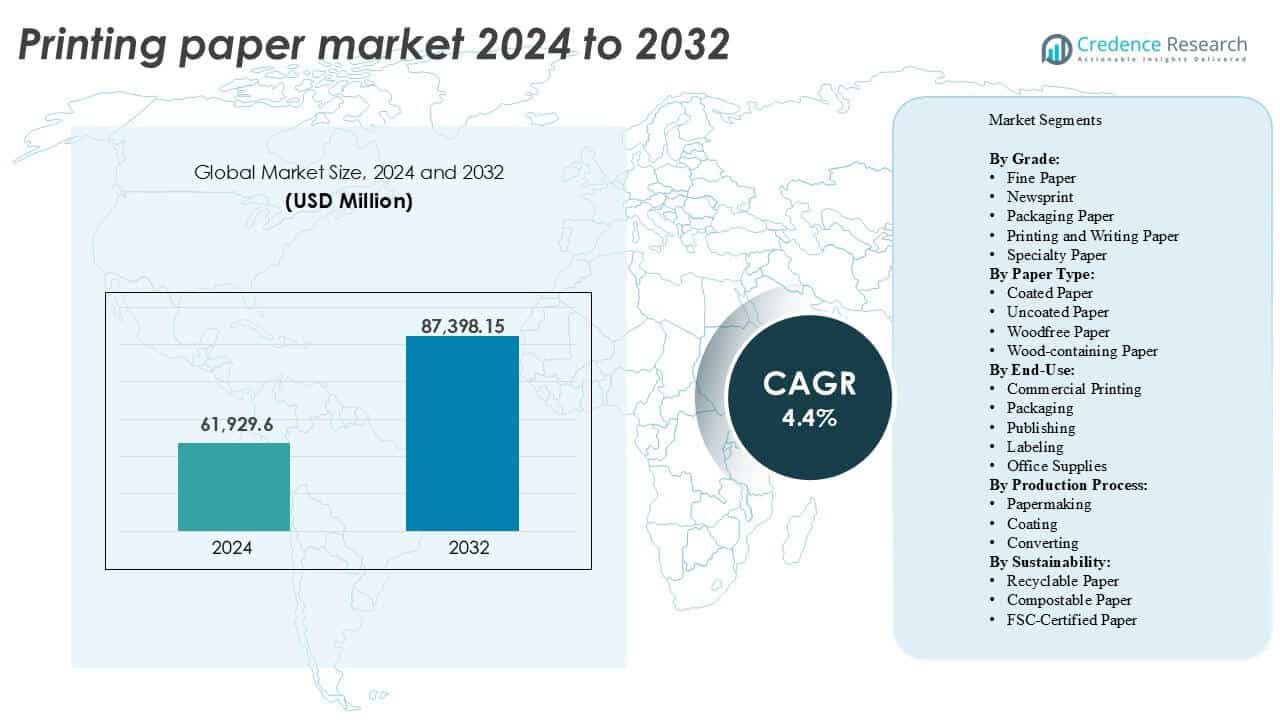
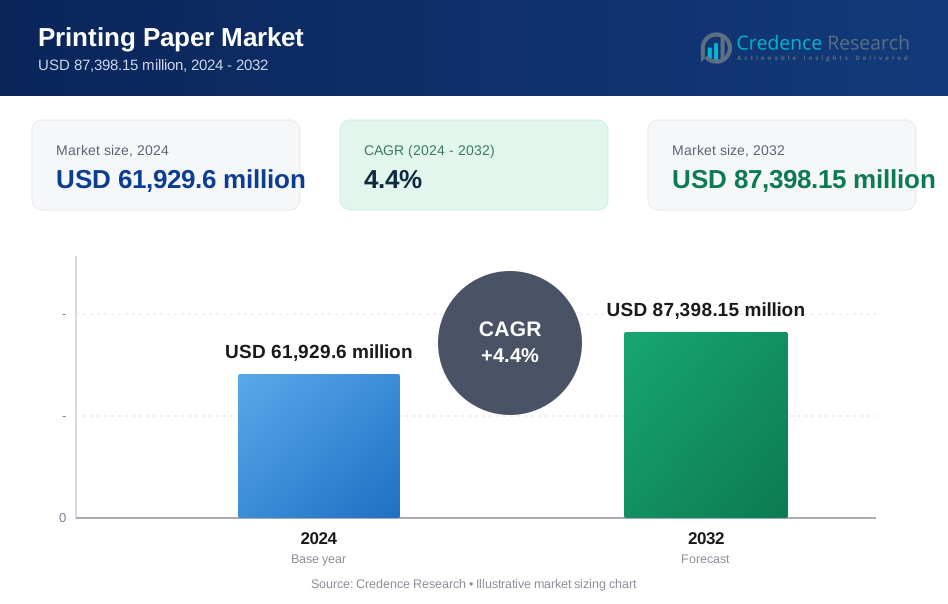
The printing paper market size was valued at USD 61,929.6 million in 2024 and is anticipated to reach USD 87,398.15 million by 2032, at a CAGR of 4.4% during the forecast period.
| REPORT ATTRIBUTE | DETAILS |
|---|---|
| Historical Period | 2020-2023 |
| Base Year | 2024 |
| Forecast Period | 2025-2032 |
| Printing Paper Market Size 2024 | USD 61,929.6 million |
| Printing Paper Market, CAGR | 4.4% |
| Printing Paper Market Size 2032 | USD 87,398.15million |
The printing paper market is led by major players such as International Paper Company, Stora Enso Oyj, UPM-Kymmene Corporation, Sappi Limited, Mondi Group, and Asia Pulp & Paper Group. These companies hold significant shares due to their extensive production capacities, global distribution networks, and diversified product portfolios. They actively invest in sustainable paper grades and digital-print-compatible solutions to meet evolving demand. Asia-Pacific stands as the dominant region, accounting for over 35% of the global market share in 2024. This leadership stems from strong consumption in China, India, and Japan across publishing, packaging, and educational sectors. Europe and North America follow, supported by demand for FSC-certified and high-quality coated papers in commercial printing and labeling applications.
Market Insights
- The global printing paper market was valued at USD 61,929.6 million in 2024 and is projected to reach USD 87,398.15 million by 2032, growing at a CAGR of 4.4% during the forecast period.
- Rising demand from commercial printing, publishing, and education sectors continues to drive market growth, especially in developing economies with high literacy rates and print-focused curricula.
- Trends such as eco-friendly paper production, FSC certification, and increased use of paper in customized packaging and labeling applications are shaping product innovation.
- The market is competitive with leading players like International Paper, UPM-Kymmene, Stora Enso, and Sappi Limited focusing on sustainable production, regional expansion, and digital-print-compatible paper types.
- Asia-Pacific leads the global market with over 35% share, followed by Europe at 25%, while Printing and Writing Paper remains the largest segment, accounting for over 40% of total volume due to its wide use in office, education, and publishing.
Market Segmentation Analysis:
By Grade
In the printing paper market, Printing and Writing Paper holds the dominant share, accounting for over 40% of total volume in 2024. Its widespread use across office environments, educational institutions, and publishing sectors supports high consumption. Governments and corporations drive stable demand through routine documentation and official records. Despite digitalization, physical documentation remains essential in many economies. Specialty paper shows rising growth potential in security printing, decorative uses, and luxury packaging. Packaging paper gains traction in e-commerce and FMCG applications. Fine paper maintains niche demand in high-end printing, while newsprint continues declining due to digital media substitution.
- For instance, in 2023, Asia Pulp & Paper (APP) reported a total global production of 13.9 million metric tons of pulp and paper. This output supports their supply of printing paper, tissue, and packaging to schools, governments, and businesses in more than 150 countries.
By Paper Type
Uncoated Paper leads the paper type segment with a market share exceeding 45% in 2024. Its dominance is supported by cost efficiency, printability, and compatibility with a wide range of commercial printers. This type is widely used in books, office papers, and notepads, where high ink absorption and fast drying are needed. Coated paper remains significant in magazine and catalog production due to its smooth finish and vibrant image reproduction. Woodfree paper finds strong demand in high-quality publishing, while wood-containing paper caters to budget-sensitive applications such as flyers and mass distribution print jobs.
- For example, Domtar has an annual production capacity of 2.2 million tons of uncoated freesheet paper, covering products like office papers and printing and publishing
By End-Use
Commercial Printing emerged as the largest end-use segment, holding over 35% share in 2024. The segment includes brochures, advertising materials, and business documents, which continue to require high-volume printing. Enterprises and marketing agencies drive ongoing demand despite growing digital alternatives. Packaging follows closely due to the surge in retail, cosmetics, and food applications where custom printed packaging enhances brand visibility. Publishing remains steady in academic and educational sectors, while office supplies support consistent consumption of copier and notepad paper. Labeling shows moderate growth as product identification and regulatory compliance needs expand across industries.
Key Growth Drivers
Sustained Demand from Commercial Printing and Publishing
The printing paper market continues to benefit from the steady requirement for high-volume output across commercial printing and publishing sectors. Despite the rise of digital formats, printed brochures, magazines, textbooks, and business documents remain essential in many regions, especially where internet penetration is moderate. Educational institutions, public administrations, and corporate offices sustain a consistent need for printing paper. In countries like India and parts of Southeast Asia, exam papers, student materials, and government records heavily rely on traditional printing formats. This drives demand for printing and writing paper grades, especially uncoated and woodfree variants. Offset printers and publishing houses maintain bulk procurement contracts, ensuring volume stability. Furthermore, government-mandated hard-copy documentation in legal and administrative processes adds to recurring paper needs. The durability, archival properties, and ease of handling associated with paper-based documents make them indispensable in multiple industries, preserving the relevance of printing paper despite digital alternatives.
- For instance, Navneet Education Ltd. (NEL), a leading provider of educational content in India with a 65% market share in Western India, produces a wide range of textbooks and supplemental materials, primarily using uncoated woodfree paper and eco-friendly agro-fiber alternatives.
Growing Packaging Sector and Customization Needs
The expansion of the global packaging industry fuels strong growth in the printing paper market, particularly within the packaging paper segment. E-commerce, FMCG, and food industries increasingly use printed paper-based packaging for labels, wrapping, and branding. This trend supports rising consumption of specialty paper and coated variants, especially those compatible with high-resolution print finishes. Brands seek customized, sustainable packaging solutions to enhance visual appeal and consumer engagement. The shift from plastic to paper packaging, driven by environmental regulations, further boosts paper-based alternatives. Small and mid-sized businesses also invest in affordable printed packaging to reinforce branding in local markets. Digital printing technologies, including inkjet and laser systems, make short-run, customized paper printing more accessible. As consumer goods markets grow, particularly in Asia-Pacific and Latin America, the demand for flexible printed packaging solutions using paper substrates is expected to rise steadily, encouraging investments across converting and printing operations within the paper industry.
- For instance, WestRock (now Smurfit Westrock) provides fiber-based food packaging for global clients like Nestlé and Unilever, utilizing high-opacity coated paperboard to ensure vivid branding and recyclability for billions of consumer units annually.
Shift Toward Sustainable and Certified Paper Products
Environmental sustainability is becoming a major growth lever in the printing paper market. Regulatory pressures, consumer awareness, and corporate ESG goals are accelerating the demand for eco-friendly paper solutions. Products labeled as recyclable, compostable, or FSC-certified are gaining traction across printing, packaging, and labeling applications. Brands are increasingly replacing plastic-based labels and wraps with sustainable paper alternatives to meet compliance requirements and boost environmental appeal. Governments in Europe and North America are mandating responsible sourcing and recyclability labeling, further driving demand for paper with verified green credentials. Additionally, print service providers now promote eco-friendly options as part of their value-added services, enabling end-users to align with green procurement policies. Sustainability not only serves as a compliance measure but also provides marketing advantages. As large buyers shift toward greener procurement, producers of environmentally certified printing paper stand to gain long-term contracts and higher-margin opportunities, reinforcing sustainability as a core growth driver.
Key Trends & Opportunities
Rise in Digital and Hybrid Printing Techniques
The growing adoption of digital printing methods is reshaping the printing paper landscape. Inkjet and laser printing systems offer faster turnaround, lower setup costs, and support for short-run jobs. This trend has expanded demand for papers optimized for digital print compatibility, including quick-drying coated and uncoated variants. Hybrid printing, which integrates digital and offset methods, allows personalized content without sacrificing volume efficiency. Personalized packaging, promotional mailers, and direct marketing materials benefit from this flexibility. Paper manufacturers are responding with surface-treated papers designed for high-resolution digital imaging and better toner adhesion. As SMEs and digital-first brands seek affordable customization, the use of digital-compatible printing paper continues to grow. This opens new opportunities in small-batch commercial print jobs, localized packaging, and event-specific printed material segments. Paper producers aligned with digital workflows and hybrid systems are likely to capture greater market share in the evolving printing ecosystem.
- For instance, Mondi’s Color Copy original paper is optimized for laser and inkjet systems, supporting resolutions up to 2400 dpi with grammages ranging from 90 to 400 gsm.
Emerging Markets Driving Volume Expansion
Developing economies across Asia, Africa, and Latin America present significant growth potential for the printing paper market. Rising literacy rates, school enrollment, and public infrastructure development in these regions sustain demand for printing and writing paper, especially uncoated and wood-containing types. Local publishing and examination boards rely on printed formats, driving bulk orders. At the same time, urbanization and growth in small businesses spur demand for commercial printing, labels, and office paper products. Affordable paper options dominate in these cost-sensitive markets, prompting investments in regional production facilities. Governments in countries like India and Indonesia continue to distribute paper-based educational content in rural areas, while new packaging regulations support paper-based solutions. As import dependency declines and domestic capacity expands, local manufacturers gain cost and lead-time advantages. The volume potential from these emerging economies supports long-term industry growth, particularly for players able to scale and customize products to regional preferences.
Key Challenges
Digital Substitution in Office and Publishing Applications
One of the most significant challenges facing the printing paper market is the ongoing shift to digital formats in business, education, and media. Enterprises increasingly rely on electronic documentation, cloud storage, and digital communication tools, reducing the need for printed reports, memos, and forms. Likewise, educational institutions adopt digital classrooms and e-learning platforms, curbing textbook printing volumes. In publishing, e-books and online newspapers capture a growing share of reader attention, impacting demand for newsprint and fine paper. This digital migration reduces recurring volumes and challenges traditional supply chains built on high-capacity runs. Moreover, the reduced frequency of printing in offices diminishes demand for copier and general-purpose paper. Paper manufacturers must now diversify into value-added segments like specialty grades or sustainable packaging to offset the volume loss. Those unable to adapt to digital disruption risk margin pressure and lower utilization across production assets.
Volatile Raw Material and Energy Costs
Fluctuating input prices present a persistent challenge for the printing paper industry. The cost of wood pulp, the primary raw material, remains highly sensitive to global supply-demand imbalances, climate conditions, and trade regulations. Any disruption in forest product supply chains such as export restrictions, natural disasters, or transportation bottlenecks—directly impacts paper production costs. Additionally, papermaking is an energy-intensive process, and rising electricity and fuel costs can erode margins, especially for small and mid-sized producers. The volatility in oil prices also affects the cost of chemical additives and coated paper finishes. In some regions, paper mills face power shortages or regulatory hurdles in sourcing biomass fuels. These factors force producers to pass on costs to customers or absorb losses. Managing input volatility while maintaining product affordability remains a key operational challenge, especially in price-sensitive markets and amid global efforts to transition to more sustainable, cost-stable raw material sources.
Regional Analysis
North America
North America accounted for approximately 22% of the global printing paper market share in 2024, driven by steady demand in commercial printing, labeling, and publishing. The U.S. dominates regional consumption due to its large corporate sector, educational institutions, and high-volume printing needs across packaging. Demand remains strong for coated and uncoated papers compatible with digital and offset printing technologies. However, sustainability regulations and digital substitution influence purchasing patterns. Canada supports demand through FSC-certified paper production and exports. As sustainability and specialty paper segments grow, regional manufacturers invest in recycled paper lines and advanced converting capabilities.
Europe
Europe held around 25% of the printing paper market share in 2024, with Germany, France, and the UK leading consumption. The region emphasizes environmentally certified paper products, driving demand for FSC and PEFC-certified grades. Packaging and labeling applications fuel growth due to e-commerce expansion. Demand for coated and woodfree papers remains high in publishing and marketing. Regulatory pressures on plastic use accelerate paper adoption in sustainable packaging. Print advertising, though declining, still contributes to steady volumes in key sectors. European paper manufacturers focus on energy-efficient production and closed-loop recycling to meet stringent environmental norms.
Asia-Pacific
Asia-Pacific dominated the printing paper market with over 35% share in 2024, led by China, India, and Japan. Rapid industrialization, rising literacy, and expanding packaging needs support high demand for uncoated, coated, and wood-containing papers. China remains the largest producer and consumer due to its massive publishing and educational sectors. India sees growing demand in school books, exams, and commercial printing. Japan leads in high-end printing and sustainable paper solutions. As digitalization advances gradually, traditional print segments continue to hold volume. Local manufacturers focus on cost-efficient, large-scale output to meet domestic and export demand.
Latin America
Latin America captured about 9% of the printing paper market in 2024, with Brazil and Mexico as leading contributors. Commercial printing and publishing remain major end-uses, while demand from packaging continues rising due to regional e-commerce growth. The market leans toward uncoated and wood-containing paper types due to affordability. Government procurement of educational materials adds to bulk volumes in public schools. Digital transition is slower in rural areas, preserving demand for print media. Sustainability trends are emerging, with local players starting to adopt recyclable paper formats. Imports from North America and Asia supplement regional shortfalls.
Middle East & Africa (MEA)
The MEA region accounted for nearly 7% of the global printing paper market in 2024. Demand is driven by commercial printing, office supplies, and growing publishing activities in education-focused economies like Egypt, South Africa, and the UAE. GCC countries invest in smart packaging and customized printing, increasing demand for coated and specialty papers. Import reliance remains high due to limited domestic production, especially in Sub-Saharan Africa. However, infrastructure development and growing retail sectors spur packaging-related paper demand. Regional paper usage patterns vary by economic development, with educational and government printing dominating in low- to mid-income economies.
Market Segmentations:
By Grade:
- Fine Paper
- Newsprint
- Packaging Paper
- Printing and Writing Paper
- Specialty Paper
By Paper Type:
- Coated Paper
- Uncoated Paper
- Woodfree Paper
- Wood-containing Paper
By End-Use:
- Commercial Printing
- Packaging
- Publishing
- Labeling
- Office Supplies
By Production Process:
- Papermaking
- Coating
- Converting
By Sustainability:
- Recyclable Paper
- Compostable Paper
- FSC-Certified Paper
By Geography:
- North America
- U.S.
- Canada
- Mexico
- Europe
- Germany
- France
- U.K.
- Italy
- Spain
- Rest of Europe
- Asia Pacific
- China
- Japan
- India
- South Korea
- South-east Asia
- Rest of Asia Pacific
- Latin America
- Brazil
- Argentina
- Rest of Latin America
- Middle East & Africa
- GCC Countries
- South Africa
- Rest of the Middle East and Africa
Competitive Landscape
The competitive landscape of the printing paper market features a mix of global conglomerates and regional manufacturers competing across product grades, sustainability features, and production scale. Leading players such as International Paper Company, UPM-Kymmene, Stora Enso, and Nippon Paper maintain strong market positions through vertically integrated operations and global supply chains. Companies like Sappi Limited and Mondi Group focus on coated, specialty, and environmentally certified papers, catering to high-value packaging and publishing segments. Nine Dragons Paper, Lee & Man, and Asia Pulp & Paper dominate in Asia with cost-efficient production and export capacity. Innovation in recycled and FSC-certified products is a key focus among top players amid rising environmental regulations. Strategic partnerships, acquisitions, and capacity expansions are common, especially in emerging markets with rising demand. Players also invest in energy-efficient technologies and digital printing compatibility to meet evolving customer needs. Price competition, raw material volatility, and digital substitution remain central challenges across the competitive landscape.
Key Player Analysis
- Smurfit Kappa Group plc
- UPM-Kymmene Corporation
- Nine Dragons Paper Limited
- Stora Enso Oyj
- Lee & Man Paper Manufacturing Ltd.
- Asia Pulp & Paper Group
- Mitsubishi Paper Mills Limited
- Nippon Paper Industries Co. Ltd.
- International Paper Company
- WestRock Company
- Mondi Group
- Svenska Cellulosa Aktiebolaget
- Georgia-Pacific LLC
- Rengo Co. Ltd.
- BJ Ball Paper
- Sappi Limited
Recent Developments
- In December 2023, DS Smith announced a €16 million investment (approximately US$ 17.3–17.6 million) to increase production capacity at its plant in Kruševac, Serbia
- In August 2023, Sichuan Huaqiao Fenghuang Paper and Voith successfully started up the highly productive PM 6 XcelLine paper machine for high-quality packaging paper.
- In 2023, NEPA achieved the completion of its renewal & mill development plan authorised by the government of India to diversify in the product sector by producing paper for printing and writing.
Report Coverage
The research report offers an in-depth analysis based on Grade, Paper Type, End-Use, Production Process, Sustainability and Geography. It details leading market players, providing an overview of their business, product offerings, investments, revenue streams, and key applications. Additionally, the report includes insights into the competitive environment, SWOT analysis, current market trends, as well as the primary drivers and constraints. Furthermore, it discusses various factors that have driven market expansion in recent years. The report also explores market dynamics, regulatory scenarios, and technological advancements that are shaping the industry. It assesses the impact of external factors and global economic changes on market growth. Lastly, it provides strategic recommendations for new entrants and established companies to navigate the complexities of the market.
Future Outlook
- Demand for sustainable and recyclable paper products will grow due to environmental regulations and corporate ESG goals.
- Digital printing technologies will drive the need for compatible paper grades with improved ink absorption and print quality.
- Asia-Pacific will continue to dominate global consumption, supported by educational demand and commercial printing needs.
- Specialty and coated papers will gain market share in high-end packaging and promotional materials.
- Paper usage in customized retail packaging and labeling will expand with the growth of e-commerce and FMCG sectors.
- Manufacturers will invest in energy-efficient and low-emission production technologies to reduce operational costs.
- Emerging markets in Latin America and Africa will show increased demand due to infrastructure development and urbanization.
- Industry players will focus on vertical integration to manage raw material volatility and improve margins.
- The shift toward plastic-free packaging will boost demand for paper-based alternatives in multiple industries.
- Digital substitution will continue to challenge traditional office and publishing paper segments.
Request a Free Sample
Fill in your details and we'll send you a free sample report.
- Sample data tables & charts
- Research methodology
Need a Custom Version of This Report?
Tailor the scope, geography, or segments to your exact requirements.
- Custom geography or segment scope
- Direct access to our analyst team
Frequently Asked Questions
What is the current market size for the printing paper market, and what is its projected size in 2032?
At what Compound Annual Growth Rate is the printing paper market projected to grow between 2024 and 2032?
Which printing paper market segment held the largest share in 2024?
What are the primary factors fueling the growth of the printing paper market?
Who are the leading companies in the printing paper market?
Which region commanded the largest share of the printing paper market in 2024?
Table of Content
Chapter 1. Report Introduction
- 1.1 Report Description & Purpose
- 1.1.1 Report Title & Market Definition
- 1.1.2 Unique Selling Propositions (USP) & Key Differentiators
- 1.1.3 Value Proposition for Stakeholders
- 1.2 Research Objectives
- 1.2.1 Market Sizing Objectives (Volume & Revenue)
- 1.2.2 Segmentation Objectives
- 1.2.3 Competitive Intelligence Objectives
- 1.2.4 Forecast & Scenario Objectives
- 1.3 Report Scope
- 1.3.1 Printing Paper Scope – Types & Subtypes Covered
- 1.3.2 Geographic Scope – Regions & Countries Covered
- 1.3.3 Historical Period, Base Year & Forecast Period (2024; forecast to 2032)
- 1.3.4 Inclusions & Exclusions
- 1.4 HS Code & Classification Framework
- 1.5 Currency, Units & Pricing Basis
- 1.6 Target Stakeholders
- 1.7 Limitations & Assumptions
Chapter 2. Executive Summary
- 2.1 Global Printing Paper Market Snapshot
- 2.1.1 Market Size – Historical (2024) & Forecast (2024-2032) (2024: USD 61,929.6 million → 2032: USD 87,398.15 million)
- 2.1.2 Volume & Revenue – Global Totals
- 2.1.3 Key Market Highlights – Top Five Facts
- 2.2 Printing Paper Market Segmentation Snapshot
- 2.2.1 Market Split by Region – 2024 vs. 2032
- 2.3 Competitive Snapshot
- 2.3.1 Top 10 Players by Revenue Share – 2024
- 2.3.2 Top 10 Players by Volume Share – 2024
- 2.3.3 Recent Strategic Developments (18-Month Summary)
- 2.4 Key Investment Highlights & Strategic Conclusions
Chapter 3. Printing Paper Market Dynamics & Industry Analysis
- 3.1 Market Overview & Context
- 3.1.1 Printing Paper Market Position in the Broader Automotive Value Chain
- 3.1.2 OEM vs. Replacement Market Dynamics
- 3.1.3 Market Maturity & Development Stage by Region
- 3.2 Printing Paper Market Drivers
- 3.3 Printing Paper Market Restraints & Challenges
- 3.4 Printing Paper Market Opportunities
- 3.5 Porter's Five Forces Analysis
- 3.5.1 Threat of New Entrants
- 3.5.2 Bargaining Power of Suppliers
- 3.5.3 Bargaining Power of Buyers
- 3.5.4 Threat of Substitutes
- 3.5.5 Competitive Rivalry – Intensity Assessment
- 3.6 Printing Paper Value Chain Analysis
- 3.6.1 Upstream – Raw Material/Input Suppliers
- 3.6.1.1 Raw Material/Input 1
- 3.6.1.2 Raw Material/Input 2
- 3.6.1.3 Raw Material/Input 3
- 3.6.2 Midstream – Production/Manufacturing/Service Delivery
- 3.6.2.1 Production/Process Overview
- 3.6.2.2 Key Facility Locations & Capacity by Manufacturer
- 3.6.3 Downstream – Distribution & End Consumer
- 3.6.3.1 Primary Channel – B2B/OEM
- 3.6.3.2 Secondary Channels – Dealer, Retail, Online, Direct
- 3.6.4 Value Chain Profitability Analysis
- 3.6.1 Upstream – Raw Material/Input Suppliers
- 3.7 PESTEL Analysis
- 3.7.1 Political Factors
- 3.7.2 Economic Factors
- 3.7.3 Social Factors
- 3.7.4 Technological Factors
- 3.7.5 Environmental Factors
- 3.7.6 Legal Factors
- 3.8 Printing Paper Supply Chain Analysis
- 3.8.1 Raw Material/Input Supply Risk Assessment
- 3.8.2 Manufacturing Concentration Risk (Geographic Exposure)
- 3.8.3 Trade Disruption Impact Analysis
- 3.9 Regulatory & Policy Landscape
Note: The regulatory and policy landscape section covers regulations based on their applicability to the market, Printing Paper category, geography, and scope of the study. Only regulatory frameworks with a material impact on operations, compliance, trade, sustainability, or market access are analyzed in detail.
Chapter 4. Key Investment Pockets & Opportunity Analysis
- 4.1 Printing Paper Market Attractiveness Analysis
- 4.1.1 By Region – Investment Attractiveness Matrix (Volume × CAGR)
- 4.2 Absolute Revenue Growth Opportunity
- 4.2.1 By Region – Absolute USD Growth Through 2032
- 4.3 Incremental Volume Opportunity
- 4.3.1 By Region – Incremental Volume Through 2032
- 4.3.2 Segment – Incremental Volume
- 4.4 Emerging Submarket Opportunity Deep Dive (Subject to Applicability)
- 4.5 Emerging Market Opportunity Scorecards
- 4.5.1 United States
- 4.5.2 Europe
- 4.5.3 Asia
- 4.5.4 Middle East & Africa
Note: Emerging Market Opportunity Scorecards will be included based on relevance and strategic importance. Regions listed are indicative and may vary depending on data availability and market dynamics.
Chapter 5. Printing Paper Import-Export Analysis & Trade Flows
- 5.1 Global Trade Overview
- 5.1.1 Global Export Value by Country (2024)
- 5.1.2 Global Export Volume by Country (2024)
- 5.1.3 Global Import Value by Country (2024)
- 5.1.4 Global Import Volume by Country (2024)
- 5.1.5 Net Trade Balance by Country (2024)
- 5.2 Export Analysis – Segment
- 5.2.1 Type 1 (HS Code)
- 5.2.2 Type 2 (HS Code)
- 5.2.3 Type 3 (HS Code)
- 5.2.4 Type 4 (HS Code)
- 5.2.5 Type 5 (HS Code)
- 5.3 Import Analysis – Segment
- 5.3.1 Type 1 (HS Code)
- 5.3.2 Type 2 (HS Code)
- 5.3.3 Type 3 (HS Code)
- 5.3.4 Type 4 (HS Code)
- 5.3.5 Type 5 (HS Code)
- 5.4 Average Unit Trade Prices
- 5.4.1 Average Export Price – Segment & Country
- 5.4.2 Average Import Price – Segment & Source Country
- 5.4.3 Price Trends (2024)
- 5.5 Key Trade Route Analysis
- 5.5.1 Trade Route 1
- 5.5.2 Trade Route 2
- 5.5.3 Trade Route 3
- 5.5.4 Trade Route 4
- 5.5.5 Trade Route 5
- 5.6 Trade Policy Impact Assessment
- 5.6.1 US Anti-Dumping & Section 301 Tariffs
- 5.6.2 EU Customs Union Impact
- 5.6.3 Major Free Trade Agreements
- 5.6.4 USMCA Rules of Origin
Note: Trade policy analysis will be included only where relevant to the Printing Paper market.
Chapter 6. Competitive Landscape & Company Benchmarking
- 6.1 Printing Paper Market Concentration & Structure
- 6.1.1 Herfindahl-Hirschman Index (HHI) – vs. 2024
- 6.1.2 Tier 1, Tier 2 & Tier 3 Market Structure
- 6.1.3 Global, Regional & Local Player Dynamics
- 6.2 Printing Paper Market Share Analysis – 2024
- 6.2.1 Global Revenue Share by Company
- 6.2.2 Global Volume Share by Company
- 6.2.3 Regional Revenue Share
- 6.2.4 Market Share Evolution ( vs. 2024)
- 6.2.5 OEM Segment Share by Company
- 6.2.6 Replacement Segment Share by Company
- 6.3 Production/Delivery Capacity & Facility Analysis
- 6.3.1 Global Installed Capacity
- 6.3.2 Capacity Utilization Rates
- 6.3.3 Production/Output Volume
- 6.3.4 Facility Locations & Capacity Map
- 6.3.5 Planned Capacity Additions
- 6.4 Printing Paper Competitive Benchmarking Matrix
- 6.4.1 Revenue, Volume, CAGR & Profitability Comparison
- 6.4.2 Channel Revenue Mix
- 6.4.3 Geographic Revenue Exposure
- 6.4.4 R&D Intensity
- 6.4.5 Sustainability Maturity
- 6.5 Strategic Developments in Printing Paper (Last 24 Months)
- 6.5.1 Mergers, Acquisitions & Divestments
- 6.5.2 New Printing Paper Launches
- 6.5.3 Facility Expansions
- 6.5.4 Strategic Alliances, Joint Ventures & Partnerships
- 6.5.5 Distribution Expansion & Market Entry
- 6.5.6 Sustainability & ESG Initiatives
- 6.6 Competitive Strategy Mapping
- 6.6.1 Leader, Challenger, Follower & Niche Classification
- 6.6.2 Pricing Strategy Comparison
- 6.6.3 Channel Strategy Matrix
Note: Strategic developments are included based on their materiality and the availability of reliable information.
Chapter 7. Global Printing Paper Market – By Distribution Channel
- 7.1 Segment Overview
- 7.1.1 Volume & Revenue Split by Channel (2024 & 2032)
- 7.1.2 Channel Mix Evolution (2024-2032)
Chapter 8. Regional Market Analysis – Global Overview
- 8.1 Global Regional Overview
- 8.1.1 Regional Volume Share
- 8.1.2 Regional Revenue Share
- 8.1.3 Regional Volume by Region
- 8.1.4 Regional Revenue by Region
- 8.1.5 Regional Forecast Through 2032
- 8.2 Cross-Regional Segment Analysis
- 8.2.1 By Distribution Channel
- 8.2.2 By Brand/Price Tier
Chapter 9. North America Printing Paper Market
- 9.1 United States
- 9.2 Canada
- 9.3 Mexico
Chapter 10. Europe Printing Paper Market
- 10.1 Germany
- 10.2 France
- 10.3 Italy
- 10.4 United Kingdom
- 10.5 Spain
- 10.6 Poland
- 10.7 Russia
- 10.8 Netherlands
- 10.9 Belgium
- 10.10 Sweden
- 10.11 Denmark
- 10.12 Norway
- 10.13 Rest of Europe
Chapter 11. Asia Pacific Printing Paper Market
- 11.1 China
- 11.2 India
- 11.3 Japan
- 11.4 South Korea
- 11.5 Thailand
- 11.6 Indonesia
- 11.7 Vietnam
- 11.8 Malaysia
- 11.9 Australia
- 11.10 Rest of Asia Pacific
Chapter 12. Latin America Printing Paper Market
- 12.1 Brazil
- 12.2 Argentina
- 12.3 Colombia
- 12.4 Chile
- 12.5 Rest of Latin America
Chapter 13. Middle East Printing Paper Market
- 13.1 Saudi Arabia
- 13.2 United Arab Emirates
- 13.3 Turkey
- 13.4 Israel
- 13.5 Iran
- 13.6 Rest of the Middle East
Chapter 14. Africa Printing Paper Market
- 14.1 South Africa
- 14.2 Egypt
- 14.3 Nigeria
- 14.4 Morocco
- 14.5 Rest of Africa
Chapter 15. Printing Paper Company Profiles
- 15.1 [Company 01]
- 15.1.1 Company Overview
- 15.1.2 Key Management Personnel
- 15.1.3 Products & Services Portfolio
- 15.1.4 Financial Performance
- 15.1.5 Key Market Focus & Geographic Presence
- 15.1.6 Recent Developments & Strategic Initiatives
Note: The company profile list is preliminary and may change based on research findings, market developments, data availability, and client requirements.
Chapter 16. Appendices
- Appendix A – List of Abbreviations & Acronyms
- Appendix B – Industry Classification Code Reference – Full Series
- Appendix C – Production & Capacity Data Tables
- Appendix D – End-Use & Demand Base Tables
- Appendix E – Consumption & Replacement Rate Assumptions
- Appendix F – ASP Reference Tables
- Appendix G – Manufacturing & Facility Database
- Appendix H – Import-Export Data Tables
- Appendix I – Regulatory Summary Tables
- Appendix J – Primary Research Participant List (Anonymized)
- Appendix K – Primary Research Questionnaire Framework
- Appendix L – Data Sources & Bibliography
- Appendix M – Market Size Divergence & Source Comparison
Chapter 17. Research Methodology
- 17.1 Research Framework & Philosophy
- 17.2 Secondary Research – Sources, Hierarchy & Data Extraction
- 17.3 Data Modeling – Bottom-Up & Top-Down Market Sizing
- 17.4 Primary Research – Stakeholder Framework, LOI & Sample Sizes
- 17.5 Forecast Methodology – Regression, Scenario & Sensitivity Analysis
- 17.6 Quality Control – Four-Layer Validation Framework
- 17.7 Limitations & Standard Assumptions
- 17.8 Disclaimer
