
Market Overview
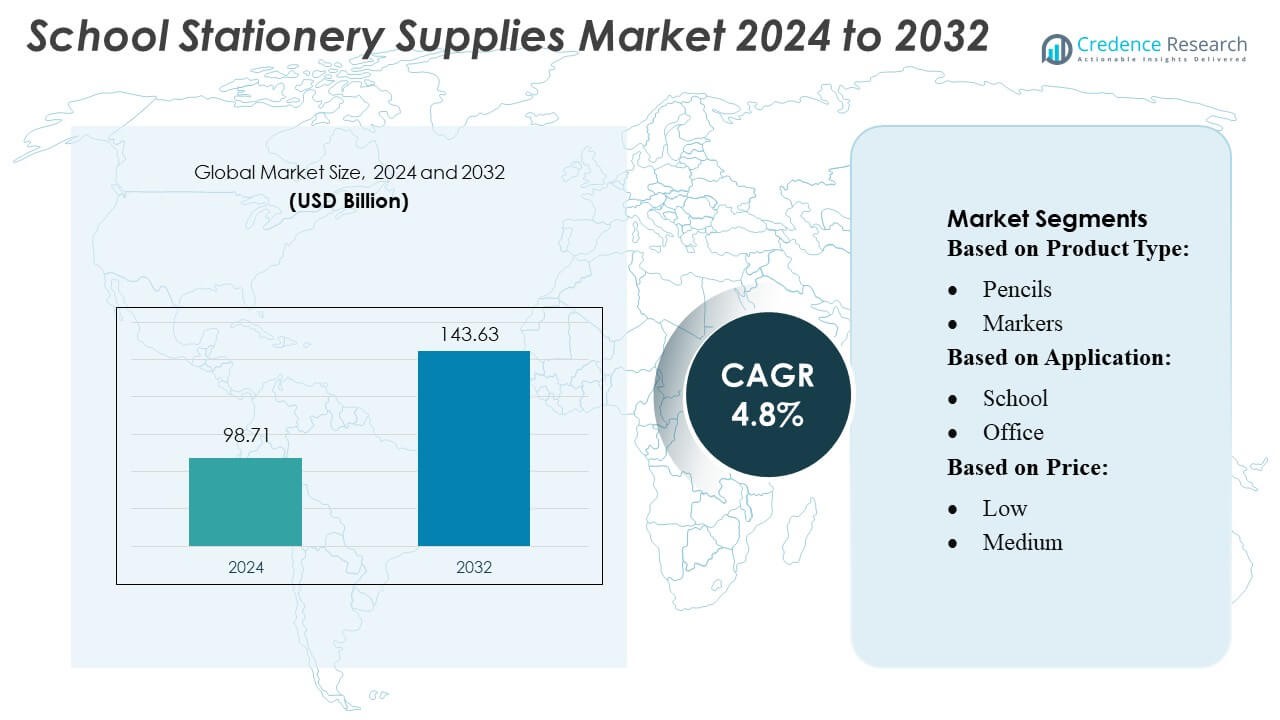
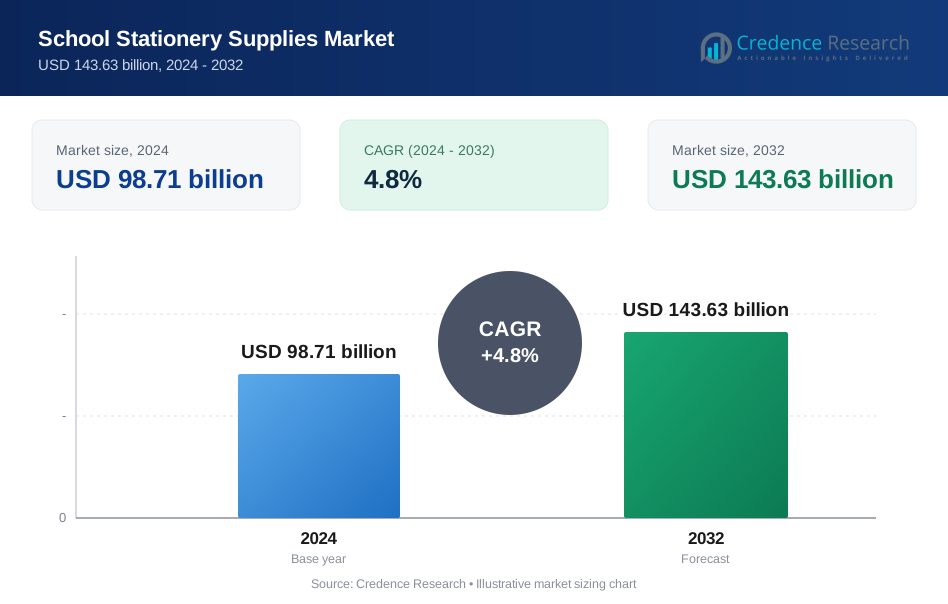
School Stationery Supplies Market size was valued USD 98.71 billion in 2024 and is anticipated to reach USD 143.63 billion by 2032, at a CAGR of 4.8% during the forecast period.
| REPORT ATTRIBUTE | DETAILS |
|---|---|
| Historical Period | 2020-2023 |
| Base Year | 2024 |
| Forecast Period | 2025-2032 |
| School Stationery Supplies Market Size 2024 | USD 98.71 Billion |
| School Stationery Supplies Market, CAGR | 4.8% |
| School Stationery Supplies Market Size 2032 | USD 143.63 Billion |
The global school stationery supplies market is led by major players such as Pilot, Kokuyo, Camlin, Newell Rubbermaid, Societe BIC, ACCO Brands, Adveo, Kaut-Bullinger, Lyreco, Ryman Group, and M&G, who together command a significant portion of the industry. These firms compete aggressively on product innovation, sustainability, and global distribution, leveraging strong R&D and regional networks. Regionally, the Asia-Pacific (APAC) market dominates, capturing approximately 45 % of the global market share, driven by growing student populations, rising educational investment, and strong demand for both traditional and eco-friendly stationery.
Market Insights
- The School Stationery Supplies Market reached USD 98.71 billion in 2024 and is projected to attain USD 143.63 billion by 2032 at a 4.8% CAGR, supported by rising student enrollment and consistent demand for essential learning materials.
- Increasing preference for eco-friendly stationery, digital-compatible writing tools, and ergonomic designs drives strong product innovation across writing instruments, office supplies, and accessory segments, boosting value growth.
- Competitive intensity remains high as leading players such as Pilot, Kokuyo, Camlin, Newell Rubbermaid, Societe BIC, ACCO Brands, Lyreco, Ryman Group, and M&G expand R&D capabilities and strengthen global distribution networks.
- Market restraints include growing digital adoption in classrooms, fluctuating raw material costs, and rising sustainability compliance requirements that increase production complexity for manufacturers.
- Regionally, Asia-Pacific holds around 45% of the global share, driven by large student populations, while writing instruments remain the largest segment, contributing a significant portion of total revenue due to their recurring demand.
Market Segmentation Analysis:
By Product Type
The school stationery supplies market remains dominated by writing instruments, which account for an estimated 38–42% market share, driven by consistent demand for pens, pencils, markers, and highlighters in daily academic activities. Pens lead within this category as the preferred writing tool due to their low cost, broad availability, and continuous product innovation such as ergonomic grips and quick-dry ink. Office stationery, including staplers, scissors, rulers, and paper clips, holds a stable secondary position as schools increasingly adopt structured organizational tools. Art supplies are growing steadily, supported by expanding creative-learning curricula and rising participation in extracurricular art programs.
- For instance, Faber-Castell reports producing more than 2.3 billion graphite and color pencils annually, and its Polychromos range features a precisely engineered 3.8-millimeter oil-based lead core.
By Application
The school segment dominates the market with an estimated 55–60% share, driven by mandatory academic requirements, large student populations, and recurring yearly purchases across grades. Demand is reinforced by rising school enrollments, increasing emphasis on project-based learning, and national education reforms that expand the use of art and writing products. The office segment contributes a modest but consistent share as administrative functions within schools require stationery for documentation and communication. The home segment gains traction due to the growth of home tutoring, digital-hybrid learning models, and parental spending on supplemental educational materials.
- For instance, Reynolds Pens documents that its widely used Reynolds 045 Fine Carbure ballpoint pen is engineered with a 0.7-millimeter fine-point tip designed for high durability and smooth writing, utilizing the company’s "laser tip technology.
By Price
The low-price segment leads the market with an estimated 60–65% share, supported by its affordability and mass adoption across public schools, budget-conscious households, and bulk procurement programs. Manufacturers in this category focus on cost efficiency and high-volume production of essential items such as pencils, pens, erasers, rulers, and sharpeners. The medium-price segment grows moderately as students and parents increasingly opt for better quality, durable, and aesthetically appealing products, particularly in writing instruments and art supplies. This shift is influenced by rising disposable incomes, brand awareness, and preference for long-lasting materials.
Key Growth Drivers
- Rising Enrollment Rates and Expanding K–12 Infrastructure
The School Stationery Supplies Market continues to grow as global K–12 enrollment increases and governments invest heavily in new educational infrastructure. Expanding public and private schools, improved access to education in developing economies, and national literacy initiatives are accelerating demand for essential stationery products. Increased classroom strength directly boosts recurring consumption of writing instruments, notebooks, art supplies, and organizational tools. Additionally, the rise of early childhood education and standardized learning kits fuels year-round procurement cycles, supporting steady market expansion.
- For instance, Mead’s Five-Star Wirebound 5-Subject Notebook features 200 perforated sheets of ink-bleed-resistant paper and a Spiral Lock wire binding engineered to prevent coil snagging.
- Increasing Consumer Preference for Premium and Ergonomic Products
The market benefits from a shift toward premium stationery that enhances writing comfort, durability, and user experience. Parents and schools increasingly prioritize high-quality pens, pencils, markers, and eco-friendly materials that offer better grip, smoother writing, and longer life cycles. Branded and design-centric stationery is gaining traction among students, creating higher-margin product opportunities. Manufacturers actively innovate in ink technology, anti-smudge formulations, and break-resistant leads, strengthening product differentiation. This demand for ergonomic and aesthetically enhanced stationery strengthens revenue growth across global markets.
- For instance, Linc Pens & Plastics Ltd. confirms that its flagship Linc Pentonic pen series uses a precision-cut 0.7-millimeter SS tip and an advanced low-viscosity ink system engineered for high-smoothness output.
- Growth of E-Commerce and Multi-Channel Retailing
E-commerce platforms play a critical role in driving stationery sales, offering broader product visibility, competitive pricing, and convenience for bulk and customized purchases. Online marketplaces and brand-specific portals allow suppliers to reach diverse customer groups, including schools, parents, and students. Digital payment adoption and faster delivery strengthen online buying behavior, particularly during peak back-to-school seasons. Multi-channel retailing, combining offline stores with online catalogs, enhances accessibility and helps brands introduce personalized bundles, subscription-based kits, and promotional offers that stimulate continuous demand.
Key Trends & Opportunities
1. Rapid Adoption of Sustainable and Eco-Friendly Materials
The industry is witnessing a strong trend toward sustainability as consumers and institutions prefer recyclable, biodegradable, and non-toxic stationery. Manufacturers increasingly use recycled paper, plant-based plastics, and natural inks to reduce carbon footprints. Regulatory pressure on single-use plastics further accelerates the shift toward greener alternatives. This creates opportunities for brands to launch certified eco-friendly product lines and integrate sustainability labels that appeal to environmentally conscious buyers. Companies offering transparent material sourcing and circular packaging models gain a competitive advantage.
- For instance, STAEDTLER SE has scaled production of its sustainable Lumocolor pens, whose barrels, caps, and end caps now consist of 97 %recycled plastic, as confirmed in sustainability progress report.
2. Rising Demand for Personalized and Themed Stationery
Customization is becoming a major opportunity as students increasingly prefer stationery reflecting personal style, characters, hobbies, or branding themes. Schools also adopt customized notebooks, planners, and writing kits featuring institutional logos. Advances in digital printing and on-demand production allow manufacturers to offer personalized designs at competitive costs. Seasonal collections, influencer-led designs, and limited-edition products further strengthen engagement. This trend supports higher pricing flexibility and helps brands differentiate in a competitive market while meeting evolving aesthetic expectations of young consumers.
- For instance, Artline India’s Softline Gel Pen is available in 12 vibrant ink colours, each built around a 0.7 mm or 1.0 mm ball diameter, enabling finely tailored sets for themed collections.
3. Increasing Integration of Digital-Aided Stationery Products
Hybrid learning environments are driving demand for digital-compatible stationery such as smart notebooks, erasable pens, stylus pens, and app-connected planning tools. These products bridge traditional writing with digital workflows, enhancing note-taking efficiency and organization. Growth in edtech adoption-especially in urban regions-creates opportunities for companies offering multifunctional products aligned with tablet-based learning. The trend is further supported by interest in productivity tools among older students. This segment, though niche, is expanding rapidly and expected to become a key differentiator for innovative brands.
Key Challenges
1. Rising Raw Material Costs and Price Volatility
Fluctuations in the cost of paper, plastics, ink, and packaging materials present ongoing challenges, particularly for budget-sensitive markets. Supply chain disruptions and global inflation increase production expenses, pressuring manufacturers to adjust pricing or absorb reduced margins. Smaller players struggle to maintain profitability while competing with established brands offering value-priced items. High logistics costs and import duties in several regions further strain operations. These challenges compel companies to optimize sourcing strategies, adopt cost-efficient materials, and streamline manufacturing processes.
2. Growing Competition from Digital Learning Tools
The expansion of digital classrooms and e-learning platforms reduces long-term dependence on traditional stationery items, especially notebooks, writing instruments, and art supplies. Tablets, e-notes, and stylus-based devices increasingly replace conventional writing tools in higher grades. Schools adopting digital curriculum models limit annual stationery procurement volumes. This shift pressures manufacturers to diversify into hybrid tools or specialized creative supplies that retain relevance in digital-centric environments. Companies unable to adapt risk losing market share to technology-driven alternatives that continue to reshape learning behavior.
Regional Analysis
North America
North America holds around 23% of the School Stationery Supplies Market, driven by high educational expenditure, widespread K–12 enrollment, and strong adoption of premium stationery products. The region benefits from established retail networks, including hypermarkets, bookstores, and expanding e-commerce platforms that support multi-channel distribution. Demand for eco-friendly and specialty stationery continues to rise as schools implement sustainability guidelines. The U.S. leads the region with significant consumption of writing instruments, art materials, and organizational tools. Growth remains stable due to consistent back-to-school spending and higher per-student expenditure compared with other global markets.
Europe
Europe accounts for approximately 28% of the global market, supported by a highly regulated education system, strong focus on sustainable stationery, and mature retail channels across the EU. Countries such as Germany, France, and the UK demonstrate steady demand for eco-certified notebooks, premium pens, and advanced writing tools. Government-backed literacy programs and expansion of early education continue to boost annual stationery consumption. The region sees rising adoption of recyclable materials and plastic-free products, creating opportunities for innovation. Despite market maturity, consistent replacement cycles and strong brand loyalty sustain Europe’s overall market dominance.
Asia-Pacific
Asia-Pacific dominates the School Stationery Supplies Market with approximately 34% share, driven by large student populations, rapid urbanization, and expanding education infrastructure in China, India, Indonesia, and Southeast Asia. The region benefits from strong domestic manufacturing capabilities, enabling cost-effective production of pens, notebooks, art supplies, and classroom essentials. Growing income levels and increased emphasis on academic performance boost purchasing of premium and innovative stationery. E-commerce adoption accelerates sales across urban and rural markets. APAC remains the fastest-growing region due to rising enrollment rates and government investment in universal education initiatives.
Latin America
Latin America holds around 8% of the market, supported by steady improvements in education access and increasing demand for affordable stationery solutions. Countries such as Brazil, Mexico, and Argentina drive consumption, with demand influenced by public school procurement programs and seasonal back-to-school campaigns. Economic volatility affects pricing sensitivity, prompting strong growth in low-cost writing instruments, notebooks, and basic school supplies. Expansion of retail chains and online marketplaces improves product availability across metropolitan areas. Despite modest growth rates, rising literacy programs and government investments continue to support stationery consumption across the region.
Middle East & Africa
The Middle East & Africa region accounts for approximately 7% of the global market, driven by expanding educational infrastructure in Gulf countries and increasing government focus on improving primary education access in Africa. The UAE and Saudi Arabia lead regional demand with high per-student spending and adoption of premium stationery. In contrast, African markets prioritize cost-efficient supplies due to budget constraints. Rising urbanization, growing youth populations, and expansion of private schools contribute to market growth. However, import dependence and economic disparities across countries create varied demand patterns and moderate overall growth.
Market Segmentations:
By Product Type:
- Pencils
- Markers
By Application:
- School
- Office
By Price:
- Low
- Medium
By Geography
- North America
- U.S.
- Canada
- Mexico
- Europe
- Germany
- France
- U.K.
- Italy
- Spain
- Rest of Europe
- Asia Pacific
- China
- Japan
- India
- South Korea
- South-east Asia
- Rest of Asia Pacific
- Latin America
- Brazil
- Argentina
- Rest of Latin America
- Middle East & Africa
- GCC Countries
- South Africa
- Rest of the Middle East and Africa
Competitive Landscape
The School Stationery Supplies Market features a diverse competitive ecosystem led by companies such as MUJI INDIA, Faber-Castell, Reynolds Pens, Maped, Mead, Linc Pens & Plastics Ltd., STAEDTLER SE, Artline India, 3M, and Fullmark Pte Ltd. The School Stationery Supplies Market remains highly competitive, characterized by a mix of global brands, regional manufacturers, and emerging private-label suppliers. Companies focus heavily on product quality, affordability, and design innovation to differentiate themselves in a largely commoditized segment. The market sees continuous investment in advanced writing technologies, sustainable materials, and premium stationery categories that appeal to students and institutions with rising quality expectations. E-commerce expansion intensifies competition as brands leverage digital platforms for broader reach, dynamic pricing, and customized product bundles. Retailers increasingly offer exclusive collections and back-to-school campaigns to attract volume sales, while manufacturers prioritize efficient supply chains and cost optimization to maintain margins. Growing demand for eco-friendly and digital-compatible stationery further drives innovation, pushing competitors to diversify portfolios and strengthen their presence across both mass-market and premium segments.
Key Player Analysis
- MUJI INDIA
- Faber-Castell
- Reynolds Pens
- Maped
- Mead
- Linc Pens & Plastics Ltd.
- STAEDTLER SE
- Artline India
- 3M
- Fullmark Pte Ltd.
Recent Developments
- In January 2025, Dynarex Corporation, a leading medical supply company, proudly announces the launch of LabChoice, a dynamic new line of laboratory products created for addressing changing priorities across various industries, including education, healthcare, food & beverage, research and other fields requiring precision tools.
- In November 2024, Grubhub announced today that it is adding office supplies to its marketplace in partnership with Office Depot, an operating company of The ODP Corporation. The platform will now feature items like paper supplies, writing tools, ink, and more, all available for on-demand delivery across over 800 locations.
- In September 2024, Labcon North America, a globally leading manufacturer of Earth Friendly laboratory disposables, formed a strategic collaboration with Polycarbin, an innovator in sustainable laboratory solutions for advancing a data-driven circular economy for pharma and life science companies.
- In May 2024, bioQ launched the world's first 100% biodegradable pen in India. It features a non-toxic ink, recycled paper refill, and options for a metal, paper, or bamboo exterior to reduce plastic waste.
Report Coverage
The research report offers an in-depth analysis based on Product Type, Application, Price and Geography. It details leading market players, providing an overview of their business, product offerings, investments, revenue streams, and key applications. Additionally, the report includes insights into the competitive environment, SWOT analysis, current market trends, as well as the primary drivers and constraints. Furthermore, it discusses various factors that have driven market expansion in recent years. The report also explores market dynamics, regulatory scenarios, and technological advancements that are shaping the industry. It assesses the impact of external factors and global economic changes on market growth. Lastly, it provides strategic recommendations for new entrants and established companies to navigate the complexities of the market.
Future Outlook
- The market is expected to grow steadily as global student enrollment increases and education access expands across developing regions.
- Demand for sustainable and recyclable stationery products will continue rising as schools and consumers prioritize environmentally responsible choices.
- Digital-compatible stationery, including smart notebooks and hybrid writing tools, will gain traction as blended learning models become more common.
- E-commerce will strengthen its role as a major distribution channel, driven by convenience, wider assortments, and competitive pricing.
- Premium and ergonomically designed stationery will experience higher adoption as parents seek quality and durability.
- Personalization and themed stationery will see strong demand, supported by customization technologies and seasonal product launches.
- Manufacturers will invest more in lightweight, non-toxic, and innovative materials to comply with evolving safety and sustainability standards.
- Private-label brands from retailers will expand their presence, increasing price competition in mass-market categories.
- Partnerships between suppliers, schools, and online marketplaces will streamline procurement and improve product accessibility.
- Rising urbanization and changing student lifestyles will boost demand for stylish, multifunctional, and trend-driven stationery items.
Request a Free Sample
Fill in your details and we'll send you a free sample report.
- Sample data tables & charts
- Research methodology
Need a Custom Version of This Report?
Tailor the scope, geography, or segments to your exact requirements.
- Custom geography or segment scope
- Direct access to our analyst team
Frequently Asked Questions
What is the current market size for the School Stationery Supplies Market, and what is its projected size in 2032?
At what Compound Annual Growth Rate is the School Stationery Supplies Market projected to grow between 2025 and 2032?
Which School Stationery Supplies Market segment held the largest share in 2024?
What are the primary factors fueling the growth of the School Stationery Supplies Market?
Who are the leading companies in the School Stationery Supplies Market?
Which region commanded the largest share of the School Stationery Supplies Market in 2024?
Table of Content
Chapter 1. Report Introduction
- 1.1 Report Description & Purpose
- 1.1.1 Report Title & Market Definition
- 1.1.2 Unique Selling Propositions (USP) & Key Differentiators
- 1.1.3 Value Proposition for Stakeholders
- 1.2 Research Objectives
- 1.2.1 Market Sizing Objectives (Volume & Revenue) (Volume Where Applicable)
- 1.2.2 Segmentation Objectives
- 1.2.3 Competitive Intelligence Objectives
- 1.2.4 Forecast & Scenario Objectives
- 1.3 Report Scope
- 1.3.1 School Stationery Supplies Scope – Segments & Subsegments Covered
- 1.3.2 Geographic Scope – Regions & Countries Covered
- 1.3.3 Historical Period, Base Year & Forecast Period (2024; forecast to 2032)
- 1.3.4 Inclusions & Exclusions
- 1.4 Industry Classification & Applicable Codes
- 1.5 Currency, Measurement Units & Valuation Basis
- 1.6 Target Stakeholders
- 1.7 Limitations & Assumptions
Chapter 2. Executive Summary
- 2.1 Global School Stationery Supplies Market Snapshot
- 2.1.1 Market Size – Historical (2024) & Forecast (2024-2032) (2024: USD 98.71 billion → 2032: USD 143.63 billion)
- 2.1.2 Volume & Revenue – Global Totals (Volume Where Applicable)
- 2.1.3 Key Market Highlights – Top Five Facts
- 2.2 School Stationery Supplies Market Segmentation Snapshot
- 2.2.1 Market Split by Region – 2024 vs. 2032
- 2.3 Competitive Snapshot
- 2.3.1 Top 10 Players by Revenue Share – 2024
- 2.3.2 Top 10 Players by Volume Share – 2024 (Volume Where Applicable)
- 2.3.3 Recent Strategic Developments (18-Month Summary)
- 2.4 Key Investment Highlights & Strategic Conclusions
Chapter 3. School Stationery Supplies Market Dynamics & Industry Analysis
- 3.1 Market Overview & Context
- 3.1.1 School Stationery Supplies Market Position in the Broader Industry Value Chain
- 3.1.2 Demand Structure & Purchasing Dynamics
- 3.1.3 Market Maturity & Development Stage by Region
- 3.2 School Stationery Supplies Market Drivers
- 3.3 School Stationery Supplies Market Restraints & Challenges
- 3.4 School Stationery Supplies Market Opportunities
- 3.5 Porter's Five Forces Analysis
- 3.5.1 Threat of New Entrants
- 3.5.2 Bargaining Power of Suppliers
- 3.5.3 Bargaining Power of Buyers
- 3.5.4 Threat of Substitutes
- 3.5.5 Competitive Rivalry – Intensity Assessment
- 3.6 School Stationery Supplies Value Chain Analysis
- 3.6.1 Upstream – Key Inputs, Resources & Suppliers
- 3.6.1.1 Key Input/Resource 1
- 3.6.1.2 Key Input/Resource 2
- 3.6.1.3 Key Input/Resource 3
- 3.6.2 Midstream – Core Operations & Value Creation
- 3.6.2.1 Operating Model & Process Overview
- 3.6.2.2 Key Operating Locations & Capabilities by Company
- 3.6.3 Downstream – Market Channels & End Users
- 3.6.3.1 Direct Sales & Customer Engagement Channels
- 3.6.3.2 Indirect Sales, Intermediaries & Partner Channels
- 3.6.4 Value Chain Profitability Analysis
- 3.6.1 Upstream – Key Inputs, Resources & Suppliers
- 3.7 PESTEL Analysis
- 3.7.1 Political Factors
- 3.7.2 Economic Factors
- 3.7.3 Social Factors
- 3.7.4 Technological Factors
- 3.7.5 Environmental Factors
- 3.7.6 Legal Factors
- 3.8 School Stationery Supplies Supply Chain Analysis
- 3.8.1 Critical Input & Resource Availability Risk Assessment
- 3.8.2 Supplier & Operational Concentration Risk (Geographic Exposure)
- 3.8.3 Supply & Service Disruption Impact Analysis
- 3.9 Regulatory & Policy Landscape
Note: The regulatory and policy landscape section covers regulations based on their applicability to the market, School Stationery Supplies category, geography, and scope of the study. Only regulatory frameworks with a material impact on operations, compliance, trade, sustainability, or market access are analyzed in detail.
Chapter 4. Key Investment Pockets & Opportunity Analysis
- 4.1 School Stationery Supplies Market Attractiveness Analysis
- 4.1.1 By Region – Investment Attractiveness Matrix (Market Size × CAGR)
- 4.2 Absolute Revenue Growth Opportunity
- 4.2.1 By Region – Absolute Revenue Growth Through 2032
- 4.3 Incremental Demand Opportunity
- 4.3.1 By Region – Incremental Demand Through 2032
- 4.3.2 Segment – Incremental Demand
- 4.4 Emerging Submarket Opportunity Deep Dive (Subject to Applicability)
- 4.5 Priority Market Opportunity Scorecards
- 4.5.1 United States
- 4.5.2 Europe
- 4.5.3 Asia
- 4.5.4 Middle East & Africa
Note: Priority market opportunity scorecards reflect the geographic scope and strategic relevance of the study. Listed markets are indicative and may be adapted to the industry.
Chapter 5. School Stationery Supplies Cross-Border Trade & Market Access Analysis
- 5.1 International Trade & Cross-Border Activity Overview
- 5.1.1 Global Export Value by Country (2024)
- 5.1.2 Global Export Volume by Country (2024) (Volume Where Applicable)
- 5.1.3 Global Import Value by Country (2024)
- 5.1.4 Global Import Volume by Country (2024) (Volume Where Applicable)
- 5.1.5 Net Trade Balance by Country (2024)
- 5.2 Export Analysis – Segment
- 5.2.1 Category 1 (Applicable Classification Code)
- 5.2.2 Category 2 (Applicable Classification Code)
- 5.2.3 Category 3 (Applicable Classification Code)
- 5.2.4 Category 4 (Applicable Classification Code)
- 5.2.5 Category 5 (Applicable Classification Code)
- 5.3 Import Analysis – Segment
- 5.3.1 Category 1 (Applicable Classification Code)
- 5.3.2 Category 2 (Applicable Classification Code)
- 5.3.3 Category 3 (Applicable Classification Code)
- 5.3.4 Category 4 (Applicable Classification Code)
- 5.3.5 Category 5 (Applicable Classification Code)
- 5.4 Cross-Border Pricing & Transaction Benchmarks
- 5.4.1 Export Pricing – Segment & Country
- 5.4.2 Import Pricing – Segment & Source Country
- 5.4.3 Price Trends (2024)
- 5.5 Key Cross-Border Trade & Delivery Routes
- 5.5.1 Cross-Border Trade/Delivery Route 1
- 5.5.2 Cross-Border Trade/Delivery Route 2
- 5.5.3 Cross-Border Trade/Delivery Route 3
- 5.5.4 Cross-Border Trade/Delivery Route 4
- 5.5.5 Cross-Border Trade/Delivery Route 5
- 5.6 Trade Policy & Market Access Impact Assessment
- 5.6.1 Tariff & Non-Tariff Barriers
- 5.6.2 Regional Trade & Economic Integration Frameworks
- 5.6.3 Bilateral & Multilateral Trade Agreements
- 5.6.4 Cross-Border Operating, Licensing & Localization Requirements
Note: This chapter applies where cross-border trade or delivery is relevant to School Stationery Supplies. Goods, services, and digital offerings are assessed using applicable classifications and transaction measures. Import-export volumes, trade balances, and route analyses are included only where meaningful to the market.
Chapter 6. Competitive Landscape & Company Benchmarking
- 6.1 School Stationery Supplies Market Concentration & Structure
- 6.1.1 Herfindahl-Hirschman Index (HHI) – vs. 2024
- 6.1.2 Leading, Mid-Sized & Emerging Player Structure
- 6.1.3 Global, Regional & Local Player Dynamics
- 6.2 School Stationery Supplies Market Share Analysis – 2024
- 6.2.1 Global Revenue Share by Company
- 6.2.2 Global Volume Share by Company (Volume Where Applicable)
- 6.2.3 Regional Revenue Share
- 6.2.4 Market Share Evolution ( vs. 2024)
- 6.2.5 Company Market Share by Key Segment
- 6.2.6 Company Market Share by Customer Group
- 6.3 Operating Scale, Capacity & Infrastructure Analysis
- 6.3.1 Global Operating Scale & Supply Capacity
- 6.3.2 Resource Utilization & Operating Efficiency
- 6.3.3 Output, Service Delivery & Activity Metrics
- 6.3.4 Operating Footprint & Infrastructure Map
- 6.3.5 Planned Operational & Capacity Expansion
- 6.4 School Stationery Supplies Competitive Benchmarking Matrix
- 6.4.1 Revenue, Growth, Profitability & Operating Metric Comparison
- 6.4.2 Channel Revenue Mix
- 6.4.3 Geographic Revenue Exposure
- 6.4.4 R&D Intensity
- 6.4.5 Sustainability Maturity
- 6.5 Strategic Developments in School Stationery Supplies (Last 24 Months)
- 6.5.1 Mergers, Acquisitions & Divestments
- 6.5.2 New Products, Services & Solutions in School Stationery Supplies
- 6.5.3 Operational & Infrastructure Expansions
- 6.5.4 Strategic Alliances, Joint Ventures & Partnerships
- 6.5.5 Distribution Expansion & Market Entry
- 6.5.6 Sustainability & ESG Initiatives
- 6.6 Competitive Strategy Mapping
- 6.6.1 Leader, Challenger, Follower & Niche Classification
- 6.6.2 Pricing Strategy Comparison
- 6.6.3 Channel Strategy Matrix
Note: Strategic developments are included based on their materiality and the availability of reliable information.
Chapter 7. Global School Stationery Supplies Market – By Sales & Delivery Channel
- 7.1 Segment Overview
- 7.1.1 Volume & Revenue Split by Channel (2024 & 2032) (Volume Where Applicable)
- 7.1.2 Channel Mix Evolution (2024-2032)
Chapter 8. Regional Market Analysis – Global Overview
- 8.1 Global Regional Overview
- 8.1.1 Regional Volume Share (Volume Where Applicable)
- 8.1.2 Regional Revenue Share
- 8.1.3 Regional Volume by Region (Volume Where Applicable)
- 8.1.4 Regional Revenue by Region
- 8.1.5 Regional Forecast Through 2032
- 8.2 Cross-Regional Segment Analysis
- 8.2.1 By Sales & Delivery Channel
- 8.2.2 By Competitive Positioning & Price Tier
Chapter 9. North America School Stationery Supplies Market
- 9.1 United States
- 9.2 Canada
- 9.3 Mexico
Chapter 10. Europe School Stationery Supplies Market
- 10.1 Germany
- 10.2 France
- 10.3 Italy
- 10.4 United Kingdom
- 10.5 Spain
- 10.6 Poland
- 10.7 Russia
- 10.8 Netherlands
- 10.9 Belgium
- 10.10 Sweden
- 10.11 Denmark
- 10.12 Norway
- 10.13 Rest of Europe
Chapter 11. Asia Pacific School Stationery Supplies Market
- 11.1 China
- 11.2 India
- 11.3 Japan
- 11.4 South Korea
- 11.5 Thailand
- 11.6 Indonesia
- 11.7 Vietnam
- 11.8 Malaysia
- 11.9 Australia
- 11.10 Rest of Asia Pacific
Chapter 12. Latin America School Stationery Supplies Market
- 12.1 Brazil
- 12.2 Argentina
- 12.3 Colombia
- 12.4 Chile
- 12.5 Rest of Latin America
Chapter 13. Middle East School Stationery Supplies Market
- 13.1 Saudi Arabia
- 13.2 United Arab Emirates
- 13.3 Turkey
- 13.4 Israel
- 13.5 Iran
- 13.6 Rest of the Middle East
Chapter 14. Africa School Stationery Supplies Market
- 14.1 South Africa
- 14.2 Egypt
- 14.3 Nigeria
- 14.4 Morocco
- 14.5 Rest of Africa
Chapter 15. School Stationery Supplies Company Profiles
- 15.1 [Company 01]
- 15.1.1 Company Overview
- 15.1.2 Key Management Personnel
- 15.1.3 Products & Services Portfolio
- 15.1.4 Financial Performance
- 15.1.5 Key Market Focus & Geographic Presence
- 15.1.6 Recent Developments & Strategic Initiatives
Note: The company profile list is preliminary and may change based on research findings, market developments, data availability, and client requirements.
Chapter 16. Appendices
- Appendix A – List of Abbreviations & Acronyms
- Appendix B – Industry Classification Code Reference – Full Series
- Appendix C – Supply, Output & Operating Capacity Data Tables
- Appendix D – End-Use & Demand Base Tables
- Appendix E – Demand, Adoption & Usage Assumptions
- Appendix F – Pricing & Revenue Metric Reference Tables
- Appendix G – Company Operations & Infrastructure Database
- Appendix H – Cross-Border Trade & Activity Data Tables (Where Applicable)
- Appendix I – Regulatory Summary Tables
- Appendix J – Primary Research Participant List (Anonymized)
- Appendix K – Primary Research Questionnaire Framework
- Appendix L – Data Sources & Bibliography
- Appendix M – Market Size Divergence & Source Comparison
Chapter 17. Research Methodology
- 17.1 Research Framework & Philosophy
- 17.2 Secondary Research – Sources, Hierarchy & Data Extraction
- 17.3 Data Modeling – Bottom-Up & Top-Down Market Sizing
- 17.4 Primary Research – Stakeholder Framework, LOI & Sample Sizes
- 17.5 Forecast Methodology – Regression, Scenario & Sensitivity Analysis
- 17.6 Quality Control – Four-Layer Validation Framework
- 17.7 Limitations & Standard Assumptions
- 17.8 Disclaimer
