
Quick answer
A ferrous sulphate plant upgrades by-product copperas and spent pickling liquor into dried monohydrate and purified grades for water treatment, fertilizer and feed. A 30,000 tonne a year monohydrate plant needs fixed CapEx of about USD 3–5 million at an Asian industrial park and an assumed USD 7–12 million at a U.S. or EU site. Gross margin runs about 18–30% with low-cost feedstock, and central-case payback takes about 5–9 years.
Viable for operators with contracted low-cost copperas or pickling liquor and feed, fertilizer or pharma grades; weak as a virgin-acid bulk commodity play.
Ferrous Sulphate plant: key highlights
| Parameter | Indicative value | Note |
|---|---|---|
| Plant capacity | 30,000 TPA (100 TPD) monohydrate | About 49,000 TPA heptahydrate-equivalent feed, 300 working days |
| Total CapEx | USD 3–5 million | Asian industrial park; assumed USD 7–12 million at a U.S. or EU site; excludes working capital |
| Raw material share of operating cost | 60–68% | Feedstock cost is the main margin driver |
| Gross margin | 18–30% | At assumed feedstock of USD 50–70 per tonne and assumed delivered or premium-grade prices of USD 190–260 per tonne |
| Payback period | 5–9 years | Central case at 80% utilization, on CapEx plus working capital margin; extreme pairings about 4–17 years |
| IRR | Available in report | Post-tax, 10-year model |
| Break-even | Available in report | Capacity utilization basis |
Ranges assume a 30,000 TPA monohydrate greenfield plant on 3 acres at an Asian chemical park, 2026 prices, 80% utilization, feedstock assumed at USD 50–70 per tonne of heptahydrate equivalent, assumed delivered or premium-grade prices of USD 190–260 per tonne, and conversions at 7 yuan, 90 rupees and 14,500 rupiah per USD. U.S. and EU costs are assumed multiples. The full report is customizable to any country.
What is ferrous sulphate?
Ferrous sulphate, or iron(II) sulphate, is a pale green iron salt sold mainly as the heptahydrate (FeSO4·7H2O), known as copperas or green vitriol, with about 20% iron, and as the dried monohydrate (FeSO4·H2O), with about 30% iron in commercial grades. Most tonnage does not begin as a purpose-made chemical. It leaves titanium dioxide plants and steel pickling lines as a co-product, and processors then dry, purify or granulate it for sale.
The Harmonized System classifies the product under HS 2833.29, other sulphates, a basket subheading that also covers other metal sulphates. National lines separate it, such as the U.S. tariff line 2833.29.20 for sulphates of iron. Water utilities use it as a coagulant and phosphate remover, cement makers use it to reduce hexavalent chromium, and farmers apply it to correct iron deficiency and control moss in turf. Feed premix makers, pigment producers and pharmaceutical firms buy higher-purity grades, and lithium iron phosphate cathode chains now use it as an iron source.
Ferrous sulphate market overview and global demand
Credence Research does not publish a dedicated report on this product, and this page does not state a USD market size for it. Physical indicators give a clearer picture. A 2026 review in RSC's EES Batteries puts by-product generation from sulfate-route titanium dioxide at up to about 6 million tonnes a year, against about 12 million tonnes of total global capacity, with water treatment taking about 30% of the market and a price near USD 100 per tonne.
Titanium dioxide therefore sets much of the supply. The USGS estimates world pigment capacity at 9.9 million tonnes at year-end 2025, including 6 million tonnes in China, or about 61%. The global titanium dioxide market was about USD 25.4 billion in 2025, based on Credence Research's USD 23.8 billion for 2024 and 6.9% CAGR. The pigment industry's drift toward the chloride route, which yields no ferrous sulphate, threatens long-term supply.
Demand spreads across regions and uses. Europe and North America buy coagulants, a segment within the water treatment chemicals market, which Credence Research values at USD 34.25 billion for 2024. Asian and Latin American growers buy iron micronutrients, and the WHO essential medicines list has included ferrous salt with folic acid since 1982.
Battery demand changed pricing in 2026. Chinese trade data show the Chinese price rising from 650 to 760 yuan per tonne between December 2025 and January 2026 as pigment output fell, followed by a sharp second-quarter surge and a pullback. Merchant processors now compete with iron phosphate plants for the same crystals.
Ferrous sulphate manufacturing process
The commercial route for a merchant plant is upgrading, not synthesis. Copperas from pigment plants and iron-rich spent pickling liquor from steel mills arrive cheaply because generators must otherwise treat or dispose of them. Dissolving scrap iron in fresh sulphuric acid also works and suits pharmaceutical and food grades, where a clean feed matters, but it rarely competes on bulk prices. One tonne of heptahydrate holds about 0.20 tonnes of iron and needs about 0.35 tonnes of sulphuric acid before losses.
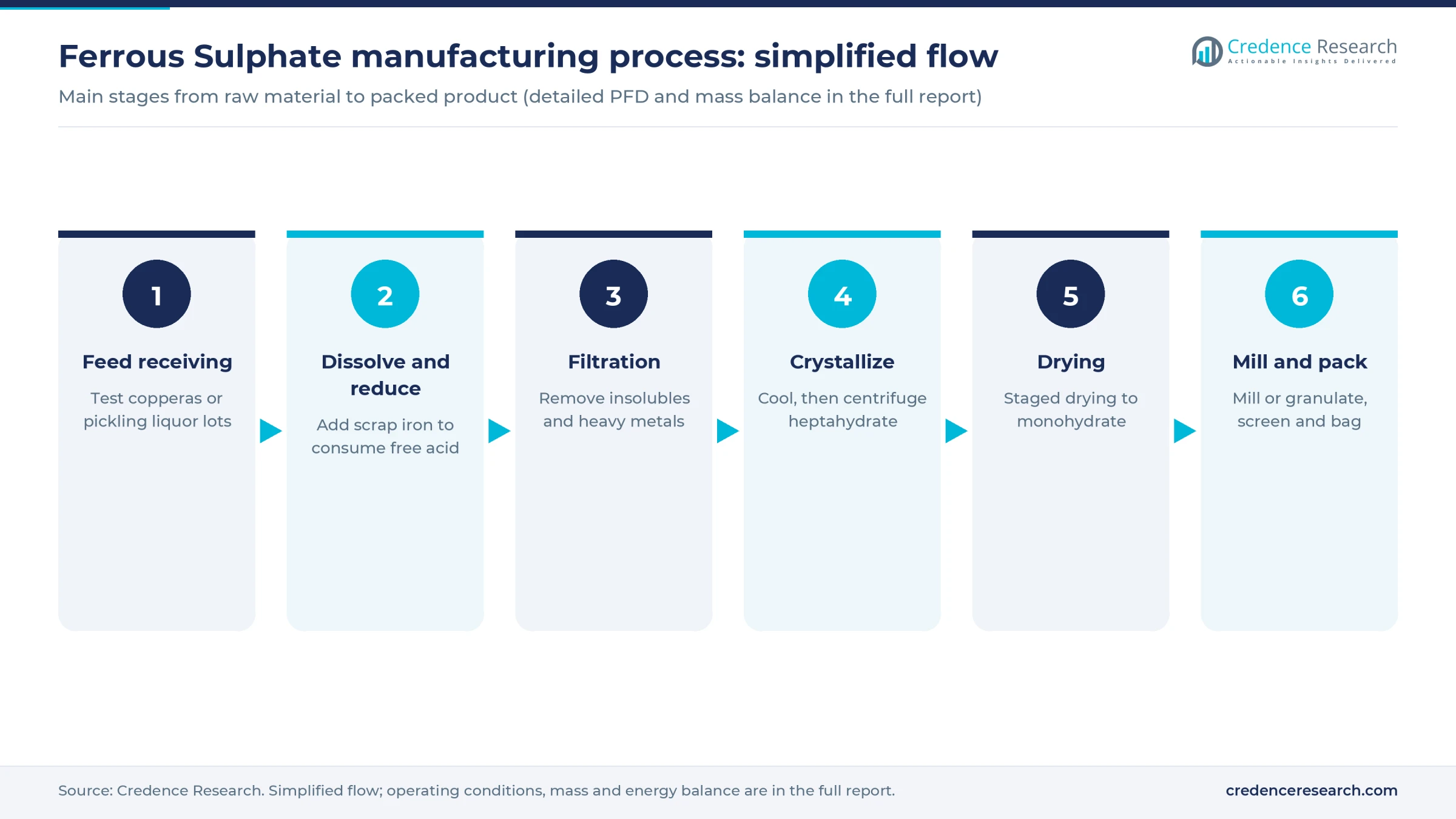
- Feedstock receiving. Each lot is tested for iron, free acid, titanium, manganese and heavy metals, because contaminants decide which grade the plant can sell.
- Dissolving and reduction. Crystals or liquor go to acid-resistant tanks. Operators add scrap iron to neutralize free acid and reduce ferric iron back to the ferrous state.
- Filtration. Filter presses remove insoluble residues, and purified grades get extra polishing or sulfide treatment to lower lead, arsenic and cadmium.
- Crystallization. Cooling crystallizers drop heptahydrate from the clarified liquor, and centrifuges separate crystals from mother liquor, which returns to the dissolver with a bleed to effluent treatment.
- Drying. Flash, rotary or fluid bed dryers drive off about 0.64 tonnes of water per tonne of monohydrate. Staged heating matters, because heptahydrate melts in its own crystal water near 64°C and can foul dryer walls, while overheating or excess air oxidizes iron to the ferric form.
- Milling and packing. Product is milled or granulated, screened and packed in 25 kg bags or bulk bags. Fertilizer buyers often prefer dust-free granules, and feed buyers specify fine powder.
Bulk water treatment sales can skip purification and drying altogether, so the plant's grade mix sets both its capital needs and its margin.
Ferrous sulphate plant setup cost
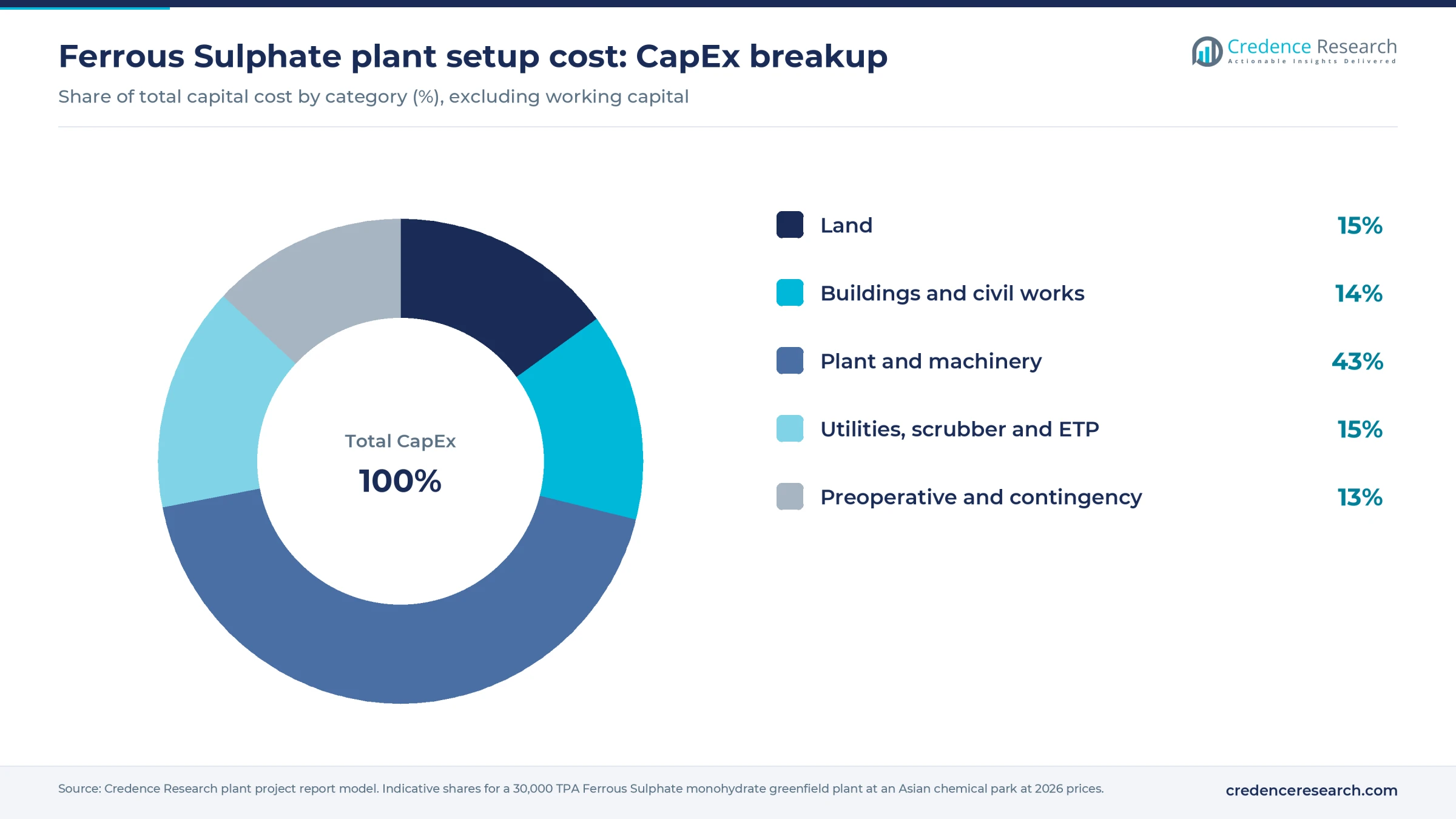
The indicative build is a 30,000 tonne a year monohydrate plant, or 100 tonnes a day over 300 days, on about 3 acres of serviced land. Fixed CapEx comes to about USD 3–5 million at an Asian chemical park and an assumed USD 7–12 million at a U.S. or EU site, where civil works, fabrication and permitting cost more. No disclosed plant gives both cost and tonnage, so this is a bottom-up estimate on assumed costs. Working capital of about USD 0.5–0.8 million is excluded, and the full report can be recast for any country.
Land shows how each row was built. At an assumed USD 40–55 per square meter, in line with chemical park allotment rates in western India, a 12,000 square meter plot costs about USD 500,000–640,000, or about 15% of CapEx at the midpoint. Rural U.S. land may cost less, and EU chemical parks often cost more, so this share moves widely by location.
Published design studies show why the scope matters. Indonesian university pre-designs for 20,000–25,000 tonne a year heptahydrate plants report fixed capital of about Rp 434–485 billion, or about USD 30–33 million, for full reactor trains on factored costs. Those studies imply profit far above current market prices, so they serve only as a ceiling, not as the base for this estimate.
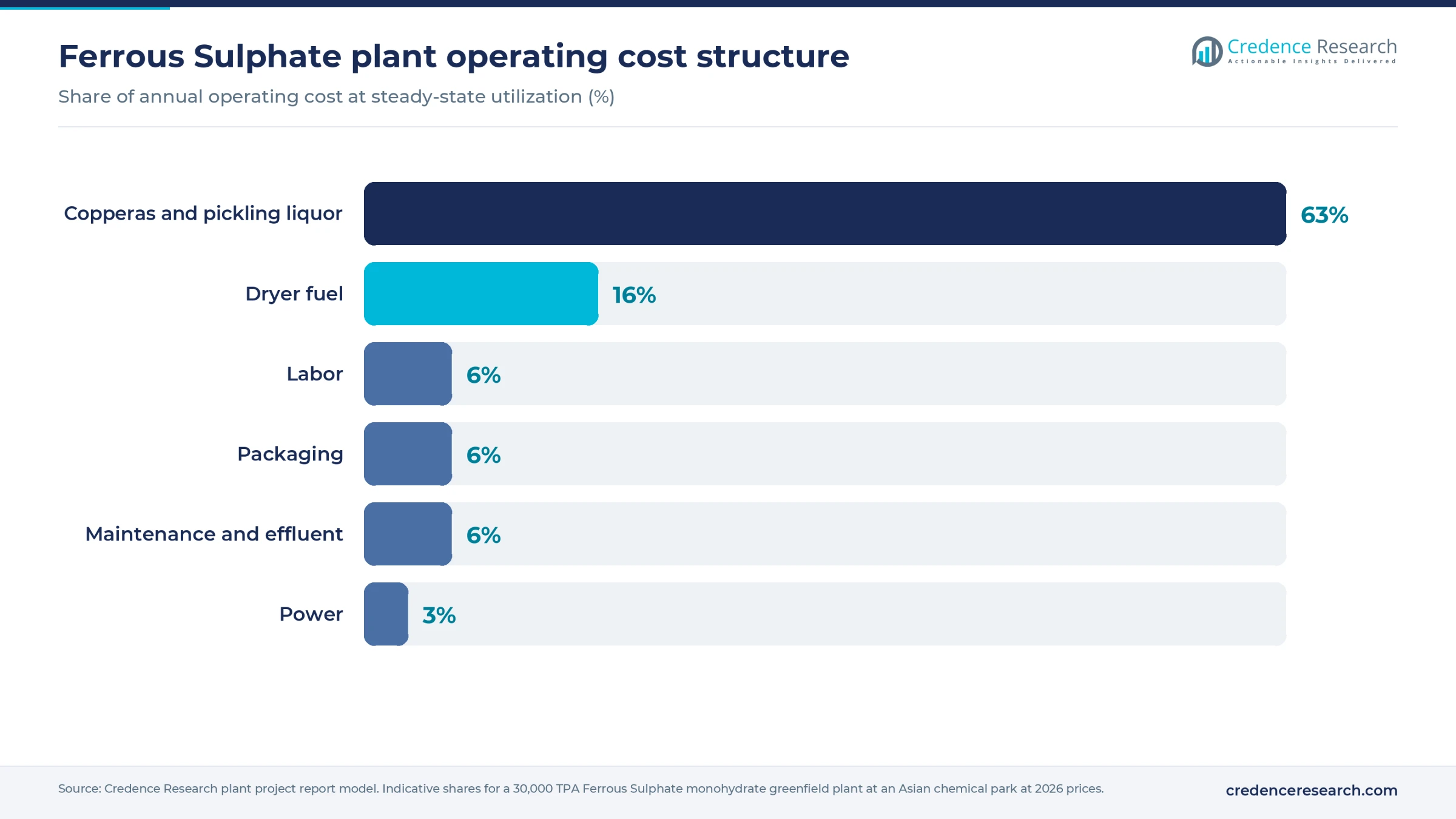
At the base case, feedstock is about 60–68% of cash cost, and dryer fuel is the next largest item. Each USD 10 per tonne change in copperas cost moves cash cost by about USD 16 per tonne of monohydrate.
Machinery and raw materials for a ferrous sulphate plant
Core equipment for a 100 tonne per day line includes the following items.
- Covered copperas storage, a bucket elevator and belt or screw feeders
- Rubber-lined or FRP dissolving and reduction tanks with agitators
- Filter presses and acid-resistant pumps
- Cooling crystallizers and basket or pusher centrifuges
- Flash, rotary or fluid bed dryers with hot air generators, cyclones and bag filters
- Mills, a granulator for fertilizer grades, vibrating screens and an automatic bagging line
- A wet scrubber, an effluent treatment plant and a lab able to test iron, ferric content, lead, arsenic and cadmium
Sourcing depends on proximity, since freight on a low-value wet salt can exceed its price. China holds most sulfate-route pigment output, so it is the main copperas source, with further plants in Europe, Japan, India and Canada. Steel pickling liquor is available around mills in China, India, the European Union, the United States, Japan and South Korea, though many mills now regenerate acid on site. Scrap iron comes from local steel fabricators. Sulphuric acid, tracked in the sulfuric acid market outlook, comes from smelters and sulfur burners, and its price follows sulfur. Natural gas or another dryer fuel is a key regional cost.
Ferrous sulphate business profit margin and ROI
Feedstock access decides this business's returns. October 2026 Henan market listings show heptahydrate mostly at 280–680 yuan per tonne, about USD 40–97, and dried 95% product at 580–1,200 yuan, about USD 83–171. An Indian supplier lists industrial monohydrate near 18 rupees per kilogram, or USD 200 per tonne. The base case assumes USD 190–260 per tonne, a delivered or premium-grade price for feed and fertilizer buyers. Commodity listings run lower, and a plant selling only at those Henan ex-works levels would barely cover cash cost.
Each tonne of monohydrate needs about 1.64 tonnes of heptahydrate equivalent. At an assumed USD 50–70 per tonne, that costs USD 82–115. Conversion adds an assumed USD 50–60 for fuel, power, labor, bags and maintenance, bringing cash cost to about USD 130–175 and central-case gross margin to about 18–30%. The risk is plain at spot prices: at 760 yuan per tonne, feedstock alone costs about USD 179, and the margin largely disappears. Virgin feed fares no better, with assumed scrap and acid costs of about USD 100–150 per tonne of heptahydrate.
At 80% utilization, 24,000 tonnes of sales yield about USD 5.4 million in revenue at the midpoint. After selling and freight costs, post-tax cash profit of about USD 0.3–0.85 million supports a central payback of about 5–9 years, with extreme pairings at about 4–17 years, on CapEx plus the working capital margin. Long feedstock contracts or a gate fee on spent liquor would shorten it.
| Metric | Value |
|---|---|
| Project IRR (post-tax) | Available in report |
| NPV | Available in report |
| ROI | Available in report |
| DSCR | Available in report |
| Break-even utilization | Available in report |
How to start a ferrous sulphate business, licenses and approvals
Every plant needs business and tax registration, zoning and building permits, an environmental permit covering dust, acid mist, wastewater and metal-bearing sludge, and occupational safety approval. Using spent liquor or pigment residues can also trigger waste handling permits, a point worth settling before signing supply contracts. Export or import registration applies to traded product. Sales claims then decide product approvals, with feed, food, drug, fertilizer and moss control grades each answering to a different authority.
| Market | Key approvals for ferrous sulphate |
|---|---|
| United States | TSCA inventory compliance for industrial grades; FDA rules for food and drug grades, with food-use ferrous sulfate affirmed as GRAS under 21 CFR 184.1315; EPA registration under FIFRA for moss control labels, for example EPA Reg. No. 83893-25; state fertilizer and feed registration; state air and water permits |
| European Union | REACH registration with ECHA at 1 tonne a year or more; feed additive authorization of both hydrates under Implementing Regulation (EU) 2017/2330 and feed establishment approval under Regulation (EC) No 183/2005; Fertilizing Products Regulation (EU) 2019/1009 for CE-marked micronutrients; iron sulphate approval under Regulation (EC) No 1107/2009 plus national authorization for moss control, with approval extended to May 31, 2030, by Implementing Regulation (EU) 2026/2348; national industrial emissions permits |
| India | Fertilizer (Inorganic, Organic or Mixed) (Control) Order, 1985, for the micronutrient grade; manufacturing license under the Drugs and Cosmetics Act for pharmaceutical grades; FSSAI license for food fortification sales; consent to establish and operate from the state pollution control board |
Key ferrous sulphate manufacturers and recent market developments
Supply splits between pigment producers and merchant processors. Kronos Worldwide sells iron-based co-products from its pigment plants for wastewater, pigment, cement and agricultural uses. Kemira makes iron coagulants and bought Thatcher's U.S. East Coast iron sulfate coagulant business in April 2025. In China, LB Group and Anada are large pigment producers, and Rech Chemical in Hunan markets feed and fertilizer monohydrate. Regional Indian suppliers cluster in Gujarat, serving growers through the agricultural micronutrients market.
- January 2026. International Chemical Investors Group agreed to buy Venator's German unit, including the Duisburg site, during insolvency proceedings, Speciality Chemicals Magazine reported, adding to uncertainty over European pigment-linked supply.
- June 2026. Chongqing Shengqing Water Treatment won environmental approval for a 3 million yuan upgrade adding a monohydrate hydration step at its 250,000 tonne a year polymeric ferric sulfate plant.
- July 2026. Anada's board approved in July 2026 a project of nearly 3.3 billion yuan in Tongling, combining 150,000 tonnes of titanium dioxide with 300,000 tonnes of iron phosphate fed by its own by-product, subject to shareholder approval.
What's inside the Ferrous Sulphate project report PDF
The report runs to 21 chapters. Open a chapter to see its sections.
1. Preface
2. Scope and Methodology
- 2.1 Objectives of the Study
- 2.2 Stakeholders
- 2.3 Research Methodology
- 2.4 Data Sources and Key Assumptions
3. Executive Summary
- 3.1 Market Snapshot
- 3.2 Project at a Glance (Capacity, CapEx, OpEx)
- 3.3 Key Financial Indicators (IRR, NPV, Payback, Break-even)
- 3.4 Feasibility Verdict
4. Product Overview
- 4.1 Ferrous Sulphate Definition and Properties
- 4.2 Grades and Specifications (BIS / ISO / ASTM)
- 4.3 HS Code and Classification
- 4.4 Key Applications
- 4.5 Substitutes
5. Global Ferrous Sulphate Market
- 5.1 Market Overview
- 5.2 Historical and Current Market Performance (Volume and Value)
- 5.3 Market Breakup by Grade / Type
- 5.4 Market Breakup by End-Use Industry
- 5.5 Market Breakup by Region
- 5.6 Market Drivers, Restraints and Trends
- 5.7 Value Chain Analysis
- 5.8 Market Forecast
6. Target Country Ferrous Sulphate Market Analysis
- 6.1 Demand and Supply Analysis
- 6.2 Installed Capacity vs Demand Gap
- 6.3 Import Dependence
- 6.4 Demand Forecast by End-Use
7. Trade Analysis
- 7.1 Imports by Volume, Value and Country
- 7.2 Exports by Volume, Value and Country
- 7.3 Trade Balance and Opportunities
8. Price Analysis
- 8.1 Historical Ferrous Sulphate Price Trends by Region
- 8.2 Raw Material / Feedstock Price Trends and Linkage
- 8.3 Price Forecast
- 8.4 Margins Across the Value Chain
9. Competitive Landscape
- 9.1 Market Structure
- 9.2 Key Players and Installed Capacities
- 9.3 Profiles of Key Players
- 9.4 Recent Developments (Expansions, M&A, New Plants)
10. Manufacturing Process and Technology
- 10.1 Comparison of Technology Routes
- 10.2 Selected Route and Process Flow Diagram
- 10.3 Unit Operations Involved
- 10.4 Chemical Reactions Involved
- 10.5 Mass Balance and Raw Material Requirements
- 10.6 Energy Balance
- 10.7 Quality Assurance Criteria and Technical Tests
- 10.8 By-products and Waste Handling
- 10.9 Technology Licensors / Providers
11. Project Details, Requirements and Costs
- 11.1 Land, Location and Site Development
- 11.1.1 Site Selection Criteria
- 11.1.2 Location Analysis
- 11.1.3 Land Requirement and Costs
- 11.1.4 Site Development Costs
- 11.2 Plant Layout
- 11.2.1 Layout Principles
- 11.2.2 Proposed Layout
- 11.2.3 Factors Influencing Layout
- 11.3 Civil Works and Buildings
- 11.4 Plant Machinery
- 11.4.1 Machinery Requirements and Specifications
- 11.4.2 Machinery Costs
- 11.4.3 Machinery Suppliers
- 11.5 Raw Materials
- 11.5.1 Requirements per Tonne of Output
- 11.5.2 Procurement and Sourcing
- 11.5.3 Costs
- 11.5.4 Suppliers
- 11.6 Packaging
- 11.6.1 Packaging Requirements
- 11.6.2 Packaging Costs
- 11.6.3 Packaging Suppliers
- 11.7 Storage and Material Handling
- 11.8 Transportation Requirements and Costs
- 11.9 Utilities
- 11.9.1 Power Requirements and Costs
- 11.9.2 Water Requirements and Costs
- 11.9.3 Steam, Fuel and Other Utilities
- 11.10 Manpower Requirements and Wages
12. Environment, Health, Safety and Sustainability
- 12.1 Effluent and Emissions Management
- 12.2 Hazard Classification and Safety Measures
- 12.3 Carbon Footprint
- 12.4 Green / Low-Carbon Process Options
13. Regulatory Procedures, Approvals and Certifications
- 13.1 Licences and Registrations
- 13.2 Environmental Clearances
- 13.3 Product Certifications (BIS, REACH, etc.)
- 13.4 Approval Timeline
14. Project Implementation Schedule
15. Project Economics
- 15.1 Capital Cost of the Project
- 15.2 Techno-Economic Parameters
- 15.3 Capacity Utilization and Ramp-up
- 15.4 Product Pricing and Margins
- 15.5 Income Projections
- 15.6 Expenditure Projections
- 15.7 Working Capital Requirement
- 15.8 Taxation
- 15.9 Depreciation
16. Financial Analysis
- 16.1 Projected Profit and Loss Account
- 16.2 Projected Cash Flow Statement
- 16.3 Projected Balance Sheet
- 16.4 Liquidity Analysis
- 16.5 Profitability Analysis (Payback, NPV, IRR, ROI)
- 16.6 Break-even Analysis
- 16.7 Debt Service Coverage Ratio (DSCR)
- 16.8 Sensitivity Analysis
- 16.9 Scenario and Uncertainty Analysis
17. Funding and Incentives
- 17.1 Means of Finance and Debt-Equity Structure
- 17.2 Loans and Financial Assistance
- 17.3 Government Schemes and Subsidies (PLI, State Policies)
18. Risk Assessment
- 18.1 Key Success Factors
- 18.2 Key Risk Factors
- 18.3 Risk Mitigation
19. Strategic Recommendations
20. Case Study of a Successful Venture
21. Appendix
- 21.1 Detailed Assumptions
- 21.2 Abbreviations
- 21.3 List of Tables and Figures
- 21.4 Sources
This page vs. the full report
| Data point | On this page (free) | In the full report |
|---|---|---|
| Total CapEx | One rounded range at one capacity | Exact figure at three capacities with a line-item breakup |
| CapEx breakup | Category shares (%) only | Cost, quantity and supplier for every machine |
| Operating cost | Share of raw materials, utilities and labor | Per-unit cost sheet with each input price and consumption |
| Profitability | Gross margin range and payback band | Exact IRR, NPV, ROI, break-even and DSCR |
| Financial statements | List of what is included | 10-year P&L, cash flow, balance sheet and Excel model |
| Sensitivity | One directional line | Full sensitivity and scenario tables |
| Process | Simplified flow diagram | Detailed process flow, mass and energy balance, operating conditions |
| Machinery | Names of the main machines | Specifications, capacity, cost and supplier list |
| Market | Headline size, growth and global demand | Segment, region, trade and price forecast tables |
| Suppliers and buyers | Supplier types and sourcing hubs | Named suppliers and buyers |
Ferrous Sulphate project report: FAQs
How much does it cost to set up a ferrous sulphate plant?
Why is copperas feedstock more important than the plant itself?
What is the profit margin in ferrous sulphate manufacturing?
Can a plant make ferrous sulphate from scrap iron and sulphuric acid?
Which licenses does a ferrous sulphate plant need?
How does battery demand affect the ferrous sulphate business?
What is the payback period for a ferrous sulphate plant?

About the analyst
Nisha Gupta, Senior Research Analyst
Nisha Gupta is a Senior Research Analyst at Credence Research Inc. who works across industry domains, including packaging, automotive parts and machinery. Her focus is the modelling engine behind each study: she builds quantitative market databases and econometric forecasting frameworks, and developed automated Excel-based market modelling templates that cut client turnaround time by 30%.
Related market research
- Titanium Dioxide Market Size, Share and Growth Report 2032
- Water Treatment Chemicals Market Size, Share and Forecast 2032
- Agricultural Micronutrients Market Size, Growth & Forecast 2032
- Feed Micronutrients Market Size, Growth, Share and Forecast 2032
- Lithium Iron Phosphate Market Size, Growth and Forecast 2032
- Chelated Iron Agriculture Micronutrient Market Size, Share and Forecast 2032
More plant project reports
- Engine Oil Manufacturing Plant Project Report (DPR) 2026
- Acetonitrile Manufacturing Plant Project Report (DPR) 2026
- Sodium Chloride Manufacturing Plant Project Report (DPR) 2026
- Sodium Chlorate Manufacturing Plant Project Report (DPR) 2026
- Copper Sulphate Manufacturing Plant Project Report (DPR) 2026
- Egg Tray Manufacturing Plant Project Report (DPR) 2026