
Artisan goods sold on origin, skill and provenance
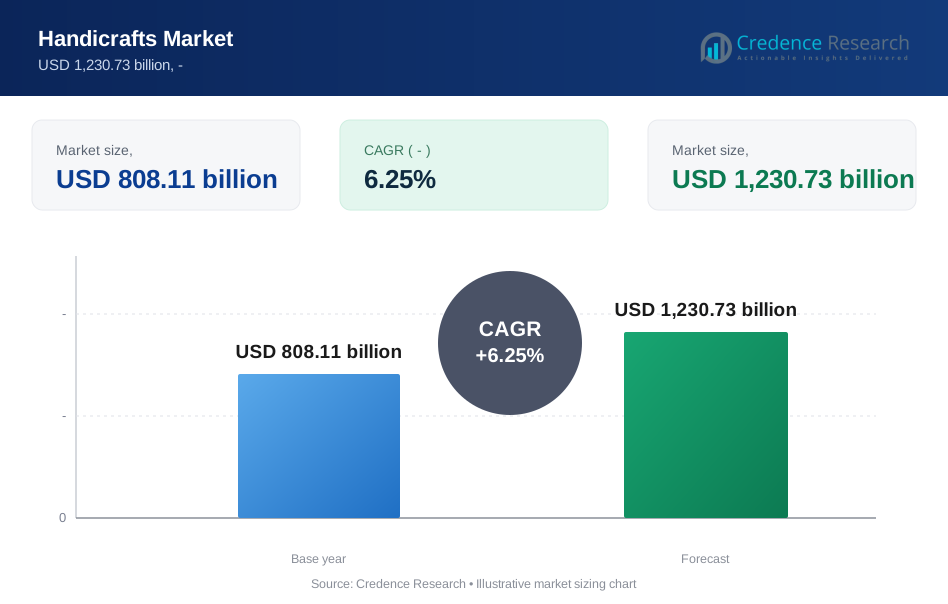
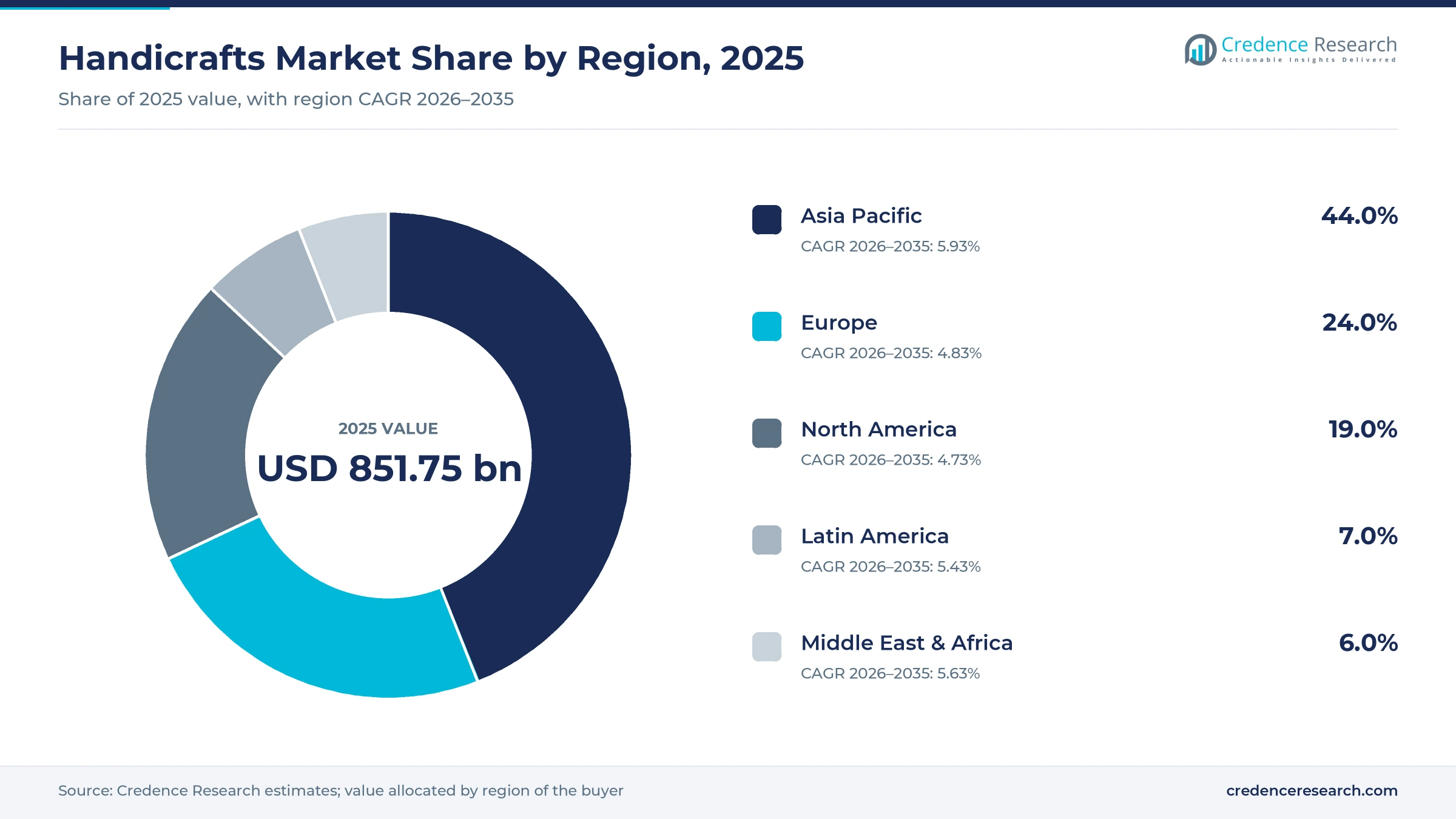
The global handicrafts market was valued at USD 851.75 billion in 2025 and is projected to increase from USD 897.74 billion in 2026 to USD 1,441.18 billion by 2035, registering a CAGR of 5.40% during 2026–2035. Demand rests on home decor, jewelry and textiles sold for their origin and hand finishing, on gift purchases and on visitors buying local work. Asia Pacific held the largest regional share, 44.0% in 2025, because India, China and Vietnam combine artisan labor with established export clusters, and it is also the fastest-growing region at 5.93% a year. The European Union opened registration for craft geographical indications on Dec. 1, 2025, which gives producers a new legal claim to origin. At the same time, the end of duty-free treatment for low-value parcels entering the United States on Aug. 29, 2025, raised costs for small sellers shipping directly to American buyers.
What is the definition of handicrafts, and what does the market count?
Handicrafts are goods made by hand or with simple tools, where manual skill shapes the finished piece. The European Union's craft rules use a close test, covering goods made entirely by hand, made with manual or digital tools, or made mechanically where manual work remains significant. This report counts artisan and hand-finished jewelry, textiles and apparel, ceramics, woodwork, metalware and glass at retail value, across stores, fairs, online marketplaces and direct sales.
The count excludes fully machine-made homeware, craft supplies sold to hobbyists and fine art sold through galleries and auctions. Because hand-finished jewelry and apparel are included, the total is much larger than handmade-only export statistics. The value chain runs from raw material suppliers and household or cluster workshops through exporters, importers and wholesalers to retailers and platforms.
Handicrafts Market Insights
- The market rises from USD 851.75 billion in 2025 to USD 1,441.18 billion by 2035, a 5.40% CAGR over 2026–2035, led by Asian export clusters and online sales.
- Asia Pacific led regional value with 44.0% in 2025, supported by India's 6.47 million artisans and more than 5,400 craft villages in Vietnam.
- Jewelry led product value with 27.8% in 2025, while gold jewelry demand reached a record value that year.
- The European Union opened craft geographical indication applications on Dec. 1, 2025, giving lace, glass, porcelain, woodwork and jewelry makers a route to protected names.
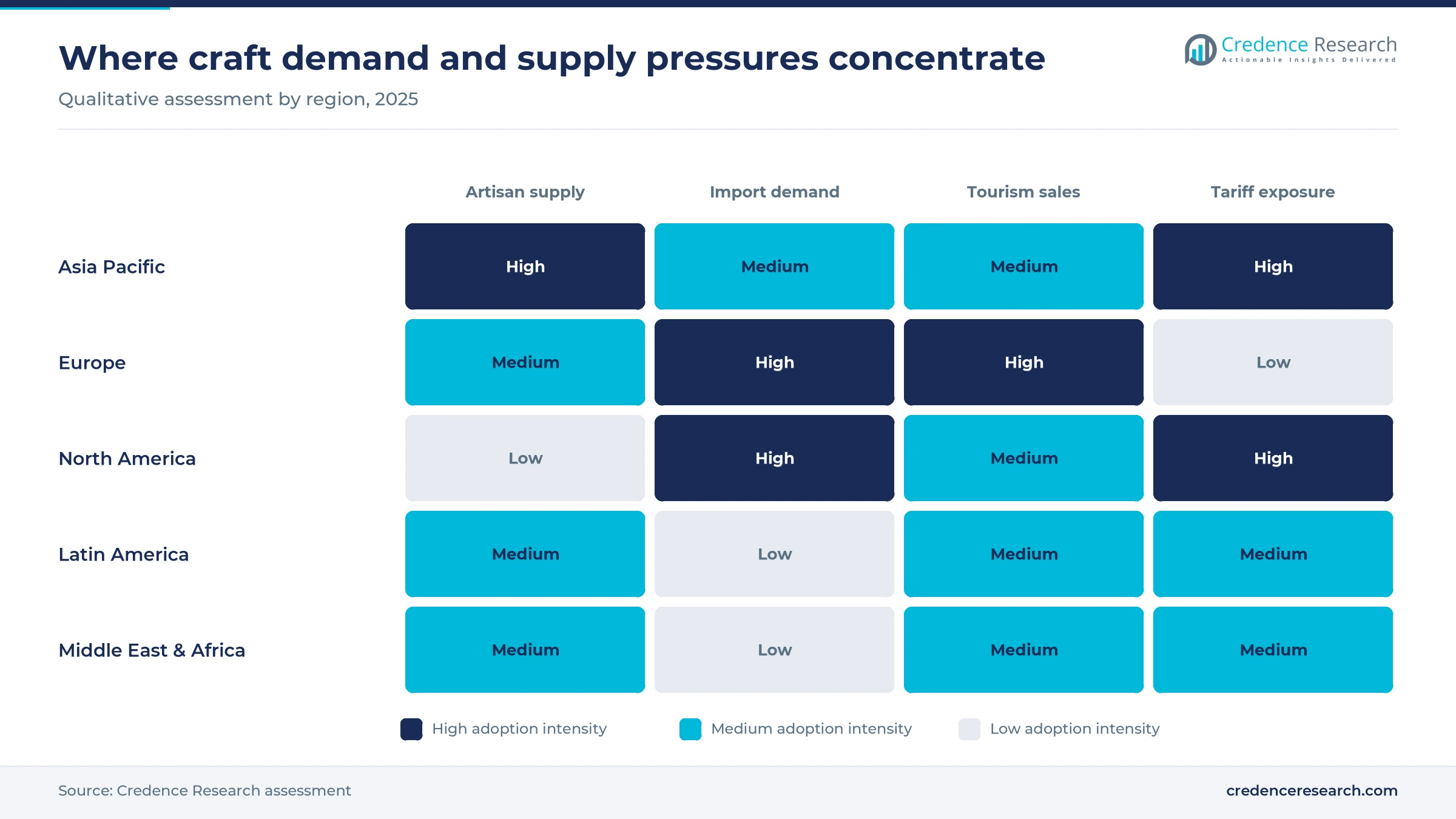
- Retail is restructuring, as Ten Thousand Villages closed 13 company-owned U.S. stores by March 2025 and moved its priorities toward online sales and wholesale supply.
Jewelry and fine fabrics carry the largest value shares
Jewelry leads value while ceramics add the fastest growth
Based on product type, the market is categorized into jewelry, textiles and apparel, wooden crafts, ceramics and pottery, metal crafts and glass crafts. Jewelry led with 27.8% of 2025 value because metal prices inflate each piece, and the World Gold Council put 2025 gold jewelry demand at a record value even as volume fell. Ceramics & Pottery grows fastest at 6.05% a year as producers scale, and People's Daily reported that Jingdezhen's ceramics industry produced over 93 billion yuan in 2024, up more than 9%, with exports reaching more than 80 countries.
Fine fabrics lead as wood draws the most export growth
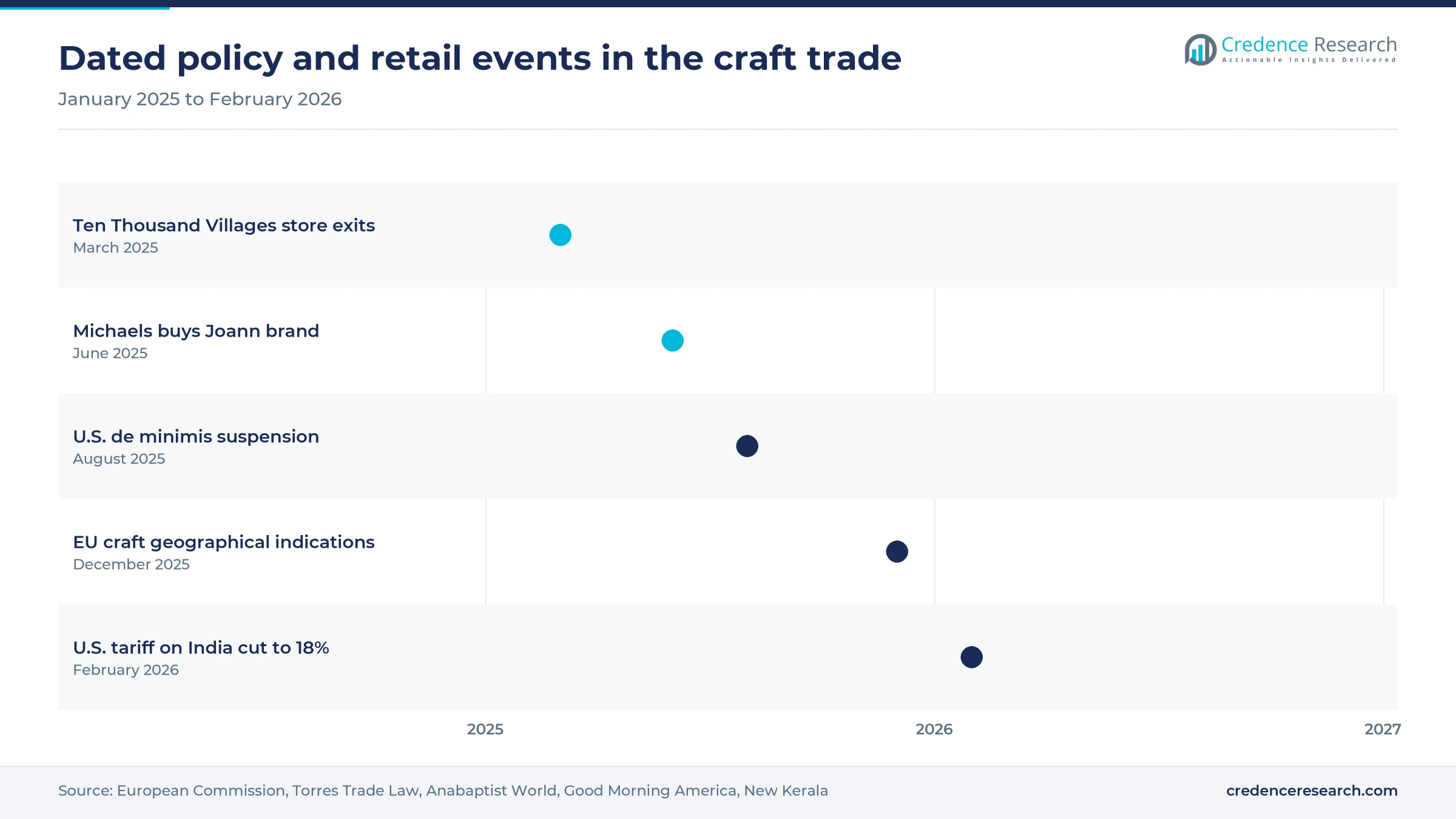
Based on material, the market is categorized into fine fabrics, precious metals, wood, precious stones and glass. Fine Fabrics held 28.0% of 2025 value because household weaving and embroidery employ large numbers of artisans, and women make up 71% of India's handloom weavers, according to India's government data of August 2025. Wood grows fastest at 5.87% a year from a strong export base, and India Brand Equity Foundation data show woodware was India's largest handicraft export category in fiscal 2025 at USD 958 million, ahead of art metalware at USD 492 million.
Home decor dominates and tourism retail gains the most
Based on end use, the market is categorized into home decor, fashion accessories, gifting, tourism retail and corporate gifting. Home Décor accounted for 38.0% of 2025 value because buyers furnish homes with craft pieces, and Etsy's fiscal 2025 annual report names home and living first among six categories that made up 85% of its marketplace sales. Tourism Retail grows fastest at 6.06% a year as travel keeps rising, with UN Tourism counting 1.52 billion international arrivals in 2025, up 4% from 2024, in its January 2026 barometer.
Specialty stores still lead while online marketplaces gain
Based on distribution channel, the market is categorized into specialty stores, online marketplaces, craft fairs and exhibitions, direct artisan sales and department stores. Specialty Stores held 29.0% of 2025 value because curated shops explain origin in person, and 21 locally run Ten Thousand Villages stores remain open in the United States, according to Anabaptist World. Online Marketplaces grow fastest at 6.42% a year as sellers go direct, and Etsy's 2025 annual filing reports 86.5 million active buyers and 5.6 million active sellers, with custom or made-to-order goods about 30% of sales.
| Segment Group | Leading Sub-segment | Share, 2025 | Fastest-growing Sub-segment | CAGR, 2026–2035 |
|---|---|---|---|---|
| By Product Type | Jewelry | 27.8% | Ceramics & Pottery | 6.05% |
| By Material | Fine Fabrics | 28.0% | Wood | 5.87% |
| By End Use | Home Décor | 38.0% | Tourism Retail | 6.06% |
| By Distribution Channel | Specialty Stores | 29.0% | Online Marketplaces | 6.42% |
Request a Free Sample
Fill in your details and we'll send you a free sample report.
- Sample data tables & charts
- Research methodology
Export programs and online reach are widening artisan sales
National artisan programs put makers on export registers
Public programs are the main reason supply reaches formal trade, since registration gives household makers access to credit, training and fairs. India counted an estimated 6.47 million handloom and handicraft artisans in August 2025, and more than 3.2 million of them held a Pehchan ID, according to government figures reported by DD India. Its National Handicraft Development Programme carries an outlay of INR 8.37 billion for 2022 to 2026, and it sanctioned 2,325 projects for more than 66,000 artisans in fiscal 2024. The PM Vishwakarma scheme had also registered about 3 million artisans and craftspeople by September 2025, with more than 2.3 million toolkit e-vouchers issued. Mexico's Culture Ministry said on April 11, 2025, that its crafts fund would support 23,894 artisans that year, up 140%.
Asian export clusters keep widening their buyer base
Export clusters drive volume because they join thousands of small workshops to overseas buyers. India's handicraft exports, excluding hand-knotted carpets, reached INR 331.23 billion in fiscal 2025, up from INR 200.83 billion in fiscal 2015, according to DD India. Vietnam Customs data reported by VOV show rattan, bamboo and sedge exports of USD 574 million in the first eight months of 2025, up 5.4%, after USD 804 million in all of 2024. Nhan Dan reported in December 2025 that Vietnam has more than 5,400 craft villages employing over 5 million rural workers. Because imported materials make up only 3% to 3.5% of the export value of those goods, most export earnings stay in the producing villages, which keeps these clusters competitive.
Online marketplaces connect single makers to global buyers
Online selling lifts demand because a single maker can now reach foreign buyers without an importer or a shop. Etsy reported 5.6 million active sellers and 86.5 million active buyers on Dec. 31, 2025, and 26% of its marketplace sales came from buyers outside the United States. Custom and made-to-order merchandise reached about 30% of those sales, which suits producers who work to order rather than from stock. However, the channel is not uniformly rising, since Etsy's active buyers fell 3% during 2025. Ten Thousand Villages closed 13 company-owned U.S. stores by March 2025 and moved toward online sales and wholesale supply to about 5,000 businesses, according to Anabaptist World. Spending on home furnishings bought online adds pull, and Online Marketplaces grow at 6.42% a year.
Tourism keeps local craft purchases growing in every region
Travel supports demand because visitors buy local work as souvenirs and gifts, often at prices above export levels. UN Tourism counted 1.52 billion international arrivals in 2025, about 60 million more than in 2024, according to its January 2026 barometer as reported by Business Report. Europe received 793 million arrivals, Africa grew 8% to 81 million and the Middle East received nearly 100 million, which brings new buyers to craft markets in those regions. Governments are building on that traffic, and Saudi Arabia's Heritage Commission held the third Banan international handicrafts week in Riyadh in November 2025 with more than 400 artisans from over 40 countries. In response, Tourism Retail is the fastest-growing use at 6.06% a year, which also lifts sales at gift retailers near heritage sites.
Provenance rules and tariffs are reshaping craft trade
Shift toward legally protected craft origin in Europe
Origin is moving from a marketing claim to a legal right, which favors producers tied to one place. From Dec. 1, 2025, producers can apply to register craft and industrial products as geographical indications under Regulation (EU) 2023/2411, with woodwork, jewelry, textiles, lace, glass, porcelain and leather goods among the listed examples. India already reflects the same logic, with 318 handicraft products holding geographical indication tags across about 455 craft categories, according to DD India. The World Crafts Council designated Panjakent in Tajikistan a World Craft City for suzani embroidery on Oct. 21, 2025, according to the Khovar news agency. As a result, importers can increasingly ask for documented origin, and 24.0% of 2025 value now sits in a region where that proof has legal weight.
Rising transparency over what counts as handmade
Buyers and platforms are drawing sharper lines around handmade claims, because mass-produced goods have copied the look of craft. Etsy introduced its Creativity Standards on July 9, 2024, requiring sellers to label listings as made, designed, sourced or handpicked and to disclose the use of artificial intelligence, according to TechCrunch. U.S. enforcement has followed a similar direction under the Indian Arts and Crafts Act, and National Jeweler reported that a Florida seller was sentenced on Jan. 30, 2026, to probation and a USD 25,000 fine after 40,905 sales of imported jewelry claimed as Native American work. UNESCO added 67 elements to its heritage lists in December 2025, including Vietnam's Dong Ho folk painting. Together, these actions raise the value of documented hand production across Ceramics & Pottery and other categories.
Opportunity in new tariff-ready export corridors
The 2025 tariff shock gives exporters a clear opening to diversify, since dependence on one buyer country proved costly. The United States accounted for about 37% of India's handicraft exports in fiscal 2025, according to India Brand Equity Foundation, and for 46.3% of Vietnam's rattan, bamboo and sedge exports in the first eight months of 2025, according to VOV. Morocco shows the same exposure, with the U.S. taking 49% of its MAD 1.232 billion craft exports in 2025 and France 10.5%, according to Morocco World News. Trade fairs offer the fastest route to new accounts, and the 60th IHGF Delhi Fair in October 2025 drew about 6,736 buyers and representatives from 112 countries, according to TEN News. Producers that add European or Asian buyers can protect margins through 2026–2035.
Opportunity in craft retail gaps after store closures
Store closures in North America leave demand that stronger retailers and direct sellers can capture. Joann filed for bankruptcy in January 2025 and said the following month that it would close its stores, about 790 locations, according to Good Morning America. Michaels then announced its purchase of the Joann brand on June 5, 2025, reported 77% more fabric searches on its website over the past year and planned to add fabric to 280 more stores. That activity concerns supplies rather than finished craft, but it shows hobby and maker customers remain active despite consolidation. Customers of Michaels are a natural audience for finished craft goods.
Tariffs, gold costs and fakes squeeze small producers
U.S. tariff swings disrupt export order books
Sudden tariff changes are the sharpest risk for exporters, because orders are placed months before delivery. The United States raised duties on Indian goods to 50% in August 2025, and ETV Bharat reported that one Kashmir exporter saw a USD 22,000 consignment put on hold. The rate fell to 18% in February 2026, according to New Kerala, after months of paused orders. Producers now seek wider buyer lists and shared shipping to limit this exposure.
End of de minimis raises costs of small parcels
Small sellers lost a cost advantage when the United States suspended duty-free treatment for shipments under USD 800 on Aug. 29, 2025, according to Torres Trade Law. Each parcel must now clear regular duties, which hurts makers who ship single pieces directly from abroad. Etsy lists this change among its stated business risks, and cross-border parcel commerce faces similar friction. Larger sellers respond by holding stock in the United States, an option most workshops cannot afford.
Record gold prices reduce jewelry volumes for artisans
High metal prices cut the work available to goldsmiths even when sales values rise. Gold jewelry volume fell 18% to 1,542.3 metric tons in 2025, with India down 24% and mainland China down 25%, according to the World Gold Council. Because lower volume means fewer pieces to make, goldsmith workloads shrink directly. Makers respond with lighter designs that use less metal, and with silver or gemstone pieces that need less capital.
Fakes and fragile preferential trade access weaken trust
Imitation goods and uncertain trade terms both weaken the position of genuine producers. The Florida case sentenced in January 2026 involved 40,905 sales of imported jewelry sold as Native American work over about 11 years. African exporters also lost duty-free U.S. access when AGOA lapsed on Sept. 30, 2025, before a renewal announced on Feb. 3, 2026, that runs only through Dec. 31, 2026. Certification and origin labels help, but they cost money that small cooperatives rarely have.
Asia Pacific supplies and leads craft value worldwide
| Region | Value, 2025 (USD billion) | Share, 2025 | CAGR, 2026–2035 |
|---|---|---|---|
| Asia Pacific | 374.77 | 44.0% | 5.93% |
| Europe | 204.42 | 24.0% | 4.83% |
| North America | 161.83 | 19.0% | 4.73% |
| Latin America | 59.62 | 7.0% | 5.43% |
| Middle East & Africa | 51.10 | 6.0% | 5.63% |
Asia Pacific leads on artisan scale and export clusters
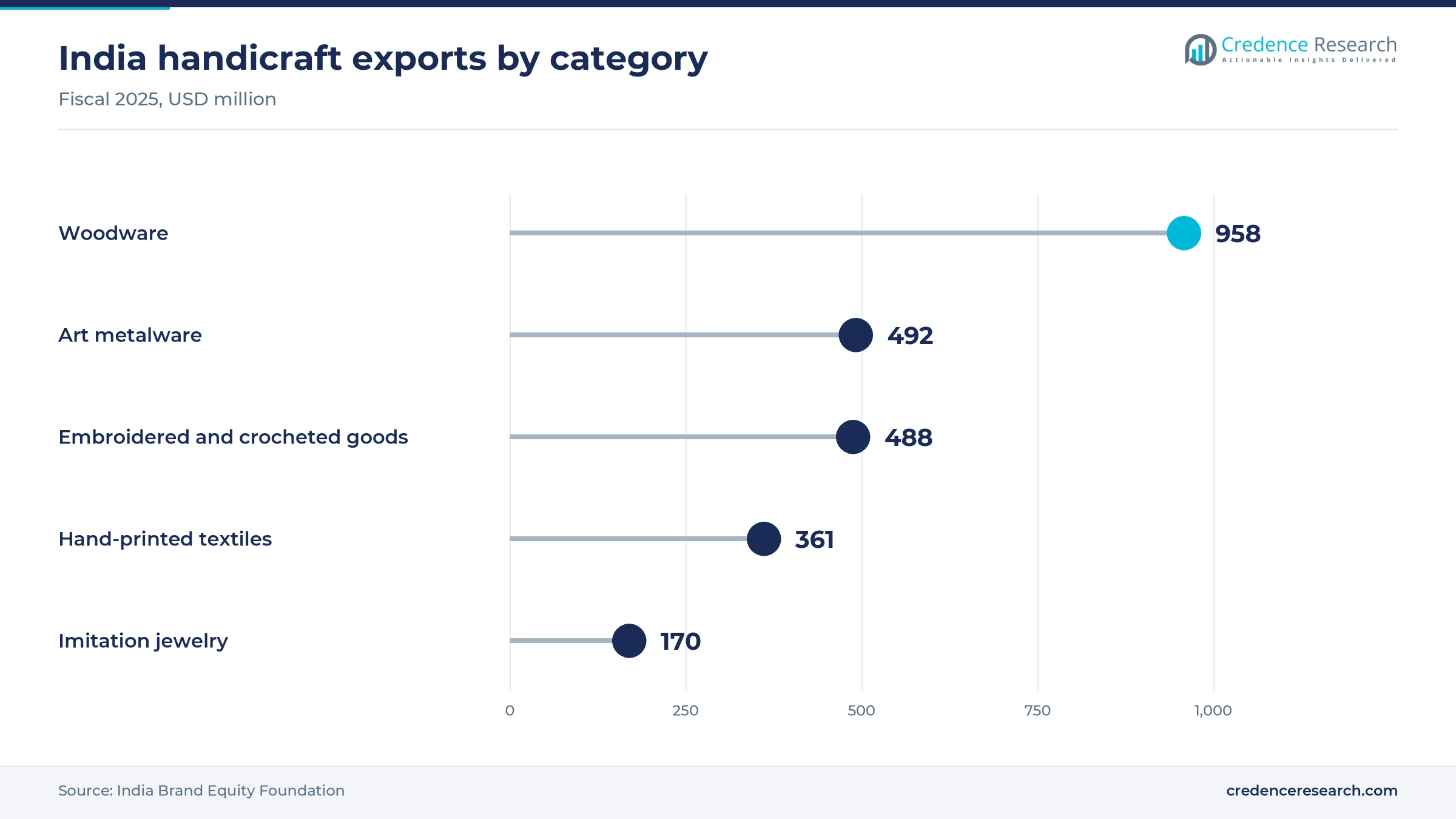
The Asia Pacific handicrafts market held 44.0% of 2025 value and grows at 5.93% a year, the fastest of any region. India's fiscal 2025 exports reached USD 3.72 billion, while Jingdezhen in China and Hanoi in Vietnam anchor ceramics and woven goods. VietnamPlus reported in September 2026 that Hanoi's 337 recognized craft villages and establishments employ more than 250,000 workers and export to 89 markets. Local demand adds to this, since India alone bought 430.5 metric tons of gold jewelry in 2025, according to the World Gold Council.
Europe buys premium craft and protects its own names
The Europe handicrafts market held 24.0% of 2025 value and grows at 4.83% a year, as a mature buyer of decor and jewelry. The new geographical indication system from Dec. 1, 2025, helps European makers of lace, glass and porcelain defend their names. Europe also imports heavily, and the United Kingdom and Spain each bought about USD 28 million of Vietnamese woven goods in the first eight months of 2025, according to VOV. Tourism adds further demand, with 793 million arrivals recorded in 2025.
North America relies on imports and online selling
North America held 19.0% of 2025 value and grows at 4.73% a year, the slowest pace among regions as retail consolidates. U.S. buyers made up 74% of Etsy's marketplace sales in 2025, and the country took about 37% of India's handicraft exports in fiscal 2025. Tariffs and the end of de minimis treatment raise landed costs, while Joann's closures and the Ten Thousand Villages store exits show pressure on physical retail. Native American work also has specific protection under federal law.
Latin America builds on fairs and public craft credit
Latin America held 7.0% of 2025 value and grows at 5.43% a year, supported by textile and ceramic traditions in Mexico and Peru. Mexico's crafts fund planned about 17,000 interest-free loans for artisans in 2025, according to Vanguardia. Peru's handicraft exports reached USD 7.3 million in the first quarter of 2025, with the U.S. taking 66.9%, according to the exporters' association Adex. Andina reported that the December 2025 Ruraq Maki fair recorded more than 3.3 million soles in direct sales.
Middle East and Africa gains from GCC heritage funding
The Middle East & Africa held 6.0% of 2025 value and grows at 5.63% a year, with GCC handicrafts spending led by Saudi Arabia, which named 2025 the Year of Handicrafts. Morocco reported record craft exports of MAD 1.232 billion in 2025, about USD 130 million, according to Morocco World News. Africa's 8% tourism growth to 81 million arrivals in 2025 widens local sales. Exporters in sub-Saharan Africa still face uncertainty because AGOA now runs only through December 2026.
Recent actions show policy and retail moving fast
| Development | Status and market relevance |
|---|---|
| In February 2026, the United States cut its tariff on Indian goods from 50% to 18%, according to New Kerala. | Reopens paused orders for clusters such as Sambhal in Uttar Pradesh |
| In December 2025, the European Union began accepting craft geographical indication applications under Regulation (EU) 2023/2411. | In force, with applications through national authorities or the EU Intellectual Property Office |
| In November 2025, the Saudi Heritage Commission opened the third Banan handicrafts week in Riyadh with artisans from over 40 countries. | Part of the Year of Handicrafts 2025 |
| In June 2025, Michaels acquired the Joann brand and private labels after Joann announced the closure of its stores. | Completed, with fabric ranges expanding across Michaels stores |
| In March 2025, Ten Thousand Villages completed the closure of 13 company-owned U.S. stores and moved toward online and wholesale sales. | Completed, with 21 independent stores remaining |
Digital tools now support hand production and selling
- Marketplace labeling requires sellers to state how an item was made, and Etsy has applied this approach through its Creativity Standards since July 2024.
- Generative design tools help small makers draft patterns quickly, although Etsy requires that sellers disclose the use of artificial intelligence in the listing.
- Digital artisan identity links makers to credit and training, as India's Pehchan cards and PM Vishwakarma e-vouchers show at a national scale.
- Digital customs entry now affects small parcels, because low-value U.S. imports must be filed through the Automated Commercial Environment since August 2025.
Need a Custom Version of This Report?
Tailor the scope, geography, or segments to your exact requirements.
- Custom geography or segment scope
- Direct access to our analyst team
A fragmented field of makers, retailers and platforms
The market is highly fragmented, because most output comes from household workshops, cooperatives and small exporters rather than large firms. Competition therefore runs along three lines, which are design and skill, proof of origin and access to buyers. Fabindia competes in India through a retail chain that sources from community-owned companies, while Ten Thousand Villages sells fair trade goods through independent stores and wholesale accounts. Etsy acts as a marketplace for makers rather than as a producer, and its labeling rules influence how sellers present their goods. Bat Trang Ceramic and Porcelain Company Limited represents the village-based exporters of Vietnam, where Bat Trang is a recognized ceramics center. Michaels serves the adjacent arts and crafts supply trade after acquiring the Joann brand. No company holds a large share of the global total, since local fairs and direct sales account for a sizable part of purchases.
Companies profiled and their roles in this market
| Company | Type | Role in the market |
|---|---|---|
| Ten Thousand Villages | Fair trade retailer | Sells artisan goods through 21 independent U.S. stores, online and wholesale |
| Etsy, Inc. | Online marketplace | Connects 5.6 million active sellers with 86.5 million active buyers |
| Fabindia | Craft-based retail chain | Sells handmade apparel and home goods sourced across rural India |
| Bat Trang Ceramic and Porcelain Company Limited | Producer and exporter | Makes ceramics in Hanoi's Bat Trang craft village |
| Michaels | Arts and crafts retailer | Acquired the Joann brand and sells craft supplies in the adjacent trade |
Provenance will separate premium craft from imitation
Credence Research's view is that proof of origin will matter more than volume through 2035. Geographical indications in Europe, handmade labels on marketplaces and criminal cases against false claims all point in the same direction, toward buyers paying for documented work. Exporters with a single dominant customer country carry the largest risk, as the 2025 U.S. tariff episode showed in India and Vietnam. The firms best placed will combine several destination markets, verifiable artisan records and direct online sales, while workshops without those links will increasingly depend on cooperatives and public programs to stay in trade.
How Credence Research built these estimates
The report uses 2025 as the base year and 2035 as the forecast year. Market values come from the Credence Research model, which brings the earlier 2024 estimate to 2025 with its own growth rate and checks it against public trade and sales data. Regional, segment and channel splits are all Credence Research estimates here. Sources are government statistics and programs, trade body figures, company filings, regulator pages, trade fair reports and news reports named in the text. No interviews or surveys were used to prepare this edition.
Value growth continues as sourcing diversifies to 2035
The market is expected to add value steadily through 2035, with growth coming from Asian supply, online reach and tourism rather than from any single product. Jewelry should stay the largest category, although its pace depends on metal prices, while ceramics and wood goods gain share. Trade policy remains the main variable, particularly the U.S. tariff level and the future of AGOA after December 2026. Producers that document origin and sell into several regions should hold margins better, and public artisan programs in India, Mexico and Saudi Arabia should keep new makers entering formal trade.
Frequently Asked Questions
How big is the global handicrafts market?
What is the definition of handicrafts?
What is the size of the Asia Pacific handicrafts market?
What share does Europe hold in the handicrafts market?
How is the GCC handicrafts market developing?
What is driving demand for handmade products?
What are the main arts and crafts consumer trends?
Which product type leads the handicrafts market?
Table of Content
Chapter 1 Market Segmentation
- 1.1 Segmentation Framework
- 1.1.1 Product and Service Classification
- 1.1.2 Application and End-Use Classification
- 1.1.3 Technology and Solution Classification
- 1.1.4 Customer and Distribution Channel Classification
- 1.1.5 Geographic Segmentation
- 1.1.6 Market Segment Definitions and Boundaries
- 1.2 By Product Type
- 1.2.1 Jewelry
- 1.2.2 Textiles & Apparel
- 1.2.3 Wooden Crafts
- 1.2.4 Ceramics & Pottery
- 1.2.5 Metal Crafts
- 1.2.6 Glass Crafts
- 1.3 By Material
- 1.3.1 Fine Fabrics
- 1.3.2 Precious Metals
- 1.3.3 Wood
- 1.3.4 Precious Stones
- 1.3.5 Glass
- 1.4 By End Use
- 1.4.1 Home Décor
- 1.4.2 Fashion Accessories
- 1.4.3 Gifting
- 1.4.4 Tourism Retail
- 1.4.5 Corporate Gifting
Chapter 2 Introduction
- 2.1 Report Objectives and Scope
- 2.2 Product Definition and Industry Terminology
- 2.3 Market Inclusions and Exclusions
- 2.4 Research Process
- 2.4.1 Primary Research and Expert Interviews
- 2.4.2 Secondary Research and Source Review
- 2.4.3 Top-Down and Bottom-Up Estimation
- 2.4.4 Data Triangulation and Verification
- 2.5 Market Size Measurement Basis
- 2.5.1 2025: USD 851.75 billion → 2035: USD 1,441.18 billion
- 2.6 Historical and Forecast Reference Periods
- 2.6.1 Historical Period: 2018-2025
- 2.6.2 Base Year: 2025
- 2.6.3 Forecast Period: 2025-2035
- 2.7 Research Assumptions and Limitations
Chapter 3 Executive Summary
- 3.1 Market Snapshot and Key Findings
- 3.2 Base-Year Market Size, 2025
- 3.3 Forecast Market Size, 2035
- 3.4 Revenue and Volume Growth Outlook
- 3.5 Key Demand and Supply Indicators
- 3.6 Leading Market Segments
- 3.7 Fastest-Growing Market Opportunities
- 3.8 Regional Performance Highlights
- 3.9 Technology and Industry Transformation
- 3.10 Competitive Landscape Summary
- 3.11 Analyst View and Strategic Implications
Chapter 4 Global Handicrafts Market Trends and Developments
- 4.1 Historical Industry Development, 2018-2025
- 4.2 Recent Market Trends and Developments
- 4.3 Demand and Customer Behavior Trends
- 4.4 Technology and Product Innovation
- 4.5 Artificial Intelligence, Automation and Digitalization
- 4.6 Local Manufacturing and Supply Chain Realignment
- 4.7 Industry Partnerships, Mergers and Acquisitions
- 4.8 Sustainability and Circular Economy Developments
- 4.9 Government and Private Sector Investment Trends
- 4.10 Emerging Business Models and Commercialization
- 4.11 Industry Developments and Announcements
Chapter 5 Global Handicrafts Market Production, Supply and Demand Analysis
- 5.1 Demand Trend and Consumption Analysis, 2018-2025
- 5.2 Demand Forecast, 2025-2035
- 5.3 Production and Output Trend, 2018-2025
- 5.4 Production and Output Forecast, 2025-2035
- 5.5 Installed Capacity and Capacity Utilization
- 5.6 Company-Wise Production Plants and Statistics
- 5.6.1 Installed Production Capacity
- 5.6.2 Actual Production
- 5.6.3 Planned Capacity and Expansion Targets
- 5.7 Supply Chain Structure and Procurement Trends
- 5.8 Supply-Demand Gap and Bottlenecks
- 5.9 Import Dependence and Sourcing Structure
- 5.10 Contract Manufacturing and Outsourcing
- 5.11 Regional Supply and Demand Concentration
Chapter 6 Global Handicrafts Market Pricing Analysis
- 6.1 Pricing Structure and Measurement
- 6.2 Historical Pricing Trends, 2018-2025
- 6.3 Pricing Outlook, 2025-2035
- 6.4 Average Selling Price and Unit Economics
- 6.5 Pricing by Product and Market Segment
- 6.6 Geographic Pricing Differences
- 6.7 Key Input, Energy, Labor and Logistics Costs
- 6.8 Contract Pricing and Purchasing Models
- 6.9 Pricing Sensitivity and Competitive Positioning
- 6.10 Price, Margin and Profitability Implications
Chapter 7 Global Handicrafts Market Dynamics
- 7.1 Market Growth Drivers
- 7.1.1 Demand-Side Drivers
- 7.1.2 Technology and Innovation Drivers
- 7.1.3 Infrastructure and Investment Drivers
- 7.1.4 Regulatory and Policy Drivers
- 7.2 Market Restraints
- 7.2.1 Cost and Affordability Constraints
- 7.2.2 Technology and Adoption Barriers
- 7.2.3 Supply Chain and Operational Constraints
- 7.3 Market Challenges
- 7.3.1 Competitive Pressure and Margin Erosion
- 7.3.2 Skills, Infrastructure and Implementation Gaps
- 7.4 Emerging Market Opportunities
- 7.5 Market Dynamics Impact and Time-Horizon Assessment
Chapter 8 Global Handicrafts Value Chain Analysis
- 8.1 Industry Value Chain Overview
- 8.2 Upstream Suppliers and Critical Inputs
- 8.3 Technology and Component Providers
- 8.4 Manufacturing or Service Delivery
- 8.5 Distribution, Channel Partners and Integrators
- 8.6 Downstream Applications and End Users
- 8.7 Value Addition and Profit Pools
- 8.8 Vertical Integration and Outsourcing
- 8.9 Supplier Concentration and Risk
- 8.10 Supply Chain Localization and Resilience
Chapter 9 Global Handicrafts Market Regulations and Policies
- 9.1 Relevant Laws, Standards and Compliance Frameworks
- 9.2 Product, Service, Safety and Quality Requirements
- 9.3 Government Policies, Incentives and Subsidies
- 9.4 Imports, Exports and Trade Barriers
- 9.5 Public Procurement and Local Content Requirements
- 9.6 Environmental and Sustainability Compliance
- 9.7 Upcoming Policy Changes and Market Implications
Chapter 10 Global Handicrafts Market Hotspots and Opportunities
- 10.1 Market Opportunity Mapping and Growth Hotspots
- 10.2 High-Growth Applications and Customer Groups
- 10.3 Underserved Markets and White-Space Opportunities
- 10.4 Emerging Technology and Product Opportunities
- 10.5 New Capacity and Investment Hotspots
- 10.6 Market Entry and Expansion Opportunities
- 10.7 Distribution and Partnership Opportunities
- 10.8 Near-Term and Long-Term Commercial Potential
- 10.9 Opportunity Attractiveness and Execution Risks
Chapter 11 Global Handicrafts Market Outlook, 2025-2035
- 11.1 Market Size and Analysis
- 11.1.1 Revenue (Market Measurement: 2025: USD 851.75 billion → 2035: USD 1,441.18 billion)
- 11.1.2 Market Volume and Quantity Sold
- 11.1.3 Historical Market Size, 2018-2025
- 11.1.4 Base-Year Market Size, 2025
- 11.2 Market Forecast, 2025-2035
- 11.2.1 Revenue Forecast to 2035
- 11.2.2 Volume Forecast to 2035
- 11.2.3 CAGR and Year-on-Year Growth
- 11.2.4 Incremental Revenue Opportunity
- 11.3 Forecast Assumptions and Scenario Analysis
- 11.3.1 Base-Case Forecast
- 11.3.2 Optimistic and Conservative Scenarios
- 11.3.3 Technology, Pricing and Policy Sensitivities
- 11.4 Market Attractiveness and Growth Outlook
Chapter 12 Global Handicrafts Market Segmentation and Outlook
- 12.1 Segmentation Summary and Market Shares, 2025
- 12.2 Largest and Fastest-Growing Segments
- 12.3 By Product Type - Market Size and Forecast, 2025-2035
- 12.3.1 Segment Definition and Scope
- 12.3.2 Historical Market Size, 2018-2025
- 12.3.3 Revenue Forecast, 2025-2035
- 12.3.4 Volume Forecast, 2025-2035
- 12.3.5 Base-Year Market Share, 2025
- 12.3.6 Segment CAGR and Growth Drivers
- 12.3.7 Subsegment Market Size and Forecast
- 12.3.7.1 Jewelry
- 12.3.7.2 Textiles & Apparel
- 12.3.7.3 Wooden Crafts
- 12.3.7.4 Ceramics & Pottery
- 12.3.7.5 Metal Crafts
- 12.3.7.6 Glass Crafts
- 12.3.8 Subsegment Pricing and Adoption Trends
- 12.3.9 Leading Suppliers and Competition
- 12.3.10 Regional Demand and Opportunities
- 12.4 By Material - Market Size and Forecast, 2025-2035
- 12.4.1 Segment Definition and Scope
- 12.4.2 Historical Market Size, 2018-2025
- 12.4.3 Revenue Forecast, 2025-2035
- 12.4.4 Volume Forecast, 2025-2035
- 12.4.5 Base-Year Market Share, 2025
- 12.4.6 Segment CAGR and Growth Drivers
- 12.4.7 Subsegment Market Size and Forecast
- 12.4.7.1 Fine Fabrics
- 12.4.7.2 Precious Metals
- 12.4.7.3 Wood
- 12.4.7.4 Precious Stones
- 12.4.7.5 Glass
- 12.4.8 Subsegment Pricing and Adoption Trends
- 12.4.9 Leading Suppliers and Competition
- 12.4.10 Regional Demand and Opportunities
- 12.5 By End Use - Market Size and Forecast, 2025-2035
- 12.5.1 Segment Definition and Scope
- 12.5.2 Historical Market Size, 2018-2025
- 12.5.3 Revenue Forecast, 2025-2035
- 12.5.4 Volume Forecast, 2025-2035
- 12.5.5 Base-Year Market Share, 2025
- 12.5.6 Segment CAGR and Growth Drivers
- 12.5.7 Subsegment Market Size and Forecast
- 12.5.7.1 Home Décor
- 12.5.7.2 Fashion Accessories
- 12.5.7.3 Gifting
- 12.5.7.4 Tourism Retail
- 12.5.7.5 Corporate Gifting
- 12.5.8 Subsegment Pricing and Adoption Trends
- 12.5.9 Leading Suppliers and Competition
- 12.5.10 Regional Demand and Opportunities
- 12.6 Segment Growth Comparison
- 12.7 Segment Attractiveness and Priority Matrix
Chapter 13 Global Handicrafts End-Use and Application Market Outlook
- 13.1 End-Use Industry and Customer Demand Structure
- 13.2 Leading Applications and Customer Groups
- 13.3 End-Use Market Size, Share and Forecast
- 13.4 Major End-Use Industry Deep Dives
- 13.4.1 Customer Requirements and Use Cases
- 13.4.2 Demand and Replacement Cycles
- 13.4.3 Technical and Regulatory Considerations
- 13.4.4 Purchasing and Procurement Models
- 13.4.5 Leading Vendors and Distribution Channels
- 13.4.6 Forecast and Commercial Opportunities
- 13.5 Emerging Applications and Cross-Segment Demand
- 13.6 End-Use Industry Investment Priorities
Chapter 14 Global Handicrafts Geographic Market Outlook, 2025-2035
- 14.1 Regional Market Size and Share, 2025
- 14.2 Regional Market Forecast, 2025-2035
- 14.3 Regional Pricing, Production and Demand Differences
- 14.4 North America
- 14.4.1 United States
- 14.4.2 Canada
- 14.4.3 Mexico
- 14.5 Europe
- 14.5.1 Germany
- 14.5.2 France
- 14.5.3 Italy
- 14.5.4 United Kingdom
- 14.5.5 Spain
- 14.5.6 Poland
- 14.5.7 Russia
- 14.5.8 Netherlands
- 14.5.9 Belgium
- 14.5.10 Sweden
- 14.5.11 Denmark
- 14.5.12 Norway
- 14.5.13 Rest of Europe
- 14.6 Asia Pacific
- 14.6.1 China
- 14.6.2 India
- 14.6.3 Japan
- 14.6.4 South Korea
- 14.6.5 Thailand
- 14.6.6 Indonesia
- 14.6.7 Vietnam
- 14.6.8 Malaysia
- 14.6.9 Australia
- 14.6.10 Rest of Asia Pacific
- 14.7 Latin America
- 14.7.1 Brazil
- 14.7.2 Argentina
- 14.7.3 Colombia
- 14.7.4 Chile
- 14.7.5 Rest of Latin America
- 14.8 Middle East
- 14.8.1 Saudi Arabia
- 14.8.2 United Arab Emirates
- 14.8.3 Turkey
- 14.8.4 Israel
- 14.8.5 Iran
- 14.8.6 Rest of the Middle East
- 14.9 Africa
- 14.9.1 South Africa
- 14.9.2 Egypt
- 14.9.3 Nigeria
- 14.9.4 Morocco
- 14.9.5 Rest of Africa
- 14.10 Regional Investment, Policy and Supply Chain Differences
- 14.11 Regional Competitive Landscape
- 14.12 Geographic Growth Hotspots
Chapter 15 Global Handicrafts Technology, Innovation and Sustainability Outlook
- 15.1 Technology Landscape and Maturity
- 15.2 Product, Process and Service Innovation
- 15.3 AI, Automation and Digital Tools in the Industry
- 15.4 Technology Adoption and Performance Benchmarking
- 15.5 Innovation Pipeline and R&D Investment
- 15.6 Patent and Intellectual Property Trends
- 15.7 Energy Efficiency and Resource Management
- 15.8 Sustainability, Recycling and Circularity
- 15.9 Technology Roadmap, 2025-2035
- 15.10 Risks of Obsolescence and Technology Substitution
Chapter 16 Global Handicrafts Market Key Strategic Imperatives
- 16.1 Growth and Market Entry Priorities
- 16.2 High-Return Products and Segments
- 16.3 Pricing, Profitability and Cost Optimization
- 16.4 Technology Investment and Product Differentiation
- 16.5 Supply Chain Localization and Resilience
- 16.6 Distribution and Customer Acquisition
- 16.7 Partnership, Acquisition and Capacity Strategy
- 16.8 Regional Expansion Priorities
- 16.9 Short-, Medium- and Long-Term Actions
Chapter 17 Competition Outlook
- 17.1 Industry Competition Characteristics
- 17.2 Market Structure and Concentration
- 17.3 Market Share and Competitive Positioning, 2025
- 17.4 Company-Wise Revenue and Product Benchmarking
- 17.5 Production and Service Capacity Benchmarking
- 17.6 Technology, Pricing and Differentiation
- 17.7 Regional Footprint and Distribution Strength
- 17.8 Mergers, Acquisitions and Strategic Alliances
- 17.9 New Entrants and Competitive Threats
- 17.10 Porter's Five Forces and Industry Attractiveness
- 17.11 Competitive Outlook, 2025-2035
Chapter 18 Company Profiles
- 18.1 Company Coverage and Selection Criteria
- 18.2 Ten Thousand Villages
- 18.2.1 Business Description
- 18.2.2 Company Ownership and Geographic Presence
- 18.2.3 Product and Service Portfolio
- 18.2.4 Manufacturing and Operating Footprint
- 18.2.5 Production Capacity and Expansion Plans
- 18.2.6 Financial Performance and Investment
- 18.2.7 Market Share and Competitive Position
- 18.2.8 Technology and Innovation Capabilities
- 18.2.9 Strategic Alliances or Partnerships
- 18.2.10 Recent Developments
- 18.2.11 Growth Strategy and Outlook
- 18.3 Etsy, Inc.
- 18.4 Fabindia
- 18.5 Michaels
- 18.6 Bat Trang Ceramic and Porcelain Company Limited
- 18.7 Other Relevant Market Participants
Note: Every listed company is profiled on the structure shown under the first company. The company list is preliminary and may change based on research findings, market developments, data availability and client requirements.
Chapter 19 Disclaimer
- 19.1 Research and Forecast Disclaimer
- 19.2 Data Source and Estimation Limitations
Note: The depth of individual sections depends on data availability for this market. Volume, capacity, trade and other unit-based metrics are included where applicable.

