
Market Overview
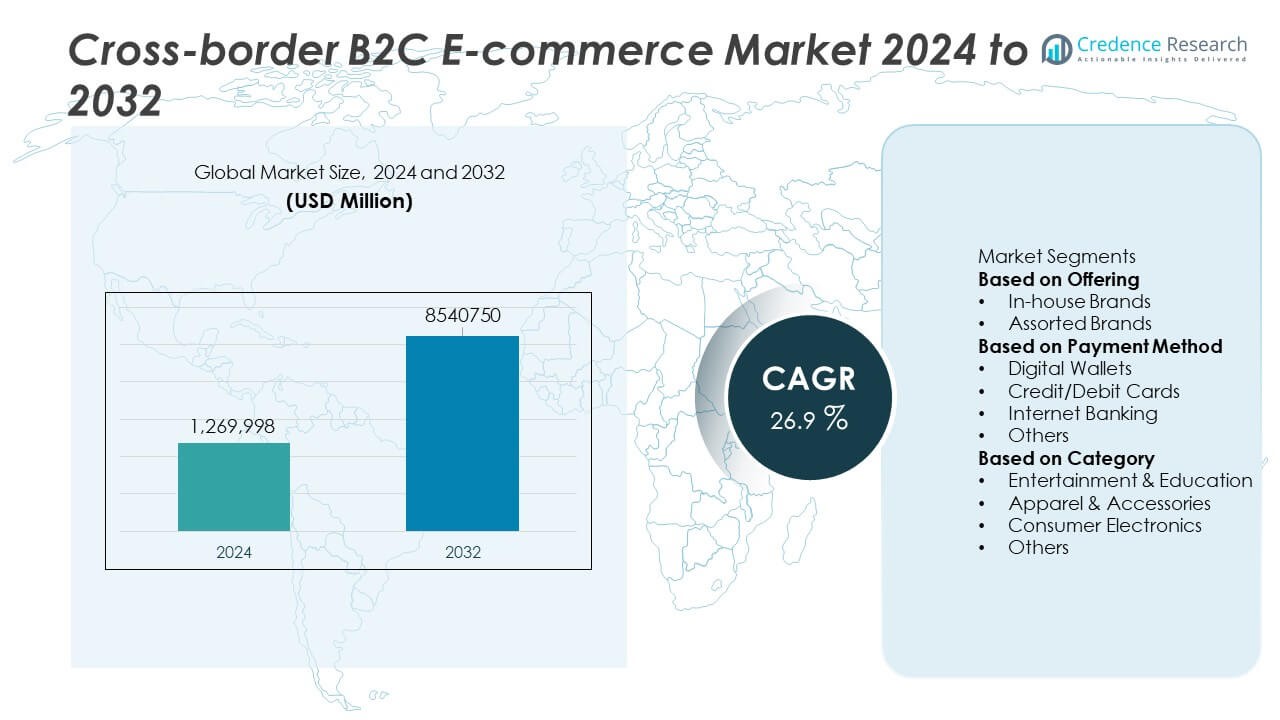
The Cross-border B2C E-commerce Market was valued at USD 1,269,998 million in 2024 and is projected to reach USD 8,540,750 million by 2032, expanding at a CAGR of 26.9% during the forecast period.
| REPORT ATTRIBUTE | DETAILS |
|---|---|
| Historical Period | 2020-2023 |
| Base Year | 2024 |
| Forecast Period | 2025-2032 |
| Cross-border B2C E-commerce Market Size 2024 | USD 1,269,998 Million |
| Cross-border B2C E-commerce Market, CAGR | 26.9% |
| Cross-border B2C E-commerce Market Size 2032 | USD 8,540,750 Million |
The Cross-border B2C E-commerce market is driven by major players such as Rakuten, ASOS, Fruugo.com Ltd., Zalando, Alibaba Group Holding Limited, SIA Joom, Amazon.com, Inc., Veepee, eBay Inc., and Jingdong JD.com. These companies strengthen global reach through diverse product assortments, multi-currency payment options, and fast international logistics networks. Asia Pacific leads the global market with a 34% share, supported by large online shopper populations and strong mobile commerce adoption. North America follows with a 29% share, driven by high purchasing power and advanced digital infrastructure. Europe holds a 26% share, reflecting strong cross-border demand for fashion, beauty, and electronics across integrated EU markets.
 Market Insights
- The Cross-border B2C E-commerce market reached USD 1,269,998 million in 2024 and will rise to USD 8,540,750 million by 2032 at a CAGR of 26.9%.
- Growth is driven by rising global demand for international products, with assorted brands leading the offering segment at 62% share, fueled by wide product variety and competitive pricing.
- Key trends include rapid adoption of digital wallets holding 48% share in payment methods, supported by secure transactions, multi-currency support, and faster cross-border checkout.
- Market competition intensifies as Rakuten, ASOS, Alibaba, Amazon, JD.com, Zalando, Veepee, Fruugo, Joom, and eBay expand logistics partnerships, AI-driven personalization, and localized shopping experiences.
- Asia Pacific leads with a 34% regional share, followed by North America at 29% and Europe at 26%, while apparel and accessories dominate with 41% share due to strong demand for global fashion and premium lifestyle products.
Market Segmentation Analysis:
By Offering
Assorted brands dominate this segment with a market share of 62%, driven by growing consumer interest in global product variety and competitive pricing. Cross-border shoppers prefer marketplaces offering multiple international brands, wider style options, and exclusive imported goods. In-house brands continue to gain traction due to improved quality standards and stronger control over supply chains, but they remain secondary. Global e-commerce platforms expand assortments in beauty, fashion, electronics, and lifestyle goods to attract broader audiences. Rising demand for niche international products and cross-border discount events further strengthens the leadership of assorted brand offerings.
- For instance, Alibaba's Tmall Global has focused on strengthening brand incubation and supply chain efficiency by leveraging AI and potentially blockchain technology for quality control, utilizing a network of over 100 overseas warehouses and six global procurement centers.
By Payment Method
Digital wallets lead the payment method segment with a market share of 48%, supported by secure transactions, currency conversion convenience, and faster checkout processes. Consumers across Asia Pacific, Europe, and North America increasingly adopt wallets for cross-border purchases due to enhanced fraud protection and low transaction fees. Credit and debit cards remain significant but face competition from wallet-based platforms integrated with global e-commerce sites. Internet banking serves selective markets with strong online banking penetration. The rise of fintech apps, localized digital wallet partnerships, and seamless multi-currency support continues to drive digital wallet adoption in cross-border shopping.
- For instance, Alipay+ has expanded its acceptance to over 100 countries and regions, connecting more than 90 million overseas merchants to users of 40 international payment partners. Alipay itself supports transactions in 27 different currencies and provides real-time exchange rate automation for cross-border transactions.
By Category
Apparel and accessories hold the top position with a market share of 41%, driven by strong global demand for international fashion trends, premium brands, and region-exclusive collections. Consumers seek wider size ranges, seasonal styles, and cost advantages available through cross-border portals. Entertainment and education categories grow steadily due to rising subscriptions for online courses, digital content, and gaming products. Consumer electronics gain momentum with interest in imported gadgets, smart devices, and brand-specific launches unavailable locally. The apparel category continues to lead due to high repeat purchases, strong social media influence, and rapid adoption of global fashion e-commerce platforms.
Key Growth Drivers
Growing Global Demand for International Products
Consumers increasingly seek overseas products for better pricing, exclusive brands, and wider assortments, fueling strong growth in cross-border B2C e-commerce. Fashion, electronics, and beauty categories benefit as shoppers look for authenticity and variety unavailable in local markets. Social media trends, influencer promotions, and global brand visibility further expand demand. Marketplaces enhance global listings and optimize product discovery to attract international buyers. As consumer preferences shift toward global shopping experiences, the demand for international goods continues to rise, strengthening market expansion.
- For instance, eBay has enabled AI-driven catalog enrichment and automated language translation to facilitate cross-border listings across markets. The AI translation service has been shown to increase trade between countries, with one study finding that it was equivalent to a significant reduction in the distance between trading partners.
Rise of Digital Payments and Fintech Integration
Digital wallets, multi-currency gateways, and secure payment technologies accelerate cross-border transactions and improve customer trust. Consumers prefer digital wallets due to lower fees, real-time exchange rates, and faster checkout. Fintech solutions enhance fraud control, identity verification, and transaction reliability. Mobile banking and government-driven digital payment ecosystems further support adoption across emerging and developed markets. These advancements make international payments seamless and drive sustained growth in cross-border B2C e-commerce.
- For instance, Mastercard has achieved massive scale with its network tokenization, with over 30% of all Mastercard transactions worldwide now tokenized. Through its secure payment rails (Mastercard Move), the company provides cross-border payment connectivity to over 200 countries and territories, reaching approximately 95% of the world's bank population.
Advanced Logistics and Cross-Border Fulfillment Infrastructure
Innovations in logistics, such as bonded warehouses, automated customs processing, and end-to-end tracking systems, significantly improve global order fulfillment. Marketplaces collaborate with logistics providers to shorten delivery times and simplify international returns. Regional distribution hubs and consolidated shipping models reduce shipping costs for sellers and buyers. Enhanced supply chain transparency boosts customer satisfaction and encourages repeat purchases. As logistics networks expand globally, cross-border e-commerce becomes more efficient and accessible.
Key Trends & Opportunities
Growing Popularity of International Fashion and Lifestyle Trends
Fashion, beauty, and lifestyle products show strong momentum as consumers follow global trends and seek exclusive collections from international brands. Influencer-driven content and social commerce push demand for Korean skincare, European fashion, Japanese electronics, and U.S. lifestyle goods. Platforms offer AI-based recommendations, virtual try-on features, and personalized catalogs to enhance discovery. This trend opens new opportunities for retailers targeting niche and trend-driven global audiences.
- For instance, Amazon Fashion expanded its global storefront and leverages artificial intelligence (AI) and machine learning to improve the customer experience and address sizing challenges globally.
Expansion of Mobile-First Cross-Border Shopping
Mobile commerce grows rapidly as smartphones become the primary shopping tool worldwide. E-commerce apps offer localized languages, region-specific catalogs, multi-currency support, and frictionless checkout. Consumers rely on mobile apps for price comparison, tracking, and instant payments. App-exclusive discounts and personalized push notifications further strengthen mobile-driven cross-border sales. Rising smartphone penetration in emerging markets accelerates this opportunity.
- For instance, Mercado Libre reported nearly 70.8 million unique buyers on its commerce platform and almost 68 million monthly active users on its Mercado Pago fintech service in the second quarter of 2025. The total number of items sold across its ecosystem reached 550.1 million units.
Key Challenges
High Customs Duties and Tax Complexities
Complex tax rules, fluctuating import duties, and lengthy customs procedures make cross-border transactions costly and unpredictable. These added fees discourage price-sensitive buyers and slow market adoption. Sellers must rely on automated tax tools, transparent cost breakdowns, and customs-prepaid models to maintain consumer trust. Regulatory variations across countries increase operational complexity for global e-commerce platforms.
Logistics Delays and Cross-Border Delivery Constraints
Despite improvements, deliveries still face delays due to customs bottlenecks, long international routes, and fragmented logistics networks. Remote regions experience higher shipping charges and limited last-mile coverage. Difficult return processes reduce customer confidence and impact repeat purchases. Strengthening cross-border logistics, expanding warehouse networks, and improving coordination among carriers remain essential to overcome these challenges.
Regional Analysis
North America
North America holds a market share of 29%, driven by strong digital adoption, high purchasing power, and widespread use of global e-commerce platforms. Consumers increasingly purchase international fashion, electronics, and lifestyle products due to better pricing and wider assortments. The U.S. leads the region with robust cross-border traffic from Asia and Europe. Advanced logistics networks, secure digital payments, and fast delivery services support market expansion. Retailers optimize multi-currency support and localized checkout to improve conversions. Growing demand for premium international brands continues to strengthen North America’s position in cross-border B2C e-commerce.
Europe
Europe accounts for a market share of 26%, supported by high internet penetration, well-established digital infrastructure, and strong consumer preference for global brands. Countries such as Germany, the U.K., France, and the Netherlands show significant cross-border buying due to attractive pricing and diverse imports from Asia and North America. The region benefits from harmonized regulations within the EU, which simplify logistics and reduce shipping barriers. Rising demand for fashion, beauty, and electronics fuels growth. Expanding digital wallet usage and improved customs handling continue to enhance the cross-border shopping experience across Europe.
Asia Pacific
Asia Pacific leads the global market with a market share of 34%, driven by massive online shopper populations, rapid smartphone adoption, and strong demand for Western and Korean brands. China, India, Japan, and South Korea dominate regional activity as consumers increasingly purchase international electronics, beauty products, and apparel. Major marketplaces enhance global shipping programs and multi-currency payments to improve accessibility. Growing middle-class income and preference for authentic imported goods support rapid expansion. Advanced mobile commerce ecosystems and active social commerce trends further accelerate cross-border B2C e-commerce growth.
Latin America
Latin America holds a market share of 7%, supported by rising digital adoption and increasing interest in imported electronics, fashion, and lifestyle goods. Brazil, Mexico, and Argentina lead regional demand as consumers seek better pricing and access to international brands. E-commerce platforms strengthen cross-border logistics partnerships to reduce delivery times and enhance tracking. Digital wallets and fintech solutions expand payment accessibility, improving purchase confidence. Despite supply chain challenges and currency fluctuations, the region experiences steady growth fueled by young online shoppers and increasing mobile commerce penetration.
Middle East & Africa
The Middle East & Africa region accounts for a market share of 4%, driven by rising online shopping adoption and strong demand for luxury, fashion, and consumer electronics from overseas markets. Countries such as the UAE, Saudi Arabia, and South Africa lead due to higher disposable incomes and advanced digital infrastructure. Global retailers expand presence through localized platforms and faster cross-border shipping options. Growing smartphone usage and secure payment solutions also support wider adoption. While logistics challenges persist in some areas, increasing interest in premium international brands continues to drive market expansion.
Market Segmentations:
By Offering
- In-house Brands
- Assorted Brands
By Payment Method
- Digital Wallets
- Credit/Debit Cards
- Internet Banking
- Others
By Category
- Entertainment & Education
- Apparel & Accessories
- Consumer Electronics
- Others
By Geography
- North America
- U.S.
- Canada
- Mexico
- Europe
- Germany
- France
- U.K.
- Italy
- Spain
- Rest of Europe
- Asia Pacific
- China
- Japan
- India
- South Korea
- South-east Asia
- Rest of Asia Pacific
- Latin America
- Brazil
- Argentina
- Rest of Latin America
- Middle East & Africa
- GCC Countries
- South Africa
- Rest of the Middle East and Africa
Competitive Landscape
The competitive landscape features leading players such as Rakuten, ASOS, Fruugo.com Ltd., Zalando, Alibaba Group Holding Limited, SIA Joom, Amazon.com, Inc., Veepee, eBay Inc., and Jingdong JD.com. These companies compete by expanding global product assortments, strengthening cross-border logistics, and enhancing multi-currency payment systems to improve buyer convenience. Platforms invest heavily in AI-driven recommendations, localized storefronts, and automated tax calculation tools to optimize international shopping experiences. Fast delivery programs, bonded warehouses, and strategic partnerships with global carriers help reduce transit times and improve return handling. Companies also focus on mobile-first experiences, app-exclusive discounts, and advanced fraud protection to increase customer trust. As competition intensifies across regions, market leaders differentiate through exclusive brand collaborations, seamless digital wallets, and broader international seller onboarding, ensuring stronger global reach and sustained customer engagement.
Key Player Analysis
- Rakuten
- ASOS
- com Ltd.
- Zalando
- Alibaba Group Holding Limited
- SIA Joom (Latvia)
- com, Inc.
- Veepee
- eBay Inc.
- Jingdong JD.com
Recent Developments
- In November 2024, Alibaba Group Holding Limited reorganised its domestic and international e-commerce platforms into a single unit, the “Alibaba E-commerce Business Group.” The new unit brings together AliExpress, Taobao, Tmall, and related arms under one leadership to strengthen cross-border and domestic integration and address rising competition.
- In September 2024, JD.com officially launched its "global sales" business in the United States, Japan, Singapore, and Malaysia as a push into cross-border B2C markets beyond China.
Report Coverage
The research report offers an in-depth analysis based on Offering, Payment Method, Category and Geography. It details leading market players, providing an overview of their business, product offerings, investments, revenue streams, and key applications. Additionally, the report includes insights into the competitive environment, SWOT analysis, current market trends, as well as the primary drivers and constraints. Furthermore, it discusses various factors that have driven market expansion in recent years. The report also explores market dynamics, regulatory scenarios, and technological advancements that are shaping the industry. It assesses the impact of external factors and global economic changes on market growth. Lastly, it provides strategic recommendations for new entrants and established companies to navigate the complexities of the market.
Future Outlook
- Cross-border demand will rise as consumers seek wider international product choices.
- Digital wallets and multi-currency payments will become the dominant global checkout methods.
- Logistics networks will expand with more regional hubs and faster customs processing.
- Mobile-first shopping will drive higher cross-border conversions across emerging markets.
- AI-driven personalization will improve product discovery and increase repeat purchases.
- Apparel, beauty, and electronics will continue to lead cross-border category growth.
- Marketplaces will onboard more global sellers through simplified compliance and automated tax tools.
- Social commerce will boost international sales through influencer-led campaigns.
- Return management systems will improve with automated workflows and consolidated reverse logistics.
- Regulatory harmonization across trade regions will support smoother and more efficient cross-border operations.

Request a Free Sample
Fill in your details and we'll send you a free sample report.
- Sample data tables & charts
- Research methodology
Market Dynamics
Growing Global Demand for International Products
Consumers are increasingly seeking overseas products for better pricing, exclusive brands, and wider assortments, fueling strong growth in cross-border B2C e-commerce. Social media trends and influencer promotions further expand demand for global fashion, electronics, and beauty products.
Rise of Digital Payments and Fintech Integration
The adoption of digital wallets, multi-currency gateways, and secure payment technologies accelerates cross-border transactions and improves customer trust. These solutions offer lower fees, real-time exchange rates, and faster checkout, making international payments seamless.
Advanced Logistics and Cross-Border Fulfillment Infrastructure
Innovations such as bonded warehouses, automated customs processing, and end-to-end tracking systems significantly improve global order fulfillment. Enhanced logistics networks reduce delivery times and costs, boosting customer satisfaction and repeat purchases.
Expansion of Mobile-First Cross-Border Shopping
Rapid smartphone adoption and mobile commerce ecosystems enable consumers to shop internationally with ease. Localized apps, multi-currency support, and app-exclusive discounts drive higher cross-border conversions, especially in emerging markets.
Popularity of International Fashion and Lifestyle Trends
Strong global demand for fashion, beauty, and lifestyle products is driven by influencer-led content and social commerce. Platforms leverage AI-based recommendations and virtual try-on features to enhance product discovery and attract trend-driven shoppers.
Need a Custom Version of This Report?
Tailor the scope, geography, or segments to your exact requirements.
- Custom geography or segment scope
- Direct access to our analyst team
Frequently Asked Questions
What is the current market size for the Cross-border B2C E-commerce market, and what is its projected size in 2032?
At what Compound Annual Growth Rate is the Cross-border B2C E-commerce market projected to grow between 2025 and 2032?
Which Cross-border B2C E-commerce market segment held the largest share in 2024?
What are the primary factors fueling the growth of the Cross-border B2C E-commerce market?
Who are the leading companies in the Cross-border B2C E-commerce market?
Which region commanded the largest share of the Cross-border B2C E-commerce market in 2024?
Table of Content
Chapter 1 Market Segmentation
- 1.1 Segmentation Framework
- 1.1.1 Product and Service Classification
- 1.1.2 Application and End-Use Classification
- 1.1.3 Technology and Solution Classification
- 1.1.4 Customer and Distribution Channel Classification
- 1.1.5 Geographic Segmentation
- 1.1.6 Market Segment Definitions and Boundaries
- 1.2 By Category
- 1.2.1 Apparel & Accessories
- 1.2.2 Consumer Electronics
- 1.2.3 Entertainment & Education
- 1.2.4 Others
- 1.3 By Offering
- 1.3.1 In-house Brands
- 1.3.2 Assorted Brands
- 1.4 By Payment Method
- 1.4.1 Digital Wallets
- 1.4.2 Credit/Debit Cards
- 1.4.3 Internet Banking
- 1.4.4 Others
Chapter 2 Introduction
- 2.1 Report Objectives and Scope
- 2.2 Product Definition and Industry Terminology
- 2.3 Market Inclusions and Exclusions
- 2.4 Research Process
- 2.4.1 Primary Research and Expert Interviews
- 2.4.2 Secondary Research and Source Review
- 2.4.3 Top-Down and Bottom-Up Estimation
- 2.4.4 Data Triangulation and Verification
- 2.5 Market Size Measurement Basis
- 2.5.1 2024: USD 1,269,998 million → 2032: USD 8,540,750 million
- 2.6 Historical and Forecast Reference Periods
- 2.6.1 Base Year: 2024
- 2.6.2 Forecast Period: 2024-2032
- 2.7 Research Assumptions and Limitations
Chapter 3 Executive Summary
- 3.1 Market Snapshot and Key Findings
- 3.2 Base-Year Market Size, 2024
- 3.3 Forecast Market Size, 2032
- 3.4 Revenue and Volume Growth Outlook
- 3.5 Key Demand and Supply Indicators
- 3.6 Leading Market Segments
- 3.7 Fastest-Growing Market Opportunities
- 3.8 Regional Performance Highlights
- 3.9 Technology and Industry Transformation
- 3.10 Competitive Landscape Summary
- 3.11 Analyst View and Strategic Implications
Chapter 4 Global Cross-Border B2C E-Commerce Market Trends and Developments
- 4.1 Historical Industry Development
- 4.2 Recent Market Trends and Developments
- 4.3 Demand and Customer Behavior Trends
- 4.4 Technology and Product Innovation
- 4.5 Artificial Intelligence, Automation and Digitalization
- 4.6 Local Manufacturing and Supply Chain Realignment
- 4.7 Industry Partnerships, Mergers and Acquisitions
- 4.8 Sustainability and Circular Economy Developments
- 4.9 Government and Private Sector Investment Trends
- 4.10 Emerging Business Models and Commercialization
- 4.11 Industry Developments and Announcements
Chapter 5 Global Cross-Border B2C E-Commerce Market Production, Supply and Demand Analysis
- 5.1 Demand Trend and Consumption Analysis
- 5.2 Demand Forecast, 2024-2032
- 5.3 Production and Output Trend
- 5.4 Production and Output Forecast, 2024-2032
- 5.5 Installed Capacity and Capacity Utilization
- 5.6 Company-Wise Production Plants and Statistics
- 5.6.1 Installed Production Capacity
- 5.6.2 Actual Production
- 5.6.3 Planned Capacity and Expansion Targets
- 5.7 Supply Chain Structure and Procurement Trends
- 5.8 Supply-Demand Gap and Bottlenecks
- 5.9 Import Dependence and Sourcing Structure
- 5.10 Contract Manufacturing and Outsourcing
- 5.11 Regional Supply and Demand Concentration
Chapter 6 Global Cross-Border B2C E-Commerce Market Pricing Analysis
- 6.1 Pricing Structure and Measurement
- 6.2 Historical Pricing Trends
- 6.3 Pricing Outlook, 2024-2032
- 6.4 Average Selling Price and Unit Economics
- 6.5 Pricing by Product and Market Segment
- 6.6 Geographic Pricing Differences
- 6.7 Key Input, Energy, Labor and Logistics Costs
- 6.8 Contract Pricing and Purchasing Models
- 6.9 Pricing Sensitivity and Competitive Positioning
- 6.10 Price, Margin and Profitability Implications
Chapter 7 Global Cross-Border B2C E-Commerce Market Dynamics
- 7.1 Market Growth Drivers
- 7.1.1 Demand-Side Drivers
- 7.1.2 Technology and Innovation Drivers
- 7.1.3 Infrastructure and Investment Drivers
- 7.1.4 Regulatory and Policy Drivers
- 7.2 Market Restraints
- 7.2.1 Cost and Affordability Constraints
- 7.2.2 Technology and Adoption Barriers
- 7.2.3 Supply Chain and Operational Constraints
- 7.3 Market Challenges
- 7.3.1 Competitive Pressure and Margin Erosion
- 7.3.2 Skills, Infrastructure and Implementation Gaps
- 7.4 Emerging Market Opportunities
- 7.5 Market Dynamics Impact and Time-Horizon Assessment
Chapter 8 Global Cross-Border B2C E-Commerce Value Chain Analysis
- 8.1 Industry Value Chain Overview
- 8.2 Upstream Suppliers and Critical Inputs
- 8.3 Technology and Component Providers
- 8.4 Manufacturing or Service Delivery
- 8.5 Distribution, Channel Partners and Integrators
- 8.6 Downstream Applications and End Users
- 8.7 Value Addition and Profit Pools
- 8.8 Vertical Integration and Outsourcing
- 8.9 Supplier Concentration and Risk
- 8.10 Supply Chain Localization and Resilience
Chapter 9 Global Cross-Border B2C E-Commerce Market Regulations and Policies
- 9.1 Relevant Laws, Standards and Compliance Frameworks
- 9.2 Product, Service, Safety and Quality Requirements
- 9.3 Government Policies, Incentives and Subsidies
- 9.4 Imports, Exports and Trade Barriers
- 9.5 Public Procurement and Local Content Requirements
- 9.6 Environmental and Sustainability Compliance
- 9.7 Data Protection, AI and Cybersecurity Compliance
- 9.8 Upcoming Policy Changes and Market Implications
Chapter 10 Global Cross-Border B2C E-Commerce Market Hotspots and Opportunities
- 10.1 Market Opportunity Mapping and Growth Hotspots
- 10.2 High-Growth Applications and Customer Groups
- 10.3 Underserved Markets and White-Space Opportunities
- 10.4 Emerging Technology and Product Opportunities
- 10.5 New Capacity and Investment Hotspots
- 10.6 Market Entry and Expansion Opportunities
- 10.7 Distribution and Partnership Opportunities
- 10.8 Near-Term and Long-Term Commercial Potential
- 10.9 Opportunity Attractiveness and Execution Risks
Chapter 11 Global Cross-Border B2C E-Commerce Market Outlook, 2024-2032
- 11.1 Market Size and Analysis
- 11.1.1 Revenue (Market Measurement: 2024: USD 1,269,998 million → 2032: USD 8,540,750 million)
- 11.1.2 Market Volume and Quantity Sold
- 11.1.3 Historical Market Size
- 11.1.4 Base-Year Market Size, 2024
- 11.2 Market Forecast, 2024-2032
- 11.2.1 Revenue Forecast to 2032
- 11.2.2 Volume Forecast to 2032
- 11.2.3 CAGR and Year-on-Year Growth
- 11.2.4 Incremental Revenue Opportunity
- 11.3 Forecast Assumptions and Scenario Analysis
- 11.3.1 Base-Case Forecast
- 11.3.2 Optimistic and Conservative Scenarios
- 11.3.3 Technology, Pricing and Policy Sensitivities
- 11.4 Market Attractiveness and Growth Outlook
Chapter 12 Global Cross-Border B2C E-Commerce Market Segmentation and Outlook
- 12.1 Segmentation Summary and Market Shares, 2024
- 12.2 Largest and Fastest-Growing Segments
- 12.3 By Category - Market Size and Forecast, 2024-2032
- 12.3.1 Segment Definition and Scope
- 12.3.2 Historical Market Size
- 12.3.3 Revenue Forecast, 2024-2032
- 12.3.4 Volume Forecast, 2024-2032
- 12.3.5 Base-Year Market Share, 2024
- 12.3.6 Segment CAGR and Growth Drivers
- 12.3.7 Subsegment Market Size and Forecast
- 12.3.7.1 Apparel & Accessories
- 12.3.7.2 Consumer Electronics
- 12.3.7.3 Entertainment & Education
- 12.3.7.4 Others
- 12.3.8 Subsegment Pricing and Adoption Trends
- 12.3.9 Leading Suppliers and Competition
- 12.3.10 Regional Demand and Opportunities
- 12.4 By Offering - Market Size and Forecast, 2024-2032
- 12.4.1 Segment Definition and Scope
- 12.4.2 Historical Market Size
- 12.4.3 Revenue Forecast, 2024-2032
- 12.4.4 Volume Forecast, 2024-2032
- 12.4.5 Base-Year Market Share, 2024
- 12.4.6 Segment CAGR and Growth Drivers
- 12.4.7 Subsegment Market Size and Forecast
- 12.4.7.1 In-house Brands
- 12.4.7.2 Assorted Brands
- 12.4.8 Subsegment Pricing and Adoption Trends
- 12.4.9 Leading Suppliers and Competition
- 12.4.10 Regional Demand and Opportunities
- 12.5 By Payment Method - Market Size and Forecast, 2024-2032
- 12.5.1 Segment Definition and Scope
- 12.5.2 Historical Market Size
- 12.5.3 Revenue Forecast, 2024-2032
- 12.5.4 Volume Forecast, 2024-2032
- 12.5.5 Base-Year Market Share, 2024
- 12.5.6 Segment CAGR and Growth Drivers
- 12.5.7 Subsegment Market Size and Forecast
- 12.5.7.1 Digital Wallets
- 12.5.7.2 Credit/Debit Cards
- 12.5.7.3 Internet Banking
- 12.5.7.4 Others
- 12.5.8 Subsegment Pricing and Adoption Trends
- 12.5.9 Leading Suppliers and Competition
- 12.5.10 Regional Demand and Opportunities
- 12.6 Segment Growth Comparison
- 12.7 Segment Attractiveness and Priority Matrix
Chapter 13 Global Cross-Border B2C E-Commerce Geographic Market Outlook, 2024-2032
- 13.1 Regional Market Size and Share, 2024
- 13.2 Regional Market Forecast, 2024-2032
- 13.3 Regional Pricing, Production and Demand Differences
- 13.4 North America
- 13.4.1 United States
- 13.4.2 Canada
- 13.4.3 Mexico
- 13.5 Europe
- 13.5.1 Germany
- 13.5.2 France
- 13.5.3 Italy
- 13.5.4 United Kingdom
- 13.5.5 Spain
- 13.5.6 Poland
- 13.5.7 Russia
- 13.5.8 Netherlands
- 13.5.9 Belgium
- 13.5.10 Sweden
- 13.5.11 Denmark
- 13.5.12 Norway
- 13.5.13 Rest of Europe
- 13.6 Asia Pacific
- 13.6.1 China
- 13.6.2 India
- 13.6.3 Japan
- 13.6.4 South Korea
- 13.6.5 Thailand
- 13.6.6 Indonesia
- 13.6.7 Vietnam
- 13.6.8 Malaysia
- 13.6.9 Australia
- 13.6.10 Rest of Asia Pacific
- 13.7 Latin America
- 13.7.1 Brazil
- 13.7.2 Argentina
- 13.7.3 Colombia
- 13.7.4 Chile
- 13.7.5 Rest of Latin America
- 13.8 Middle East
- 13.8.1 Saudi Arabia
- 13.8.2 United Arab Emirates
- 13.8.3 Turkey
- 13.8.4 Israel
- 13.8.5 Iran
- 13.8.6 Rest of the Middle East
- 13.9 Africa
- 13.9.1 South Africa
- 13.9.2 Egypt
- 13.9.3 Nigeria
- 13.9.4 Morocco
- 13.9.5 Rest of Africa
- 13.10 Regional Investment, Policy and Supply Chain Differences
- 13.11 Regional Competitive Landscape
- 13.12 Geographic Growth Hotspots
Chapter 14 Global Cross-Border B2C E-Commerce Technology, Innovation and Sustainability Outlook
- 14.1 Technology Landscape and Maturity
- 14.2 Product, Process and Service Innovation
- 14.3 AI, Automation and Digital Tools in the Industry
- 14.4 Technology Adoption and Performance Benchmarking
- 14.5 Innovation Pipeline and R&D Investment
- 14.6 Patent and Intellectual Property Trends
- 14.7 Energy Efficiency and Resource Management
- 14.8 Sustainability, Recycling and Circularity
- 14.9 Technology Roadmap, 2024-2032
- 14.10 Risks of Obsolescence and Technology Substitution
Chapter 15 Global Cross-Border B2C E-Commerce Market Key Strategic Imperatives
- 15.1 Growth and Market Entry Priorities
- 15.2 High-Return Products and Segments
- 15.3 Pricing, Profitability and Cost Optimization
- 15.4 Technology Investment and Product Differentiation
- 15.5 Supply Chain Localization and Resilience
- 15.6 Distribution and Customer Acquisition
- 15.7 Partnership, Acquisition and Capacity Strategy
- 15.8 Regional Expansion Priorities
- 15.9 Short-, Medium- and Long-Term Actions
Chapter 16 Competition Outlook
- 16.1 Industry Competition Characteristics
- 16.2 Market Structure and Concentration
- 16.3 Market Share and Competitive Positioning, 2024
- 16.4 Company-Wise Revenue and Product Benchmarking
- 16.5 Production and Service Capacity Benchmarking
- 16.6 Technology, Pricing and Differentiation
- 16.7 Regional Footprint and Distribution Strength
- 16.8 Mergers, Acquisitions and Strategic Alliances
- 16.9 New Entrants and Competitive Threats
- 16.10 Porter's Five Forces and Industry Attractiveness
- 16.11 Competitive Outlook, 2024-2032
Chapter 17 Company Profiles
- 17.1 Company Coverage and Selection Criteria
- 17.2 Rakuten
- 17.2.1 Business Description
- 17.2.2 Company Ownership and Geographic Presence
- 17.2.3 Product and Service Portfolio
- 17.2.4 Manufacturing and Operating Footprint
- 17.2.5 Production Capacity and Expansion Plans
- 17.2.6 Financial Performance and Investment
- 17.2.7 Market Share and Competitive Position
- 17.2.8 Technology and Innovation Capabilities
- 17.2.9 Strategic Alliances or Partnerships
- 17.2.10 Recent Developments
- 17.2.11 Growth Strategy and Outlook
- 17.3 ASOS
- 17.4 Fruugo.com Ltd.
- 17.5 Zalando
- 17.6 Alibaba Group Holding Limited
- 17.7 SIA Joom
- 17.8 Amazon.com, Inc.
- 17.9 Veepee
- 17.10 eBay Inc.
- 17.11 Jingdong JD.com
- 17.12 Other Relevant Market Participants
Note: Every listed company is profiled on the structure shown under the first company. The company list is preliminary and may change based on research findings, market developments, data availability and client requirements.
Chapter 18 Disclaimer
- 18.1 Research and Forecast Disclaimer
- 18.2 Data Source and Estimation Limitations
Note: The depth of individual sections depends on data availability for this market. Volume, capacity, trade and other unit-based metrics are included where applicable.

