
Market Insights
-
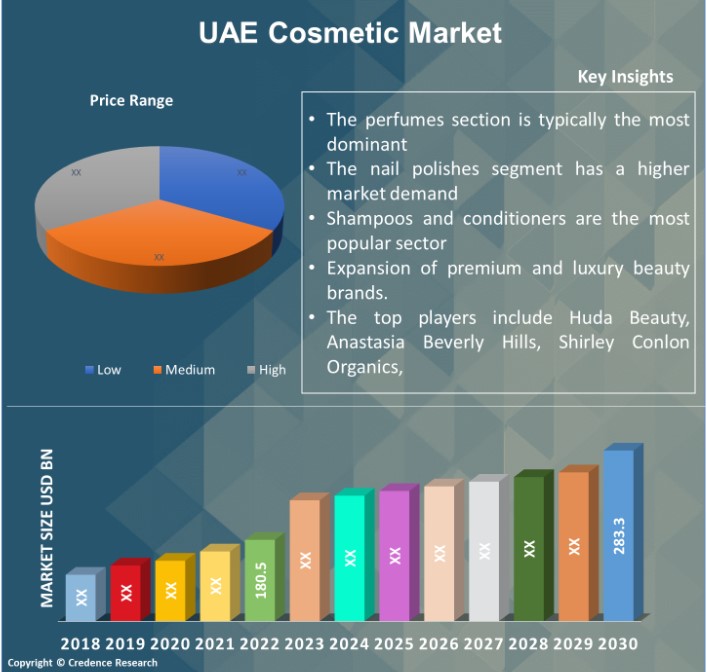
- The most popular segment of the cosmetics market is facial care, and the second largest area is body care.
- Shampoos and conditioners are the most popular category, while hair styling products are the second most important category in the cosmetics industry.
- The most popular makeup component is facial makeup, while the eye makeup section is the second largest in the cosmetics market.
- Perfumes are often the most dominating segment of the cosmetics business, followed by body sprays and deodorants.
- The nail polish section has a higher market demand, whereas the nail care products business adds to the cosmetics market.
- The oral care market is well-known and popular, and the Hygiene Products sector is equally important.
- The Natural and organic sector maintained the largest share of the market in 2022.
- The ethnic cosmetics business has expanded tremendously, and the Halal cosmetics market is another key component.
- Online retail category has grown significantly in recent years, and it remains the market's second most important area.
- Demand for personal care products will drive market growth.
- Counterfeiting in cosmetics and personal care products is a major impediment to market expansion.
Executive Summary
Market Definition
The UAE cosmetic market refers to the UAE's beauty and personal care Market. It contains skincare, makeup, haircare, fragrances, and other items. It's a vibrant market with a diverse choice of local and international brands.
Market Overview
Segmentation by Skin Care
- Facial care is the most popular segment of the cosmetics market. Individuals seek for facial care products such as cleansers, moisturizers, serums, and masks for their regular skincare routine.
- Body care is the second largest segment of the cosmetics market. Body care products, such as lotions, washes, scrubs, and oils, are commonly used to hydrate and nurture the skin on the body. Body care is an essential component of general skincare since it keeps the skin nourished and smooth.
- Men's skin care is likewise growing in popularity and has emerged as a significant market niche in the cosmetics industry.
Segmentation by Hair Care
- Shampoos and conditioners are the most popular sector. Shampoos and conditioners are necessary for the care and nourishment of our hair. They aid in the cleansing of the scalp, the removal of impurities and excess oil, and the provision of moisture and nutrients to maintain our hair healthy and beautiful.
- The hair styling products area is the second most important segment in the cosmetics market.
Segmentation by Makeup
- The facial makeup component is the most popular. Face makeup consists of materials such as foundation, concealer, powder, and blush that are intended to enhance and level out the complexion.
- The eye makeup segment is the second largest in the cosmetics market. Eye cosmetics, such as eyeshadow, eyeliner, and mascara, are used to highlight and define the eyes.
- Lip products, such as lipsticks, lip glosses, and lip balms, are also popular in the cosmetics industry. They come in a variety of colours and finishes, allowing people to express their particular style while also adding a pop of colour to their lips.
Segmentation by Fragrances
- The perfumes section is typically the most dominant. Perfumes are in high demand due to their capacity to enhance personal aroma and leave a lasting impression. They are available in a wide range of scents, from floral and fruity to woody and oriental, to suit a variety of tastes and moods.
- Body sprays and deodorants are another key section of the cosmetics market.
Segmentation by Nail Care
- The nail polishes segment has a higher market demand. Individuals who appreciate expressing themselves through unique and colourful nail colours are fans of nail paints. They provide a diverse choice of colours, finishes, and effects, allowing individuals to experiment with various appearances and styles.
- The nail care products industry, on the other hand, contributes to the cosmetics market.
Key Highlights of the Report
The UAE Cosmetic Market is segmented by Skin Care, Hair Care, Makeup, Fragrances, Nail Care, Personal Care, Feminine Hygiene Products, Luxury Cosmetics, Online and Offline Channels and region. In 2022, the organic sector accounted for the most share of the market. In addition, the nail polish category has a bigger market demand, and the perfumes area is usually the most dominant. Also, shampoos and conditioners are the most popular industry, with eye makeup ranking second in the cosmetics market.
The primary drivers of the market include rising beauty consciousness and demand for personal care products, as well as the influence of social media and digital marketing in promoting beauty trends. Furthermore, the primary market limitations are counterfeit and low-quality product competition, stringent regulations and compliance requirements, and fluctuations in raw material prices impacting product costs.
What Elements Are Driving the Market for UAE Cosmetic?
Several variables influence the UAE cosmetic market. Beauty and personal care goods are in high demand due to a growing population and rising disposable income. People with more disposable income are more likely to invest in skincare, cosmetics, haircare, and fragrances. Second, there is a noteworthy growth in beauty consciousness among UAE residents. People are becoming more conscious of the value of self-care and are actively looking for goods to improve their beauty habits.
What Are The Main Obstacles That The UAE Cosmetic MarketFaces?
While the UAE cosmetic sector is thriving, it is not without challenges. One significant difficulty is competition from counterfeit and low-quality products. Because of the market's prominence, there is an increased possibility of counterfeit products entering the market, which can be harmful to both consumers and real brands. Another impediment is the presence of severe regulations and compliance requirements. The UAE has rigorous restrictions addressing the safety and efficacy of cosmetic products, which can provide hurdles for firms looking to enter or expand in the market.
What Market Development Prospects Are There For UAE Cosmetic ly?
The UAE cosmetic sector offers a number of fascinating options. The growth of e-commerce platforms and online beauty purchasing creates new opportunities for firms to reach a larger customer base. Consumers may browse and purchase a variety of beauty goods from the comfort of their own homes thanks to the ease of internet shopping. In addition, there is a growing demand in the UAE for natural and organic beauty products. Consumers are becoming more aware of the materials used in skincare and cosmetic products, opening up potential for firms that provide natural and sustainable alternatives.
Market Drivers
The UAE Cosmetic Market is driven by several factors. The following are the key drivers of the UAE Cosmetic Market:
Personal Care Product Demand
Changes in people's lives, shifting weather patterns, and consumers' growing concern for their skin and sun protection all have an impact on cosmetics manufacturing.
Men and women are both utilizing more skincare products. Women between the ages of 45 and 65 are far more likely to use anti-aging products than men.
The market for personal care product components will expand due to rising demand for skin care products among consumers of all ages. As people ly grow more health-conscious, there has been an increase in demand for multipurpose skin care products. Because of the increased demand and awareness, manufacturers in the personal care industry have devised extremely effective and environmentally friendly products using cosmetic chemicals.
Furthermore, a movement in consumer behaviour toward healthier lifestyles is a major driver driving the need for personal care products, which is expected to raise demand for cosmetic chemicals over the forecast period.
Market Restraints
The UAE Cosmetic Market faces some challenges that may hinder its growth. These include the following:
Counterfeiting in Cosmetics and Personal Care
Consumers who purchase counterfeit cosmetics run a very high risk of having allergies and irritations due to the use of inexpensive/synthetic components and the lack of licensed production facilities, laboratories with the requisite workers, or specialists. Because purchasers confuse these counterfeit goods for the real thing, this diluting of genuine brands is another effect of these counterfeit goods.
As a result of the market's increased acceptance of counterfeit goods, genuine businesses' sales and brand awareness suffer. Unlicensed vendors are also increasingly selling luxury goods with no guarantees and no resale value. These dealers of counterfeit goods are free from paying federal excise taxes on their items. They may benefit more than the original product's manufacturers as a result. To address this issue, established enterprises must sell their products at fair prices by cutting profit margins, which has an impact on the whole market under study's expansion.
Opportunities
The UAE Cosmetic Market offers significant growth opportunities. These include the following:
Increasing Cosmetic Market Research and Development
Producers all around the world are beginning to use a more comprehensive and integrated strategy while making their goods. They do not divide health and beauty items into two distinct categories under the category of personal care, but rather group them together. As a result, they are becoming more open to concepts that establish a link between scientific advances in the health and biotechnology industries and the efficacy of beauty products.
Pharmaceutical, biotechnology, and food ingredient companies are increasingly interested in growing their position in the beauty market. The end result will be the installation of highly superior componentry.
Competitive Landscape
Key Players
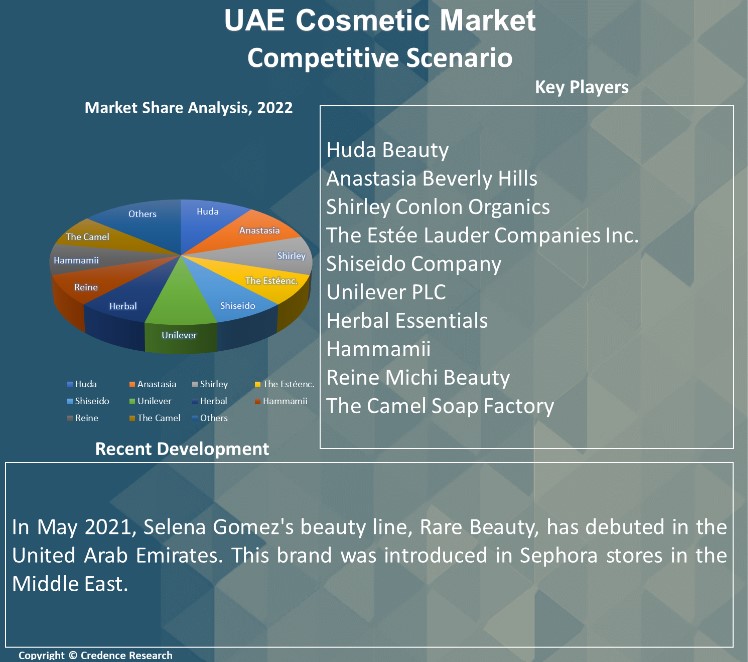
The UAE Cosmetic Market is highly competitive, with several key players. Some of the major players in the market and their market share are as follows:
- Huda Beauty
- Anastasia Beverly Hills
- Shirley Conlon Organics
- The Estée Lauder Companies Inc.
- Shiseido Company
- Unilever PLC
- Herbal Essentials
- Hammamii
- Reine Michi Beauty
- The Camel Soap Factory and other prominent players.
These organizations prioritize Skin Care innovation, Disease Area expansion, and mergers and acquisitions to stay competitive.
The UAE Cosmetic Market's key players continually seek to stay ahead by offering new Skin Cares and developments.
In May 2021, Cosmo Cosmetics, an organic and natural cosmetics brand based in the UAE, has launched a new web gateway to provide simple access to their extensive array of healthy, sustainable, and cruelty-free products.
In August 2021, RAMICOS Cosmetics, a new startup, has announced the debut of a new line of products featuring clean, vegan, and freshly packaged recipes. In the next two months, the firm will launch its direct-to-consumer website, which will provide access to both RAMICOS cosmetics and skincare brands, including colour cosmetics.
In April 2022, during in-cosmetics, Ashland showcases natural, nature-derived, and biodegradable personal care solutions, as well as nature-positive STEM education programs for village farmers in India.
In May 2022, at Excipient World in Kissimmee, Florida, Ashland presented Vialose trehalose dihydrate, a high purity lyoprotectant and stabilizer for biologic medications and other parenteral formulations.
Summary of Key Findings
- Counterfeit in cosmetics and personal care products stifles industry growth.
- Market segmented by Skin Care, Hair Care, Makeup, Fragrances, Nail Care, Personal Care, Feminine Hygiene Products, Luxury Cosmetics, Online and Offline Channels and region.
- The most popular makeup component is facial makeup
- Perfumes are often the most dominating segment of the cosmetics business
- The market is highly competitive with key players including Huda Beauty, Anastasia Beverly Hills, Shirley Conlon Organics, The Estée Lauder Companies Inc., Shiseido Company
Future Outlook
- Continued expansion in the beauty and personal care industry.
- Rising interest in natural and organic products.
- Increase in e-commerce and online beauty purchasing.
- Product introductions that are new and technologically advanced.
- Emphasize sustainability and environmentally beneficial techniques.
- Men's grooming products are becoming increasingly popular.
- Expansion of premium and luxury beauty brands.
- Personalized and tailored beauty solutions are emphasized.
Segmentation
- By Skin Care:
- Facial Care
- Body Care
- Men's Skin Care
- By Hair Care:
- Shampoos and Conditioners
- Hair Styling Products
- Hair Coloring and Treatments
- By Makeup:
- Face Makeup
- Eye Makeup
- Lip Products
- Makeup Tools
- By Fragrances:
- Perfumes
- Body Sprays and Deodorants
- By Nail Care:
- Nail Polishes
- Nail Care Products

Request a Free Sample
Fill in your details and we'll send you a free sample report.
- Sample data tables & charts
- Research methodology
Market Dynamics
Rising Beauty Consciousness and Personal Care Awareness
Increasing awareness of personal grooming and beauty routines among UAE consumers, driven by social media influence and changing lifestyle trends, is fueling demand for a wide range of cosmetic products.
Growth of E-commerce and Online Retail
The rapid expansion of online shopping platforms in the UAE has made cosmetics more accessible, allowing consumers to easily browse and purchase products, which has significantly boosted market growth.
Preference for Natural and Organic Products
A growing segment of UAE consumers is seeking natural, organic, and halal-certified cosmetics, prompting brands to innovate and expand their product lines to meet this demand.
Premiumization and Luxury Brand Expansion
The UAE's affluent population and tourism sector are driving demand for premium and luxury cosmetic brands, with consumers willing to spend more on high-quality, branded products.
Men’s Grooming and Niche Segments
There is a notable rise in demand for men’s skincare and grooming products, as well as ethnic and halal cosmetics, reflecting evolving consumer preferences and expanding the overall market.
Need a Custom Version of This Report?
Tailor the scope, geography, or segments to your exact requirements.
- Custom geography or segment scope
- Direct access to our analyst team
Frequently Asked Questions
What is the current Makeup of the UAE Cosmetic Market?
What is the predicted growth rate of the UAE Cosmetic Market between 2023 and 2030?
Which segment has the most market share in terms of industrial vertical?
Which Nail Care segment governs the market demand for UAE Cosmetic?
Table of Content
Chapter 1 Market Segmentation
- 1.1 Segmentation Framework
- 1.1.1 Product and Service Classification
- 1.1.2 Application and End-Use Classification
- 1.1.3 Technology and Solution Classification
- 1.1.4 Customer and Distribution Channel Classification
- 1.1.5 Geographic Segmentation
- 1.1.6 Market Segment Definitions and Boundaries
- 1.2 By Makeup
- 1.2.1 Face Makeup
- 1.2.2 Eye Makeup
- 1.2.3 Lip Products
- 1.2.4 Makeup Tools
- 1.3 By Hair Care
- 1.3.1 Shampoos and Conditioners
- 1.3.2 Hair Styling Products
- 1.3.3 Hair Coloring and Treatments
- 1.4 By Skin Care
- 1.4.1 Facial Care
- 1.4.2 Body Care
- 1.4.3 Men's Skin Care
- 1.5 By Fragrances
- 1.5.1 Perfumes
- 1.5.2 Body Sprays and Deodorants
Chapter 2 Introduction
- 2.1 Report Objectives and Scope
- 2.2 Product Definition and Industry Terminology
- 2.3 Market Inclusions and Exclusions
- 2.4 Research Process
- 2.4.1 Primary Research and Expert Interviews
- 2.4.2 Secondary Research and Source Review
- 2.4.3 Top-Down and Bottom-Up Estimation
- 2.4.4 Data Triangulation and Verification
- 2.5 Market Size Measurement Basis
- 2.5.1 2023: USD 190.97 million → 2032: USD 317.20 million
- 2.6 Historical and Forecast Reference Periods
- 2.6.1 Base Year: 2023
- 2.6.2 Forecast Period: 2023-2032
- 2.7 Research Assumptions and Limitations
Chapter 3 Executive Summary
- 3.1 Market Snapshot and Key Findings
- 3.2 Base-Year Market Size, 2023
- 3.3 Forecast Market Size, 2032
- 3.4 Revenue and Volume Growth Outlook
- 3.5 Key Demand and Supply Indicators
- 3.6 Leading Market Segments
- 3.7 Fastest-Growing Market Opportunities
- 3.8 Regional Performance Highlights
- 3.9 Technology and Industry Transformation
- 3.10 Competitive Landscape Summary
- 3.11 Analyst View and Strategic Implications
Chapter 4 UAE Cosmetic Market Trends and Developments
- 4.1 Historical Industry Development
- 4.2 Recent Market Trends and Developments
- 4.3 Demand and Customer Behavior Trends
- 4.4 Technology and Product Innovation
- 4.5 Artificial Intelligence, Automation and Digitalization
- 4.6 Local Manufacturing and Supply Chain Realignment
- 4.7 Industry Partnerships, Mergers and Acquisitions
- 4.8 Sustainability and Circular Economy Developments
- 4.9 Government and Private Sector Investment Trends
- 4.10 Emerging Business Models and Commercialization
- 4.11 Industry Developments and Announcements
Chapter 5 UAE Cosmetic Market Production, Supply and Demand Analysis
- 5.1 Demand Trend and Consumption Analysis
- 5.2 Demand Forecast, 2023-2032
- 5.3 Production and Output Trend
- 5.4 Production and Output Forecast, 2023-2032
- 5.5 Installed Capacity and Capacity Utilization
- 5.6 Company-Wise Production Plants and Statistics
- 5.6.1 Installed Production Capacity
- 5.6.2 Actual Production
- 5.6.3 Planned Capacity and Expansion Targets
- 5.7 Supply Chain Structure and Procurement Trends
- 5.8 Supply-Demand Gap and Bottlenecks
- 5.9 Import Dependence and Sourcing Structure
- 5.10 Contract Manufacturing and Outsourcing
- 5.11 Regional Supply and Demand Concentration
Chapter 6 UAE Cosmetic Market Pricing Analysis
- 6.1 Pricing Structure and Measurement
- 6.2 Historical Pricing Trends
- 6.3 Pricing Outlook, 2023-2032
- 6.4 Average Selling Price and Unit Economics
- 6.5 Pricing by Product and Market Segment
- 6.6 Geographic Pricing Differences
- 6.7 Key Input, Energy, Labor and Logistics Costs
- 6.8 Contract Pricing and Purchasing Models
- 6.9 Pricing Sensitivity and Competitive Positioning
- 6.10 Price, Margin and Profitability Implications
Chapter 7 UAE Cosmetic Market Dynamics
- 7.1 Market Growth Drivers
- 7.1.1 Demand-Side Drivers
- 7.1.2 Technology and Innovation Drivers
- 7.1.3 Infrastructure and Investment Drivers
- 7.1.4 Regulatory and Policy Drivers
- 7.2 Market Restraints
- 7.2.1 Cost and Affordability Constraints
- 7.2.2 Technology and Adoption Barriers
- 7.2.3 Supply Chain and Operational Constraints
- 7.3 Market Challenges
- 7.3.1 Competitive Pressure and Margin Erosion
- 7.3.2 Skills, Infrastructure and Implementation Gaps
- 7.4 Emerging Market Opportunities
- 7.5 Market Dynamics Impact and Time-Horizon Assessment
Chapter 8 UAE Cosmetic Value Chain Analysis
- 8.1 Industry Value Chain Overview
- 8.2 Upstream Suppliers and Critical Inputs
- 8.3 Technology and Component Providers
- 8.4 Manufacturing or Service Delivery
- 8.5 Distribution, Channel Partners and Integrators
- 8.6 Downstream Applications and End Users
- 8.7 Value Addition and Profit Pools
- 8.8 Vertical Integration and Outsourcing
- 8.9 Supplier Concentration and Risk
- 8.10 Supply Chain Localization and Resilience
Chapter 9 UAE Cosmetic Market Regulations and Policies
- 9.1 Relevant Laws, Standards and Compliance Frameworks
- 9.2 Product, Service, Safety and Quality Requirements
- 9.3 Government Policies, Incentives and Subsidies
- 9.4 Imports, Exports and Trade Barriers
- 9.5 Public Procurement and Local Content Requirements
- 9.6 Environmental and Sustainability Compliance
- 9.7 Upcoming Policy Changes and Market Implications
Chapter 10 UAE Cosmetic Market Hotspots and Opportunities
- 10.1 Market Opportunity Mapping and Growth Hotspots
- 10.2 High-Growth Applications and Customer Groups
- 10.3 Underserved Markets and White-Space Opportunities
- 10.4 Emerging Technology and Product Opportunities
- 10.5 New Capacity and Investment Hotspots
- 10.6 Market Entry and Expansion Opportunities
- 10.7 Distribution and Partnership Opportunities
- 10.8 Near-Term and Long-Term Commercial Potential
- 10.9 Opportunity Attractiveness and Execution Risks
Chapter 11 UAE Cosmetic Market Outlook, 2023-2032
- 11.1 Market Size and Analysis
- 11.1.1 Revenue (Market Measurement: 2023: USD 190.97 million → 2032: USD 317.20 million)
- 11.1.2 Market Volume and Quantity Sold
- 11.1.3 Historical Market Size
- 11.1.4 Base-Year Market Size, 2023
- 11.2 Market Forecast, 2023-2032
- 11.2.1 Revenue Forecast to 2032
- 11.2.2 Volume Forecast to 2032
- 11.2.3 CAGR and Year-on-Year Growth
- 11.2.4 Incremental Revenue Opportunity
- 11.3 Forecast Assumptions and Scenario Analysis
- 11.3.1 Base-Case Forecast
- 11.3.2 Optimistic and Conservative Scenarios
- 11.3.3 Technology, Pricing and Policy Sensitivities
- 11.4 Market Attractiveness and Growth Outlook
Chapter 12 UAE Cosmetic Market Segmentation and Outlook
- 12.1 Segmentation Summary and Market Shares, 2023
- 12.2 Largest and Fastest-Growing Segments
- 12.3 By Makeup - Market Size and Forecast, 2023-2032
- 12.3.1 Segment Definition and Scope
- 12.3.2 Historical Market Size
- 12.3.3 Revenue Forecast, 2023-2032
- 12.3.4 Volume Forecast, 2023-2032
- 12.3.5 Base-Year Market Share, 2023
- 12.3.6 Segment CAGR and Growth Drivers
- 12.3.7 Subsegment Market Size and Forecast
- 12.3.7.1 Face Makeup
- 12.3.7.2 Eye Makeup
- 12.3.7.3 Lip Products
- 12.3.7.4 Makeup Tools
- 12.3.8 Subsegment Pricing and Adoption Trends
- 12.3.9 Leading Suppliers and Competition
- 12.3.10 Regional Demand and Opportunities
- 12.4 By Hair Care - Market Size and Forecast, 2023-2032
- 12.4.1 Segment Definition and Scope
- 12.4.2 Historical Market Size
- 12.4.3 Revenue Forecast, 2023-2032
- 12.4.4 Volume Forecast, 2023-2032
- 12.4.5 Base-Year Market Share, 2023
- 12.4.6 Segment CAGR and Growth Drivers
- 12.4.7 Subsegment Market Size and Forecast
- 12.4.7.1 Shampoos and Conditioners
- 12.4.7.2 Hair Styling Products
- 12.4.7.3 Hair Coloring and Treatments
- 12.4.8 Subsegment Pricing and Adoption Trends
- 12.4.9 Leading Suppliers and Competition
- 12.4.10 Regional Demand and Opportunities
- 12.5 By Skin Care - Market Size and Forecast, 2023-2032
- 12.5.1 Segment Definition and Scope
- 12.5.2 Historical Market Size
- 12.5.3 Revenue Forecast, 2023-2032
- 12.5.4 Volume Forecast, 2023-2032
- 12.5.5 Base-Year Market Share, 2023
- 12.5.6 Segment CAGR and Growth Drivers
- 12.5.7 Subsegment Market Size and Forecast
- 12.5.7.1 Facial Care
- 12.5.7.2 Body Care
- 12.5.7.3 Men's Skin Care
- 12.5.8 Subsegment Pricing and Adoption Trends
- 12.5.9 Leading Suppliers and Competition
- 12.5.10 Regional Demand and Opportunities
- 12.6 By Fragrances - Market Size and Forecast, 2023-2032
- 12.6.1 Segment Definition and Scope
- 12.6.2 Historical Market Size
- 12.6.3 Revenue Forecast, 2023-2032
- 12.6.4 Volume Forecast, 2023-2032
- 12.6.5 Base-Year Market Share, 2023
- 12.6.6 Segment CAGR and Growth Drivers
- 12.6.7 Subsegment Market Size and Forecast
- 12.6.7.1 Perfumes
- 12.6.7.2 Body Sprays and Deodorants
- 12.6.8 Subsegment Pricing and Adoption Trends
- 12.6.9 Leading Suppliers and Competition
- 12.6.10 Regional Demand and Opportunities
- 12.7 Segment Growth Comparison
- 12.8 Segment Attractiveness and Priority Matrix
Chapter 13 UAE Cosmetic Geographic Market Outlook, 2023-2032
- 13.1 Regional Market Size and Country-Level Shares, 2023
- 13.2 Country Market Size Comparison, 2023
- 13.3 Country Market Forecasts, 2023-2032
- 13.4 Subregional Industrial and Demand Clusters
- 13.5 Intra-Regional Pricing and Cost Differences
- 13.6 Cross-Border Trade and Supply Networks
- 13.7 Regional Supply and Demand Balances
- 13.8 Country Opportunity Comparison and Prioritization
Note: Every listed country is covered on the structure shown under the first country.
Chapter 14 UAE Cosmetic Technology, Innovation and Sustainability Outlook
- 14.1 Technology Landscape and Maturity
- 14.2 Product, Process and Service Innovation
- 14.3 AI, Automation and Digital Tools in the Industry
- 14.4 Technology Adoption and Performance Benchmarking
- 14.5 Innovation Pipeline and R&D Investment
- 14.6 Patent and Intellectual Property Trends
- 14.7 Energy Efficiency and Resource Management
- 14.8 Sustainability, Recycling and Circularity
- 14.9 Technology Roadmap, 2023-2032
- 14.10 Risks of Obsolescence and Technology Substitution
Chapter 15 UAE Cosmetic Market Key Strategic Imperatives
- 15.1 Growth and Market Entry Priorities
- 15.2 High-Return Products and Segments
- 15.3 Pricing, Profitability and Cost Optimization
- 15.4 Technology Investment and Product Differentiation
- 15.5 Supply Chain Localization and Resilience
- 15.6 Distribution and Customer Acquisition
- 15.7 Partnership, Acquisition and Capacity Strategy
- 15.8 Regional Expansion Priorities
- 15.9 Short-, Medium- and Long-Term Actions
Chapter 16 Competition Outlook
- 16.1 Industry Competition Characteristics
- 16.2 Market Structure and Concentration
- 16.3 Market Share and Competitive Positioning, 2023
- 16.4 Company-Wise Revenue and Product Benchmarking
- 16.5 Production and Service Capacity Benchmarking
- 16.6 Technology, Pricing and Differentiation
- 16.7 Regional Footprint and Distribution Strength
- 16.8 Mergers, Acquisitions and Strategic Alliances
- 16.9 New Entrants and Competitive Threats
- 16.10 Porter's Five Forces and Industry Attractiveness
- 16.11 Competitive Outlook, 2023-2032
Chapter 17 Company Profiles
- 17.1 Company Coverage and Selection Criteria
- 17.2 Huda Beauty
- 17.2.1 Business Description
- 17.2.2 Company Ownership and Geographic Presence
- 17.2.3 Product and Service Portfolio
- 17.2.4 Manufacturing and Operating Footprint
- 17.2.5 Production Capacity and Expansion Plans
- 17.2.6 Financial Performance and Investment
- 17.2.7 Market Share and Competitive Position
- 17.2.8 Technology and Innovation Capabilities
- 17.2.9 Strategic Alliances or Partnerships
- 17.2.10 Recent Developments
- 17.2.11 Growth Strategy and Outlook
- 17.3 Anastasia Beverly Hills
- 17.4 Shirley Conlon Organics
- 17.5 The Estée Lauder Companies Inc.
- 17.6 Shiseido Company
- 17.7 Unilever PLC
- 17.8 Herbal Essentials
- 17.9 Hammamii
- 17.10 Reine Michi Beauty
- 17.11 The Camel Soap Factory
- 17.12 Other Relevant Market Participants
Note: Every listed company is profiled on the structure shown under the first company. The company list is preliminary and may change based on research findings, market developments, data availability and client requirements.
Chapter 18 Disclaimer
- 18.1 Research and Forecast Disclaimer
- 18.2 Data Source and Estimation Limitations
Note: The depth of individual sections depends on data availability for this market. Volume, capacity, trade and other unit-based metrics are included where applicable.

