
Market Overview:
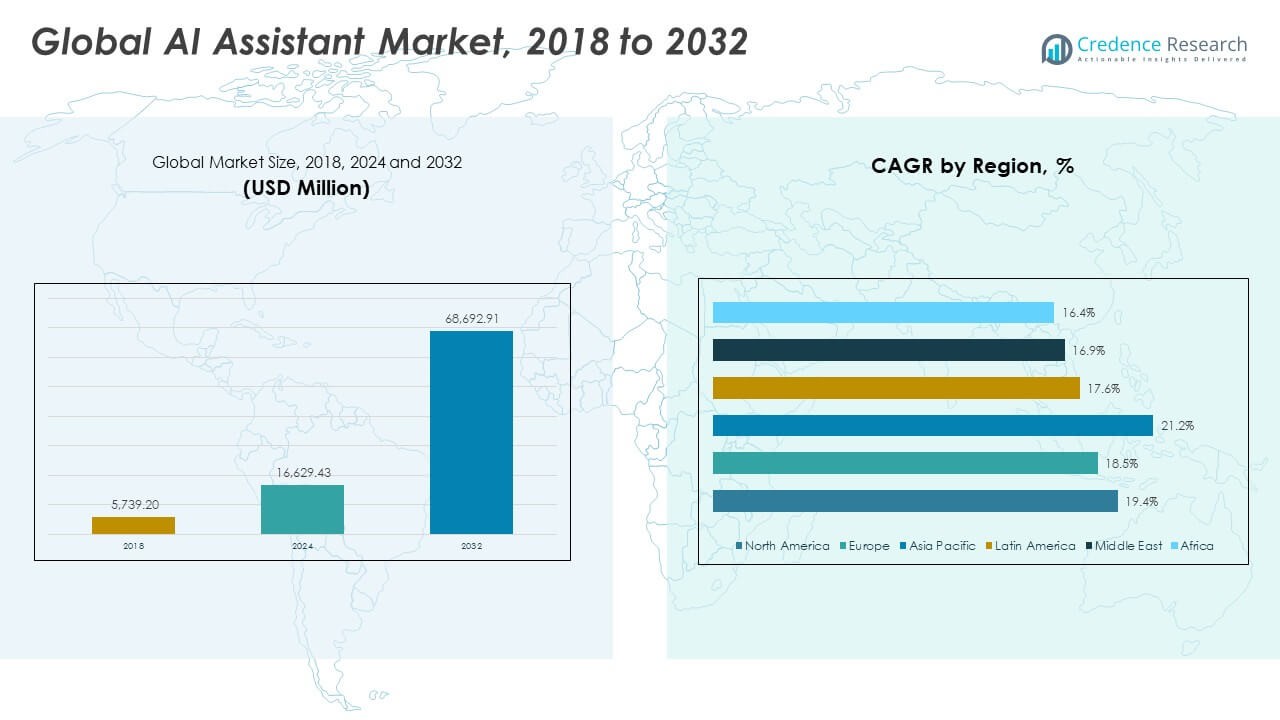
The Global AI Assistant Market size was valued at USD 5,739.20 million in 2018, reached USD 16,629.43 million in 2024, and is anticipated to reach USD 68,692.91 million by 2032, registering a CAGR of 19.40% during the forecast period.
| REPORT ATTRIBUTE | DETAILS |
|---|---|
| Historical Period | 2020-2023 |
| Base Year | 2024 |
| Forecast Period | 2025-2032 |
| AI Assistant Market Size 2024 | USD 16,629.43 Million |
| AI Assistant Market, CAGR | 19.40% |
| AI Assistant Market Size 2032 | USD 68,692.91 Million |
The market is driven by the growing integration of AI assistants across smartphones, smart speakers, and enterprise applications. Organizations are adopting conversational AI to enhance productivity, automate customer interactions, and provide real-time support. Advancements in natural language processing (NLP) and machine learning have improved contextual understanding, enabling AI assistants to perform complex tasks efficiently. The rapid adoption of voice-enabled technologies in consumer electronics and the expansion of digital ecosystems continue to boost market demand.
Regionally, North America dominates due to strong AI infrastructure, high adoption in enterprises, and leading technology providers. Europe follows closely, supported by advancements in customer engagement platforms and data security regulations. The Asia-Pacific region is the fastest-growing, driven by increasing smartphone penetration, expanding e-commerce, and government support for AI innovation in China, Japan, and India. Emerging markets in Latin America and the Middle East & Africa are also gaining momentum as digital transformation accelerates.
Market Insights:
- The Global AI Assistant Market was valued at USD 5,739.20 million in 2018, reached USD 16,629.43 million in 2024, and is expected to reach USD 68,692.91 million by 2032, registering a CAGR of 19.4% during the forecast period.
- North America (31%), Europe (25%), and Asia Pacific (27%) dominate due to strong AI infrastructure, high adoption of smart technologies, and active investment in voice-enabled systems across enterprises.
- Asia Pacific is the fastest-growing region with a 2% CAGR, driven by rapid digitalization, smartphone penetration, and government-led AI innovation programs across China, Japan, and India.
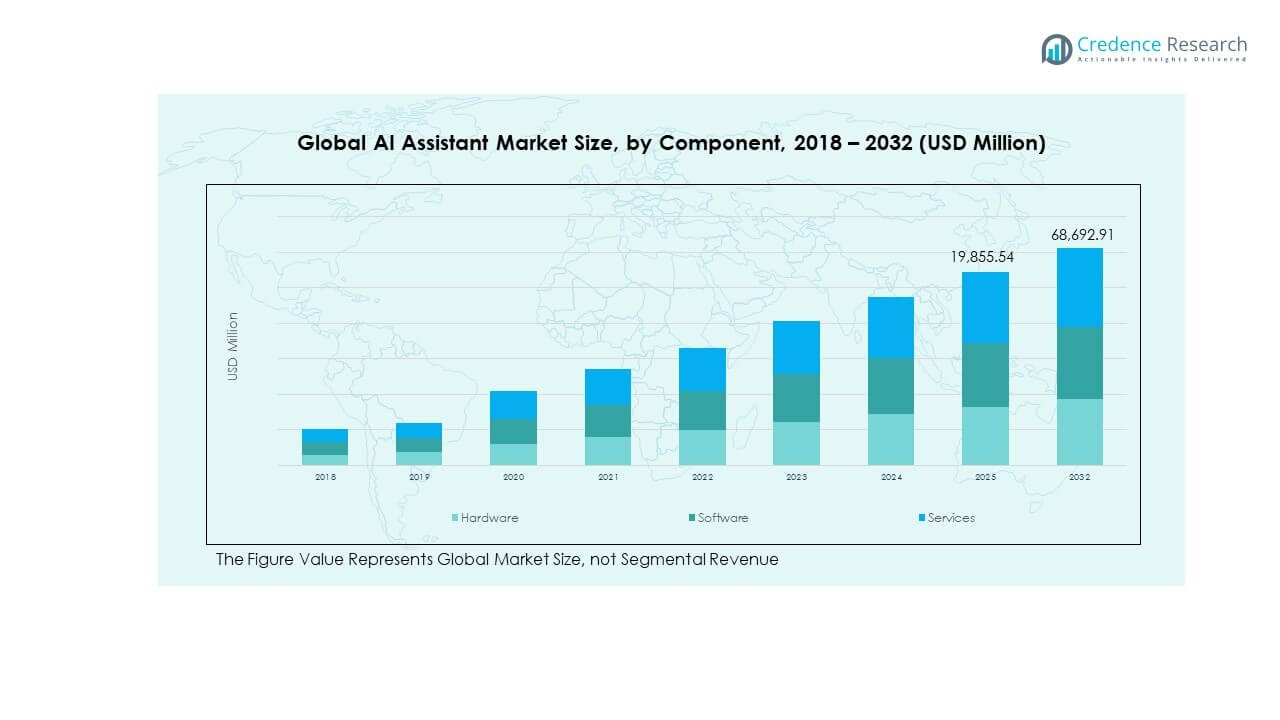
- By component, software holds around 55% of the total market share, supported by continuous innovation in NLP and ML technologies that enhance personalization and scalability.
- Services account for nearly 30%, fueled by rising demand for AI deployment, maintenance, and customization across enterprise ecosystems globally.
Market Drivers:
Rising Integration of Voice and Virtual Assistants Across Consumer Devices
The Global AI Assistant Market is expanding due to widespread use of smart devices that rely on voice-enabled technologies. Consumers are adopting AI-powered assistants in smartphones, smart speakers, and home automation systems for daily tasks. Companies like Apple, Google, and Amazon continue to refine speech recognition to improve user experience. The shift toward hands-free operation and personalized recommendations enhances customer satisfaction. AI assistants also help in managing schedules, online shopping, and entertainment, making them indispensable in connected homes. It benefits businesses by increasing product engagement and user loyalty. The demand for seamless human-machine communication continues to boost integration. Rising digital adoption in emerging economies adds further momentum to the market.
- For instance, Siri by Apple Inc. uses an on-device voice-trigger system across iPhone, iPad and HomePod to support two keywords and distinguish the primary user from other speakers.
Growing Demand for AI in Business Operations and Customer Support
Enterprises are deploying AI assistants to automate communication, improve response times, and reduce operational costs. Customer service bots powered by NLP offer 24/7 support and faster query resolution. It allows organizations to handle high volumes of requests without adding human resources. AI integration in HR, sales, and IT processes enhances efficiency and reduces workload. The market benefits from rising investment in enterprise automation and workflow optimization. Companies in sectors such as retail, healthcare, and finance are using assistants to streamline user interaction. The focus on improving customer satisfaction and reducing employee burnout strengthens adoption. Continuous system upgrades and AI model improvements sustain long-term growth.
- For instance, Microsoft 365 Copilot is used by nearly 70 % of the Fortune 500 companies, helping streamline operations and transform workflows.
Advancements in Natural Language Processing and Machine Learning Algorithms
Enhanced NLP and machine learning capabilities are driving smarter conversational experiences. AI assistants now recognize tone, intent, and emotions with higher accuracy. It enables complex decision-making tasks like booking, navigation, and contextual recommendations. Machine learning allows systems to learn user behavior and deliver tailored responses. Integration of multimodal capabilities, including voice, text, and gesture recognition, further broadens use cases. Companies are investing heavily in R&D to refine adaptive AI models. The rise of open-source NLP frameworks supports faster deployment across industries. These innovations are shaping the next generation of interactive, intelligent digital assistants.
Expansion of AI-Powered Ecosystems Across Industries
The Global AI Assistant Market benefits from the rise of integrated ecosystems in healthcare, automotive, and banking. Voice assistants in cars improve navigation and driver safety through real-time assistance. In healthcare, AI supports patient data management, appointment scheduling, and diagnostics. It also powers personalized banking and investment tools that enhance financial decision-making. Businesses use AI-driven assistants to strengthen user engagement and brand interaction. The integration of cloud-based platforms ensures better scalability and reliability. Global enterprises are aligning strategies to enhance connectivity across their digital ecosystems. The diversification of applications continues to strengthen industry-wide adoption.
Market Trends:
Emergence of Multilingual and Context-Aware AI Assistants
The Global AI Assistant Market is witnessing a shift toward multilingual and context-aware systems. AI assistants now support regional languages to improve accessibility and inclusivity. Contextual awareness enables them to interpret user intent beyond basic commands. It enhances personalization by analyzing tone, behavior, and previous interactions. Leading developers focus on regional adaptation to expand user reach across global markets. This trend strengthens engagement in non-English-speaking regions. Enhanced accuracy and comprehension make AI more human-like in communication. Growing use in education and customer engagement reflects its cross-sector potential.
- For instance, Google launched multilingual support in its assistant enabling users to switch between two languages - English and Spanish (followed by French, German, Italian and Japanese) - seamlessly in a single conversation.
Integration of AI Assistants with Internet of Things (IoT) Platforms
The convergence of AI assistants and IoT technology is transforming smart environments. Users control lighting, temperature, and appliances through voice commands. It creates unified ecosystems that promote convenience and energy efficiency. Manufacturers embed assistants in connected vehicles and industrial automation systems. Integration supports predictive maintenance and operational control. The trend aligns with global efforts toward smart city development. Businesses are leveraging this synergy to offer intelligent and adaptive solutions. The growing IoT penetration enhances the scope of AI-powered assistants across diverse domains.
- For instance, Amazon Alexa integrates with hundreds of millions of smart home devices and thousands of developers, expanding beyond simple voice commands to control lights, plugs, TVs, and a vast range of other appliances.
Adoption of Cloud-Based AI Platforms and Edge Computing Models
Cloud technology accelerates the deployment and scalability of AI assistants across industries. The Global AI Assistant Market is moving toward cloud and edge computing integration for better performance. It ensures faster processing, improved data security, and lower latency. Enterprises prefer hybrid models to balance data control with computational power. The demand for on-device processing is also increasing for privacy-sensitive applications. Cloud-based frameworks simplify AI model updates and global accessibility. Tech companies invest in decentralized infrastructure to optimize user experience. This evolution strengthens system efficiency and responsiveness in real-time interactions.
Rise of Emotionally Intelligent and Ethical AI Assistants
Developers are prioritizing emotional intelligence and ethics in AI design. The focus has shifted toward responsible and transparent AI interaction. It ensures trust and empathy in human-AI engagement. Emotionally aware assistants interpret tone and sentiment to provide sensitive responses. Ethical frameworks are guiding product design to prevent bias and misuse. Organizations emphasize data protection and privacy compliance. Consumers prefer assistants that align with their moral and social values. This movement defines a major transformation toward human-centric AI systems.
Market Challenges Analysis:
Concerns Over Data Privacy, Security, and Regulatory Compliance
The Global AI Assistant Market faces challenges linked to data collection and user privacy. AI assistants rely heavily on voice data and behavioral analytics for personalization. It raises concerns over unauthorized access and misuse of sensitive information. Data breaches and cyberattacks can erode consumer trust in smart technologies. Compliance with privacy laws like GDPR and CCPA increases operational complexity. Companies must ensure encryption and transparent consent mechanisms. Striking a balance between personalization and confidentiality remains difficult. Users are becoming more cautious about allowing devices to record or analyze their data. This challenge may slow adoption in regions with strict data regulations.
Limited Contextual Understanding and Cultural Adaptability
AI assistants still struggle to interpret diverse human emotions, dialects, and cultural nuances. It leads to inconsistent responses and miscommunication in global applications. The systems often depend on large datasets that may contain regional biases. Adapting to varied linguistic patterns and cultural expectations requires extensive retraining. This challenge limits performance in multilingual or culturally diverse environments. Businesses risk losing engagement when assistants fail to recognize local context. Technical constraints in real-time learning also hinder scalability. Improving contextual intelligence remains essential for achieving universal usability and trust.
Market Opportunities:
Rising Adoption of AI Assistants in Healthcare, Retail, and Automotive Sectors
The Global AI Assistant Market holds promising opportunities across major industries. Healthcare systems use AI assistants for diagnostics, patient management, and teleconsultations. In retail, they enhance personalized shopping and streamline customer engagement. Automotive applications include in-car assistants that improve navigation and safety. It encourages partnerships between technology providers and industry leaders. Continuous development of voice analytics and automation creates new service models. Enterprises are also adopting AI assistants for workforce training and customer analytics. This cross-industry diversification broadens revenue streams for global players.
Expansion in Emerging Economies Through Localized AI Innovations
Emerging economies present untapped potential due to increasing internet connectivity and smartphone adoption. Companies are localizing AI assistants to suit regional languages and preferences. It helps in expanding digital inclusion and improving access to smart technologies. Governments are supporting AI innovation through national digital transformation programs. Local developers are collaborating with global firms to build context-aware systems. Rapid growth in small and medium enterprises drives new commercial uses. The shift toward cost-efficient cloud AI models enables scalable adoption across new markets.
Market Segmentation Analysis:
By Component
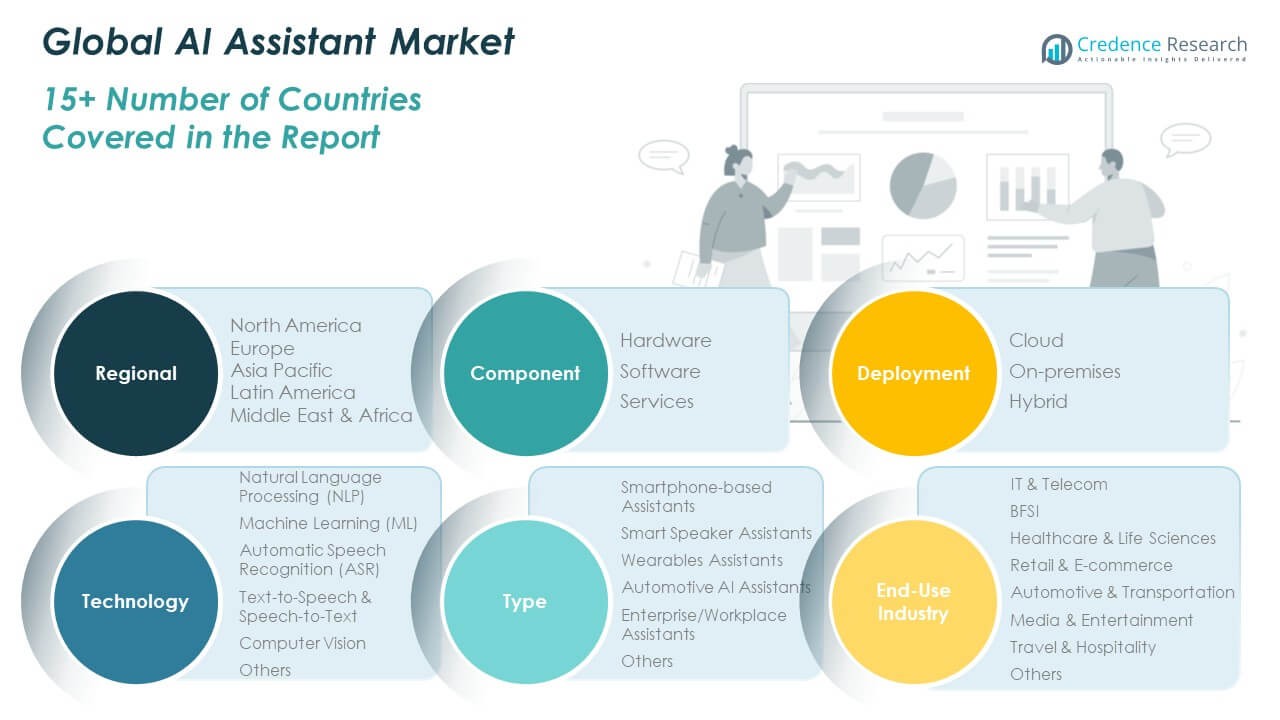
The Global AI Assistant Market is segmented into software, services, and hardware. Software dominates due to continuous innovation in AI algorithms, voice processing, and machine learning integration. It supports diverse applications across personal and enterprise environments. Services play a vital role in deployment, customization, and ongoing support for businesses adopting AI-driven systems. Hardware demand is growing with the proliferation of smart devices, sensors, and edge computing tools that enhance processing efficiency and user interaction. Each component contributes to creating a connected, responsive, and intelligent digital ecosystem.
By Deployment
The market is divided into cloud-based and on-premises segments. Cloud-based solutions hold a major share due to scalability, cost-effectiveness, and ease of integration with enterprise systems. It supports remote access and continuous updates that improve performance and security. On-premises deployment remains relevant for industries handling sensitive data, ensuring control and compliance with privacy regulations. Both deployment types enable organizations to align AI capabilities with their operational strategies.
- For instance, Microsoft advocates hybrid models combining cloud infrastructure with on-device processing to maintain performance and data governance.
By Technology
Key technologies include Natural Language Processing (NLP), Machine Learning (ML), Speech Recognition, Computer Vision, Context Awareness, and others. NLP and ML lead the segment by enhancing comprehension, personalization, and contextual understanding. Speech recognition and computer vision strengthen user experience through multimodal interaction. Context awareness enables adaptive responses based on user behavior and environment, improving engagement and precision.
By Type and End-Use Industry
By type, chatbots, smart speakers, virtual assistants, mobile assistants, and web-based assistants drive adoption across sectors. BFSI, healthcare, retail, IT & telecom, automotive, education, and media industries rely on AI assistants to automate operations, improve service quality, and enhance user experience. It continues to redefine business efficiency and customer engagement globally.
Segmentation:
By Component
- Software
- Services
- Hardware
By Deployment
- Cloud-Based
- On-Premises
By Technology
- Natural Language Processing (NLP)
- Machine Learning (ML)
- Speech Recognition
- Computer Vision
- Context Awareness
- Others
By Type
- Chatbots
- Smart Speakers
- Virtual Assistants
- Mobile Assistants
- Web-Based Assistants
By End-Use Industry
- BFSI
- Healthcare
- Retail & E-Commerce
- IT & Telecommunications
- Automotive
- Education
- Media & Entertainment
- Others
By Region
- North America
- U.S.
- Canada
- Mexico
- Europe
- Germany
- France
- U.K.
- Italy
- Spain
- Rest of Europe
- Asia Pacific
- China
- Japan
- India
- South Korea
- South-east Asia
- Rest of Asia Pacific
- Latin America
- Brazil
- Argentina
- Rest of Latin America
- Middle East & Africa
- GCC Countries
- South Africa
- Rest of the Middle East and Africa
Regional Analysis:
Write Regional Analysis * in professional tone of * [ Global AI Assistant Market ] in separate para for [NorthAmerica, Europe, Asia Pacific, Latin America, Middle east, Africa[ paragraphs with 8-9 sentences under 400 words, maintain professional tone, direct style and active voice.
. Use the [ Global AI Assistant Market ] one times in a paragraphs, use "it" as a subject if required more. Dont use "as a result", limit "ing" form of verb. Dont start sentences with "as". Dont use "Additionally", "Moreover", "in conclusion".
Before each region add this para [The [Region name] Global AI Assistant Market size was valued at USD W million in 2018 to USD X million in 2024 and is anticipated to reach USD Y million by 2032, at a CAGR of Z during the forecast period. , pick up the relavant market value n cagr from the table given below. With sub headings. add Add market share for each region after calculating.
Key Player Analysis:
- Google LLC
- Microsoft Corporation
- Salesforce, Inc.
- Oracle Corporation
- SAP SE
- IBM Corporation
- Meta Platforms, Inc.
- Amazon Web Services (AWS)
- Apple Inc.
- Baidu, Inc.
- SoundHound Inc.
- Nuance Communications (Microsoft)
- Samsung Electronics Co., Ltd.
- Cortana Intelligence (Microsoft)
Competitive Analysis:
The Global AI Assistant Market is highly competitive, driven by innovation and rapid technological advancements. Leading companies such as Google, Amazon, Microsoft, Apple, and IBM dominate through strong R&D capabilities and extensive product portfolios. It emphasizes strategic partnerships, acquisitions, and integration of advanced NLP and ML technologies to strengthen product efficiency. New entrants are focusing on niche applications like healthcare, education, and enterprise automation. Companies differentiate through language adaptability, security, and platform integration. Growing competition encourages constant improvement in conversational accuracy and contextual intelligence across global markets.
Recent Developments:
- In October 2025, Google reported that its AI Overviews and conversational capabilities within Search Generative Experience (SGE) have driven an increase in commercial query activity across more than 40 languages. Additionally, Google announced the integration of advertisements directly within AI Assistant Overviews for select English-speaking markets outside the U.S., allowing Search Ads and Shopping Ads to appear in the answer boxes. This is part of Google's broader strategy to embed conversational AI deeper into web and cloud experiences, with enhanced entity recognition to support brand-safe responses in large language models like Gemini.
- On October 16, 2025, Microsoft launched major upgrades to its Copilot AI assistant platform on Windows 11. The new features include activating the AI assistant via the wake phrase “Hey Copilot” to execute voice commands, expanded Copilot Vision for content analysis, and Copilot Actions for autonomous real-world tasks such as making restaurant reservations. These upgrades position Copilot as an ambient, conversational AI agent integrating across enterprise and consumer environments, further bolstered by new capabilities on Xbox Ally gaming consoles for real-time gameplay assistance.
- On October 14, 2025, Salesforce entered a strategic partnership with OpenAI, enabling its Agentforce 360 platform to integrate with ChatGPT. This allows users to query sales records, review customer conversations, and create Tableau visualizations within ChatGPT, using frontier models such as GPT-5. Through the partnership, Salesforce’s Agentforce Commerce supports instant checkout within ChatGPT, and new Slack integrations are rolling out that merge Slackbot capabilities with OpenAI’s technology. These moves reflect a turn toward agent-driven, multi-surface enterprise experiences powered by generative AI agents.
Report Coverage:
The research report offers an in-depth analysis based on component, deployment, technology, type, and end-use industry. It details leading market players, providing an overview of their business, product offerings, investments, revenue streams, and key applications. Additionally, the report includes insights into the competitive environment, SWOT analysis, current market trends, as well as the primary drivers and constraints. Furthermore, it discusses various factors that have driven market expansion in recent years. The report also explores market dynamics, regulatory scenarios, and technological advancements that are shaping the industry. It assesses the impact of external factors and global economic changes on market growth. Lastly, it provides strategic recommendations for new entrants and established companies to navigate the complexities of the market.
Future Outlook:
- Growing adoption of AI assistants across industries for automation and customer engagement.
- Integration of advanced NLP and multimodal communication features in smart devices.
- Expansion of localized AI assistants supporting multiple languages and cultural contexts.
- Rising deployment of AI in healthcare diagnostics, education, and financial services.
- Increasing investments in ethical AI frameworks and data privacy protection.
- Stronger collaboration between global tech firms and regional startups.
- Rapid adoption of voice-enabled IoT ecosystems and connected environments.
- Evolution of emotionally intelligent AI improving human-AI interaction quality.
- Broader use of AI assistants in autonomous vehicles and smart infrastructure.
- Growing government and enterprise support for AI-driven digital transformation.

Request a Free Sample
Fill in your details and we'll send you a free sample report.
- Sample data tables & charts
- Research methodology
Need a Custom Version of This Report?
Tailor the scope, geography, or segments to your exact requirements.
- Custom geography or segment scope
- Direct access to our analyst team
Frequently Asked Questions
What is the current market size for Global AI Assistant Market, and what is its projected size in 2032?
At what Compound Annual Growth Rate is the Global AI Assistant Market projected to grow between 2025 and 2032?
Which Global AI Assistant Market segment held the largest share in 2024?
What are the primary factors fueling the growth of the Global AI Assistant Market?
Who are the leading companies in the Global AI Assistant Market?
Which region commanded the largest share of the Global AI Assistant Market in 2024?
Table of Content
Chapter 1 Market Segmentation
- 1.1 Segmentation Framework
- 1.1.1 Product and Service Classification
- 1.1.2 Application and End-Use Classification
- 1.1.3 Technology and Solution Classification
- 1.1.4 Customer and Distribution Channel Classification
- 1.1.5 Geographic Segmentation
- 1.1.6 Market Segment Definitions and Boundaries
Chapter 2 Introduction
- 2.1 Report Objectives and Scope
- 2.2 Product Definition and Industry Terminology
- 2.3 Market Inclusions and Exclusions
- 2.4 Research Process
- 2.4.1 Primary Research and Expert Interviews
- 2.4.2 Secondary Research and Source Review
- 2.4.3 Top-Down and Bottom-Up Estimation
- 2.4.4 Data Triangulation and Verification
- 2.5 Market Size Measurement Basis
- 2.5.1 2024: USD 16,629.43 million → 2032: USD 68,692.91 million
- 2.6 Historical and Forecast Reference Periods
- 2.6.1 Base Year: 2024
- 2.6.2 Forecast Period: 2024-2032
- 2.7 Research Assumptions and Limitations
Chapter 3 Executive Summary
- 3.1 Market Snapshot and Key Findings
- 3.2 Base-Year Market Size, 2024
- 3.3 Forecast Market Size, 2032
- 3.4 Revenue and Volume Growth Outlook
- 3.5 Key Demand and Supply Indicators
- 3.6 Leading Market Segments
- 3.7 Fastest-Growing Market Opportunities
- 3.8 Regional Performance Highlights
- 3.9 Technology and Industry Transformation
- 3.10 Competitive Landscape Summary
- 3.11 Analyst View and Strategic Implications
Chapter 4 Global AI Assistant Market Trends and Developments
- 4.1 Historical Industry Development
- 4.2 Recent Market Trends and Developments
- 4.3 Demand and Customer Behavior Trends
- 4.4 Technology and Product Innovation
- 4.5 Artificial Intelligence, Automation and Digitalization
- 4.6 Local Manufacturing and Supply Chain Realignment
- 4.7 Industry Partnerships, Mergers and Acquisitions
- 4.8 Sustainability and Circular Economy Developments
- 4.9 Government and Private Sector Investment Trends
- 4.10 Emerging Business Models and Commercialization
- 4.11 Industry Developments and Announcements
Chapter 5 Global AI Assistant Market Production, Supply and Demand Analysis
- 5.1 Demand Trend and Consumption Analysis
- 5.2 Demand Forecast, 2024-2032
- 5.3 Production and Output Trend
- 5.4 Production and Output Forecast, 2024-2032
- 5.5 Installed Capacity and Capacity Utilization
- 5.6 Company-Wise Production Plants and Statistics
- 5.6.1 Installed Production Capacity
- 5.6.2 Actual Production
- 5.6.3 Planned Capacity and Expansion Targets
- 5.7 Supply Chain Structure and Procurement Trends
- 5.8 Supply-Demand Gap and Bottlenecks
- 5.9 Import Dependence and Sourcing Structure
- 5.10 Contract Manufacturing and Outsourcing
- 5.11 Regional Supply and Demand Concentration
Chapter 6 Global AI Assistant Market Pricing Analysis
- 6.1 Pricing Structure and Measurement
- 6.2 Historical Pricing Trends
- 6.3 Pricing Outlook, 2024-2032
- 6.4 Average Selling Price and Unit Economics
- 6.5 Pricing by Product and Market Segment
- 6.6 Geographic Pricing Differences
- 6.7 Key Input, Energy, Labor and Logistics Costs
- 6.8 Contract Pricing and Purchasing Models
- 6.9 Pricing Sensitivity and Competitive Positioning
- 6.10 Price, Margin and Profitability Implications
Chapter 7 Global AI Assistant Market Dynamics
- 7.1 Market Growth Drivers
- 7.1.1 Demand-Side Drivers
- 7.1.2 Technology and Innovation Drivers
- 7.1.3 Infrastructure and Investment Drivers
- 7.1.4 Regulatory and Policy Drivers
- 7.2 Market Restraints
- 7.2.1 Cost and Affordability Constraints
- 7.2.2 Technology and Adoption Barriers
- 7.2.3 Supply Chain and Operational Constraints
- 7.3 Market Challenges
- 7.3.1 Competitive Pressure and Margin Erosion
- 7.3.2 Skills, Infrastructure and Implementation Gaps
- 7.4 Emerging Market Opportunities
- 7.5 Market Dynamics Impact and Time-Horizon Assessment
Chapter 8 Global AI Assistant Value Chain Analysis
- 8.1 Industry Value Chain Overview
- 8.2 Upstream Suppliers and Critical Inputs
- 8.3 Technology and Component Providers
- 8.4 Manufacturing or Service Delivery
- 8.5 Distribution, Channel Partners and Integrators
- 8.6 Downstream Applications and End Users
- 8.7 Value Addition and Profit Pools
- 8.8 Vertical Integration and Outsourcing
- 8.9 Supplier Concentration and Risk
- 8.10 Supply Chain Localization and Resilience
Chapter 9 Global AI Assistant Market Regulations and Policies
- 9.1 Relevant Laws, Standards and Compliance Frameworks
- 9.2 Product, Service, Safety and Quality Requirements
- 9.3 Government Policies, Incentives and Subsidies
- 9.4 Imports, Exports and Trade Barriers
- 9.5 Public Procurement and Local Content Requirements
- 9.6 Environmental and Sustainability Compliance
- 9.7 Data Protection, AI and Cybersecurity Compliance
- 9.8 Upcoming Policy Changes and Market Implications
Chapter 10 Global AI Assistant Market Hotspots and Opportunities
- 10.1 Market Opportunity Mapping and Growth Hotspots
- 10.2 High-Growth Applications and Customer Groups
- 10.3 Underserved Markets and White-Space Opportunities
- 10.4 Emerging Technology and Product Opportunities
- 10.5 New Capacity and Investment Hotspots
- 10.6 Market Entry and Expansion Opportunities
- 10.7 Distribution and Partnership Opportunities
- 10.8 Near-Term and Long-Term Commercial Potential
- 10.9 Opportunity Attractiveness and Execution Risks
Chapter 11 Global AI Assistant Market Outlook, 2024-2032
- 11.1 Market Size and Analysis
- 11.1.1 Revenue (Market Measurement: 2024: USD 16,629.43 million → 2032: USD 68,692.91 million)
- 11.1.2 Market Volume and Quantity Sold
- 11.1.3 Historical Market Size
- 11.1.4 Base-Year Market Size, 2024
- 11.2 Market Forecast, 2024-2032
- 11.2.1 Revenue Forecast to 2032
- 11.2.2 Volume Forecast to 2032
- 11.2.3 CAGR and Year-on-Year Growth
- 11.2.4 Incremental Revenue Opportunity
- 11.3 Forecast Assumptions and Scenario Analysis
- 11.3.1 Base-Case Forecast
- 11.3.2 Optimistic and Conservative Scenarios
- 11.3.3 Technology, Pricing and Policy Sensitivities
- 11.4 Market Attractiveness and Growth Outlook
Chapter 12 Global AI Assistant Market Segmentation and Outlook
- 12.1 Segmentation Summary and Market Shares, 2024
- 12.2 Largest and Fastest-Growing Segments
- 12.3 Segment Growth Comparison
- 12.4 Segment Attractiveness and Priority Matrix
Chapter 13 Global AI Assistant Geographic Market Outlook, 2024-2032
- 13.1 Regional Market Size and Share, 2024
- 13.2 Regional Market Forecast, 2024-2032
- 13.3 Regional Pricing, Production and Demand Differences
- 13.4 North America
- 13.4.1 United States
- 13.4.2 Canada
- 13.4.3 Mexico
- 13.5 Europe
- 13.5.1 Germany
- 13.5.2 France
- 13.5.3 Italy
- 13.5.4 United Kingdom
- 13.5.5 Spain
- 13.5.6 Poland
- 13.5.7 Russia
- 13.5.8 Netherlands
- 13.5.9 Belgium
- 13.5.10 Sweden
- 13.5.11 Denmark
- 13.5.12 Norway
- 13.5.13 Rest of Europe
- 13.6 Asia Pacific
- 13.6.1 China
- 13.6.2 India
- 13.6.3 Japan
- 13.6.4 South Korea
- 13.6.5 Thailand
- 13.6.6 Indonesia
- 13.6.7 Vietnam
- 13.6.8 Malaysia
- 13.6.9 Australia
- 13.6.10 Rest of Asia Pacific
- 13.7 Latin America
- 13.7.1 Brazil
- 13.7.2 Argentina
- 13.7.3 Colombia
- 13.7.4 Chile
- 13.7.5 Rest of Latin America
- 13.8 Middle East
- 13.8.1 Saudi Arabia
- 13.8.2 United Arab Emirates
- 13.8.3 Turkey
- 13.8.4 Israel
- 13.8.5 Iran
- 13.8.6 Rest of the Middle East
- 13.9 Africa
- 13.9.1 South Africa
- 13.9.2 Egypt
- 13.9.3 Nigeria
- 13.9.4 Morocco
- 13.9.5 Rest of Africa
- 13.10 Regional Investment, Policy and Supply Chain Differences
- 13.11 Regional Competitive Landscape
- 13.12 Geographic Growth Hotspots
Chapter 14 Global AI Assistant Technology, Innovation and Sustainability Outlook
- 14.1 Technology Landscape and Maturity
- 14.2 Product, Process and Service Innovation
- 14.3 AI, Automation and Digital Tools in the Industry
- 14.4 Technology Adoption and Performance Benchmarking
- 14.5 Innovation Pipeline and R&D Investment
- 14.6 Patent and Intellectual Property Trends
- 14.7 Energy Efficiency and Resource Management
- 14.8 Sustainability, Recycling and Circularity
- 14.9 Technology Roadmap, 2024-2032
- 14.10 Risks of Obsolescence and Technology Substitution
Chapter 15 Global AI Assistant Market Key Strategic Imperatives
- 15.1 Growth and Market Entry Priorities
- 15.2 High-Return Products and Segments
- 15.3 Pricing, Profitability and Cost Optimization
- 15.4 Technology Investment and Product Differentiation
- 15.5 Supply Chain Localization and Resilience
- 15.6 Distribution and Customer Acquisition
- 15.7 Partnership, Acquisition and Capacity Strategy
- 15.8 Regional Expansion Priorities
- 15.9 Short-, Medium- and Long-Term Actions
Chapter 16 Competition Outlook
- 16.1 Industry Competition Characteristics
- 16.2 Market Structure and Concentration
- 16.3 Market Share and Competitive Positioning, 2024
- 16.4 Company-Wise Revenue and Product Benchmarking
- 16.5 Production and Service Capacity Benchmarking
- 16.6 Technology, Pricing and Differentiation
- 16.7 Regional Footprint and Distribution Strength
- 16.8 Mergers, Acquisitions and Strategic Alliances
- 16.9 New Entrants and Competitive Threats
- 16.10 Porter's Five Forces and Industry Attractiveness
- 16.11 Competitive Outlook, 2024-2032
Chapter 17 Company Profiles
- 17.1 Company Coverage and Selection Criteria
- 17.2 Leading Market Participants – Standard Profile Structure
- 17.2.1 Business Description
- 17.2.2 Company Ownership and Geographic Presence
- 17.2.3 Product and Service Portfolio
- 17.2.4 Manufacturing and Operating Footprint
- 17.2.5 Production Capacity and Expansion Plans
- 17.2.6 Financial Performance and Investment
- 17.2.7 Market Share and Competitive Position
- 17.2.8 Technology and Innovation Capabilities
- 17.2.9 Strategic Alliances or Partnerships
- 17.2.10 Recent Developments
- 17.2.11 Growth Strategy and Outlook
- 17.3 Other Relevant Market Participants
Note: Every listed company is profiled on the structure shown under the first company. The company list is preliminary and may change based on research findings, market developments, data availability and client requirements.
Chapter 18 Disclaimer
- 18.1 Research and Forecast Disclaimer
- 18.2 Data Source and Estimation Limitations
Note: The depth of individual sections depends on data availability for this market. Volume, capacity, trade and other unit-based metrics are included where applicable.

