
Market Overview:
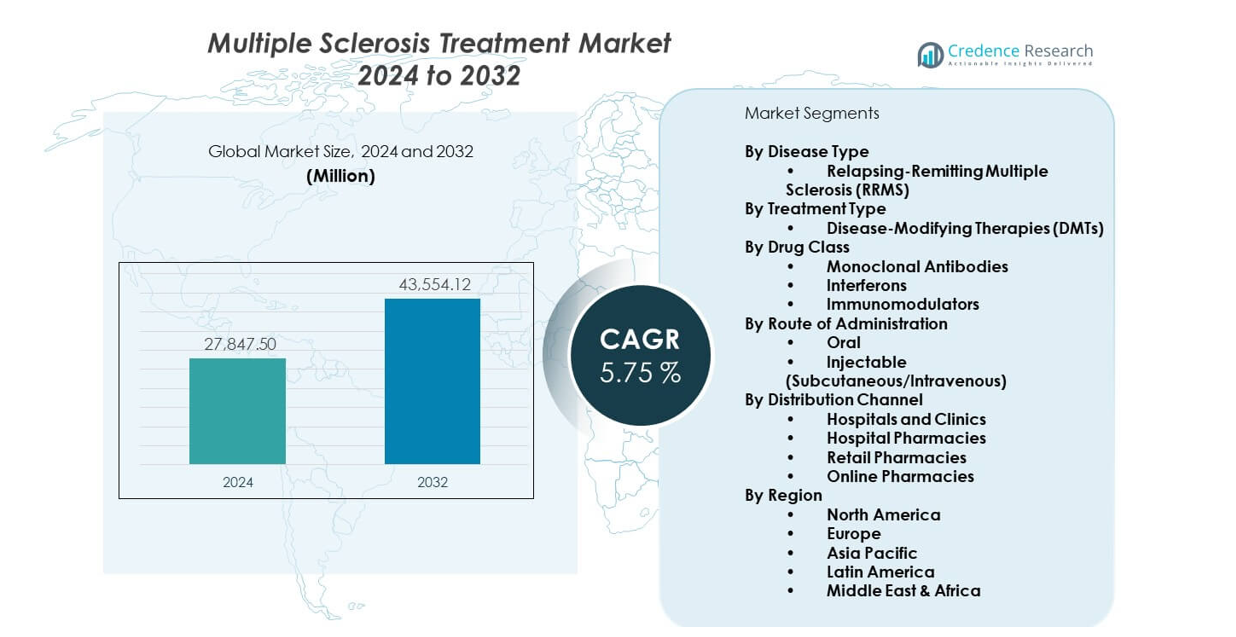
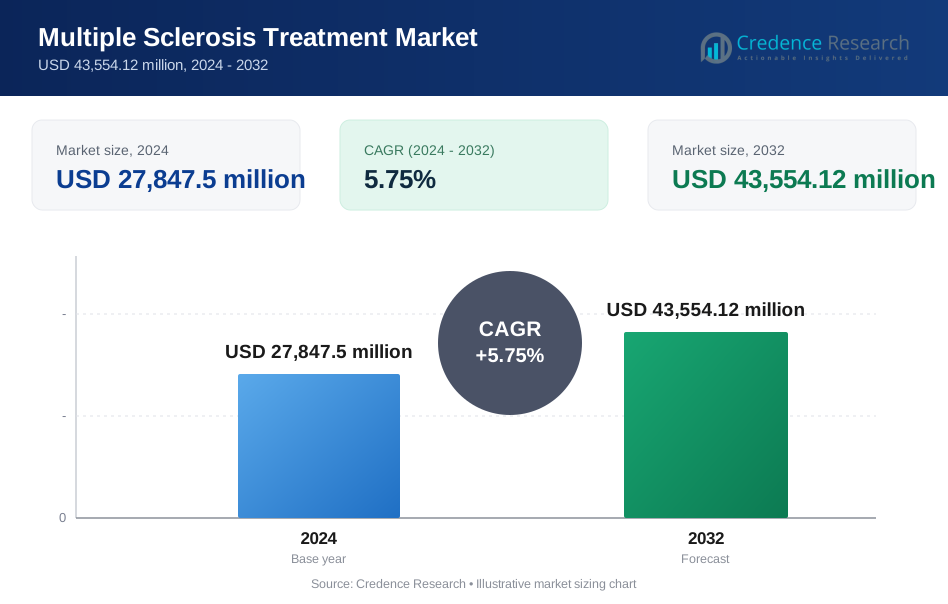
The Multiple sclerosis treatment market is projected to grow from USD 27,847.5 million in 2024 to USD 43,554.12 million by 2032, reflecting a CAGR of 5.75% from 2024 to 2032. Growth reflects rising diagnosis rates and strong demand for advanced therapies.
| REPORT ATTRIBUTE | DETAILS |
|---|---|
| Historical Period | 2020-2023 |
| Base Year | 2024 |
| Forecast Period | 2025-2032 |
| Multiple Sclerosis Treatment Market Size 2024 | USD 27,847.5 million |
| Multiple Sclerosis Treatment Market, CAGR | 5.75% |
| Multiple Sclerosis Treatment Market Size 2032 | USD 43,554.12 million |
Demand rises due to better imaging tools and early detection. New drug classes improve symptom control and slow disease activity. More patients receive long-term care because survival rates improve. Companies focus on targeted therapies that reduce relapse frequency.
North America leads due to strong access to neurologists and advanced drugs. Europe follows with broad insurance coverage and expanding clinical programs. Asia Pacific grows fast as awareness increases and treatment reach improves. Emerging markets show rising demand as healthcare systems expand and more specialists manage neurological diseases.
Market Insights:
- The multiple sclerosis treatment market reached USD 27,847.5 million in 2024 and is projected to hit USD 43,554.12 million by 2032, growing at a CAGR of 5.75% driven by rising adoption of advanced therapies.
- North America (over 40%), Europe (around 30%), and Asia Pacific (near 18%) hold the highest shares due to strong specialist availability, broad reimbursement coverage, and expanding diagnosis programs.
- Asia Pacific represents the fastest-growing region (over 18%), supported by rising awareness, improving access to biologics, and expanding neurological care centers across major countries.
- Relapsing-Remitting MS accounts for over 70% of disease-type share due to its high prevalence and strong response to early therapy.
- Disease-Modifying Therapies hold more than 60% of the treatment-type share, supported by strong efficacy, wide clinical adoption, and long-term disease control benefits.
Market Drivers:
Growing Emphasis on Early Diagnosis and Timely Therapeutic Intervention
The Multiple sclerosis treatment market expands as awareness improves across major regions. Early diagnosis increases due to wider MRI access and stronger clinical guidelines. Physicians initiate therapy sooner to slow disability progression. Patients seek care earlier because symptoms receive more visibility in public health programs. Health systems adopt structured neurological screening that improves detection quality. The shift toward early therapeutic planning supports long-term disease management. Companies introduce tools that help clinicians track disease activity with more precision. This trend strengthens demand for timely intervention across care networks.
- For instance, Philips and Synthetic MR's Smart Quant Neuro 3D platform delivers automatic segmentation and tissue volume measurement in under 10 seconds of post-processing, enabling clinicians to identify myelin loss and detect abnormalities that remain invisible on conventional MR scans, significantly improving early detection precision.
Rapid Development of Advanced Drug Classes Driving Clinical Adoption
Innovation fuels stronger adoption across hospitals and specialty clinics. New drug classes improve relapse control and support better patient adherence. Oral therapies gain traction due to ease of use and fewer treatment interruptions. Monoclonal antibodies offer targeted action that reduces disease activity. Physicians prefer agents with proven long-term safety records. Expanded clinical evidence strengthens trust among specialists. Patients move toward treatments that improve daily functioning and reduce flare frequency. It strengthens confidence in advanced therapeutic options across the Multiple sclerosis treatment market.
- For example, Novartis' Gilenya (fingolimod) demonstrated a 54% reduction in annualized relapse rate compared to placebo in two-year studies, with 81.2% of patients remaining on therapy versus 72.5% on placebo, establishing superior treatment persistence.
Increasing Integration of Real-World Evidence Supporting Treatment Patterns
Real-world data programs help clinicians refine therapy decisions. Health systems collect outcome data from diverse patient groups. These insights reveal long-term performance trends beyond controlled trials. Payers rely on such data to support reimbursement approvals. Providers use digital tools to track treatment responses across wider patient pools. Pharmaceutical firms invest in registries to evaluate therapy durability. The approach supports personalized management strategies. It aligns treatment patterns with evolving patient needs across global markets.
Rising Patient Access Through Expanding Insurance and Reimbursement Coverage
Coverage expansion improves access for a larger patient base. Public programs include more disease-modifying therapies in reimbursement lists. Private insurers create structured plans that reduce out-of-pocket costs. Hospitals integrate support programs that guide patients through funding pathways. Patients continue therapy for longer cycles due to lower financial burdens. Policymakers update neurological care standards to support equitable access. It strengthens continuity of care for chronic disease management. This trend enhances long-term treatment adherence across regions.
Market Trends:
Growing Shift Toward Personalized and Precision-Centered Therapy Models
The Multiple sclerosis treatment market moves toward precision-centered care strategies. Biomarker use increases as clinicians target therapies more accurately. Genetic profiling gains relevance in selecting agents for complex cases. Providers explore immune pathway analysis for better response prediction. Companies invest in tools that support individualized treatment plans. Patients expect tailored care with clearer outcome projections. Data-driven clinical models improve therapy efficiency. It helps health systems adopt targeted approaches with fewer trial errors.
- For instance, genetic profiling identified HLA-A∗03:01 as a predictive biomarker enabling clinicians to determine that one-third of MS patients receiving glatiramer acetate experienced significantly slower disease progression (0.42 EDSS points per year versus 0.47 points per year with interferon-beta treatment), allowing physicians to select optimal first-line therapies before initiating treatment.
Expansion of Home-Based Care Models and Remote Treatment Monitoring
Remote monitoring tools reshape patient engagement across regions. Wearable devices help track symptoms with higher accuracy. Tele-neurology expands due to better digital infrastructure. Patients prefer home care models due to improved convenience. Clinicians supervise therapy adherence through digital dashboards. Hospitals integrate remote programs for stable cases requiring less frequent visits. The shift reduces travel burdens and supports better quality of life. It strengthens long-term disease control through continuous oversight.
- For example, tele-neurology encounters reduced missed workdays by 65%, saved an average of 258 km of travel, and reduced lodging costs by 17% for MS patients, while 97% of participants recommended telemedicine visits to others. Tele-neurology expands due to better digital infrastructure.
Increasing Adoption of High-Efficacy Monoclonal Antibodies Across Diverse Patient Groups
Monoclonal antibodies gain strong traction due to superior clinical outcomes. Physicians consider these agents for both early and advanced cases. Hospitals invest in infusion centers to support rising demand. New formulations enter trials with improved dosing schedules. Safety records continue to strengthen confidence among specialists. Patients prefer options that reduce relapse frequency. Manufacturers refine production pipelines to meet consistent global demand. It supports broader clinical use across the global market landscape.
Rising Influence of Digital Therapeutics and AI-Based Clinical Support Tools
Digital therapeutics support cognitive training and symptom management. AI platforms help physicians evaluate disease activity more precisely. Clinics adopt software tools that predict relapse risk. Pharmaceutical firms partner with tech companies to develop integrated care systems. Patients engage through structured mobile applications that track daily progress. Data collected supports timely therapeutic adjustments. Providers use AI decision aids to strengthen diagnosis accuracy. It improves clinical outcomes through technology-enabled pathways.
Market Challenges Analysis
High Treatment Costs and Uneven Access Across Global Healthcare Systems
The Multiple sclerosis treatment market faces major restraints linked to affordability barriers. Advanced therapies carry high prices that limit access in low-income regions. Patients struggle with out-of-pocket costs when insurance offers limited coverage. Hospitals experience budget pressure when adopting premium biologics. Payers apply strict reimbursement criteria that delay approvals. The supply of neurologists remains uneven across emerging countries. Long travel distances further restrict access to specialized care. It slows adoption of advanced options in underserved areas.
Complex Disease Variability and Limited Predictive Tools for Long-Term Response
Disease variability creates major challenges for clinicians across global settings. Patients respond differently to similar therapy classes due to biological diversity. Physicians lack consistent predictive tools for long-term outcomes. Trial data often excludes diverse real-world populations. Treatment adjustments require frequent monitoring that strains clinic capacity. Switching therapies creates uncertainty for patients and providers. Relapse patterns shift unpredictably across disease stages. It complicates management planning and reduces treatment consistency.
Market Opportunities
Rising Potential for Next-Generation Therapies Targeting Novel Immune Pathways
The Multiple sclerosis treatment market gains new opportunities through emerging immune-targeted therapies. Developers explore novel pathways that reduce disease activity with higher precision. Patients seek options with fewer long-term safety concerns. Clinical trials test molecules that improve relapse control. Providers anticipate drugs that support stable neurological function. Hospitals prepare for adoption of alternatives to traditional immunomodulators. It expands treatment choice across diverse patient categories. Growth prospects strengthen as innovation accelerates.
Expanding Scope for Digital Integration and Global Care Outreach Programs
Digitalization creates strong expansion opportunities for global care delivery. Remote treatment platforms reach patients in underserved regions. Hospitals improve neurological care access through telemedicine networks. Pharmaceutical firms invest in tools that guide therapy adherence. Patients rely on digital programs that support symptom tracking. Clinical teams use data to refine dosing adjustments. It improves disease management efficiency across regional markets. This trend broadens access and strengthens patient engagement.
Market Segmentation Analysis:
By Disease Type
Relapsing-Remitting Multiple Sclerosis (RRMS) dominates the Multiple sclerosis treatment market due to its high prevalence and stronger response to early therapies. RRMS patients often begin treatment soon after diagnosis, which drives steady uptake of advanced drug classes. It benefits from continuous clinical innovation targeting relapse reduction and better long-term stability.
By Treatment Type
Disease-Modifying Therapies (DMTs) lead uptake due to their proven ability to slow disease activity. These therapies support relapse control and reduce progression risk across broad patient groups. Physicians prioritize DMTs for early management, and it strengthens long-term adherence through structured treatment pathways.
- For example, Highly active RRMS patients treated with Tecfidera showed a 56% reduction in annualized relapse rate (p <0.0040) and a 78% reduction in time to 12-week sustained disability progression (p=0.0067) compared to placebo within two years, establishing DMTs as the standard of care.
By Drug Class
Monoclonal antibodies record strong demand due to high efficacy in controlling active disease. Interferons maintain relevance in stable cases due to established safety records. Immunomodulators deliver consistent benefits for patients needing flexible treatment choices. Each class supports a different clinical need and improves therapeutic reach.
By Route of Administration
Oral formulations see growing preference due to ease of use and improved patient adherence. Injectable options, including subcutaneous and intravenous routes, remain essential for severe or fast-progressing conditions. It helps clinicians tailor dosing plans to disease stage and patient comfort.
By Distribution Channel
Hospitals and clinics lead distribution due to strong specialist availability and regular monitoring needs. Hospital pharmacies support controlled dispensing for complex therapies. Retail pharmacies expand access for stable patients, while online pharmacies improve reach for remote users. Each channel strengthens continuity of care across regions.
Segmentation:
By Disease Type- Relapsing-Remitting Multiple Sclerosis (RRMS)
- Disease-Modifying Therapies (DMTs)
- Monoclonal Antibodies
- Interferons
- Immunomodulators
- Oral
- Injectable (Subcutaneous/Intravenous)
- Hospitals and Clinics
- Hospital Pharmacies
- Retail Pharmacies
- Online Pharmacies
- North America
- U.S.
- Canada
- Mexico
- Europe
- Germany
- France
- U.K.
- Italy
- Spain
- Rest of Europe
- Asia Pacific
- China
- Japan
- India
- South Korea
- South-east Asia
- Rest of Asia Pacific
- Latin America
- Brazil
- Argentina
- Rest of Latin America
- Middle East & Africa
- GCC Countries
- South Africa
- Rest of the Middle East and Africa
Regional Analysis:
North America
North America holds the largest share of the multiple sclerosis treatment market due to strong access to advanced therapies and specialist networks. The region benefits from early diagnosis programs and broad insurance coverage that support rapid treatment initiation. Hospitals adopt high-efficacy monoclonal antibodies at a faster rate due to strong clinical infrastructure. Patients engage in structured long-term care programs supported by trained neurologists. Pharmaceutical companies launch new therapies in the region before global rollout. It maintains market leadership through high awareness and consistent therapy adoption.
Europe
Europe secures the second-largest share due to well-established healthcare systems and strong reimbursement frameworks. The region integrates standardized neurological care pathways that improve disease monitoring. Hospitals support wide adoption of interferons, immunomodulators, and advanced biologics across diverse patient groups. Research institutions conduct large clinical studies that expand treatment choices. Patients benefit from regional guidelines that promote early and sustained therapy use. It maintains a strong position supported by consistent regulatory support and broad treatment availability.
Asia Pacific
Asia Pacific emerges as the fastest-growing region with a rising share driven by expanding healthcare access and improving diagnostic capacity. Awareness campaigns increase early evaluation and specialty referrals across urban centers. Hospitals introduce advanced biologics as treatment guidelines evolve. Pharmaceutical companies expand regional footprint through local partnerships and targeted distribution. Patients gain better access to oral therapies due to improving affordability. It builds momentum as healthcare infrastructure strengthens and neurological care capacity grows across major markets.
Key Player Analysis:
- Roche (F. Hoffmann-La Roche Ltd.)
- Biogen
- Novartis AG
- Sanofi
- Merck & Co.
- Bayer AG
- Bristol-Myers Squibb Company
- Teva Pharmaceutical Industries Ltd.
Competitive Analysis:
The Multiple sclerosis treatment market features strong competition among global pharmaceutical leaders focused on high-efficacy therapies and long-term patient outcomes. Companies invest in monoclonal antibodies, oral DMTs, and immunomodulators to strengthen product portfolios. Firms expand clinical pipelines to address unmet needs across progressive disease types. Hospitals adopt therapies backed by large-scale safety evidence, which increases competition in high-demand segments. Strategic partnerships support broader distribution across emerging regions. Pipeline diversity drives active competition across infusion, injectable, and oral categories. It maintains a dynamic landscape shaped by innovation and treatment differentiation.
Recent Developments:
- In October 2025, Novartis announced a $12 billion acquisition of Avidity Biosciences Inc., representing the Swiss drugmaker's biggest acquisition in more than a decade. While this deal is primarily focused on adding several potential blockbuster treatments as generic competition looms for Novartis's current top-sellers, it reflects the company's continued strategic investment in expanding its pharmaceutical portfolio. Additionally, throughout 2025, Novartis declared plans to spend over $17 billion in licensing and acquisition deals aimed at strengthening its pipeline across various therapeutic areas. The company also licensed Monte Rosa, which develops protein degraders such as MRT-6160 designed to degrade the protein VAV1, a mechanism known to address autoimmune conditions including multiple sclerosis.
- In April 2025, Merck KGaA announced the acquisition of SpringWorks Therapeutics for $3.9 billion (or $47 per share), a transaction expected to close in the second half of 2025. While SpringWorks' primary focus is on rare tumors including neurofibromatosis and desmoid tumors rather than MS directly, the deal strengthens Merck KGaA's oncology and rare disease pipelines with potential implications for innovative therapeutic approaches. The acquisition reflects Merck KGaA's strategy to add to its portfolio as the company faces imminent expiry of patents on its MS treatment Mavenclad (cladribine), beginning in 2026.
- In February 2025, Biogen CEO Chris Viehbacher highlighted the company's focus on building up four recent drug launches-Skyclarys, Leqembi, Zurzuvae, and Qalsody-to offset the continued decline in its MS franchise revenue. While Biogen's MS sales declined 9% at constant currencies in the fourth quarter of 2024 to slightly more than $1 billion, the company's leadership remained confident that the newer launches would pick up the slack in the months and years to come. The MS franchise, including drugs like Tysabri and Tecfidera, declined 7% to $4.4 billion for all of 2024. Biogen has undergone a restructuring initiative to save around $1 billion by the end of 2025 as part of its strategy to adapt to the changing MS market landscape.
Report Coverage:
The research report offers an in-depth analysis based on By Disease Type (Relapsing-Remitting Multiple Sclerosis), By Treatment Type (Disease-Modifying Therapies), By Drug Class (Monoclonal Antibodies, Interferons, Immunomodulators), By Route of Administration (Oral, Injectable), and By Distribution Channel (Hospitals and Clinics, Hospital Pharmacies, Retail Pharmacies, Online Pharmacies). It details leading market players, providing an overview of their business, product offerings, investments, revenue streams, and key applications. Additionally, the report includes insights into the competitive environment, SWOT analysis, current market trends, as well as the primary drivers and constraints. Furthermore, it discusses various factors that have driven market expansion in recent years. The report also explores market dynamics, regulatory scenarios, and technological advancements that are shaping the industry. It assesses the impact of external factors and global economic changes on market growth. Lastly, it provides strategic recommendations for new entrants and established companies to navigate the complexities of the market.
Future Outlook:
- Innovation in monoclonal antibodies will strengthen clinical outcomes across advanced disease categories.
- Oral DMTs will gain broader adoption due to improved adherence and patient comfort.
- AI-supported diagnostic tools will enhance early disease detection and treatment planning.
- Real-world evidence programs will guide therapy optimization and long-term patient management.
- Digital platforms will expand remote monitoring capabilities across major regions.
- Hospitals will integrate advanced infusion centers to support biologic therapy demand.
- Partnerships between pharma and tech firms will increase treatment personalization.
- Emerging markets will expand access as neurological care networks improve.
- Regulatory support for high-efficacy therapies will accelerate product approvals.
- It will benefit from sustained investment in next-generation immune-targeted therapies.
Request a Free Sample
Fill in your details and we'll send you a free sample report.
- Sample data tables & charts
- Research methodology
Need a Custom Version of This Report?
Tailor the scope, geography, or segments to your exact requirements.
- Custom geography or segment scope
- Direct access to our analyst team
Frequently Asked Questions
What is the current market size for the multiple sclerosis treatment market, and what is its projected size in 2032?
At what Compound Annual Growth Rate is the multiple sclerosis treatment market projected to grow between 2025 and 2032?
Which drug class Route of administration segment governs the demand for multiple sclerosis treatment worldwide?
Which segment is expected to post the highest CAGR during the forecast period
Who are the major players in the global multiple sclerosis treatment market?
What are the major market drivers of the multiple sclerosis treatment industry?
What are the major market restraints of multiple sclerosis treatment industry?
What are the major market opportunities of the multiple sclerosis treatment industry?
Who are the leading companies in the multiple sclerosis treatment market?
Table of Content
Chapter 1. Report Introduction
- 1.1 Report Description & Purpose
- 1.1.1 Report Title & Market Definition
- 1.1.2 Unique Selling Propositions (USP) & Key Differentiators
- 1.1.3 Value Proposition for Stakeholders
- 1.2 Research Objectives
- 1.2.1 Market Sizing Objectives (Volume & Revenue) (Volume Where Applicable)
- 1.2.2 Segmentation Objectives
- 1.2.3 Competitive Intelligence Objectives
- 1.2.4 Forecast & Scenario Objectives
- 1.3 Report Scope
- 1.3.1 Multiple Sclerosis Treatment Scope – Segments & Subsegments Covered
- 1.3.2 Geographic Scope – Regions & Countries Covered
- 1.3.3 Historical Period, Base Year & Forecast Period (2024; forecast to 2032)
- 1.3.4 Inclusions & Exclusions
- 1.4 Industry Classification & Applicable Codes
- 1.5 Currency, Measurement Units & Valuation Basis
- 1.6 Target Stakeholders
- 1.7 Limitations & Assumptions
Chapter 2. Executive Summary
- 2.1 Global Multiple Sclerosis Treatment Market Snapshot
- 2.1.1 Market Size – Historical (2024) & Forecast (2024-2032) (2024: USD 27,847.5 million → 2032: USD 43,554.12 million)
- 2.1.2 Volume & Revenue – Global Totals (Volume Where Applicable)
- 2.1.3 Key Market Highlights – Top Five Facts
- 2.2 Multiple Sclerosis Treatment Market Segmentation Snapshot
- 2.2.1 Market Split by Region – 2024 vs. 2032
- 2.3 Competitive Snapshot
- 2.3.1 Top 10 Players by Revenue Share – 2024
- 2.3.2 Top 10 Players by Volume Share – 2024 (Volume Where Applicable)
- 2.3.3 Recent Strategic Developments (18-Month Summary)
- 2.4 Key Investment Highlights & Strategic Conclusions
Chapter 3. Multiple Sclerosis Treatment Market Dynamics & Industry Analysis
- 3.1 Market Overview & Context
- 3.1.1 Multiple Sclerosis Treatment Market Position in the Broader Industry Value Chain
- 3.1.2 Demand Structure & Purchasing Dynamics
- 3.1.3 Market Maturity & Development Stage by Region
- 3.2 Multiple Sclerosis Treatment Market Drivers
- 3.3 Multiple Sclerosis Treatment Market Restraints & Challenges
- 3.4 Multiple Sclerosis Treatment Market Opportunities
- 3.5 Porter's Five Forces Analysis
- 3.5.1 Threat of New Entrants
- 3.5.2 Bargaining Power of Suppliers
- 3.5.3 Bargaining Power of Buyers
- 3.5.4 Threat of Substitutes
- 3.5.5 Competitive Rivalry – Intensity Assessment
- 3.6 Multiple Sclerosis Treatment Value Chain Analysis
- 3.6.1 Upstream – Key Inputs, Resources & Suppliers
- 3.6.1.1 Key Input/Resource 1
- 3.6.1.2 Key Input/Resource 2
- 3.6.1.3 Key Input/Resource 3
- 3.6.2 Midstream – Core Operations & Value Creation
- 3.6.2.1 Operating Model & Process Overview
- 3.6.2.2 Key Operating Locations & Capabilities by Company
- 3.6.3 Downstream – Market Channels & End Users
- 3.6.3.1 Direct Sales & Customer Engagement Channels
- 3.6.3.2 Indirect Sales, Intermediaries & Partner Channels
- 3.6.4 Value Chain Profitability Analysis
- 3.6.1 Upstream – Key Inputs, Resources & Suppliers
- 3.7 PESTEL Analysis
- 3.7.1 Political Factors
- 3.7.2 Economic Factors
- 3.7.3 Social Factors
- 3.7.4 Technological Factors
- 3.7.5 Environmental Factors
- 3.7.6 Legal Factors
- 3.8 Multiple Sclerosis Treatment Supply Chain Analysis
- 3.8.1 Critical Input & Resource Availability Risk Assessment
- 3.8.2 Supplier & Operational Concentration Risk (Geographic Exposure)
- 3.8.3 Supply & Service Disruption Impact Analysis
- 3.9 Regulatory & Policy Landscape
Note: The regulatory and policy landscape section covers regulations based on their applicability to the market, Multiple Sclerosis Treatment category, geography, and scope of the study. Only regulatory frameworks with a material impact on operations, compliance, trade, sustainability, or market access are analyzed in detail.
Chapter 4. Key Investment Pockets & Opportunity Analysis
- 4.1 Multiple Sclerosis Treatment Market Attractiveness Analysis
- 4.1.1 By Region – Investment Attractiveness Matrix (Market Size × CAGR)
- 4.2 Absolute Revenue Growth Opportunity
- 4.2.1 By Region – Absolute Revenue Growth Through 2032
- 4.3 Incremental Demand Opportunity
- 4.3.1 By Region – Incremental Demand Through 2032
- 4.3.2 Segment – Incremental Demand
- 4.4 Emerging Submarket Opportunity Deep Dive (Subject to Applicability)
- 4.5 Priority Market Opportunity Scorecards
- 4.5.1 United States
- 4.5.2 Europe
- 4.5.3 Asia
- 4.5.4 Middle East & Africa
Note: Priority market opportunity scorecards reflect the geographic scope and strategic relevance of the study. Listed markets are indicative and may be adapted to the industry.
Chapter 5. Multiple Sclerosis Treatment Cross-Border Trade & Market Access Analysis
- 5.1 International Trade & Cross-Border Activity Overview
- 5.1.1 Global Export Value by Country (2024)
- 5.1.2 Global Export Volume by Country (2024) (Volume Where Applicable)
- 5.1.3 Global Import Value by Country (2024)
- 5.1.4 Global Import Volume by Country (2024) (Volume Where Applicable)
- 5.1.5 Net Trade Balance by Country (2024)
- 5.2 Export Analysis – Segment
- 5.2.1 Category 1 (Applicable Classification Code)
- 5.2.2 Category 2 (Applicable Classification Code)
- 5.2.3 Category 3 (Applicable Classification Code)
- 5.2.4 Category 4 (Applicable Classification Code)
- 5.2.5 Category 5 (Applicable Classification Code)
- 5.3 Import Analysis – Segment
- 5.3.1 Category 1 (Applicable Classification Code)
- 5.3.2 Category 2 (Applicable Classification Code)
- 5.3.3 Category 3 (Applicable Classification Code)
- 5.3.4 Category 4 (Applicable Classification Code)
- 5.3.5 Category 5 (Applicable Classification Code)
- 5.4 Cross-Border Pricing & Transaction Benchmarks
- 5.4.1 Export Pricing – Segment & Country
- 5.4.2 Import Pricing – Segment & Source Country
- 5.4.3 Price Trends (2024)
- 5.5 Key Cross-Border Trade & Delivery Routes
- 5.5.1 Cross-Border Trade/Delivery Route 1
- 5.5.2 Cross-Border Trade/Delivery Route 2
- 5.5.3 Cross-Border Trade/Delivery Route 3
- 5.5.4 Cross-Border Trade/Delivery Route 4
- 5.5.5 Cross-Border Trade/Delivery Route 5
- 5.6 Trade Policy & Market Access Impact Assessment
- 5.6.1 Tariff & Non-Tariff Barriers
- 5.6.2 Regional Trade & Economic Integration Frameworks
- 5.6.3 Bilateral & Multilateral Trade Agreements
- 5.6.4 Cross-Border Operating, Licensing & Localization Requirements
Note: This chapter applies where cross-border trade or delivery is relevant to Multiple Sclerosis Treatment. Goods, services, and digital offerings are assessed using applicable classifications and transaction measures. Import-export volumes, trade balances, and route analyses are included only where meaningful to the market.
Chapter 6. Competitive Landscape & Company Benchmarking
- 6.1 Multiple Sclerosis Treatment Market Concentration & Structure
- 6.1.1 Herfindahl-Hirschman Index (HHI) – vs. 2024
- 6.1.2 Leading, Mid-Sized & Emerging Player Structure
- 6.1.3 Global, Regional & Local Player Dynamics
- 6.2 Multiple Sclerosis Treatment Market Share Analysis – 2024
- 6.2.1 Global Revenue Share by Company
- 6.2.2 Global Volume Share by Company (Volume Where Applicable)
- 6.2.3 Regional Revenue Share
- 6.2.4 Market Share Evolution ( vs. 2024)
- 6.2.5 Company Market Share by Key Segment
- 6.2.6 Company Market Share by Customer Group
- 6.3 Operating Scale, Capacity & Infrastructure Analysis
- 6.3.1 Global Operating Scale & Supply Capacity
- 6.3.2 Resource Utilization & Operating Efficiency
- 6.3.3 Output, Service Delivery & Activity Metrics
- 6.3.4 Operating Footprint & Infrastructure Map
- 6.3.5 Planned Operational & Capacity Expansion
- 6.4 Multiple Sclerosis Treatment Competitive Benchmarking Matrix
- 6.4.1 Revenue, Growth, Profitability & Operating Metric Comparison
- 6.4.2 Channel Revenue Mix
- 6.4.3 Geographic Revenue Exposure
- 6.4.4 R&D Intensity
- 6.4.5 Sustainability Maturity
- 6.5 Strategic Developments in Multiple Sclerosis Treatment (Last 24 Months)
- 6.5.1 Mergers, Acquisitions & Divestments
- 6.5.2 New Products, Services & Solutions in Multiple Sclerosis Treatment
- 6.5.3 Operational & Infrastructure Expansions
- 6.5.4 Strategic Alliances, Joint Ventures & Partnerships
- 6.5.5 Distribution Expansion & Market Entry
- 6.5.6 Sustainability & ESG Initiatives
- 6.6 Competitive Strategy Mapping
- 6.6.1 Leader, Challenger, Follower & Niche Classification
- 6.6.2 Pricing Strategy Comparison
- 6.6.3 Channel Strategy Matrix
Note: Strategic developments are included based on their materiality and the availability of reliable information.
Chapter 7. Global Multiple Sclerosis Treatment Market – By Sales & Delivery Channel
- 7.1 Segment Overview
- 7.1.1 Volume & Revenue Split by Channel (2024 & 2032) (Volume Where Applicable)
- 7.1.2 Channel Mix Evolution (2024-2032)
Chapter 8. Regional Market Analysis – Global Overview
- 8.1 Global Regional Overview
- 8.1.1 Regional Volume Share (Volume Where Applicable)
- 8.1.2 Regional Revenue Share
- 8.1.3 Regional Volume by Region (Volume Where Applicable)
- 8.1.4 Regional Revenue by Region
- 8.1.5 Regional Forecast Through 2032
- 8.2 Cross-Regional Segment Analysis
- 8.2.1 By Sales & Delivery Channel
- 8.2.2 By Competitive Positioning & Price Tier
Chapter 9. North America Multiple Sclerosis Treatment Market
- 9.1 United States
- 9.2 Canada
- 9.3 Mexico
Chapter 10. Europe Multiple Sclerosis Treatment Market
- 10.1 Germany
- 10.2 France
- 10.3 Italy
- 10.4 United Kingdom
- 10.5 Spain
- 10.6 Poland
- 10.7 Russia
- 10.8 Netherlands
- 10.9 Belgium
- 10.10 Sweden
- 10.11 Denmark
- 10.12 Norway
- 10.13 Rest of Europe
Chapter 11. Asia Pacific Multiple Sclerosis Treatment Market
- 11.1 China
- 11.2 India
- 11.3 Japan
- 11.4 South Korea
- 11.5 Thailand
- 11.6 Indonesia
- 11.7 Vietnam
- 11.8 Malaysia
- 11.9 Australia
- 11.10 Rest of Asia Pacific
Chapter 12. Latin America Multiple Sclerosis Treatment Market
- 12.1 Brazil
- 12.2 Argentina
- 12.3 Colombia
- 12.4 Chile
- 12.5 Rest of Latin America
Chapter 13. Middle East Multiple Sclerosis Treatment Market
- 13.1 Saudi Arabia
- 13.2 United Arab Emirates
- 13.3 Turkey
- 13.4 Israel
- 13.5 Iran
- 13.6 Rest of the Middle East
Chapter 14. Africa Multiple Sclerosis Treatment Market
- 14.1 South Africa
- 14.2 Egypt
- 14.3 Nigeria
- 14.4 Morocco
- 14.5 Rest of Africa
Chapter 15. Multiple Sclerosis Treatment Company Profiles
- 15.1 [Company 01]
- 15.1.1 Company Overview
- 15.1.2 Key Management Personnel
- 15.1.3 Products & Services Portfolio
- 15.1.4 Financial Performance
- 15.1.5 Key Market Focus & Geographic Presence
- 15.1.6 Recent Developments & Strategic Initiatives
Note: The company profile list is preliminary and may change based on research findings, market developments, data availability, and client requirements.
Chapter 16. Appendices
- Appendix A – List of Abbreviations & Acronyms
- Appendix B – Industry Classification Code Reference – Full Series
- Appendix C – Supply, Output & Operating Capacity Data Tables
- Appendix D – End-Use & Demand Base Tables
- Appendix E – Demand, Adoption & Usage Assumptions
- Appendix F – Pricing & Revenue Metric Reference Tables
- Appendix G – Company Operations & Infrastructure Database
- Appendix H – Cross-Border Trade & Activity Data Tables (Where Applicable)
- Appendix I – Regulatory Summary Tables
- Appendix J – Primary Research Participant List (Anonymized)
- Appendix K – Primary Research Questionnaire Framework
- Appendix L – Data Sources & Bibliography
- Appendix M – Market Size Divergence & Source Comparison
Chapter 17. Research Methodology
- 17.1 Research Framework & Philosophy
- 17.2 Secondary Research – Sources, Hierarchy & Data Extraction
- 17.3 Data Modeling – Bottom-Up & Top-Down Market Sizing
- 17.4 Primary Research – Stakeholder Framework, LOI & Sample Sizes
- 17.5 Forecast Methodology – Regression, Scenario & Sensitivity Analysis
- 17.6 Quality Control – Four-Layer Validation Framework
- 17.7 Limitations & Standard Assumptions
- 17.8 Disclaimer
