
Stock control software moves beyond the back office
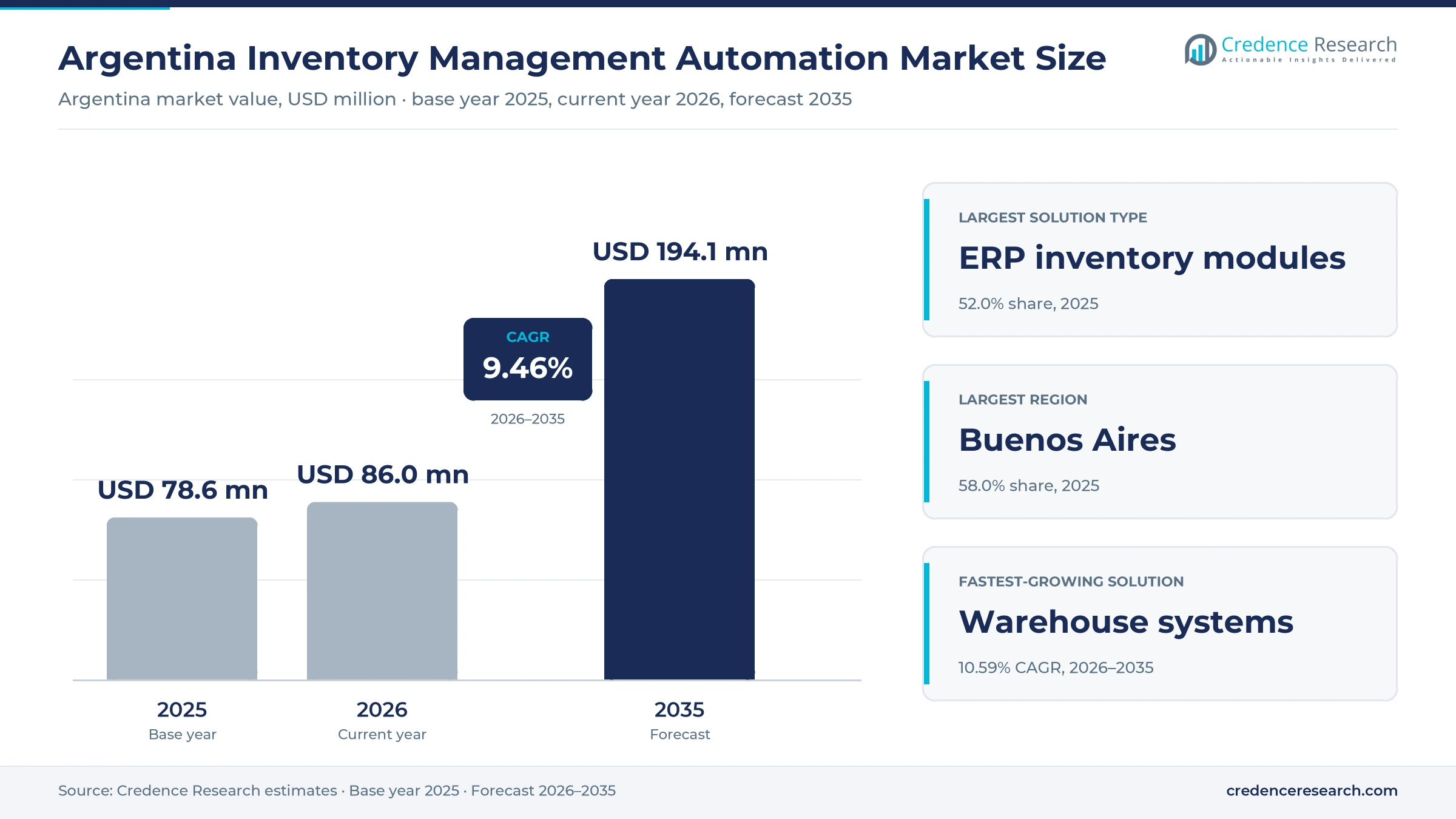
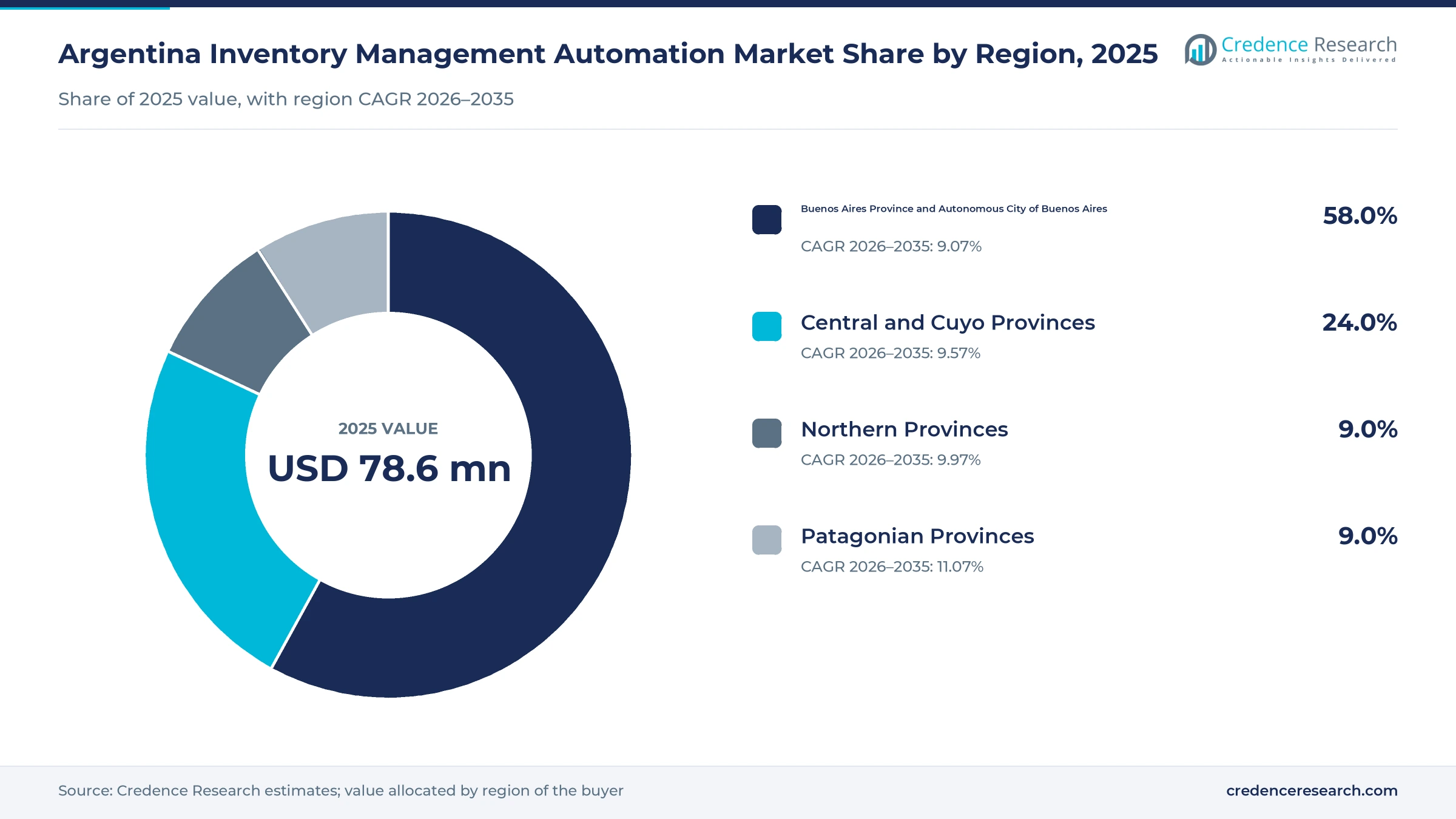
The Argentina inventory management automation market was valued at USD 78.6 million in 2025 and is projected to increase from USD 86.0 million in 2026 to USD 194.1 million by 2035, registering a CAGR of 9.46% during 2026–2035. Demand comes from retailers, distributors, factories and logistics operators that must match stock across online and physical channels, record regulated movements and replace spreadsheets with subscription software. Buenos Aires Province and Autonomous City of Buenos Aires held the largest regional share, 58.0% in 2025, because head offices, large distribution centers and the bulk of online billing sit there. Patagonian Provinces are the fastest-growing region at 11.07% a year as energy and mining suppliers build stock control around Vaca Muerta. On the regulatory side, ANMAT widened national drug traceability in September 2025, and Senasa made electronic cattle identification mandatory from Jan. 1, 2026. Commercially, Mercado Libre opened its largest Argentine logistics center in Escobar in October 2026, which raises the delivery standard that other sellers must meet.
What does inventory management automation cover in Argentina?
The market counts software and related contracts that record, locate, forecast and replenish stock, whether sold as inventory modules inside an enterprise resource planning suite, as warehouse management systems or as standalone applications. Buyers pay through subscription, perpetual license or project and support contracts, and they usually purchase through a local partner that handles tax localization.
The estimate excludes physical warehouse robots, conveyors, racking and barcode hardware, and it also excludes outsourced storage and transport fees. Value therefore sits with software vendors, implementation partners and support teams, while logistics operators and shippers appear as buyers rather than as sellers of the counted product.
Argentina Inventory Management Automation Market Insights
- The market grows from USD 78.6 million in 2025 to USD 194.1 million by 2035, a 9.46% CAGR that reflects a small software base and new compliance duties.
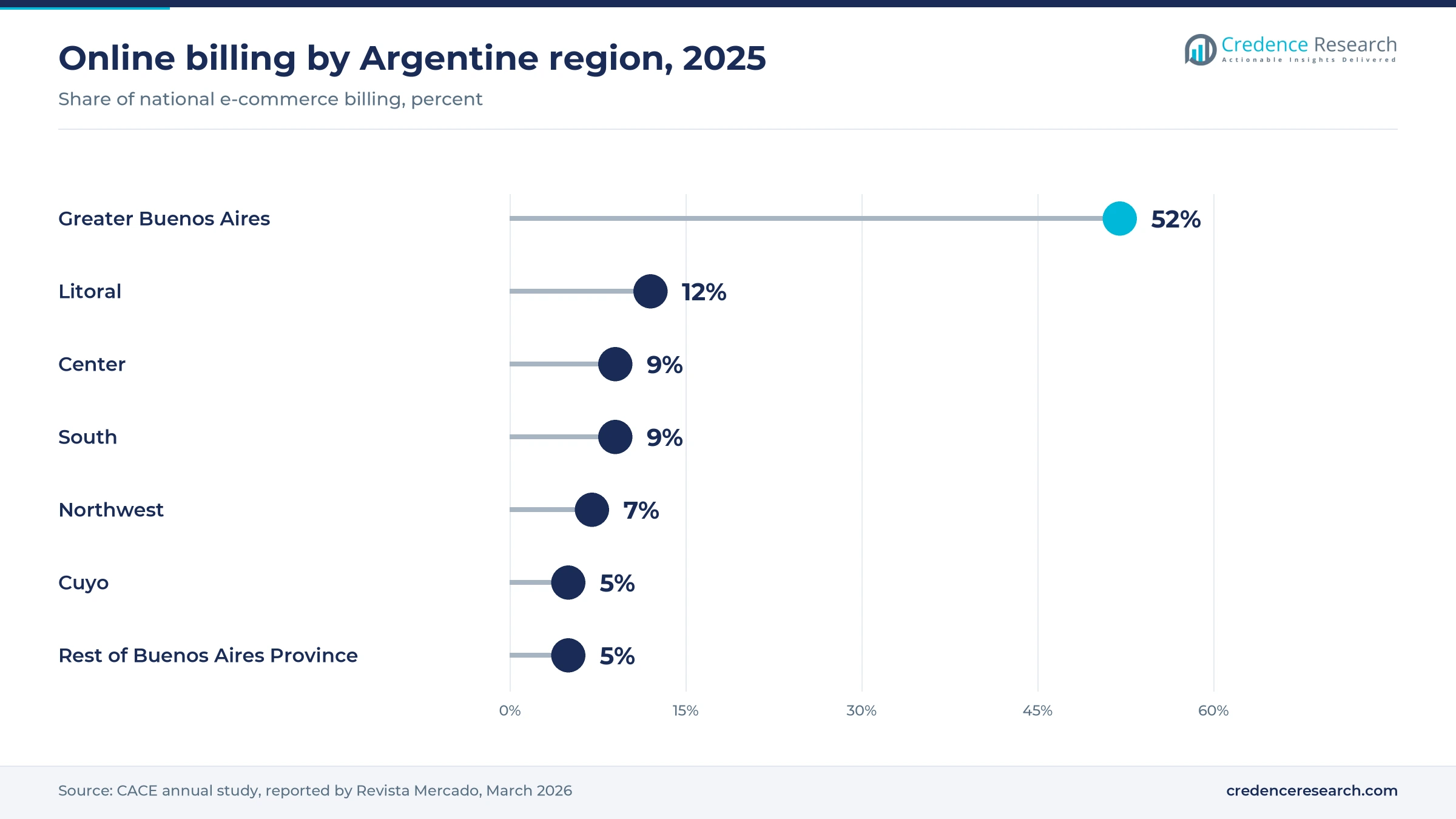
- Buenos Aires Province and Autonomous City of Buenos Aires held 58.0% of 2025 value, in line with a location where Greater Buenos Aires accounts for over half of online billing.
- Enterprise Resource Planning Inventory Modules led with 52.0% of 2025 value because long-established local suites already hold stock data for thousands of firms.
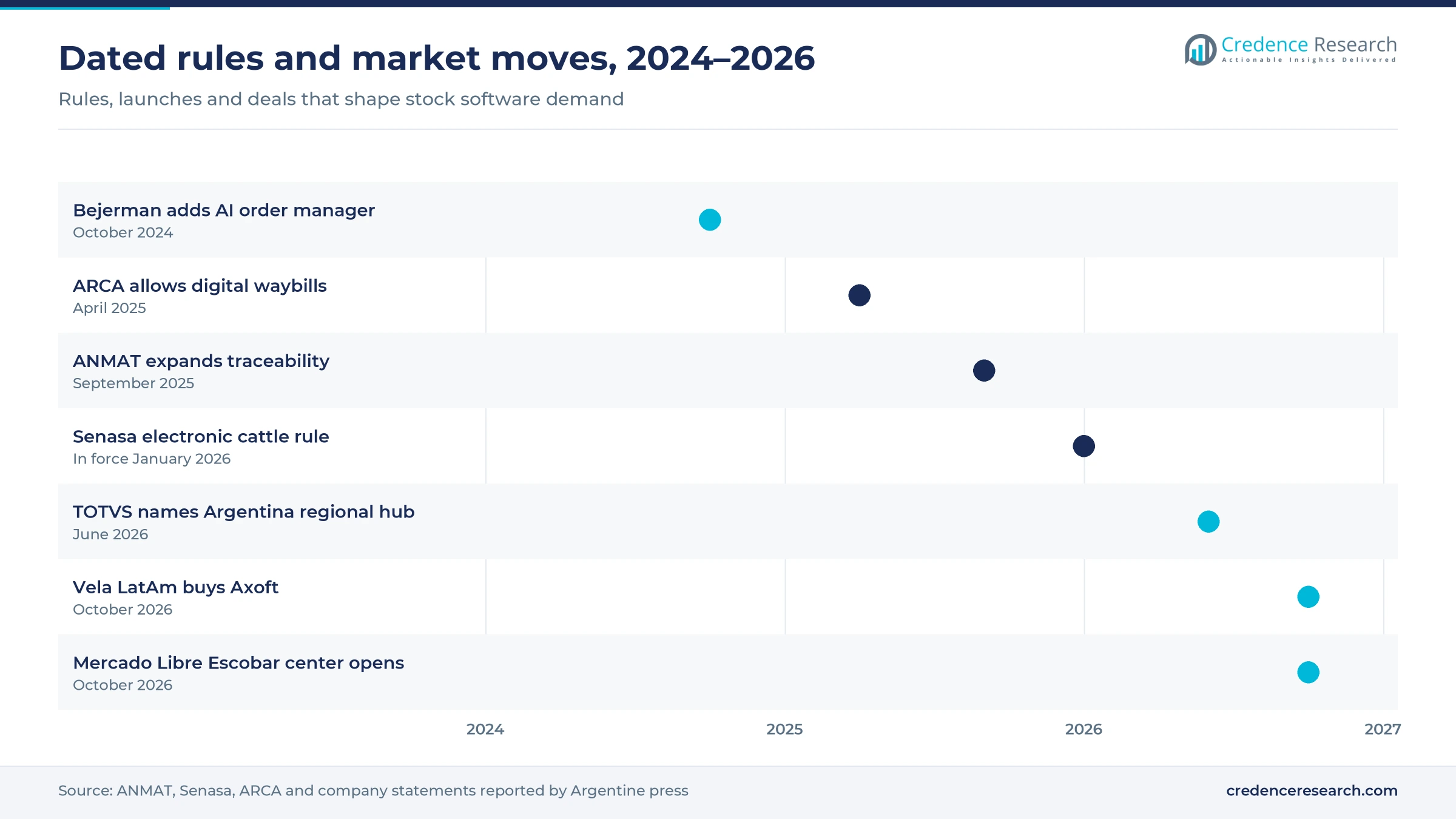
- Senasa Resolution 841/2025 required electronic cattle identification from Jan. 1, 2026, which extended automated stock records from warehouses to farms and meatpackers across the country.
- Ownership is shifting, with Vela LatAm buying Axoft in October 2026 and TOTVS naming Argentina its main regional hub in June 2026.
ERP modules lead while warehouse systems gain ground
Why do ERP inventory modules hold the largest share?
Based on solution type, the market is categorized into enterprise resource planning inventory modules, warehouse management systems and standalone inventory management systems. Enterprise Resource Planning Inventory Modules led with 52.0% of 2025 value because stock records already sit inside established suites, with Calipso counting about 1,000 active clients according to Infonegocios in June 2026. Warehouse Management Systems grow fastest at 10.59% a year as large sites need slotting and picking control, and Dólar Hoy reported in October 2026 that Mercado Libre opened its largest national center in Escobar. Standalone tools remain useful for firms that keep a separate accounting package.
How is cloud pricing changing deployment choices?
Based on deployment model, the market is categorized into cloud, on-premise and hybrid. Cloud led with 55.0% of 2025 value because subscriptions remove server costs, and Infonegocios reported in June 2026 that Calipso cloud plans start at USD 500 a month. Cloud also records the quickest growth at 10.19% a year as local capacity improves, with Claro planning more than 200 Oracle cloud and AI services from its Argentine data center from December 2026, according to DPL News. On-premise contracts persist where firms hold older licenses, while the hybrid option lets large clients keep their own hardware under vendor-managed updates.
Which industries buy most, and which add buyers fastest?
Based on end-use industry, the market is categorized into retail and wholesale, manufacturing, logistics services and primary production and construction. Retail and Wholesale led with 41.0% of 2025 value because online sellers shipped 645 million units in 2025, according to CACE, and chains such as Frávega run more than 100 branches across 18 provinces, according to SNP Group. Logistics Services advance fastest at 10.61% a year as delivery promises tighten, and Noticias NQN reported that Mercado Libre opened an 11,000-square-meter center in Don Torcuato in June 2026. Manufacturing demand follows plant recovery, while Senasa electronic cattle rules bring primary producers into digital stock records.
Where do enterprise budgets and new adopters differ?
Based on enterprise size, the market is categorized into large enterprises, medium enterprises, small enterprises and micro enterprises. Large Enterprises led with 52.0% of 2025 value because multi-site projects carry larger contracts, as shown by the Frávega move to SAP S/4HANA for 290 users, which SNP Group describes as an eight-month project. Small Enterprises grow fastest at 10.46% a year as packaged subscriptions reach a wide base, since UCEMA counted small firms at 13% of 509,661 firms in December 2025. Medium firms buy similar suites with lighter customization, whereas micro firms often start with invoicing tools.
| Segment Group | Leading Sub-segment | Share, 2025 | Fastest-growing Sub-segment | CAGR, 2026–2035 |
|---|---|---|---|---|
| By Solution Type | Enterprise Resource Planning Inventory Modules | 52.0% | Warehouse Management Systems | 10.59% |
| By Deployment Model | Cloud | 55.0% | Cloud | 10.19% |
| By End-Use Industry | Retail and Wholesale | 41.0% | Logistics Services | 10.61% |
| By Enterprise Size | Large Enterprises | 52.0% | Small Enterprises | 10.46% |
Request a Free Sample
Fill in your details and we'll send you a free sample report.
- Sample data tables & charts
- Research methodology
Fulfillment and traceability drive stock software demand
E-commerce fulfillment complexity raises picking workloads
Online selling has made each order harder to fill, which pushes shippers toward system-directed picking. According to the CACE annual study, sellers moved 645 million units in 2025, up 28%, while orders rose only 3% to 253 million, so each order now carries more units. The same study found that 37% of deliveries arrived in under 24 hours, a promise that leaves little room for stock errors. Mercado Libre then raised the standard with its Escobar center of more than 100,000 square meters, a USD 115 million site opened in October 2026. As a result, Warehouse Management Systems are growing at 10.59% a year, because retailers and carriers, including those offering logistics outsourcing, need location-level control that basic accounting modules rarely provide.
Subscription affordability opens software to midsize firms
Subscription pricing has lowered the entry cost for firms that could never fund a large license. Infonegocios reported in June 2026 that Calipso cloud plans start at USD 500 a month and scale with users and databases. Migration risk has also fallen, since Cronista reported that animal nutrition firm Bioter moved its ERP to a cloud service in under 40 days, over a long weekend. The addressable base remains wide, with UCEMA counting 509,661 small and midsize firms in December 2025. In turn, Cloud is growing at 10.19% a year, and vendors can sell inventory functions as an added module within cloud enterprise resource planning rather than as a separate capital project.
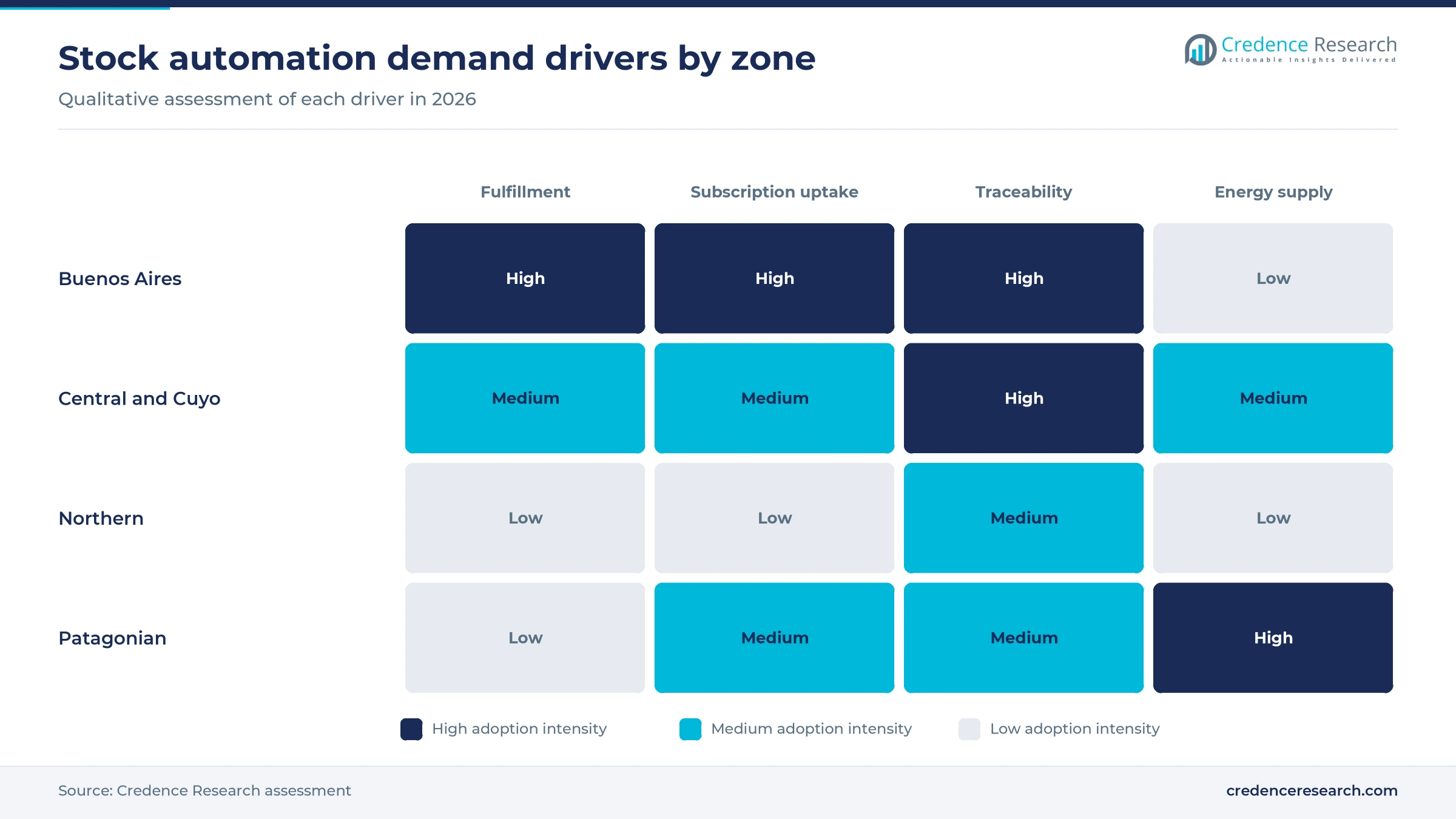
Traceability requirements turn stock data into a legal record
Regulators now expect movements to be recorded digitally, which makes accurate stock data a compliance matter. ANMAT Disposition 6223/2025, announced on Sept. 3, 2025, expanded the national drug traceability system and required every movement to be reported online, with 45 business days for newly listed products to comply. Senasa Resolution 841/2025 made electronic identification mandatory for calves from Jan. 1, 2026, and meatpackers must declare devices on arrival. ARCA General Resolution 5678 then allowed paperless electronic waybills from April 22, 2025, provided that the issuer keeps the file. Consequently, distributors in the food and pharmaceutical cold chain and livestock producers need systems that link lot, location and shipment records in one place.
Vendor investment brings more local capacity to buyers
Suppliers are committing capital and staff to the country, which widens local support for stock projects. Forbes Argentina reported in June 2026 that TOTVS is making Argentina its main regional hub for support, operations and software development, with about 300 of 500 regional employees based there. Bruchou & Funes de Rioja reported on Oct. 8, 2026, that Vela LatAm bought all of Axoft, the owner of Tango Software. The talent pool also remains deep, as the CESSI software observatory counted 158,179 registered jobs in 2024, according to ITSitio. Therefore, buyers in retail and logistics can find partners who understand local tax rules.
AI agents and in-country cloud reshape vendor offers
The rise of AI agents inside stock and purchasing modules
Vendors are adding assistants that query live stock rather than static reports, which changes how managers use inventory data. Infonegocios reported in June 2026 that Calipso, with about 1,000 active clients, was piloting Maia Studio with five of them, including prompts that ask which stock is idle and losing value. Thomson Reuters added an order manager to Bejerman in October 2024, and it reads text, images and audio, according to Innovación Digital 360. TOTVS is also building Lynn agents for retail, manufacturing and logistics, according to Revista Mercado in May 2026. Meanwhile, CACE found that 62% of surveyed online sellers use AI in at least one process, although technical skills remain the main barrier.
A shift toward in-country cloud for regulated stock data
Data location is becoming a sales argument, because retail, health and energy buyers want local control over operational records. Telesemana reported on Oct. 7, 2026, that Oracle and Claro announced the first Argentine use of Oracle Alloy, with more than 200 cloud and AI services. DPL News added that availability is planned from December 2026, with retail, health and energy among the target sectors. TOTVS is also extending its own TOTVS Cloud and T-Cloud to the region, according to Forbes Argentina in June 2026, and the company operates in more than 40 countries. Connectivity supports this move, as World Bank data show that 89.67% of Argentines used the internet in 2024. As a result, cloud inventory offers can now answer data sovereignty objections.
Opportunity in energy and mining supply bases of the interior
Energy and mining suppliers offer an opening for vendors, because spare parts and drilling materials are costly to lose or overstock. Ámbito reported in September 2026 that Neuquén produced 658,600 barrels of oil a day in July, about 72% of the national total. The 437-kilometer VMOS pipeline was about 80% complete by late July, and Tecpetrol had Los Toldos II Este approved with about USD 6.4 billion in capital spending. TOTVS is already studying energy, mining and agribusiness in Neuquén, San Juan, Tucumán and Santa Fe, according to Revista Mercado. This activity supports growth in the Patagonian Provinces, where vendors are only starting to build local partner coverage.
Opportunity in localized packages for small and micro firms
Small and micro firms offer the largest untapped count of buyers, provided that vendors handle Argentine tax rules at low cost. UCEMA data for December 2025 show that 84% of formal small and midsize firms have fewer than 10 employees. Odoo partner Adhoc, which pioneered the Argentine localization, reports over 100 clients and a 99% retention rate on the Odoo website. AlfaPeople has published an Argentine tax and electronic invoicing localization for Microsoft Dynamics 365 Business Central, although it does not list inventory features. Tango also passes Tiendanube orders into its sales module, according to Tiendanube help pages, a typical bridge between accounting and e-commerce and retail technology. Therefore, stock add-ons sold through invoicing tools could reach Small Enterprises at low acquisition cost.
Weak consumption and firm exits slow new contracts
Soft retail sales delay software budgets
Weak store sales make retailers cautious about new recurring costs, even when software pays back through lower stock. CAME reported that small-retailer sales fell 3.2% year over year in April 2026 and 3.5% over the first four months, according to Perfil. Small chains and wholesalers feel this pressure first, so they often postpone upgrades or buy fewer licenses. Vendors can respond with short payback cases, monthly pricing and phased rollouts that begin with one warehouse or one product line.
Idle factory capacity limits manufacturing projects
Plants running well below capacity have less reason to fund new planning tools, which slows manufacturing contracts. INDEC reported that industry used 59.8% of installed capacity in March 2026, while automotive stood at 49.6% and metalworking at 40.0%, according to Cronista on May 13, 2026. Suppliers to these sectors feel the delay most, because lower volumes reduce stock turns. Vendors can focus instead on food, refining and chemical plants, where utilization is higher and audit demands are stronger.
A shrinking firm base narrows the small-business pipeline
The number of formal firms is falling, which trims the pool that subscription vendors depend on for new accounts. UCEMA reported in May 2026 that small and midsize firms fell by about 8,000 in the year to December 2025, leaving the count about 18,500 below the 2023 peak. Micro firms account for most of that loss, and churn among them raises vendor acquisition costs. Partners can limit this risk through annual plans, accountant channels and low-cost data migration.
Cross-border buying bypasses local stock
More consumers now buy directly from abroad, which moves some volume outside local warehouses and their software budgets. The CACE study, reported by Cronista in March 2026, found that shoppers using international platforms rose from 37% in 2024 to 47% in 2025, with Temu, Mercado Libre and Shein leading. Local importers and midsize online sellers are most exposed, since lost units reduce their stock turns. They can respond by automating replenishment on fast-moving lines and competing on delivery speed.
Buenos Aires leads as Patagonian Provinces accelerate
| Region | Value, 2025 (USD million) | Share, 2025 | CAGR, 2026–2035 |
|---|---|---|---|
| Buenos Aires Province and Autonomous City of Buenos Aires | 45.6 | 58.0% | 9.07% |
| Central and Cuyo Provinces | 18.9 | 24.0% | 9.57% |
| Northern Provinces | 7.1 | 9.0% | 9.97% |
| Patagonian Provinces | 7.1 | 9.0% | 11.07% |
Buenos Aires keeps the head offices and largest sites
Buenos Aires Province and Autonomous City of Buenos Aires held 58.0% of 2025 value and grow at 9.07% a year. Fundar data cited by Dólar Hoy in June 2025 put the province at 32% of national output and the city at more than 20%. CACE places 52% of online billing in Greater Buenos Aires, which explains why large fulfillment projects concentrate here. Mercado Libre added a further center in Don Torcuato in June 2026, alongside its much larger Escobar site, which reinforces this concentration of stock.
Central and Cuyo combine agro-industry and factories
Central and Cuyo Provinces held 24.0% of 2025 value and grow at 9.57% a year. Fundar data cited by Dólar Hoy show Córdoba at 8% of national output, Santa Fe at 7.8% and Cuyo at 5.6%. This base gives vendors factory and agribusiness buyers that need lot control across several sites. Grupo Ayudín, which runs plants in Buenos Aires and San Juan, adopted RISE with SAP, according to SAP News in July 2024. As a result, multi-plant stock visibility is the main purchase theme here.
Northern provinces add buyers through agribusiness and chains
Northern Provinces held 9.0% of 2025 value and grow at 9.97% a year. Fundar data cited by Dólar Hoy put the Northwest at 7.9% of national output and the Northeast at 4.9%, while CACE assigns the Northwest 7% of online billing. Purchases come mainly from farm operators and national chains, and Frávega alone runs branches across 18 provinces, according to SNP Group. TOTVS named Tucumán among the provinces it is studying, according to Revista Mercado in May 2026, which would add local partner coverage.
Patagonian Provinces grow fastest on energy supply chains
Patagonian Provinces held 9.0% of 2025 value and grow at 11.07% a year, the quickest rate in the country. Fundar data cited by Dólar Hoy show Patagonia at 9.5% of national output, and CACE assigns the South 9% of online billing. Neuquén oil activity creates demand for parts and materials control across supplier bases. Cronista also reported in May 2026 that Mercado Libre added air deliveries to four Patagonian destinations, which raises stock positioning demands for sellers serving the south.
Deals and sites from 2025 and 2026 change the field
| Development | Status and market relevance |
|---|---|
| In October 2026, Mercado Libre opened its Escobar logistics center with Plaza Logística, a USD 115 million site of more than 100,000 square meters. | Operating; it raises the delivery standard for large sellers |
| In October 2026, Vela LatAm acquired all of the share capital of Axoft, the Buenos Aires company behind Tango Software. | Completed; Axoft keeps its brand and team |
| In October 2026, Oracle and Claro announced the first Argentine use of Oracle Alloy, with more than 200 cloud and AI services. | Availability planned from December 2026 |
| In June 2026, TOTVS confirmed Argentina as its main regional hub for support, operations and software development, with about 300 staff. | In progress, including Napse retail integration |
| In November 2025, Senasa published Resolution 841/2025 on electronic identification of cattle, buffalo and deer. | In force since Jan. 1, 2026 |
RFID, digital waybills and AI change daily stock work
- RFID identification pairs a visual tag with an electronic button, rumen bolus or injectable chip under Senasa Resolution 841/2025, and those reads flow into the electronic transit document for each movement.
- Digital waybills can travel without printing under ARCA General Resolution 5678 of April 2025, so warehouse systems can issue, store and confirm shipments electronically when recipients acknowledge receipt.
- AI assistants answer stock questions from live databases, as shown by the Maia Studio pilot at Calipso in June 2026, which includes prebuilt prompts for sales, purchasing and inventory.
- Sovereign cloud platforms host enterprise workloads inside the country through Oracle Alloy at Claro, which targets retail, health and energy users from December 2026.
Need a Custom Version of This Report?
Tailor the scope, geography, or segments to your exact requirements.
- Custom geography or segment scope
- Direct access to our analyst team
Local ERP brands face global suites and new owners
Competition splits into local suites, global platforms and open-source partners. Axoft sells Tango Software to small and midsize firms, retailers and accounting practices, and Vela LatAm bought the company in October 2026. Calipso, owned by Visma since 2022, serves about 1,000 clients with cloud and hybrid plans. Finnegans reported more than 4,000 client organizations in Forbes Argentina in February 2023, while Thomson Reuters offers Bejerman to smaller firms. At the top end, SAP has won RISE projects at Danone and Grupo Cepas, and Oracle ERP and supply chain cloud have been implemented locally by IT Convergence. TOTVS is enlarging its Buenos Aires hub, and Odoo reaches small firms through partners such as Adhoc. Microsoft competes through partner localizations of Dynamics 365 Business Central. Rivals therefore compete on tax localization, implementation speed and partner coverage in the interior rather than on warehouse features alone.
Companies profiled and their roles in this market
| Company | Type | Role in the market |
|---|---|---|
| Axoft Argentina | Local suite vendor | Tango Software for small and midsize firms and retailers; bought by Vela LatAm in October 2026 |
| Calipso | Local suite vendor | Cloud and hybrid ERP with an inventory prompt library; owned by Visma |
| Finnegans | Local suite vendor | Cloud management software, used in agribusiness at Lartirigoyen |
| Thomson Reuters Argentina | Global owner of local brand | Bejerman ERP for smaller firms, with an AI order manager |
| SAP Argentina | Global suite vendor | RISE with SAP at Danone, Grupo Cepas, Grupo Ayudín and Frávega |
| Oracle Argentina | Global suite and cloud vendor | ERP and supply chain cloud, and Oracle Alloy at Claro |
| TOTVS Argentina | Regional suite vendor | Main regional hub, TOTVS Cloud and Napse retail integration |
| Odoo | Open-source suite | Argentine localization led by partner Adhoc |
| Microsoft Argentina | Global suite vendor | Dynamics 365 Business Central through partner localization by AlfaPeople |
Buyers will reward audit-ready stock records
Credence Research's view is that the market will reward vendors whose stock records can survive an audit, rather than those with the longest feature list in inventory management automation. ANMAT, Senasa and ARCA rules from 2025 and 2026 each require digital proof of movement, and that requirement holds even when consumption is weak. The main risk sits with small retailers, whose sales fell in early 2026, so monthly pricing and short deployment times matter. Buyers should test how well each product links lots, locations and waybills before they sign a contract.
How Credence Research built this estimate
The report uses 2025 as the base year and 2035 as the forecast year, and market values come from the Credence Research model. Segment and regional splits are Credence Research estimates informed by firm counts, provincial output, online billing and vendor announcements. Source types include government agencies, regulators, statistical bodies, university indicators, trade associations, company statements and business press. No interviews or surveys were conducted for this edition of the report.
Warehouse and subscription contracts set the path to 2035
Spending on inventory management automation should reach USD 194.1 million by 2035 as warehouse systems and subscription contracts gain share from older licensed modules. Growth depends on three things that can be tracked, namely the pace of large distribution center openings, how far traceability duties extend beyond drugs and cattle, and whether small firm numbers recover from the decline seen through December 2025. Patagonian Provinces should remain the quickest zone if VMOS begins shipments in early 2027 as planned. By contrast, sustained weakness in retail sales would slow adoption among smaller chains and wholesalers.
Frequently Asked Questions
How big is the Argentina inventory management automation market?
Which solution type holds the largest share?
Which province group leads the market?
Which zone grows fastest?
How do traceability rules affect demand?
Why is cloud deployment gaining ground?
What is holding the market back?
Who are the main companies in this market?
Table of Content
Chapter 1 Market Segmentation
- 1.1 Segmentation Framework
- 1.1.1 Product and Service Classification
- 1.1.2 Application and End-Use Classification
- 1.1.3 Technology and Solution Classification
- 1.1.4 Customer and Distribution Channel Classification
- 1.1.5 Geographic Segmentation
- 1.1.6 Market Segment Definitions and Boundaries
- 1.2 By Solution Type
- 1.2.1 Enterprise Resource Planning Inventory Modules
- 1.2.2 Warehouse Management Systems
- 1.2.3 Standalone Inventory Management Systems
- 1.3 By Deployment Model
- 1.3.1 Cloud
- 1.3.2 On-Premise
- 1.3.3 Hybrid
- 1.4 By End-Use Industry
- 1.4.1 Retail and Wholesale
- 1.4.2 Manufacturing
- 1.4.3 Logistics Services
- 1.4.4 Primary Production and Construction
- 1.5 By Enterprise Size
- 1.5.1 Large Enterprises
- 1.5.2 Medium Enterprises
- 1.5.3 Small Enterprises
- 1.5.4 Micro Enterprises
Chapter 2 Introduction
- 2.1 Report Objectives and Scope
- 2.2 Product Definition and Industry Terminology
- 2.3 Market Inclusions and Exclusions
- 2.4 Research Process
- 2.4.1 Primary Research and Expert Interviews
- 2.4.2 Secondary Research and Source Review
- 2.4.3 Top-Down and Bottom-Up Estimation
- 2.4.4 Data Triangulation and Verification
- 2.5 Market Size Measurement Basis
- 2.5.1 2025: USD 78.6 million → 2035: USD 194.1 million
- 2.6 Historical and Forecast Reference Periods
- 2.6.1 Historical Period: 2018-2025
- 2.6.2 Base Year: 2025
- 2.6.3 Forecast Period: 2025-2035
- 2.7 Research Assumptions and Limitations
Chapter 3 Executive Summary
- 3.1 Market Snapshot and Key Findings
- 3.2 Base-Year Market Size, 2025
- 3.3 Forecast Market Size, 2035
- 3.4 Revenue and Volume Growth Outlook
- 3.5 Key Demand and Supply Indicators
- 3.6 Leading Market Segments
- 3.7 Fastest-Growing Market Opportunities
- 3.8 Regional Performance Highlights
- 3.9 Technology and Industry Transformation
- 3.10 Competitive Landscape Summary
- 3.11 Analyst View and Strategic Implications
Chapter 4 Argentina Inventory Management Automation Market Trends and Developments
- 4.1 Historical Industry Development, 2018-2025
- 4.2 Recent Market Trends and Developments
- 4.3 Demand and Customer Behavior Trends
- 4.4 Technology and Product Innovation
- 4.5 Artificial Intelligence, Automation and Digitalization
- 4.6 Local Manufacturing and Supply Chain Realignment
- 4.7 Industry Partnerships, Mergers and Acquisitions
- 4.8 Sustainability and Circular Economy Developments
- 4.9 Government and Private Sector Investment Trends
- 4.10 Emerging Business Models and Commercialization
- 4.11 Industry Developments and Announcements
Chapter 5 Argentina Inventory Management Automation Market Supply and Demand Analysis
- 5.1 Demand Trend and Consumption Analysis, 2018-2025
- 5.2 Demand Forecast, 2025-2035
- 5.3 Supply Chain Structure and Procurement Trends
- 5.4 Supply-Demand Gap and Bottlenecks
- 5.5 Import Dependence and Sourcing Structure
- 5.6 Regional Supply and Demand Concentration
Chapter 6 Argentina Inventory Management Automation Market Pricing Analysis
- 6.1 Pricing Structure and Measurement
- 6.2 Historical Pricing Trends, 2018-2025
- 6.3 Pricing Outlook, 2025-2035
- 6.4 Pricing by Product and Market Segment
- 6.5 Geographic Pricing Differences
- 6.6 Key Input, Energy, Labor and Logistics Costs
- 6.7 Contract Pricing and Purchasing Models
- 6.8 Pricing Sensitivity and Competitive Positioning
- 6.9 Price, Margin and Profitability Implications
Chapter 7 Argentina Inventory Management Automation Market Dynamics
- 7.1 Market Growth Drivers
- 7.1.1 Demand-Side Drivers
- 7.1.2 Technology and Innovation Drivers
- 7.1.3 Infrastructure and Investment Drivers
- 7.1.4 Regulatory and Policy Drivers
- 7.2 Market Restraints
- 7.2.1 Cost and Affordability Constraints
- 7.2.2 Technology and Adoption Barriers
- 7.2.3 Supply Chain and Operational Constraints
- 7.3 Market Challenges
- 7.3.1 Competitive Pressure and Margin Erosion
- 7.3.2 Skills, Infrastructure and Implementation Gaps
- 7.4 Emerging Market Opportunities
- 7.5 Market Dynamics Impact and Time-Horizon Assessment
Chapter 8 Argentina Inventory Management Automation Value Chain Analysis
- 8.1 Industry Value Chain Overview
- 8.2 Upstream Suppliers and Critical Inputs
- 8.3 Technology and Component Providers
- 8.4 Manufacturing or Service Delivery
- 8.5 Distribution, Channel Partners and Integrators
- 8.6 Downstream Applications and End Users
- 8.7 Value Addition and Profit Pools
- 8.8 Vertical Integration and Outsourcing
- 8.9 Supplier Concentration and Risk
- 8.10 Supply Chain Localization and Resilience
Chapter 9 Argentina Inventory Management Automation Market Regulations and Policies
- 9.1 Relevant Laws, Standards and Compliance Frameworks
- 9.2 Product, Service, Safety and Quality Requirements
- 9.3 Government Policies, Incentives and Subsidies
- 9.4 Imports, Exports and Trade Barriers
- 9.5 Public Procurement and Local Content Requirements
- 9.6 Data Protection, AI and Cybersecurity Compliance
- 9.7 Upcoming Policy Changes and Market Implications
Chapter 10 Argentina Inventory Management Automation Market Hotspots and Opportunities
- 10.1 Market Opportunity Mapping and Growth Hotspots
- 10.2 High-Growth Applications and Customer Groups
- 10.3 Underserved Markets and White-Space Opportunities
- 10.4 Emerging Technology and Product Opportunities
- 10.5 New Capacity and Investment Hotspots
- 10.6 Market Entry and Expansion Opportunities
- 10.7 Distribution and Partnership Opportunities
- 10.8 Near-Term and Long-Term Commercial Potential
- 10.9 Opportunity Attractiveness and Execution Risks
Chapter 11 Argentina Inventory Management Automation Market Outlook, 2025-2035
- 11.1 Market Size and Analysis
- 11.1.1 Revenue (Market Measurement: 2025: USD 78.6 million → 2035: USD 194.1 million)
- 11.1.2 Historical Market Size, 2018-2025
- 11.1.3 Base-Year Market Size, 2025
- 11.2 Market Forecast, 2025-2035
- 11.2.1 Revenue Forecast to 2035
- 11.2.2 CAGR and Year-on-Year Growth
- 11.2.3 Incremental Revenue Opportunity
- 11.3 Forecast Assumptions and Scenario Analysis
- 11.3.1 Base-Case Forecast
- 11.3.2 Optimistic and Conservative Scenarios
- 11.3.3 Technology, Pricing and Policy Sensitivities
- 11.4 Market Attractiveness and Growth Outlook
Chapter 12 Argentina Inventory Management Automation Market Segmentation and Outlook
- 12.1 Segmentation Summary and Market Shares, 2025
- 12.2 Largest and Fastest-Growing Segments
- 12.3 By Solution Type - Market Size and Forecast, 2025-2035
- 12.3.1 Segment Definition and Scope
- 12.3.2 Historical Market Size, 2018-2025
- 12.3.3 Revenue Forecast, 2025-2035
- 12.3.4 Base-Year Market Share, 2025
- 12.3.5 Segment CAGR and Growth Drivers
- 12.3.6 Subsegment Market Size and Forecast
- 12.3.6.1 Enterprise Resource Planning Inventory Modules
- 12.3.6.2 Warehouse Management Systems
- 12.3.6.3 Standalone Inventory Management Systems
- 12.3.7 Subsegment Pricing and Adoption Trends
- 12.3.8 Leading Suppliers and Competition
- 12.3.9 Regional Demand and Opportunities
- 12.4 By Deployment Model - Market Size and Forecast, 2025-2035
- 12.4.1 Segment Definition and Scope
- 12.4.2 Historical Market Size, 2018-2025
- 12.4.3 Revenue Forecast, 2025-2035
- 12.4.4 Base-Year Market Share, 2025
- 12.4.5 Segment CAGR and Growth Drivers
- 12.4.6 Subsegment Market Size and Forecast
- 12.4.6.1 Cloud
- 12.4.6.2 On-Premise
- 12.4.6.3 Hybrid
- 12.4.7 Subsegment Pricing and Adoption Trends
- 12.4.8 Leading Suppliers and Competition
- 12.4.9 Regional Demand and Opportunities
- 12.5 By End-Use Industry - Market Size and Forecast, 2025-2035
- 12.5.1 Segment Definition and Scope
- 12.5.2 Historical Market Size, 2018-2025
- 12.5.3 Revenue Forecast, 2025-2035
- 12.5.4 Base-Year Market Share, 2025
- 12.5.5 Segment CAGR and Growth Drivers
- 12.5.6 Subsegment Market Size and Forecast
- 12.5.6.1 Retail and Wholesale
- 12.5.6.2 Manufacturing
- 12.5.6.3 Logistics Services
- 12.5.6.4 Primary Production and Construction
- 12.5.7 Subsegment Pricing and Adoption Trends
- 12.5.8 Leading Suppliers and Competition
- 12.5.9 Regional Demand and Opportunities
- 12.6 By Enterprise Size - Market Size and Forecast, 2025-2035
- 12.6.1 Segment Definition and Scope
- 12.6.2 Historical Market Size, 2018-2025
- 12.6.3 Revenue Forecast, 2025-2035
- 12.6.4 Base-Year Market Share, 2025
- 12.6.5 Segment CAGR and Growth Drivers
- 12.6.6 Subsegment Market Size and Forecast
- 12.6.6.1 Large Enterprises
- 12.6.6.2 Medium Enterprises
- 12.6.6.3 Small Enterprises
- 12.6.6.4 Micro Enterprises
- 12.6.7 Subsegment Pricing and Adoption Trends
- 12.6.8 Leading Suppliers and Competition
- 12.6.9 Regional Demand and Opportunities
- 12.7 Segment Growth Comparison
- 12.8 Segment Attractiveness and Priority Matrix
Chapter 13 Argentina Inventory Management Automation End-Use and Application Market Outlook
- 13.1 End-Use Industry and Customer Demand Structure
- 13.2 Leading Applications and Customer Groups
- 13.3 End-Use Market Size, Share and Forecast
- 13.4 Major End-Use Industry Deep Dives
- 13.4.1 Customer Requirements and Use Cases
- 13.4.2 Demand and Replacement Cycles
- 13.4.3 Technical and Regulatory Considerations
- 13.4.4 Purchasing and Procurement Models
- 13.4.5 Leading Vendors and Distribution Channels
- 13.4.6 Forecast and Commercial Opportunities
- 13.5 Emerging Applications and Cross-Segment Demand
- 13.6 End-Use Industry Investment Priorities
Chapter 14 Argentina Inventory Management Automation Geographic Market Outlook, 2025-2035
- 14.1 Domestic Market Distribution and Demand Clusters
- 14.2 State- or Province-Wise Market Size and Forecast, 2025-2035
- 14.3 City and Metropolitan Market Outlook
- 14.4 Industrial, Manufacturing and Commercial Clusters
- 14.5 Geographic Concentration of Key End Users
- 14.6 Local Pricing and Purchasing Differences
- 14.7 Domestic Production Facilities and Capacity Map
- 14.8 Local Infrastructure and Project Pipeline
- 14.9 State-Level Policy and Incentive Differences
- 14.10 Subnational Investment Hotspots and Opportunities
- 14.11 Distribution and Logistics Networks
- 14.12 Domestic Competitive Footprint
Chapter 15 Argentina Inventory Management Automation Technology, Innovation and Sustainability Outlook
- 15.1 Technology Landscape and Maturity
- 15.2 Product, Process and Service Innovation
- 15.3 AI, Automation and Digital Tools in the Industry
- 15.4 Technology Adoption and Performance Benchmarking
- 15.5 Innovation Pipeline and R&D Investment
- 15.6 Patent and Intellectual Property Trends
- 15.7 Energy Efficiency and Resource Management
- 15.8 Sustainability, Recycling and Circularity
- 15.9 Technology Roadmap, 2025-2035
- 15.10 Risks of Obsolescence and Technology Substitution
Chapter 16 Argentina Inventory Management Automation Market Key Strategic Imperatives
- 16.1 Growth and Market Entry Priorities
- 16.2 High-Return Products and Segments
- 16.3 Pricing, Profitability and Cost Optimization
- 16.4 Technology Investment and Product Differentiation
- 16.5 Supply Chain Localization and Resilience
- 16.6 Distribution and Customer Acquisition
- 16.7 Partnership, Acquisition and Capacity Strategy
- 16.8 Regional Expansion Priorities
- 16.9 Short-, Medium- and Long-Term Actions
Chapter 17 Competition Outlook
- 17.1 Industry Competition Characteristics
- 17.2 Market Structure and Concentration
- 17.3 Market Share and Competitive Positioning, 2025
- 17.4 Company-Wise Revenue and Product Benchmarking
- 17.5 Production and Service Capacity Benchmarking
- 17.6 Technology, Pricing and Differentiation
- 17.7 Regional Footprint and Distribution Strength
- 17.8 Mergers, Acquisitions and Strategic Alliances
- 17.9 New Entrants and Competitive Threats
- 17.10 Porter's Five Forces and Industry Attractiveness
- 17.11 Competitive Outlook, 2025-2035
Chapter 18 Company Profiles
- 18.1 Company Coverage and Selection Criteria
- 18.2 SAP Argentina
- 18.2.1 Business Description
- 18.2.2 Company Ownership and Geographic Presence
- 18.2.3 Product and Service Portfolio
- 18.2.4 Manufacturing and Operating Footprint
- 18.2.5 Financial Performance and Investment
- 18.2.6 Market Share and Competitive Position
- 18.2.7 Technology and Innovation Capabilities
- 18.2.8 Strategic Alliances or Partnerships
- 18.2.9 Recent Developments
- 18.2.10 Growth Strategy and Outlook
- 18.3 Axoft Argentina
- 18.4 Oracle Argentina
- 18.5 Microsoft Argentina
- 18.6 TOTVS Argentina
- 18.7 Odoo
- 18.8 Calipso
- 18.9 Thomson Reuters Argentina
- 18.10 Finnegans
- 18.11 Quae Argentina
- 18.12 Other Relevant Market Participants
Note: Every listed company is profiled on the structure shown under the first company. The company list is preliminary and may change based on research findings, market developments, data availability and client requirements.
Chapter 19 Disclaimer
- 19.1 Research and Forecast Disclaimer
- 19.2 Data Source and Estimation Limitations
Note: The depth of individual sections depends on data availability for this market. Volume, capacity, trade and other unit-based metrics are included where applicable.

