
| REPORT ATTRIBUTE | DETAILS |
|---|---|
| Historical Period | 2020-2023 |
| Base Year | 2024 |
| Forecast Period | 2025-2032 |
| Artificial Stone Market Size 2024 | USD 22,425 million |
| Artificial Stone Market, CAGR | 5.6% |
| Artificial Stone Market Size 2032 | USD 34,677.1 million |
Market Overview
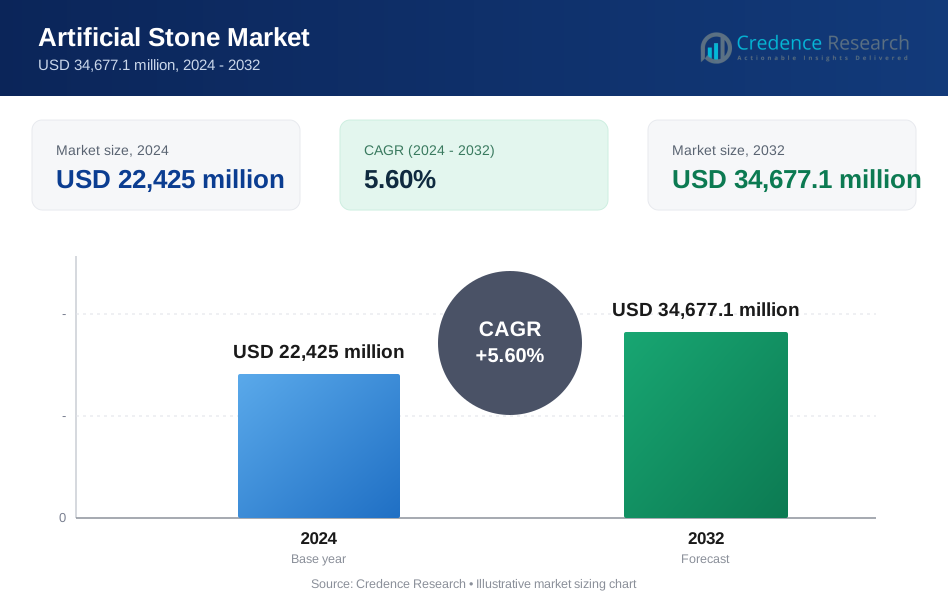
The artificial stone market is projected to grow from USD 22,425 million in 2024 to USD 34,677.1 million by 2032, registering a CAGR of 5.6% during the forecast period.
The artificial stone market is driven by the rising demand for durable, low-maintenance, and aesthetically appealing surface materials across residential and commercial construction. Urbanization and infrastructure development, particularly in emerging economies, continue to stimulate market growth. Builders and designers increasingly prefer artificial stone for its versatility, consistent quality, and wide range of design options compared to natural stone. The hospitality, healthcare, and retail sectors are fueling demand for engineered stone in countertops, flooring, and wall applications due to its hygienic properties and resistance to stains and scratches. Technological advancements in resin and polymer composites enhance product durability and customization, further attracting end users. Sustainability trends are also influencing the market, with manufacturers adopting eco-friendly production methods and recycled materials. Moreover, the growth of modular kitchen and bathroom remodeling activities in developed markets supports steady product uptake. Digital marketing and e-commerce platforms have improved product visibility and accessibility, reinforcing demand across broader customer segments.
The artificial stone market shows strong geographical diversification, with Asia Pacific leading at 36% market share, followed by North America at 28% and Europe at 22%. Asia Pacific’s dominance is driven by rapid urban development and high-volume construction in China and India. North America benefits from residential remodeling trends, while Europe emphasizes sustainable and premium design applications. Key players operating globally include Kuraray, Aristech Acrylics, Hanex, and Durat, along with regional manufacturers such as CXUN, PengXiang Industry, ChuanQi, New SunShine Stone, Leigei Stone, GuangTaiXiang, and Wanfeng Compound Stone. These companies compete by expanding product lines, focusing on design flexibility, and integrating sustainable manufacturing practices. The artificial stone market in these regions evolves through digital innovation, cost optimization, and growing demand from residential, commercial, and infrastructure sectors.
Market Insights
- The artificial stone market is projected to grow from USD 22,425 million in 2024 to USD 34,677.1 million by 2032, supported by a CAGR of 5.6%.
- Rising demand in residential and commercial construction fuels adoption due to artificial stone’s durability, low maintenance, and aesthetic appeal.
- Technological advancements in composite materials and digital fabrication enhance product performance, design flexibility, and manufacturing efficiency.
- Sustainability trends drive market growth, with manufacturers using recycled content and low-emission resins to align with green building standards.
- E-commerce and digital visualization tools increase product accessibility, while customization demands boost usage in modular kitchens and interiors.
- Competitive pressure from low-cost synthetic surfaces and natural stone alternatives challenges established players on pricing and differentiation.
- Asia Pacific leads with 36% market share, followed by North America at 28% and Europe at 22%, with strong regional players and diverse application demand.
Market Drivers
Rising Demand from Residential and Commercial Construction Sectors
The artificial stone market is experiencing strong demand due to growth in residential and commercial construction activities. Builders and architects favor artificial stone for its design flexibility, uniform appearance, and cost-efficiency compared to natural stone. It suits diverse applications including countertops, wall cladding, flooring, and facades. In rapidly urbanizing regions, rising disposable income and lifestyle changes fuel home renovations and new housing projects. Commercial spaces such as hotels and hospitals also prefer artificial stone for hygiene and durability. It supports easy installation and maintenance, which lowers lifetime costs. These benefits continue to reinforce its adoption across global construction markets.
- For instance, Cosentino’s Silestone products have been installed in hospital food facilities, where their durability and ease of cleaning are essential for meeting strict health standards.
Technological Advancements in Manufacturing and Design
Innovations in composite materials and manufacturing techniques have enhanced the appeal of artificial stone. It now replicates the aesthetics of granite, marble, and quartz with superior consistency. Advanced fabrication allows for intricate patterns, customized finishes, and better structural properties. The artificial stone market benefits from improved resistance to heat, moisture, stains, and mechanical stress. These upgrades expand its usage in high-traffic areas and demanding environments. Manufacturers also invest in automated processes and surface engineering, reducing production defects and wastage. These developments make artificial stone a competitive alternative to both natural materials and traditional surfacing solutions.
- For instance, Pacific Industries Ltd has installed an automated Breton line for engineered quartz stone slab manufacturing, which enables precise replication of natural stone patterns and ensures consistent quality across large production volumes.
Sustainability and Environmental Considerations
Environmental regulations and consumer awareness have led to rising demand for sustainable building materials. The artificial stone market responds with eco-friendly production methods, including the use of recycled aggregates and low-emission resins. It reduces dependency on quarrying natural stone, which supports conservation efforts. Manufacturing processes continue to become more energy-efficient, lowering the carbon footprint of end products. It also contributes to green building certifications like LEED and BREEAM. Many developers now select artificial stone to meet environmental compliance without compromising on aesthetics or performance. This alignment with sustainability goals reinforces its position in the modern construction industry.
Growth of E-Commerce and Design Customization
Online platforms have accelerated product awareness and accessibility for artificial stone solutions. Customers and contractors can now explore material specifications, visual samples, and customization tools digitally. The artificial stone market leverages digital marketing and showroom visualization technologies to engage clients early in the design process. These platforms also streamline procurement and project planning. Rising demand for tailored design in home and commercial interiors increases the need for customizable surface materials. Artificial stone offers consistency across batches and supports bespoke shapes, finishes, and color tones. This trend strengthens market penetration, especially in developed economies where personalization influences purchase decisions.
Market Trends
Growing Preference for Engineered Surfaces in Interior Applications
The artificial stone market is witnessing a notable shift toward engineered surfaces for interior design applications. Designers and homeowners increasingly favor engineered quartz and solid surfaces for kitchens, bathrooms, and living spaces due to their uniform quality and modern appearance. Artificial stone offers scratch resistance, low porosity, and ease of cleaning, making it suitable for high-use environments. Consumers demand materials that combine aesthetics with functionality, and artificial stone meets both needs effectively. It supports minimalistic, sleek, and high-gloss finishes preferred in contemporary interiors. Demand continues to grow across urban residential and luxury hospitality projects where visual appeal and long-term durability are essential.
- For instance, Caesarstone’s engineered quartz countertops are widely used in kitchens and bathrooms due to their scratch resistance, low porosity, and ease of cleaning, making them ideal for high-traffic areas.
Expansion of Eco-Conscious Product Lines Across Manufacturers
Sustainability trends continue to influence the artificial stone market, prompting manufacturers to introduce eco-conscious product lines. Companies incorporate recycled stone fragments, glass, and low-emission binders to meet environmental standards. Eco-labeled artificial stones are gaining traction among builders aiming for LEED or BREEAM certification. Manufacturers also reduce water and energy consumption during production, aligning operations with global climate goals. Artificial stone fits into circular construction practices, offering long lifecycle and reusability potential. It strengthens the green credentials of construction projects without compromising performance or visual quality. This trend supports brand differentiation in a competitive materials market.
- For instance, Beer Sten AS offers the BeerEcoSten® Evjen product group, which is EPD-certified and sourced from local Norwegian quarries to reduce transportation emissions. The product’s design emphasizes longevity and minimal adhesive use, aligning with sustainable construction goals.
Increased Investment in Digital Fabrication and Smart Production
Automation and digital tools are reshaping the production processes in the artificial stone market. CNC machines, water-jet cutters, and 3D scanning systems allow precise fabrication of custom stone surfaces. These technologies reduce material wastage and enhance production accuracy. Manufacturers improve efficiency and respond faster to customer-specific demands by integrating smart production lines. It enables large-scale customization with consistent product quality. Digital fabrication also supports seamless integration with Building Information Modeling (BIM) in architectural planning. These innovations reduce lead times and improve profitability across the value chain, reinforcing the competitiveness of artificial stone manufacturers.
Rising Popularity of Bold Colors and Textured Finishes
Consumer preferences in surface aesthetics are shifting toward bolder color palettes and tactile textures. The artificial stone market is adapting with new product launches featuring veined patterns, matte finishes, and natural stone effects. Designers seek to create statement pieces in kitchens and bathrooms, favoring materials that offer depth and character. Artificial stone can replicate the look of granite, terrazzo, or marble while offering better durability. It supports artistic expression in both residential and commercial environments. The rise of darker tones, mixed materials, and large-format slabs reflects evolving design trends. These innovations help artificial stone maintain relevance in high-end design projects.
Market Challenges Analysis
Rising Competition from Low-Cost Alternatives and Natural Stone
The artificial stone market faces increasing competition from both low-cost alternatives and premium natural stone options. Emerging players from price-sensitive regions offer synthetic surfaces at lower costs, impacting profitability for established brands. Natural stone remains a preferred choice for luxury projects due to its authenticity and prestige appeal. It also challenges artificial stone in high-end commercial and residential applications. Customers often weigh pricing, brand reputation, and visual preferences before selecting materials. This competition pressures manufacturers to balance cost-efficiency with innovation to retain market share.
Concerns over Silica Exposure and Regulatory Scrutiny
Health concerns associated with crystalline silica exposure during artificial stone cutting and fabrication present a growing challenge. Regulatory authorities in several countries are tightening workplace safety standards for engineered stone processing. The artificial stone market must adapt by investing in dust control systems and low-silica formulations. Failure to comply can lead to legal penalties and damage to brand reputation. Labor unions and health organizations continue to push for stricter regulations, especially in regions with high installation volumes. Addressing these concerns is critical to maintaining industry credibility and protecting long-term growth potential.
Market Opportunities
Expansion in Emerging Markets and Infrastructure Projects
The artificial stone market has significant opportunities in emerging economies undergoing rapid urbanization and infrastructure development. Governments in Asia, the Middle East, and Africa are investing heavily in residential, commercial, and public infrastructure. These projects require durable, cost-effective, and visually appealing materials, making artificial stone a strong fit. Rising middle-class populations seek modern interiors, which drives demand for engineered surfaces in housing developments. It benefits from its adaptability to various design preferences and climatic conditions. Market players can expand their presence by forming regional distribution partnerships and investing in localized production.
Product Innovation for High-Value Applications and Segments
Innovation in material composition and design opens new revenue streams for the artificial stone market. Manufacturers can develop antimicrobial, UV-resistant, and thermal-insulated surfaces for healthcare, hospitality, and outdoor use. These features address sector-specific performance needs and extend product relevance. Customization and digital fabrication also support high-end architectural applications. It enables seamless integration into furniture, facades, and large-format panels. The ability to serve diverse functional and aesthetic requirements creates strong potential for premiumization and value-added services across segments.
Market Segmentation Analysis:
By Type
The artificial stone market includes four major product types: cement, polyester, composite, and sintered artificial stone. Cement artificial stone dominates in heavy-duty construction due to its strength and cost-efficiency. Polyester artificial stone finds widespread use in interiors for its design flexibility and smooth finishes. Composite artificial stone offers enhanced performance and is often used where higher durability is required. Sintered artificial stone, although premium-priced, is gaining attention for its advanced aesthetics and heat resistance. Each type serves specific use cases, expanding the market's application scope. It allows manufacturers to target both mass-market and high-end segments.
- For instance, Skyway Cement supplied slag cement for The Reed at Southbank, a 43-story cast-in-place structure in Chicago, where over 30,000 yd³ of low-carbon concrete was used for enhanced durability and strength in a high-rise application.
By Application
The artificial stone market serves diverse applications, primarily across construction and decoration, furniture, and other niche uses. Construction and decoration remain the largest application segment, driven by demand for flooring, wall cladding, and countertops in both residential and commercial spaces. Furniture manufacturers use artificial stone for tabletops, vanity units, and designer surfaces. Other applications include signage, retail displays, and laboratory worktops, where hygiene and durability are critical. It supports a wide range of end-use requirements through customizable design and high-performance characteristics. Growing design trends and functional needs continue to expand the role of artificial stone across industries.
- For instance, Caesarstone’s engineered quartz surfaces are widely installed as kitchen countertops and bathroom vanities in residential and commercial buildings, offering high stain resistance and customizable aesthetics.
Segments:
Based on Type
- Cement Artificial Stone
- Polyester Artificial Stone
- Composite Artificial Stone
- Sintered Artificial Stone
Based on Application
- Construction and Decoration
- Fuiture
- Other
Based on the Geography:
- North America
- U.S.
- Canada
- Mexico
- Europe
- Germany
- France
- U.K.
- Italy
- Spain
- Rest of Europe
- Asia Pacific
- China
- Japan
- India
- South Korea
- South-east Asia
- Rest of Asia Pacific
- Latin America
- Brazil
- Argentina
- Rest of Latin America
- Middle East & Africa
- GCC Countries
- South Africa
- Rest of the Middle East and Africa
Regional Analysis
North America
North America accounts for 28% of the global artificial stone market share, driven by strong demand in residential remodeling and commercial construction. The U.S. leads the region with significant consumption across kitchen countertops, bathroom vanities, and flooring. Home improvement trends and rising investments in interior upgrades continue to fuel growth. Developers prefer artificial stone for its durability, aesthetic appeal, and ease of maintenance. It also benefits from a mature distribution network and a growing preference for sustainable and non-porous materials. The market is further supported by innovation in composite and quartz-based surfaces.
Asia Pacific
Asia Pacific holds the largest share at 36%, led by China, India, and Southeast Asia. Rapid urbanization, rising disposable incomes, and infrastructure development drive strong adoption in residential and commercial projects. Local manufacturers offer competitive pricing and product variety, making artificial stone accessible to a broader customer base. Government-backed housing schemes and commercial developments increase demand for surface materials with long-term performance. The artificial stone market in this region is growing rapidly due to expanding construction activity and population-driven housing demand. It continues to benefit from low production costs and increasing domestic consumption.
Europe
Europe represents 22% of the artificial stone market, supported by demand for high-end design applications and sustainable construction. Countries such as Germany, France, and Italy are key contributors due to their advanced architecture and interior design sectors. The region emphasizes eco-friendly materials and strict building regulations, which favor engineered stone over natural alternatives. It supports applications in hospitality, retail, and luxury housing projects. European consumers value visual aesthetics and technical performance, driving innovation in premium product lines. Manufacturers respond with advanced fabrication and tailored finishes to meet regional design preferences.
Key Player Analysis
- GuangTaiXiang
- CXUN
- Kuraray
- ChuanQi
- Wanfeng Compound Stone
- New SunShine Stone
- Durat
- PengXiang Industry
- Hanex
- Leigei Stone
- MARMIL
- Aristech Acrylics
Competitive Analysis
The artificial stone market features a competitive landscape driven by innovation, product quality, and pricing strategies. Key players such as Kuraray, Aristech Acrylics, Durat, and Hanex focus on expanding product portfolios and improving performance features to meet diverse application demands. Companies like CXUN, PengXiang Industry, and Wanfeng Compound Stone strengthen their position through regional manufacturing and cost-efficient distribution. The artificial stone market also includes design-centric firms such as New SunShine Stone, Leigei Stone, and GuangTaiXiang, which emphasize customization and surface aesthetics. MARMIL and ChuanQi invest in sustainable production processes and material innovation to gain a competitive edge. It continues to evolve with strategic partnerships, facility expansions, and digital fabrication capabilities. Market leaders compete on brand recognition, technical support, and responsiveness to evolving construction and interior design trends.
Recent Developments
- In July 2024, OK Stone Engineering Inc. announced its new Fort Worth manufacturing facility using Breton S.p.A.’s Bioquartz® technology, with production of engineered quartz slabs scheduled to begin in Q3 2025.
- In February 2024, Aristech Acrylics LLC introduced a new thermoformable artificial stone series offering high impact resistance and seamless installation for modular interior and compact architectural spaces.
- In April 2024, Durat launched a fully recyclable solid surface collection with over 30 color variants, made using post-industrial plastic waste to support circular design practices across European markets.
- In May 2025, Huabao Stone launched a new inorganic artificial stone line using vibro‑vacuum technology to produce large slabs (over 3 m) with flamed textures-enhancing outdoor and architectural applications.
Market Concentration & Characteristics
The artificial stone market demonstrates moderate market concentration with a mix of global and regional players competing across price tiers and application segments. Large multinational companies such as Kuraray, Aristech Acrylics, and Hanex maintain a strong presence through advanced technology, brand reputation, and global distribution. Regional manufacturers like CXUN, PengXiang Industry, and GuangTaiXiang offer cost-effective solutions and cater to localized demand. The artificial stone market is characterized by product diversity, design flexibility, and rapid innovation in manufacturing processes. It serves both high-volume construction needs and customized interior applications. Market participants focus on durability, aesthetic consistency, and sustainable practices to differentiate offerings. The industry also experiences strong integration across the value chain, from raw material sourcing to end-user delivery. Digital fabrication, eco-friendly formulations, and expanding e-commerce channels influence product development and customer engagement. It continues to evolve in response to design trends, regulatory standards, and global construction activity.
Report Coverage
The research report offers an in-depth analysis based on Type, Application and Geography. It details leading market players, providing an overview of their business, product offerings, investments, revenue streams, and key applications. Additionally, the report includes insights into the competitive environment, SWOT analysis, current market trends, as well as the primary drivers and constraints. Furthermore, it discusses various factors that have driven market expansion in recent years. The report also explores market dynamics, regulatory scenarios, and technological advancements that are shaping the industry. It assesses the impact of external factors and global economic changes on market growth. Lastly, it provides strategic recommendations for new entrants and established companies to navigate the complexities of the market.
Future Outlook
- Demand for artificial stone will rise with increasing residential and commercial construction projects globally.
- Urbanization in emerging markets will continue to drive high-volume usage of engineered surfaces.
- Manufacturers will expand eco-friendly product lines to align with sustainability goals and green building standards.
- Technological improvements will enhance material strength, design options, and production efficiency.
- Customization and digital fabrication will play a central role in meeting diverse architectural needs.
- Health and safety regulations will encourage adoption of low-silica and safer processing materials.
- Growth in modular kitchens and bathroom remodeling will support steady product demand.
- Online sales and visualization tools will boost product awareness and streamline client decision-making.
- Competition from low-cost suppliers will push established brands to innovate and optimize pricing.
- Regional players will expand their presence by targeting niche applications and local construction trends.
Request a Free Sample
Fill in your details and we'll send you a free sample report.
- Sample data tables & charts
- Research methodology
Market Dynamics
Growth in Residential and Commercial Construction
Expanding construction activities, especially in urbanizing regions, are increasing the demand for durable, low-maintenance, and aesthetically versatile surface materials like artificial stone for applications such as countertops, flooring, and wall cladding.
Technological Advancements in Composite Materials
Innovations in resin and polymer composites have improved the durability, design flexibility, and performance of artificial stone, making it more attractive for high-traffic and demanding environments in both residential and commercial sectors.
Sustainability and Eco-Friendly Production
Manufacturers are increasingly adopting recycled materials and low-emission resins, aligning artificial stone products with green building standards and meeting the rising demand for sustainable construction materials.
Expansion of E-Commerce and Digital Customization
The growth of online sales channels and digital visualization tools has made artificial stone products more accessible, enabling customers and designers to explore, customize, and procure materials efficiently, thus broadening market reach.
Health and Hygiene Requirements in Commercial Spaces
Sectors such as healthcare, hospitality, and retail are driving demand for artificial stone due to its non-porous, stain-resistant, and easy-to-clean properties, which are essential for meeting stringent hygiene and safety standards.
Need a Custom Version of This Report?
Tailor the scope, geography, or segments to your exact requirements.
- Custom geography or segment scope
- Direct access to our analyst team
Frequently Asked Questions
What is the current size of the Artificial Stone Market?
What are the key segments within the Artificial Stone Market?
What are some challenges faced by the Artificial Stone Market?
Who are the major players in the Artificial Stone Market?
Table of Content
Chapter 1 Market Segmentation
- 1.1 Segmentation Framework
- 1.1.1 Product and Service Classification
- 1.1.2 Application and End-Use Classification
- 1.1.3 Technology and Solution Classification
- 1.1.4 Customer and Distribution Channel Classification
- 1.1.5 Geographic Segmentation
- 1.1.6 Market Segment Definitions and Boundaries
- 1.2 By Type
- 1.2.1 Cement Artificial Stone
- 1.2.2 Polyester Artificial Stone
- 1.2.3 Composite Artificial Stone
- 1.2.4 Sintered Artificial Stone
- 1.3 By End User
- 1.3.1 Residential
- 1.3.2 Commercial
- 1.3.3 Industrial
- 1.4 By Application
- 1.4.1 Construction and Decoration
- 1.4.2 Furniture
- 1.4.3 Other
Chapter 2 Introduction
- 2.1 Report Objectives and Scope
- 2.2 Product Definition and Industry Terminology
- 2.3 Market Inclusions and Exclusions
- 2.4 Research Process
- 2.4.1 Primary Research and Expert Interviews
- 2.4.2 Secondary Research and Source Review
- 2.4.3 Top-Down and Bottom-Up Estimation
- 2.4.4 Data Triangulation and Verification
- 2.5 Market Size Measurement Basis
- 2.5.1 2024: USD 22,425 million → 2032: USD 34,677.1 million
- 2.6 Historical and Forecast Reference Periods
- 2.6.1 Base Year: 2024
- 2.6.2 Forecast Period: 2024-2032
- 2.7 Research Assumptions and Limitations
Chapter 3 Executive Summary
- 3.1 Market Snapshot and Key Findings
- 3.2 Base-Year Market Size, 2024
- 3.3 Forecast Market Size, 2032
- 3.4 Revenue and Volume Growth Outlook
- 3.5 Key Demand and Supply Indicators
- 3.6 Leading Market Segments
- 3.7 Fastest-Growing Market Opportunities
- 3.8 Regional Performance Highlights
- 3.9 Technology and Industry Transformation
- 3.10 Competitive Landscape Summary
- 3.11 Analyst View and Strategic Implications
Chapter 4 Global Artificial Stone Market Trends and Developments
- 4.1 Historical Industry Development
- 4.2 Recent Market Trends and Developments
- 4.3 Demand and Customer Behavior Trends
- 4.4 Technology and Product Innovation
- 4.5 Artificial Intelligence, Automation and Digitalization
- 4.6 Local Manufacturing and Supply Chain Realignment
- 4.7 Industry Partnerships, Mergers and Acquisitions
- 4.8 Sustainability and Circular Economy Developments
- 4.9 Government and Private Sector Investment Trends
- 4.10 Emerging Business Models and Commercialization
- 4.11 Industry Developments and Announcements
Chapter 5 Global Artificial Stone Market Production, Supply and Demand Analysis
- 5.1 Demand Trend and Consumption Analysis
- 5.2 Demand Forecast, 2024-2032
- 5.3 Production and Output Trend
- 5.4 Production and Output Forecast, 2024-2032
- 5.5 Installed Capacity and Capacity Utilization
- 5.6 Company-Wise Production Plants and Statistics
- 5.6.1 Installed Production Capacity
- 5.6.2 Actual Production
- 5.6.3 Planned Capacity and Expansion Targets
- 5.7 Supply Chain Structure and Procurement Trends
- 5.8 Supply-Demand Gap and Bottlenecks
- 5.9 Import Dependence and Sourcing Structure
- 5.10 Contract Manufacturing and Outsourcing
- 5.11 Regional Supply and Demand Concentration
Chapter 6 Global Artificial Stone Market Pricing Analysis
- 6.1 Pricing Structure and Measurement
- 6.2 Historical Pricing Trends
- 6.3 Pricing Outlook, 2024-2032
- 6.4 Average Selling Price and Unit Economics
- 6.5 Pricing by Product and Market Segment
- 6.6 Geographic Pricing Differences
- 6.7 Key Input, Energy, Labor and Logistics Costs
- 6.8 Contract Pricing and Purchasing Models
- 6.9 Pricing Sensitivity and Competitive Positioning
- 6.10 Price, Margin and Profitability Implications
Chapter 7 Global Artificial Stone Market Dynamics
- 7.1 Market Growth Drivers
- 7.1.1 Demand-Side Drivers
- 7.1.2 Technology and Innovation Drivers
- 7.1.3 Infrastructure and Investment Drivers
- 7.1.4 Regulatory and Policy Drivers
- 7.2 Market Restraints
- 7.2.1 Cost and Affordability Constraints
- 7.2.2 Technology and Adoption Barriers
- 7.2.3 Supply Chain and Operational Constraints
- 7.3 Market Challenges
- 7.3.1 Competitive Pressure and Margin Erosion
- 7.3.2 Skills, Infrastructure and Implementation Gaps
- 7.4 Emerging Market Opportunities
- 7.5 Market Dynamics Impact and Time-Horizon Assessment
Chapter 8 Global Artificial Stone Value Chain Analysis
- 8.1 Industry Value Chain Overview
- 8.2 Upstream Suppliers and Critical Inputs
- 8.3 Technology and Component Providers
- 8.4 Manufacturing or Service Delivery
- 8.5 Distribution, Channel Partners and Integrators
- 8.6 Downstream Applications and End Users
- 8.7 Value Addition and Profit Pools
- 8.8 Vertical Integration and Outsourcing
- 8.9 Supplier Concentration and Risk
- 8.10 Supply Chain Localization and Resilience
Chapter 9 Global Artificial Stone Market Regulations and Policies
- 9.1 Relevant Laws, Standards and Compliance Frameworks
- 9.2 Product, Service, Safety and Quality Requirements
- 9.3 Government Policies, Incentives and Subsidies
- 9.4 Imports, Exports and Trade Barriers
- 9.5 Public Procurement and Local Content Requirements
- 9.6 Environmental and Sustainability Compliance
- 9.7 Upcoming Policy Changes and Market Implications
Chapter 10 Global Artificial Stone Market Hotspots and Opportunities
- 10.1 Market Opportunity Mapping and Growth Hotspots
- 10.2 High-Growth Applications and Customer Groups
- 10.3 Underserved Markets and White-Space Opportunities
- 10.4 Emerging Technology and Product Opportunities
- 10.5 New Capacity and Investment Hotspots
- 10.6 Market Entry and Expansion Opportunities
- 10.7 Distribution and Partnership Opportunities
- 10.8 Near-Term and Long-Term Commercial Potential
- 10.9 Opportunity Attractiveness and Execution Risks
Chapter 11 Global Artificial Stone Market Outlook, 2024-2032
- 11.1 Market Size and Analysis
- 11.1.1 Revenue (Market Measurement: 2024: USD 22,425 million → 2032: USD 34,677.1 million)
- 11.1.2 Market Volume and Quantity Sold
- 11.1.3 Historical Market Size
- 11.1.4 Base-Year Market Size, 2024
- 11.2 Market Forecast, 2024-2032
- 11.2.1 Revenue Forecast to 2032
- 11.2.2 Volume Forecast to 2032
- 11.2.3 CAGR and Year-on-Year Growth
- 11.2.4 Incremental Revenue Opportunity
- 11.3 Forecast Assumptions and Scenario Analysis
- 11.3.1 Base-Case Forecast
- 11.3.2 Optimistic and Conservative Scenarios
- 11.3.3 Technology, Pricing and Policy Sensitivities
- 11.4 Market Attractiveness and Growth Outlook
Chapter 12 Global Artificial Stone Market Segmentation and Outlook
- 12.1 Segmentation Summary and Market Shares, 2024
- 12.2 Largest and Fastest-Growing Segments
- 12.3 By Type - Market Size and Forecast, 2024-2032
- 12.3.1 Segment Definition and Scope
- 12.3.2 Historical Market Size
- 12.3.3 Revenue Forecast, 2024-2032
- 12.3.4 Volume Forecast, 2024-2032
- 12.3.5 Base-Year Market Share, 2024
- 12.3.6 Segment CAGR and Growth Drivers
- 12.3.7 Subsegment Market Size and Forecast
- 12.3.7.1 Cement Artificial Stone
- 12.3.7.2 Polyester Artificial Stone
- 12.3.7.3 Composite Artificial Stone
- 12.3.7.4 Sintered Artificial Stone
- 12.3.8 Subsegment Pricing and Adoption Trends
- 12.3.9 Leading Suppliers and Competition
- 12.3.10 Regional Demand and Opportunities
- 12.4 By End User - Market Size and Forecast, 2024-2032
- 12.4.1 Segment Definition and Scope
- 12.4.2 Historical Market Size
- 12.4.3 Revenue Forecast, 2024-2032
- 12.4.4 Volume Forecast, 2024-2032
- 12.4.5 Base-Year Market Share, 2024
- 12.4.6 Segment CAGR and Growth Drivers
- 12.4.7 Subsegment Market Size and Forecast
- 12.4.7.1 Residential
- 12.4.7.2 Commercial
- 12.4.7.3 Industrial
- 12.4.8 Subsegment Pricing and Adoption Trends
- 12.4.9 Leading Suppliers and Competition
- 12.4.10 Regional Demand and Opportunities
- 12.5 By Application - Market Size and Forecast, 2024-2032
- 12.5.1 Segment Definition and Scope
- 12.5.2 Historical Market Size
- 12.5.3 Revenue Forecast, 2024-2032
- 12.5.4 Volume Forecast, 2024-2032
- 12.5.5 Base-Year Market Share, 2024
- 12.5.6 Segment CAGR and Growth Drivers
- 12.5.7 Subsegment Market Size and Forecast
- 12.5.7.1 Construction and Decoration
- 12.5.7.2 Furniture
- 12.5.7.3 Other
- 12.5.8 Subsegment Pricing and Adoption Trends
- 12.5.9 Leading Suppliers and Competition
- 12.5.10 Regional Demand and Opportunities
- 12.6 Segment Growth Comparison
- 12.7 Segment Attractiveness and Priority Matrix
Chapter 13 Global Artificial Stone End-Use and Application Market Outlook
- 13.1 End-Use Industry and Customer Demand Structure
- 13.2 Leading Applications and Customer Groups
- 13.3 End-Use Market Size, Share and Forecast
- 13.4 Major End-Use Industry Deep Dives
- 13.4.1 Customer Requirements and Use Cases
- 13.4.2 Demand and Replacement Cycles
- 13.4.3 Technical and Regulatory Considerations
- 13.4.4 Purchasing and Procurement Models
- 13.4.5 Leading Vendors and Distribution Channels
- 13.4.6 Forecast and Commercial Opportunities
- 13.5 Emerging Applications and Cross-Segment Demand
- 13.6 End-Use Industry Investment Priorities
Chapter 14 Global Artificial Stone Geographic Market Outlook, 2024-2032
- 14.1 Regional Market Size and Share, 2024
- 14.2 Regional Market Forecast, 2024-2032
- 14.3 Regional Pricing, Production and Demand Differences
- 14.4 North America
- 14.4.1 United States
- 14.4.2 Canada
- 14.4.3 Mexico
- 14.5 Europe
- 14.5.1 Germany
- 14.5.2 France
- 14.5.3 Italy
- 14.5.4 United Kingdom
- 14.5.5 Spain
- 14.5.6 Poland
- 14.5.7 Russia
- 14.5.8 Netherlands
- 14.5.9 Belgium
- 14.5.10 Sweden
- 14.5.11 Denmark
- 14.5.12 Norway
- 14.5.13 Rest of Europe
- 14.6 Asia Pacific
- 14.6.1 China
- 14.6.2 India
- 14.6.3 Japan
- 14.6.4 South Korea
- 14.6.5 Thailand
- 14.6.6 Indonesia
- 14.6.7 Vietnam
- 14.6.8 Malaysia
- 14.6.9 Australia
- 14.6.10 Rest of Asia Pacific
- 14.7 Latin America
- 14.7.1 Brazil
- 14.7.2 Argentina
- 14.7.3 Colombia
- 14.7.4 Chile
- 14.7.5 Rest of Latin America
- 14.8 Middle East
- 14.8.1 Saudi Arabia
- 14.8.2 United Arab Emirates
- 14.8.3 Turkey
- 14.8.4 Israel
- 14.8.5 Iran
- 14.8.6 Rest of the Middle East
- 14.9 Africa
- 14.9.1 South Africa
- 14.9.2 Egypt
- 14.9.3 Nigeria
- 14.9.4 Morocco
- 14.9.5 Rest of Africa
- 14.10 Regional Investment, Policy and Supply Chain Differences
- 14.11 Regional Competitive Landscape
- 14.12 Geographic Growth Hotspots
Chapter 15 Global Artificial Stone Technology, Innovation and Sustainability Outlook
- 15.1 Technology Landscape and Maturity
- 15.2 Product, Process and Service Innovation
- 15.3 AI, Automation and Digital Tools in the Industry
- 15.4 Technology Adoption and Performance Benchmarking
- 15.5 Innovation Pipeline and R&D Investment
- 15.6 Patent and Intellectual Property Trends
- 15.7 Energy Efficiency and Resource Management
- 15.8 Sustainability, Recycling and Circularity
- 15.9 Technology Roadmap, 2024-2032
- 15.10 Risks of Obsolescence and Technology Substitution
Chapter 16 Global Artificial Stone Market Key Strategic Imperatives
- 16.1 Growth and Market Entry Priorities
- 16.2 High-Return Products and Segments
- 16.3 Pricing, Profitability and Cost Optimization
- 16.4 Technology Investment and Product Differentiation
- 16.5 Supply Chain Localization and Resilience
- 16.6 Distribution and Customer Acquisition
- 16.7 Partnership, Acquisition and Capacity Strategy
- 16.8 Regional Expansion Priorities
- 16.9 Short-, Medium- and Long-Term Actions
Chapter 17 Competition Outlook
- 17.1 Industry Competition Characteristics
- 17.2 Market Structure and Concentration
- 17.3 Market Share and Competitive Positioning, 2024
- 17.4 Company-Wise Revenue and Product Benchmarking
- 17.5 Production and Service Capacity Benchmarking
- 17.6 Technology, Pricing and Differentiation
- 17.7 Regional Footprint and Distribution Strength
- 17.8 Mergers, Acquisitions and Strategic Alliances
- 17.9 New Entrants and Competitive Threats
- 17.10 Porter's Five Forces and Industry Attractiveness
- 17.11 Competitive Outlook, 2024-2032
Chapter 18 Company Profiles
- 18.1 Company Coverage and Selection Criteria
- 18.2 Kuraray
- 18.2.1 Business Description
- 18.2.2 Company Ownership and Geographic Presence
- 18.2.3 Product and Service Portfolio
- 18.2.4 Manufacturing and Operating Footprint
- 18.2.5 Production Capacity and Expansion Plans
- 18.2.6 Financial Performance and Investment
- 18.2.7 Market Share and Competitive Position
- 18.2.8 Technology and Innovation Capabilities
- 18.2.9 Strategic Alliances or Partnerships
- 18.2.10 Recent Developments
- 18.2.11 Growth Strategy and Outlook
- 18.3 Aristech Acrylics
- 18.4 Hanex
- 18.5 Durat
- 18.6 GuangTaiXiang
- 18.7 CXUN
- 18.8 PengXiang Industry
- 18.9 ChuanQi
- 18.10 Wanfeng Compound Stone
- 18.11 New SunShine Stone
- 18.12 Other Relevant Market Participants
Note: Every listed company is profiled on the structure shown under the first company. The company list is preliminary and may change based on research findings, market developments, data availability and client requirements.
Chapter 19 Disclaimer
- 19.1 Research and Forecast Disclaimer
- 19.2 Data Source and Estimation Limitations
Note: The depth of individual sections depends on data availability for this market. Volume, capacity, trade and other unit-based metrics are included where applicable.

