
Market Overview
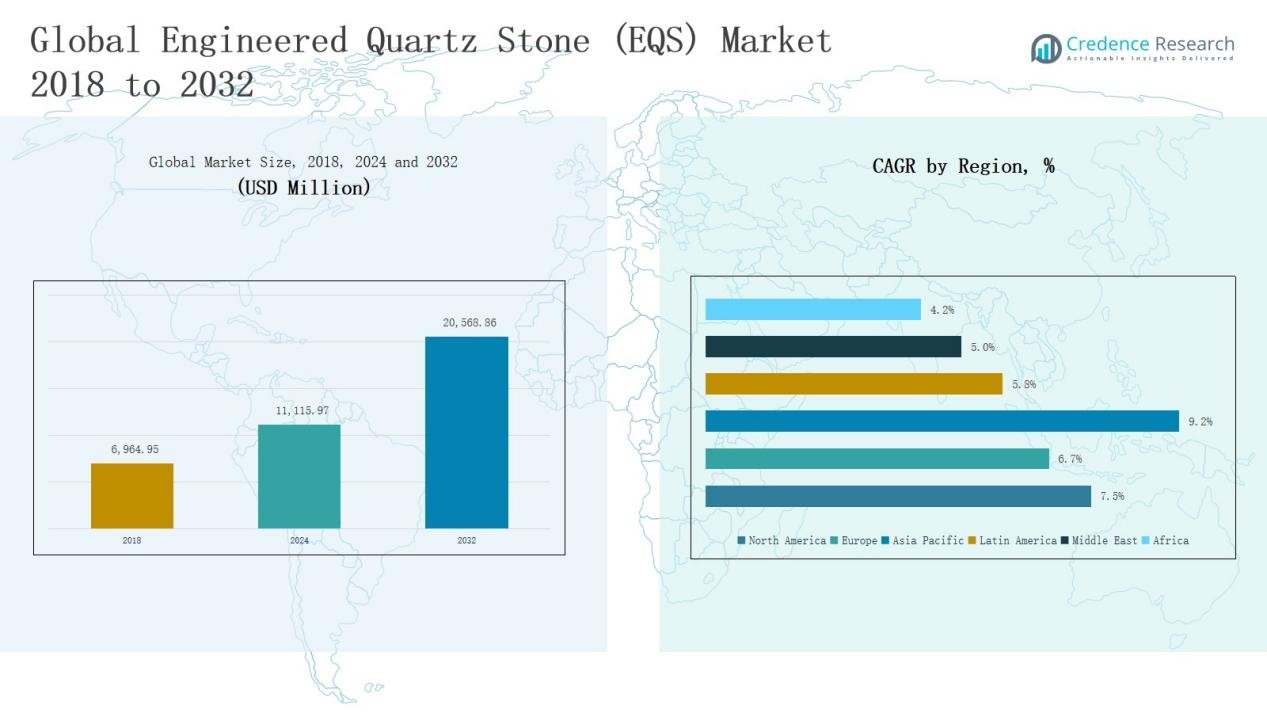
Engineered Quartz Stone (EQS) Market size was valued at USD 6,964.95 million in 2018, reached USD 11,115.97 million in 2024, and is anticipated to reach USD 20,568.86 million by 2032, growing at a CAGR of 7.45% during the forecast period.
| REPORT ATTRIBUTE | DETAILS |
|---|---|
| Historical Period | 2020-2023 |
| Base Year | 2024 |
| Forecast Period | 2025-2032 |
| Engineered Quartz Stone (EQS) Market Size 2024 | USD 11,115.97 Million |
| Engineered Quartz Stone (EQS) Market, CAGR | 7.45% |
| Engineered Quartz Stone (EQS) Market Size 2032 | USD 20,568.86 Million |
The Engineered Quartz Stone (EQS) Market is shaped by global leaders such as Cosentino S.A., Caesarstone Ltd., Cambria Company LLC, Hanwha Solutions (HanStone), Vicostone, RAK Ceramics, Compac S.A., Levantina Group, and Stone Italiana S.p.A. These companies maintain a competitive edge through strong product portfolios, innovative designs, and eco-friendly solutions, including recycled and silica-free quartz surfaces. Strategic partnerships with architects and contractors, along with expanding digital retail presence, further strengthen their market positions. North America emerged as the leading region in 2024, commanding a 43.7% market share, driven by robust remodeling activity, premium housing projects, and strong consumer preference for durable, low-maintenance quartz surfaces.
Market Insights
- The Engineered Quartz Stone (EQS) Market grew from USD 6,964.95 million in 2018 to USD 11,115.97 million in 2024, and is expected to reach USD 20,568.86 million by 2032.
- Kitchen countertops dominated with over 55% revenue share in 2024, driven by durability, stain resistance, and preference in residential and commercial construction projects.
- Distributors and dealers led distribution with around 48% share in 2024, supported by strong contractor networks and wide product offerings across global markets.
- North America held 43.7% share in 2024, valued at USD 4,811.05 million, driven by remodeling activity, premium housing demand, and expanding commercial construction projects.
- Leading players such as Cosentino, Caesarstone, Cambria, Hanwha Solutions, Vicostone, RAK Ceramics, Compac, Levantina, and Stone Italiana focus on innovation, eco-friendly solutions, and strategic partnerships.
Market Segment Insights
By Application
Kitchen countertops dominated the Engineered Quartz Stone market in 2024, accounting for over 55% of revenue share. Their popularity stems from durability, stain resistance, and a wide range of design options, making them the preferred choice in residential and commercial projects. Bathroom vanities followed as the second largest sub-segment with rising adoption in premium housing. Flooring, wall cladding, and other applications are growing steadily, supported by modern architecture trends and consumer preference for low-maintenance surfaces.
- For instance, Caesarstone introduced its Pebbles Collection in 2022, featuring neutral-toned quartz slabs tailored for kitchen and bathroom applications.
By Distribution Channel
Distributors and dealers held the largest share of the EQS market in 2024, representing around 48% of global revenue. Their extensive networks, ability to offer variety, and strong relationships with contractors drive sales dominance. Direct sales followed closely, driven by premium brand strategies and large-scale project contracts. Home improvement retailers are witnessing steady growth, supported by do-it-yourself renovations and rising urban home upgrades, while the “others” category benefits from niche channels such as online platforms.
- For instance, Lowe’s introduced enhanced digital tools to support online-to-store purchases, catering to both urban upgraders and small contractors through its retail platform.
Key Growth Drivers
Rising Demand for Premium Kitchen Countertops
Engineered quartz stone is witnessing strong demand in kitchen countertops, driven by consumer preference for aesthetics, durability, and low maintenance. Its resistance to stains, scratches, and bacteria makes it more appealing compared to natural stone. Growing disposable incomes and rapid urbanization, especially in emerging economies, further support market expansion. Residential renovation and remodeling projects in North America and Europe continue to boost adoption, while premium housing projects in Asia-Pacific increase demand for high-quality quartz-based surfaces.
- For instance, Wilsonart introduced a new collection of quartz designs at KBIS 2025, featuring ten innovative designs inspired by natural stone, including Icelandic Mist and Emerald Brook.
Expansion of Residential and Commercial Construction
The steady rise in global residential and commercial construction projects strongly fuels EQS adoption. Builders and architects increasingly specify engineered quartz for countertops, flooring, and wall cladding due to its durability and design flexibility. Commercial spaces such as hotels, restaurants, and retail outlets prefer quartz for its cost-effectiveness and long-term performance. Urban infrastructure investments and government-backed housing schemes in developing nations are further driving market penetration, ensuring sustained demand across both developed and emerging markets.
- For instance, Cosentino launched its Silestone Ethereal collection in recent years, offering innovative colors and sustainable manufacturing using its HybriQ+ technology, designed to meet both eco-conscious housing and premium hospitality projects.
Growing Preference for Sustainable and Eco-Friendly Materials
Sustainability is becoming a decisive factor in material selection across construction and interior design sectors. Engineered quartz stone, often manufactured with recycled materials and minimal environmental impact, aligns well with green building practices. Growing certifications such as LEED and BREEAM encourage developers to integrate eco-friendly solutions. Manufacturers are also innovating silica-free and low-emission quartz surfaces to meet regulatory requirements. Rising consumer awareness about environmental responsibility continues to position engineered quartz as a preferred sustainable alternative to natural stone.
Key Trends & Opportunities
Increasing Penetration of Smart Retail and Online Sales
Digital transformation in the building materials sector creates new opportunities for EQS distribution. Online platforms and smart retail solutions allow customers to compare designs, customize orders, and access a wider variety of surface options. Homeowners and contractors increasingly rely on e-commerce channels to purchase engineered quartz for renovations and smaller projects. This trend benefits smaller brands by improving visibility and competitiveness. Online retail is expected to play a stronger role in complementing traditional distributors and home improvement stores.
- For instance, Caesarstone Ltd. integrated its product offerings with Home Depot’s online platform, providing U.S. customers seamless access to customizable quartz surfaces.
Product Innovation and Customization Opportunities
Manufacturers are actively investing in new designs, textures, and finishes to meet evolving consumer preferences. Advancements in digital printing and manufacturing techniques allow greater customization of engineered quartz stone surfaces. Customers now demand unique colors and patterns, including natural marble and granite-like appearances. This innovation supports differentiation and brand loyalty, especially in premium markets. Companies offering tailored solutions for residential and commercial projects gain competitive advantage, making product innovation and customization a major growth opportunity.
- For instance, Cambria Quartz launched the Inverness collection featuring deeply textured veining, catering to customers seeking bold, natural-stone aesthetics for kitchen and commercial interiors.
Key Challenges
High Production and Installation Costs
Despite its benefits, engineered quartz stone remains more expensive compared to traditional materials such as laminate or ceramic tiles. High production costs, driven by raw material and energy requirements, often limit adoption in cost-sensitive markets. Installation also requires skilled labor, which adds to the overall expense. These factors restrict penetration in low- to mid-income housing projects. Manufacturers face the challenge of balancing premium quality with affordability to expand customer base while sustaining profitability.
Competition from Alternative Surface Materials
EQS faces significant competition from natural stone, solid surfaces, and emerging eco-friendly substitutes. Granite and marble still appeal to consumers due to their natural aesthetics and established presence in luxury projects. Meanwhile, materials like sintered stone and recycled composites are gaining market attention for sustainability. Price competition and shifting consumer preferences intensify the challenge for EQS manufacturers. Maintaining differentiation through design innovation and marketing is crucial to address the threat of substitute materials.
Health and Environmental Concerns from Silica Dust
A growing challenge for the EQS market is the health risk associated with crystalline silica dust released during cutting and fabrication. Exposure can lead to serious respiratory issues such as silicosis, prompting stricter workplace safety regulations. Regulatory agencies in Australia, the U.S., and Europe are already enforcing tighter rules, leading some regions to consider restrictions on silica-based quartz surfaces. Manufacturers are under pressure to develop safer, silica-free alternatives while ensuring compliance with evolving health and environmental standards.
Regional Analysis
North America
North America led the Engineered Quartz Stone market with a 43.7% share in 2024, valued at USD 4,811.05 million, rising from USD 3,046.05 million in 2018 and projected to reach USD 8,926.99 million by 2032, at a CAGR of 7.5%. Growth is driven by strong remodeling and renovation activity, particularly in the U.S. housing sector. Premium kitchen countertops and bathroom vanities dominate demand, supported by consumer preference for durable, aesthetic, and low-maintenance materials. Expanding commercial construction also strengthens the region’s leadership position in global EQS adoption.
Europe
Europe accounted for a 28.3% market share in 2024, reaching USD 3,148.36 million, up from USD 2,043.91 million in 2018, and is anticipated to hit USD 5,496.59 million by 2032 at a CAGR of 6.7%. Demand is fueled by sustainable building initiatives, advanced architectural designs, and rising adoption of eco-friendly quartz products. Germany, the UK, and France remain key contributors due to robust residential upgrades and commercial projects. Increasing consumer focus on premium surfaces and compliance with EU green building standards enhances long-term growth across the region.
Asia Pacific
Asia Pacific emerged as the fastest-growing region with a 19.8% market share in 2024, valued at USD 2,206.30 million, compared to USD 1,270.02 million in 2018, and expected to reach USD 4,651.03 million by 2032 at a CAGR of 9.2%. Rapid urbanization, rising disposable incomes, and large-scale housing developments in China and India drive growth. Japan, South Korea, and Australia add momentum through premium residential projects and modern interiors. Expanding infrastructure and increased consumer preference for durable, low-maintenance surfaces continue to make Asia Pacific the most dynamic market.
Latin America
Latin America captured a 4.6% share of the EQS market in 2024, with revenues of USD 507.41 million, growing from USD 322.02 million in 2018, and projected to reach USD 828.65 million by 2032, at a CAGR of 5.8%. Growth is supported by rising urban housing demand in Brazil and Argentina, coupled with modernization of commercial infrastructure. The adoption of quartz stone is increasing in premium housing and hospitality projects. However, slower economic growth and higher product costs limit wider adoption, though expansion of distribution networks improves accessibility.
Middle East
The Middle East accounted for a 2.4% market share in 2024, with revenues of USD 263.63 million, up from USD 181.95 million in 2018, and forecast to reach USD 405.55 million by 2032, registering a CAGR of 5.0%. Strong investments in luxury residential projects and hospitality infrastructure, particularly in GCC countries, drive demand. Engineered quartz stone is favored for high-end countertops and flooring in modern construction. However, limited awareness and reliance on imports constrain broader adoption, although rising government-backed smart city projects provide opportunities for steady growth.
Africa
Africa represented a 1.6% share in 2024, valued at USD 179.22 million, compared with USD 101.01 million in 2018, and is set to reach USD 260.05 million by 2032, at a CAGR of 4.2%. Market growth is driven by increasing urbanization and construction projects in South Africa and Egypt. Adoption remains modest due to high product costs and limited awareness, but gradual improvements in distribution and retail infrastructure support expansion. Growing middle-class housing demand and infrastructure modernization present long-term potential for engineered quartz stone adoption.
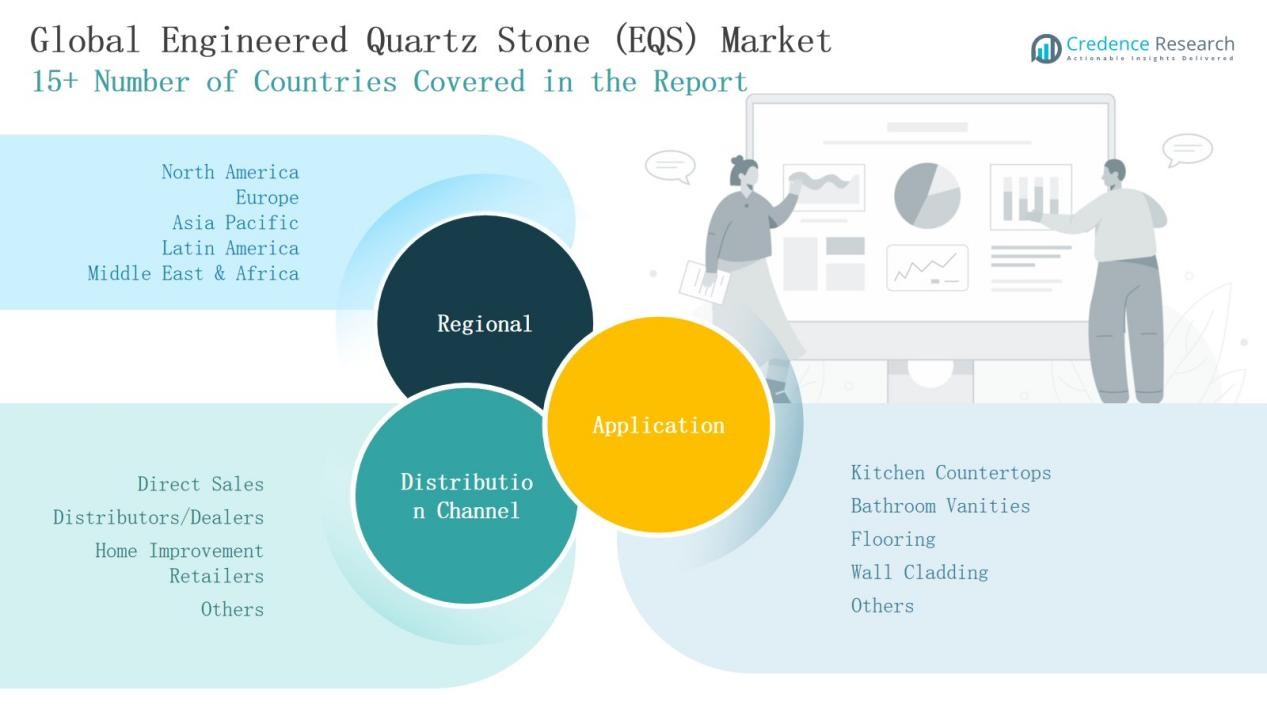
Market Segmentations:
By Application
- Kitchen Countertops
- Bathroom Vanities
- Flooring
- Wall Cladding
- Others
By Distribution Channel
- Direct Sales
- Distributors/Dealers
- Home Improvement Retailers
- Others
By Region
North America
- S.
- Canada
- Mexico
Europe
- UK
- France
- Germany
- Italy
- Spain
- Russia
- Rest of Europe
Asia Pacific
- China
- Japan
- South Korea
- India
- Australia
- Southeast Asia
- Rest of Asia Pacific
Latin America
- Brazil
- Argentina
- Rest of Latin America
Middle East
- GCC Countries
- Israel
- Turkey
- Rest of Middle East
Africa
- South Africa
- Egypt
- Rest of Africa
Competitive Landscape
The Engineered Quartz Stone (EQS) market is moderately consolidated, with global leaders and regional specialists competing on product quality, design variety, and sustainability. Key players such as Cosentino S.A., Caesarstone Ltd., Cambria Company LLC, Hanwha Solutions (HanStone), Vicostone, RAK Ceramics, and Compac S.A. dominate through extensive product portfolios and strong brand recognition. These companies focus on innovation in patterns, colors, and eco-friendly formulations, including silica-free and recycled material-based surfaces, to meet rising sustainability standards. Strategic partnerships with architects, contractors, and distributors enhance market penetration, while investment in digital showrooms and e-commerce strengthens customer outreach. Regional players like Stone Italiana S.p.A. and Levantina Group cater to localized demand, offering tailored solutions at competitive pricing. The competitive environment is further shaped by mergers, acquisitions, and capacity expansions aimed at strengthening global presence. Continuous R&D, premium branding, and compliance with environmental regulations remain critical differentiators for sustaining leadership in this evolving market.
Key Players
- Cosentino S.A.
- Caesarstone Ltd.
- Compac S.A.
- Cambria Company LLC
- Hanwha Solutions (HanStone)
- Vicostone
- RAK Ceramics
- Q Holdings PLC (Quartzforms)
- Levantina Group
- Stone Italiana S.p.A.
Recent Developments
- In May 2025, LOTTE Chemical partnered with EKO Stone to distribute Radianz Quartz in the U.S. Midwest.
- In July 2024, UMI Stone signed an exclusive distribution deal with Vicostone for the U.S. East Coast.
- In March 2025, Specta unveiled its Pastel Poise quartz collection featuring soft pastel shades.
- In August 2025, Wilsonart introduced new Quartz & Solid Surface designs with bold colorways.
Report Coverage
The research report offers an in-depth analysis based on Application, Distribution Channel and Region. It details leading market players, providing an overview of their business, product offerings, investments, revenue streams, and key applications. Additionally, the report includes insights into the competitive environment, SWOT analysis, current market trends, as well as the primary drivers and constraints. Furthermore, it discusses various factors that have driven market expansion in recent years. The report also explores market dynamics, regulatory scenarios, and technological advancements that are shaping the industry. It assesses the impact of external factors and global economic changes on market growth. Lastly, it provides strategic recommendations for new entrants and established companies to navigate the complexities of the market.
Future Outlook
- Demand for engineered quartz stone will increase with rising home renovation projects worldwide.
- Kitchen countertops will remain the largest application due to durability and premium appeal.
- Bathroom vanities and flooring will witness steady growth driven by luxury housing demand.
- Asia Pacific will continue as the fastest-growing region with large-scale urbanization and housing projects.
- North America and Europe will sustain dominance through remodeling activity and eco-friendly adoption.
- Manufacturers will focus on eco-friendly, recycled, and silica-free engineered quartz surfaces.
- Digital showrooms and online retail platforms will expand distribution and customer accessibility.
- Strategic partnerships with architects and contractors will strengthen brand positioning.
- Product innovation in textures, finishes, and customization will shape competitive advantage.
- Compliance with environmental and workplace safety regulations will influence production strategies globally.

Request a Free Sample
Fill in your details and we'll send you a free sample report.
- Sample data tables & charts
- Research methodology
Market Dynamics
Premium Kitchen Countertop Demand
Engineered quartz stone is increasingly preferred for kitchen countertops due to its durability, stain resistance, and low maintenance, making it a top choice in both residential and commercial construction. Rising disposable incomes and urbanization, especially in North America and Asia Pacific, further accelerate this trend.
Expansion of Residential and Commercial Construction
Global growth in residential and commercial building projects is fueling demand for engineered quartz stone, as architects and builders specify it for its design flexibility and long-term performance. Urban infrastructure investments and government-backed housing schemes in emerging markets are expanding the customer base.
Sustainability and Eco-Friendly Materials
The market is benefiting from a shift toward sustainable building practices, with engineered quartz stone often manufactured using recycled materials and low-emission processes. Increasing regulatory requirements and consumer awareness are driving adoption of eco-friendly and silica-free quartz surfaces.
Digital Retail and Smart Distribution Channels
The rise of online platforms and digital showrooms is transforming how engineered quartz stone is marketed and sold, making it easier for consumers and contractors to access a wide variety of products. This digital transformation is expanding market reach and supporting growth, especially among younger, urban buyers.
Product Innovation and Customization
Manufacturers are investing in new designs, textures, and finishes, including natural stone-like appearances and customizable options, to meet evolving consumer preferences. This focus on innovation and tailored solutions is helping brands differentiate and capture premium market segments.
Need a Custom Version of This Report?
Tailor the scope, geography, or segments to your exact requirements.
- Custom geography or segment scope
- Direct access to our analyst team
Frequently Asked Questions
What is the current market size for Engineered Quartz Stone (EQS) Market, and what is its projected size in 2032?
At what Compound Annual Growth Rate is the Engineered Quartz Stone (EQS) Market projected to grow between 2025 and 2032?
Which Engineered Quartz Stone (EQS) Market segment held the largest share in 2024?
What are the primary factors fueling the growth of the Engineered Quartz Stone (EQS) Market?
Who are the leading companies in the Engineered Quartz Stone (EQS) Market?
Which region commanded the largest share of the Engineered Quartz Stone (EQS) Market in 2024?
Table of Content
Chapter 1 Market Segmentation
- 1.1 Segmentation Framework
- 1.1.1 Product and Service Classification
- 1.1.2 Application and End-Use Classification
- 1.1.3 Technology and Solution Classification
- 1.1.4 Customer and Distribution Channel Classification
- 1.1.5 Geographic Segmentation
- 1.1.6 Market Segment Definitions and Boundaries
- 1.2 By Application
- 1.2.1 Kitchen Countertops
- 1.2.2 Bathroom Vanities
- 1.2.3 Flooring
- 1.2.4 Wall Cladding
- 1.2.5 Others
Chapter 2 Introduction
- 2.1 Report Objectives and Scope
- 2.2 Product Definition and Industry Terminology
- 2.3 Market Inclusions and Exclusions
- 2.4 Research Process
- 2.4.1 Primary Research and Expert Interviews
- 2.4.2 Secondary Research and Source Review
- 2.4.3 Top-Down and Bottom-Up Estimation
- 2.4.4 Data Triangulation and Verification
- 2.5 Market Size Measurement Basis
- 2.5.1 2024: USD 11,115.97 million → 2032: USD 20,568.86 million
- 2.6 Historical and Forecast Reference Periods
- 2.6.1 Base Year: 2024
- 2.6.2 Forecast Period: 2024-2032
- 2.7 Research Assumptions and Limitations
Chapter 3 Executive Summary
- 3.1 Market Snapshot and Key Findings
- 3.2 Base-Year Market Size, 2024
- 3.3 Forecast Market Size, 2032
- 3.4 Revenue and Volume Growth Outlook
- 3.5 Key Demand and Supply Indicators
- 3.6 Leading Market Segments
- 3.7 Fastest-Growing Market Opportunities
- 3.8 Regional Performance Highlights
- 3.9 Technology and Industry Transformation
- 3.10 Competitive Landscape Summary
- 3.11 Analyst View and Strategic Implications
Chapter 4 Global Engineered Quartz Stone (EQS) Market Trends and Developments
- 4.1 Historical Industry Development
- 4.2 Recent Market Trends and Developments
- 4.3 Demand and Customer Behavior Trends
- 4.4 Technology and Product Innovation
- 4.5 Artificial Intelligence, Automation and Digitalization
- 4.6 Local Manufacturing and Supply Chain Realignment
- 4.7 Industry Partnerships, Mergers and Acquisitions
- 4.8 Sustainability and Circular Economy Developments
- 4.9 Government and Private Sector Investment Trends
- 4.10 Emerging Business Models and Commercialization
- 4.11 Industry Developments and Announcements
Chapter 5 Global Engineered Quartz Stone (EQS) Market Production, Supply and Demand Analysis
- 5.1 Demand Trend and Consumption Analysis
- 5.2 Demand Forecast, 2024-2032
- 5.3 Production and Output Trend
- 5.4 Production and Output Forecast, 2024-2032
- 5.5 Installed Capacity and Capacity Utilization
- 5.6 Company-Wise Production Plants and Statistics
- 5.6.1 Installed Production Capacity
- 5.6.2 Actual Production
- 5.6.3 Planned Capacity and Expansion Targets
- 5.7 Supply Chain Structure and Procurement Trends
- 5.8 Supply-Demand Gap and Bottlenecks
- 5.9 Import Dependence and Sourcing Structure
- 5.10 Contract Manufacturing and Outsourcing
- 5.11 Regional Supply and Demand Concentration
Chapter 6 Global Engineered Quartz Stone (EQS) Market Pricing Analysis
- 6.1 Pricing Structure and Measurement
- 6.2 Historical Pricing Trends
- 6.3 Pricing Outlook, 2024-2032
- 6.4 Average Selling Price and Unit Economics
- 6.5 Pricing by Product and Market Segment
- 6.6 Geographic Pricing Differences
- 6.7 Key Input, Energy, Labor and Logistics Costs
- 6.8 Contract Pricing and Purchasing Models
- 6.9 Pricing Sensitivity and Competitive Positioning
- 6.10 Price, Margin and Profitability Implications
Chapter 7 Global Engineered Quartz Stone (EQS) Market Dynamics
- 7.1 Market Growth Drivers
- 7.1.1 Demand-Side Drivers
- 7.1.2 Technology and Innovation Drivers
- 7.1.3 Infrastructure and Investment Drivers
- 7.1.4 Regulatory and Policy Drivers
- 7.2 Market Restraints
- 7.2.1 Cost and Affordability Constraints
- 7.2.2 Technology and Adoption Barriers
- 7.2.3 Supply Chain and Operational Constraints
- 7.3 Market Challenges
- 7.3.1 Competitive Pressure and Margin Erosion
- 7.3.2 Skills, Infrastructure and Implementation Gaps
- 7.4 Emerging Market Opportunities
- 7.5 Market Dynamics Impact and Time-Horizon Assessment
Chapter 8 Global Engineered Quartz Stone (EQS) Value Chain Analysis
- 8.1 Industry Value Chain Overview
- 8.2 Upstream Suppliers and Critical Inputs
- 8.3 Technology and Component Providers
- 8.4 Manufacturing or Service Delivery
- 8.5 Distribution, Channel Partners and Integrators
- 8.6 Downstream Applications and End Users
- 8.7 Value Addition and Profit Pools
- 8.8 Vertical Integration and Outsourcing
- 8.9 Supplier Concentration and Risk
- 8.10 Supply Chain Localization and Resilience
Chapter 9 Global Engineered Quartz Stone (EQS) Market Regulations and Policies
- 9.1 Relevant Laws, Standards and Compliance Frameworks
- 9.2 Product, Service, Safety and Quality Requirements
- 9.3 Government Policies, Incentives and Subsidies
- 9.4 Imports, Exports and Trade Barriers
- 9.5 Public Procurement and Local Content Requirements
- 9.6 Environmental and Sustainability Compliance
- 9.7 Upcoming Policy Changes and Market Implications
Chapter 10 Global Engineered Quartz Stone (EQS) Market Hotspots and Opportunities
- 10.1 Market Opportunity Mapping and Growth Hotspots
- 10.2 High-Growth Applications and Customer Groups
- 10.3 Underserved Markets and White-Space Opportunities
- 10.4 Emerging Technology and Product Opportunities
- 10.5 New Capacity and Investment Hotspots
- 10.6 Market Entry and Expansion Opportunities
- 10.7 Distribution and Partnership Opportunities
- 10.8 Near-Term and Long-Term Commercial Potential
- 10.9 Opportunity Attractiveness and Execution Risks
Chapter 11 Global Engineered Quartz Stone (EQS) Market Outlook, 2024-2032
- 11.1 Market Size and Analysis
- 11.1.1 Revenue (Market Measurement: 2024: USD 11,115.97 million → 2032: USD 20,568.86 million)
- 11.1.2 Market Volume and Quantity Sold
- 11.1.3 Historical Market Size
- 11.1.4 Base-Year Market Size, 2024
- 11.2 Market Forecast, 2024-2032
- 11.2.1 Revenue Forecast to 2032
- 11.2.2 Volume Forecast to 2032
- 11.2.3 CAGR and Year-on-Year Growth
- 11.2.4 Incremental Revenue Opportunity
- 11.3 Forecast Assumptions and Scenario Analysis
- 11.3.1 Base-Case Forecast
- 11.3.2 Optimistic and Conservative Scenarios
- 11.3.3 Technology, Pricing and Policy Sensitivities
- 11.4 Market Attractiveness and Growth Outlook
Chapter 12 Global Engineered Quartz Stone (EQS) Market Segmentation and Outlook
- 12.1 Segmentation Summary and Market Shares, 2024
- 12.2 Largest and Fastest-Growing Segments
- 12.3 By Application - Market Size and Forecast, 2024-2032
- 12.3.1 Segment Definition and Scope
- 12.3.2 Historical Market Size
- 12.3.3 Revenue Forecast, 2024-2032
- 12.3.4 Volume Forecast, 2024-2032
- 12.3.5 Base-Year Market Share, 2024
- 12.3.6 Segment CAGR and Growth Drivers
- 12.3.7 Subsegment Market Size and Forecast
- 12.3.7.1 Kitchen Countertops
- 12.3.7.2 Bathroom Vanities
- 12.3.7.3 Flooring
- 12.3.7.4 Wall Cladding
- 12.3.7.5 Others
- 12.3.8 Subsegment Pricing and Adoption Trends
- 12.3.9 Leading Suppliers and Competition
- 12.3.10 Regional Demand and Opportunities
- 12.4 Segment Growth Comparison
- 12.5 Segment Attractiveness and Priority Matrix
Chapter 13 Global Engineered Quartz Stone (EQS) End-Use and Application Market Outlook
- 13.1 End-Use Industry and Customer Demand Structure
- 13.2 Leading Applications and Customer Groups
- 13.3 End-Use Market Size, Share and Forecast
- 13.4 Major End-Use Industry Deep Dives
- 13.4.1 Customer Requirements and Use Cases
- 13.4.2 Demand and Replacement Cycles
- 13.4.3 Technical and Regulatory Considerations
- 13.4.4 Purchasing and Procurement Models
- 13.4.5 Leading Vendors and Distribution Channels
- 13.4.6 Forecast and Commercial Opportunities
- 13.5 Emerging Applications and Cross-Segment Demand
- 13.6 End-Use Industry Investment Priorities
Chapter 14 Global Engineered Quartz Stone (EQS) Geographic Market Outlook, 2024-2032
- 14.1 Regional Market Size and Share, 2024
- 14.2 Regional Market Forecast, 2024-2032
- 14.3 Regional Pricing, Production and Demand Differences
- 14.4 North America
- 14.4.1 United States
- 14.4.2 Canada
- 14.4.3 Mexico
- 14.5 Europe
- 14.5.1 Germany
- 14.5.2 France
- 14.5.3 Italy
- 14.5.4 United Kingdom
- 14.5.5 Spain
- 14.5.6 Poland
- 14.5.7 Russia
- 14.5.8 Netherlands
- 14.5.9 Belgium
- 14.5.10 Sweden
- 14.5.11 Denmark
- 14.5.12 Norway
- 14.5.13 Rest of Europe
- 14.6 Asia Pacific
- 14.6.1 China
- 14.6.2 India
- 14.6.3 Japan
- 14.6.4 South Korea
- 14.6.5 Thailand
- 14.6.6 Indonesia
- 14.6.7 Vietnam
- 14.6.8 Malaysia
- 14.6.9 Australia
- 14.6.10 Rest of Asia Pacific
- 14.7 Latin America
- 14.7.1 Brazil
- 14.7.2 Argentina
- 14.7.3 Colombia
- 14.7.4 Chile
- 14.7.5 Rest of Latin America
- 14.8 Middle East
- 14.8.1 Saudi Arabia
- 14.8.2 United Arab Emirates
- 14.8.3 Turkey
- 14.8.4 Israel
- 14.8.5 Iran
- 14.8.6 Rest of the Middle East
- 14.9 Africa
- 14.9.1 South Africa
- 14.9.2 Egypt
- 14.9.3 Nigeria
- 14.9.4 Morocco
- 14.9.5 Rest of Africa
- 14.10 Regional Investment, Policy and Supply Chain Differences
- 14.11 Regional Competitive Landscape
- 14.12 Geographic Growth Hotspots
Chapter 15 Global Engineered Quartz Stone (EQS) Technology, Innovation and Sustainability Outlook
- 15.1 Technology Landscape and Maturity
- 15.2 Product, Process and Service Innovation
- 15.3 AI, Automation and Digital Tools in the Industry
- 15.4 Technology Adoption and Performance Benchmarking
- 15.5 Innovation Pipeline and R&D Investment
- 15.6 Patent and Intellectual Property Trends
- 15.7 Energy Efficiency and Resource Management
- 15.8 Sustainability, Recycling and Circularity
- 15.9 Technology Roadmap, 2024-2032
- 15.10 Risks of Obsolescence and Technology Substitution
Chapter 16 Global Engineered Quartz Stone (EQS) Market Key Strategic Imperatives
- 16.1 Growth and Market Entry Priorities
- 16.2 High-Return Products and Segments
- 16.3 Pricing, Profitability and Cost Optimization
- 16.4 Technology Investment and Product Differentiation
- 16.5 Supply Chain Localization and Resilience
- 16.6 Distribution and Customer Acquisition
- 16.7 Partnership, Acquisition and Capacity Strategy
- 16.8 Regional Expansion Priorities
- 16.9 Short-, Medium- and Long-Term Actions
Chapter 17 Competition Outlook
- 17.1 Industry Competition Characteristics
- 17.2 Market Structure and Concentration
- 17.3 Market Share and Competitive Positioning, 2024
- 17.4 Company-Wise Revenue and Product Benchmarking
- 17.5 Production and Service Capacity Benchmarking
- 17.6 Technology, Pricing and Differentiation
- 17.7 Regional Footprint and Distribution Strength
- 17.8 Mergers, Acquisitions and Strategic Alliances
- 17.9 New Entrants and Competitive Threats
- 17.10 Porter's Five Forces and Industry Attractiveness
- 17.11 Competitive Outlook, 2024-2032
Chapter 18 Company Profiles
- 18.1 Company Coverage and Selection Criteria
- 18.2 Cosentino S.A.
- 18.2.1 Business Description
- 18.2.2 Company Ownership and Geographic Presence
- 18.2.3 Product and Service Portfolio
- 18.2.4 Manufacturing and Operating Footprint
- 18.2.5 Production Capacity and Expansion Plans
- 18.2.6 Financial Performance and Investment
- 18.2.7 Market Share and Competitive Position
- 18.2.8 Technology and Innovation Capabilities
- 18.2.9 Strategic Alliances or Partnerships
- 18.2.10 Recent Developments
- 18.2.11 Growth Strategy and Outlook
- 18.3 Caesarstone Ltd.
- 18.4 Cambria Company LLC
- 18.5 Hanwha Solutions (HanStone)
- 18.6 Vicostone
- 18.7 RAK Ceramics
- 18.8 Compac S.A.
- 18.9 Levantina Group
- 18.10 Stone Italiana S.p.A.
- 18.11 Q Holdings PLC (Quartzforms)
- 18.12 Other Relevant Market Participants
Note: Every listed company is profiled on the structure shown under the first company. The company list is preliminary and may change based on research findings, market developments, data availability and client requirements.
Chapter 19 Disclaimer
- 19.1 Research and Forecast Disclaimer
- 19.2 Data Source and Estimation Limitations
Note: The depth of individual sections depends on data availability for this market. Volume, capacity, trade and other unit-based metrics are included where applicable.

