Clinic courses and home IPL devices shape hair reduction
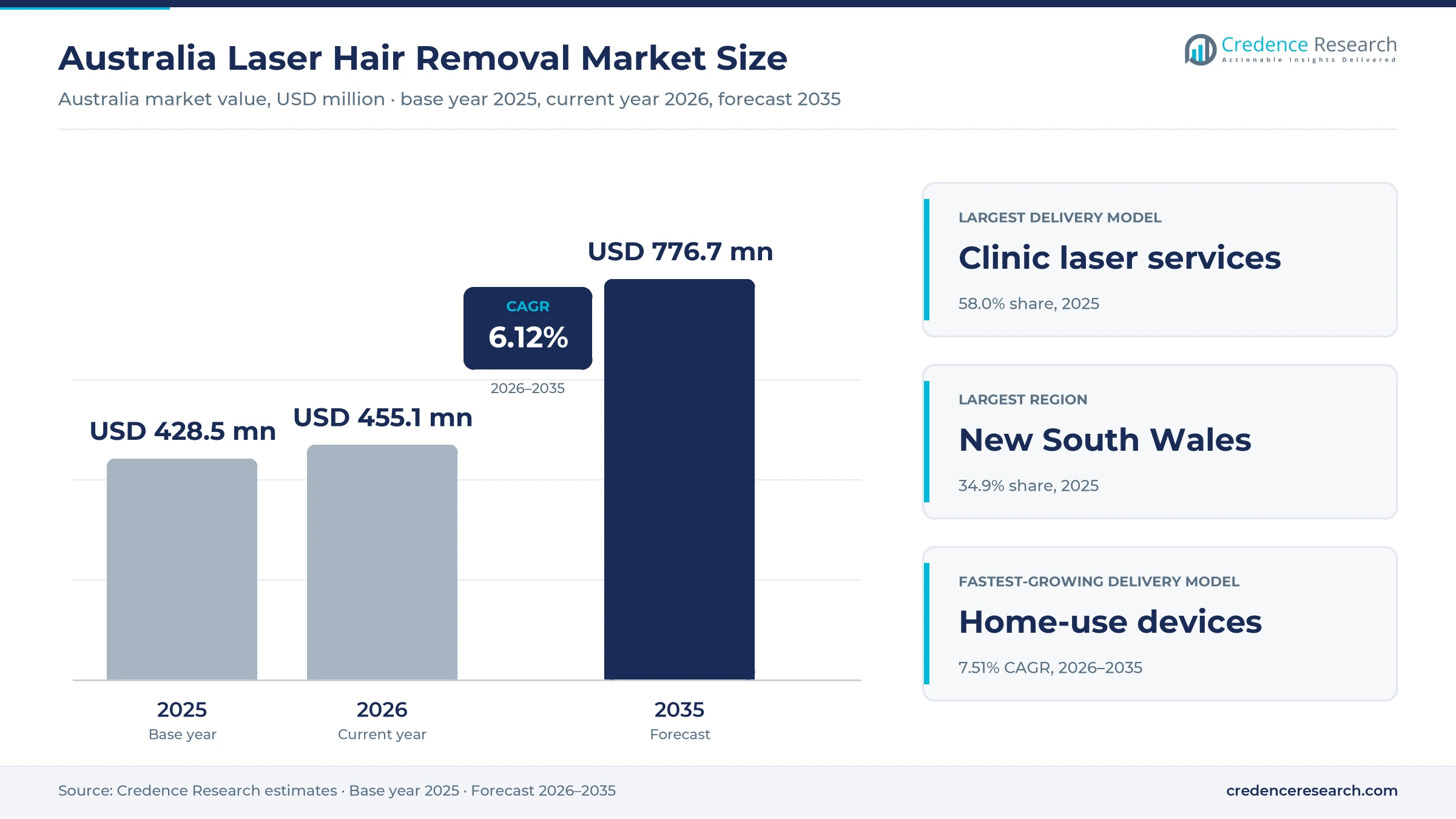
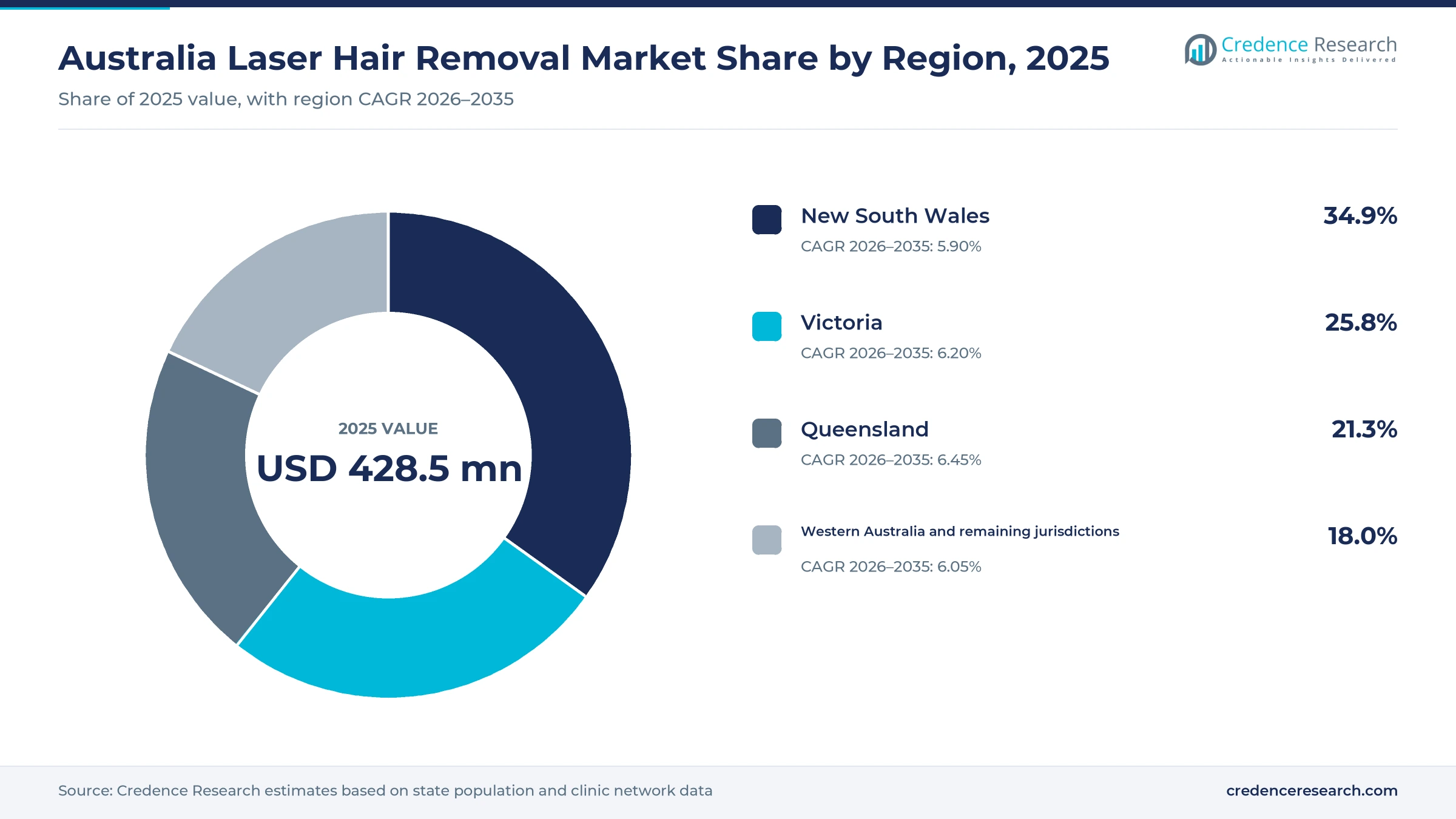
The Australia laser hair removal market was valued at USD 428.5 million in 2025 and is projected to increase from USD 455.1 million in 2026 to USD 776.7 million by 2035, registering a CAGR of 6.12% during 2026–2035. Demand comes from clients who buy multi-session treatment courses at clinic chains, from dermatology practices that treat darker skin types with Nd:YAG systems, and from households that buy intense pulsed light devices for home use. New South Wales held the largest regional share, 34.9% in 2025, because it has the largest population and dense clinic networks across Sydney. Queensland is the fastest-growing region at 6.45% a year, as population growth and a licensed clinic base widen access. In turn, the operating landscape is changing, because large chains are changing hands and home devices registered as medical devices are now sold through mainstream electronics retailers.
What spending is counted in the national estimate?
The estimate measures spending on hair reduction with lasers and intense pulsed light in Australia. It counts single-session and treatment-package fees paid at specialist laser clinics, dermatology clinics, beauty salons and spas, and the retail value of home-use devices bought through clinics, brand websites, retail stores and online marketplaces.
The estimate excludes waxing, threading, electrolysis, depilatory creams and laser treatments for skin resurfacing, pigment or tattoo removal. The value chain runs from device makers and their local sponsors through clinic chains, franchisees and independent operators to the clients who buy treatment courses or devices for home use.
Australia Laser Hair Removal Market Insights
- The Australia laser hair removal market was valued at USD 428.5 million in 2025 and is projected to reach USD 776.7 million by 2035, registering a CAGR of 6.12% during 2026–2035.
- New South Wales held a 34.9% share of 2025 value, because the state has the largest population and dense clinic networks across Sydney.
- Clinic laser services led delivery models with a 58.0% share of 2025 value, because clinics sell full treatment courses as prepaid packages.
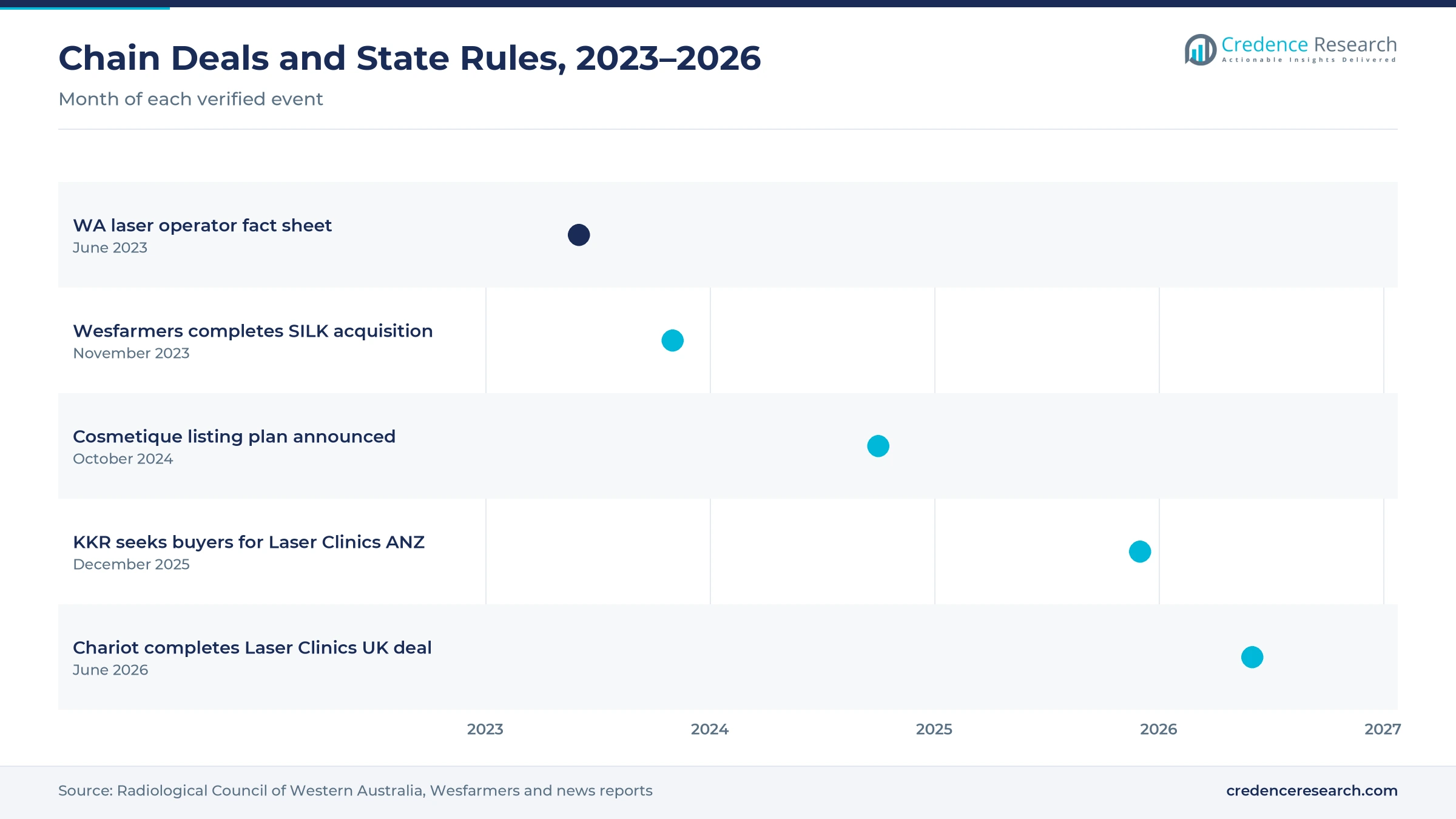
- A Wesfarmers subsidiary acquired 100 percent of SILK Laser Australia on Nov. 29, 2023, adding a national laser clinic chain to its health division.
- Home-use devices grow fastest at 7.51% a year during 2026–2035, as registered intense pulsed light devices reach mainstream electronics retailers.
Clinic laser courses lead as home devices grow fastest
Why do clinic laser courses lead hair reduction spending?
Based on delivery model, the market is categorized into Clinic laser services, Clinic IPL services and Home-use devices. Clinic laser services led with a 58.0% share of 2025 value, because clinic chains sell courses of several sessions as prepaid packages. Home-use devices grow fastest at 7.51% a year, as registered home devices reach electronics retailers and online stores at a fraction of course prices.
Which light sources carry most treatment value?
Based on technology, the market is categorized into Diode laser, Alexandrite laser, Nd:YAG laser and Intense pulsed light. Diode laser systems led with a 40.0% share of 2025 value, because chains favor fast diode platforms for large body areas. Nd:YAG laser systems grow fastest at 6.98% a year, as clinics add Nd:YAG systems that suit a wider range of skin types.
Where do clients receive light-based hair reduction?
Based on care setting, the market is categorized into Specialist laser clinics, Dermatology clinics, Beauty salons and spas, and Household use. Specialist laser clinics led with a 52.0% share of 2025 value, because national chains run large networks in shopping centers. Household use grows fastest at 7.46% a year, as buyers add home devices for touch-up sessions between or after clinic courses.
Which body areas generate the most treatment value?
Based on application, the market is categorized into Face and neck, Underarms and arms, Bikini and legs, and Torso and full body. Bikini and legs led with a 38.0% share of 2025 value, because these large areas need longer sessions and full courses. Torso and full body grows fastest at 6.82% a year, as chains promote full-body packages that bundle several large treatment areas into one course.
| Segment Group | Leading Sub-segment | Share, 2025 | Fastest-growing Sub-segment | CAGR, 2026–2035 |
|---|---|---|---|---|
| By Delivery Model | Clinic laser services | 58.0% | Home-use devices | 7.51% |
| By Technology | Diode laser | 40.0% | Nd:YAG laser | 6.98% |
| By Care Setting | Specialist laser clinics | 52.0% | Household use | 7.46% |
| By Application | Bikini and legs | 38.0% | Torso and full body | 6.82% |
Request a Free Sample
Fill in your details and we'll send you a free sample report.
- Sample data tables & charts
- Research methodology
Repeat courses, chain scale and home IPL lift demand
How do repeat treatment courses sustain clinic demand?
Light-based hair reduction is sold as a course rather than a single visit, which turns each new client into several bookings over a year. In a guide published Oct. 9, 2019, the consumer group CHOICE notes that most people need three to six treatments, because only hairs in the growing phase respond to each session. Home devices follow the same pattern, since the Philips Lumea Advanced sold by JB Hi-Fi needs its first four treatments every two weeks and touch-ups every four weeks. Results Laser Clinic states that it has performed more than 20 million laser hair removal treatments across Australia. As a result, Clinic laser services led delivery models with 58.0% of 2025 value, because clinics sell prepaid packages that cover a full course.
How does clinic network consolidation lift operating scale?
Large chains now hold much of the national service capacity, which gives them buying power for devices, shared training and national marketing. Australian Pharmaceutical Industries, a Wesfarmers subsidiary, acquired 100 percent of SILK Laser Australia on Nov. 29, 2023, and placed it alongside the Clearskincare chain in its health division. AAP reported in 2023 that the Adelaide-based SILK operated 142 clinics offering laser hair removal, injectables and skin treatments. Laser Clinics Australia grew from more than 80 clinics in 2017 to more than 115 clinics nationally by March 2019, according to Business Franchise Australia. Because chains run most treatment sites, Specialist laser clinics lead care settings with 52.0% of 2025 value.
Why is household access to light-based devices widening?
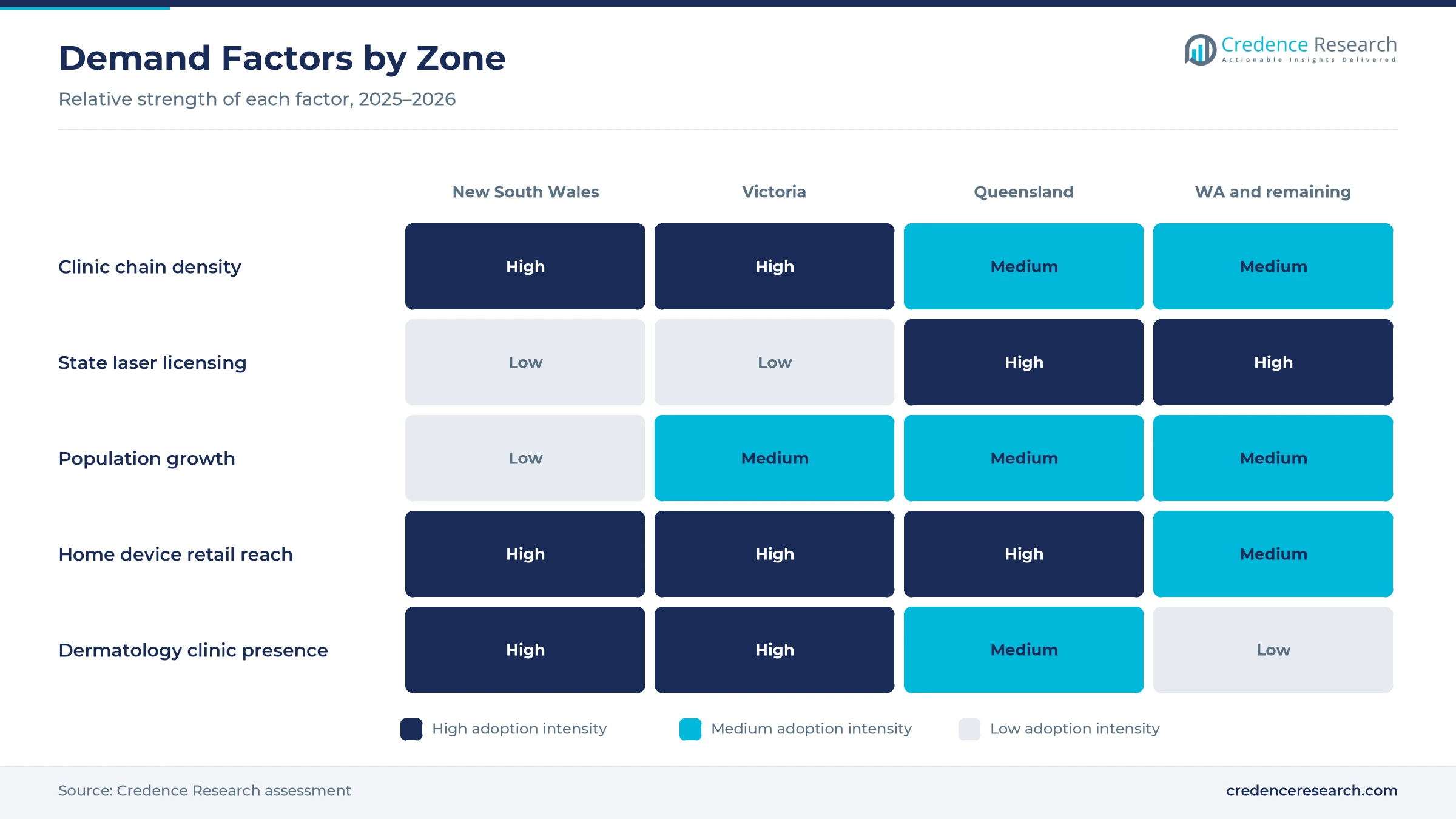
Home intense pulsed light devices have moved into mainstream retail, which lets buyers treat hair between or instead of clinic visits. The Australian Register of Therapeutic Goods lists a home-use intense pulsed light hair removal unit made by Shenzhen Ulike Smart Electronics as a Class IIa medical device. JB Hi-Fi sells the Philips Lumea Advanced, which carries 250,000 flashes, described as equivalent to 20 years of lamp lifetime. Australia's GDP per capita reached about USD 65,130 in 2025, according to the World Bank, which supports spending on discretionary personal care devices. As a result, Home-use devices grow fastest among delivery models at 7.51% a year during 2026–2035.
How do state laser licenses steer work to trained clinics?
State licensing raises the bar for operators in three jurisdictions, which channels laser work toward clinics with trained staff and medical oversight. In Queensland, a person who provides cosmetic laser services needs a use license, and Queensland Health estimates 25 training hours for hair removal. A possession license must be obtained before buying a laser, and apparatus and rooms must be certified under the Radiation Safety Act 1999. Western Australia requires a laser safety course and at least 25 practical hours under supervision for hair removal operators, according to a June 2023 Radiological Council fact sheet. Because these rules favor trained clinic operators, specialist chains running Diode laser systems held 40.0% of 2025 value.
Combined menus, new wavelengths and ownership shifts
Why are clinics adding skin and injectable menus?
Laser chains are widening their menus beyond hair reduction, which raises the value of each client relationship and spreads clinic overheads. SILK offered laser hair removal, injectables and skin treatments across 142 clinics when Wesfarmers agreed to buy the group in 2023, according to AAP. Results Laser Clinic offers laser hair removal, skin treatments and injectables at more than 70 clinics nationwide. Cosmetique specialized in injectables and laser hair removal across 17 clinics in five states, Inside Retail reported on Oct. 3, 2024. Because hair reduction brings repeat visits, chains use it to introduce clients to cosmetic injectables and skin programs, which keeps clients inside one brand.
Why are Nd:YAG and alexandrite systems on the rise?
Clinics are adding wavelengths suited to darker skin, because intense pulsed light works best on dark hair and light skin. CHOICE notes that Nd:YAG lasers can be safely used on a larger variety of skin types, while darker skin needs careful treatment with other sources. The national register lists a dermatological alexandrite laser system from Cynosure under ARTG ID 216878 and a hair-removal diode laser system from Beijing Sano Laser under ARTG ID 524121, both as Class IIb devices. Philips states that its Lumea home IPL is not suitable for very dark skin, and its sensor stops emitting pulses on skin that is too dark. As a result, Nd:YAG laser systems grow fastest among technologies at 6.98% a year.
Is a laser clinics sale an opening for new capital?
Pending ownership changes at large chains create an opening for investors and device suppliers that can fund clinic refits and new sites. Franchise Executives reported on Dec. 1, 2025, citing the Australian Financial Review, that KKR is seeking buyers for its Australian and New Zealand Laser Clinics business of more than 100 clinics. The chain runs as a 50/50 joint venture between franchisor and franchisee, which ties local operators to national growth plans. KKR acquired its majority stake in 2017, when the network had more than 80 clinics and about 135 doctors and nurses. A new owner could therefore reset spending on energy-based aesthetic devices and clinic expansion across both countries.
Can training and compliance services fill regulatory gaps?
Uneven state rules leave room for training providers and clinics that can show consistent national standards. The Australian Radiation Protection and Nuclear Safety Agency states that cosmetic lasers are regulated only in Queensland, Tasmania and Western Australia, and intense pulsed light only in Tasmania. Its 2015 consultation found too little information to support a national framework, so the Radiation Health Committee chose to develop national advice on consumer education and provider competency instead. Western Australia lets holders of a Queensland or Tasmanian cosmetic laser license obtain an equivalent license. A Queensland use license can run for 1, 2 or three years, and renewal forms are sent 40 days before expiry. In turn, chains that train staff to the 25-hour Queensland benchmark can market safety nationally.
Injury risk, uneven rules and skin limits test clinics
How do burn and diagnosis risks weigh on clinics?
Incorrect light-based treatments can cause injuries that range from minor burns to severe injuries with permanent scarring, according to the national radiation safety agency. The agency also warns that treating symptoms of malignant skin conditions can mask them and delay diagnosis. As a result, clinics face complaint, insurance and reputation risks after each poor outcome. Larger chains respond with medical supervision, skin checks before courses and test patches, while smaller operators often lack that clinical support.
Why does uneven regulation complicate national standards?
Most states and territories have no licensing for cosmetic lasers or intense pulsed light, so training and equipment standards differ widely between operators. The radiation safety agency notes that devices sold for cosmetic use are often not approved by the national therapeutic goods regulator. In turn, clients cannot easily compare providers, and low-cost operators can undercut trained clinics on price. Industry groups respond by advising clients to choose experienced operators working under medical supervision.
How do skin tone and hair color limit results?
Light-based methods work best on dark hair and light skin, which leaves some clients with weaker or riskier results. Philips states that its home device does not suit white or gray, light blond or red hair. A Sydney dermatologist quoted by CHOICE says up to 20% of hair may keep growing, which is why the term permanent hair reduction is preferred. As a result, clinics must manage expectations carefully and offer Nd:YAG systems for darker skin.
Why do home devices pressure clinic pricing?
Home devices give buyers a lower-cost route to hair reduction, which pressures clinic package prices in mature body areas. CHOICE notes that home units are smaller and less powerful than professional equipment, and that lamp life ranges from 50,000 to 250,000 flashes before replacement. In turn, clinics stress faster results and supervised care, while device brands stress convenience. Chains respond with membership plans and touch-up pricing that keep clients booking after a course ends.
New South Wales leads while Queensland grows fastest
| Region | Value, 2025 (USD million) | Share, 2025 | CAGR, 2026–2035 |
|---|---|---|---|
| New South Wales | 149.5 | 34.9% | 5.90% |
| Victoria | 110.6 | 25.8% | 6.20% |
| Queensland | 91.3 | 21.3% | 6.45% |
| Western Australia and remaining jurisdictions | 77.1 | 18.0% | 6.05% |
What keeps New South Wales ahead in clinic treatments?
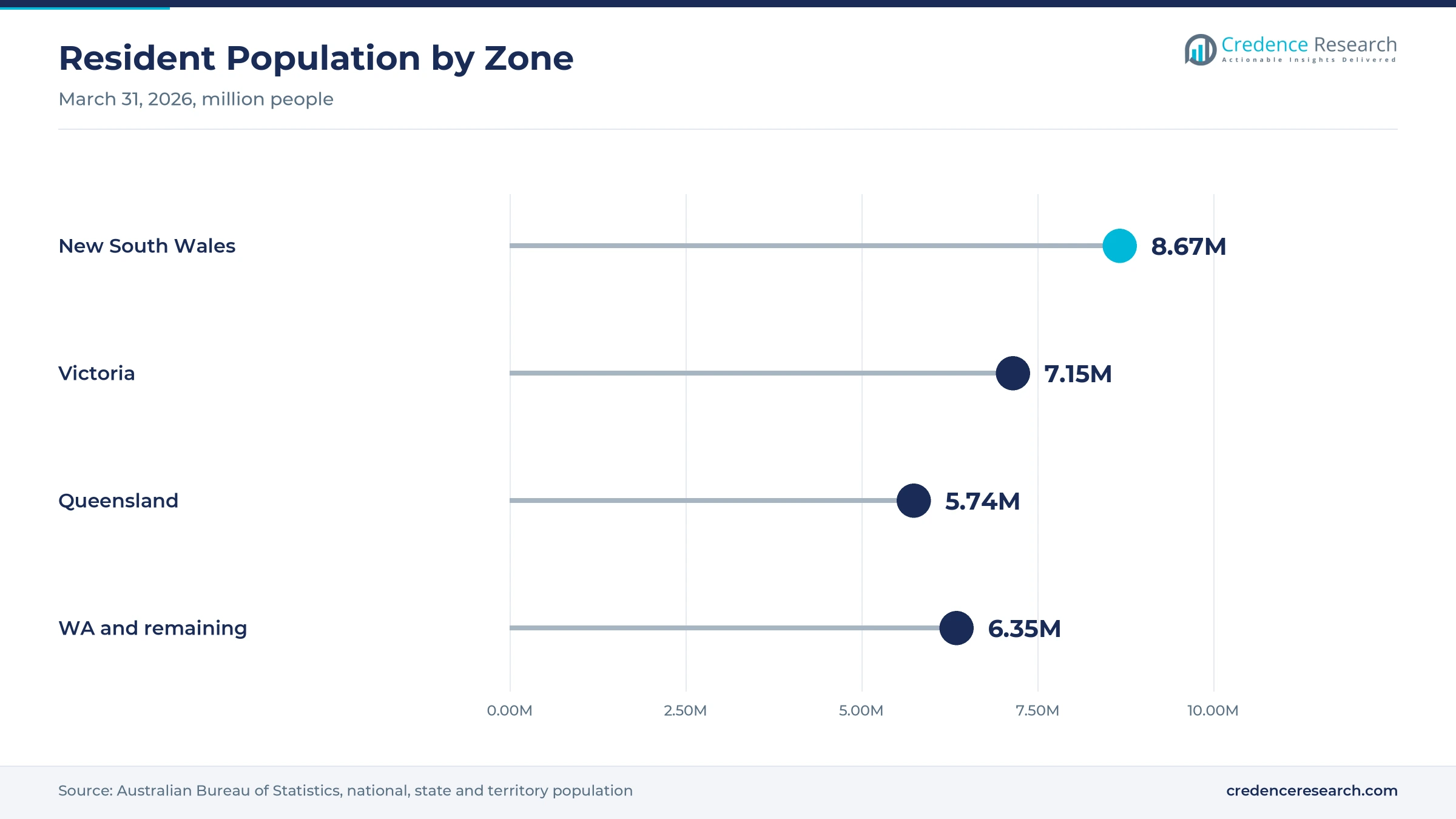
New South Wales held 34.9% of 2025 value and grows at 5.90% a year, because it has the largest population and dense clinic networks across Sydney. The state had 8,670,100 residents on March 31, 2026, according to the Australian Bureau of Statistics. Evolution Laser Clinic offers laser hair removal, skin treatments and injections across Sydney and the wider state. Because New South Wales does not license cosmetic lasers, clinic chains and salons compete on brand, training and price.
How does Victoria support chain-led growth?
Victoria held a 25.8% share of 2025 value and grows at 6.20% a year, as Melbourne's large shopping center base supports chain clinics. The state had 7,154,200 residents on March 31, 2026, after growth of 1.6% over the year. Stormeur announced plans in October 2024 to open two new Cosmetique clinics in Melbourne within 24 months of listing, Smallcaps reported. In turn, Victoria remains the second-largest zone, with demand led by package buyers at national chains.
Why is Queensland growing fastest in hair reduction?
Queensland held a 21.3% share of 2025 value and grows fastest at 6.45% a year, because population growth and a licensed clinic base widen access. The state had 5,739,500 residents on March 31, 2026, after growth of 1.6% over the year. Every operator who provides cosmetic laser services in Queensland needs a use license, which supports client confidence in clinic treatments. As a result, specialist chains and dermatology clinics gain a larger part of state demand.
What shapes demand across the remaining jurisdictions?
Western Australia and the remaining jurisdictions held 18.0% of 2025 value and grow at 6.05% a year. Western Australia had 3,096,200 residents on March 31, 2026, after growth of 2.1%, the fastest rate nationally, while Tasmania grew only 0.6%. Laser Clinics Australia opened its Joondalup clinic in October 2018, one of six in Western Australia at the time, and SILK is based in Adelaide. In turn, licensing in Western Australia and Tasmania favors trained clinic operators.
Chain deals, listings and population shifts, 2023–2026
| Development | Status and market relevance |
|---|---|
| In November 2023, Australian Pharmaceutical Industries, a Wesfarmers subsidiary, completed its acquisition of SILK Laser Australia, which was delisted from the ASX. | Placed a national laser clinic chain inside a pharmacy and health group |
| In October 2024, Stormeur announced a planned ASX listing to fund new Cosmetique clinics in Sydney and Melbourne, with 17 clinics across five states. | Signals continued clinic network expansion by mid-sized chains |
| In December 2025, Franchise Executives reported that KKR is seeking buyers for its Australian and New Zealand Laser Clinics business of more than 100 clinics. | Could change ownership of the largest national chain |
| In June 2026, Chariot Capital Group completed its acquisition of Laser Clinics U.K., carving the U.K. clinics out of the KKR-owned Laser Clinics Group. | Leaves the Australian and New Zealand network as the group core |
| In September 2026, the Australian Bureau of Statistics reported that Western Australia grew 2.1% in the year to March 2026, the fastest rate nationally. | Confirms faster client base growth outside the east coast |
Diode, alexandrite, Nd:YAG and IPL systems compete
- Diode lasers treat large body areas in clinic sessions, and the national register lists hair-removal diode laser systems as Class IIb medical devices supplied by local sponsors.
- Alexandrite lasers suit lighter skin with dark hair, and a dermatological alexandrite laser system from Cynosure appears on the national register as a Class IIb device.
- Nd:YAG lasers are described by CHOICE as safe for a larger variety of skin types, which makes them a common choice for darker skin.
- Intense pulsed light systems use broad-spectrum flashes in clinics and at home, where registered Class IIa home units carry skin tone sensors and lamps rated for up to 250,000 flashes.
Need a Custom Version of This Report?
Tailor the scope, geography, or segments to your exact requirements.
- Custom geography or segment scope
- Direct access to our analyst team
National clinic chains compete on reach and menus
Competition is led by national clinic chains that combine shopping center sites, prepaid treatment packages and wider aesthetic menus. Laser Clinics Australia runs a joint venture model with franchisees and had more than 100 Australian and New Zealand clinics when KKR began seeking buyers in December 2025. SILK Group became part of Wesfarmers Health in November 2023, alongside the Clearskincare chain. Results Laser Clinic lists more than 70 clinics nationwide, while Evolution Laser Clinic focuses on Sydney and New South Wales. Cosmetique operated 17 clinics across five states in October 2024 and combines injectables with laser hair removal. Rivals compete on location, device range, operator training, medical oversight and package pricing. Because many clients also buy non-invasive aesthetic treatments, chains that cross-sell skin programs gain more value from each client.
Which clinic chains compete for hair reduction clients?
| Company | Type | Role in the market |
|---|---|---|
| Laser Clinics Australia | National clinic chain | Joint venture network of more than 100 Australian and New Zealand clinics |
| SILK Group | National clinic chain | Adelaide-based chain owned by Wesfarmers Health since November 2023 |
| Results Laser Clinic | National clinic chain | More than 70 clinics offering laser hair removal and skin treatments |
| Evolution Laser Clinic | Regional clinic chain | Laser hair removal and skin clinics across Sydney and New South Wales |
| Cosmetique | Multi-state clinic chain | Injectables and laser hair removal across 17 clinics in five states |
Credence Research view on light-based hair reduction
Credence Research's view is that Australian demand for light-based hair reduction will grow steadily because treatment courses create repeat visits and large chains keep adding sites and services. Clinic laser services remain the largest value pool, while home devices add the fastest growth as registered units spread through retail channels. Chains with trained staff, several wavelengths and medical oversight should gain share as clients look for safer care. Uneven state rules and price competition will slow growth, while ownership changes could fund new investment in medical aesthetics services.
How the national hair reduction estimate was built
The report uses 2025 as the base year on a calendar basis, and market values come from the Credence Research model. That model combines clinic network data, device registration records, state licensing rules, state population data and company disclosures. Segment splits and zone growth rates are Credence Research estimates, while zone shares follow the client's regional split. Sources used are government regulators, official statistics, consumer group publications, news reports and company publications, and no interviews or surveys were used.
Chain scale and home devices carry growth to 2035
Value across Australian light-based hair reduction is expected to reach USD 776.7 million by 2035, a 6.12% CAGR during 2026–2035, as repeat courses, chain growth and home devices widen access. Growth should be strongest where population growth and licensed clinic networks combine, led by Queensland. Home devices will take a larger share of touch-up demand, while clinics keep the largest share of first courses. National licensing rules would favor trained chains, while weaker oversight would keep price competition intense. Chains that offer several wavelengths for different skin types should gain the most.
Frequently Asked Questions
How big is the Australia laser hair removal market?
Which delivery model leads hair reduction spending?
Which state leads light-based hair reduction spending?
Which states license cosmetic lasers?
How many treatments does hair reduction usually need?
Are home intense pulsed light devices regulated?
Which companies compete for hair reduction clients in Australia?
What are the main challenges for hair reduction clinics?
Table of Content
Chapter 1 Market Segmentation
- 1.1 Segmentation Framework
- 1.1.1 Product and Service Classification
- 1.1.2 Application and End-Use Classification
- 1.1.3 Technology and Solution Classification
- 1.1.4 Customer and Distribution Channel Classification
- 1.1.5 Geographic Segmentation
- 1.1.6 Market Segment Definitions and Boundaries
- 1.2 By Delivery Model
- 1.2.1 Clinic laser services
- 1.2.2 Clinic IPL services
- 1.2.3 Home-use devices
- 1.3 By Technology
- 1.3.1 Diode laser
- 1.3.2 Alexandrite laser
- 1.3.3 Nd:YAG laser
- 1.3.4 Intense pulsed light
- 1.4 By Care Setting
- 1.4.1 Specialist laser clinics
- 1.4.2 Dermatology clinics
- 1.4.3 Beauty salons and spas
- 1.4.4 Household use
- 1.5 By Application
- 1.5.1 Face and neck
- 1.5.2 Underarms and arms
- 1.5.3 Bikini and legs
- 1.5.4 Torso and full body
Chapter 2 Introduction
- 2.1 Report Objectives and Scope
- 2.2 Product Definition and Industry Terminology
- 2.3 Market Inclusions and Exclusions
- 2.4 Research Process
- 2.4.1 Primary Research and Expert Interviews
- 2.4.2 Secondary Research and Source Review
- 2.4.3 Top-Down and Bottom-Up Estimation
- 2.4.4 Data Triangulation and Verification
- 2.5 Market Size Measurement Basis
- 2.5.1 2025: USD 428.5 million → 2035: USD 776.7 million
- 2.6 Historical and Forecast Reference Periods
- 2.6.1 Historical Period: 2018-2025
- 2.6.2 Base Year: 2025
- 2.6.3 Forecast Period: 2025-2035
- 2.7 Research Assumptions and Limitations
Chapter 3 Executive Summary
- 3.1 Market Snapshot and Key Findings
- 3.2 Base-Year Market Size, 2025
- 3.3 Forecast Market Size, 2035
- 3.4 Revenue and Volume Growth Outlook
- 3.5 Key Demand and Supply Indicators
- 3.6 Leading Market Segments
- 3.7 Fastest-Growing Market Opportunities
- 3.8 Regional Performance Highlights
- 3.9 Technology and Industry Transformation
- 3.10 Competitive Landscape Summary
- 3.11 Analyst View and Strategic Implications
Chapter 4 Australia Laser Hair Removal Market Trends and Developments
- 4.1 Historical Industry Development, 2018-2025
- 4.2 Recent Market Trends and Developments
- 4.3 Demand and Customer Behavior Trends
- 4.4 Technology and Product Innovation
- 4.5 Artificial Intelligence, Automation and Digitalization
- 4.6 Local Manufacturing and Supply Chain Realignment
- 4.7 Industry Partnerships, Mergers and Acquisitions
- 4.8 Sustainability and Circular Economy Developments
- 4.9 Government and Private Sector Investment Trends
- 4.10 Emerging Business Models and Commercialization
- 4.11 Industry Developments and Announcements
Chapter 5 Australia Laser Hair Removal Market Production, Supply and Demand Analysis
- 5.1 Demand Trend and Consumption Analysis, 2018-2025
- 5.2 Demand Forecast, 2025-2035
- 5.3 Production and Output Trend, 2018-2025
- 5.4 Production and Output Forecast, 2025-2035
- 5.5 Installed Capacity and Capacity Utilization
- 5.6 Company-Wise Production Plants and Statistics
- 5.6.1 Installed Production Capacity
- 5.6.2 Actual Production
- 5.6.3 Planned Capacity and Expansion Targets
- 5.7 Supply Chain Structure and Procurement Trends
- 5.8 Supply-Demand Gap and Bottlenecks
- 5.9 Import Dependence and Sourcing Structure
- 5.10 Contract Manufacturing and Outsourcing
- 5.11 Regional Supply and Demand Concentration
Chapter 6 Australia Laser Hair Removal Market Pricing Analysis
- 6.1 Pricing Structure and Measurement
- 6.2 Historical Pricing Trends, 2018-2025
- 6.3 Pricing Outlook, 2025-2035
- 6.4 Average Selling Price and Unit Economics
- 6.5 Pricing by Product and Market Segment
- 6.6 Geographic Pricing Differences
- 6.7 Key Input, Energy, Labor and Logistics Costs
- 6.8 Contract Pricing and Purchasing Models
- 6.9 Pricing Sensitivity and Competitive Positioning
- 6.10 Price, Margin and Profitability Implications
Chapter 7 Australia Laser Hair Removal Market Dynamics
- 7.1 Market Growth Drivers
- 7.1.1 Demand-Side Drivers
- 7.1.2 Technology and Innovation Drivers
- 7.1.3 Infrastructure and Investment Drivers
- 7.1.4 Regulatory and Policy Drivers
- 7.2 Market Restraints
- 7.2.1 Cost and Affordability Constraints
- 7.2.2 Technology and Adoption Barriers
- 7.2.3 Supply Chain and Operational Constraints
- 7.3 Market Challenges
- 7.3.1 Competitive Pressure and Margin Erosion
- 7.3.2 Skills, Infrastructure and Implementation Gaps
- 7.4 Emerging Market Opportunities
- 7.5 Market Dynamics Impact and Time-Horizon Assessment
Chapter 8 Australia Laser Hair Removal Value Chain Analysis
- 8.1 Industry Value Chain Overview
- 8.2 Upstream Suppliers and Critical Inputs
- 8.3 Technology and Component Providers
- 8.4 Manufacturing or Service Delivery
- 8.5 Distribution, Channel Partners and Integrators
- 8.6 Downstream Applications and End Users
- 8.7 Value Addition and Profit Pools
- 8.8 Vertical Integration and Outsourcing
- 8.9 Supplier Concentration and Risk
- 8.10 Supply Chain Localization and Resilience
Chapter 9 Australia Laser Hair Removal Market Regulations and Policies
- 9.1 Relevant Laws, Standards and Compliance Frameworks
- 9.2 Product, Service, Safety and Quality Requirements
- 9.3 Government Policies, Incentives and Subsidies
- 9.4 Imports, Exports and Trade Barriers
- 9.5 Public Procurement and Local Content Requirements
- 9.6 Environmental and Sustainability Compliance
- 9.7 Upcoming Policy Changes and Market Implications
Chapter 10 Australia Laser Hair Removal Market Hotspots and Opportunities
- 10.1 Market Opportunity Mapping and Growth Hotspots
- 10.2 High-Growth Applications and Customer Groups
- 10.3 Underserved Markets and White-Space Opportunities
- 10.4 Emerging Technology and Product Opportunities
- 10.5 New Capacity and Investment Hotspots
- 10.6 Market Entry and Expansion Opportunities
- 10.7 Distribution and Partnership Opportunities
- 10.8 Near-Term and Long-Term Commercial Potential
- 10.9 Opportunity Attractiveness and Execution Risks
Chapter 11 Australia Laser Hair Removal Market Outlook, 2025-2035
- 11.1 Market Size and Analysis
- 11.1.1 Revenue (Market Measurement: 2025: USD 428.5 million → 2035: USD 776.7 million)
- 11.1.2 Market Volume and Quantity Sold
- 11.1.3 Historical Market Size, 2018-2025
- 11.1.4 Base-Year Market Size, 2025
- 11.2 Market Forecast, 2025-2035
- 11.2.1 Revenue Forecast to 2035
- 11.2.2 Volume Forecast to 2035
- 11.2.3 CAGR and Year-on-Year Growth
- 11.2.4 Incremental Revenue Opportunity
- 11.3 Forecast Assumptions and Scenario Analysis
- 11.3.1 Base-Case Forecast
- 11.3.2 Optimistic and Conservative Scenarios
- 11.3.3 Technology, Pricing and Policy Sensitivities
- 11.4 Market Attractiveness and Growth Outlook
Chapter 12 Australia Laser Hair Removal Market Segmentation and Outlook
- 12.1 Segmentation Summary and Market Shares, 2025
- 12.2 Largest and Fastest-Growing Segments
- 12.3 By Delivery Model - Market Size and Forecast, 2025-2035
- 12.3.1 Segment Definition and Scope
- 12.3.2 Historical Market Size, 2018-2025
- 12.3.3 Revenue Forecast, 2025-2035
- 12.3.4 Volume Forecast, 2025-2035
- 12.3.5 Base-Year Market Share, 2025
- 12.3.6 Segment CAGR and Growth Drivers
- 12.3.7 Subsegment Market Size and Forecast
- 12.3.7.1 Clinic laser services
- 12.3.7.2 Clinic IPL services
- 12.3.7.3 Home-use devices
- 12.3.8 Subsegment Pricing and Adoption Trends
- 12.3.9 Leading Suppliers and Competition
- 12.3.10 Regional Demand and Opportunities
- 12.4 By Technology - Market Size and Forecast, 2025-2035
- 12.4.1 Segment Definition and Scope
- 12.4.2 Historical Market Size, 2018-2025
- 12.4.3 Revenue Forecast, 2025-2035
- 12.4.4 Volume Forecast, 2025-2035
- 12.4.5 Base-Year Market Share, 2025
- 12.4.6 Segment CAGR and Growth Drivers
- 12.4.7 Subsegment Market Size and Forecast
- 12.4.7.1 Diode laser
- 12.4.7.2 Alexandrite laser
- 12.4.7.3 Nd:YAG laser
- 12.4.7.4 Intense pulsed light
- 12.4.8 Subsegment Pricing and Adoption Trends
- 12.4.9 Leading Suppliers and Competition
- 12.4.10 Regional Demand and Opportunities
- 12.5 By Care Setting - Market Size and Forecast, 2025-2035
- 12.5.1 Segment Definition and Scope
- 12.5.2 Historical Market Size, 2018-2025
- 12.5.3 Revenue Forecast, 2025-2035
- 12.5.4 Volume Forecast, 2025-2035
- 12.5.5 Base-Year Market Share, 2025
- 12.5.6 Segment CAGR and Growth Drivers
- 12.5.7 Subsegment Market Size and Forecast
- 12.5.7.1 Specialist laser clinics
- 12.5.7.2 Dermatology clinics
- 12.5.7.3 Beauty salons and spas
- 12.5.7.4 Household use
- 12.5.8 Subsegment Pricing and Adoption Trends
- 12.5.9 Leading Suppliers and Competition
- 12.5.10 Regional Demand and Opportunities
- 12.6 By Application - Market Size and Forecast, 2025-2035
- 12.6.1 Segment Definition and Scope
- 12.6.2 Historical Market Size, 2018-2025
- 12.6.3 Revenue Forecast, 2025-2035
- 12.6.4 Volume Forecast, 2025-2035
- 12.6.5 Base-Year Market Share, 2025
- 12.6.6 Segment CAGR and Growth Drivers
- 12.6.7 Subsegment Market Size and Forecast
- 12.6.7.1 Face and neck
- 12.6.7.2 Underarms and arms
- 12.6.7.3 Bikini and legs
- 12.6.7.4 Torso and full body
- 12.6.8 Subsegment Pricing and Adoption Trends
- 12.6.9 Leading Suppliers and Competition
- 12.6.10 Regional Demand and Opportunities
- 12.7 Segment Growth Comparison
- 12.8 Segment Attractiveness and Priority Matrix
Chapter 13 Australia Laser Hair Removal End-Use and Application Market Outlook
- 13.1 End-Use Industry and Customer Demand Structure
- 13.2 Leading Applications and Customer Groups
- 13.3 End-Use Market Size, Share and Forecast
- 13.4 Major End-Use Industry Deep Dives
- 13.4.1 Customer Requirements and Use Cases
- 13.4.2 Demand and Replacement Cycles
- 13.4.3 Technical and Regulatory Considerations
- 13.4.4 Purchasing and Procurement Models
- 13.4.5 Leading Vendors and Distribution Channels
- 13.4.6 Forecast and Commercial Opportunities
- 13.5 Emerging Applications and Cross-Segment Demand
- 13.6 End-Use Industry Investment Priorities
Chapter 14 Australia Laser Hair Removal Geographic Market Outlook, 2025-2035
- 14.1 Domestic Market Distribution and Demand Clusters
- 14.2 State- or Province-Wise Market Size and Forecast, 2025-2035
- 14.3 City and Metropolitan Market Outlook
- 14.4 Industrial, Manufacturing and Commercial Clusters
- 14.5 Geographic Concentration of Key End Users
- 14.6 Local Pricing and Purchasing Differences
- 14.7 Domestic Production Facilities and Capacity Map
- 14.8 Local Infrastructure and Project Pipeline
- 14.9 State-Level Policy and Incentive Differences
- 14.10 Subnational Investment Hotspots and Opportunities
- 14.11 Distribution and Logistics Networks
- 14.12 Domestic Competitive Footprint
Chapter 15 Australia Laser Hair Removal Technology, Innovation and Sustainability Outlook
- 15.1 Technology Landscape and Maturity
- 15.2 Product, Process and Service Innovation
- 15.3 AI, Automation and Digital Tools in the Industry
- 15.4 Technology Adoption and Performance Benchmarking
- 15.5 Innovation Pipeline and R&D Investment
- 15.6 Patent and Intellectual Property Trends
- 15.7 Energy Efficiency and Resource Management
- 15.8 Sustainability, Recycling and Circularity
- 15.9 Technology Roadmap, 2025-2035
- 15.10 Risks of Obsolescence and Technology Substitution
Chapter 16 Australia Laser Hair Removal Market Key Strategic Imperatives
- 16.1 Growth and Market Entry Priorities
- 16.2 High-Return Products and Segments
- 16.3 Pricing, Profitability and Cost Optimization
- 16.4 Technology Investment and Product Differentiation
- 16.5 Supply Chain Localization and Resilience
- 16.6 Distribution and Customer Acquisition
- 16.7 Partnership, Acquisition and Capacity Strategy
- 16.8 Regional Expansion Priorities
- 16.9 Short-, Medium- and Long-Term Actions
Chapter 17 Competition Outlook
- 17.1 Industry Competition Characteristics
- 17.2 Market Structure and Concentration
- 17.3 Market Share and Competitive Positioning, 2025
- 17.4 Company-Wise Revenue and Product Benchmarking
- 17.5 Production and Service Capacity Benchmarking
- 17.6 Technology, Pricing and Differentiation
- 17.7 Regional Footprint and Distribution Strength
- 17.8 Mergers, Acquisitions and Strategic Alliances
- 17.9 New Entrants and Competitive Threats
- 17.10 Porter's Five Forces and Industry Attractiveness
- 17.11 Competitive Outlook, 2025-2035
Chapter 18 Company Profiles
- 18.1 Company Coverage and Selection Criteria
- 18.2 Laser Clinics Australia
- 18.2.1 Business Description
- 18.2.2 Company Ownership and Geographic Presence
- 18.2.3 Product and Service Portfolio
- 18.2.4 Manufacturing and Operating Footprint
- 18.2.5 Production Capacity and Expansion Plans
- 18.2.6 Financial Performance and Investment
- 18.2.7 Market Share and Competitive Position
- 18.2.8 Technology and Innovation Capabilities
- 18.2.9 Strategic Alliances or Partnerships
- 18.2.10 Recent Developments
- 18.2.11 Growth Strategy and Outlook
- 18.3 SILK Group
- 18.4 Results Laser Clinic
- 18.5 Evolution Laser Clinic
- 18.6 Cosmetique
- 18.7 Other Relevant Market Participants
Note: Every listed company is profiled on the structure shown under the first company. The company list is preliminary and may change based on research findings, market developments, data availability and client requirements.
Chapter 19 Disclaimer
- 19.1 Research and Forecast Disclaimer
- 19.2 Data Source and Estimation Limitations
Note: The depth of individual sections depends on data availability for this market. Volume, capacity, trade and other unit-based metrics are included where applicable.