
Market Overview
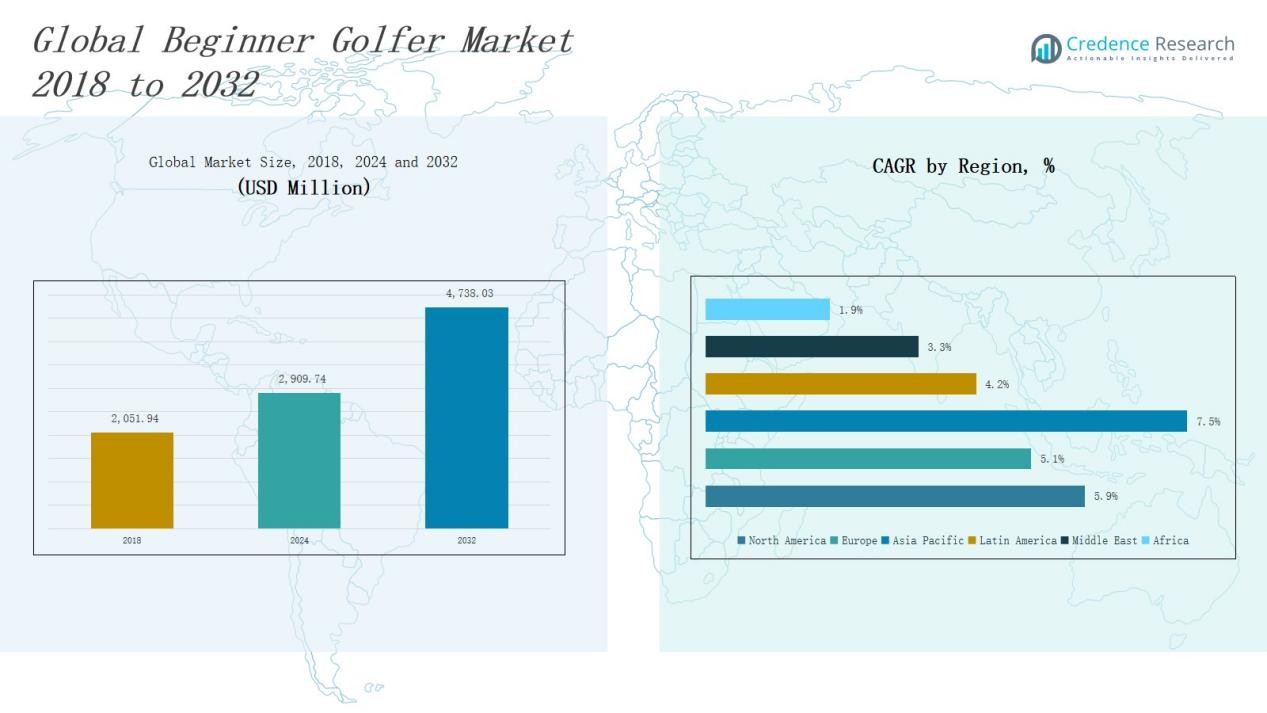
Beginner Golfer Market size was valued at USD 2,051.94 million in 2018 to USD 2,909.74 million in 2024 and is anticipated to reach USD 4,738.03 million by 2032, at a CAGR of 5.85% during the forecast period.
| REPORT ATTRIBUTE | DETAILS |
|---|---|
| Historical Period | 2020-2024 |
| Base Year | 2024 |
| Forecast Period | 2025-2032 |
| Beginner Golfer Market Size 2024 | USD 2,909.74 Million |
| Beginner Golfer Market, CAGR | 5.85% |
| Beginner Golfer Market Size 2032 | USD 4,738.03 Million |
The Beginner Golfer Market features key players such as Callaway Golf Company, TaylorMade Golf Company, Titleist, Ping, Cobra Golf, and Wilson Sporting Goods. These companies dominate through extensive product portfolios, innovative beginner-friendly equipment, and strong distribution networks. North America leads the market, accounting for approximately 38.5% of the global revenue share in 2024. The region benefits from a well-established golfing culture, widespread availability of golf courses, and significant investments in golf development programs targeting new players. This strong regional presence underscores North America’s pivotal role in shaping market trends and growth opportunities.
Market Insights
- The Beginner Golfer Market grew from USD 2.05 billion in 2018 to USD 2.91 billion in 2024 and is projected to reach USD 4.74 billion by 2032, at a CAGR of 5.85%.
- Leading companies like Callaway, TaylorMade, and Titleist dominate the market with innovative, beginner-friendly equipment and strong distribution channels.
- North America commands approximately 38.5% of the global market share in 2024, driven by a strong golfing culture and extensive infrastructure.
- Rising interest in golf, supported by inclusive programs and affordable gear, fuels beginner participation worldwide.
- Asia Pacific shows the fastest regional growth with a CAGR of 7.5%, fueled by increasing disposable incomes and expanding golf infrastructure.
Market Segment Insights
By Player Type
The Beginner / Entry-level segment dominates the Beginner Golfer Market, accounting for the largest revenue share due to the continuous influx of new golfers. This segment benefits from growing awareness of golf’s accessibility and the introduction of beginner-friendly products that simplify learning. Amateur/Recreational players also contribute significantly, seeking affordable, versatile equipment for leisure play. Intermediate and Professional segments hold smaller shares within this market, as they often transition to more advanced product lines outside the beginner category.
- For instance, PING, Inc. emphasizes custom fitting and precision engineering in its beginner-friendly irons and putters, which have gained popularity among new golfers seeking tailored equipment to improve their game.
By Product Type
Golf Clubs lead the product type segment, commanding the highest market share owing to their essential role and innovation targeted at beginners. Lightweight, forgiving clubs designed for ease of use stimulate strong demand. Golf Balls follow closely, with tailored designs that enhance performance for novices. Golf Bags and Shoes maintain notable shares, supported by increasing emphasis on comfort and style. Apparel and Others, including accessories like gloves and training aids, contribute to market growth through diversified offerings that enhance the overall golfing experience for beginners. Product innovation and affordability remain key growth drivers.
- For instance, BAL.ON Smart Kit developed by Continental uses insoles and smart pods to measure force distribution during swings, offering real-time pressure feedback to improve weight transfer and balance for golfers of all levels.
By Distribution Channel
Sports Retail Stores dominate distribution, capturing the largest market share by providing hands-on shopping experiences and expert assistance, which appeal to beginner golfers seeking guidance. Online Stores rapidly gain traction, driven by convenience, wider product selections, and competitive pricing, making them a critical growth channel. Golf Academies and Pro Shops contribute by bundling equipment with coaching services, directly engaging new players. Specialty Stores and Others account for smaller shares but add value through niche products and localized customer service.
Key Growth Drivers
Rising Popularity of Golf Among Beginners
Rising popularity of golf among beginners significantly drives market growth. Increased awareness of golf’s health, social, and recreational benefits motivates more individuals to take up the sport globally. Golf clubs and associations actively promote beginner-friendly programs, facilitating entry-level participation. Equipment manufacturers respond by developing affordable, accessible products tailored to novices, enhancing user experience and retention. This widening player base fuels steady demand growth, making beginner golfers a critical segment that shapes overall market expansion and encourages continuous innovation in entry-level golfing gear.
- For instance, the LPGA-USGA Girls Golf program offers instruction and life skills education to over 120,000 girls annually at more than 600 global sites, promoting inclusive beginner participation.
Technological Advancements in Golf Equipment
Technological innovations in golf equipment enhance accessibility and performance for beginners, boosting market demand. Manufacturers incorporate lightweight materials, adjustable designs, and user-friendly features into clubs, balls, and accessories, reducing learning barriers for novices. These improvements increase player confidence and enjoyment, encouraging longer engagement with the sport. Advanced manufacturing techniques also optimize equipment durability and playability, attracting new users. The integration of technology not only differentiates product offerings but also drives consumer preference toward beginner-friendly gear, thereby accelerating revenue growth in this expanding market segment.
- For instance, Callaway’s AI-driven 10X Face Technology in their Elyte drivers, which varies the face thickness strategically to optimize ball speed and stability even on imperfect hits, enhancing forgiveness for beginners.
Expansion of Distribution Channels
The expansion of diverse distribution channels supports broader market penetration for beginner golfers. Online platforms offer convenience, detailed product information, and competitive pricing, empowering consumers to make informed purchasing decisions. Specialized golf academies and pro shops provide personalized services and expert advice, enhancing beginner engagement and boosting sales. Retailers increasingly adopt omni-channel strategies combining physical and digital presence, improving accessibility for novices. This multi-channel approach expands geographic reach, particularly in emerging markets, and caters to varied consumer preferences, fostering stronger brand connections and accelerating overall market growth in beginner golf equipment.
Key Trends & Opportunities
Integration of Digital Coaching Tools and Smart Equipment
Integration of digital coaching tools and smart golf equipment is transforming the beginner golfer experience. Devices like swing analyzers and app-based training programs offer real-time feedback and personalized guidance, helping novices improve skills efficiently. This technological trend increases engagement and retention among new players, creating demand for connected equipment and services. Companies leveraging these innovations can differentiate their products and build loyalty. Furthermore, digital solutions open opportunities for data-driven marketing and subscription models, fostering recurring revenue streams and strengthening the market position of brands focused on beginner golfers.
- For instance, SMARTGOLF’s AI-powered coaching system provides vocal instructions after each swing, analyzing club angle and impact through sensors to prescribe precise improvements, effectively simulating a personal coach experience.
Growing Female and Youth Participation
The beginner golfer market benefits from increasing female and youth participation, driven by targeted initiatives and inclusive programs. Efforts by golf associations and brands to promote diversity attract new demographics previously underrepresented in the sport. Customized product lines, marketing campaigns, and beginner clinics designed for women and young players encourage entry and sustained involvement. This demographic shift expands the market base, offering significant growth potential. Brands capitalizing on these trends through innovation and outreach can establish strong customer relationships, enhancing market share while contributing to the sport’s long-term development and popularity among future generations.
- For instance, Golf Australia supports Vision 2025, a collaborative effort to grow female golf participation through outreach and engagement with clubs nationwide.
Sustainability and Eco-friendly Products
Rising environmental awareness among consumers fuels demand for sustainable and eco-friendly golf products, presenting a strategic opportunity for manufacturers. Beginner golfers increasingly seek equipment and apparel made from recycled or renewable materials and produced via environmentally responsible processes. Brands adopting green initiatives benefit from positive consumer perception and competitive differentiation. This trend encourages investment in sustainable product development, packaging reduction, and carbon footprint minimization. By addressing environmental concerns, companies can attract conscientious beginners and align with broader industry efforts, strengthening their market position while contributing to sustainable growth in the beginner golfer segment.
Key Challenges
High Entry Costs and Equipment Complexity
High entry costs and equipment complexity remain major challenges limiting beginner golfer market growth. The initial financial investment in clubs, balls, apparel, and lessons can discourage new players from committing to the sport. Additionally, the technical variety and jargon associated with golf gear overwhelm many novices, complicating purchase decisions and reducing user confidence. This complexity can result in slow adoption and limited engagement, impeding market expansion. Industry efforts to simplify products and offer affordable starter kits partially mitigate these issues, but overcoming cost and complexity barriers continues to be essential for sustained growth.
Limited Access to Facilities in Emerging Markets
Inadequate golf infrastructure in many emerging economies restricts beginner participation and market penetration. The scarcity of accessible golf courses, practice ranges, and training centers limits opportunities for new players to learn and practice. This lack of facilities deters interest and hinders demand for beginner-specific equipment. Additionally, socioeconomic factors and limited awareness contribute to slower adoption in these regions. Expanding infrastructure through public-private partnerships, government initiatives, and investment in affordable golf programs is crucial to unlocking growth potential and increasing the beginner golfer base in underdeveloped markets.
Seasonality and Weather Dependence
The outdoor nature of golf subjects the beginner golfer market to seasonality and regional weather fluctuations, posing challenges for consistent revenue. Cold climates, heavy rainfall, or extreme heat reduce playtime during certain months, impacting equipment sales and service demand. Beginners, who typically require more frequent practice and guidance, may delay or limit participation due to unfavorable conditions. This seasonality affects manufacturers, retailers, and training providers alike, requiring strategic inventory management and marketing to balance sales cycles.
Regional Analysis
North America
North America holds a leading position in the Beginner Golfer Market, generating USD 1,259.37 million in revenue in 2024 and projected to reach USD 2,056.35 million by 2032. The region commands the largest market share, driven by a strong golfing culture, extensive infrastructure, and growing beginner participation. With a steady CAGR of 5.9%, North America benefits from widespread access to golf courses, advanced retail channels, and effective beginner outreach programs. These factors collectively sustain robust demand for beginner-specific equipment and services, solidifying the region’s dominant role in the global market.
Europe
Europe accounts for a significant portion of the Beginner Golfer Market, with revenue rising from USD 583.98 million in 2018 to an estimated USD 798.35 million in 2024. Forecasts indicate growth to USD 1,224.18 million by 2032, reflecting a CAGR of 5.1%. The market expansion stems from increasing interest among amateur and recreational players, supportive government initiatives, and growing investment in golf facilities. European countries maintain a strong tradition of golf, and efforts to attract younger and female beginners further drive demand, ensuring sustained regional market growth.
Asia Pacific
Asia Pacific demonstrates the fastest growth in the Beginner Golfer Market, expanding from USD 399.45 million in 2018 to USD 613.39 million in 2024. The market is expected to reach USD 1,129.76 million by 2032, growing at a CAGR of 7.5%. Rapid urbanization, rising disposable incomes, and expanding golf infrastructure fuel beginner participation in countries such as China, Japan, and India. Increasing awareness of golf’s lifestyle benefits and targeted marketing by equipment manufacturers also contribute to accelerated adoption, positioning Asia Pacific as a key growth engine for the market.
Latin America
Latin America’s Beginner Golfer Market shows steady growth, with revenue increasing from USD 94.87 million in 2018 to USD 132.82 million in 2024. The market is projected to reach USD 190.88 million by 2032, at a CAGR of 4.2%. Growth is supported by emerging golfing communities, increased investment in sports infrastructure, and government programs promoting golf as a recreational activity. While the market remains smaller compared to other regions, expanding urban centers and rising middle-class interest create opportunities for beginner-focused product adoption and regional market development.
Middle East
The Middle East Beginner Golfer Market remains nascent but is gradually expanding, growing from USD 51.78 million in 2018 to USD 66.42 million in 2024. Expected to reach USD 89.21 million by 2032, the market grows at a CAGR of 3.3%. Increasing tourism, luxury sports investments, and golf course developments drive beginner participation. The region’s focus on attracting international golfing events and developing beginner programs supports market expansion, although geopolitical and economic factors may moderate growth pace relative to other regions.
Africa
Africa accounts for the smallest share of the Beginner Golfer Market, with revenue growing from USD 24.45 million in 2018 to USD 39.39 million in 2024. The market is forecasted to reach USD 47.66 million by 2032, expanding at a modest CAGR of 1.9%. Limited golf infrastructure and economic constraints restrict beginner participation. However, increased investments in golf tourism, community outreach, and facility development provide opportunities to stimulate market growth. Focused efforts to build awareness and accessibility are essential to unlocking Africa’s potential in the beginner golfer segment.
Market Segmentations:
By Player Type:
- Beginner / Entry-level
- Amateur / Recreational
- Intermediate
- Professional
By Product Type:
- Golf Clubs
- Golf Balls
- Golf Bags
- Shoes
- Apparel
- Others
By Distribution Channel:
- Sports Retail Stores
- Online Stores
- Golf Academies / Pro Shops
- Specialty Stores
- Others
By Region:
- North America
- U.S.
- Canada
- Mexico
- Europe
- Germany
- France
- U.K.
- Italy
- Spain
- Rest of Europe
- Asia Pacific
- China
- Japan
- India
- South Korea
- South-east Asia
- Rest of Asia Pacific
- Latin America
- Brazil
- Argentina
- Rest of Latin America
- Middle East & Africa
- GCC Countries
- South Africa
- Rest of the Middle East and Africa
Competitive Landscape
The Beginner Golfer Market features a competitive landscape dominated by established global brands such as Callaway Golf, TaylorMade Golf, Wilson Sporting Goods, and PING, which lead through extensive product innovation and strong brand recognition. These companies focus on developing beginner-friendly equipment that emphasizes ease of use, performance, and affordability to attract novice players. Additionally, specialized brands like U.S. Kids Golf target younger demographics, expanding the market base. The competitive intensity drives continuous advancements in technology and design, prompting players to frequently update their product lines to meet evolving consumer preferences. Distribution strategies combining traditional retail, online platforms, and golf academies enable broad market reach and personalized customer engagement. Smaller and emerging brands, such as Tour Edge and Top Flite, compete by offering cost-effective solutions and niche products. Overall, market players prioritize strategic partnerships, marketing initiatives, and expanding geographic presence to enhance market share and capitalize on the growing influx of beginner golfers worldwide.
Key Players
- Callaway Golf
- TaylorMade Golf
- Wilson Sporting Goods
- Cobra Puma Golf
- Cleveland Golf
- PING
- Srixon
- Tour Edge
- S. Kids Golf
- Top Flite
Recent Developments
l In April 2025, MGI Golf partnered with four Epson Tour athletes to promote its products and support women's professional golf.
- In February 2025, Under Armour collaborated with digital agency Albatross to lead its 2025 marketing campaign, aiming to engage a wider consumer base through innovative digital strategies.
- In 2025, Callaway expanded its beginner-friendly lineup with the Elyte series launched in January, featuring high-forgiveness clubs like the Elyte X model that helps reduce slices through a draw bias.
- In August 2025, Titleist introduced its 2025 T-Series iron range, including the T350 model, which delivers maximum forgiveness and improved flight control for enhanced consistency.
Market Concentration & Characteristics
The Beginner Golfer Market exhibits a moderately concentrated structure, dominated by a few leading players such as Callaway Golf, TaylorMade Golf, and Wilson Sporting Goods. These companies hold significant market shares due to their strong brand equity, extensive distribution networks, and continuous product innovation focused on beginner-friendly equipment. It fosters competitive dynamics where established brands leverage technological advancements and targeted marketing to maintain dominance. Smaller players and niche brands contribute by addressing specific segments like youth golf and budget-conscious consumers. The market’s characteristics include high product differentiation and growing adoption of digital sales channels, which enable wider reach and consumer engagement. Competitive pressure drives improvements in quality, affordability, and customer support, enhancing overall market accessibility for new golfers. This dynamic environment encourages strategic collaborations and geographic expansion, sustaining steady growth and broadening the beginner golfer base worldwide.
Report Coverage
The research report offers an in-depth analysis based on Player Type, Product Type, Distribution Channel. It details leading market players, providing an overview of their business, product offerings, investments, revenue streams, and key applications. Additionally, the report includes insights into the competitive environment, SWOT analysis, current market trends, as well as the primary drivers and constraints. Furthermore, it discusses various factors that have driven market expansion in recent years. The report also explores market dynamics, regulatory scenarios, and technological advancements that are shaping the industry. It assesses the impact of external factors and global economic changes on market growth. Lastly, it provides strategic recommendations for new entrants and established companies to navigate the complexities of the market.
Future Outlook
- The Beginner Golfer Market will expand due to increasing global interest in golf among new players.
- Technological innovation will enhance beginner equipment, improving usability and performance.
- Online sales channels will grow, providing greater convenience and product accessibility.
- Manufacturers will focus on developing eco-friendly and sustainable golf products.
- Rising female and youth participation will diversify the beginner golfer demographic.
- Golf academies and training programs will strengthen engagement and skill development for novices.
- Expansion into emerging markets will open new opportunities for growth and product adoption.
- Brands will intensify marketing efforts targeting entry-level players and recreational golfers.
- Collaboration between equipment manufacturers and digital technology providers will increase.
- The market will see more personalized and customizable products designed specifically for beginners.

Request a Free Sample
Fill in your details and we'll send you a free sample report.
- Sample data tables & charts
- Research methodology
Market Dynamics
Rising Popularity of Golf Among Beginners
Increased awareness of golf’s health, social, and recreational benefits is motivating more individuals to take up the sport, with clubs and associations actively promoting beginner-friendly programs. This growing influx of new players is expanding the market for entry-level equipment and services.
Technological Advancements in Golf Equipment
Manufacturers are introducing lightweight, forgiving, and user-friendly clubs and accessories that lower the learning curve for novices. These innovations boost confidence and enjoyment, encouraging longer engagement and higher retention among beginner golfers.
Expansion of Distribution Channels
The growth of online stores and omni-channel retail strategies has made beginner golf products more accessible, while golf academies and pro shops offer bundled coaching and equipment, directly engaging new players and supporting market penetration.
Growing Female and Youth Participation
Targeted initiatives and inclusive programs are attracting more women and young players to golf, expanding the beginner golfer demographic and driving demand for customized, beginner-friendly products.
Integration of Digital Coaching Tools and Smart Equipment
The adoption of app-based training, swing analyzers, and smart equipment provides real-time feedback and personalized guidance, making it easier for beginners to improve and stay engaged, thus fueling demand for connected golf products.
Need a Custom Version of This Report?
Tailor the scope, geography, or segments to your exact requirements.
- Custom geography or segment scope
- Direct access to our analyst team
Frequently Asked Questions
What is the current market size for Beginner Golfer Market, and what is its projected size in 2032?
At what Compound Annual Growth Rate is the Beginner Golfer Market projected to grow between 2025 and 2032?
Which Beginner Golfer Market segment held the largest share in 2024?
What are the primary factors fueling the growth of the Beginner Golfer Market?
Who are the leading companies in the Beginner Golfer Market?
Which region commanded the largest share of the Beginner Golfer Market market in 2024?
Table of Content
Chapter 1 Market Segmentation
- 1.1 Segmentation Framework
- 1.1.1 Product and Service Classification
- 1.1.2 Application and End-Use Classification
- 1.1.3 Technology and Solution Classification
- 1.1.4 Customer and Distribution Channel Classification
- 1.1.5 Geographic Segmentation
- 1.1.6 Market Segment Definitions and Boundaries
- 1.2 By Player Type
- 1.2.1 Beginner / Entry-level
- 1.2.2 Amateur / Recreational
- 1.2.3 Intermediate
- 1.2.4 Professional
- 1.3 By Product Type
- 1.3.1 Golf Clubs
- 1.3.2 Golf Balls
- 1.3.3 Golf Bags
- 1.3.4 Shoes
- 1.3.5 Apparel
- 1.3.6 Others
Chapter 2 Introduction
- 2.1 Report Objectives and Scope
- 2.2 Product Definition and Industry Terminology
- 2.3 Market Inclusions and Exclusions
- 2.4 Research Process
- 2.4.1 Primary Research and Expert Interviews
- 2.4.2 Secondary Research and Source Review
- 2.4.3 Top-Down and Bottom-Up Estimation
- 2.4.4 Data Triangulation and Verification
- 2.5 Market Size Measurement Basis
- 2.5.1 2024: USD 2,909.74 million → 2032: USD 4,738.03 million
- 2.6 Historical and Forecast Reference Periods
- 2.6.1 Base Year: 2024
- 2.6.2 Forecast Period: 2024-2032
- 2.7 Research Assumptions and Limitations
Chapter 3 Executive Summary
- 3.1 Market Snapshot and Key Findings
- 3.2 Base-Year Market Size, 2024
- 3.3 Forecast Market Size, 2032
- 3.4 Revenue and Volume Growth Outlook
- 3.5 Key Demand and Supply Indicators
- 3.6 Leading Market Segments
- 3.7 Fastest-Growing Market Opportunities
- 3.8 Regional Performance Highlights
- 3.9 Technology and Industry Transformation
- 3.10 Competitive Landscape Summary
- 3.11 Analyst View and Strategic Implications
Chapter 4 Global Beginner Golfer Market Trends and Developments
- 4.1 Historical Industry Development
- 4.2 Recent Market Trends and Developments
- 4.3 Demand and Customer Behavior Trends
- 4.4 Technology and Product Innovation
- 4.5 Artificial Intelligence, Automation and Digitalization
- 4.6 Local Manufacturing and Supply Chain Realignment
- 4.7 Industry Partnerships, Mergers and Acquisitions
- 4.8 Sustainability and Circular Economy Developments
- 4.9 Government and Private Sector Investment Trends
- 4.10 Emerging Business Models and Commercialization
- 4.11 Industry Developments and Announcements
Chapter 5 Global Beginner Golfer Market Production, Supply and Demand Analysis
- 5.1 Demand Trend and Consumption Analysis
- 5.2 Demand Forecast, 2024-2032
- 5.3 Production and Output Trend
- 5.4 Production and Output Forecast, 2024-2032
- 5.5 Installed Capacity and Capacity Utilization
- 5.6 Company-Wise Production Plants and Statistics
- 5.6.1 Installed Production Capacity
- 5.6.2 Actual Production
- 5.6.3 Planned Capacity and Expansion Targets
- 5.7 Supply Chain Structure and Procurement Trends
- 5.8 Supply-Demand Gap and Bottlenecks
- 5.9 Import Dependence and Sourcing Structure
- 5.10 Contract Manufacturing and Outsourcing
- 5.11 Regional Supply and Demand Concentration
Chapter 6 Global Beginner Golfer Market Pricing Analysis
- 6.1 Pricing Structure and Measurement
- 6.2 Historical Pricing Trends
- 6.3 Pricing Outlook, 2024-2032
- 6.4 Average Selling Price and Unit Economics
- 6.5 Pricing by Product and Market Segment
- 6.6 Geographic Pricing Differences
- 6.7 Key Input, Energy, Labor and Logistics Costs
- 6.8 Contract Pricing and Purchasing Models
- 6.9 Pricing Sensitivity and Competitive Positioning
- 6.10 Price, Margin and Profitability Implications
Chapter 7 Global Beginner Golfer Market Dynamics
- 7.1 Market Growth Drivers
- 7.1.1 Demand-Side Drivers
- 7.1.2 Technology and Innovation Drivers
- 7.1.3 Infrastructure and Investment Drivers
- 7.1.4 Regulatory and Policy Drivers
- 7.2 Market Restraints
- 7.2.1 Cost and Affordability Constraints
- 7.2.2 Technology and Adoption Barriers
- 7.2.3 Supply Chain and Operational Constraints
- 7.3 Market Challenges
- 7.3.1 Competitive Pressure and Margin Erosion
- 7.3.2 Skills, Infrastructure and Implementation Gaps
- 7.4 Emerging Market Opportunities
- 7.5 Market Dynamics Impact and Time-Horizon Assessment
Chapter 8 Global Beginner Golfer Value Chain Analysis
- 8.1 Industry Value Chain Overview
- 8.2 Upstream Suppliers and Critical Inputs
- 8.3 Technology and Component Providers
- 8.4 Manufacturing or Service Delivery
- 8.5 Distribution, Channel Partners and Integrators
- 8.6 Downstream Applications and End Users
- 8.7 Value Addition and Profit Pools
- 8.8 Vertical Integration and Outsourcing
- 8.9 Supplier Concentration and Risk
- 8.10 Supply Chain Localization and Resilience
Chapter 9 Global Beginner Golfer Market Regulations and Policies
- 9.1 Relevant Laws, Standards and Compliance Frameworks
- 9.2 Product, Service, Safety and Quality Requirements
- 9.3 Government Policies, Incentives and Subsidies
- 9.4 Imports, Exports and Trade Barriers
- 9.5 Public Procurement and Local Content Requirements
- 9.6 Environmental and Sustainability Compliance
- 9.7 Upcoming Policy Changes and Market Implications
Chapter 10 Global Beginner Golfer Market Hotspots and Opportunities
- 10.1 Market Opportunity Mapping and Growth Hotspots
- 10.2 High-Growth Applications and Customer Groups
- 10.3 Underserved Markets and White-Space Opportunities
- 10.4 Emerging Technology and Product Opportunities
- 10.5 New Capacity and Investment Hotspots
- 10.6 Market Entry and Expansion Opportunities
- 10.7 Distribution and Partnership Opportunities
- 10.8 Near-Term and Long-Term Commercial Potential
- 10.9 Opportunity Attractiveness and Execution Risks
Chapter 11 Global Beginner Golfer Market Outlook, 2024-2032
- 11.1 Market Size and Analysis
- 11.1.1 Revenue (Market Measurement: 2024: USD 2,909.74 million → 2032: USD 4,738.03 million)
- 11.1.2 Market Volume and Quantity Sold
- 11.1.3 Historical Market Size
- 11.1.4 Base-Year Market Size, 2024
- 11.2 Market Forecast, 2024-2032
- 11.2.1 Revenue Forecast to 2032
- 11.2.2 Volume Forecast to 2032
- 11.2.3 CAGR and Year-on-Year Growth
- 11.2.4 Incremental Revenue Opportunity
- 11.3 Forecast Assumptions and Scenario Analysis
- 11.3.1 Base-Case Forecast
- 11.3.2 Optimistic and Conservative Scenarios
- 11.3.3 Technology, Pricing and Policy Sensitivities
- 11.4 Market Attractiveness and Growth Outlook
Chapter 12 Global Beginner Golfer Market Segmentation and Outlook
- 12.1 Segmentation Summary and Market Shares, 2024
- 12.2 Largest and Fastest-Growing Segments
- 12.3 By Player Type - Market Size and Forecast, 2024-2032
- 12.3.1 Segment Definition and Scope
- 12.3.2 Historical Market Size
- 12.3.3 Revenue Forecast, 2024-2032
- 12.3.4 Volume Forecast, 2024-2032
- 12.3.5 Base-Year Market Share, 2024
- 12.3.6 Segment CAGR and Growth Drivers
- 12.3.7 Subsegment Market Size and Forecast
- 12.3.7.1 Beginner / Entry-level
- 12.3.7.2 Amateur / Recreational
- 12.3.7.3 Intermediate
- 12.3.7.4 Professional
- 12.3.8 Subsegment Pricing and Adoption Trends
- 12.3.9 Leading Suppliers and Competition
- 12.3.10 Regional Demand and Opportunities
- 12.4 By Product Type - Market Size and Forecast, 2024-2032
- 12.4.1 Segment Definition and Scope
- 12.4.2 Historical Market Size
- 12.4.3 Revenue Forecast, 2024-2032
- 12.4.4 Volume Forecast, 2024-2032
- 12.4.5 Base-Year Market Share, 2024
- 12.4.6 Segment CAGR and Growth Drivers
- 12.4.7 Subsegment Market Size and Forecast
- 12.4.7.1 Golf Clubs
- 12.4.7.2 Golf Balls
- 12.4.7.3 Golf Bags
- 12.4.7.4 Shoes
- 12.4.7.5 Apparel
- 12.4.7.6 Others
- 12.4.8 Subsegment Pricing and Adoption Trends
- 12.4.9 Leading Suppliers and Competition
- 12.4.10 Regional Demand and Opportunities
- 12.5 Segment Growth Comparison
- 12.6 Segment Attractiveness and Priority Matrix
Chapter 13 Global Beginner Golfer Geographic Market Outlook, 2024-2032
- 13.1 Regional Market Size and Share, 2024
- 13.2 Regional Market Forecast, 2024-2032
- 13.3 Regional Pricing, Production and Demand Differences
- 13.4 North America
- 13.4.1 United States
- 13.4.2 Canada
- 13.4.3 Mexico
- 13.5 Europe
- 13.5.1 Germany
- 13.5.2 France
- 13.5.3 Italy
- 13.5.4 United Kingdom
- 13.5.5 Spain
- 13.5.6 Poland
- 13.5.7 Russia
- 13.5.8 Netherlands
- 13.5.9 Belgium
- 13.5.10 Sweden
- 13.5.11 Denmark
- 13.5.12 Norway
- 13.5.13 Rest of Europe
- 13.6 Asia Pacific
- 13.6.1 China
- 13.6.2 India
- 13.6.3 Japan
- 13.6.4 South Korea
- 13.6.5 Thailand
- 13.6.6 Indonesia
- 13.6.7 Vietnam
- 13.6.8 Malaysia
- 13.6.9 Australia
- 13.6.10 Rest of Asia Pacific
- 13.7 Latin America
- 13.7.1 Brazil
- 13.7.2 Argentina
- 13.7.3 Colombia
- 13.7.4 Chile
- 13.7.5 Rest of Latin America
- 13.8 Middle East
- 13.8.1 Saudi Arabia
- 13.8.2 United Arab Emirates
- 13.8.3 Turkey
- 13.8.4 Israel
- 13.8.5 Iran
- 13.8.6 Rest of the Middle East
- 13.9 Africa
- 13.9.1 South Africa
- 13.9.2 Egypt
- 13.9.3 Nigeria
- 13.9.4 Morocco
- 13.9.5 Rest of Africa
- 13.10 Regional Investment, Policy and Supply Chain Differences
- 13.11 Regional Competitive Landscape
- 13.12 Geographic Growth Hotspots
Chapter 14 Global Beginner Golfer Technology, Innovation and Sustainability Outlook
- 14.1 Technology Landscape and Maturity
- 14.2 Product, Process and Service Innovation
- 14.3 AI, Automation and Digital Tools in the Industry
- 14.4 Technology Adoption and Performance Benchmarking
- 14.5 Innovation Pipeline and R&D Investment
- 14.6 Patent and Intellectual Property Trends
- 14.7 Energy Efficiency and Resource Management
- 14.8 Sustainability, Recycling and Circularity
- 14.9 Technology Roadmap, 2024-2032
- 14.10 Risks of Obsolescence and Technology Substitution
Chapter 15 Global Beginner Golfer Market Key Strategic Imperatives
- 15.1 Growth and Market Entry Priorities
- 15.2 High-Return Products and Segments
- 15.3 Pricing, Profitability and Cost Optimization
- 15.4 Technology Investment and Product Differentiation
- 15.5 Supply Chain Localization and Resilience
- 15.6 Distribution and Customer Acquisition
- 15.7 Partnership, Acquisition and Capacity Strategy
- 15.8 Regional Expansion Priorities
- 15.9 Short-, Medium- and Long-Term Actions
Chapter 16 Competition Outlook
- 16.1 Industry Competition Characteristics
- 16.2 Market Structure and Concentration
- 16.3 Market Share and Competitive Positioning, 2024
- 16.4 Company-Wise Revenue and Product Benchmarking
- 16.5 Production and Service Capacity Benchmarking
- 16.6 Technology, Pricing and Differentiation
- 16.7 Regional Footprint and Distribution Strength
- 16.8 Mergers, Acquisitions and Strategic Alliances
- 16.9 New Entrants and Competitive Threats
- 16.10 Porter's Five Forces and Industry Attractiveness
- 16.11 Competitive Outlook, 2024-2032
Chapter 17 Company Profiles
- 17.1 Company Coverage and Selection Criteria
- 17.2 Callaway Golf
- 17.2.1 Business Description
- 17.2.2 Company Ownership and Geographic Presence
- 17.2.3 Product and Service Portfolio
- 17.2.4 Manufacturing and Operating Footprint
- 17.2.5 Production Capacity and Expansion Plans
- 17.2.6 Financial Performance and Investment
- 17.2.7 Market Share and Competitive Position
- 17.2.8 Technology and Innovation Capabilities
- 17.2.9 Strategic Alliances or Partnerships
- 17.2.10 Recent Developments
- 17.2.11 Growth Strategy and Outlook
- 17.3 TaylorMade Golf
- 17.4 Wilson Sporting Goods
- 17.5 Cobra Puma Golf
- 17.6 Cleveland Golf
- 17.7 PING
- 17.8 Srixon
- 17.9 Tour Edge
- 17.10 U.S. Kids Golf
- 17.11 Top Flite
- 17.12 Other Relevant Market Participants
Note: Every listed company is profiled on the structure shown under the first company. The company list is preliminary and may change based on research findings, market developments, data availability and client requirements.
Chapter 18 Disclaimer
- 18.1 Research and Forecast Disclaimer
- 18.2 Data Source and Estimation Limitations
Note: The depth of individual sections depends on data availability for this market. Volume, capacity, trade and other unit-based metrics are included where applicable.

