| REPORT ATTRIBUTE | DETAILS |
|---|---|
| Historical Period | 2020-2023 |
| Base Year | 2024 |
| Forecast Period | 2025-2032 |
| Built-In Electric Oven Market Size 2024 | USD 7,946.65 million |
| Built-In Electric Oven Market, CAGR | 5.73% |
| Built-In Electric Oven Market Size 2032 | USD 12,818.63 million |
Market Overview
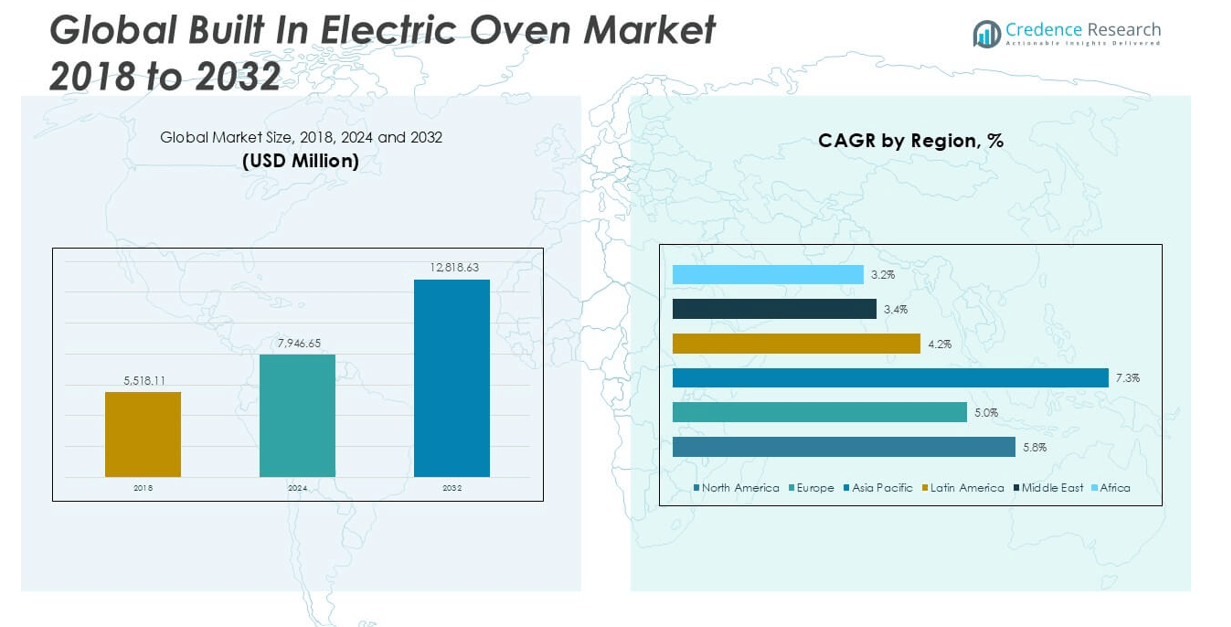
The Built-In Electric Oven market size was valued at USD 5,518.11 million in 2018, increased to USD 7,946.65 million in 2024, and is anticipated to reach USD 12,818.63 million by 2032, growing at a CAGR of 5.73% during the forecast period.
The built-in electric oven market is led by prominent players such as Samsung, Bosch, GE Appliances, Miele, Electrolux, and Neff GmbH, known for their innovation, product diversity, and strong global presence. These companies drive market growth through the integration of smart technologies, energy efficiency, and sleek design. Premium brands like Bertazzoni, La Germania, Viking, Dacor, and Verona also contribute by catering to niche, high-end segments with advanced performance features. Regionally, North America dominates the market, holding a 41.4% share in 2024, driven by high consumer spending, smart home adoption, and the popularity of modular kitchens. Europe follows with a 27.8% share, supported by demand for energy-efficient and design-centric appliances.
Market Insights
- The built-in electric oven market was valued at USD 7,946.65 million in 2024 and is projected to reach USD 12,818.63 million by 2032, growing at a CAGR of 5.73% during the forecast period.
- Increasing demand for modular kitchens, rising disposable incomes, and growing consumer preference for smart and energy-efficient appliances are key drivers boosting market expansion.
- Smart connectivity, self-cleaning features, and energy-efficient models are trending, with convection ovens dominating the features segment due to faster and uniform cooking performance.
- The market is competitive with major players like Samsung, Bosch, GE Appliances, and Miele leading through innovation, while premium brands cater to niche consumers; however, high installation costs and limited retrofit compatibility in older kitchens act as restraints.
- Regionally, North America leads with 41.4% market share, followed by Europe at 27.8%, while Asia Pacific is the fastest-growing region; by type, above 50 liters ovens hold the largest segment share.
Market Segmentation Analysis:
By Type
In the built-in electric oven market, the Above 50 Liters segment dominates with the highest market share in 2024, driven by growing consumer demand for high-capacity ovens suitable for large families and frequent home cooking. These ovens offer greater versatility in meal preparation and are preferred in markets where spacious kitchen designs allow integration of larger appliances. Rising urbanization and increasing adoption of modular kitchens in both developed and emerging economies further boost demand for this segment. The Below 50 Liters segment, although smaller, caters to compact households and limited-space kitchens.
- For instance, Bosch offers its Series 8 built-in oven with a 71-liter capacity and 4D hot air feature, enabling uniform heat distribution across all four shelves, allowing simultaneous multi-level cooking without flavor transfer.
By Features
Among the features segment, Convection ovens hold the largest market share owing to their enhanced cooking efficiency and uniform heat distribution. These models are highly favored for their faster cooking times and better energy performance, aligning with consumer preferences for convenience and reduced energy consumption. Additionally, self-cleaning and energy-efficient models are gaining traction due to rising awareness about hygiene and sustainability. The smart connectivity sub-segment, including Wi-Fi and IoT-enabled ovens, is witnessing steady growth, particularly among tech-savvy consumers seeking remote control and automation features.
- For instance, Samsung’s NV7000B Series smart oven features SmartThings connectivity, enabling control via mobile devices and integration with Bixby voice assistant, and includes 50+ auto-cook programs and AI Pro Cooking that uses internal cameras to recognize ingredients and suggest optimal cooking modes.
By Application
The Residential segment accounts for the majority of the market share in the built-in electric oven market. The rising popularity of home cooking, along with increasing kitchen renovations and the integration of high-end appliances in modern homes, drives this dominance. Consumers are prioritizing aesthetics, functionality, and space optimization, which built-in models offer effectively. The Commercial segment, comprising restaurants, bakeries, and food service providers, also contributes to market growth but remains comparatively smaller. Demand in this segment is supported by the need for efficient and consistent baking performance in high-volume settings.
Market Overview
Rising Demand for Modular and Smart Kitchens
The increasing adoption of modular kitchens, especially in urban households, significantly drives demand for built-in electric ovens. These appliances offer space-saving solutions and enhance kitchen aesthetics, making them a preferred choice among design-conscious consumers. As disposable incomes rise and lifestyles become more convenience-oriented, homebuyers and renovators are prioritizing integrated kitchen solutions. Moreover, built-in ovens align with the growing trend of seamless kitchen designs that promote functionality and style, especially in premium and mid-range residential developments.
- For instance, Miele’s Generation 7000 built-in ovens are engineered for flush-fit integration into modular kitchens, offering a 76-liter capacity with Touch2Open technology and MotionReact, which activates lighting and display automatically when someone approaches
Shift Toward Home Cooking and Healthier Lifestyles
The global shift toward healthier lifestyles and home-cooked meals has led to increased adoption of kitchen appliances like built-in electric ovens. Consumers are increasingly preparing meals at home due to rising health awareness and cost-efficiency, especially post-pandemic. These ovens support healthier cooking methods such as baking and roasting, which require less oil compared to frying. This shift is particularly evident in urban centers, where dual-income families seek reliable and efficient cooking appliances to support their dietary habits and busy schedules.
- For instance, the Electrolux EOB7S31Z SteamBoost oven preserves 58 milligrams of vitamin C in 100 grams of broccoli when steamed, compared to 36 milligrams when boiled, and reduces fat content in roast chicken by 8 grams per 100 grams using steam-assisted cooking.
Technological Advancements and Product Innovation
Continuous technological advancements in the built-in electric oven market are spurring product adoption. Features such as smart connectivity (Wi-Fi, IoT), programmable cooking modes, and energy-efficient designs are increasingly integrated into newer models. These innovations enhance convenience, user control, and energy savings, which are critical factors for modern consumers. Manufacturers are also investing in multi-functional ovens that combine convection, grilling, and microwave capabilities in a single unit, further enhancing their appeal across diverse customer segments.
Key Trends & Opportunities
Growth in Smart and Connected Appliances
Smart ovens equipped with Wi-Fi, app integration, and voice command features are gaining rapid traction. Consumers are increasingly drawn to appliances that offer remote monitoring, recipe suggestions, and automated cooking processes. This trend is supported by the broader smart home ecosystem, where connectivity and automation drive appliance innovation. As IoT penetration increases and smart home adoption becomes mainstream, manufacturers have a significant opportunity to differentiate through digital features and enhanced user experiences.
- For instance, the GE Profile PTD7000SNSS oven connects to the SmartHQ app and includes 138 pre-programmed recipes, supports voice control, and maintains internal temperature accuracy within 1 degree Celsius during multi-rack baking cycles.
Surge in Eco-friendly and Energy-efficient Models
Environmental concerns and regulatory pressures are prompting a shift toward energy-efficient and eco-friendly built-in ovens. Consumers are now more aware of their energy consumption and are actively seeking appliances with lower environmental impact. Energy star ratings and eco-modes have become important decision factors. This trend presents opportunities for manufacturers to invest in sustainable product lines that reduce operational costs and carbon footprints, especially in regions with strict energy efficiency standards such as Europe and North America.
- For instance, the Whirlpool W7 OM4 4BS1 H built-in oven consumes 0.91 kilowatt-hours in conventional cooking mode and 0.69 kilowatt-hours in fan-forced mode, supporting long-term energy savings while complying with the EU’s highest efficiency tier for household ovens.
Key Challenges
High Installation and Maintenance Costs
Despite their growing popularity, built-in electric ovens often involve high initial costs related to installation, cabinetry modifications, and electrical setup. These expenses can deter cost-sensitive consumers, particularly in developing economies where affordability remains a key concern. Additionally, maintenance and repair services for built-in models tend to be more expensive and less accessible compared to freestanding ovens, limiting adoption in certain regions and consumer segments.
Limited Retrofit Compatibility in Older Kitchens
Built-in ovens require specific cabinetry and kitchen layouts, making them difficult to install in older or traditional kitchens. This limitation restricts market penetration among consumers living in older homes or rental properties where kitchen modifications are impractical. Retrofitting built-in appliances often involves extensive remodeling, increasing both cost and complexity. As a result, potential customers may opt for freestanding alternatives that offer more flexibility and ease of installation.
Intense Market Competition and Price Sensitivity
The built-in electric oven market faces intense competition from established brands and low-cost regional players. Price sensitivity among middle-income consumers can limit the growth of premium product segments, particularly in emerging markets. While leading brands differentiate through technology and design, budget-conscious buyers often prioritize affordability over features. This dynamic pressures manufacturers to balance innovation with competitive pricing, while also managing rising raw material and logistics costs.
Regional Analysis
North America
North America held the largest share of the built-in electric oven market in 2024, accounting for approximately 41.4% of global revenue. The market grew from USD 2,308.47 million in 2018 to USD 3,288.40 million in 2024 and is projected to reach USD 5,319.86 million by 2032, expanding at a CAGR of 5.8%. Growth in the region is driven by high penetration of modular kitchens, strong consumer purchasing power, and increasing demand for smart home appliances. The U.S. leads the regional market, supported by robust distribution networks and product innovation from key players.
Europe
Europe captured around 27.8% of the built-in electric oven market revenue in 2024, rising from USD 1,591.73 million in 2018 to USD 2,210.99 million in 2024. The market is expected to reach USD 3,361.41 million by 2032, growing at a CAGR of 5.0%. The region benefits from strong demand in Western Europe, where energy-efficient appliances and design-centric kitchen solutions are popular. EU regulations favoring eco-friendly appliances and increasing kitchen renovations further support market expansion. Germany, the UK, and France are among the key contributors to regional growth.
Asia Pacific
Asia Pacific is the fastest-growing region in the built-in electric oven market, with a CAGR of 7.3%. The market increased from USD 1,098.77 million in 2018 to USD 1,710.56 million in 2024 and is expected to reach USD 3,113.58 million by 2032, claiming a 21.5% market share in 2024. Rapid urbanization, rising disposable incomes, and growing adoption of smart home appliances in countries like China, India, and South Korea drive regional growth. The region also benefits from expanding retail infrastructure and increasing consumer awareness of energy-efficient cooking technologies.
Latin America
Latin America accounted for about 4.8% of the global built-in electric oven market in 2024. The market rose from USD 266.77 million in 2018 to USD 379.51 million in 2024 and is projected to reach USD 543.48 million by 2032, growing at a CAGR of 4.2%. Rising middle-class populations and increasing demand for modern kitchen appliances, particularly in Brazil and Mexico, are supporting market development. However, the region faces challenges like economic fluctuations and limited adoption in rural areas, which slightly temper overall growth momentum.
Middle East
The Middle East built-in electric oven market expanded from USD 150.87 million in 2018 to USD 198.14 million in 2024, and is projected to reach USD 268.34 million by 2032, growing at a CAGR of 3.4%. In 2024, the region held a market share of approximately 2.5%. Demand is primarily concentrated in high-income urban centers such as the UAE and Saudi Arabia, where luxury and energy-efficient appliances are in demand. Growth is supported by increasing investments in residential infrastructure and premium housing developments, although adoption remains modest in less urbanized areas.
Africa
Africa represented around 2.0% of the global built-in electric oven market in 2024, with the market size growing from USD 101.50 million in 2018 to USD 159.05 million in 2024, and projected to reach USD 211.96 million by 2032, at a CAGR of 3.2%. Market growth is supported by gradual urbanization and improving access to electricity in several countries. However, limited consumer affordability and infrastructural challenges constrain faster adoption. Growth potential exists in urban centers and among middle-income consumers, particularly as awareness of energy-efficient appliances gradually increases.
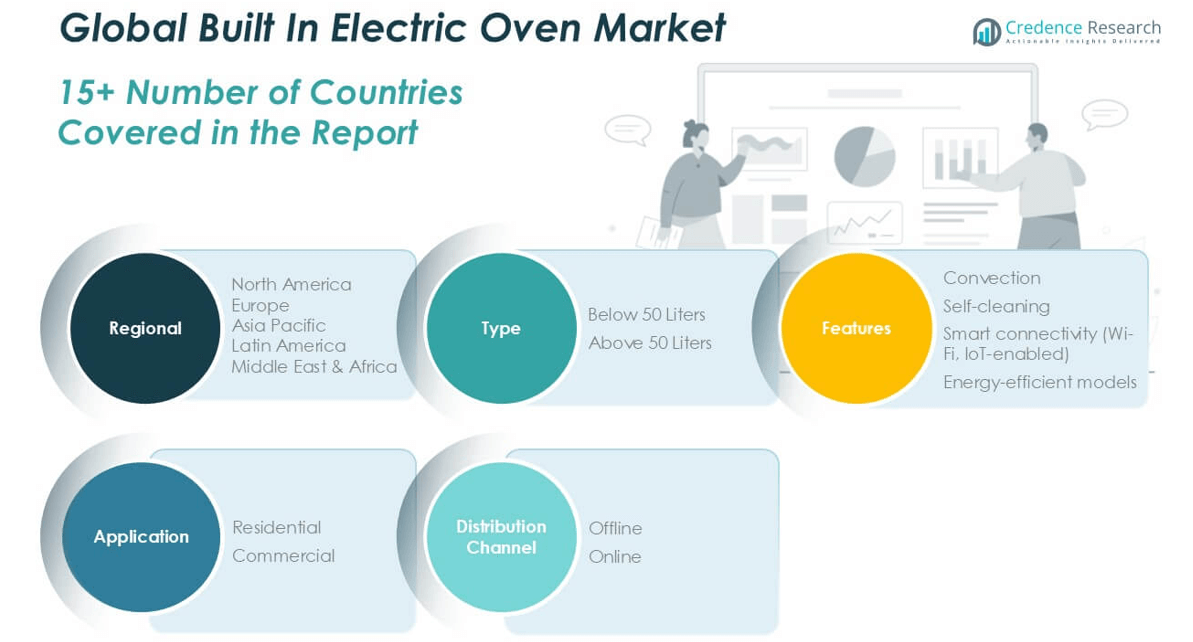
Market Segmentations:
By Type
- Below 50 Liters
- Above 50 Liters
By Features
- Convection
- Self-cleaning
- Smart connectivity (Wi-Fi, IoT-enabled)
- Energy-efficient models
By Application
- Residential
- Commercial
By Distribution Channel
- Offline
- Online
By Geography
- North America
- U.S.
- Canada
- Mexico
- Europe
- Germany
- France
- U.K.
- Italy
- Spain
- Rest of Europe
- Asia Pacific
- China
- Japan
- India
- South Korea
- South-east Asia
- Rest of Asia Pacific
- Latin America
- Brazil
- Argentina
- Rest of Latin America
- Middle East & Africa
- GCC Countries
- South Africa
- Rest of the Middle East and Africa
Competitive Landscape
The built-in electric oven market features a highly competitive landscape marked by the presence of several well-established global players and emerging regional manufacturers. Leading companies such as Samsung, Bosch, GE Appliances, Miele, Electrolux, and Neff GmbH dominate the market through strong brand recognition, diversified product portfolios, and continuous innovation in smart and energy-efficient technologies. These players invest significantly in R&D to integrate advanced features like IoT connectivity, touch controls, and self-cleaning systems. Premium brands such as Bertazzoni, La Germania, and Viking cater to niche segments seeking high-end design and performance. Meanwhile, companies like Maytag, Dacor, and Verona focus on offering reliable and affordable options for broader consumer segments. Strategic collaborations, product launches, and regional expansions are common growth strategies. The market also experiences price competition, especially in emerging economies, compelling manufacturers to balance quality with affordability. The increasing demand for sustainable and technologically advanced ovens continues to shape competitive dynamics in this evolving market.
Key Player Analysis
- Samsung
- Bosch
- GE Appliances
- Miele
- Neff GmbH
- Electrolux
- Bertazzoni
- La Germania
- Viking
- Maytag
- Dacor
- Verona
Recent Developments
- In March 2025, Panasonic launched the HomeChef Connect 4-in-1 multi-oven, revolutionizing everyday cooking with the kitchen+ App that connects with Fresco. The transitional shift from selling the product, with cooking guidance, has enhanced the business strategy.
- In July 2024, LG Electronics India launched a new range of microwave ovens for 2024, featuring technology and modern designs. The new lineup from LG includes nine new models, with seven from the Scan to Cook series and two from the premium object series.
- In December 2024, Cucu Electronics, a general home appliance company, launched a microwave oven that anyone can easily use with dial operation in a compact appearance that fits the minimalist trend.
- In August 2023, LG Electronics introduced their built-in package At IFA 2023, featuring energy-efficient appliances and stylish design. The lineup included an InstaView oven, QuadWash dishwasher, downdraft induction hob, bottom-freezer refrigerator, and microwave oven, aiming to elevate culinary experiences. LG's strategic vision includes expanding into the North American and European markets, aiming to solidify its position as one of the top five brands globally in the built-in appliance sector.
- In February 2023, Samsung Electronics UK Ltd. announced the launch of their Series 7 Bespoke AI Oven, enhancing kitchen experiences with AI Pro Cooking technology. This innovative oven optimizes settings and monitors food, offering real-time meal tracking via the SmartThings App. With Dual Cook Steam, users can prepare multiple dishes simultaneously, revolutionizing healthy meal prep. This launch marks a significant advancement in home cooking technology, providing convenience and culinary creativity.
Market Concentration & Characteristics
The Built-In Electric Oven Market exhibits a moderate to high market concentration, with a few key global players holding significant shares due to their strong brand reputation, advanced product offerings, and widespread distribution networks. It is characterized by continuous technological advancements, rising consumer demand for smart and energy-efficient appliances, and a growing preference for integrated kitchen solutions. Product differentiation remains critical, with manufacturers focusing on design, functionality, and energy performance to attract varied consumer segments. The market caters to both premium and mass-market buyers, with high-end brands addressing demand for luxury features and aesthetics, while mainstream players emphasize value and reliability. It faces steady demand from residential users, particularly in urban areas, supported by the expansion of modular kitchen trends and lifestyle changes. Competitive pricing and innovation drive strategic positioning. Companies compete by enhancing after-sales services, expanding retail presence, and launching smart, multi-functional ovens that align with modern consumer expectations.
Report Coverage
The research report offers an in-depth analysis based on Type, Features, Application, Distribution Channel and Geography. It details leading market players, providing an overview of their business, product offerings, investments, revenue streams, and key applications. Additionally, the report includes insights into the competitive environment, SWOT analysis, current market trends, as well as the primary drivers and constraints. Furthermore, it discusses various factors that have driven market expansion in recent years. The report also explores market dynamics, regulatory scenarios, and technological advancements that are shaping the industry. It assesses the impact of external factors and global economic changes on market growth. Lastly, it provides strategic recommendations for new entrants and established companies to navigate the complexities of the market.
Future Outlook
- The market will continue to grow steadily due to increasing adoption of modular and smart kitchens.
- Demand for energy-efficient and environmentally friendly ovens will rise with tightening regulations.
- Smart connectivity features such as Wi-Fi and voice control will become standard across new models.
- Residential segment will maintain its dominance with growing home renovation and remodeling projects.
- Asia Pacific will emerge as the fastest-growing region supported by urbanization and rising income levels.
- Manufacturers will invest more in R&D to integrate multi-functional capabilities in compact designs.
- Online distribution channels will gain traction, especially among younger, tech-savvy consumers.
- Premium brands will expand their presence in emerging markets to tap into luxury appliance demand.
- Product customization and design aesthetics will influence purchasing decisions more significantly.
- Competition will intensify, encouraging companies to differentiate through innovation and customer service.

Request a Free Sample
Fill in your details and we'll send you a free sample report.
- Sample data tables & charts
- Research methodology
Need a Custom Version of This Report?
Tailor the scope, geography, or segments to your exact requirements.
- Custom geography or segment scope
- Direct access to our analyst team
Frequently Asked Questions
What is the current size of the Built in Electric Oven Market?
What are the key segments within the Built in Electric Oven Market?
What are some challenges faced by the Built in Electric Oven Market?
Who are the major players in the Built in Electric Oven Market?
Table of Content
Chapter 1 Market Segmentation
- 1.1 Segmentation Framework
- 1.1.1 Product and Service Classification
- 1.1.2 Application and End-Use Classification
- 1.1.3 Technology and Solution Classification
- 1.1.4 Customer and Distribution Channel Classification
- 1.1.5 Geographic Segmentation
- 1.1.6 Market Segment Definitions and Boundaries
Chapter 2 Introduction
- 2.1 Report Objectives and Scope
- 2.2 Product Definition and Industry Terminology
- 2.3 Market Inclusions and Exclusions
- 2.4 Research Process
- 2.4.1 Primary Research and Expert Interviews
- 2.4.2 Secondary Research and Source Review
- 2.4.3 Top-Down and Bottom-Up Estimation
- 2.4.4 Data Triangulation and Verification
- 2.5 Market Size Measurement Basis
- 2.5.1 2024: USD 7,946.65 million → 2032: USD 12,818.63 million
- 2.6 Historical and Forecast Reference Periods
- 2.6.1 Base Year: 2024
- 2.6.2 Forecast Period: 2024-2032
- 2.7 Research Assumptions and Limitations
Chapter 3 Executive Summary
- 3.1 Market Snapshot and Key Findings
- 3.2 Base-Year Market Size, 2024
- 3.3 Forecast Market Size, 2032
- 3.4 Revenue and Volume Growth Outlook
- 3.5 Key Demand and Supply Indicators
- 3.6 Leading Market Segments
- 3.7 Fastest-Growing Market Opportunities
- 3.8 Regional Performance Highlights
- 3.9 Technology and Industry Transformation
- 3.10 Competitive Landscape Summary
- 3.11 Analyst View and Strategic Implications
Chapter 4 Global Built-In Electric Oven Market Trends and Developments
- 4.1 Historical Industry Development
- 4.2 Recent Market Trends and Developments
- 4.3 Demand and Customer Behavior Trends
- 4.4 Technology and Product Innovation
- 4.5 Artificial Intelligence, Automation and Digitalization
- 4.6 Local Manufacturing and Supply Chain Realignment
- 4.7 Industry Partnerships, Mergers and Acquisitions
- 4.8 Sustainability and Circular Economy Developments
- 4.9 Government and Private Sector Investment Trends
- 4.10 Emerging Business Models and Commercialization
- 4.11 Industry Developments and Announcements
Chapter 5 Global Built-In Electric Oven Market Production, Supply and Demand Analysis
- 5.1 Demand Trend and Consumption Analysis
- 5.2 Demand Forecast, 2024-2032
- 5.3 Production and Output Trend
- 5.4 Production and Output Forecast, 2024-2032
- 5.5 Installed Capacity and Capacity Utilization
- 5.6 Company-Wise Production Plants and Statistics
- 5.6.1 Installed Production Capacity
- 5.6.2 Actual Production
- 5.6.3 Planned Capacity and Expansion Targets
- 5.7 Supply Chain Structure and Procurement Trends
- 5.8 Supply-Demand Gap and Bottlenecks
- 5.9 Import Dependence and Sourcing Structure
- 5.10 Contract Manufacturing and Outsourcing
- 5.11 Regional Supply and Demand Concentration
Chapter 6 Global Built-In Electric Oven Market Pricing Analysis
- 6.1 Pricing Structure and Measurement
- 6.2 Historical Pricing Trends
- 6.3 Pricing Outlook, 2024-2032
- 6.4 Average Selling Price and Unit Economics
- 6.5 Pricing by Product and Market Segment
- 6.6 Geographic Pricing Differences
- 6.7 Key Input, Energy, Labor and Logistics Costs
- 6.8 Contract Pricing and Purchasing Models
- 6.9 Pricing Sensitivity and Competitive Positioning
- 6.10 Price, Margin and Profitability Implications
Chapter 7 Global Built-In Electric Oven Market Dynamics
- 7.1 Market Growth Drivers
- 7.1.1 Demand-Side Drivers
- 7.1.2 Technology and Innovation Drivers
- 7.1.3 Infrastructure and Investment Drivers
- 7.1.4 Regulatory and Policy Drivers
- 7.2 Market Restraints
- 7.2.1 Cost and Affordability Constraints
- 7.2.2 Technology and Adoption Barriers
- 7.2.3 Supply Chain and Operational Constraints
- 7.3 Market Challenges
- 7.3.1 Competitive Pressure and Margin Erosion
- 7.3.2 Skills, Infrastructure and Implementation Gaps
- 7.4 Emerging Market Opportunities
- 7.5 Market Dynamics Impact and Time-Horizon Assessment
Chapter 8 Global Built-In Electric Oven Value Chain Analysis
- 8.1 Industry Value Chain Overview
- 8.2 Upstream Suppliers and Critical Inputs
- 8.3 Technology and Component Providers
- 8.4 Manufacturing or Service Delivery
- 8.5 Distribution, Channel Partners and Integrators
- 8.6 Downstream Applications and End Users
- 8.7 Value Addition and Profit Pools
- 8.8 Vertical Integration and Outsourcing
- 8.9 Supplier Concentration and Risk
- 8.10 Supply Chain Localization and Resilience
Chapter 9 Global Built-In Electric Oven Market Regulations and Policies
- 9.1 Relevant Laws, Standards and Compliance Frameworks
- 9.2 Product, Service, Safety and Quality Requirements
- 9.3 Government Policies, Incentives and Subsidies
- 9.4 Imports, Exports and Trade Barriers
- 9.5 Public Procurement and Local Content Requirements
- 9.6 Environmental and Sustainability Compliance
- 9.7 Upcoming Policy Changes and Market Implications
Chapter 10 Global Built-In Electric Oven Market Hotspots and Opportunities
- 10.1 Market Opportunity Mapping and Growth Hotspots
- 10.2 High-Growth Applications and Customer Groups
- 10.3 Underserved Markets and White-Space Opportunities
- 10.4 Emerging Technology and Product Opportunities
- 10.5 New Capacity and Investment Hotspots
- 10.6 Market Entry and Expansion Opportunities
- 10.7 Distribution and Partnership Opportunities
- 10.8 Near-Term and Long-Term Commercial Potential
- 10.9 Opportunity Attractiveness and Execution Risks
Chapter 11 Global Built-In Electric Oven Market Outlook, 2024-2032
- 11.1 Market Size and Analysis
- 11.1.1 Revenue (Market Measurement: 2024: USD 7,946.65 million → 2032: USD 12,818.63 million)
- 11.1.2 Market Volume and Quantity Sold
- 11.1.3 Historical Market Size
- 11.1.4 Base-Year Market Size, 2024
- 11.2 Market Forecast, 2024-2032
- 11.2.1 Revenue Forecast to 2032
- 11.2.2 Volume Forecast to 2032
- 11.2.3 CAGR and Year-on-Year Growth
- 11.2.4 Incremental Revenue Opportunity
- 11.3 Forecast Assumptions and Scenario Analysis
- 11.3.1 Base-Case Forecast
- 11.3.2 Optimistic and Conservative Scenarios
- 11.3.3 Technology, Pricing and Policy Sensitivities
- 11.4 Market Attractiveness and Growth Outlook
Chapter 12 Global Built-In Electric Oven Market Segmentation and Outlook
- 12.1 Segmentation Summary and Market Shares, 2024
- 12.2 Largest and Fastest-Growing Segments
- 12.3 Segment Growth Comparison
- 12.4 Segment Attractiveness and Priority Matrix
Chapter 13 Global Built-In Electric Oven Geographic Market Outlook, 2024-2032
- 13.1 Regional Market Size and Share, 2024
- 13.2 Regional Market Forecast, 2024-2032
- 13.3 Regional Pricing, Production and Demand Differences
- 13.4 North America
- 13.4.1 United States
- 13.4.2 Canada
- 13.4.3 Mexico
- 13.5 Europe
- 13.5.1 Germany
- 13.5.2 France
- 13.5.3 Italy
- 13.5.4 United Kingdom
- 13.5.5 Spain
- 13.5.6 Poland
- 13.5.7 Russia
- 13.5.8 Netherlands
- 13.5.9 Belgium
- 13.5.10 Sweden
- 13.5.11 Denmark
- 13.5.12 Norway
- 13.5.13 Rest of Europe
- 13.6 Asia Pacific
- 13.6.1 China
- 13.6.2 India
- 13.6.3 Japan
- 13.6.4 South Korea
- 13.6.5 Thailand
- 13.6.6 Indonesia
- 13.6.7 Vietnam
- 13.6.8 Malaysia
- 13.6.9 Australia
- 13.6.10 Rest of Asia Pacific
- 13.7 Latin America
- 13.7.1 Brazil
- 13.7.2 Argentina
- 13.7.3 Colombia
- 13.7.4 Chile
- 13.7.5 Rest of Latin America
- 13.8 Middle East
- 13.8.1 Saudi Arabia
- 13.8.2 United Arab Emirates
- 13.8.3 Turkey
- 13.8.4 Israel
- 13.8.5 Iran
- 13.8.6 Rest of the Middle East
- 13.9 Africa
- 13.9.1 South Africa
- 13.9.2 Egypt
- 13.9.3 Nigeria
- 13.9.4 Morocco
- 13.9.5 Rest of Africa
- 13.10 Regional Investment, Policy and Supply Chain Differences
- 13.11 Regional Competitive Landscape
- 13.12 Geographic Growth Hotspots
Chapter 14 Global Built-In Electric Oven Technology, Innovation and Sustainability Outlook
- 14.1 Technology Landscape and Maturity
- 14.2 Product, Process and Service Innovation
- 14.3 AI, Automation and Digital Tools in the Industry
- 14.4 Technology Adoption and Performance Benchmarking
- 14.5 Innovation Pipeline and R&D Investment
- 14.6 Patent and Intellectual Property Trends
- 14.7 Energy Efficiency and Resource Management
- 14.8 Sustainability, Recycling and Circularity
- 14.9 Technology Roadmap, 2024-2032
- 14.10 Risks of Obsolescence and Technology Substitution
Chapter 15 Global Built-In Electric Oven Market Key Strategic Imperatives
- 15.1 Growth and Market Entry Priorities
- 15.2 High-Return Products and Segments
- 15.3 Pricing, Profitability and Cost Optimization
- 15.4 Technology Investment and Product Differentiation
- 15.5 Supply Chain Localization and Resilience
- 15.6 Distribution and Customer Acquisition
- 15.7 Partnership, Acquisition and Capacity Strategy
- 15.8 Regional Expansion Priorities
- 15.9 Short-, Medium- and Long-Term Actions
Chapter 16 Competition Outlook
- 16.1 Industry Competition Characteristics
- 16.2 Market Structure and Concentration
- 16.3 Market Share and Competitive Positioning, 2024
- 16.4 Company-Wise Revenue and Product Benchmarking
- 16.5 Production and Service Capacity Benchmarking
- 16.6 Technology, Pricing and Differentiation
- 16.7 Regional Footprint and Distribution Strength
- 16.8 Mergers, Acquisitions and Strategic Alliances
- 16.9 New Entrants and Competitive Threats
- 16.10 Porter's Five Forces and Industry Attractiveness
- 16.11 Competitive Outlook, 2024-2032
Chapter 17 Company Profiles
- 17.1 Company Coverage and Selection Criteria
- 17.2 Leading Market Participants – Standard Profile Structure
- 17.2.1 Business Description
- 17.2.2 Company Ownership and Geographic Presence
- 17.2.3 Product and Service Portfolio
- 17.2.4 Manufacturing and Operating Footprint
- 17.2.5 Production Capacity and Expansion Plans
- 17.2.6 Financial Performance and Investment
- 17.2.7 Market Share and Competitive Position
- 17.2.8 Technology and Innovation Capabilities
- 17.2.9 Strategic Alliances or Partnerships
- 17.2.10 Recent Developments
- 17.2.11 Growth Strategy and Outlook
- 17.3 Other Relevant Market Participants
Note: Every listed company is profiled on the structure shown under the first company. The company list is preliminary and may change based on research findings, market developments, data availability and client requirements.
Chapter 18 Disclaimer
- 18.1 Research and Forecast Disclaimer
- 18.2 Data Source and Estimation Limitations
Note: The depth of individual sections depends on data availability for this market. Volume, capacity, trade and other unit-based metrics are included where applicable.